


Last updated: July 2026
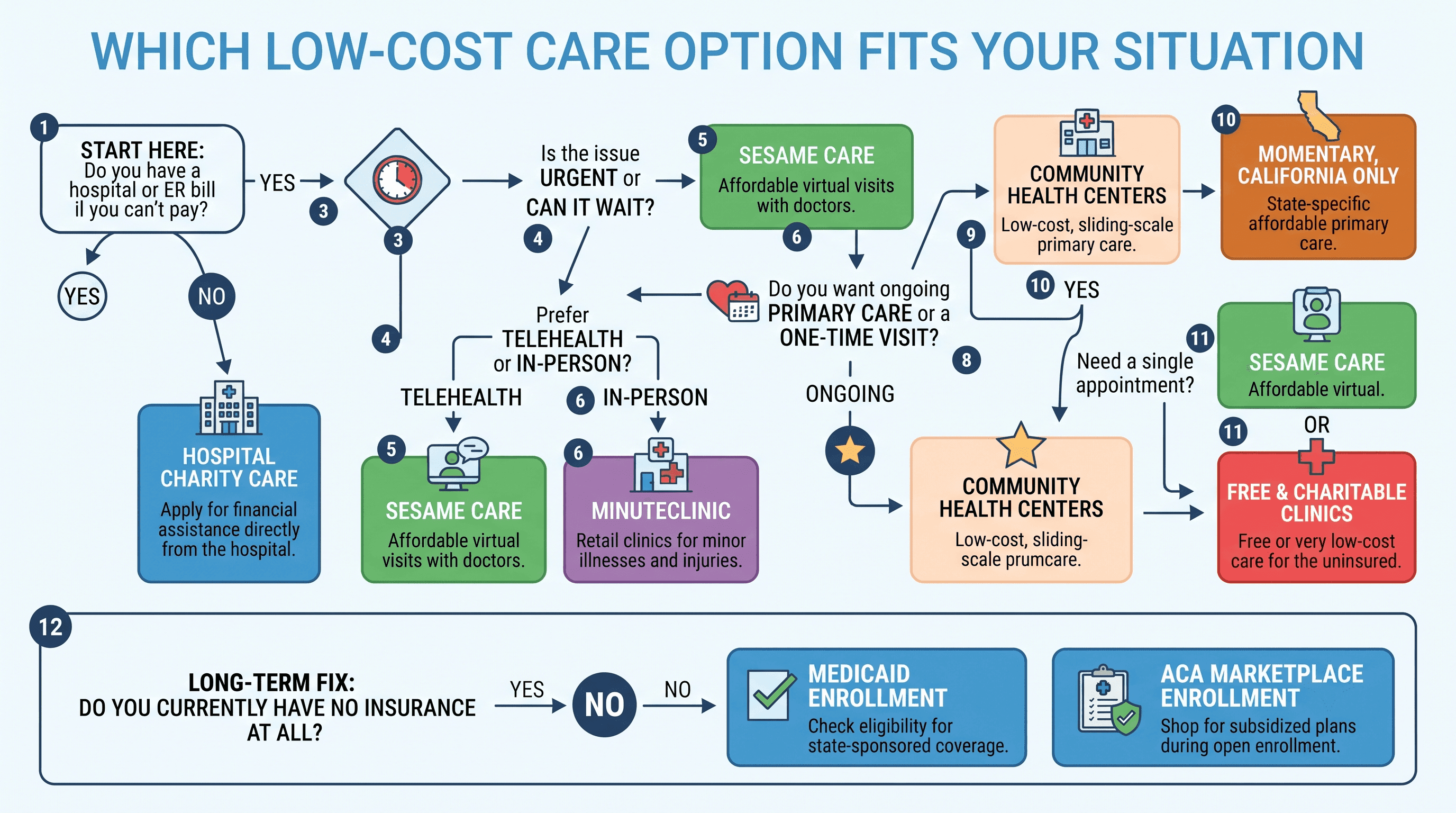
If you can't afford to see a doctor, start with a Federally Qualified Health Center near you. These federally funded clinics charge on a sliding scale based on income, see patients regardless of insurance status, and are required by law to never turn someone away for inability to pay. Find one in minutes at findahealthcenter.hrsa.gov, or call 2-1-1 for a local referral, then use the ranked list below for other same-day, low-cost, or free ways to get seen.
| Option | Best For | Price | Rating | Works Without Insurance |
|---|---|---|---|---|
| Community Health Centers (FQHCs) | Ongoing primary care on a tight budget | $0 to $20 sliding scale | HRSA-regulated federal program | Yes |
| Free & Charitable Clinics | Zero-cost visits for uninsured patients | $0 to $20 nominal fee | 1,400+ NAFC member clinics nationwide | Yes |
| Sesame Care | Fast, transparent cash-pay visits | $25 to $65 per visit | A rating with the Better Business Bureau | Yes |
| Medicaid / ACA Marketplace | Fixing the insurance gap for good | $0 to subsidized premium | Federal program via healthcare.gov | Yes, this is how you get covered |
| CVS MinuteClinic | Walk-in care for minor illness | $59 to $199 self-pay | Nationwide retail health chain | Yes |
| Hospital Charity Care | Reducing or erasing a hospital bill | $0 to a reduced bill, income-based | Federally required under IRS 501(r) | Yes |
| Momentary Virtual Care | Unlimited primary care, California only | $19.99/month | LegitScript verified, HIPAA compliant | Yes, cash-pay |
How we ranked this list. Best means getting a reader who is uninsured, underinsured, or low income in front of a licensed clinician at the lowest real cost with the fewest upfront barriers. We scored every entry on clinical credibility, cost and value, speed and availability, scope fit, user experience, and trust signals, weighting cost and value at 30 percent since affordability is the premise of this list, clinical credibility and scope fit at 20 psuggestion ent each, speed at 15 percent, and user experience and trust signals at 10 and 5 percent. Scores reflect information available as of July 2026. Momentary is our own product. We scored it on the same criteria as every other entry.
1. Community Health Centers (FQHCs): Sliding-scale primary care built for people who can't pay full price
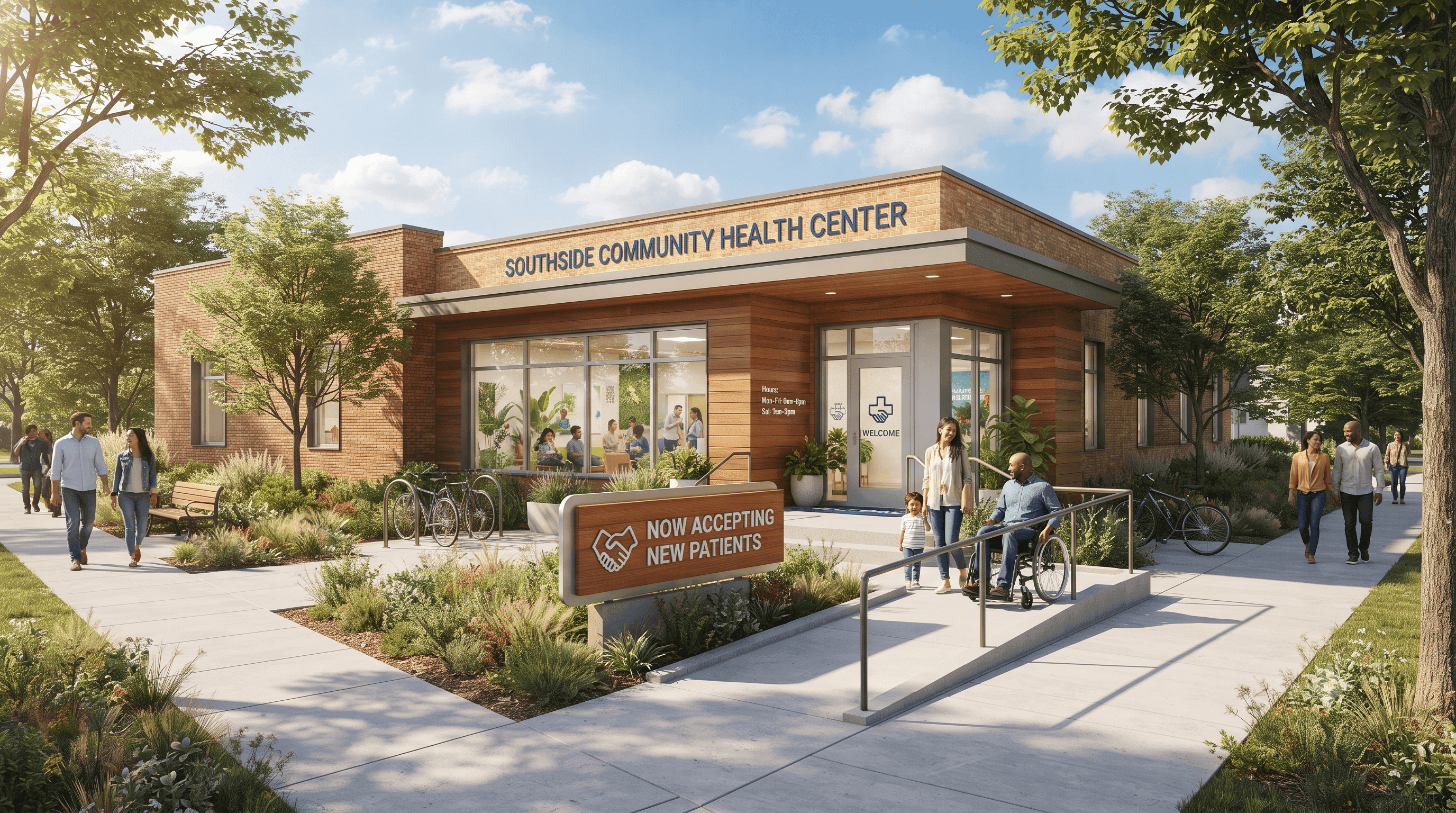
Community Health Centers, also called Federally Qualified Health Centers, are nonprofit clinics that receive federal funding to serve people who are uninsured, underinsured, or low income. Under HRSA's Section 330 program, they must adjust your bill based on household income and family size, and a patient at or below the federal poverty line can qualify for a full discount on medical, dental, and behavioral health visits.
Pros: Fees are tied directly to income, with a full discount available at or below the poverty guideline, and no one is denied care for inability to pay. A national directory at findahealthcenter.hrsa.gov lists every site.
Cons: Popular locations often carry waitlists, especially for dental and specialty care, and you'll need to complete an income verification form before your discount applies.
Pricing: $0 for patients at or below 100 percent of the federal poverty level, sliding up through partial discounts at 200 percent FPL.
Best for: Anyone who wants an ongoing primary care relationship, not just a one-time visit.
Rating: Federally regulated under HRSA's Health Center Program, with more than 1,400 award-recipient organizations operating across the US (HRSA, 2026).
2. Free & Charitable Clinics: No-cost care in your own community
Free and charitable clinics are independent nonprofits, separate from the FQHC network, that provide medical, dental, and sometimes mental health care to uninsured and underinsured patients, generally between 100 and 300 percent of the federal poverty level. Most charge nothing, and the few that do keep the fee nominal.
Pros: A large share of visits carry no charge at all, and the National Association of Free & Charitable Clinics runs a free searchable directory by city or ZIP code. Many also connect patients to donated medications.
Cons: Hours are often limited to a few evenings a week since many clinics rely on volunteer physicians, and not every clinic offers every specialty.
Pricing: $0 to $20 for a medical visit, $20 to $60 for routine dental care, according to clinic-reported averages.
Best for: Uninsured patients who want a genuinely free visit and can be flexible on scheduling.
Rating: Over 1,400 member clinics listed through the NAFC Find a Clinic directory (National Association of Free & Charitable Clinics, 2026).
3. Sesame Care: Transparent cash-pay pricing before you book
Sesame is a marketplace of independent, licensed physicians and nurse practitioners who set and publish their own cash prices. It never bills insurance, so there's no claims process, no deductible math, and no surprise invoice weeks later.
Pros: Primary care telehealth visits are listed as low as $25 to $65 depending on the provider, and same-day appointments are common. Prices are shown before you book, so there are no hidden fees.
Cons: Sesame providers cannot prescribe controlled substances, and specialty availability can be thinner in rural areas.
Pricing: $25 to $65 for primary care telehealth, $35 to $180 across other specialties depending on provider and service.
Best for: Uninsured patients who want a same-day visit at a fixed, known price.
Rating: A rating with the Better Business Bureau and a 9,000-plus provider network as of 2026 (Sesame Care, accessed June 2026).
4. Medicaid or ACA Marketplace Enrollment: The fix that solves the problem going forward
If the real issue is that you don't have insurance at all, the most durable fix is applying for Medicaid or an ACA Marketplace plan through healthcare.gov. Medicaid is free or nearly free in the 40 states plus DC that expanded eligibility to adults earning up to 138 percent of the federal poverty level, and Marketplace subsidies apply for households between 100 and 400 percent FPL.
Pros: Approved Medicaid enrollees typically pay $0 to very low copays, and Marketplace subsidies can bring a monthly premium down to $0 for many lower-income households. Coverage then applies to every future doctor visit, not just one.
Cons: Open enrollment runs November 1 to January 15 in most states, so outside that window you generally need a qualifying life event to enroll, and the application requires documenting income and household size.
Pricing: $0 premium for Medicaid-eligible applicants in expansion states, $0 to a subsidized premium on the Marketplace depending on income (HealthCare.gov, 2026).
Best for: Anyone whose lack of insurance, not a single visit, is the real problem.
Rating: A federal program covering millions of enrollees annually, with over 23 million people selecting Marketplace plans for 2026 coverage (KFF, 2026).
5. CVS MinuteClinic: Walk-in convenience for minor, non-emergency issues
MinuteClinic locations sit inside CVS Pharmacy stores and are staffed by nurse practitioners and physician assistants who treat common, minor conditions without an appointment. For a reader who needs to be seen today for something straightforward, like a sinus infection or a UTI, this is one of the fastest paths available.
Pros: No appointment is needed at most locations, self-pay pricing is published in advance, and locations are open seven days a week in thousands of communities.
Cons: Self-pay visits typically cost more than a sliding-scale clinic or Sesame Care, and providers only handle minor, straightforward issues rather than chronic disease management.
Pricing: $59 to $199 self-pay depending on the service, with basic visits most commonly in the $79 to $99 range.
Best for: Same-day treatment of a minor illness when a clinic or FQHC appointment isn't available fast enough.
Rating: Thousands of locations nationwide inside CVS Pharmacy stores (CVS MinuteClinic, accessed June 2026).
6. Hospital Charity Care: Getting an ER or hospital bill reduced or forgiven
If you already went to a hospital or ER and now have a bill you can't pay, federal law requires nonprofit hospitals, about 58 percent of US community hospitals, to maintain a written financial assistance policy under IRS Section 501(r). Many patients qualify for a full or partial write-off without ever knowing the option existed.
Pros: Eligible patients can't be charged more than the amount generally billed to insured patients for the same care, and you typically have at least 240 days after your first bill to apply. ERs are separately required under EMTALA to screen and stabilize you regardless of ability to pay.
Cons: The application requires income documentation and can take weeks to process, and eligibility thresholds vary widely between hospitals, from 41 percent to 600 percent of the federal poverty guideline.
Pricing: $0 for patients under a hospital's free-care threshold, commonly around 200 percent FPL, with sliding discounts above that (Health Affairs, 2024; LegalClarity, 2026).
Best for: Someone facing a hospital or ER bill they cannot pay, not routine primary care.
Rating: Applies to the roughly 58 percent of US community hospitals organized as nonprofits under federal law (KFF, 2026).
7. Momentary Virtual Care: Unlimited primary care from a real doctor for less than a copay, if you're in California
Momentary is a physician-reviewed virtual primary care service built by doctors trained at Harvard and UC Berkeley. It is not a replacement for an in-person physician, but it can be a first step when you're uninsured or underinsured and need to talk to a licensed doctor about a diagnosis, a prescription, or what to do next.
Pros: Membership runs $19.99 a month for unlimited primary care access, far cheaper than paying $185 per office visit out of pocket, and the service is HIPAA compliant and LegitScript verified.
Cons: Momentary is currently licensed to see patients in California only, so most readers outside the state can't use it yet, and like any telehealth service, it can't perform in-person exams or procedures.
Pricing: $19.99 per month, HSA and FSA eligible.
Best for: California residents who want an affordable, ongoing relationship with a doctor without a per-visit fee.
Rating: LegitScript verified and HIPAA compliant, built by physicians with Harvard and UC Berkeley training (Momentary Labs, accessed July 2026).
Why being uninsured or low income changes what's actually available to you
When you have insurance, seeing a doctor mostly means picking someone in-network and paying a copay. Without insurance, price becomes the first filter instead of the last one. Some providers, like FQHCs and free clinics, are built to charge based on income and can never turn you away. Others, like Sesame Care or MinuteClinic, are cash-pay by design, so the price you see is the price you pay with no claims process behind it. Knowing which category a provider falls into before you book saves you from an unpleasant surprise.
It also matters legally. Nonprofit hospitals must publish a financial assistance policy and cannot bill an eligible uninsured patient more than what an insurer would have paid for the same care. Emergency rooms are separately required under EMTALA to screen and stabilize anyone with a medical emergency regardless of ability to pay, though that protection covers stabilization, not the bill that follows. Before booking anywhere, ask directly: is there a sliding scale, what's the self-pay price without insurance, and is a payment plan available.
Readers who need more than what a single visit or a phone consult can offer eventually need a live provider they can return to. If you want to talk to a licensed doctor today about symptoms, a prescription, or what kind of care to pursue next, you can see a doctor online through Momentary Virtual Care and get a plan in minutes rather than waiting for the next available appointment.
FAQ
What should I do if I have no insurance and need to see a doctor? Start with a Federally Qualified Health Center or a free and charitable clinic near you, since both charge based on income and can never turn you away for inability to pay. If you need to be seen today, a cash-pay telehealth option like Sesame Care is usually your fastest and cheapest route.
Should I go to the hospital even if I can't afford it? Yes, if it's a true emergency. EMTALA requires hospitals with an emergency department to screen and stabilize you regardless of ability to pay, and nonprofit hospitals separately must offer financial assistance on the resulting bill. For anything that isn't an emergency, a clinic or telehealth visit will almost always be cheaper.
How can I get surgery if I can't afford it? Ask the hospital's financial assistance office for a Financial Assistance Policy application before the procedure, not after, since approval can significantly reduce or eliminate what you owe. Many hospitals also accept retroactive applications on bills from the prior several months.
What can I do if I can't get an appointment or afford to see a doctor? Call 2-1-1 for a local referral to free and low-cost clinics, or search findahealthcenter.hrsa.gov for the nearest sliding-scale health center. For same-day answers, a cash-pay telehealth visit or Momentary's AI health navigator can help you understand your symptoms while you wait for an appointment.
What are red flags to watch for when choosing a low-cost doctor or clinic? Be cautious of any provider who won't state their price before treatment, since transparent, upfront pricing is standard at legitimate sliding-scale and cash-pay clinics. Also watch for pressure into add-on services you didn't ask about, and confirm a provider's license through your state medical board if anything feels off.


