


Last updated: July 2026
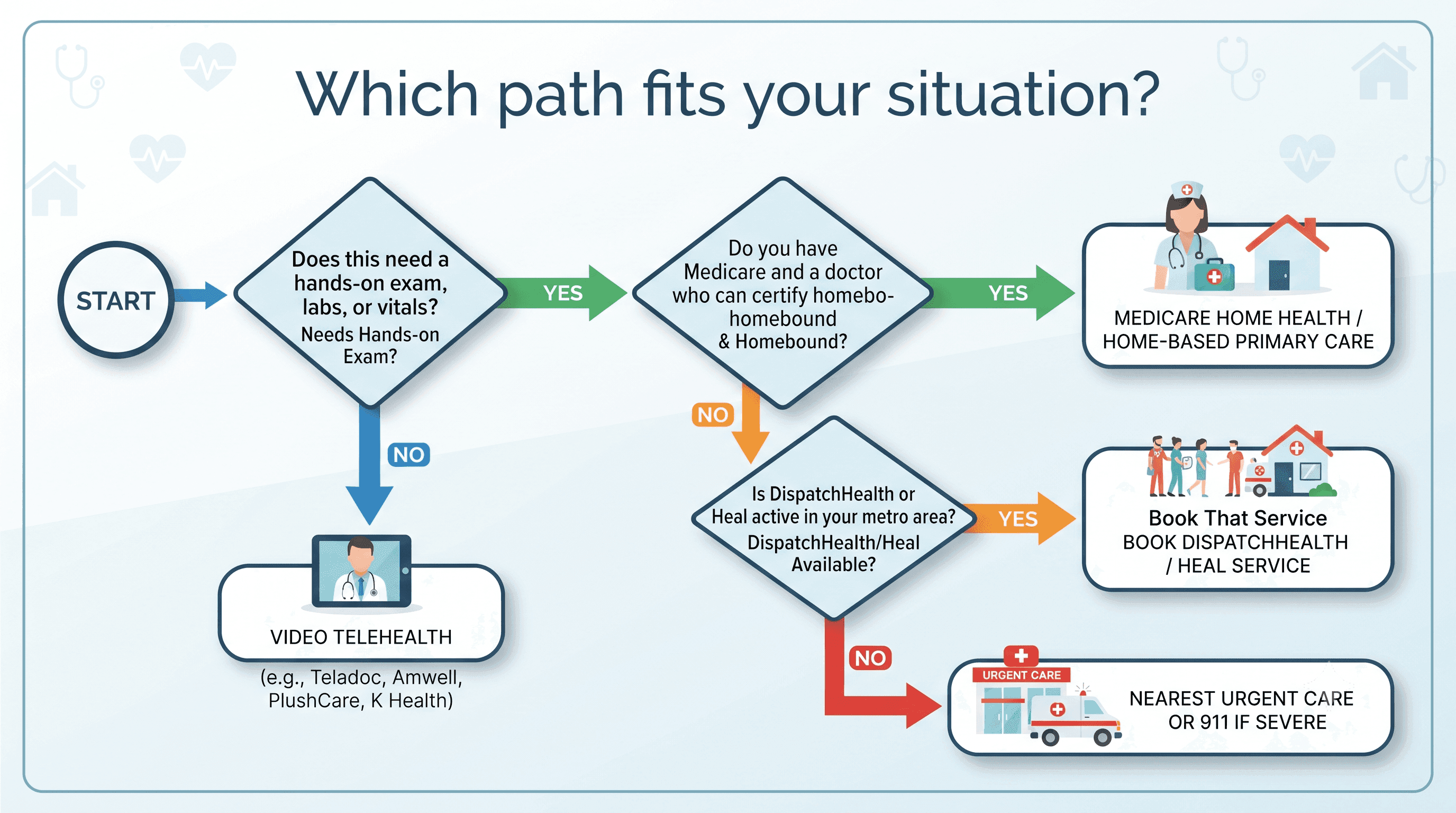
If getting to a clinic is the real obstacle, the fastest path to care usually isn't a single app. It's matching the option to what you actually need done. A video visit works for a prescription refill or a rash, but a true home visit is what gets vitals, labs, or a hands-on exam without you leaving your chair. Start by asking whether the problem can be assessed by camera or whether someone needs to physically be in the room with you, then pick from the list below.
| Option | Best For | Price | Rating | In-Home Physical Exam? |
|---|---|---|---|---|
| Medicare-Certified Home Health / Home-Based Primary Care | Medicare-eligible patients with chronic conditions | $0 to 20% coinsurance under Part B after deductible | N/A (CMS-regulated) | Yes |
| DispatchHealth | Insured patients needing same-day, hands-on urgent care at home | $0 to $45 copay with insurance | Not independently rated | Yes |
| Teladoc | Fast, nationwide video visits and prescriptions | $89/visit cash pay; often $0 with insurance | 51% user satisfaction (99 reviews) | No |
| Amwell | On-demand 24/7 video urgent care | $79/visit cash pay | 2.9/5 Trustpilot (2,000+ reviews) | No |
| Heal | In-home doctor house calls in select states | $159 house call; $79 telemedicine | Not independently rated | Yes |
| K Health | Lowest-cost text-based care, no insurance needed | $49/month or $73/one-time visit | 4.7/5 App Store | No |
| PlushCare | Same-day video visits with a consistent provider | $19.99/month plus $129/visit | 3.1/5 (2,000+ reviews) | No |
| Momentary Virtual Care | California residents wanting AI-assisted, physician-reviewed primary care | Under a typical copay (exact rate not published) | Not independently rated | No |
How We Ranked
For this list, "best" means the option that gets a homebound or mobility-limited reader real medical attention entirely from home, weighted toward how directly it fits that physical limitation rather than convenience alone. We scored eight eligible options on clinical credibility, cost and value, speed and availability, scope fit, user experience, and trust signals, using weights of 20% clinical credibility, 15% cost and value, 20% speed and availability, 25% scope fit, 10% user experience, and 10% trust signals. Scope fit was raised from the 20% default and cost and value was lowered because, for someone who cannot physically leave home, whether a service can actually reach the patient (in person or by camera) matters more than price differences of a few dollars. Evaluation date: July 2026. Momentary is our own product. We scored it on the same criteria as every other entry.
1. Medicare-Certified Home Health and Home-Based Primary Care: built for the homebound situation
This is not one company but a category: Medicare-certified home health agencies and home-based primary care practices that send a nurse, therapist, or physician to a patient's home under a doctor-ordered plan of care, built specifically for this situation rather than adapted to fit it.
Pros: It is the only pathway here designed around the legal definition of homebound, covering skilled nursing, physical therapy, and physician oversight in one coordinated plan. A randomized trial published in JAMA Network Open found tele-delivered therapy significantly improved depressive symptoms, disability, and social engagement among 277 homebound older adults, supporting the broader home-based care model this category relies on.
Cons: Getting started requires a doctor's certification that you meet Medicare's homebound criteria and a referral, so it is not something you can book same-day the way you can with an app.
Pricing: $0 to 20% coinsurance under Medicare Part B after the annual deductible is met for covered home health services.
Best for: Medicare beneficiaries with chronic conditions who need ongoing, hands-on care at home rather than a one-off visit.
Rating: Not independently rated, since this is a CMS-regulated benefit category rather than a single branded service; program design verified against CMS's 2026 physician fee schedule rule, accessed July 2026.

2. DispatchHealth: same-day, hands-on urgent care delivered to your door
DispatchHealth sends a physician assistant or nurse practitioner, backed by an on-call physician, directly to your home for non-life-threatening conditions that would otherwise mean a trip to urgent care. The team can run labs and basic imaging in your living room instead of asking a mobility-limited patient to travel for them.
Pros: The team can perform many of the same diagnostic tests as an in-person urgent care visit, and the co-pay typically matches what you would pay at a clinic. Same-day arrival is standard in markets where it operates.
Cons: DispatchHealth currently cannot treat patients without insurance coverage in its network, and its hours run 8 a.m. to 10 p.m. rather than 24/7 (DispatchHealth, accessed July 2026).
Pricing: $0 to $45 copay with insurance; not available for cash-pay uninsured patients.
Best for: Insured homebound patients who need a physical exam or labs done at home the same day.
Rating: Not independently rated on a standardized platform; operates 8 a.m. to 10 p.m., seven days a week, in its active markets (DispatchHealth, accessed July 2026).
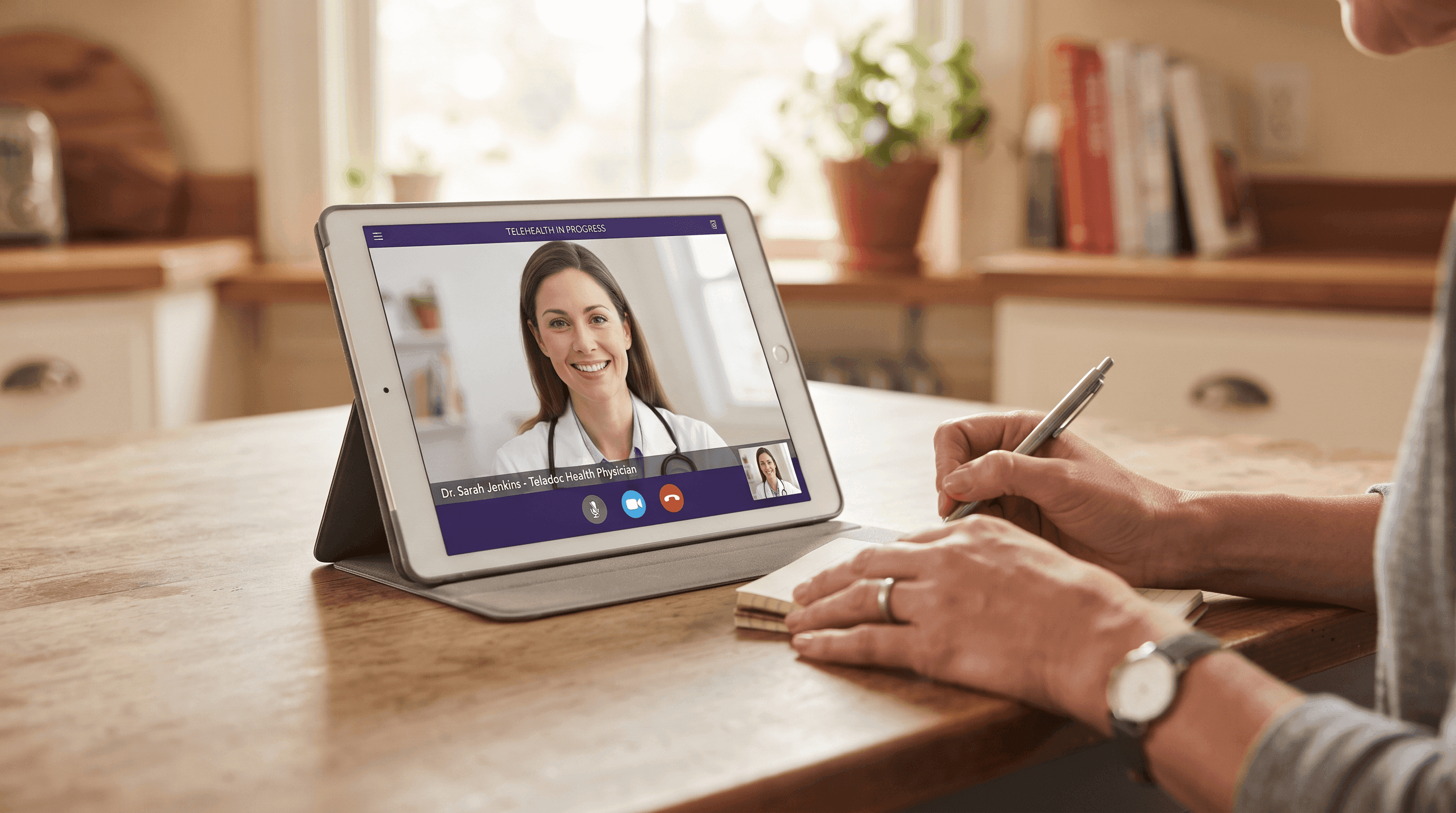
3. Teladoc: the largest nationwide video telehealth network
Teladoc connects you with a board-certified physician, nurse practitioner, or physician assistant by phone or video, 24 hours a day, in all 50 states. For a homebound reader whose issue does not require a hands-on exam, such as a UTI, cold symptoms, or a medication refill, it is one of the fastest ways to get a prescription without arranging any kind of home visit.
Pros: Coverage is genuinely nationwide and available around the clock, and many employer or health plan members pay $0 per visit.
Cons: Teladoc's own no-insurance pricing page lists visits at $89, and independent review aggregators report a 51% user satisfaction rating drawn from 99 reviews across recognized software review sites, with recurring complaints about inconsistent provider quality and slow support response (SelectHub, accessed July 2026).
Pricing: $89 per visit cash pay; $119 for mental health visits; often $0 with qualifying insurance or an employer plan (Teladoc, accessed July 2026).
Best for: Homebound patients who need a fast prescription or diagnosis for a condition that does not require a physical exam.
Rating: 51% user satisfaction based on 99 reviews across three recognized software review sites (SelectHub, accessed July 2026); Teladoc states it serves more than 90 million people (Teladoc, accessed July 2026).
4. Amwell: 24/7 on-demand video visits with no appointment required
Amwell offers urgent care video visits that typically start within minutes of requesting one, with no scheduling needed, alongside therapy, psychiatry, and nutrition counseling. That immediacy is useful for a mobility-limited patient dealing with a sudden but non-emergency symptom late at night.
Pros: Urgent care visits often begin in 10 minutes or less, and the platform accepts a wide range of insurance plans that can bring the cost close to a normal copay.
Cons: Amwell's app has drawn user reports of crashes and connection failures during video calls, and its Trustpilot rating sits at 2.9 out of 5 based on more than 2,000 reviews, with billing and customer service cited most often.
Pricing: $79 per urgent care visit cash pay; $109 or more for therapy and psychiatry (Amwell, accessed July 2026).
Best for: Homebound patients who want to see someone on camera immediately without booking ahead.
Rating: 2.9/5 on Trustpilot based on more than 2,000 reviews (accessed July 2026).
5. Heal: old-fashioned doctor house calls, modernized
Heal sends a licensed physician to your home for a full house call, or connects you by video for a lower-cost telemedicine visit, in California, New York, New Jersey, Georgia, Virginia, Washington, Maryland, and Washington D.C. It is one of only two options on this list that puts an actual doctor in your home rather than on a screen.
Pros: House calls typically arrive within about two hours of booking, and Heal is in-network with major PPO insurers as well as Medicare, which can bring the cash cost down substantially.
Cons: The service is only available in a limited set of states, so most of the country cannot use it at all, and independent, dated user-rating data is sparse compared to larger platforms.
Pricing: $159 per house call cash pay; $79 per telemedicine visit cash pay (Heal, accessed July 2026, per TechRadar and Fierce Healthcare reporting).
Best for: Homebound patients in one of Heal's eight service areas who want an actual physician examining them in person.
Rating: Not independently rated on a standardized platform; the company reports delivering more than 200,000 house calls to date (Heal press materials, accessed July 2026).
6. K Health: the lowest-cost option, built around AI-assisted text chat
K Health pairs an AI symptom checker with a licensed clinician who takes over by text chat, not video, for diagnosis and prescriptions. It does not accept insurance, but its flat pricing makes it the cheapest option on this list by a wide margin.
Pros: A single visit costs a fraction of most competitors, and the $49 monthly membership covers unlimited messaging, which suits someone managing a chronic condition with frequent refill needs.
Cons: The entire visit happens through text rather than video or an in-person exam, which limits what a clinician can actually assess, and K Health holds an F rating with the Better Business Bureau alongside a strong 4.7 rating on the Apple App Store, a split worth weighing (BBB and App Store, accessed July 2026).
Pricing: $49 per month unlimited or $73 for a single visit; no insurance accepted (K Health, accessed July 2026).
Best for: Cost-sensitive homebound patients managing straightforward, recurring issues like refills or minor infections.
Rating: 4.7/5 on the Apple App Store and 4.6/5 on Google Play (accessed July 2026); F rating with the Better Business Bureau based on 197 reviews (accessed July 2026).
7. PlushCare: same-day video visits with a consistent physician
PlushCare schedules same-day or next-day video appointments and lets you choose a provider you can return to for continuity, which matters if you are managing an ongoing condition and want the same person tracking it over time.
Pros: Same-day booking is genuinely available in most metro areas, and the option to keep seeing the same physician across visits helps homebound patients avoid re-explaining their history every time.
Cons: At $129 per cash-pay visit plus a $19.99 monthly membership fee, it is one of the pricier options here, and its average rating sits at 3.1 out of 5 across more than 2,000 reviews, with some users reporting bills higher than the quoted price.
Pricing: $19.99/month membership (or $149/year) plus $129 per visit cash pay; insured patients often pay a copay instead (PlushCare, accessed July 2026).
Best for: Homebound patients who want to build an ongoing relationship with one telehealth physician.
Rating: 3.1/5 based on more than 2,000 reviews (TopConsumerReviews, accessed July 2026).
8. Momentary Virtual Care: AI-assisted, physician-reviewed primary care in California
Momentary pairs an AI intake and symptom review with a licensed physician who reviews and signs off on your care. It is a first step when you're homebound in California and want a low-cost way to get initial guidance before deciding whether you need a house call, an ER, or a specialist. Momentary is a physician-reviewed AI tool, not a replacement for a physician.
Pros: The company advertises unlimited primary care access priced under a typical insurance copay, and its companion tool lets patients compare costs and quality across every hospital and imaging center in California for 33 common procedures.
Cons: The service is currently licensed only in California, so most homebound readers outside the state cannot use it, and Momentary has not published independently verified App Store ratings, response-time data, or a specific dollar price, which makes it harder to compare directly against competitors on cost.
Pricing: Not published as a fixed dollar figure; Momentary states pricing is "less than a typical copay" (Momentary, accessed July 2026).
Best for: California residents who are homebound and want an AI-assisted first look at a symptom before booking anything else.
Rating: Not independently rated on a standardized platform as of July 2026.
Why Being Homebound Changes What "Without Leaving Home" Actually Means
For most people, "see a doctor without leaving home" means picking a telehealth app and hopping on a video call. For someone who is genuinely homebound or has limited mobility, that framing misses half the picture. A video call solves the transportation problem, but it cannot take your blood pressure, listen to your lungs, draw blood, or check a wound. Research on home-based primary care programs notes that homebound adults often carry complex, overlapping chronic conditions, which is exactly the population where a screen-only visit can miss something a hands-on exam would catch.
That is why this list splits options into two categories instead of treating them as interchangeable. Video-only services like Teladoc, Amwell, PlushCare, and K Health are fast and inexpensive, and they suit a straightforward refill, a rash, or a general question. In-home services like DispatchHealth, Heal, and Medicare-certified home health exist for visits that need a physical presence: labs, vitals, wound checks, or anything a camera can't fully assess.
Before booking, it's worth checking three things: whether the condition needs a hands-on exam or a test, whether the service accepts your specific insurance (Medicare fee-for-service isn't accepted everywhere), and whether it's actually licensed in your state. Skipping that check is the most common reason people end up on a video visit that ends with "you'll need to be seen in person anyway."
If a video visit or a home health referral turns up something that needs more than a screening opinion, the next step is connecting with a primary care provider who can take over your ongoing care. Momentary's own virtual primary care service is one way to reach a physician for that kind of continuity if you're in California, and every option higher on this list has its own path to a live provider as well.
Frequently Asked Questions
How can I see a doctor if I'm homebound and can't drive or take transit? Use a video telehealth visit like Teladoc or Amwell for anything that doesn't need a physical exam, and a home-visit service like DispatchHealth or Heal, or a Medicare-certified home health referral, when you need labs, vitals, or hands-on care. A doctor can advise on individual cases where the route isn't clear.
Does Medicare pay for a doctor to come to my house? Yes, in specific circumstances. Medicare Part A and Part B cover home health services, including skilled nursing and therapy, once a doctor certifies you meet the homebound definition and orders a plan of care, and coverage typically requires only the Part B deductible plus coinsurance.
Can I get a prescription without a video call at all? K Health offers text-only visits with a licensed clinician for a flat fee. A text-based visit has real limits compared to video or an in-person exam, so it fits straightforward, recurring issues better than anything complex.
What's the difference between a telehealth video visit and an in-home doctor visit? A video visit connects you with a provider by camera for conditions that don't require touch or testing, while an in-home visit brings a clinician to your house who can check vitals, run basic labs, and perform a hands-on exam. If you're unsure which one your symptoms call for, you can use an AI health tool to get guidance on your next steps before deciding.
Is DispatchHealth or Heal available where I live? Both operate in specific metro markets rather than nationwide, so availability depends on your city and state. Check each company's site directly, since coverage areas change.
What should I do if my mobility limitation is temporary, like recovering from surgery? The same options apply, but you likely won't meet the formal Medicare homebound definition unless leaving home takes considerable and taxing effort, so a video visit or an in-home urgent care service is usually the more practical starting point than a home health referral.


