


Last updated: June 2026
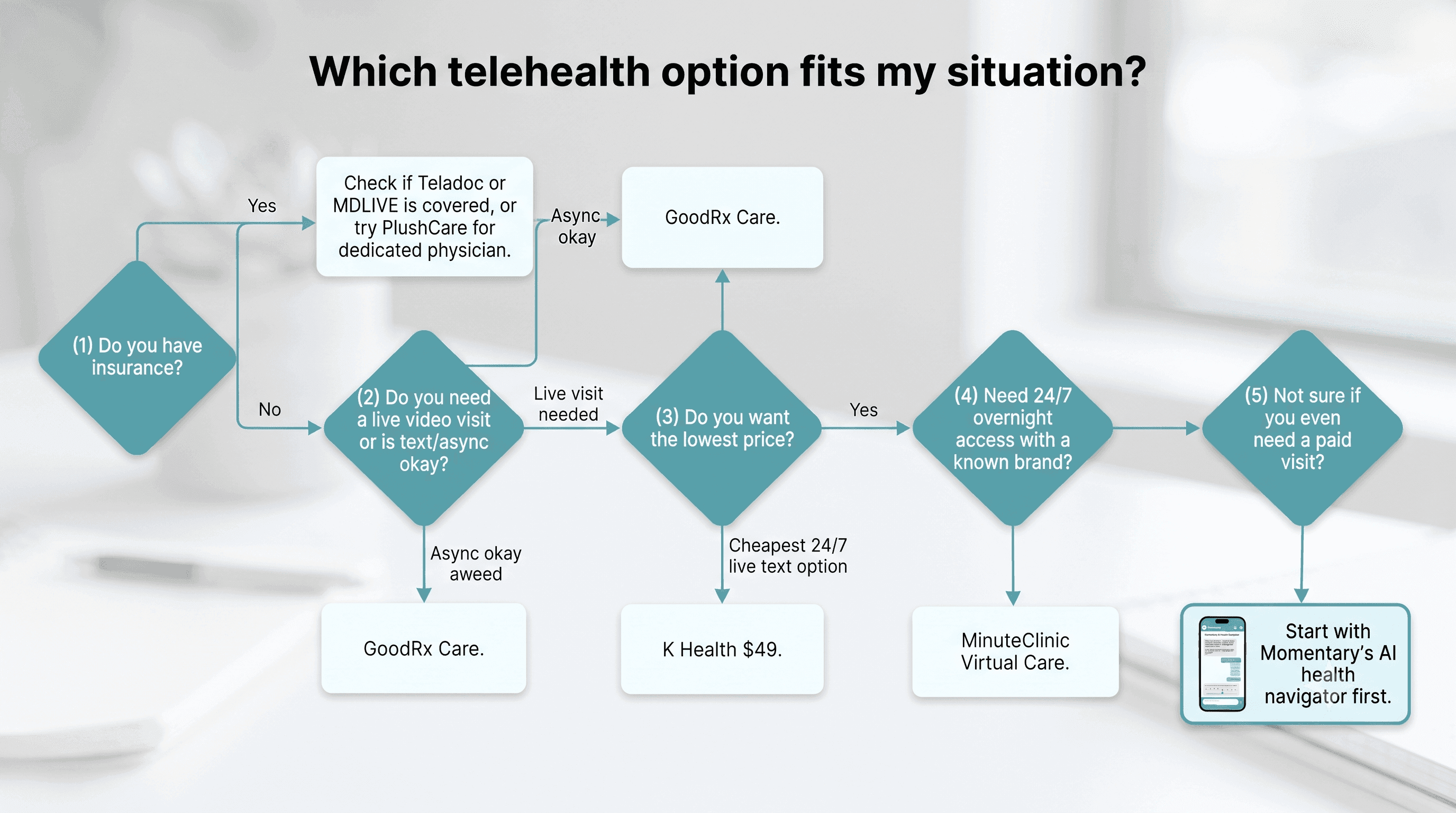
If you need to speak with a doctor right now but cannot get a same-day slot, telehealth is your fastest legitimate path. The most direct first step is to open Sesame Care (visits from $29), Teladoc (on-demand, covered by most major insurers), or GoodRx Care (async visits from $20 with no video required), all of which connect you to a licensed clinician without scheduling in advance. If you want to start by understanding your symptoms before seeing anyone, Momentary's AI health navigator lets you do that instantly at no cost.
| Option | Best For | Price | Rating | No Appointment |
|---|---|---|---|---|
| Sesame Care | Lowest cash-pay price | From $29/visit | 4.9/5 (App Store) | Yes |
| Teladoc | Insured patients, fastest on-demand MD | $89 cash / $0-$75 insured | 44,000+ Trustpilot reviews | Yes |
| GoodRx Care | Async visits, prescription bundled with coupon | $20-$75/visit | 4.7/5 (GoodRx) | Yes |
| Momentary | AI symptom check, physician-reviewed guidance | Free | Physician-reviewed AI | Yes, instant |
| MinuteClinic Virtual | Brand trust, 24/7, 200+ languages | ~$59-$99 cash | 95% satisfaction (CVS) | Yes |
| MDLIVE | Cigna members, multi-specialty | $89 cash / $0 insured | 4.0/5 (ChosingTherapy) | Yes |
| K Health | Cheapest live-provider option at $49 | $49/visit or $49/month | App Store rated | Yes |
| Doctor On Demand | Strong psychiatry, Medicare accepted | $99 cash / $0 insured | 4.6/5 (App Store) | Yes |
| PlushCare | Insured patients wanting a dedicated physician | $19.99/mo + $99/visit | 3.4/5 (Trustpilot) | Same-day only |
How We Ranked
For this list, "best" means the fastest, most accessible, most legitimate way for a US adult to speak with or receive guidance from a licensed clinician online without a prior appointment, regardless of insurance status. We scored each eligible entry on six criteria: clinical credibility (20%), cost and value (20%), speed and availability (25%), scope fit (25%), user experience (5%), and trust signals (5%). Speed and scope fit each carry 25% because the defining constraint in this situation is access without friction, not an ongoing care relationship. We evaluated entries in June 2026 using each platform's own pricing pages, App Store and Trustpilot ratings dated within the past 6 months, and third-party clinical reviews. Momentary is our own product. We scored it on the same criteria as every other entry.
1. Sesame Care — Lowest cash price, same-day on-demand access with no insurance required
Sesame Care is a direct-pay telehealth marketplace where board-certified physicians and nurse practitioners set their own transparent prices, and you book directly without going through an insurer. When you need to talk to a doctor without an appointment and without insurance complexity, Sesame's marketplace model removes more friction than any other live-provider platform in this list. Visit prices for acute care start at $29, making Sesame the cheapest path to a real clinician for most situations this list covers.
Pros: Sesame offers the lowest published prices of any live-provider platform on this list, starting at $29 for an acute care telehealth visit. The platform has over 10,000 board-certified providers across 45-plus specialties, with same-day or within-hours booking available including on weekends and holidays. Sesame earns 4.9 out of 5 stars on the Apple App Store (June 2026) and reports over 1 million patients served with 95% patient satisfaction, both of which reflect consistent provider quality at its price point.
Cons: Sesame does not accept insurance, which means prescription costs are your responsibility and reimbursement through your plan is not guaranteed. Provider quality can vary because Sesame is a marketplace where individual clinicians set their own rates and availability.
Pricing: Acute care visits from $29; mental health from $50; Sesame Plus membership at $10.99/month or $99/year includes discounted rates and a free annual lab panel.
Best for: Anyone paying cash or with a high-deductible plan who wants the lowest per-visit cost to talk to a real doctor fast.
Rating: 4.9/5 on the Apple App Store, June 2026; 95% patient satisfaction reported on sesamecare.com.
2. Teladoc Health — Widest insurance coverage, on-demand visits in under 10 minutes for most insured patients
Teladoc is the largest telehealth network in the United States and the most likely platform to be included in your employer health plan or insurer's telehealth benefit. For patients with active insurance, Teladoc often represents the fastest path to a board-certified physician without a traditional appointment because the copay is frequently $0 and wait times average under 10 minutes for urgent care. Without insurance, the cash price is $89 per visit.
Pros: Teladoc operates in all 50 states and connects patients 24/7 with board-certified physicians and nurse practitioners for urgent care, with on-demand wait times typically under 10 minutes. The platform covers urgent care, primary care, dermatology, mental health, and condition management, making it the broadest single-platform option. Teladoc has over 44,000 reviews on Trustpilot as of June 2026, reflecting its scale and longevity in the market.
Cons: The cash-pay price of $89 per visit is mid-range rather than low, and Teladoc's on-demand model assigns whichever physician is available rather than letting you choose, so care continuity varies by visit. Some patient reviews note inconsistent physician engagement during shorter visits.
Pricing: $89/visit without insurance; $0-$75 copay with insurance depending on your plan; pricing shown before booking.
Best for: Insured patients who want the fastest on-demand access through a platform their plan already covers.
Rating: 4.0/5 on the App Store (June 2026, per Apple listing); 44,000-plus Trustpilot reviews with mixed ratings reflecting scale rather than uniformly negative experience.
3. GoodRx Care — Asynchronous visits from $20, no video call required, and prescription coupons bundled in
GoodRx Care (formerly HeyDoctor) lets you start a medical consultation through a text-based questionnaire at any hour, with no scheduled time, no waiting room, and no camera required. For common conditions like UTIs, sinus infections, birth control, or prescription refills, a licensed clinician reviews your responses and sends a prescription to your pharmacy, often within a few hours. The integration with GoodRx's prescription discount network means the app that handles your visit also shows you the cheapest pharmacy for your medication.
Pros: Visit fees start at $20 for text-based consultations and go up to $75 for video visits depending on condition, making GoodRx Care one of the most affordable per-visit options with a live clinician. The asynchronous format means you submit your intake when convenient and get a response without scheduling, which is genuinely faster than booking any live video appointment for straightforward conditions. GoodRx Care does not require insurance and covers all 50 states.
Cons: GoodRx Care is best suited to simple, well-defined conditions where a questionnaire can substitute for a live exam. It is not the right platform for complex or ambiguous symptoms where a real-time conversation with a physician would change the clinical picture. The asynchronous format also means no immediate back-and-forth if the clinician has follow-up questions.
Pricing: $20-$75 per visit depending on condition; $19 for Gold Members per visit. No subscription required.
Best for: Anyone who wants the convenience of skipping a video call entirely for a straightforward acute condition.
Rating: GoodRx is a BBB-accredited company with a widely trusted prescription discount platform; third-party reviews from VirtualCareFinder rate GoodRx Care positively for uninsured cash-pay patients (June 2026).
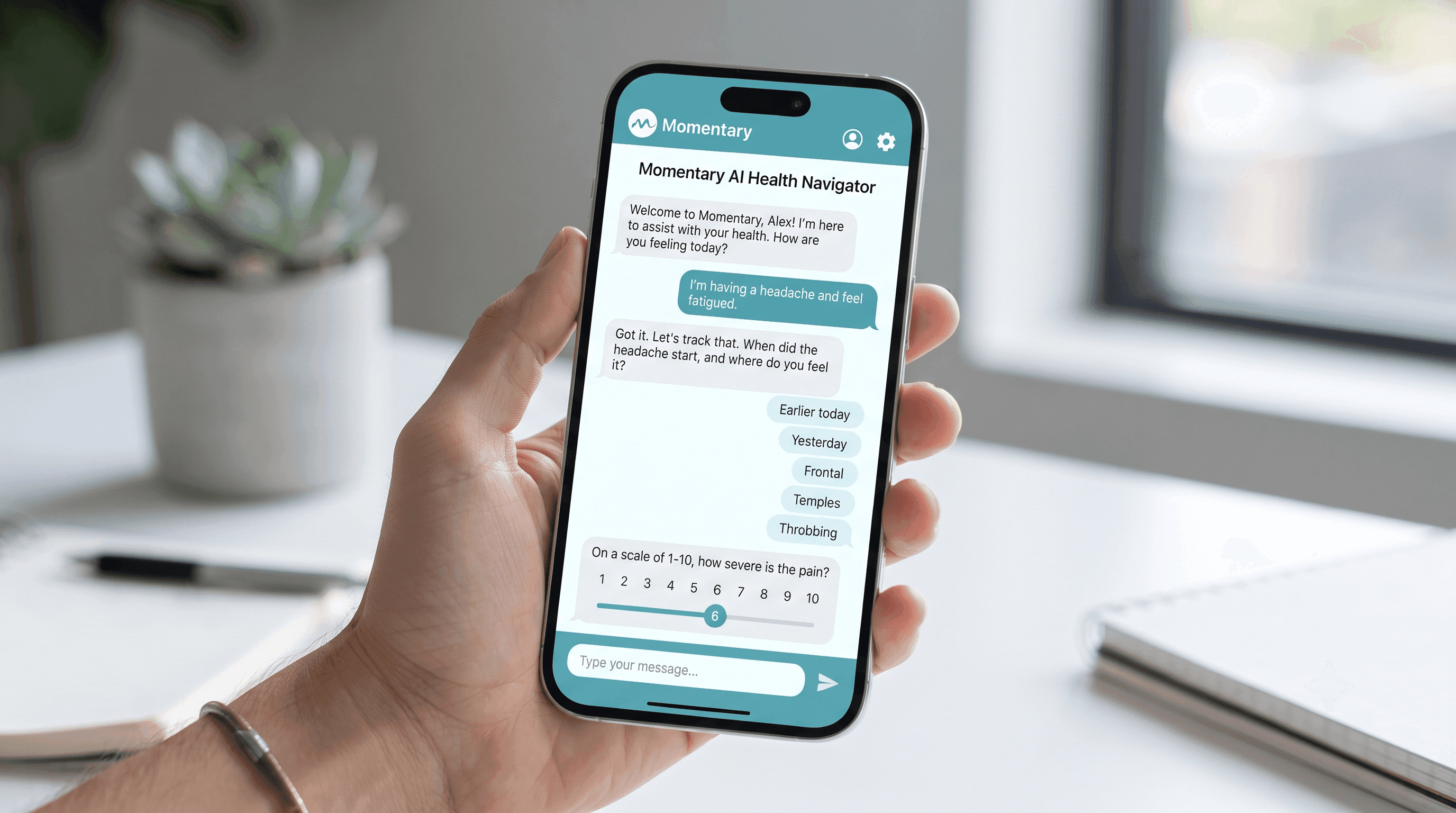
4. Momentary — Physician-reviewed AI health navigator as a first step when you need guidance before booking a visit
Momentary is an AI-powered health tool that is physician-reviewed rather than physician-operated. When you are trying to understand your symptoms, decide whether they require a live visit, or figure out which type of provider you actually need, Momentary gives you a structured, evidence-informed starting point at no cost and with no scheduling required. This is a first step when you are trying to talk to a doctor online without an appointment, not a replacement for that conversation.
Pros: Momentary is available instantly, requires no signup delay, and costs nothing for the AI navigation layer, making it the lowest-friction starting point on this list. Physician review of the underlying clinical content means the guidance reflects medical accuracy rather than generic consumer health copy. For a reader who is uncertain whether they even need a prescription-level visit, Momentary helps triage that decision before spending $29 to $89.
Cons: Momentary is an AI health tool, not a licensed physician and cannot diagnose, prescribe, or replace a clinician visit. Conditions that require a prescription, lab test, or clinical examination require one of the live platforms ranked above this entry. Per California AB 489, Momentary must not be used as a substitute for physician care.
Pricing: Free for AI navigation.
Best for: Anyone who wants to understand their symptoms or decide what kind of care they need before committing to a paid telehealth visit.
5. CVS MinuteClinic Virtual Care — 24/7 walk-in style video visits from a nationally trusted health system, no appointment needed
MinuteClinic Virtual Care brings the no-appointment model of CVS retail clinics into a virtual format. You can start a video visit on your phone, tablet, or computer at any hour including holidays, without scheduling in advance. MinuteClinic providers include nurse practitioners and physician assistants supervised by physicians, and the service accepts most major insurance plans. CVS also offers translation services in 200-plus languages, which makes this one of the most accessible options for non-English-speaking patients.
Pros: MinuteClinic Virtual Care is a 24/7 no-appointment service available across the US from a system that has completed over 18 million patient visits, per CVS Health's published data. The CVS brand carries substantial credibility for patients who are more comfortable with a known retail health system than a pure telehealth startup. Insurance acceptance is broad, and the connection to CVS Pharmacy means prescriptions can be sent to your preferred CVS location or another pharmacy of your choice.
Cons: Cash-pay pricing for MinuteClinic Virtual Care falls in the $59-$99 range depending on service, which is higher than Sesame or GoodRx Care for uninsured patients. Services are not yet available in all states, and the scope of virtual care conditions is narrower than full-service platforms like Teladoc.
Pricing: Approximately $59-$99 per visit without insurance; variable with insurance. Patients are not charged until a treatment plan is provided.
Best for: Patients who prefer a large retail health system name, need 24/7 access with insurance, or require a non-English consultation.
Rating: MinuteClinic reports a 95% customer satisfaction rating based on over 18 million in-clinic and virtual visits (CVS Health, 2026).
6. MDLIVE — Multi-specialty on-demand telehealth with strong overnight staffing, best for Cigna plan members
MDLIVE is part of Evernorth, Cigna's health services division, and is the telehealth benefit platform for many Cigna members. It operates 24/7 across all 50 states and Puerto Rico for urgent care and behavioral health, with a provider pool that is specifically staffed for overnight and weekend volume. Beyond Cigna, MDLIVE accepts Humana, Blue Cross Blue Shield, Regence, and other major insurers, and charges $89 per urgent care visit without insurance.
Pros: MDLIVE offers urgent care, primary care, dermatology, and behavioral health on a single platform, which reduces the number of accounts a patient needs to manage. The platform is available 24/7 in all 50 states and Puerto Rico, and its overnight staffing makes it more consistently fast than competitors during off-peak hours. An independent review from ChosingTherapy gave MDLIVE 4 out of 5 stars, citing strong provider credentials and insurance acceptance.
Cons: MDLIVE's $89 cash-pay urgent care price is higher than Sesame and GoodRx Care for uninsured patients. Patient review analysis from Unstar.app (April 2026) found that MDLIVE had a higher share of complaints about wait times and visit length than most competitors on this list, and the app interface is noted as functional but dated.
Pricing: Urgent care from $0-$89 depending on insurance; dermatology from $0-$95; behavioral health from $0-$179.
Best for: Cigna or Humana plan members who want on-demand multi-specialty access under one telehealth benefit.
Rating: 4 out of 5 stars (ChosingTherapy independent review, 2025).
7. K Health — AI-assisted triage plus a live clinician at $49/visit with no appointment and 24/7 access
K Health uses an AI symptom checker to triage your intake before connecting you to a board-certified clinician via text-based chat. The result is a platform that covers primary care, urgent care, and mental health 24/7 in all 48 continental US states without requiring a scheduled appointment. A single visit costs $49 without insurance, and a $49/month membership covers unlimited primary care and mental health messaging.
Pros: K Health's $49 per visit cash-pay rate is competitive for a live-clinician platform that requires no appointment, and the AI triage step means the clinician who joins your chat already has structured symptom data before the conversation starts. The platform operates 24/7 in 48 continental US states with no appointment required, and clinicians can prescribe antibiotics, antidepressants, anti-anxiety medications, and other non-controlled substances directly through the app.
Cons: K Health's care is delivered primarily through text chat rather than video, which some patients find less satisfying than a face-to-face encounter. Patient reviews on Trustpilot and app stores include complaints about wait times, app glitches, and clinicians not reviewing intake data before responding.
Pricing: $49/visit; $49/month for unlimited primary care and mental health. Not available in Alaska or Hawaii.
Best for: Patients comfortable with text-based care who want the lowest possible live-clinician price without a subscription commitment.
8. Doctor On Demand (Included Health) — Strongest on-demand psychiatry, Medicare accepted, $99 per urgent care visit
Doctor On Demand, now part of Included Health, connects patients to board-certified physicians via video for urgent care, primary care, and mental health. It is one of the few on-demand telehealth platforms that accepts Medicare Part B, which makes it relevant to patients over 65 or with qualifying disabilities who need to see a doctor online without an appointment. The cash-pay price for a 15-minute urgent care visit is $99 without insurance.
Pros: Doctor On Demand accepts Medicare Part B and is a covered benefit for over 98 million Americans through employer or insurance plans, making it one of the broadest coverage options in this list. The platform has a 4.6-star rating on the App Store (Doctor On Demand, June 2026) and is specifically praised for its psychiatry services, which accept insurance at rates that are substantially lower than the $299 initial cash-pay psychiatry price. On-demand urgent care connects patients to a physician within minutes in most cases.
Cons: The $99 per urgent care visit cash-pay price is the highest in this list for urgent care, and the 15-minute session length can feel rushed for patients with multiple concerns. Doctor On Demand does not prescribe controlled substances in most cases.
Pricing: $99 per urgent care visit (15 minutes) without insurance; $134 per therapy session; $299 initial psychiatry visit. With insurance, many visits are $0.
Best for: Medicare patients, insured patients needing psychiatry, and anyone whose employer covers Doctor On Demand as a free benefit.
Rating: 4.6 out of 5 stars on the Apple App Store (June 2026, per App Store listing).
9. PlushCare — Same-day scheduling for insured patients who want a dedicated physician relationship
PlushCare offers same-day telehealth appointments with board-certified physicians for urgent care, primary care, and mental health, and accepts over 220 insurance plans. Unlike most other platforms on this list, PlushCare uses a membership plus per-visit model ($19.99/month plus $99+ per visit without insurance), and the experience is closer to building a relationship with a primary care physician than accessing on-demand care. It earns its place here because same-day slots are available for many conditions without a prior appointment.
Pros: PlushCare accepts more insurance plans than most platforms on this list, including Aetna, Cigna, United Healthcare, Humana, and Blue Cross Blue Shield, and bills your insurer directly for many visits including lab orders and referrals. Physicians at PlushCare average 15 years of experience and come from top-50 US medical schools per PlushCare's published materials. A 98% prescription fill rate (reported on PlushCare.com) reflects strong medication management capability.
Cons: The cost model of $19.99/month plus $99+ per visit without insurance is the most expensive no-appointment option on this list for uninsured patients, and the membership can continue charging if not actively cancelled, per multiple BBB complaints reviewed in June 2026. PlushCare requires a live video appointment rather than async access, which adds scheduling friction compared to the top entries on this list.
Pricing: $19.99/month membership (first month free); $99-$129 per visit without insurance; copay only with most major insurance plans.
Best for: Insured patients with chronic conditions who want an ongoing relationship with one physician and are willing to pay for continuity.
Rating: 3.4 out of 5 stars on Trustpilot (June 2026, 2,713 reviews) reflecting billing transparency concerns; app store ratings trend higher.
Why Talking to a Doctor Without an Appointment Is Different From Booking One
The core difference between no-appointment telehealth and traditional booking is not just speed. It is what the platform has to do to make that access work, and what trade-offs that creates for the patient.
Platforms that operate without appointments maintain standing pools of on-call providers who are paid to be available now. That structure introduces a trade-off: you are likely to see whoever is available at that moment rather than a physician who knows your history. For straightforward conditions like a UTI, strep throat, a sinus infection, or a prescription refill for a stable medication, this does not meaningfully affect clinical outcomes. The American Medical Association reports that telehealth and in-person diagnoses match up approximately 90% of the time for acute conditions that telehealth platforms typically handle. For anything more complex or ambiguous, the lack of continuity is a real limitation.
The pricing structure also works differently without an appointment. Platforms like Sesame and GoodRx Care can offer lower per-visit prices because they eliminate the insurer billing layer, the follow-up infrastructure, and the practice overhead that traditional healthcare includes. The National Institutes of Health notes that telehealth removes significant cost burdens for patients with non-emergency conditions, but that the savings are most reliable for acute, uncomplicated presentations rather than chronic disease management.
For readers who are uninsured or whose deductible is unmet, this distinction matters most. A $29 Sesame visit for a UTI is a complete solution. A $29 visit for unexplained chest pressure or recurring neurological symptoms is a first step to an in-person referral, not an endpoint. Knowing which category your situation falls into before you open the first app is what this piece is designed to help you figure out.
When a telehealth visit resolves your concern, you are done. But if your provider recommends a follow-up, lab tests, imaging, or specialist care that a telehealth visit cannot deliver, the next step is connecting with a primary care provider who can order those services. If you do not have a regular physician or your usual provider has no availability, see a doctor online through Momentary Virtual Care to connect with a licensed provider who can coordinate next steps.
Frequently Asked Questions
Can I talk to a doctor online for free?
Genuinely free live-physician visits are rare. What is free is using an AI health tool like Momentary to understand your symptoms and decide whether you need a paid visit. Among live-provider platforms, the closest to free is when your employer or insurance plan covers Teladoc, MDLIVE, or Doctor On Demand as a $0 benefit. Without insurance, the lowest-cost live-clinician visits start at $29 (Sesame Care) or $20 (GoodRx Care for async consultations). If cost is the barrier to care, Sesame Care is the most consistently affordable starting point.
Is there a ChatGPT for medical questions?
Several AI health tools exist, including Momentary, K Health's symptom checker, and Sesame's built-in AI chat, but they are not the same as clinical AI systems used in healthcare settings. Consumer AI health tools are designed to help you organize symptoms and understand your options, not to diagnose or prescribe. Momentary is physician-reviewed, which means the clinical logic behind its guidance reflects medical accuracy rather than general language model output. You can explore your symptoms with Momentary's AI health navigator as a starting point before committing to a paid telehealth visit.
Is Gemini or ChatGPT better for medical questions?
General-purpose AI assistants like Gemini and ChatGPT can help you understand terminology, research conditions, and think through questions to ask a provider. They are not licensed clinicians and are not designed for medical guidance. For medically accurate, physician-reviewed AI health navigation specifically built for the task, a purpose-built tool like Momentary is more appropriate than a general assistant. For a diagnosis, prescription, or clinical recommendation, any AI tool, general or specialized, is not a substitute for a licensed provider visit.
What is the 30% rule for AI?
There is no single "30% rule" that applies universally to AI in healthcare. The phrase occasionally appears in discussions about AI diagnostic accuracy, but it is not a standard clinical guideline established by the CDC, FDA, NIH, or major clinical bodies. If you encountered this term in a specific context, a doctor can advise on what it means for your individual situation.
What should I do if I cannot afford a telehealth visit and need a doctor?
Start with GoodRx Care (from $20 async) or Sesame Care (from $29) since both are cash-pay only and do not require insurance. Community Health Centers funded under Section 330 of the Public Health Service Act offer sliding-scale fees based on income for patients who cannot afford standard telehealth rates. The Health Resources and Services Administration (HRSA) maintains a searchable directory of these centers. Additionally, some local health departments and Federally Qualified Health Centers (FQHCs) offer telehealth at reduced cost for qualifying patients.
Does telehealth without an appointment replace a regular doctor?
No. On-demand telehealth is designed for acute, uncomplicated conditions and situations where timely access matters more than continuity. For ongoing chronic condition management, preventive care, specialist referrals, and lab monitoring, a regular primary care relationship remains clinically important. The CDC recommends that adults establish care with a primary care physician for preventive screening and chronic condition management, regardless of how they access acute care.


