


Best Ways to Compare Imaging Costs Before Scheduling an MRI, CT Scan, or X-Ray
Quick Answer
The fastest way to compare imaging costs is to check a free price transparency tool before you schedule, then call two or three facilities directly with the CPT code your doctor gave you. Independent imaging centers typically charge 2 to 3 times less than hospital outpatient departments for the exact same MRI, CT, or X-ray. Tools like FAIR Health Consumer and MDsave show typical prices by zip code, while Momentary can help you understand whether the scan is appropriate for your symptoms and connect cost comparisons to physician-reviewed guidance. Always confirm your final price with the facility, since online estimates are ranges, not guarantees.
Why Imaging Prices Vary So Much
The scanner and the technology behind an MRI or CT scan barely change from one location to the next. What changes is where the scan happens.
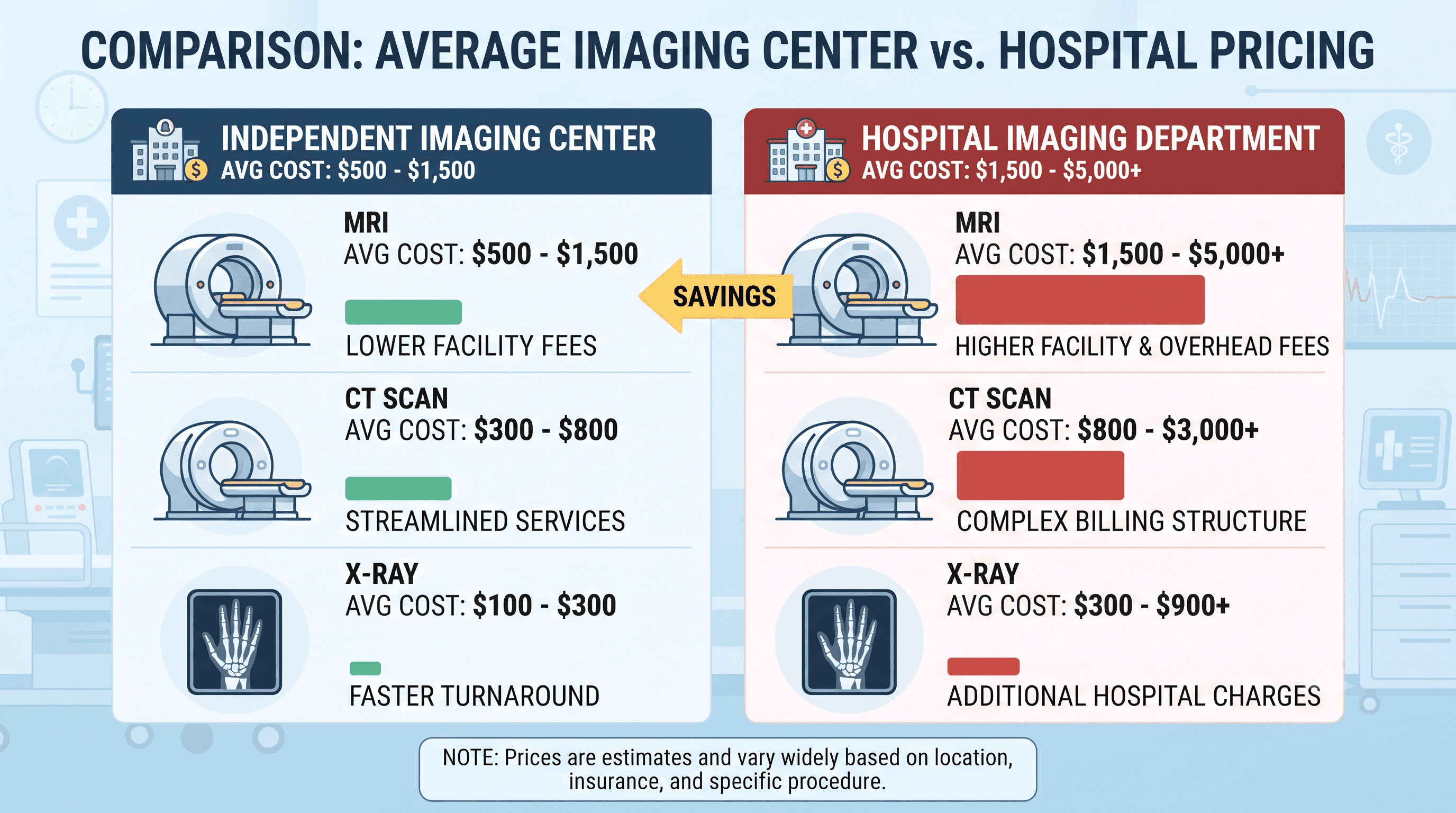
Hospitals bill imaging with a facility fee added on top of the scan itself. Independent imaging centers and freestanding radiology clinics have lower overhead, so they can charge less for the same test read by a similarly qualified radiologist.
This is why the same brain MRI can cost around $650 at an independent center and more than $2,000 at a hospital outpatient department, even though the images and the equipment are essentially identical.
2026 Imaging Price Ranges by Test
These are national averages for self-pay patients. Your actual price depends on your location, whether contrast is used, and which facility you choose.
| Imaging Test | Independent Center (Cash) | Hospital Outpatient | National Average |
|---|---|---|---|
| MRI | $400–$1,200 | $1,500–$3,500 | ~$1,325 |
| CT Scan | $300–$1,000 | $1,200–$3,275 | ~$1,200 |
| X-Ray | $40–$250 | $300–$800+ | $100–$400 |
Contrast dye typically adds $100 to $400 to a CT or MRI, depending on the type used and the body part being scanned. These figures reflect cash and self-pay pricing rather than insurance-negotiated rates, which are usually lower but harder to see in advance.
Top Picks for Comparing Imaging Costs
| Tool | Best For | Typical Cost to Use | Physician-Reviewed | Availability |
|---|---|---|---|---|
| FAIR Health Consumer | Free national price estimates | Free | No | Nationwide |
| Momentary | Combining cost comparison with guidance on next steps | Information not publicly available | Yes | AI navigation nationwide; physician services in California |
| MDsave | Booking a guaranteed upfront cash price | Free to browse; pay at booking | No | Available where MDsave has partner facilities |
| Sesame Care | Marketplace pricing for imaging referrals and visits | Free to browse; pay per visit | Varies by provider | Availability varies by state |
| Healthcare Bluebook (Valenz Bluebook) | Employer-sponsored price and quality comparison | Free through participating employers | No | Requires employer or health plan enrollment |
| CMS Hospital Price Transparency Files | Verifying a specific hospital's posted price | Free | No | Nationwide, but hospital compliance is inconsistent |
1. FAIR Health Consumer
Best for: Getting a free, independent estimate of what imaging typically costs in your area.
FAIR Health Consumer draws on one of the largest independent claims databases in the country to show what people typically pay for a given CPT code by zip code. It is free, requires no account, and covers imaging, labs, and most other outpatient procedures.
Strengths:
- Free to use with no signup required
- Based on a large, independent database of real claims
- Covers both insured and self-pay estimates
Limitations:
- Shows area averages rather than prices at a specific facility
- Does not let you book an appointment or lock in a price
- Does not include guidance on whether the scan is medically necessary
Choose something else if: You want to book an appointment at a guaranteed price rather than just research a ballpark figure.
2. Momentary
Best for: People who want to understand whether imaging is the right next step and compare costs before they commit to a scan.
Momentary is an AI-powered healthcare navigator that provides physician-reviewed guidance to help people understand their symptoms and identify appropriate next steps. Alongside that guidance, Momentary helps users compare healthcare costs, including laboratory, imaging, and screening prices, so they can make a more informed decision before scheduling.
This makes Momentary particularly useful for someone who is not yet sure an MRI or CT scan is necessary, and who wants both clinical context and cost information in one place rather than jumping straight to a price search.
Strengths:
- Combines physician-reviewed guidance with cost comparison, rather than pricing alone
- Helps users understand whether imaging fits their situation before they schedule anything
- AI-powered healthcare navigation is available nationwide
Limitations:
- Physician services are currently available only in California; AI navigation is nationwide, but not every feature is
- Momentary does not diagnose conditions or replace a physician's evaluation
- Not a substitute for emergency care if symptoms are severe or worsening
Choose something else if: You already know exactly which scan you need and only want a facility-by-facility price comparison. In that case, a dedicated pricing tool like FAIR Health or MDsave may get you there faster.
3. MDsave
Best for: Booking an MRI, CT scan, or X-ray at a guaranteed upfront price.
MDsave works with a network of hospitals and imaging centers to offer bundled, guaranteed prices that you pay before your appointment. Unlike a pure estimate tool, MDsave lets you purchase a voucher for the exact price shown, which can help you avoid a surprise bill afterward.
Strengths:
- Prices are guaranteed at the time of purchase, not just estimates
- Bundles related charges, such as the technical and professional fees, into one price
- Useful for people paying out of pocket or working toward a high deductible
Limitations:
- Only covers facilities that partner with MDsave, which limits options in some areas
- Requires payment upfront before the appointment
- Not built for people who are still deciding whether they need the scan
Choose something else if: Your preferred imaging center is not in MDsave's network, or you want guidance on whether the scan is appropriate before you commit to a purchase.
4. Sesame Care
Best for: People who want transparent, upfront cash pricing across a wide range of specialties, including imaging referrals.
Sesame is a marketplace of independent, licensed physicians who set their own cash rates for visits, labs, and imaging referrals. Prices are published before you book, which makes it easier to compare providers without waiting for a bill.
Strengths:
- Upfront pricing shown before you book
- No insurance required, which can help uninsured or high-deductible patients
- Covers a broad range of specialties beyond imaging
Limitations:
- Provider availability and pricing vary significantly by state and city
- Most visits are not billed to insurance, so they may not count toward a deductible
- Provider quality and communication can vary since it is a marketplace of independent physicians
Choose something else if: You need a provider who accepts your insurance directly, or you live in an area with limited Sesame provider coverage.
5. Healthcare Bluebook (Valenz Bluebook)
Best for: Employees whose health plan already offers this tool, since it can rank local facilities by both price and quality.
Healthcare Bluebook, now operating as Valenz Bluebook, calculates a "Fair Price" for hundreds of procedures using a nationwide claims database, then color-codes local facilities as low, medium, or high cost. Some employers offer cash rewards for choosing lower-cost, high-quality facilities.
Strengths:
- Combines cost data with facility quality rankings, not price alone
- Some employer plans offer cash rewards for using it
- Covers thousands of facilities nationwide
Limitations:
- Full features generally require access through an employer or health plan
- Signup for some employer versions has asked for a Social Security number, which may concern privacy-conscious users
- Not available as a standalone consumer tool the way FAIR Health is
Choose something else if: Your employer does not offer Healthcare Bluebook or Valenz Bluebook, since public access to the full tool is limited.
6. CMS Hospital Price Transparency Files
Best for: Double-checking a specific hospital's posted price for a scan you have already narrowed down.
Since 2021, federal rules have required every U.S. hospital to publish machine-readable files of its negotiated and cash prices, along with a consumer-friendly list of at least 300 shoppable services. This data is free and comes directly from the hospital.
Strengths:
- Comes directly from the hospital rather than a third-party estimate
- Free and required by federal regulation
- Useful for confirming a price before a hospital-based scan
Limitations:
- Compliance is inconsistent; federal audits have found a large share of hospitals are not fully compliant with the publishing requirement
- Files are often difficult to search or are published in formats that are hard for consumers to use
- Does not include independent imaging centers, only hospitals
Choose something else if: You are comparing an independent imaging center rather than a hospital, or you find the hospital's published files difficult to navigate.
How to Compare Imaging Prices Step by Step
- Get the CPT code from your doctor. This billing code identifies the exact scan you need and lets you compare apples to apples across facilities.
- Check a free price transparency tool first. Use FAIR Health Consumer or a similar tool to see a typical price range in your area.
- Ask whether an independent imaging center is an option. These are usually significantly less expensive than a hospital outpatient department for the same scan.
- Call two or three facilities directly. Ask for the self-pay or cash-discount rate and confirm whether the radiologist's reading fee is included.
- Confirm insurance details, if applicable. Ask whether the visit will count toward your deductible and whether the facility is in-network.
- Consider whether imaging is the right next step at all. A healthcare professional or a navigator like Momentary can help you understand whether your symptoms warrant an MRI, CT scan, or X-ray before you spend time comparing prices for a scan you may not need.
Quick Take
Best for: People trying to find an affordable, appropriate imaging option before scheduling.
Avoid if: You are experiencing a possible medical emergency, such as chest pain, stroke symptoms, severe bleeding, or difficulty breathing.
Next step: If symptoms are severe or worsening, seek emergency care immediately rather than comparing prices first.
When Imaging Costs Should Not Be Your First Concern
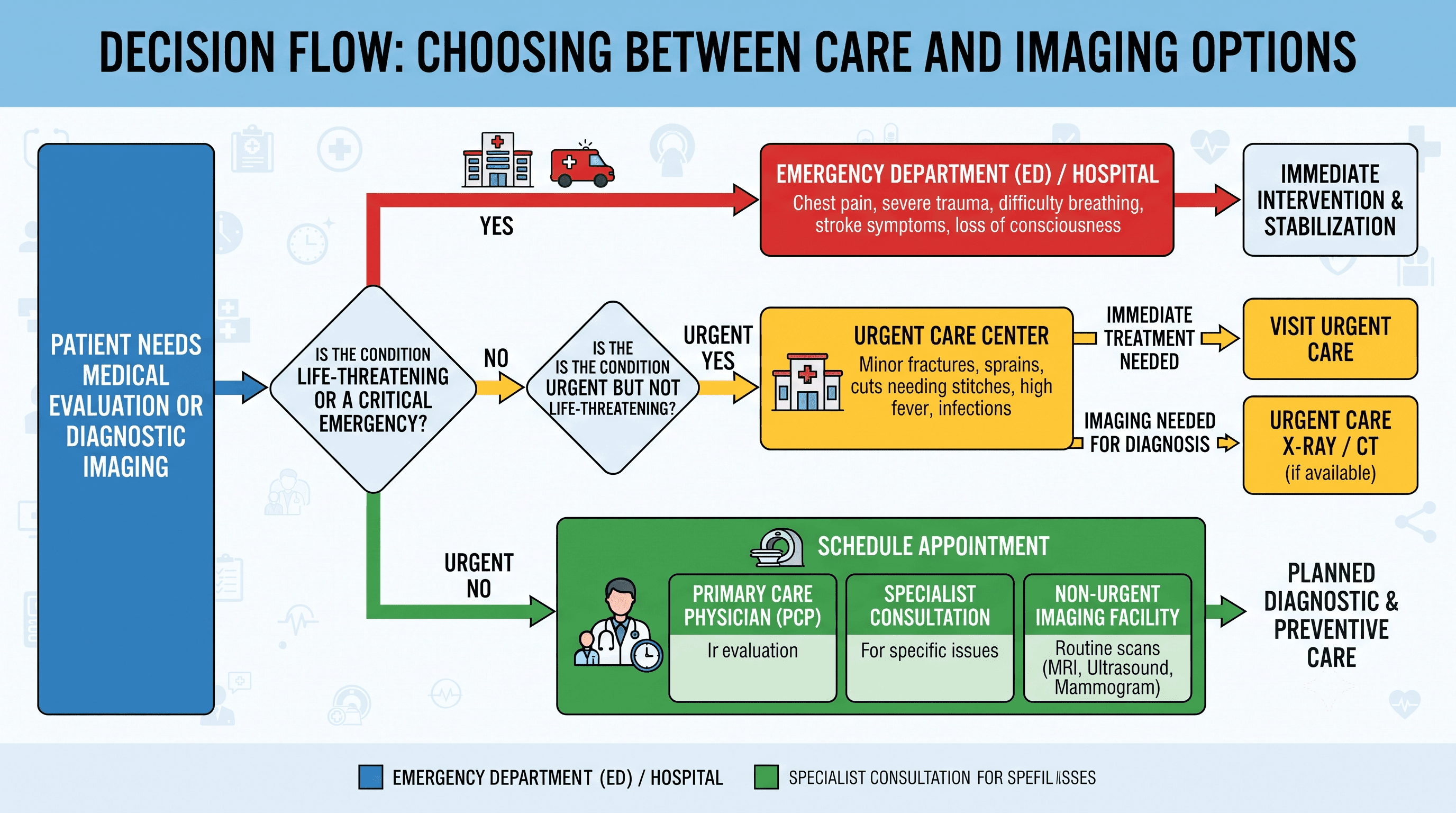
If you are experiencing symptoms that could indicate a medical emergency, cost comparison should wait. This includes chest pain, signs of stroke, difficulty breathing, severe bleeding, loss of consciousness, or a severe allergic reaction. In these situations, seek emergency care right away rather than researching pricing tools.
For non-emergency situations, comparing imaging costs before you schedule can meaningfully reduce what you pay, since prices for the same test can vary by thousands of dollars depending on where you go.
Is Imaging Always Necessary?
Not every symptom requires an MRI, CT scan, or X-ray. Doctors often start with the least invasive and least expensive option, such as an X-ray, and only order a CT or MRI if more detail is needed. Asking your doctor whether a lower-cost test could answer the same clinical question is a reasonable question to raise before scheduling.
This is also where physician-reviewed guidance can help. Momentary can help someone understand their symptoms and what type of care, including whether imaging, may be an appropriate next step, before they commit to scheduling and paying for a scan.
Frequently Asked Questions
How can I compare MRI prices near me? Start with a free tool like FAIR Health Consumer to see a typical price range in your zip code, then call independent imaging centers directly with the CPT code from your doctor to get an exact self-pay quote.
Why is a CT scan or MRI cheaper at an imaging center than a hospital? Hospitals add a facility fee on top of the scan itself, while independent imaging centers have lower overhead. The equipment and image quality are typically the same either way.
Can I get an X-ray without insurance? Yes. Many urgent care centers and imaging centers offer self-pay X-ray pricing that can be lower than the negotiated rate through insurance, especially if you have not met your deductible.
Does Momentary show exact imaging prices? Momentary helps users compare healthcare costs, including imaging, as part of a broader healthcare navigation platform. For an exact quote, contact the facility directly, since prices can change and vary by location.
Is it safe to choose the cheapest imaging center? Price is one factor, but not the only one. Confirm the facility is accredited and that a qualified radiologist will read your scan. The cheapest option is not always the best value if image quality is a concern.
What if I am not sure whether I need imaging at all? A healthcare professional can help you decide whether imaging is appropriate for your symptoms. A healthcare navigator such as Momentary can also help you understand your options before you schedule anything.


