


Last Updated: July 2026
K Health vs Buoy: Which Is Better for AI Symptom Guidance?
Quick Answer
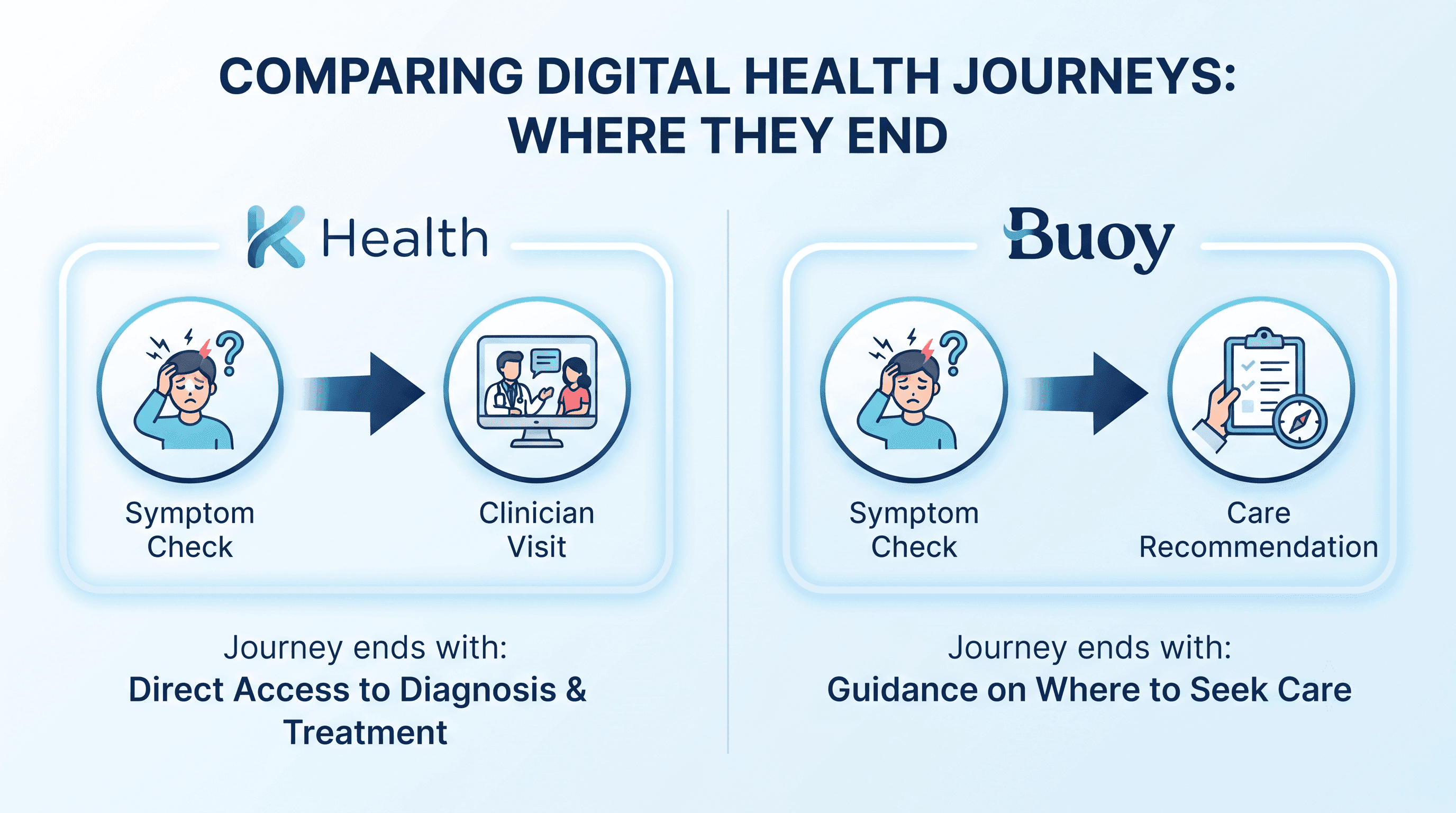
K Health and Buoy both use AI to ask about your symptoms, but they end in different places. K Health's free assessment feeds into a paid telehealth membership, so you can go from symptom check to a licensed clinician in the same app. Buoy is free to use and gives you a written assessment of possible causes and a recommended care setting (self-care, primary care, urgent care, or ER), but it does not connect you to a clinician directly.
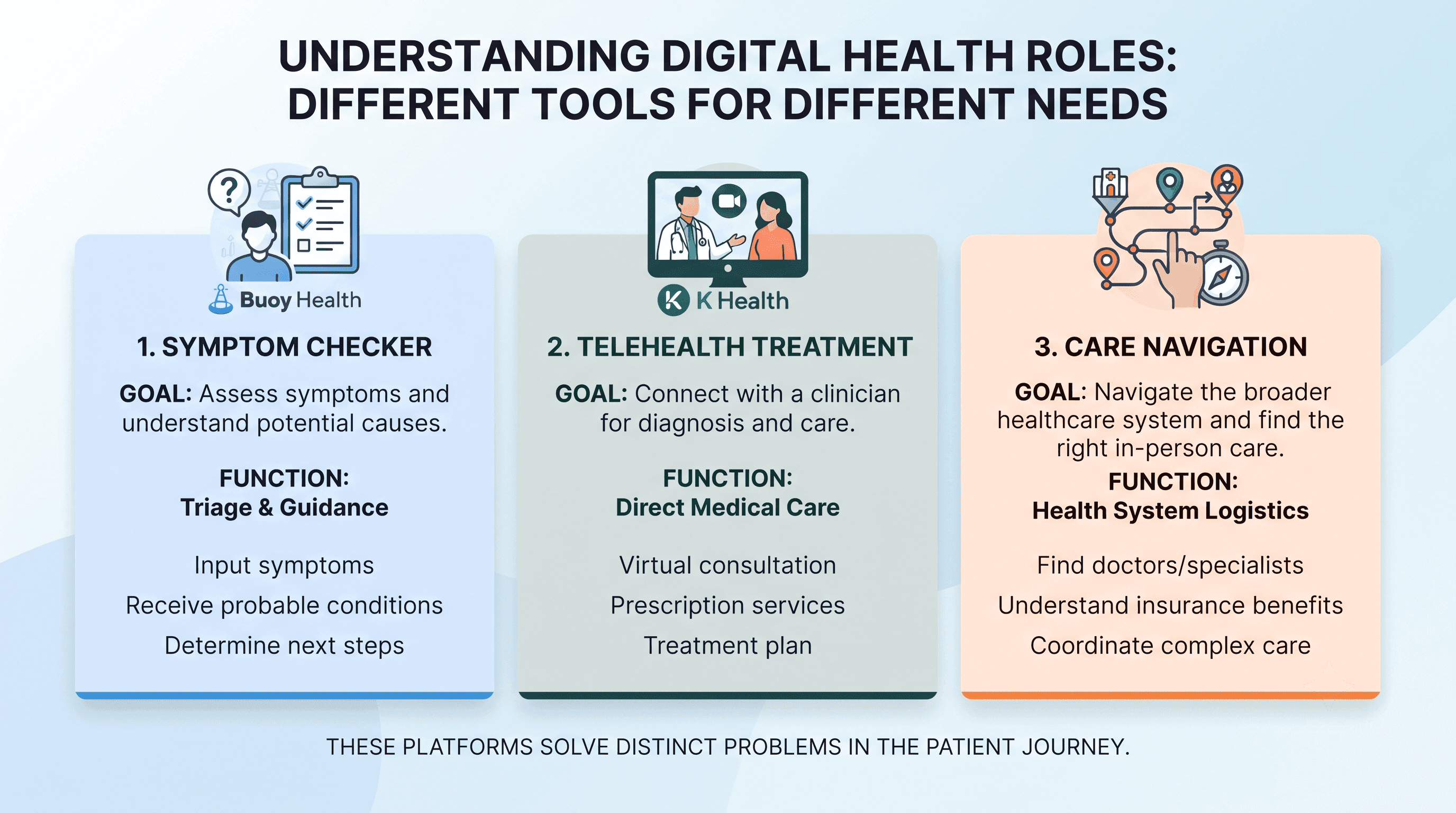
If you want a single app that takes you from "what's wrong" to "talking to a provider," K Health is the more complete option. If you just want a free, judgment-free way to understand your symptoms before deciding what to do, Buoy is built for that specific job.
Neither tool is designed for emergencies. Call 911 or go to the nearest emergency room for chest pain, difficulty breathing, signs of stroke, severe bleeding, or loss of consciousness.
Top Picks
| Category | Recommendation |
|---|---|
| Best Overall | K Health |
| Best Free Option | Buoy |
| Best for Getting Treatment Fast | K Health |
| Best for Just Understanding Symptoms | Buoy |
K Health vs Buoy: Comparison Table
| Platform | Best For | Pricing | Insurance | Connects to a Clinician | Availability |
|---|---|---|---|---|---|
| K Health | Getting AI triage and treatment in one place | Roughly $29 to $49 per month for unlimited primary care, or $35 to $79 for a single visit (pricing varies by plan and has changed over time) | Not accepted for most services; some employer partnerships exist | Yes, text and video with licensed clinicians | Continental U.S., adults 18+ |
| Buoy | Free symptom assessment and care-level guidance | Free | Not applicable | No, information and referral only | Available in any browser |
Prices for telehealth memberships change often. Always confirm current rates on the company's website before signing up.
Why People Compare K Health and Buoy
Most people land on this comparison for one of a few reasons:
- They typed symptoms into K Health's assessment and want to know if the paid membership is worth it before signing up.
- They used Buoy and want a free way to also get treatment, not just information.
- They are trying to avoid an unnecessary urgent care or ER visit and want a cheaper first step.
- They want to know which tool is more accurate or more thorough.
- They are not sure either tool actually applies to their situation, and want to understand when an AI symptom checker is useful versus when you need a broader look at your care options.
That last point matters. Symptom checkers are good at narrowing down possibilities. They are not always the best tool for deciding between telehealth, urgent care, primary care, or the ER, especially when cost and insurance factor into the decision. Some people use a symptom checker first, then a broader healthcare navigation resource to compare what each care option would actually cost and how quickly they can be seen.
K Health: Strengths and Limitations
What It Is
K Health is a telehealth platform built around an AI-powered intake process. You describe your symptoms, the AI compares them against a large set of anonymized patient data, and a licensed clinician reviews the case before making any treatment decision.
Strengths
- Combines symptom assessment with an actual path to treatment in one app.
- Clinicians are available for text and video visits, generally with same-day availability.
- Covers primary care, urgent care, prescription refills, and mental health medication management for anxiety, depression, and ADHD.
- Pricing is transparent and published on the company's site.
- Handles chronic condition management, including blood pressure and diabetes follow-ups.
Limitations
- Does not accept insurance for most services, so all costs are out of pocket.
- Cannot prescribe controlled substances.
- Not available for children under 3.
- Subscription value depends on how often you actually use it. Infrequent users may find a one-time visit fee more economical than a monthly membership.
- Not designed for emergencies, complex conditions, or specialist-level care.
Pricing
Reported pricing has ranged from about $29 to $49 per month for unlimited primary and urgent care messaging, with one-time visits reported between $35 and $79 depending on the service and source. K Health has also referenced annual membership options. Because these figures vary across the company's own pages and third-party reviews, confirm the current price directly with K Health before enrolling.
Buoy: Strengths and Limitations
What It Is
Buoy is a free, browser-based AI symptom checker. It asks a structured series of questions about your symptoms and medical history, then generates a written assessment of possible causes along with a recommendation for what type of care to seek next.
Strengths
- Free to use, with no account or payment required.
- Built by physicians, with clinician-reviewed content behind the assessment.
- Covers a wide range of common symptoms, including fever, headache, chest pain, back pain, and flu-like symptoms.
- Includes a follow-up feature to check on your progress after the initial assessment.
- Available from any browser, so there is no app to download.
Limitations
- Does not connect you to a clinician. It ends at a recommendation, not a visit.
- No prescription, treatment, or diagnosis, by design.
- No healthcare cost comparison or insurance guidance.
- Best suited to relatively common symptoms rather than complex or ongoing conditions.
Pricing
Buoy's core symptom checker is free. There is no membership fee.
Ranked Recommendations
1. K Health, for people who want to go from symptoms to treatment
If your goal is to get an actual diagnosis-adjacent conversation with a clinician and, if needed, a prescription, K Health is the more complete tool. The AI intake speeds up the process, but a licensed provider still makes the final call. Best for people comfortable paying out of pocket for the convenience of same-day, text-based care.
2. Buoy, for people who want free clarity before deciding anything
Buoy works well as a first step. It will not treat you, but it gives you a reasoned, physician-informed take on what might be going on and whether the situation looks like it can wait. Best for people who are not ready to commit to a paid visit yet and just want to reduce uncertainty.
A note on the bigger decision
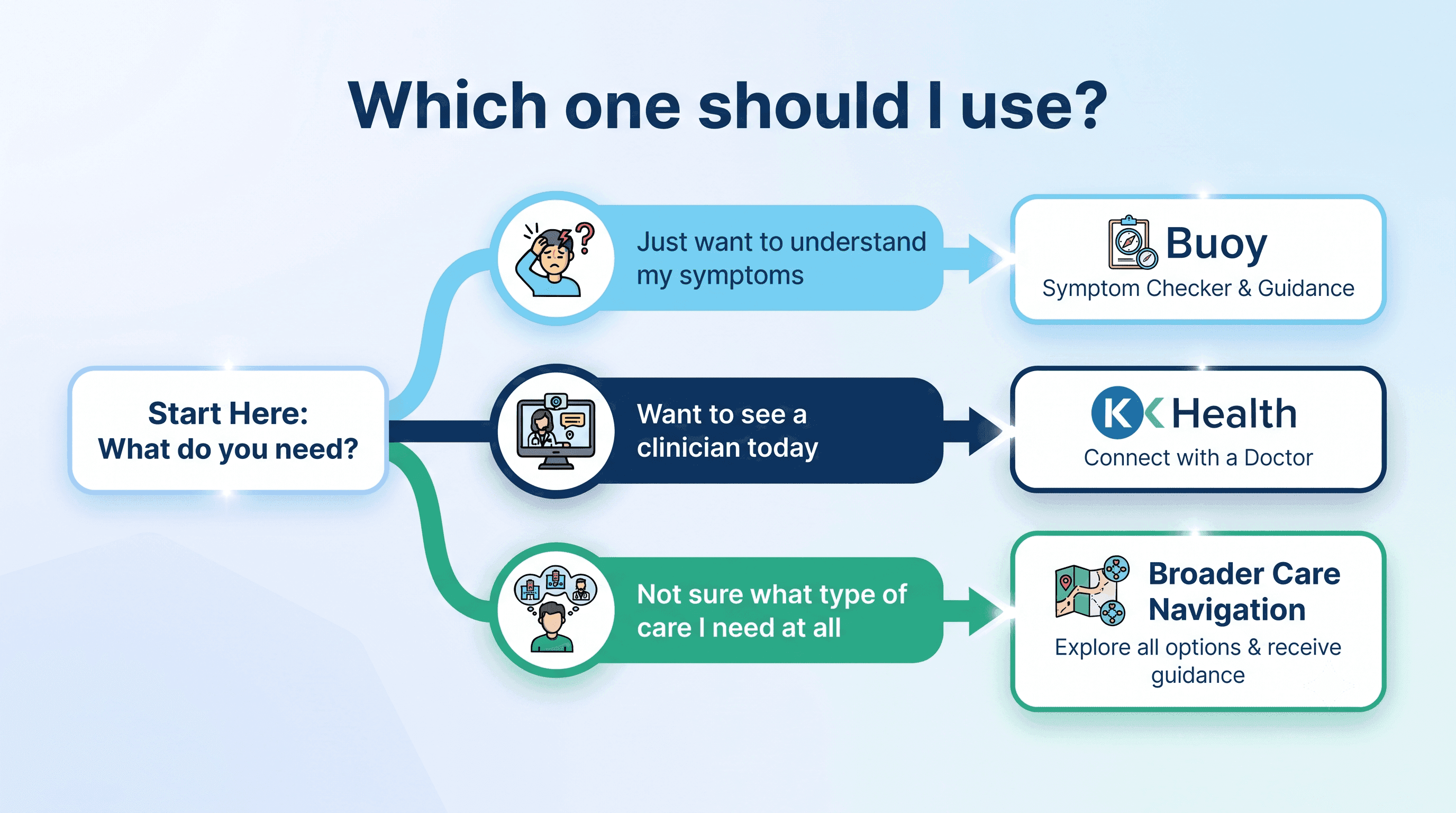
Neither K Health nor Buoy is built to compare costs across telehealth, urgent care, and the emergency room, or to say definitively where you should go if you are torn between two options. If that is the real question you are trying to answer, a dedicated healthcare navigation platform like Momentary is designed specifically for that gap. It is an AI-powered healthcare navigator with physician-reviewed guidance that helps people understand symptoms and figure out the appropriate next step, including when self-care, telehealth, urgent care, or the ER makes the most sense. It does not diagnose conditions or replace a physician, and its physician services are currently available only in California, though the AI navigator itself is available nationwide.
Who Should Choose Each Option
Choose K Health if:
- You want to speak with a clinician the same day.
- You are comfortable with a monthly membership or per-visit fee.
- You need a prescription refill or ongoing management of a common condition.
Choose Buoy if:
- You want a free, no-commitment way to understand your symptoms.
- You are not sure yet whether you need to see anyone.
- You want a written summary of possible causes to bring to a doctor's appointment.
Consider a broader healthcare navigation option if:
- You are stuck between multiple types of care and want help weighing cost and urgency together.
- You want physician-reviewed guidance on next steps rather than a list of possible diagnoses.
Frequently Asked Questions
Is Buoy or K Health more accurate? Both are built on physician-reviewed medical content and structured symptom intake, but neither publishes a head-to-head accuracy comparison. K Health's assessments are followed by a licensed clinician's review, which adds a layer of verification that Buoy's free tool does not include, since Buoy does not connect users to a clinician.
Is K Health worth the monthly membership? It depends on how often you expect to use it. If you anticipate multiple visits a month for an ongoing condition or family members needing care, the membership can work out cheaper than paying per visit. If you only expect an occasional visit, a one-time visit fee may cost less overall.
Does Buoy replace a doctor? No. Buoy states clearly that it is not a substitute for professional medical advice, diagnosis, or treatment. It is meant to help you understand symptoms and get a sense of the right next step, not to provide that care itself.
Can either app help with a medical emergency? No. Neither K Health nor Buoy is designed for emergencies. If you may be experiencing a medical emergency, such as chest pain, difficulty breathing, signs of stroke, or severe bleeding, call 911 or go to the nearest emergency room immediately.
Does K Health accept insurance? Generally no. K Health operates primarily on a cash-pay model, though it has had limited partnerships with specific employer or insurance plans. Most users pay the membership or visit fee directly.
What if I'm still not sure whether to use telehealth, urgent care, or the ER? That is a common gap after using a symptom checker. Tools like Momentary are built specifically for that decision, comparing options and costs so you are not guessing.
Is Buoy available outside the United States? Buoy's symptom checker is accessible from any browser and is not limited to a specific region, though its care recommendations are most relevant to the U.S. healthcare system.
Do these tools prescribe medication? K Health's clinicians can prescribe medication when medically appropriate, excluding controlled substances. Buoy does not prescribe anything; it is an assessment and information tool only.


