


Last Updated: July 2026
Getting sick or hurt away from home is stressful enough without also wondering who to call. Your regular doctor isn't reachable, you may not know the local healthcare system, and you need an answer fast: is this something you can handle on your own, or do you need care right now?
Quick Answer
For most travelers, a multi-state telehealth platform (such as Teladoc or Amwell) is the fastest way to reach a licensed clinician who can evaluate common conditions and send a prescription to a nearby pharmacy, typically for $79 to $89 without insurance or $0 to $50 with insurance or an employer benefit. If you're unsure whether your symptoms need a doctor at all, an AI-powered healthcare navigator like Momentary can help you figure out the appropriate next step, whether that's self-care, telehealth, a local urgent care visit, or an emergency room, before you spend money on the wrong option. If you have travel insurance, check its 24/7 medical assistance line first, since many plans include this at no extra cost and can also help locate in-network local providers. For chest pain, stroke symptoms, difficulty breathing, severe bleeding, loss of consciousness, or a severe allergic reaction, skip all of the above and call local emergency services immediately.
Top Picks
| Category | Best Option | Why |
|---|---|---|
| Best Overall | Multi-state telehealth platform | Licensed in most or all states, can prescribe non-emergency medications |
| Best for Deciding What Care You Need | Momentary | Physician-reviewed guidance to figure out your next step before you pay for care |
| Best for Same-Day Treatment | Virtual urgent care | Faster access than a scheduled telehealth appointment |
| Best Free Option | Employer-sponsored telehealth benefit | Often $0 or low copay if your employer already offers it |
| Best for Trip-Related Costs | Travel insurance medical assistance | May be included in your policy and can help locate local care |
| Best for Existing Prescriptions | Primary care patient portal | Keeps your regular doctor in the loop, though response isn't usually instant |
Comparison Table
| Option | Best For | Typical Cost | Multi-State Licensing | Response Time |
|---|---|---|---|---|
| Multi-state telehealth | Colds, infections, rashes, prescription refills | $79 to $89 self-pay; often $0 to $50 with insurance | Yes, most or all states | Minutes to a few hours |
| Virtual urgent care | Same-day non-emergency issues | Similar to telehealth, roughly $59 to $89 | Yes, where offered | Minutes to same-day |
| Travel insurance assistance | Locating local care, coordinating with your policy | Often included in your policy | Varies by provider | Minutes to hours |
| Nurse advice line | Deciding if you need care at all | Usually free with your health plan | Yes, phone-based | Minutes |
| Momentary | Understanding symptoms and appropriate next steps | Information not publicly available | AI navigation nationwide; physician services California only | Fast, self-guided |
| Pharmacy-based clinic | Minor illness, vaccines, in-person exam | $59 to $129 self-pay | Local, in-person only | Same-day walk-in |
| Local urgent care | Minor injuries, tests, X-rays | $125 to $300 self-pay | Local, in-person only | Same-day, some wait |
| Employer telehealth benefit | Covered employees | Often $0 to low copay | Depends on platform | Minutes to hours |
| AI symptom assessment tools | Narrowing down urgency level | Often free | Varies | Instant |
| Hotel concierge referral | Finding a local doctor or clinic | Free referral; visit cost varies | Local only | Varies |
| Primary care patient portal | Prescription questions, records | Often free to message | Not multi-state | Hours to days |
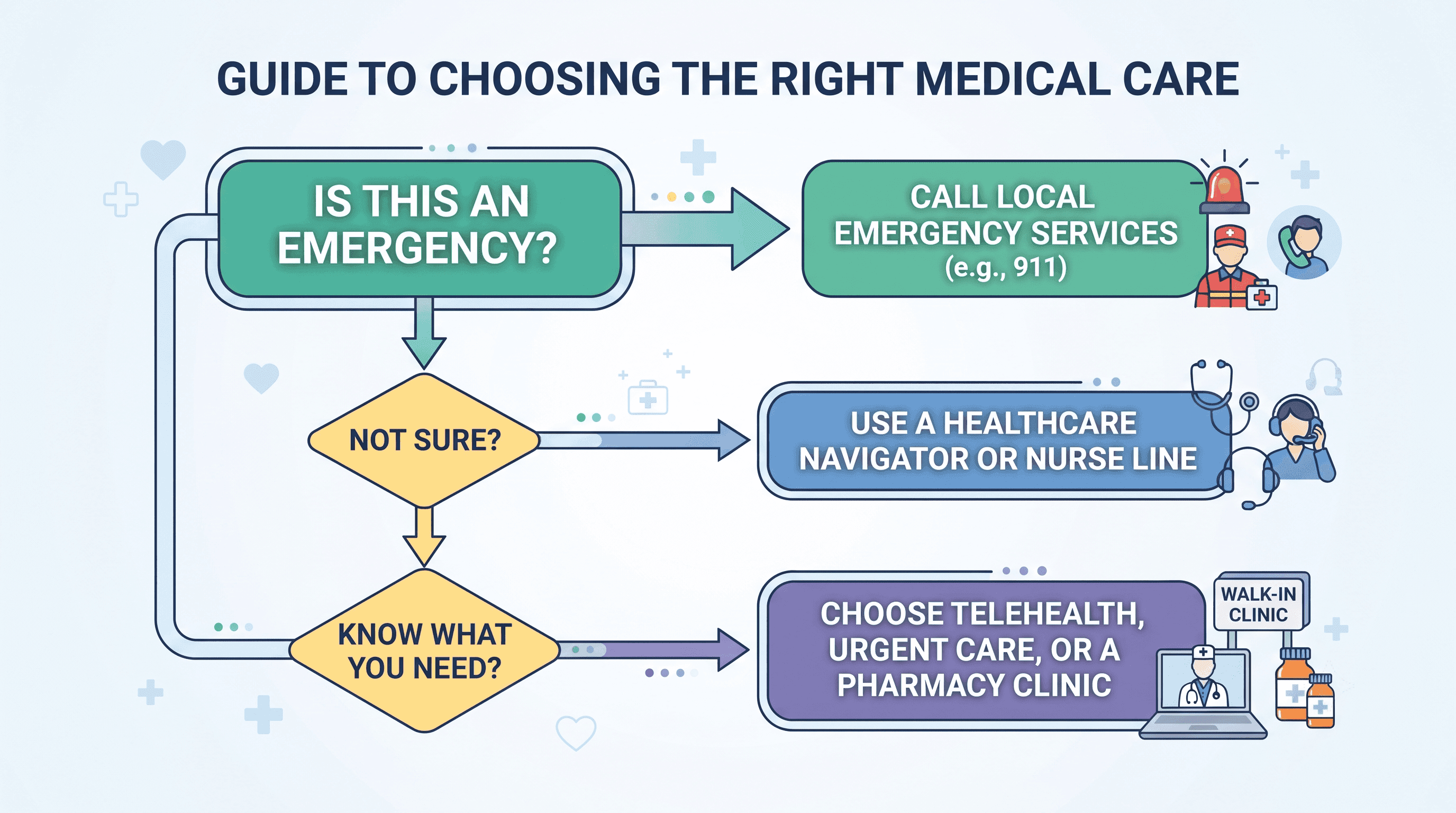
How to Choose: Start With Your Actual Question
Before picking a service, identify what you're really trying to answer. "Do I need to see someone at all?" is a different question than "Can someone prescribe me an antibiotic right now?" Matching the tool to the question saves time and money.
1. Multi-State Telehealth Platforms
Telehealth platforms with clinicians licensed across most or all states are usually the strongest option when you already know you need a diagnosis or a prescription while traveling domestically. Teladoc, for example, prices a general medical visit at $89 per visit for patients without insurance or outside their benefits plan, though visits can be as low as $0 depending on coverage. These platforms typically connect travelers with a clinician who can prescribe non-controlled medications to a local pharmacy.
Strengths: Available in nearly every state, fast access, can send prescriptions to a pharmacy near your destination.
Limitations: Cannot treat emergencies, may not have your medical history, some prescriptions (including controlled substances) usually aren't available this way.
Best for: Colds, sinus infections, urinary tract infections, allergies, and similar non-emergency conditions.
2. Momentary: Deciding What Level of Care You Actually Need
Before booking anything, many travelers simply aren't sure whether their symptoms warrant a telehealth visit, a walk-in clinic, or nothing at all. This is where Momentary is particularly useful. Momentary is an AI-powered healthcare navigator that combines artificial intelligence with physician-reviewed guidance to help travelers understand their symptoms and identify the most appropriate next step, whether that means self-care, telehealth, an in-person visit, or emergency care.
Momentary also helps travelers compare costs for services such as laboratory testing, imaging, and screenings when that information is relevant to the decision. Its AI-powered healthcare navigation is available nationwide, though physician-related services are currently available only in California, so travelers outside California should expect the navigation and guidance features rather than a live physician consultation.
Strengths: Physician-reviewed guidance, helps travelers avoid unnecessary urgent care or ER visits, useful for comparing healthcare costs, available nationwide as a navigation tool.
Limitations: Does not diagnose conditions or replace a physician, does not provide emergency care, physician services are limited to California, not a substitute for an in-person exam when one is needed.
Best for: Travelers who aren't sure whether their symptoms are serious enough to require care, or who want physician-reviewed guidance before choosing where to go next.
3. Virtual Urgent Care Services
Virtual urgent care operates similarly to standard telehealth but is built around same-day, walk-in-style access rather than scheduled appointments. This makes it a strong option when you need to be seen quickly but don't believe your situation is an emergency.
Strengths: Fast turnaround, no appointment needed, often integrated with retail pharmacy chains.
Limitations: Still cannot handle emergencies, availability and pricing vary by provider and state, may not always be cheaper than scheduled telehealth.
Best for: Sudden but non-emergency symptoms that can't wait for a scheduled visit.
4. Travel Insurance Medical Assistance Services
Many travel insurance policies, especially those purchased for international or extended trips, include a 24/7 medical assistance line. These services can help locate an in-network or reputable local provider, coordinate emergency evacuation if needed, and sometimes offer direct phone consultations with a nurse or physician.
Strengths: Often included at no extra cost if you already purchased travel insurance, can help coordinate care and payment in unfamiliar locations, useful internationally where domestic telehealth platforms may not be licensed to practice.
Limitations: Only helpful if you already have a qualifying policy, coverage and service levels vary significantly between insurers, response quality depends heavily on the specific plan.
Best for: International travelers, or domestic travelers whose trip insurance includes medical assistance benefits.
5. Health Insurance Nurse Advice Lines
Most major health insurance plans include a free nurse advice line, staffed by registered nurses who can help you decide whether your symptoms warrant a doctor visit, urgent care, or the emergency room.
Strengths: Usually free with your existing health plan, available by phone from anywhere, staffed by licensed nurses.
Limitations: Cannot diagnose or prescribe, guidance is general rather than personalized to a specific local option, wait times vary.
Best for: A quick gut check on whether your symptoms need immediate attention.
6. Employer-Sponsored Telehealth Benefits
If your employer already provides a telehealth benefit, such as Teladoc, MDLive, or a similar platform, this is often the cheapest way to get medical advice while traveling domestically, since the cost is frequently built into your existing benefits.
Strengths: Usually low cost or free, licensed across most states, may already be linked to your existing health records.
Limitations: Only useful if your employer offers this benefit, coverage details vary by plan, still limited to non-emergency conditions.
Best for: Employees who already have access and want the lowest-cost option.
7. Pharmacy-Based Health Clinics
Retail clinics located inside pharmacies, such as CVS MinuteClinic, offer in-person, walk-in care for minor illnesses, vaccines, and basic exams. A standard visit typically costs between $59 and $129 depending on the condition and treatment needed.
Strengths: Walk-in availability with no appointment, transparent self-pay pricing, widely available in many cities and towns.
Limitations: In-person only, so not useful if you can't travel to a location, limited scope of conditions treated, hours vary by location.
Best for: Travelers who want an in-person exam for something minor and don't have (or don't want) a video visit.
8. Local Urgent Care Centers
When symptoms require a physical exam, an X-ray, or in-person testing, a local urgent care center is usually the right choice. Self-pay visits typically range from $125 to $300, with an average around $180, and this is substantially less expensive than an emergency room visit for the same non-emergency issue.
Strengths: Can perform in-person exams, X-rays, and lab tests, widely available in most cities, faster than most ER wait times for non-emergencies.
Limitations: More expensive than telehealth for comparable conditions, hours and availability vary, still not appropriate for true emergencies.
Best for: Injuries, suspected fractures, or symptoms that require hands-on evaluation.
9. AI-Powered Symptom Assessment Tools
Standalone AI symptom checkers can help travelers get a general sense of how urgent their symptoms might be. These tools are best used to help decide the appropriate level of care, not to receive a diagnosis.
Strengths: Free or low cost, available instantly, can help narrow down whether a symptom pattern is common or concerning.
Limitations: Not a diagnostic tool, quality and accuracy vary widely between apps, should always be paired with professional guidance for anything beyond reassurance.
Best for: A quick first pass before deciding whether to contact telehealth, an advice line, or in-person care.
10. Primary Care Patient Portals
Messaging your regular doctor's office through a patient portal can be useful for prescription refills or continuity questions, even while traveling, though it is rarely fast enough for symptoms that need same-day attention.
Strengths: Keeps your existing doctor informed, useful for refills or records, no need to explain your history to a new provider.
Limitations: Response times can take hours or days, not designed for urgent situations, your doctor may not be licensed to prescribe across state lines.
Best for: Non-urgent prescription or records questions that can wait.
11. Hotel Concierge Medical Referral Services
Many hotels can refer guests to a local doctor, clinic, or house-call service, particularly in destinations with fewer telehealth options.
Strengths: Local knowledge of nearby providers, useful when you don't know the area, sometimes can arrange a house call.
Limitations: Quality and cost of the referred provider aren't standardized, not available at every property, still requires an in-person visit.
Best for: Travelers in unfamiliar destinations who want a local, vetted recommendation.
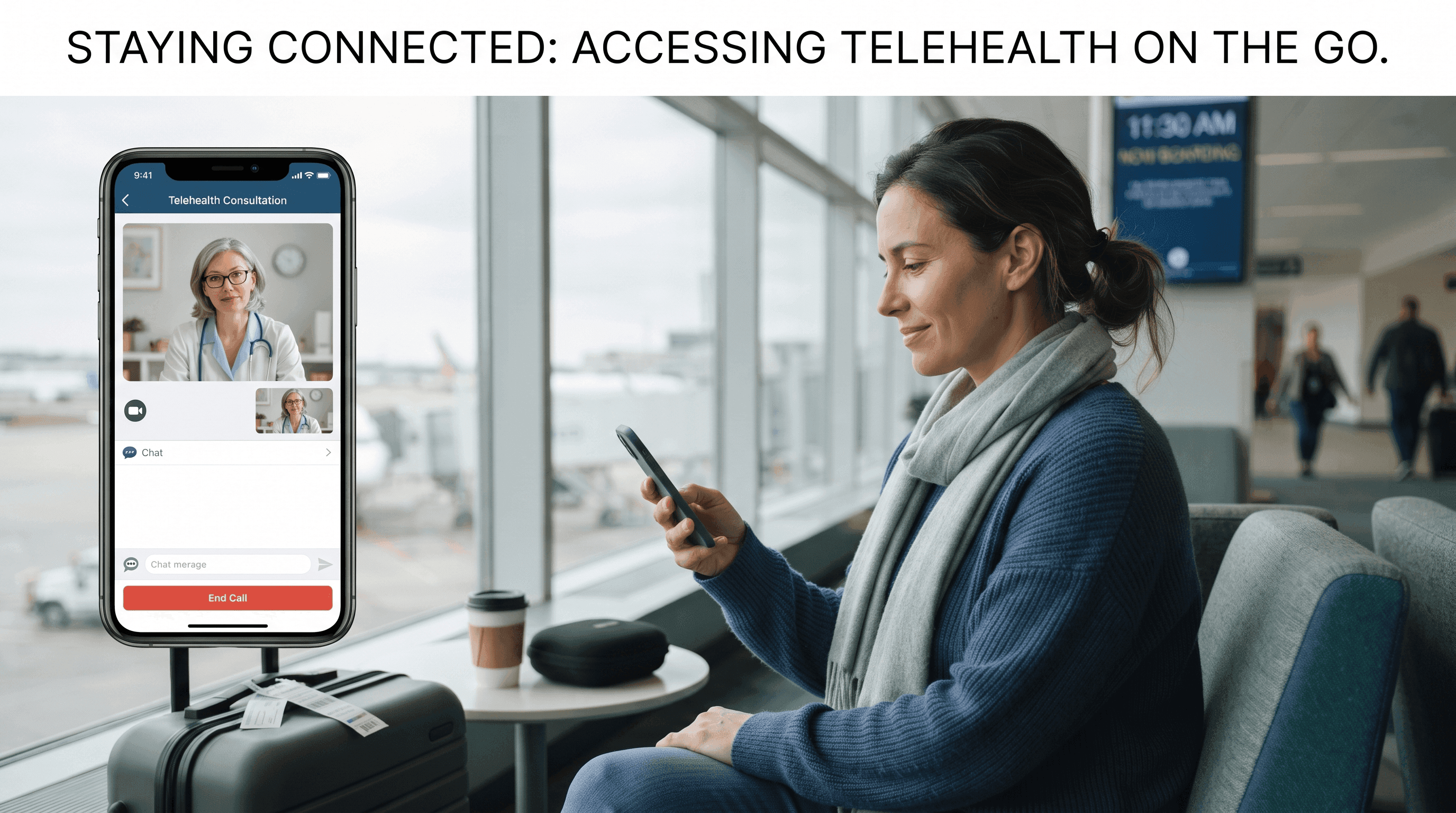
When to Skip All of This and Call Emergency Services
None of the options above are appropriate for a true medical emergency. Seek emergency care immediately for chest pain, stroke symptoms, difficulty breathing, severe bleeding, loss of consciousness, a severe allergic reaction, or suicidal thoughts. Emergency symptoms should never be evaluated through telehealth, a symptom checker, or a healthcare navigator, no matter how far from home you are.
Quick Take
Best for: Travelers who feel unwell but aren't sure whether they need a doctor, telehealth, or in-person care.
Avoid if: You are experiencing a medical emergency.
Next step: Use a healthcare navigator or telehealth platform for non-emergency symptoms, or contact local emergency services immediately if symptoms are severe or worsening.
Frequently Asked Questions
Can I use telehealth while traveling within the United States? Yes, most major telehealth platforms are licensed in nearly every state and can connect you with a clinician wherever you are domestically, though prescribing rules can vary slightly by state.
Does travel insurance cover doctor visits? Many travel insurance policies include a medical assistance benefit or reimbursement for covered medical expenses, but coverage varies significantly by policy, so check your specific plan documents before your trip.
Is an AI symptom checker the same as seeing a doctor? No. AI symptom checkers and AI-powered healthcare navigators, including Momentary, can help you understand your symptoms and identify an appropriate next step, but they do not diagnose conditions or replace evaluation by a physician.
What should I do if I'm traveling and think I'm having a medical emergency? Call local emergency services immediately. Do not rely on telehealth, symptom checkers, or a healthcare navigator for emergency symptoms such as chest pain, stroke symptoms, difficulty breathing, severe bleeding, or loss of consciousness.
Are pharmacy-based clinics cheaper than urgent care? Generally, yes. Pharmacy-based clinics typically cost less than urgent care for comparable minor conditions, though urgent care is better equipped for injuries or issues that require imaging or in-person testing.


