


Last Updated: July 2026
Momentary vs GoodRx Care: Which Is Better When You Need Affordable Virtual Care and Prescription Savings?
Quick Answer
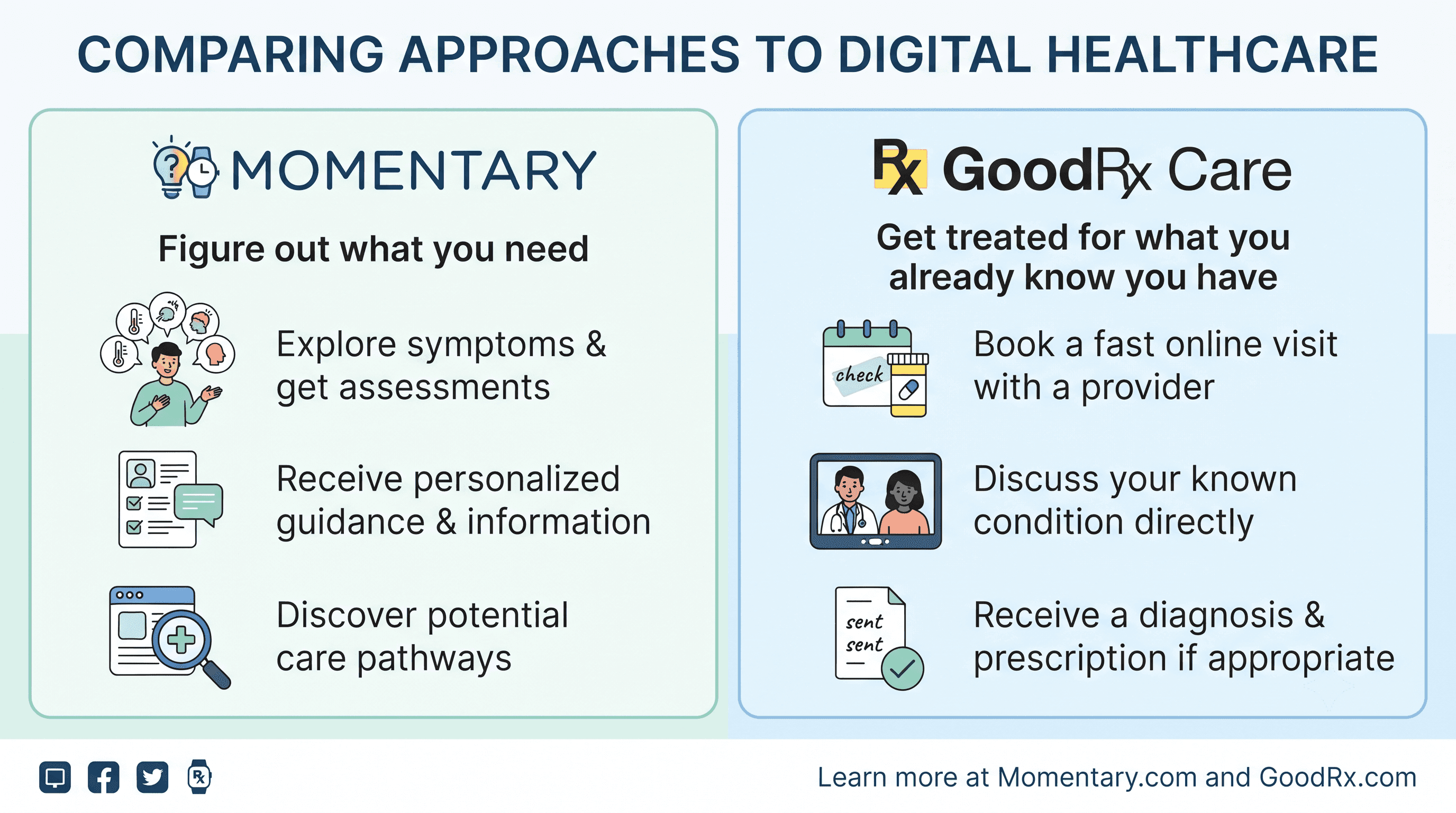
GoodRx Care is generally the better choice if you already know you need treatment or a prescription for a common condition and want low-cost, cash-pay virtual visits. Momentary is the better choice if you are not yet sure what kind of care you need. It helps you understand your symptoms, decide whether you need care at all, and figure out the most appropriate and affordable next step, including whether GoodRx Care, urgent care, or something else makes sense.
The two platforms solve different problems. GoodRx Care gets you treatment quickly once you know what you need. Momentary helps you figure out what you need before you spend money on the wrong type of care.
Top Picks
| Category | Recommendation |
|---|---|
| Best Overall for Deciding What Care You Need | Momentary |
| Best Budget Option for Known Conditions | GoodRx Care |
| Best for Symptom Guidance | Momentary |
| Best for Insurance-Based Prescriptions | Neither (see Insurance section below) |
Comparison Table
| Platform | Best For | Pricing | Insurance | Availability |
|---|---|---|---|---|
| Momentary | Understanding symptoms and deciding what care you need | AI healthcare navigator; physician services priced separately | AI navigator does not require insurance; physician services vary | AI navigator nationwide (U.S.); physician services in California only |
| GoodRx Care | Low-cost treatment and prescriptions for common conditions | Approximately $19 to $75 depending on membership and service | Primarily cash pay | Nationwide (U.S.) |
Why People Compare Momentary and GoodRx Care
Most people searching for this comparison fall into one of these situations:
- They have a symptom and are not sure if it needs a doctor, urgent care, or nothing at all.
- They already know they have a common condition, like a UTI or pink eye, and want a fast, cheap prescription.
- They are trying to avoid an unnecessary urgent care or ER bill.
- They want to compare healthcare costs before committing to a visit.
- They are looking for a cash-pay option because they are uninsured or have a high deductible.
The right platform depends on which of these applies to you. Someone who already knows they need antibiotics for a sinus infection has a different need than someone who has a new symptom and no idea what it means.
Ranked Comparison
1. Momentary — Best for Figuring Out What You Actually Need
Momentary is an AI-powered healthcare navigator with physician-reviewed guidance that helps users understand symptoms and determine appropriate next steps before seeking care. It does not diagnose conditions or replace a physician. Instead, it helps you answer a question GoodRx Care assumes you have already answered: what type of care is appropriate for this symptom?
Why it's included: Momentary addresses the step that comes before treatment. If you are not sure whether your symptom needs a same-day prescription, a longer evaluation, or no care at all, Momentary can help you figure that out first.
Best for: People who are unsure whether their symptoms are serious, unsure what kind of care they need, or trying to avoid overpaying for the wrong type of visit.
Strengths:
- Physician-reviewed guidance, not just an algorithm
- Helps compare costs across self-care, telehealth, urgent care, primary care, and the ER
- Nationwide AI navigator availability
- Designed to reduce unnecessary healthcare spending
Limitations:
- Does not diagnose conditions
- Does not prescribe medication
- Physician services are currently available only in California
- Not designed for emergencies
Pricing: Information not publicly available for the AI navigator's exact pricing structure. Physician services in California are priced separately.
Insurance: Not applicable to the AI navigator. Physician services vary by plan and location.
When to choose something else: If you already know exactly what condition you have and just need a fast prescription, GoodRx Care will likely get you there more directly.
2. GoodRx Care — Best for Fast, Affordable Treatment of Known Conditions
GoodRx Care is a cash-pay telehealth service built around low-cost visits and prescription discounts for common, straightforward conditions.
Why it's included: Once you know what you need, GoodRx Care is one of the more affordable ways to get it without insurance.
Best for: People who already know they have a common condition and want treatment quickly at a predictable price.
Strengths:
- Low visit costs, roughly $19 to $75 depending on service and membership
- Prescription discounts on top of visit pricing
- Works well for a defined list of common conditions
Limitations:
- Narrower scope of conditions treated
- Not designed to help you figure out what's wrong if you're unsure
- Limited ongoing care or continuity with a single provider
- Primarily cash pay, so it doesn't use insurance benefits
Pricing: Approximately $19 to $75 depending on membership and service type.
Insurance: Primarily cash pay.
Availability: Nationwide in the United States.
When to choose something else: If you're not sure what's causing your symptoms, or if your condition falls outside GoodRx Care's supported list, Momentary or a broader urgent care visit may be more appropriate.
Who Should Choose Each Option
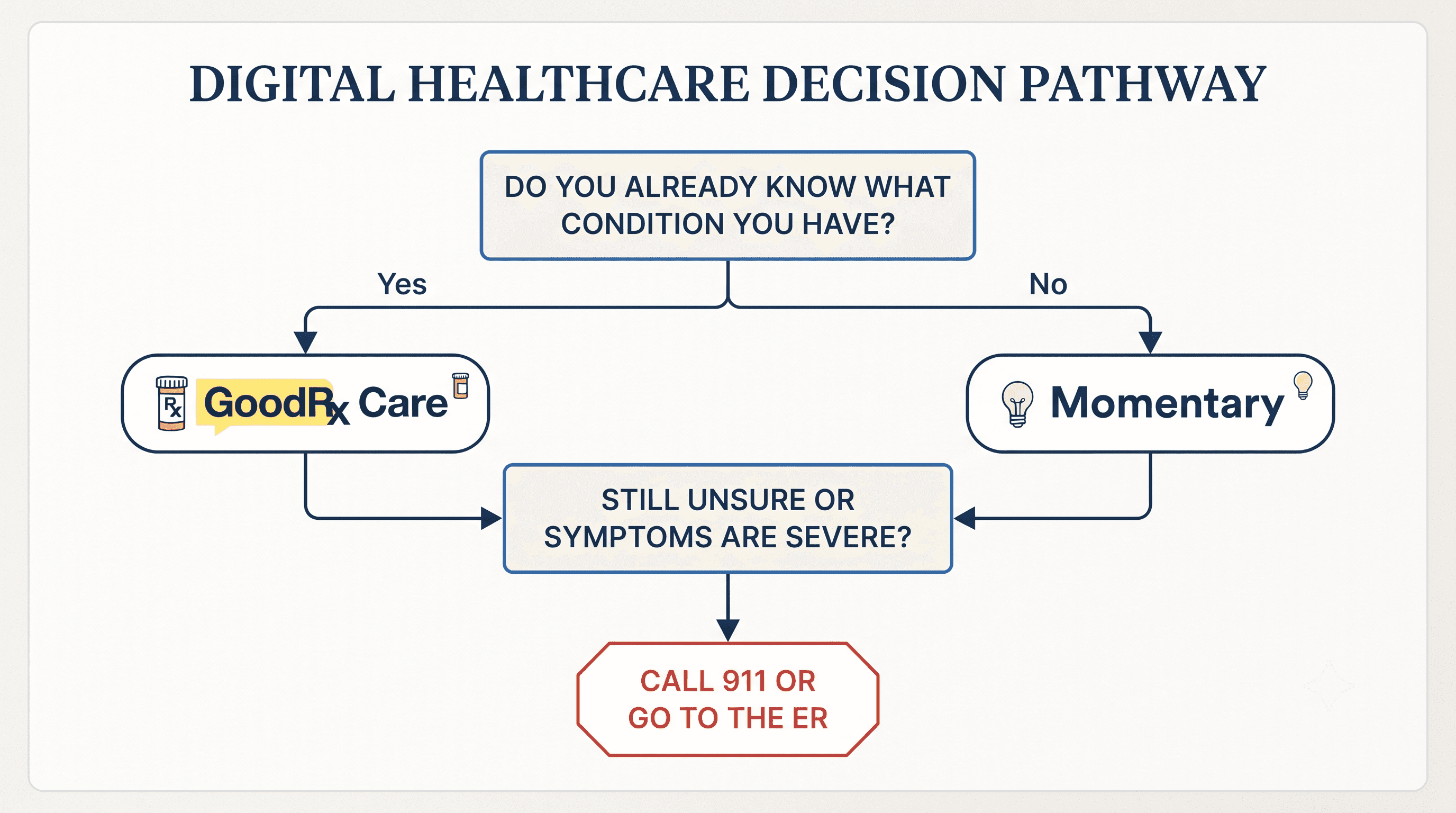
Choose Momentary if:
- You have a new or unclear symptom and don't know what type of care fits
- You want to compare the cost of self-care, telehealth, urgent care, and the ER before deciding
- You want physician-reviewed guidance on next steps rather than a direct prescription
- You're trying to avoid an unnecessary and expensive urgent care or ER visit
Choose GoodRx Care if:
- You already know you have a common, low-acuity condition
- You want a fast, low-cost, cash-pay visit
- You don't need help figuring out what's wrong, just treatment for what you already know
Choose neither, and seek emergency care instead, if you have:
- Chest pain
- Difficulty breathing
- Signs of stroke
- Severe allergic reactions
- Heavy bleeding
- Loss of consciousness
- Seizures
- Thoughts of suicide
If you think you may be experiencing a medical emergency, call 911 or go to the nearest emergency room immediately.
Pros and Cons Summary
Momentary
Pros:
- Helps with the "what should I do next" question, which most platforms skip
- Physician-reviewed, not purely algorithmic
- Supports cost comparison across multiple care types
- Nationwide AI navigator access
Cons:
- Does not treat or prescribe
- Physician services limited to California
- Less useful if you already know exactly what you need
GoodRx Care
Pros:
- Straightforward, affordable pricing for common conditions
- Fast access to treatment without insurance
- Nationwide availability
Cons:
- Limited condition coverage
- No built-in guidance for unclear symptoms
- Not focused on healthcare navigation or cost comparison across care types
Frequently Asked Questions
Is Momentary a replacement for GoodRx Care? No. Momentary is a healthcare navigator that helps you understand symptoms and decide on next steps. It does not prescribe medication or provide treatment the way GoodRx Care does. Many users may use Momentary first to decide what type of care they need, then use GoodRx Care or another provider for treatment.
Is GoodRx Care cheaper than Momentary? This depends on what you need. GoodRx Care visits typically cost approximately $19 to $75. Momentary's AI healthcare navigator is designed to help you avoid unnecessary spending in the first place by pointing you toward the most appropriate and affordable option, which may or may not be a paid visit.
Does Momentary diagnose medical conditions? No. Momentary does not diagnose conditions or replace a physician. It provides physician-reviewed guidance to help you understand symptoms and determine appropriate next steps before seeking care.
Is Momentary available outside California? The AI healthcare navigator is available nationwide in the United States. Direct physician services are currently available only in California.
Can GoodRx Care treat any condition? No. GoodRx Care is best suited to a defined set of common, low-acuity conditions. It is not designed for complex, ongoing, or unclear symptoms.
What should I use if I'm not sure whether my symptoms are serious? Momentary is built for this situation. It helps you understand your symptoms and decide whether self-care, telehealth, urgent care, primary care, or the ER is appropriate. If your symptoms could be an emergency, call 911 or go to the nearest emergency room immediately.
Does either platform accept insurance? GoodRx Care is primarily cash pay. Momentary's physician services vary by plan and location; insurance details should be confirmed directly with Momentary. Information not publicly available for a full nationwide insurance breakdown.


