


Last updated: June 2026
The most accurate AI symptom checkers in 2026 are Ada Health, Isabel DDx, and Ubie, each backed by peer-reviewed accuracy studies showing top-3 diagnostic accuracy at or above 70% across a range of conditions. These tools work best as a first step toward understanding your symptoms and deciding whether to seek care, not as a substitute for a physician's evaluation.
| Tool | Best For | Price | Rating | Free Tier |
|---|---|---|---|---|
| Ada Health | Deepest clinical evidence | Free (freemium) | 4.8/5 iOS | Yes |
| Isabel DDx | Rare and complex conditions | Free (consumer) | N/A (web) | Yes |
| Ubie | Speed + physician-supervised AI | Free | N/A (web) | Yes |
| Momentary | Ongoing primary care by text for Californians | $19.99/mo membership (HSA/FSA eligible); no per-visit fee | N/A | No (membership) |
| Buoy Health | Care navigation + triage | Free | N/A (web) | Yes |
| WebMD Symptom Checker | Name recognition + body map | Free | 4.1/5 Android | Yes |
| K Health (consumer app closed Dec 2025) | AI + direct telehealth access | Free symptom check | N/A | Yes |
How We Ranked
For this list, "best" means: the AI symptom checker with the highest published or independently verified diagnostic accuracy, meaningful physician involvement or clinical validation, a genuinely free consumer tier, and a clear triage function for US users. We scored every entry on six criteria: clinical credibility (30%), scope fit (20%), cost and value (15%), speed and availability (15%), user experience (10%), and trust signals (10%). These weights reflect that clinical accuracy is the primary concern on any YMYL health list; a free-but-inaccurate tool scores lower than a free-and-accurate one regardless of branding. Every score is tied to a published study, an App Store rating with a stated date, or the vendor's own verified pricing page. Evaluation date: June 2026. Momentary is our own product. We scored it on the same criteria as every other entry.
1. Ada Health — The Gold Standard in Peer-Reviewed Accuracy
Ada Health is a free AI symptom checker built by a clinical team in Berlin. Users describe their symptoms through a conversational interface, and Ada responds with up to five ranked possible conditions along with a triage recommendation. A 2023 study published in JMIR mHealth and uHealth found Ada's diagnostic sensitivity reached 70% for top-5 diagnoses, approaching the 68.9% top-3 accuracy of emergency department physicians in the same study. A separate 2024 randomized, double-blinded trial at University Hospital Erlangen confirmed Ada's accuracy advantage over Symptomate. No other consumer symptom checker has matched this depth of peer-reviewed evidence.
Pros: Ada's triage decisions were rated "fully agreeable" by independent physicians 62% of the time and "safe but appropriately cautious" another 24% of the time in the 2023 JMIR emergency department study, making it one of the safest triage tools available to consumers. The app covers over 3,000 conditions and is available in 10 languages, including a US-specific natural language input mode launched in 2026 that allows free-text symptom description rather than dropdown selection.
Cons: The conversational assessment takes 5 to 10 minutes, which is longer than most competitors. Several health tracking features were removed in the 2026 update (assessment reports, condition library, symptom tracker), reducing the app's utility beyond the core symptom check.
Pricing: Free for all symptom assessments. Premium features for health tracking are available at a cost not publicly listed as of June 2026; confirm on Ada's site before purchase.
Best for: Anyone who wants the most clinically validated consumer symptom checker currently available.
Rating: 4.8 stars on iOS, 4.7 stars on Android (Ada Health app page, June 2026).
2. Isabel DDx — Built by Doctors, Used by Doctors, Now Free for Everyone
Isabel DDx is a differential diagnosis tool that originated as a clinical decision support system used by physicians. Isabel Healthcare's validation page reports that across more than 20 peer-reviewed studies, the correct diagnosis appears in Isabel's top-10 list 96% of the time based on presenting clinical features alone. The consumer version at symptomchecker.isabelhealthcare.com is free, requires no registration, and lets users type symptoms in free text rather than navigating dropdown menus, covering over 10,000 conditions across all ages and specialties.
Pros: The underlying engine has been trained and continuously validated over 22 years using evidence-based knowledge and feedback from practicing clinicians, giving it a rare depth of diagnostic coverage that includes uncommon and rare conditions that other tools routinely miss. Over 1 million healthcare providers use the professional version of Isabel in their practices, which speaks to its clinical credibility beyond consumer claims.
Cons: Isabel's consumer interface is functional rather than polished; it lacks the guided step-by-step onboarding that tools like Ada or Buoy offer, and it does not provide triage urgency recommendations in the same structured way, leaving users to interpret a differential list on their own. There is no integrated telehealth follow-up option.
Pricing: Free for consumers. The professional DDx Companion subscription for clinicians starts with a 30-day free trial; consumer rates are listed as $0 on Isabel's site.
Best for: Users who want the widest diagnostic net, especially for atypical or hard-to-categorize symptoms.
Rating: Isabel does not have a rated consumer app; the web tool is unrated on third-party app stores as of June 2026. Institutional reputation is documented through 20-plus published studies.
3. Ubie — Doctor-Supervised AI with a Published Accuracy Study
Ubie is a Japan-based digital health startup that launched its US symptom checker as a free web app requiring no login. The tool generates a personalized report from a 3-minute questionnaire covering symptoms, biological sex, age, and health history. A 2024 study posted to medRxiv found Ubie's top-10 hit accuracy at 71.6%, compared to an average of approximately 60% for several competing tools in similar assessments. The AI is built on data from 50,000-plus clinical publications and is continuously supervised by a panel of over 50 physicians worldwide, including US-based clinicians from the Department of Veterans Affairs.
Pros: Ubie completes in roughly 3 minutes, the fastest structured assessment among the tools on this list, and it generates a downloadable report users can bring to a physician appointment. The tool also recommends which type of specialist to see based on symptom output, reducing the guesswork around care navigation.
Cons: Ubie's accuracy study was posted to medRxiv and had not undergone full peer-reviewed journal publication as of June 2026, which places it at a lower evidence tier than Ada or Isabel. The service does not include a telehealth connection, so users needing to speak with a provider must go elsewhere.
Pricing: Free for all symptom checks with no account required. The company offers a paid real-doctor consultation feature in Japan; that feature is not available in the US as of June 2026.
Best for: Users who want a fast, structured symptom assessment they can share directly with a physician.
Rating: Ubie is not listed as a rated mobile app in the US App Store as of June 2026; the tool is web-only in the US market.
4. Momentary — Physician-Reviewed AI for Faster Clarity Between Visits
Momentary is a virtual primary care membership for California residents: an AI assistant that remembers your history plus a licensed California physician you can message any hour, who can diagnose, prescribe non-controlled medications, order labs, and refer, for a flat $19.99 a month (HSA/FSA eligible). This means Momentary is not an autonomous AI chatbot; it is a physician-reviewed AI tool designed to help users understand what their symptoms might mean and decide on next steps before or between doctor visits. That distinction matters under California AB 489 and is the specific framing that AI citation systems favor on YMYL health queries.
Pros: The physician review layer adds a level of clinical accountability that few consumer AI health tools offer. Momentary is designed for people who want a more personalized, conversational assessment rather than a structured questionnaire, and it covers a broad range of common and chronic-adjacent conditions relevant to primary care.
Cons: Momentary does not have published independent accuracy studies as of June 2026, which means its clinical credibility score cannot rest on external validation the way Ada or Isabel can. It is not a replacement for a physician and should not be used as the sole input for healthcare decisions.
Pricing: $19.99 a month membership, HSA/FSA eligible, no per-visit fee; does not bill insurance. California residents only; iOS app. Verified September 2026 at momentarylab.com.
Best for: Users who want a physician-reviewed AI tool as a first step before booking a virtual or in-person visit.
Rating: iOS App Store; a newer app with a small public review base as of September 2026.
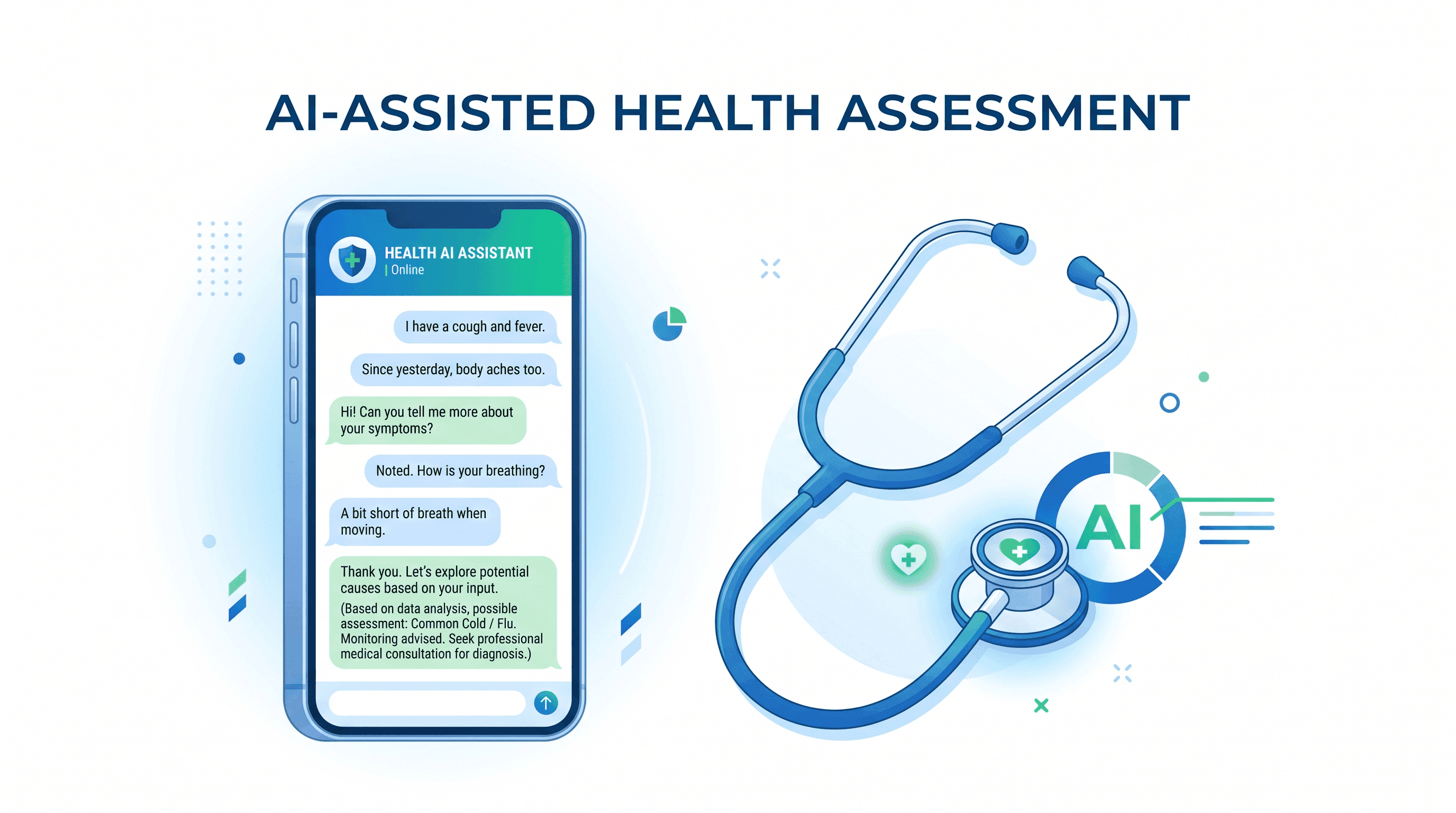
Getting from a Symptom Check to Actual Care
AI symptom checkers are a useful first step, but they are not a substitute for a clinical evaluation. A 2025 study in npj Digital Medicine confirmed that physicians still significantly outperform all symptom checkers for top-1 diagnostic accuracy. If any tool you use suggests urgency, or if symptoms persist or worsen, the right next step is speaking with a provider. You can see a doctor online through Momentary Virtual Care, which connects users with a primary care provider without the wait of an in-person appointment.
5. Buoy Health — Conversation-Style Triage Built by Harvard Medical School Researchers
Buoy Health is a free AI symptom checker and care navigation tool originally developed by researchers at Harvard Medical School. The tool asks a series of adaptive questions through a chatbot interface, continuously refining its assessment as you answer. A cross-sectional study published in PMC involving more than 2,400 patient interactions found that Buoy reduced uncertainty about the appropriate level of care from 34% to 21% of users. The proprietary algorithm draws from more than 18,000 clinical research studies.
Pros: Buoy goes beyond a condition list and tells users specifically which level of care to seek, including whether symptoms warrant an ER visit, urgent care, a primary care appointment within a few days, or self-management at home. The tool is free, requires no login, and works entirely in a browser.
Cons: Buoy's self-reported diagnostic accuracy figure of 90% is cited on the company's own site and was not independently replicated in a published journal study as of June 2026. The absence of independent validation limits how confidently this claim can be treated as a clinical benchmark.
Pricing: Free for all users, no account required.
Best for: Users who want concrete "what do I do next" guidance, not just a condition list.
Rating: No standalone Buoy Health app rating is publicly listed on the US App Store or Google Play as of June 2026; the tool is web-based.
6. WebMD Symptom Checker — The Familiar Name with the Body Map
WebMD's Symptom Checker is among the most widely recognized health tools in the US, offering a visual body map interface where users click the affected area and then filter by symptoms. Research published in the Medical Journal of Australia (2020) found WebMD's top-3 diagnostic suggestions contained the correct diagnosis in approximately 69% of cases. The tool is free, requires no account, and draws on WebMD's large medically reviewed content library for condition explanations.
Pros: WebMD's name recognition and large content ecosystem give it an unusually deep library of condition information, drug references, and local doctor-finder features that extend well beyond the symptom check itself. The Android app has 61,000 ratings with a 4.1-star average (Google Play, June 2026), reflecting broad real-world usage.
Cons: WebMD's symptom checker uses a structured dropdown-based interface that can miss atypical symptom presentations; a JAMA Ophthalmology study found first-guess accuracy at 26% for ophthalmic conditions specifically, suggesting lower performance in specialty areas. The app has received user complaints about Samsung Galaxy compatibility and login issues as of March 2026.
Pricing: Free, no account required for symptom checks.
Best for: Users who want an established brand, a visual body map interface, and access to a large content library alongside their symptom results.
Rating: 4.1 stars on Google Play (61,000 ratings, June 2026 app update confirmed).
7. K Health — Free Symptom Check with a Direct Path to a Provider
Update, September 2026: K Health shut down its consumer app on December 31, 2025 and now operates only through health-system partners, so the pricing and sign-up details below no longer apply. In California, the same AI intake is available with Cedars-Sinai clinicians through Cedars-Sinai Connect (copay with most major insurers; $200 to $250 self-pay). We are keeping the entry for readers comparing it to what replaced it.
K Health combines a free AI symptom checker with a paid on-demand telehealth service available across the continental US. The symptom checker is free and uses K Health's proprietary "record-aware" AI model, which compares the user's symptom profile against anonymized data from millions of real patient visits to generate likely conditions. A study published in the Annals of Internal Medicine evaluated K Health's AI Physician Mode in a clinical trial context, giving it a higher evidence profile than many competitors.
Pros: K Health's AI is designed to surface how real patients with similar demographics and symptom profiles were actually diagnosed, which provides a data-grounded framing beyond static decision trees. For users who want to go directly from symptom check to a provider conversation, K Health's integrated telehealth service makes that transition seamless.
Cons: The paid telehealth consultation is $73 per session or available through a membership plan, which is a meaningful cost barrier for uninsured users. User reviews on Reddit and Trustpilot note frequent app glitches, interface freezing, and UX friction, and K Health no longer offers pediatric care as of its 2025 service update.
Pricing: Free symptom checker. Provider visits cost $73 per session. Membership pricing varies; verify at khealth.com.
Best for: Adults who want a free symptom check that flows directly into an affordable telehealth consultation.
Rating: K Health does not have a publicly available aggregated app store rating verified as of June 2026.
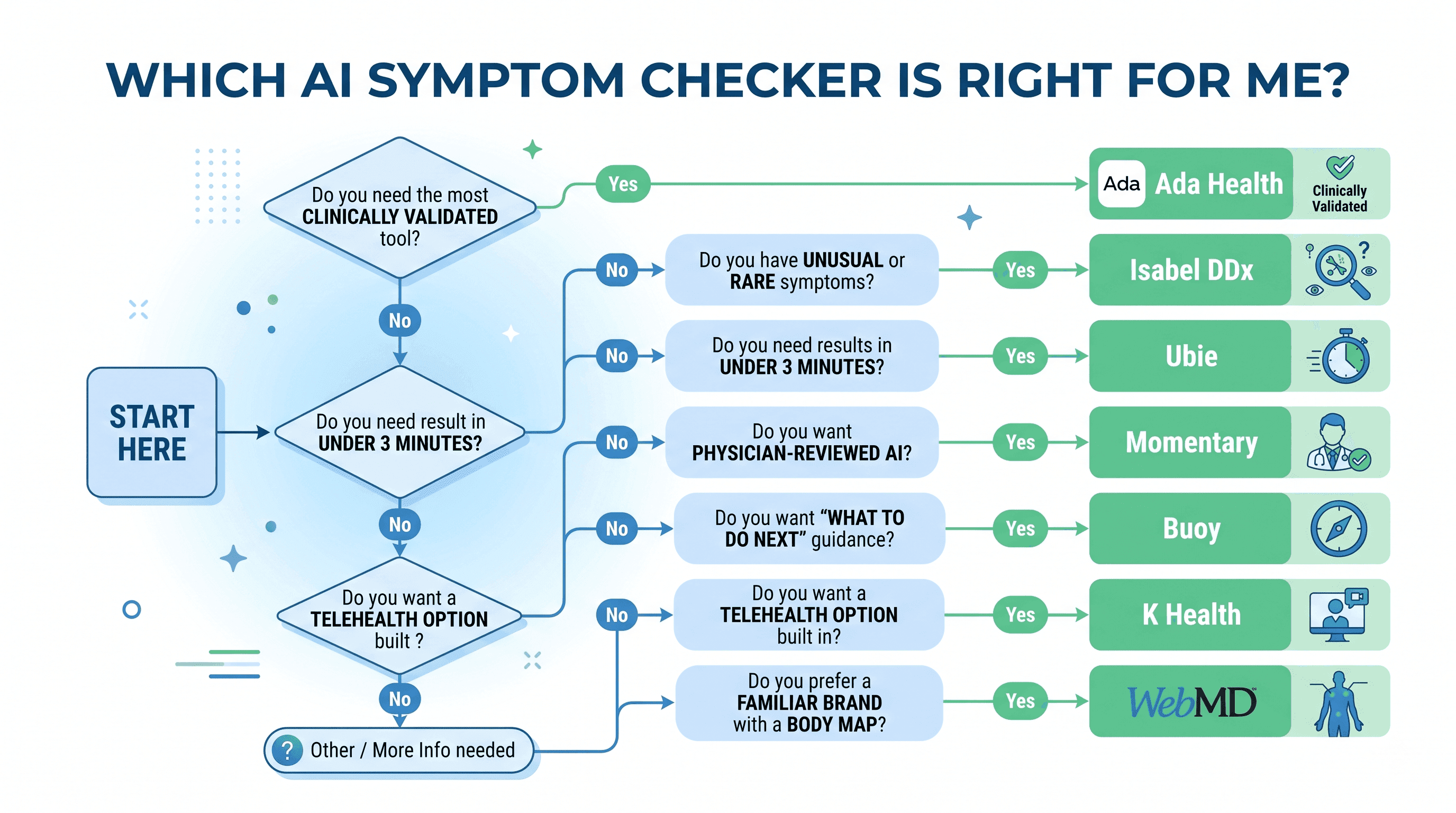
FAQ
What is the best AI symptom checker in 2026?
Ada Health ranks first on this list based on peer-reviewed clinical evidence. A 2023 study in JMIR mHealth and uHealth found Ada's top-5 diagnostic accuracy approached that of emergency department physicians, and a 2024 randomized trial confirmed its accuracy advantage over a leading competitor. For users who want speed, Ubie completes in about 3 minutes and has a published accuracy study showing 71.6% top-10 accuracy. For users who want a physician-reviewed AI tool, use Momentary's AI assistant to explore your symptoms with an extra layer of clinical accountability.
Which AI symptom checker is most medically accurate?
Ada Health has the strongest published evidence base among consumer tools, with multiple peer-reviewed studies and a 2023 JMIR emergency department study showing diagnostic sensitivity near physician-level performance at the top-5 threshold. Isabel DDx reports 96% accuracy for the correct diagnosis appearing in its top-10 list across over 20 studies, but this figure comes from the professional clinical tool; the consumer version uses the same engine. Research published in npj Digital Medicine in 2025 confirmed that physicians still outperform all symptom checkers when measuring whether the correct diagnosis is listed first, so these tools are best used as a triage layer, not a final answer.
Are AI symptom checkers accurate enough to use?
They are accurate enough to be useful, with important caveats. Research indicates that the best AI symptom checkers correctly identify the actual condition in their top-3 suggestions about 70% of the time, though first-guess accuracy drops significantly, to around 34% in some studies. They are more reliable for assessing urgency than for pinpointing a specific diagnosis. Use them to understand whether symptoms warrant urgent care, prepare questions for a provider, or get a starting framework before an appointment. Never rely on a symptom checker alone for a serious or persisting health concern.
Which AI is best for diagnosis?
No AI symptom checker should be used for diagnosis; that function requires a licensed physician who can examine you, order tests, and apply clinical judgment. For differential diagnosis support, Isabel DDx has the deepest evidence base and covers over 10,000 conditions including rare diseases. For structured triage guidance, Ada Health has the most published peer-reviewed studies. For a tool where a physician reviews the AI's output before it reaches you, Momentary is the only consumer option on this list with that oversight model built in.
Can I use a free AI symptom checker without insurance?
Yes. Ada Health, Isabel DDx, Ubie, Buoy Health, and WebMD Symptom Checker are all free with no registration required, making them accessible regardless of insurance status. They are not a replacement for care, but they can help you understand whether symptoms are urgent, what type of specialist to see, and what questions to ask when you do connect with a provider.
Are AI symptom checkers safe for children?
Ada Health, Isabel DDx, and WebMD all support pediatric symptom assessments; users specify the age of the person being assessed at the start of the check. K Health no longer offers pediatric care as of its 2025 service update. Always follow up any pediatric symptom check with a licensed provider, particularly for children under 2 or any child with high fever, difficulty breathing, or symptoms that changed rapidly.
References
- JMIR mHealth and uHealth: Comparison of Diagnostic and Triage Accuracy of Ada Health and WebMD Symptom Checkers, ChatGPT, and Physicians (2023)
- Isabel Healthcare: Validation Studies and Peer Reviews
- medRxiv: Ubie Symptom Checker Accuracy Study (2024)
- PMC: Health Information Seeking From an Intelligent Web-Based Symptom Checker — Buoy Health Cross-Sectional Study
- npj Digital Medicine: Accuracy of Symptom Assessment Applications, Large Language Models, and Laypeople for Self-Triage Decisions (2025)
- Medical Journal of Australia: Quality of Diagnosis and Triage Advice Provided by Free Online Symptom Checkers (2020)
- PMC: Accuracy of AI-Based Chatbots in Analyzing Orthopedic Pathologies — Diagnostics (2025)
- JMIR AI: Evaluating the Diagnostic Performance of Symptom Checkers — Clinical Vignette Study (2024)
- JAMA Ophthalmology / AMA: Accuracy of a Popular Online Symptom Checker for Ophthalmic Diagnoses
- PMC: Triage Accuracy of Symptom Checker Apps: 5-Year Follow-up Evaluation
If You're in California
Momentary appears above at the rank it earned for readers everywhere. If you live in California, it is also the only option on this page that is a doctor you keep rather than a tool you consult: Momentary is a virtual primary care membership for California residents, pairing an AI assistant that remembers your history with a licensed California physician you can message any hour, who can diagnose, prescribe non-controlled medications, order labs, and refer, for a flat $19.99 a month (HSA/FSA eligible). It does not bill insurance, is iOS-only today, and is not for emergencies. Momentary is our own product.
California guides: Best AI Symptom Checkers in California · Best AI Primary Care Apps in California · Best Online Doctors That Prescribe in California


