
Quick Summary: Blood Pressure Cuff Sizes at a Glance
| Topic | Key Facts |
|---|---|
| Why size matters | A wrong-size cuff can skew systolic readings by up to 20 mmHg |
| Most common adult size | Standard adult cuff: 8.7–12.6 inches (22–32 cm) arm circumference |
| Large arm threshold | Large adult cuff needed at 12.6–16.5 inches (32–42 cm) |
| XL range | Extra-large cuffs cover 16.5–19.7 inches (42–50 cm) |
| Who needs a large cuff | More than half of US adults with hypertension require a large or extra-large cuff |
| Correct placement | Upper arm, 1–2 cm above the elbow crease, on bare skin |
| AHA recommendation | Automatic, cuff-style, upper-arm monitor with a clinically validated device |
| When to see a doctor | A doctor can advise on individual cases, including special sizing needs |
Getting a blood pressure reading seems simple: wrap on the cuff, press a button, read the numbers. But one factor quietly undermines accuracy for millions of people at home, and that is cuff size. Using the wrong blood pressure monitor cuff is one of the most common sources of error in home readings. This guide covers everything needed to choose the right size, apply it correctly, and understand when replacement cuffs or specialty sizes apply.
If you are ready to start tracking your numbers at home, some programs offer a free blood pressure monitor through qualifying insurance plans. Either way, clinically accurate home BP monitoring begins with a device and a cuff sized for your arm.
Why Blood Pressure Cuff Size Matters for Accurate Readings
Cuff fit is the single most controllable factor in home blood pressure measurement accuracy.
According to the American Heart Association (AHA), a cuff that is too small for the arm can artificially elevate readings, while one that is too large can cause underestimates. A study published in JAMA Internal Medicine (Ishigami J et al., 2023) found that using a regular-size cuff on people who needed a large cuff overestimated systolic blood pressure by roughly 5 mmHg, and by approximately 20 mmHg in those who required an extra-large cuff. Measurement errors of this magnitude can influence clinical decisions about blood pressure management. Many people monitoring at home are not sure what high blood pressure actually feels like, which makes accurate readings from a properly fitted cuff even more important.
The Mayo Clinic confirms that accurate blood pressure readings depend on using the proper size cuff. The bladder inside the cuff, which is the inflatable component, must encircle a sufficient proportion of the upper arm to register pressure against the brachial artery accurately.
Pickering TG et al., in recommendations published for the AHA and American Society of Hypertension (ASH), state that the cuff bladder length should be at least 80% of the arm circumference and the bladder width at least 40%. These proportions allow the cuff to apply even, consistent pressure around the artery during inflation and deflation.
The British Hypertension Society echoes this guidance and notes that using the wrong cuff size remains one of the most preventable sources of blood pressure measurement error in both clinical and home settings.
"The most important factor in blood pressure measurement is that the cuff bladder encircles at least 80% of the arm circumference." Pickering TG et al., Hypertension, 2005

Standard Cuff Size Chart: How to Measure Your Arm Circumference
The correct blood pressure monitor cuff size is determined by the mid-upper-arm circumference, not by body weight or general body size.
How to measure arm circumference at home:
- Stand or sit upright with the arm relaxed at the side.
- Bend the elbow to a 90-degree angle.
- Find the midpoint between the shoulder tip (acromion process) and the tip of the elbow (olecranon).
- Mark that midpoint on the back of the arm.
- Relax the arm back to the side.
- Wrap a flexible measuring tape horizontally around the arm at that midpoint mark, without indenting the skin.
- Record the measurement in centimeters or inches.
Standard blood pressure cuff size chart:
| Cuff Size | Arm Circumference (cm) | Arm Circumference (inches) | Typical User |
|---|---|---|---|
| Pediatric / Small Adult | Under 22 cm | Under 8.7 in | Children, slim adults |
| Standard Adult | 22–32 cm | 8.7–12.6 in | Most adults |
| Large Adult | 32–42 cm | 12.6–16.5 in | Larger arms, many adults with obesity |
| Extra-Large (XL) | 42–50 cm | 16.5–19.7 in | Very large upper arms |
| XXL / Thigh | Over 50 cm | Over 19.7 in | Specialty sizing |
Note: Sizing ranges vary slightly across manufacturers. Always check the specific cuff range listed on the product before purchase. Omron Healthcare and other major brands publish cuff size specifications in their product guides.
A 2022 analysis published in the American Journal of Hypertension (Jackson SL et al.), drawing on National Health and Nutrition Examination Survey (NHANES) data, found that among US adults with hypertension, more than half required a large or extra-large cuff. Most monitors sold at retail pharmacies include only a standard-size cuff, which means a significant share of home users may be measuring with a cuff that does not fit correctly.

Small Cuffs (Child/Slim Adult): Best Options and When to Use
A small or pediatric blood pressure monitor cuff is appropriate for arm circumferences below approximately 22 cm (8.7 inches).
Adults with slim builds, older adults who have experienced muscle loss, or adolescents may fall into this range. When a standard adult cuff is used on a small arm, the bladder is proportionally too long relative to the arm circumference, which can lead to underestimated readings per the 80% bladder-length rule.
Who typically needs a small cuff:
- Children aged 3 and older (pediatric cuffs designed for approximately 16–22 cm arms)
- Slim adults with arm circumference under 22 cm
- Older adults who have experienced significant muscle loss in the upper arm
What to look for:
- A cuff bladder designed to span 80% of the arm at its smaller circumference
- Compatibility with an automatic, oscillometric upper-arm monitor, the type recommended for home use by the AHA
- A device that has been clinically validated for the specific cuff size being used
Omron produces pediatric and small adult cuffs for several of its upper-arm models. Microlife also offers small-arm cuffs compatible with its upper-arm monitors. A doctor can advise on the appropriate cuff size for children or adults with unusually slim arms.
Standard Adult Cuffs: Most Common Monitors Reviewed
Standard adult cuffs fit arms between approximately 22 and 32 cm (8.7 to 12.6 inches) in circumference and cover the majority of adults with average builds.
Most upper-arm home monitors from Omron, Microlife, Relion, and A&D Medical include a standard cuff. The AHA recommends an automatic, cuff-style, upper-arm monitor for home blood pressure monitoring, and standard-cuff models account for the largest share of the consumer home monitor market.
Features worth considering in a standard-cuff monitor:
- Clinical validation status (check validatebp.org, a free resource maintained by the American Medical Association)
- Memory storage for multiple users and readings
- Irregular heartbeat detection
- Bluetooth connectivity for logging readings over time
- Display readability, including screen size and backlight
Omron replacement cuffs are available directly through Omron Healthcare, and Relion replacement cuffs are sold at Walmart. Compatibility between replacement cuffs and specific monitor models varies by brand and connector type, covered in detail in the Replacement Cuffs section below.
Standard-cuff monitors listed on the AMA Validated Device Listing (VDL) represent a reliable starting point for most adults. To measure blood pressure with the right fit, confirming both the monitor's validation status and the cuff's fit for your arm circumference are the two most practical first steps.
Large and XL Cuffs: Best Monitors for Larger Arms
A large adult blood pressure cuff is needed for arm circumferences between approximately 32 and 42 cm (12.6 to 16.5 inches), and an XL cuff covers roughly 42 to 50 cm (16.5 to 19.7 inches).
Stergiou GS et al., writing in the Journal of Hypertension (2021), reviewed the evidence on cuff sizing and blood pressure accuracy, concluding that appropriate bladder dimensions relative to arm size are a prerequisite for reliable measurement. This is especially relevant for adults with larger arms, where the gap between standard and correct sizing is wider.
Monitors commonly available with large or XL cuffs:
- Omron large cuff options: Omron's wide-range ComFit cuff fits arm circumferences of approximately 9 to 17 inches (23 to 43 cm) and is compatible with several Omron upper-arm monitor models. Omron also sells large cuffs separately for specific models. Current range and compatibility details are published at Omron Healthcare.
- Microlife blood pressure monitor cuff: Microlife's upper-arm monitors include large-arm cuff options. Microlife publishes a cuff size guide and compatibility chart on its product pages.
- Relion large-cuff models: Relion large-cuff monitors and replacement cuffs are available at Walmart, designed for arm circumferences up to approximately 42 cm. Confirm compatibility with the specific Relion model before purchasing.
- A&D Medical: Several A&D Medical upper-arm monitors include both a standard and large cuff in the same package.
When comparing blood pressure monitors for large arms, checking the bladder dimensions listed by the manufacturer, rather than only the overall cuff wrap range, is the most reliable way to confirm a fit that meets the 80% circumference guideline.
XXL and Thigh Cuffs: When Specialty Sizing Is Needed
An XXL blood pressure monitor cuff is designed for arm circumferences greater than approximately 42 to 50 cm (16.5 to 19.7 inches). A thigh cuff is used when the upper arm cannot accommodate any available cuff size, or when a medical reason prevents upper-arm measurement.
Very few consumer-grade home monitors include XXL cuffs as a standard accessory. Some brands, including Omron and A&D Medical, offer XXL replacement cuffs sold separately for specific monitor models. Purchasing a blood pressure monitor with an XXL cuff typically involves buying the cuff as a compatible add-on accessory.
When arm circumference exceeds 50 cm, a thigh cuff may be the only option that satisfies the 80% bladder-length requirement. Thigh cuffs attach to validated upper-arm-style monitors and use the same oscillometric measurement method. Thigh cuff readings reflect pressure at a different vascular location and are not directly comparable to upper-arm readings for diagnosing or managing hypertension. A doctor can advise on individual cases where thigh cuff use is clinically appropriate.
The British Hypertension Society notes that using a thigh cuff on the arm is not an acceptable substitute for an appropriately sized arm cuff when one is available. The goal is always to match the cuff to the measurement site, with bladder dimensions appropriate to that limb.
For very large or unusually shaped arms, a consultation with a healthcare provider or pharmacist before purchasing home monitoring equipment is a reasonable step.
How to Properly Apply a Blood Pressure Cuff (Step-by-Step)
Correct blood pressure monitor cuff placement is as important as cuff size. A well-sized cuff applied incorrectly still produces unreliable readings.
The AHA provides the following guidance for home upper-arm cuff application:
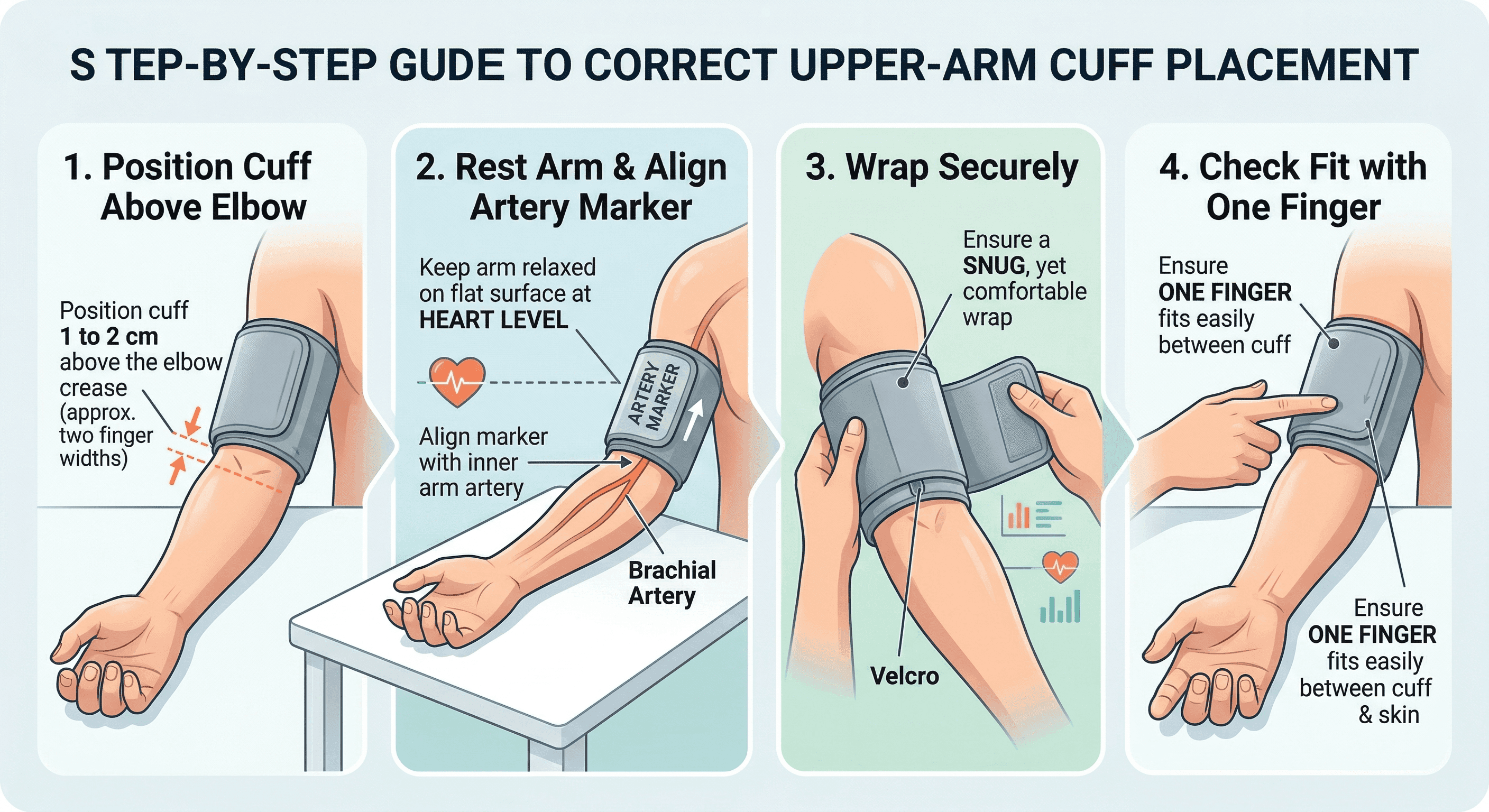
Step-by-step cuff application:
- Remove clothing from the arm. The cuff must sit on bare skin, not over a sleeve or thin fabric.
- Sit quietly for at least 5 minutes before taking the reading. Avoid caffeine, exercise, and smoking for 30 minutes beforehand.
- Sit with proper posture. Feet flat on the floor, back supported, legs uncrossed.
- Position the arm. Rest the arm on a flat surface such as a table or armrest so the cuff is at heart level, approximately mid-chest height.
- Place the cuff. The lower edge of the cuff should sit approximately 1 to 2 cm, about one finger-width, above the bend of the elbow.
- Align the artery marker. Most cuffs have an arrow or "artery marker" printed on the fabric. Align this marker with the brachial artery, which runs along the inner-center of the upper arm.
- Check the fit. One or two fingers should slide snugly under the cuff at its edge. A cuff too tight restricts blood flow before inflation, and a cuff too loose slips or inflates unevenly.
- Keep still and silent. Do not talk or move the arm during measurement. Speaking during a reading can elevate results.
- Take two readings, 1 to 2 minutes apart. The average of these readings is more representative than a single measurement.
Common cuff application errors and their approximate effect on readings:
Values below are drawn from Pickering TG et al., AHA/ASH recommendations, Hypertension 2005 and AHA home monitoring guidance.
| Error | Approximate Effect on Reading |
|---|---|
| Arm below heart level | Up to +10 mmHg (elevated) |
| Arm above heart level | Underestimated reading |
| Cuff over clothing | Variable; can significantly affect results |
| Cuff too small for arm | Systolic overestimated by up to 20 mmHg |
| Cuff too loose | Inaccurate in either direction |
| Talking during reading | Elevated reading |
| Crossed legs | +2 to +8 mmHg |
| Full bladder | Approximately +10 mmHg |
| Back unsupported | +6 to +10 mmHg |
| Once a correct reading is in hand, readers who see elevated numbers may find it useful to understand what high blood pressure feels like day to day and explore evidence-based approaches to lowering blood pressure before their next clinical appointment. |
Replacement Cuffs: Where to Buy and Compatibility Guide
Cuffs wear out with regular use. The fabric stretches, the fastening weakens, and the bladder may lose consistent pressure over time. Replacing the cuff every one to two years, or sooner if the fastening no longer holds securely, is a standard maintenance step for home monitors.
Compatibility: the most important factor
Replacement cuffs are not universally interchangeable. A cuff designed for one brand's connector type will not fit a different brand's monitor in most cases. Before purchasing any replacement cuff, confirm:
- The brand and model number of the monitor, printed on the device itself
- Whether the monitor uses a single-tube or dual-tube connection
- The cuff size needed based on arm circumference, using the size chart above
Where to buy replacement cuffs:
- Omron blood pressure monitor cuff replacement: Available directly at Omron Healthcare, major pharmacies including CVS and Walgreens, and online retailers. Omron cuffs are model-specific, and the product page lists compatible monitor models.
- Relion blood pressure monitor replacement cuff: Available at Walmart in-store and online. Relion cuffs are designed for corresponding Relion monitor models.
- Microlife blood pressure monitor cuff: Available through Microlife's website and select pharmacies. Microlife uses a standard connector for most of its upper-arm models, but model verification is still recommended before purchasing.
- Generic replacement cuffs: Some third-party sellers offer universal replacement cuffs. These may be cost-effective but require careful compatibility checks. A cuff that does not form a secure seal with the monitor port will affect measurement consistency.
If a replacement cuff does not resolve inconsistent readings, the monitor itself may require calibration or replacement. Most manufacturers recommend having home monitors checked against a reference device every one to two years. A clinician's office can compare a home device reading against an office-grade measurement to assess ongoing accuracy.
Frequently Asked Questions
What size blood pressure cuff do I need?
The right cuff size depends on the arm circumference measured at the midpoint of the upper arm. Wrap a flexible tape measure around the arm at that point, without indenting the skin, and match the measurement to a size chart. Standard adult cuffs fit 22 to 32 cm. Large adult cuffs fit 32 to 42 cm. XL cuffs cover 42 to 50 cm. A doctor or pharmacist can assist with sizing if there is uncertainty.
Does blood pressure cuff size affect accuracy?
Yes. Research published in JAMA Internal Medicine (Ishigami J et al., 2023) shows that a cuff too small for the arm can overestimate systolic blood pressure by up to 20 mmHg, and a cuff that is too large can underestimate it. The AHA recommends choosing a cuff whose bladder length covers at least 80% of the arm circumference.
What is considered a large cuff for a blood pressure monitor?
A large adult blood pressure cuff is generally designed for arm circumferences between 32 and 42 cm (12.6 to 16.5 inches). Extra-large (XL) cuffs typically cover 42 to 50 cm. Sizing terminology varies slightly across manufacturers, so checking the bladder dimensions listed on the specific cuff provides the most reliable confirmation.
Can I use a regular blood pressure cuff if I have large arms?
Using a standard cuff on a large arm will produce inaccurate readings in most cases. A standard cuff bladder does not encircle enough of a larger arm to meet the 80% circumference guideline, which leads to overestimated systolic numbers. Anyone with an arm circumference above 32 cm should use a large or XL cuff.
Where can I buy a replacement cuff for my blood pressure monitor?
Replacement cuffs are available from the original monitor manufacturer's website, major pharmacies, and online retailers. Compatibility is brand- and model-specific, so confirm the monitor's model number and connector type before ordering. Omron, Microlife, and Relion all sell replacement cuffs through their respective retail channels.
Tracking blood pressure at home is a well-supported approach for managing hypertension, but readings are only as reliable as the equipment and technique used. Choosing the correctly sized blood pressure monitor cuff, applying it according to established guidelines, and replacing it when worn are the steps that directly affect the numbers on the screen.
For guidance on finding a clinician who can review home monitoring technique, find a doctor near you.