
A pulse oximeter is one of the most useful tools a person can have at home, and one of the most misread. Two numbers appear on the screen within seconds, yet most people focus on only one of them and are left wondering what "normal" actually looks like for their age, their condition, or the elevation they live at.
This guide covers the pulse oximeter readings chart in full: what each number means, what ranges to expect across different life stages, and what specific readings from 100% down to 87% actually indicate.
If you have a chronic respiratory condition or recently received a reading that concerns you, find a doctor near you for a personalized assessment.
At a Glance: Pulse Oximeter Readings Quick Reference
| Topic | Key Facts |
|---|---|
| Device measures | SpO2 (oxygen saturation) and PR BPM (pulse rate) |
| Normal SpO2 (healthy adults) | 95–100% |
| Normal SpO2 (adults over 70) | 93–97% |
| Normal pulse rate (adults at rest) | 60–100 BPM |
| Call a doctor if SpO2 | Drops to 93–94% and stays there after recheck |
| Seek emergency care if SpO2 | Falls to 90% or below |
| Device accuracy range | Within 2–4% for FDA-cleared devices |
| Who benefits from regular monitoring | People with COPD, asthma, heart failure, sleep apnea, or pneumonia |
What Do the Two Numbers on a Pulse Oximeter Mean?
The two numbers displayed on a pulse oximeter measure completely different things, though both reflect how well the body is circulating and using oxygen.
SpO2: Oxygen Saturation
SpO2 stands for peripheral oxygen saturation, which is the percentage of hemoglobin molecules in the blood that are carrying oxygen. A reading of 97% means that 97 out of every 100 hemoglobin binding sites are loaded with oxygen.
The device measures this by passing two wavelengths of light, red and infrared, through a fingertip. Oxygenated hemoglobin absorbs infrared light differently from deoxygenated hemoglobin. The oximeter calculates the ratio and converts it to a percentage, according to the WHO Pulse Oximetry Training Manual.
This is an estimate, not a direct measurement. According to Jubran (2015) in Critical Care, FDA-cleared pulse oximeters are accurate to within approximately 2% of the true arterial oxygen saturation value when SpO2 is above 90%. Accuracy decreases below that threshold.
PR BPM: Pulse Rate in Beats Per Minute
The bottom number on a pulse oximeter is PR BPM, which stands for pulse rate in beats per minute. This is the heart rate as detected at the fingertip, not measured by an ECG. The oximeter detects the rhythmic surge of blood through the capillaries with each heartbeat and counts those pulses per minute.
PR BPM is a useful quick reference for heart rate, but it is not as precise as a dedicated cardiac monitor for detecting rhythm abnormalities. It shows how fast the heart is beating, not whether its rhythm is regular.
What Is the Third Number? (Perfusion Index)
Some modern fingertip pulse oximeters also display a perfusion index (PI), a percentage that reflects the strength of blood flow at the sensor site. A PI above 1% generally indicates a reliable reading. A PI below 0.3% suggests the signal is weak, often because of cold fingers, poor circulation, or improper placement. If PI appears very low, warming the hand and repositioning the device before relying on the SpO2 value is a reasonable first step.
Normal SpO2 Oxygen Levels by Age
Oxygen saturation norms are largely consistent across age groups, with meaningful differences for newborns, older adults, and those with chronic conditions.
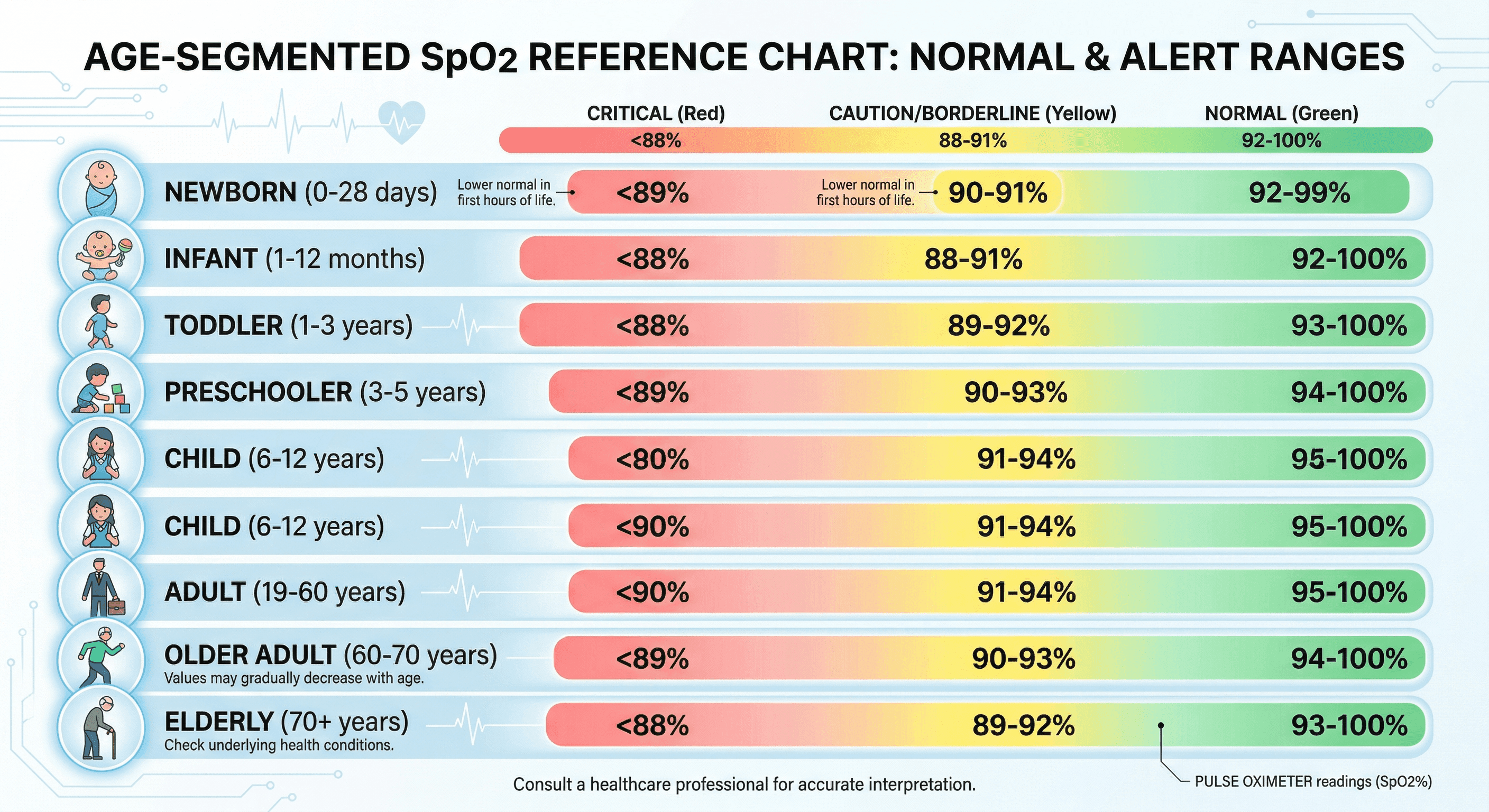
SpO2 by Age Group
| Age Group | Normal SpO2 Range | Notes |
|---|---|---|
| Newborn (first minutes of life) | 90–95% | Should rise to 95–100% within 10 minutes of birth |
| Infants (1 month to 1 year) | 97–100% | Pediatric sensor required for small fingers |
| Children (1–17 years) | 97–100% | Most healthy children fall in the 99–100% range per a 2025 PMC pediatric study |
| Healthy adults (18–69 years) | 95–100% | 97–100% is the typical resting range |
| Adults over 70 | 93–97% | Slight physiological decline with age is normal |
| COPD patients | 88–92% (individualized) | Doctor-established baseline; not a universal threshold |
| Heart failure patients | 92–95% (individualized) | Monitor for drops from personal baseline |
| Sleep apnea patients | Variable during sleep | Continuous monitoring is more informative than spot checks |
Newborns require special attention. In the first minutes after birth, SpO2 below 95% is expected as the lungs adapt to breathing air. The American Thoracic Society notes that newborn SpO2 should reach the 95–100% range within approximately 10 minutes of delivery.
For children, a 2025 cross-sectional study published in PMC found that most healthy pediatric patients had SpO2 values of 99–100%, with none falling below 97%. A persistent reading between 95–96% in a child may warrant further evaluation, as that range correlates with higher respiratory rates and hospitalization rates compared to children reading 97% or above.
For adults over 70, oxygen saturation can drift toward the lower end of the normal range as lung elasticity decreases with age. A reading of 94–95% in a healthy 75-year-old may be that person's normal baseline. Context and trend matter more than any single number.
Normal Pulse Rate (PR BPM) Ranges and What Affects Them
The normal resting pulse rate for an adult is 60–100 BPM, according to the American Thoracic Society. Pulse rate shifts considerably across age groups and circumstances.
Pulse Rate by Age Group
| Age Group | Normal Resting Pulse Rate |
|---|---|
| Newborn | 100–160 BPM |
| Infant (1–12 months) | 80–140 BPM |
| Toddler (1–3 years) | 80–130 BPM |
| Child (4–10 years) | 70–120 BPM |
| Older child (11–17 years) | 60–100 BPM |
| Adult (18–64 years) | 60–100 BPM |
| Adult (65+ years) | 60–100 BPM |
| Trained athletes | 40–60 BPM (physiologically normal) |
A resting pulse above 100 BPM is called tachycardia. A reading below 60 BPM is called bradycardia, which in some cases can be related to underlying heart conditions. In a trained endurance athlete, a resting pulse of 45–55 BPM is expected and reflects cardiovascular efficiency.
Factors That Shift Pulse Rate
Pulse rate is influenced by more than underlying health. Caffeine, dehydration, anxiety, fever, and certain medications all raise heart rate temporarily. Sitting still and breathing at a normal pace for a few minutes before taking a reading produces a more accurate resting value.
Pulse Oximeter Readings Chart
This level-by-level chart covers every clinically meaningful SpO2 range. It is a reference tool, not a substitute for medical evaluation when symptoms are present.
SpO2 Level Reference Table
| SpO2 Reading | Classification | What It Generally Means | Suggested Action |
|---|---|---|---|
| 97–100% | Optimal | Lungs are efficiently saturating the blood | No action needed |
| 95–96% | Normal | Within acceptable range for most adults | Continue monitoring; note any symptoms |
| 93–94% | Borderline | May reflect mild low blood oxygen; recheck first | Recheck on a different finger; contact a doctor if it persists |
| 90–92% | Low | Below the generally accepted clinical threshold | Contact a healthcare provider promptly |
| Below 90% | Requires attention | Meets criteria for clinically significant low blood oxygen | Seek emergency care |
| Below 88% | Severe | Meets Medicare coverage criteria for supplemental oxygen per CMS NCD 240.2 | Call emergency services |
For people managing chronic conditions like COPD, these thresholds do not apply uniformly. A doctor establishes an individualized baseline and target range for each patient. A reading that would prompt concern in a healthy adult may be that person's established normal.
What to Know About PR BPM Alongside SpO2
A good pulse oximeter reading is not only about the SpO2 number. If the PR BPM reading appears unusually high (above 120 BPM at rest) or very low (below 50 BPM in a non-athlete), that warrants attention independent of the oxygen saturation value.
Tracking Readings Over Time
To track blood oxygen levels and pulse rate over time, a printable readings log makes it straightforward to notice trends rather than reacting to isolated numbers. A simple table with columns for date, time, SpO2, PR BPM, and notes serves this purpose well. Consistent timing, such as morning readings before activity, produces the most comparable data.
Tracking readings over days or weeks is particularly useful for people managing respiratory conditions who want to monitor their blood oxygen levels continuously and give clinicians a meaningful picture rather than a single snapshot.
What Does a Reading of 95%, 94%, 92%, or 87% Mean?
These specific numbers come up frequently because they sit in ranges where people are genuinely uncertain about what to do next.
SpO2 of 100%
A reading of 100% on a home pulse oximeter is normal and not a cause for concern. It means hemoglobin is fully saturated with oxygen at the measurement site. Some people, particularly younger adults and those at lower altitudes, routinely read 100%.
SpO2 of 97%
A reading of 97% is well within the normal range for a healthy adult. No action is needed.
SpO2 of 95%
A reading of 95% sits at the lower boundary of the normal range. In a healthy adult with no symptoms, it is generally acceptable. In a child, it may warrant a repeat measurement. In someone with an active respiratory illness, it is worth monitoring closely over the following hours.
SpO2 of 94%
A reading of 94% is at the borderline. The Mayo Clinic notes that a reading below 95% can reflect low blood oxygen, depending on the individual's baseline. Before drawing conclusions, run the recheck protocol: warm the hand, remove nail polish from the test finger, sit still, and re-measure. If 94% persists without symptoms, contacting a doctor is a reasonable step. If 94% is accompanied by shortness of breath, confusion, or chest discomfort, seeking care the same day is appropriate.
SpO2 of 92%
A reading of 92% falls below the generally accepted clinical threshold. The American Thoracic Society indicates that supplemental oxygen is often considered at SpO2 values at or below 92%. Contacting a healthcare provider is appropriate, particularly if the reading does not improve after re-measuring correctly.
SpO2 of 87%
A reading of 87% reflects significant low blood oxygen. At this level, body tissues may receive less oxygen than they need for normal function. This reading calls for emergency evaluation, particularly when accompanied by any symptoms. A reading of 87% is not one to monitor at home while waiting to see if it improves.
Pulse Oximetry for Pneumonia
Pneumonia is one of the conditions where pulse oximetry provides genuinely useful real-time information at home or in a clinical setting.
How Pneumonia Affects SpO2
Pneumonia causes inflammation and fluid buildup in the air sacs of the lungs. This impairs the transfer of oxygen from inhaled air into the bloodstream, a process called gas exchange. As gas exchange becomes less efficient, SpO2 falls. The drop can be gradual or rapid depending on the severity of infection and the patient's baseline lung function, as noted by the Mayo Clinic.
During COVID-19 pneumonia, clinicians documented a pattern they termed "silent hypoxia," in which patients had SpO2 readings well below normal yet reported little or no breathlessness. Tobin, Laghi, and Jubran (2020) in the American Journal of Respiratory and Critical Care Medicine described this disconnect as particularly notable, and it contributed to pulse oximetry becoming a standard home monitoring tool for people who tested positive for COVID-19.
What to Monitor During Pneumonia Recovery
For a patient recovering from pneumonia at home, daily SpO2 readings taken at the same time each morning provide a useful trend. A stable or improving SpO2 over 48–72 hours generally reflects recovery. A decline of more than 3–4 percentage points from the previous day warrants contact with a doctor.
A resting SpO2 below 92% in a pneumonia patient generally calls for medical evaluation rather than home management. If SpO2 drops to or below 90%, emergency care is appropriate.
If you are managing pneumonia recovery and want to track pulse and oxygen at home, consistent daily logging gives clinicians far more useful data than a single office reading.
Pulse Oximeter Readings at High Altitude
Altitude significantly affects SpO2 readings, and what is considered normal at sea level does not apply at elevation.
Why Altitude Lowers SpO2
At higher altitudes, atmospheric pressure decreases. This means less oxygen is available in each breath of air, even though the percentage of oxygen in the air (approximately 21%) remains constant. The body responds by breathing faster and increasing red blood cell production over time, but SpO2 falls in the short term.
Bhutta and Haber (2010) studied pulse oximetry at high altitude and found that SpO2 values decline predictably with increasing elevation in people who have not yet acclimatized. At approximately 5,000 feet (1,524 m), SpO2 in a healthy person may read 95–97%. At 10,000 feet (3,048 m), readings of 90–94% are common and may be physiologically expected for that elevation. Above 18,000 feet (5,486 m), values below 80% can occur without supplemental oxygen.
High Altitude SpO2 Reference
| Elevation | Expected SpO2 Range (Unacclimatized) |
|---|---|
| Sea level | 95–100% |
| 5,000 ft (1,524 m) | 92–97% |
| 8,000 ft (2,438 m) | 91–95% |
| 10,000 ft (3,048 m) | 90–93% |
| 14,000 ft (4,267 m) | 85–90% |
At altitude, the most informative comparison is the individual's own readings over time at that elevation rather than against the sea-level chart. Acclimatization typically improves SpO2 by several percentage points over days to weeks.
The Bhutta and Haber study also noted that consumer-grade pulse oximeters may slightly overestimate true arterial oxygen saturation at very high altitudes, meaning actual oxygen availability may be modestly lower than the device displays. Travelers spending extended time above 8,000 feet benefit from knowing this margin of error.

When to Seek Emergency Care Based on a Pulse Oximeter Reading
The Recheck Protocol First
Before acting on any single low reading, run this brief recheck:
- Remove the device and warm the hand for 1–2 minutes if the skin feels cool.
- Remove any nail polish, gel nails, or acrylic nails from the test finger.
- Sit still and breathe normally for 2–3 minutes.
- Reattach the device to the middle or index finger of the dominant hand.
- Wait until the reading stabilizes, at least 30–60 seconds.
- If the perfusion index (PI) displayed is below 0.3%, the signal is unreliable. Try a different finger or site.
If the reading remains below 95% after this protocol, the guidance below applies.
Action Thresholds by Reading
SpO2 94–95% with no symptoms: Monitor over the next few hours. Take readings every 30–60 minutes. Contact a doctor if the reading does not return to your personal baseline or if any symptoms develop.
SpO2 93–94% persisting after recheck: Call a healthcare provider the same day. If in-person access is limited, a telehealth visit can be a practical first step. If shortness of breath is present, do not wait overnight.
SpO2 90–92%: Contact a healthcare provider promptly. If a provider is unavailable, go to an urgent care or emergency department. Avoid driving if lightheaded or confused.
SpO2 below 90%: Seek emergency care. Call 911 or have someone drive to the nearest emergency department. This is not a reading to manage at home while waiting to see if it improves.
SpO2 below 88%: Call emergency services. Per the Centers for Medicare and Medicaid Services, an oxygen saturation at or below 88% at rest meets clinical criteria for home supplemental oxygen coverage, reflecting the threshold at which low blood oxygen is considered medically significant.
Any SpO2 with the following symptoms: Confusion, blue or grayish lips or fingertips (cyanosis), inability to complete a sentence, chest pain, or breathlessness that comes on suddenly all warrant calling 911 regardless of the SpO2 reading. A pulse oximeter is a tool, not a replacement for clinical judgment. Physical symptoms matter as much as the number on the screen.
A doctor evaluating individual readings and patterns can provide far more tailored guidance than any general chart. Find a doctor near you who can help interpret your specific readings in context.
Frequently Asked Questions
What is a normal pulse oximeter reading?
For a healthy adult at rest at sea level, a normal SpO2 reading is 95–100%. Most healthy adults aged 18–69 read between 97–100%. Adults over 70 may normally read 93–97%. The pulse rate (PR BPM) should fall between 60–100 BPM for adults at rest.
What does the bottom number on a pulse oximeter mean?
The bottom number on a pulse oximeter is PR BPM, which stands for pulse rate in beats per minute. It shows how many times per minute the heart is beating, as detected through blood flow at the fingertip. Normal resting PR BPM for adults is 60–100. Athletes may normally fall below 60 BPM.
What is a dangerously low pulse oximeter reading?
A reading below 90% is considered clinically significant low blood oxygen and generally requires emergency evaluation. Below 88%, the reading meets the threshold at which Medicare covers supplemental oxygen therapy, per the CMS National Coverage Determination for Home Use of Oxygen. Any reading in this range accompanied by confusion, chest pain, or bluish lips warrants calling 911.
Is a 95% oxygen level on a pulse oximeter normal?
Yes, 95% is within the accepted normal range for most adults. It sits at the lower boundary of normal, so it warrants attention if it persists, is declining, or is accompanied by symptoms. In a child, 95% may warrant a repeat measurement, as pediatric norms tend toward 97–100%.
What is PR BPM on a pulse oximeter?
PR BPM stands for pulse rate in beats per minute. It is the heart rate measurement detected at the fingertip via the pulse oximeter's light sensor. It is captured non-invasively through changes in light absorption with each heartbeat.