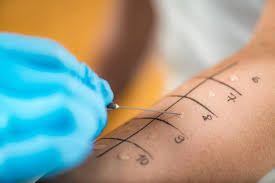


Stomach cramps after dinner. A rash that appears out of nowhere. A headache that keeps showing up around the same meal. When something you eat keeps making you feel off, the instinct to find answers fast is completely reasonable. At home food allergy test kits have made that search more accessible, but the market is crowded with products that range from genuinely useful to medically meaningless. This guide cuts through the noise so readers can make a confident, informed decision rather than an expensive guess.
At a Glance
| Topic | Key Facts |
|---|---|
| Primary test types | IgE (true allergy) vs. IgG (sensitivity marker) |
| Gold-standard diagnosis | Allergist evaluation, skin prick test, oral food challenge |
| Most reliable at-home option | CLIA-certified IgE finger-prick blood panels |
| IgG tests | Not diagnostic per AAAAI; use with caution and dietitian oversight |
| Hair/bioresonance tests | No scientific basis; avoid |
| Price range | $60 to $350+ depending on panel size |
| HSA/FSA eligibility | Yes, for select IgE-based kits |
| When to skip at-home testing | Children under 18, history of anaphylaxis, EpiPen use |
Food Allergy vs. Food Sensitivity vs. Food Intolerance
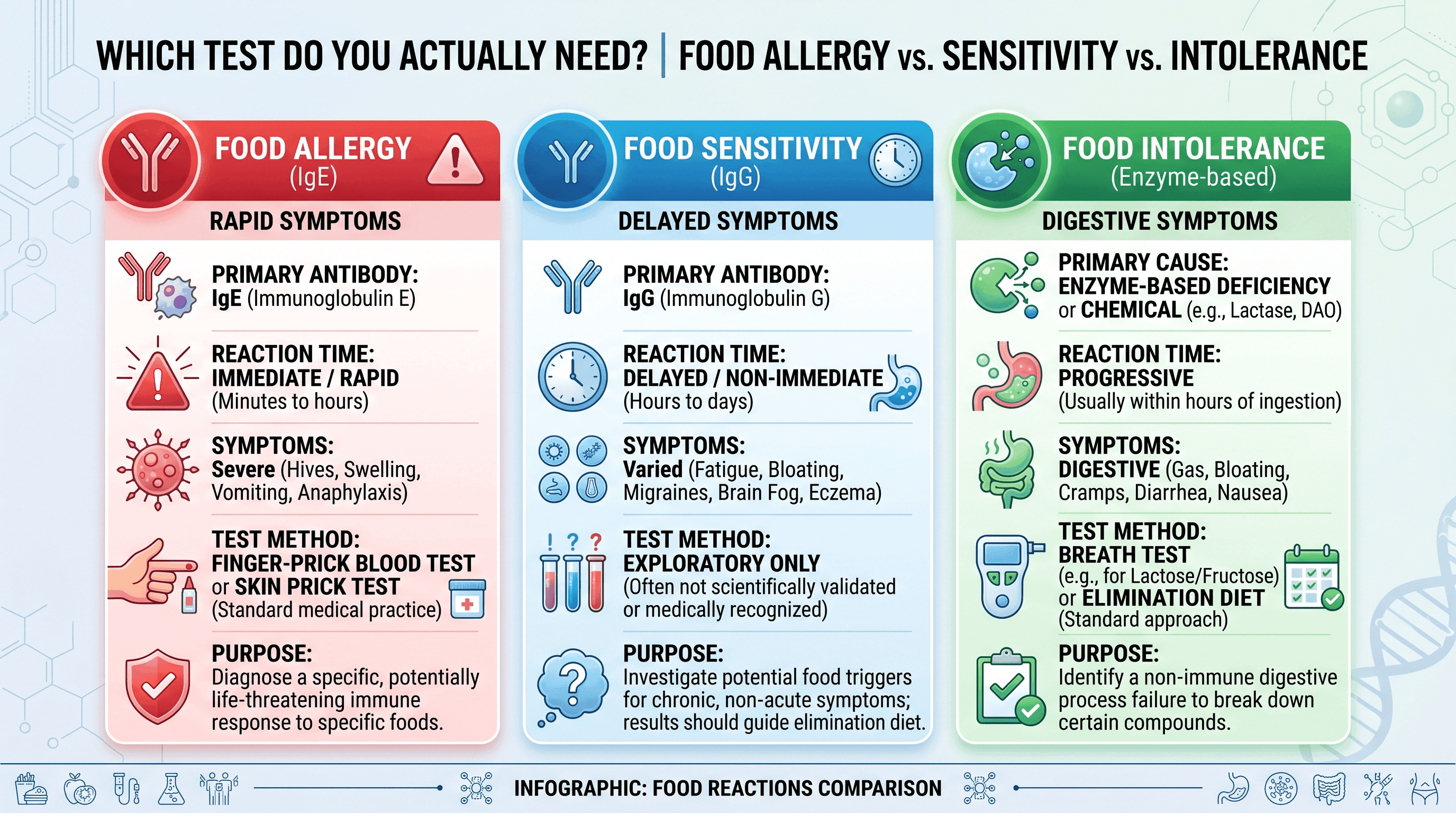
Understanding the difference between these three categories is the single most important thing a reader can do before purchasing any test kit. They are not interchangeable terms, and they require fundamentally different testing approaches.
A food allergy is an immune system response driven by Immunoglobulin E (IgE) antibodies. The reaction is typically rapid, appearing within two hours of eating a trigger food, and symptoms can range from hives and itching to swelling, vomiting, and in severe cases, anaphylaxis. According to the American Academy of Allergy, Asthma and Immunology (AAAAI), an estimated 32 million Americans live with food allergies. The nine most common triggers, known as the Big 9, are milk, eggs, fish, shellfish, tree nuts, peanuts, wheat, soybeans, and sesame.
A food sensitivity refers to a delayed, non-immune-mediated reaction that may not appear for hours or even days after eating. Symptoms tend to be diffuse: bloating, fatigue, brain fog, headaches, or skin changes. There is no universally accepted diagnostic biomarker for food sensitivity. Many commercial tests sell panels measuring Immunoglobulin G (IgG) antibodies as a proxy, but the AAAAI has explicitly stated that IgG testing is not a validated diagnostic tool for food sensitivity.
A food intolerance is physiological rather than immunological. The most common example is lactose intolerance, where the body lacks sufficient lactase enzyme to digest dairy sugar. Breath testing and elimination diets are the standard diagnostic tools, not blood panels.
| Type | Mechanism | Onset | At-Home Test Type |
|---|---|---|---|
| Food allergy | IgE immune response | Within 2 hours | IgE blood panel (finger-prick) |
| Food sensitivity | Possible IgG response; unclear | Hours to days | IgG panel (exploratory only) |
| Food intolerance | Enzyme deficiency | Variable | Breath test, elimination diet |
Choosing the wrong test for the wrong condition wastes money and, more importantly, can delay appropriate care.
What Do At-Home Food Allergy Test Kits Actually Measure?
Not all kits test for the same thing. The type of antibody being measured determines whether the result has any real diagnostic weight.
IgE blood panel kits (finger-prick, CLIA-certified lab)
IgE-based at-home kits measure the presence and level of Immunoglobulin E antibodies specific to particular food proteins. A positive result indicates sensitization, meaning the immune system has mounted a response to that food. Whether that sensitization translates into a clinically significant allergy requires follow-up with an allergist, but IgE testing is the same mechanism used in clinical settings.
What matters most for consumers is CLIA certification. CLIA stands for Clinical Laboratory Improvement Amendments, the federal regulatory framework for laboratory testing quality in the United States. A CLIA-certified lab is held to the same accuracy and quality standards as hospital laboratories. When evaluating any at-home kit, CLIA certification on the processing lab is a non-negotiable marker of credibility.
Most IgE-based kits screen for the Big 9 allergens, with expanded panels covering dozens more, including specific tree nuts, grains, fruits, and proteins. Sample collection involves a simple finger-prick, a drop of blood onto a collection card, and mail-in return to the lab.
IgG sensitivity panels and why results require careful interpretation
IgG antibodies are a normal and expected part of the immune system's response to food. When someone regularly eats a food, the body produces IgG antibodies to it. This is not a sign of intolerance or a problem. It is a sign of exposure.
The AAAAI has published a position statement clarifying that food-specific IgG testing is not a reliable method for diagnosing food allergy or intolerance. Elevated IgG levels to a food more often reflect frequent consumption than an adverse reaction. Using IgG results to drive sweeping food eliminations can lead to unnecessary dietary restriction, nutritional gaps, and in some cases, increased sensitization risk when eliminated foods are reintroduced.
That said, some dietitians and functional medicine practitioners use IgG panels as a hypothesis-generating starting point alongside a structured elimination diet. The key word is alongside. IgG results alone should not drive clinical decisions.
Hair analysis and bioresonance tests
Some companies market "food intolerance tests" conducted on hair samples or through bioresonance devices. There is no peer-reviewed evidence supporting hair analysis or bioresonance as valid methods for detecting food reactions of any kind. These tests have no known scientific mechanism for identifying food-specific immune responses. They are not CLIA-certified because they do not process blood samples in regulated laboratories. Avoid them entirely.
The Best At-Home Food Allergy Test Kits in 2026
The kits below have been organized by test type because that distinction matters more than brand recognition. Prices and panel sizes reflect publicly available information and may vary.
Best IgE-based at-home food allergy kits
| Kit | Panel Size | Price Range | CLIA Lab | Age Restriction | Turnaround |
|---|---|---|---|---|---|
| Labcorp OnDemand Food Allergy | 17 allergens | ~$150 | Yes | 18+ | 3-5 days |
| Everlywell Food Allergy Test | 9 foods (Big 9) | ~$99 | Yes | 18+ | 5-7 days |
| YorkTest US Food Allergy Test | 23 foods + 19 environmental | ~$199 | Yes | 18+ | 5-7 days |
| 4U Health Food Allergy Panel | 15 allergens | ~$120 | Yes | 18+ | 5-7 days |
| RxHomeTest Allergy | Custom panels available | $60-$200 | Yes | 18+ | 3-7 days |
These kits represent the legitimate end of at-home allergy testing. IgE testing through a CLIA-certified lab is the closest at-home equivalent to what an allergist's office would order. A positive result is not a diagnosis on its own, but it is meaningful data to bring to a clinical appointment.
IgG sensitivity panels, if exploring this route
| Kit | Panel Size | Price Range | Test Method |
|---|---|---|---|
| Everlywell Food Sensitivity | 96 foods | ~$159 | IgG ELISA |
| YorkTest Premium | 200 foods | ~$220 | IgG ELISA |
| Pinnacle BioLabs FSIT200 | 200 foods | ~$199 | IgG ELISA |
These panels can serve as a conversation starter with a registered dietitian planning a structured elimination and reintroduction protocol. They should not be used to self-diagnose or self-restrict without professional guidance. Hair and bioresonance kits sold alongside some of these brands are not in the same category and should be avoided.
Clinical-grade at-home options
Labcorp OnDemand stands apart because it operates under a physician-ordered model, meaning results are reviewed by a licensed clinician before delivery and, for positive IgE results, the lab may automatically run reflex component testing to identify specific protein triggers within a food. This brings the testing closer to what a hospital laboratory would produce without requiring an in-person appointment. It is among the most rigorous options available outside of a clinical setting.
How to Choose the Right Kit for Your Symptoms
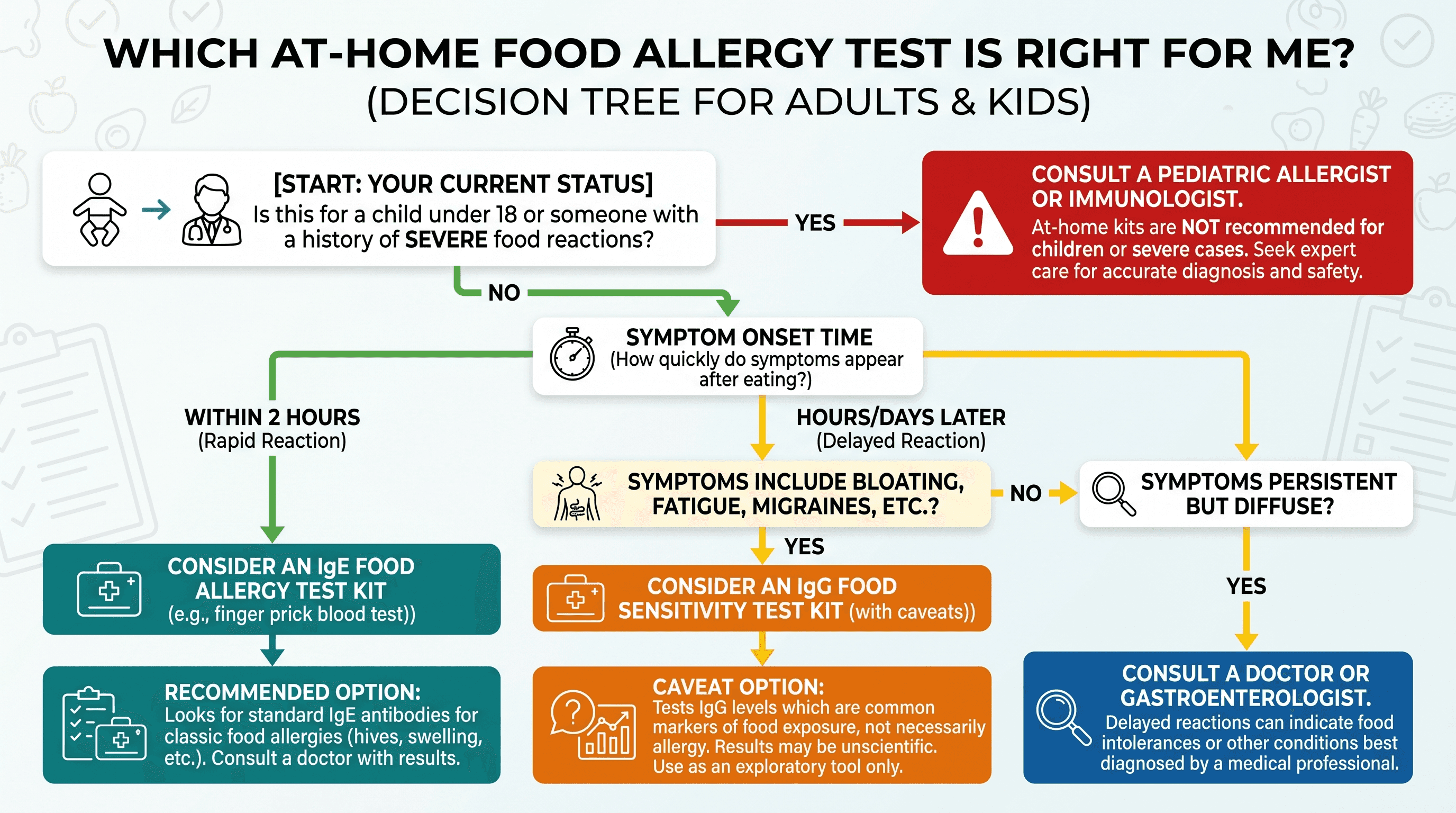
The following framework maps symptoms to the most appropriate course of action.
Hives, swelling, lip or throat tingling, vomiting, or breathing difficulty appearing within two hours of eating point toward a true IgE-mediated allergy. An IgE-based kit from a CLIA-certified lab is a reasonable first step, followed by allergist confirmation.
Bloating, fatigue, brain fog, skin changes, or headaches appearing hours or days after eating suggest the possibility of a food sensitivity. An IgG panel is an exploratory tool here, not a diagnostic one, and it should be used alongside a dietitian.
Digestive symptoms like gas, cramping, or diarrhea specifically tied to dairy, wheat, or other common intolerances point toward intolerance rather than allergy. Breath testing and a supervised elimination diet are more appropriate than any antibody panel.
Children under 18, anyone who has used an EpiPen, anyone who has experienced anaphylaxis, and pregnant or breastfeeding individuals should skip at-home testing entirely and proceed directly to allergist evaluation.
How to Use an At-Home Food Allergy Test Kit
The process is consistent across most major IgE-based kits and takes less than fifteen minutes on the day of collection.
Order the kit online and wait for it to arrive. Before collecting a sample, register the kit on the company's platform to ensure results reach the correct account. Hydrate well in the hours before collection, since adequate hydration makes finger-prick collection easier. Warm the finger by rubbing it or holding it briefly under warm water to improve blood flow. Use the provided lancet on the side of a fingertip, not the pad. Allow blood to drop onto the collection card without smearing. Seal and package the card according to the enclosed instructions and mail it using the prepaid return label.
Digital results typically arrive within three to seven days via the company's app or web portal. Most platforms allow the report to be downloaded as a PDF for sharing with a physician.
How to Read and Act on Your Results
This step is where most at-home testing guides fall short. A result without context is not particularly useful.
After an IgE positive result
An IgE positive result indicates sensitization to a specific food protein. Sensitization means the immune system has produced IgE antibodies in response to that protein. It does not automatically confirm a clinically significant allergy.
The appropriate next step is booking an appointment with a board-certified allergist and bringing the printed or digital result. The allergist will likely recommend a skin prick test, additional specific IgE bloodwork, or in some cases, a supervised oral food challenge, which is considered the gold standard for confirming or ruling out a food allergy. Do not begin food elimination based solely on an at-home IgE result without professional guidance. Some sensitizations never become symptomatic allergies, and eliminating foods unnecessarily carries its own risks.
To find a qualified specialist, search for an allergist or immunologist near you using a physician directory to book a follow-up consultation.
After an IgG sensitivity panel result
IgG results typically report a reactivity score for each tested food, often on a color-coded scale from low to high. High reactivity does not mean a dangerous reaction. It often reflects frequency of consumption.
Working with a registered dietitian, a structured elimination protocol involves removing high-reactivity foods for a defined period, typically four to six weeks, and then reintroducing them one at a time while tracking symptoms. This approach generates useful data when done carefully. Blanket elimination of all high-reactivity foods simultaneously can compromise nutrition, disrupt gut microbiome diversity, and make it harder to identify actual triggers.
Cost, Insurance, and HSA/FSA Eligibility
At-home food allergy test kits range from approximately $60 for basic IgE panels to over $350 for comprehensive combination kits. IgG sensitivity panels typically fall between $99 and $250 depending on panel size.
HSA and FSA eligibility: Several IgE-based kits qualify for payment through Health Savings Accounts (HSA) or Flexible Spending Accounts (FSA). Labcorp OnDemand, Everlywell, and 4U Health have confirmed HSA/FSA eligibility for qualifying products. Check the product page before purchasing to confirm eligibility, as it can vary by kit type.
Insurance reimbursement: Insurance coverage for at-home kits is not standard. IgE panels ordered through a physician's office are more likely to receive coverage than self-purchased kits. IgG sensitivity panels are rarely if ever covered by insurance, regardless of how they are ordered. Readers dealing with ongoing symptoms may find that visiting an allergist first, obtaining a physician-ordered IgE panel, and submitting through insurance results in lower out-of-pocket costs than purchasing a kit directly.
State restrictions: Some kits are not available in New York, New Jersey, or Rhode Island due to state-specific laboratory laws. Always verify state availability before ordering.
When to Skip the Kit and See an Allergist Instead
At-home kits are screening tools. They are not a substitute for clinical evaluation, and for certain individuals they are not appropriate at all.
See an allergist directly, without attempting at-home testing first, if any of the following apply: a history of severe allergic reactions or anaphylaxis, prior use of an epinephrine auto-injector (EpiPen), symptoms affecting breathing, swallowing, or blood pressure, reactions to multiple unrelated foods simultaneously, or age under 18. Parents seeking answers about a child's possible food allergy should work with a pediatric allergist from the start.
The oral food challenge, conducted under direct clinical supervision, remains the diagnostic gold standard for confirming or ruling out food allergy according to the American College of Allergy, Asthma and Immunology (ACAAI). At-home kits can support and inform that process, but they cannot replace it.
For broader guidance on understanding symptoms and finding the right type of care, Momentary Lab's AI Healthcare Navigator can help identify relevant information and point toward the right next steps.
Frequently Asked Questions
Are at-home food allergy test kits accurate?
IgE-based kits processed by CLIA-certified laboratories produce results comparable in methodology to physician-ordered blood tests. A positive IgE result indicates sensitization to a food protein, which is clinically meaningful, though confirmation by an allergist is still recommended. IgG-based sensitivity panels are a different category entirely. Per the AAAAI, IgG testing is not a validated diagnostic tool for food allergy or intolerance, so "accurate" is not the right frame for evaluating those results.
What is the difference between a food allergy test and a food sensitivity test?
A food allergy test measures IgE antibodies, which are part of the immune system's rapid-response mechanism. A food sensitivity test typically measures IgG antibodies, which reflect exposure rather than immune reactivity. These tests answer different questions, have different levels of clinical support, and should not be used interchangeably.
Can I test for gluten intolerance at home?
At-home IgE panels can screen for wheat allergy, which is different from celiac disease or non-celiac gluten sensitivity. Celiac disease requires specific blood tests measuring antibodies such as anti-tTG IgA, and definitive diagnosis involves an endoscopic biopsy. A wheat IgE result does not diagnose celiac disease. Anyone suspecting celiac disease should not begin a gluten-free diet before testing, as dietary changes affect the accuracy of celiac bloodwork.
Which food allergy test kit is most accurate?
For true IgE-mediated food allergies, Labcorp OnDemand's physician-reviewed panel offers the highest level of rigor among at-home options, including reflex component testing on positive results. Any CLIA-certified IgE kit from a major provider will produce clinically relevant data. IgG sensitivity tests do not have a "most accurate" ranking in any meaningful clinical sense because their diagnostic validity is limited regardless of brand.
Should I see a doctor instead of using an at-home food allergy test?
Anyone with a history of severe reactions, use of an epinephrine injector, respiratory symptoms during reactions, or reactions in a child should see a board-certified allergist rather than starting with at-home testing. For adults with mild, delayed symptoms and no history of severe reactions, a CLIA-certified IgE kit can be a reasonable first step before or alongside a physician consultation.
Are at-home food allergy tests covered by insurance or FSA?
Standard health insurance rarely covers self-purchased at-home kits. HSA and FSA funds can be used for several IgE-based kits from Labcorp OnDemand, Everlywell, and 4U Health. Physician-ordered IgE blood panels submitted through a laboratory have a higher chance of partial insurance reimbursement.
Can a hair test detect food allergies?
No. Hair analysis and bioresonance devices have no validated scientific mechanism for detecting food-specific immune responses. No peer-reviewed evidence supports their use for allergy or intolerance testing. They are not CLIA-certified. Purchasing these tests provides no clinically useful information.