
If you have been sneezing through every spring, breaking out after certain meals, or just feeling perpetually run-down with no clear cause, the idea of mailing a few drops of blood to a lab and getting answers in a week sounds genuinely appealing. At-home allergy test kits have matured significantly, and a few of them now use the same IgE immunoassay technology that allergists rely on in clinical settings. But the category also has a noisy fringe of scientifically unsupported products that look similar on a shelf. This guide cuts through all of it.
At a Glance
| Topic | Key Facts |
|---|---|
| What they test | IgE antibodies (true allergy) or IgG antibodies (sensitivity, controversial) |
| Sample type | Finger-prick dried blood spot, mailed to a CLIA-certified lab |
| Turnaround time | 5 to 10 business days for most kits |
| Accuracy vs. in-office | IgE blood tests: comparable to in-office serum IgE panels; IgG panels: not validated for clinical diagnosis |
| Who should use them | Adults and older children with mild, exploratory allergy questions |
| Who should skip them | Anyone with anaphylaxis history, severe reactions, or complex pediatric cases |
| Cost range | $50 to $500+ depending on panel size |
| FSA/HSA eligible | Many IgE-based kits qualify; confirm with your FSA administrator |
What Is an At-Home Allergy Test Kit and How Does It Work?
An at-home allergy test kit is a consumer diagnostic tool that measures immune markers in a small blood sample you collect yourself, then ships to a certified laboratory for analysis. The kit arrives with a lancet for a finger-prick, a collection card or tube, a prepaid return mailer, and instructions. You do not need clinical training to complete the collection.
The key distinction sitting underneath all at-home allergy testing is the difference between an IgE-based test and an IgG-based test. IgE (immunoglobulin E) is the antibody the immune system produces during a true allergic reaction. IgG (immunoglobulin G) is a different antibody altogether, and its role in food sensitivity is contested among allergists. Understanding this distinction before purchasing any kit is the most important step in this entire process.

Allergy vs. Sensitivity vs. Intolerance: Why the Difference Matters
These three terms are used interchangeably in marketing, but they describe three distinct biological processes, and confusing them leads to wasted money and missed diagnoses.
Food Allergy (IgE Response)
A food allergy is an immune-mediated reaction driven by IgE antibodies. When a sensitized person is exposed to an allergen, IgE triggers mast cells to release histamine and other inflammatory chemicals, producing symptoms that range from hives and nasal congestion to anaphylaxis. According to the American Academy of Allergy, Asthma and Immunology (AAAAI), IgE-mediated testing is the established clinical standard for diagnosing true allergies. Reactions are typically rapid, appearing within minutes to two hours of exposure.
Food Sensitivity and Intolerance (IgG Response)
Food sensitivity describes a delayed, non-immune reaction to a food that does not involve IgE. Food intolerance, such as lactose intolerance, has a metabolic rather than immunological basis. IgG panels marketed as sensitivity tests measure IgG4 or total IgG antibodies to dozens of foods. The AAAAI has explicitly stated that IgG food panel testing is not a validated diagnostic tool and that elevated IgG to a food may simply reflect recent dietary exposure, not intolerance.
That said, IgG panels are not entirely without use. Some practitioners use them as a hypothesis-generating tool to prioritize elimination diets, with the understanding that a positive result requires confirmation through a structured elimination and reintroduction protocol, not dietary elimination alone. If you choose an IgG panel, treat it as a starting point for a conversation with a clinician, not as a diagnosis.
How At-Home Allergy Test Kits Work
The process from unboxing to results follows a consistent sequence across most reputable kits. Understanding each step helps avoid the most common collection errors that lead to rejected samples.
The Finger-Prick Blood Test Process
Warm your hands under warm water for two minutes before collection; cold hands reduce blood flow and make the prick more difficult. Use the lancet included in the kit to prick the side of a fingertip, not the pad, which is denser and more painful. Let gravity and gentle pressure do the work rather than squeezing aggressively, which can introduce tissue fluid and dilute the sample.
One preparation step that most competitor guides skip: antihistamines do not typically interfere with IgE blood tests, because the test measures circulating IgE antibody levels rather than a histamine response. However, oral corticosteroids and some immunosuppressants can suppress IgE levels and affect results. If you take these medications regularly, disclose this to your clinician before ordering or interpreting any allergy test. Some kits also ask you to avoid heavy allergen exposure in the 24 hours before collection, though the evidence base for this instruction is limited.
Allow the blood spot to dry completely on the collection card, at least 30 minutes, before sealing it in the provided biohazard bag and placing it in the prepaid mailer. Ship same day or the following morning if possible.
What Lab Certifications to Look For (CLIA, CAP, ISO)
Three certifications signal that the lab analyzing your sample meets rigorous quality standards. CLIA (Clinical Laboratory Improvement Amendments) is a US federal certification administered by CMS that requires labs processing human specimens to meet proficiency testing and personnel standards. CAP (College of American Pathologists) accreditation goes further, requiring unannounced on-site inspections and peer-review programs. ISO 15189 is an international standard specifically for medical laboratories covering competence and quality management.
Any at-home allergy test kit worth purchasing will process samples at a CLIA-certified lab. CAP accreditation is the gold standard and should be your preference for IgE panels where diagnostic accuracy matters most.
Types of At-Home Allergy Tests: Which One Is Right for You?
The right kit depends entirely on what you are trying to learn. Using an IgG panel when you suspect a true IgE-mediated allergy, for example, will produce data that cannot confirm or rule out your actual concern.
Environmental Allergy Tests (Dust, Pollen, Pet Dander, Mold)
Environmental panels test IgE reactivity to inhalant allergens: tree pollen, grass pollen, weed pollen, dust mites, cat and dog dander, cockroach, and mold species. These are among the most accurate application of at-home IgE testing. The specific IgE values generated align with those used in clinical practice to guide decisions about allergy immunotherapy. Turnaround is typically five to seven business days.
Food Allergy Tests (IgE-Based)
IgE food panels cover the most common allergenic foods: peanuts, tree nuts, milk, eggs, wheat, soy, fish, and shellfish. According to a review published in the Journal of Allergy and Clinical Immunology: In Practice, specific IgE blood tests for food allergens have a high specificity when results are interpreted in the context of clinical history, meaning that a high IgE value combined with a credible reaction history is diagnostically meaningful. A positive result alone, without a consistent clinical history, can produce false positives that do not represent a clinically relevant allergy.
Food Sensitivity Panels (IgG-Based: Use With Caution)
IgG panels test for reactions to a wide range of foods, sometimes 96 to over 200 items. They are widely marketed but, as noted above, not validated for clinical diagnosis by major allergy organizations. Use these only as a structured starting point for elimination diet exploration, always in consultation with a dietitian or physician, and never as justification for eliminating major food groups unsupervised.
How Accurate Are At-Home Allergy Tests?
Accuracy depends almost entirely on the test type. IgE blood tests have a well-established accuracy profile. IgG panels and non-blood-based tests do not.
Why False Positives Happen and What They Actually Mean
A false positive on an IgE test occurs most often because of cross-reactivity. Birch pollen allergy, for example, frequently triggers positive IgE results to apples, pears, and stone fruits because the proteins share structural similarities. This is not a food allergy in the clinical sense; it is oral allergy syndrome, and most people with it tolerate cooked versions of those foods without difficulty.
CCD (cross-reactive carbohydrate determinants) are another source of false positives. CCDs are sugar structures found in plant and insect proteins that can bind IgE antibodies without causing clinical reactions. Some lab platforms include anti-CCD antibody controls to flag this interference; others do not. This is worth asking about when choosing a kit.
A positive result on a reputable IgE test does not confirm an allergy. It confirms sensitization, which is the presence of IgE antibodies. Whether sensitization translates to a clinically relevant allergy requires correlation with your symptom history, ideally reviewed by a clinician.
Test Types With No Scientific Backing (Hair, Saliva, Pulse Tests)
Several products in this space use testing methods that have no clinical validation. Hair-based testing (marketed by brands like 5Strands) purports to detect food sensitivities through a bioresonance or electrodermal scan of hair samples. There is no peer-reviewed evidence supporting this methodology. The American College of Allergy, Asthma and Immunology (ACAAI) does not recognize hair analysis, kinesiology-based testing, or pulse testing as valid allergy diagnostic methods.
Saliva IgE testing has lower sensitivity than serum IgE testing for most allergens and has not been validated for clinical decision-making at the consumer level. Pulse testing, which claims to detect allergies based on heart rate changes after food ingestion, has no immunological basis.
"Unproven and disproven tests for the diagnosis of allergic diseases can result in the misdiagnosis of allergy, unnecessary dietary restrictions, delayed diagnosis of the true cause of symptoms, and incorrect or unnecessary treatment." American College of Allergy, Asthma and Immunology (ACAAI)
Avoid any at-home allergy product that does not explicitly state it measures IgE or IgG antibodies via immunoassay from a blood sample analyzed at a CLIA-certified lab.
Cost, Insurance, and FSA/HSA Eligibility
At-home allergy test kit pricing varies significantly based on the number of allergens tested and the type of antibody measured. A focused IgE panel covering 10 to 20 common environmental allergens typically runs from $50 to $150. Broader food allergy panels covering 40 to 100 foods range from $150 to $300. Comprehensive combined food and environmental IgE panels from physician-associated services like Wyndly can cost $300 to $500 or more, often bundled with a telehealth consultation.
Standard health insurance plans rarely cover at-home test kits directly, because they fall outside the clinical encounter framework insurers use for reimbursement. In-office specific IgE testing ordered by a physician is more likely to be covered after deductibles.
FSA and HSA funds can often be used to purchase IgE-based at-home allergy test kits, because they qualify as a medical diagnostic device under IRS guidelines. The key is that the test must be used to diagnose a medical condition, not for general wellness. Most reputable IgE kit sellers explicitly state FSA/HSA eligibility on their product pages, but confirming with your FSA administrator before purchase removes any ambiguity. IgG-based sensitivity panels are less consistently eligible, because their diagnostic status is contested.
Can Kids Use At-Home Allergy Test Kits?
This section is almost entirely absent from competing guides, which is a real gap because parents are among the most active purchasers of at-home allergy tests.
Most at-home allergy kits set a minimum age of 2 years for use, though the practicalities of a finger-prick collection from a toddler make it genuinely difficult below ages 4 to 5. The clinical accuracy of specific IgE blood tests in young children is comparable to that in adults, but the interpretation is more context-dependent: infants and toddlers can have elevated IgE to foods they will eventually tolerate, and sensitization rates shift considerably through early childhood.
Situations where a pediatric allergist visit is mandatory rather than optional include any child with a history of anaphylaxis, any child requiring an epinephrine auto-injector, suspected multiple food allergies in an infant or toddler, eczema that is severe or not responding to standard treatment, and any scenario where a food needs to be reintroduced under medical supervision. The American Academy of Pediatrics (AAP) recommends against delaying introduction of allergenic foods in infants without prior clinical evaluation, and at-home testing results should not be used to guide infant feeding decisions independently.
For older children aged 7 and up with suspected seasonal or environmental allergies, an at-home environmental IgE panel can provide useful preliminary information to bring to a pediatrician or allergist appointment.

At-Home Allergy Testing and Sublingual Immunotherapy
One significant development in the at-home allergy testing space is its integration with telehealth-based immunotherapy services. Companies like Wyndly use a proprietary at-home IgE test as the entry point to a sublingual immunotherapy (SLIT) program, where customized allergen drops are prescribed based on your specific IgE reactivity profile.
Sublingual immunotherapy is the administration of small, gradually increasing doses of allergens under the tongue to build immune tolerance over time. The American Academy of Allergy, Asthma and Immunology (AAAAI) recognizes SLIT as a clinically effective treatment for allergic rhinitis and some other IgE-mediated conditions, with a safety profile that allows home administration, unlike subcutaneous immunotherapy injections (SCIT), which must be administered in a clinical setting for 20 to 30 minutes of post-injection monitoring.
The connected testing-to-treatment model has real advantages: it eliminates the multi-month wait for an allergist appointment that many patients face, and it generates a clinically actionable IgE profile rather than a vague sensitivity report. The limitations are that SLIT services work best for environmental allergens (pollen, dust mites, pet dander) and are not currently a pathway to treating food allergies, which still require supervised oral immunotherapy in a clinical setting.
If your primary concern is seasonal or perennial environmental allergies and you are a candidate for immunotherapy, an IgE-based at-home test connected to a telehealth SLIT service is one of the most clinically meaningful ways to use at-home testing technology.
What to Do With Your At-Home Allergy Test Results
This is the section that almost no competitor guide provides in usable detail. A result is only as useful as the action it informs.
If Your Results Are Negative
A negative IgE result for a specific allergen is generally reliable and meaningful: it makes IgE-mediated allergy to that substance unlikely. But a negative result does not rule out non-IgE-mediated conditions, such as food protein-induced enterocolitis syndrome (FPIES), eosinophilic esophagitis, or contact dermatitis, all of which require separate clinical evaluation. If symptoms persist despite negative IgE results, an in-person evaluation is the appropriate next step.
If Your Results Are Positive
A positive result is the beginning of a diagnostic conversation, not the end of one. Bring the result to a physician or allergist, who will correlate it with your symptom history and potentially recommend confirmatory testing (a skin prick test or supervised oral food challenge) before making treatment recommendations. Do not eliminate major food groups from your or your child's diet based solely on at-home test results without clinical guidance.
Treatment pathways after confirmed allergy diagnosis include antihistamines and nasal corticosteroids for symptom management, allergen avoidance, SLIT for environmental allergens, and allergen-specific immunotherapy for food allergies in appropriate candidates under specialist supervision.
How to Talk to Your Doctor About At-Home Results
A simple, direct approach works best. At your appointment, you can say: "I ran an at-home IgE allergy panel through a CLIA-certified lab and got elevated results for a few allergens. I wanted to go through them with you to understand whether they're clinically significant for my symptoms and whether any follow-up testing makes sense."
That framing tells the clinician you used a scientifically grounded test type, you understand the limits of the result, and you are looking for clinical context rather than just confirmation. Physicians are far more receptive to at-home results presented this way.
If you are looking for a specialist, you can search for a board-certified allergist or primary care physician who can review your results, order confirmatory testing if warranted, and guide you toward a treatment plan suited to your specific findings.
At-Home vs. In-Office Allergy Testing: When to Skip the Kit
At-home IgE testing is appropriate for adults and older children with mild to moderate symptoms who want preliminary information before seeking a clinical appointment, or who want to start a telehealth-based immunotherapy program for environmental allergies.
In-office testing is the right choice when any of the following apply: a history of anaphylaxis or use of an epinephrine auto-injector, symptoms severe enough to affect daily functioning, suspected allergy in an infant or toddler, inconclusive or contradictory at-home results, the need to test with a larger allergen panel than at-home kits support, or a requirement for skin prick testing, which cannot be performed outside a clinical setting.
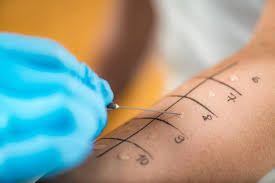
A skin prick test involves placing small amounts of allergen extract on the forearm or back skin and using a lancet to introduce it just below the surface. It provides results in 15 to 20 minutes and is widely regarded as the most cost-effective and sensitive method for inhalant allergy diagnosis. It requires in-person administration and post-test monitoring for rare systemic reactions.
At-home and in-office testing are not competitors. For many people, an at-home IgE panel is a useful first step that makes the in-office visit more targeted and efficient.
Frequently Asked Questions
Do I need to stop taking antihistamines before an at-home IgE blood test?
For IgE blood tests specifically, antihistamines do not need to be stopped, because the test measures antibody levels in your blood rather than a skin or histamine response. You would need to stop antihistamines before a skin prick test, which cannot be performed at home. If you take oral corticosteroids or immunosuppressants, discuss timing with your clinician before testing.
Are at-home allergy test results protected under HIPAA?
HIPAA (the Health Insurance Portability and Accountability Act) applies to covered entities such as healthcare providers, health plans, and healthcare clearinghouses. At-home test kit companies vary in how they handle data: most operate under their own privacy policies rather than HIPAA, though some with integrated telehealth components are covered entities. Review the privacy policy of the specific company before purchasing if data privacy is a concern.
How long do at-home allergy test results take?
Most CLIA-certified kits report results within five to ten business days of the lab receiving your sample. Some services offer expedited processing for an additional fee. Timeline starts when the lab receives the sample, not when you mail it, so shipping time adds one to two days depending on your location.
Can I use FSA or HSA funds to pay for an at-home allergy test kit?
IgE-based at-home allergy test kits are generally FSA and HSA eligible, because they are used to diagnose a medical condition. IgG sensitivity panels have less consistent eligibility. Most reputable kit sellers indicate FSA/HSA eligibility on their product page, and many accept FSA/HSA cards directly at checkout.
Are at-home allergy tests actually worth it?
For someone with mild to moderate suspected environmental or food allergies who wants organized, clinically grounded information before or between specialist appointments, a CLIA-certified IgE-based at-home kit offers real value. For someone who has had an anaphylactic reaction, has a complex allergy history, or is considering immunotherapy for food allergy, an in-office evaluation with a board-certified allergist is a better starting point.
Are hair-based or saliva-based allergy tests legitimate?
No. Neither hair analysis nor saliva-based IgE testing has been validated for allergy diagnosis by any major clinical allergy organization, including the AAAAI or the ACAAI. These tests cannot diagnose allergies or intolerances and should be avoided.
Navigating Your Next Step
At-home allergy testing has moved well past its early-generation limitations, but only for products grounded in validated IgE immunoassay technology from CLIA-certified labs. The right kit, used correctly and interpreted with clinical context, can give you genuinely useful information and connect you to treatment pathways that would otherwise require months on a specialist waitlist.
If you want help understanding your options, comparing care pathways, or finding clinicians who work with at-home allergy test results, the Momentary Lab AI healthcare navigator is a free resource built to help you find the right information and the right next step for your specific situation.