


Primary care doctors can legally prescribe Adderall, but whether yours actually will depends on a tangle of regulatory requirements, clinic policy, and clinical judgment that most patients never see coming.
The short answer is yes. The full answer is: it depends on three things that have nothing to do with your symptoms.
At a Glance
| Topic | Key Facts |
|---|---|
| Can a PCP prescribe Adderall? | Yes, legally. But clinic policy, state law, and case complexity often determine whether they will. |
| DEA classification | Schedule II controlled substance. No automatic refills. Strict prescriber rules apply. |
| New diagnosis vs. refill | PCPs routinely handle refills. New diagnoses are where most hesitation occurs. |
| Telehealth rules (2026) | DEA temporary extension allows Schedule II prescriptions via telehealth through December 31, 2026. |
| Who else prescribes? | Psychiatrists, nurse practitioners, physician assistants, pediatricians, neurologists. |
| Alternatives if PCP declines | Specialist referral, PMHNP, community mental health center, telehealth platform. |
| Non-stimulant options | Strattera (atomoxetine), Wellbutrin (off-label), Intuniv, Kapvay. |
The Short Answer (and Why It Is More Nuanced Than a Yes/No)
Yes, a primary care physician (PCP) is fully licensed to prescribe Adderall. The question is whether the doctor in front of you will, and that comes down to three variables: state-level regulations governing controlled substance prescribing, the individual physician's clinical comfort level with stimulant medications, and the complexity of the patient's case.
A straightforward adult who was previously diagnosed and stabilized by a psychiatrist? Many PCPs are glad to take over monthly management. A patient walking in without a prior diagnosis, reporting classic ADHD symptoms, and asking for a stimulant by name? That visit looks and feels very different to the prescriber across the desk.
Understanding these variables is not just useful background. It is the difference between leaving an appointment with a prescription or a referral.
Why Adderall Is Harder to Prescribe Than Most Medications
Most prescription drugs fall under no special federal regulatory framework beyond basic prescribing standards. Adderall is not most drugs.
DEA Schedule II: What It Actually Means for Your Prescription
Adderall (amphetamine salts) is classified by the Drug Enforcement Administration as a Schedule II controlled substance, the most tightly regulated category of drugs that still have accepted medical use. Schedule II status means the federal government has determined that the substance carries a high potential for misuse and physical or psychological dependence.
For patients, the practical consequences are immediate. Schedule II prescriptions cannot be called in to a pharmacy. They cannot be automatically refilled. Each prescription requires a separate written or electronic order from a DEA-registered prescriber. In most states, a 30-day supply is the standard limit per prescription, though some states permit a prescriber to issue up to three 30-day prescriptions simultaneously, post-dated so the patient can fill them sequentially across three months.
Every physician, nurse practitioner, and physician assistant who prescribes controlled substances must hold an active DEA registration number. That registration comes with audit risk and liability exposure. For primary care physicians who prescribe stimulants infrequently, that liability can feel disproportionate to the clinical benefit, which is one concrete reason some PCPs refer ADHD cases out even when they are technically qualified to handle them.
"Stimulant medications have well-established efficacy for ADHD, but their Schedule II classification means prescribers must weigh clinical benefit against regulatory obligations on every prescription they write." — National Institute of Mental Health
Who Else Can Prescribe Adderall (Beyond Your Primary Care Doctor)
If a PCP is not the right fit for a given patient, several other provider types can evaluate and prescribe.
Psychiatrists
Psychiatrists are the most common specialist destination for ADHD diagnosis and stimulant management. They specialize in mental health conditions including ADHD, are comfortable with the diagnostic nuance that Schedule II prescribing requires, and are well-positioned to manage cases where ADHD overlaps with anxiety, depression, or other conditions. The tradeoff is access: psychiatrist wait times in many US regions range from several weeks to several months, and not all psychiatrists accept insurance.
Nurse Practitioners and Physician Assistants
Nurse practitioners (NPs) and physician assistants (PAs) are authorized to prescribe Schedule II medications in most US states, provided state law permits it and they hold the appropriate DEA registration. This is a category that most competing sources overlook entirely. In practice, NPs and PAs at primary care clinics, urgent care centers, and telehealth platforms frequently handle ADHD medication management. A psychiatric mental health nurse practitioner (PMHNP) in particular offers near-psychiatrist-level expertise with shorter wait times in many markets.
Pediatricians (for Children and Adolescents)
For patients under 18, the primary prescribing pathway typically runs through a pediatrician rather than a family medicine physician. Pediatricians routinely diagnose and manage ADHD in children and adolescents, and most are comfortable initiating stimulant therapy after a clinical evaluation. For children with more complex presentations, such as suspected learning disabilities or treatment resistance, a developmental pediatrician or child psychiatrist may be the right next step.
Neurologists
Neurologists are an underutilized option for adult ADHD, particularly when the presentation involves a history of traumatic brain injury, seizure disorders, or other neurological conditions that complicate the diagnostic picture. Most neurologists do not manage ADHD as a primary caseload, but for patients with overlapping neurological diagnoses, a referral to neurology can resolve both sets of symptoms under one provider.
What Happens During a PCP Evaluation for Adderall
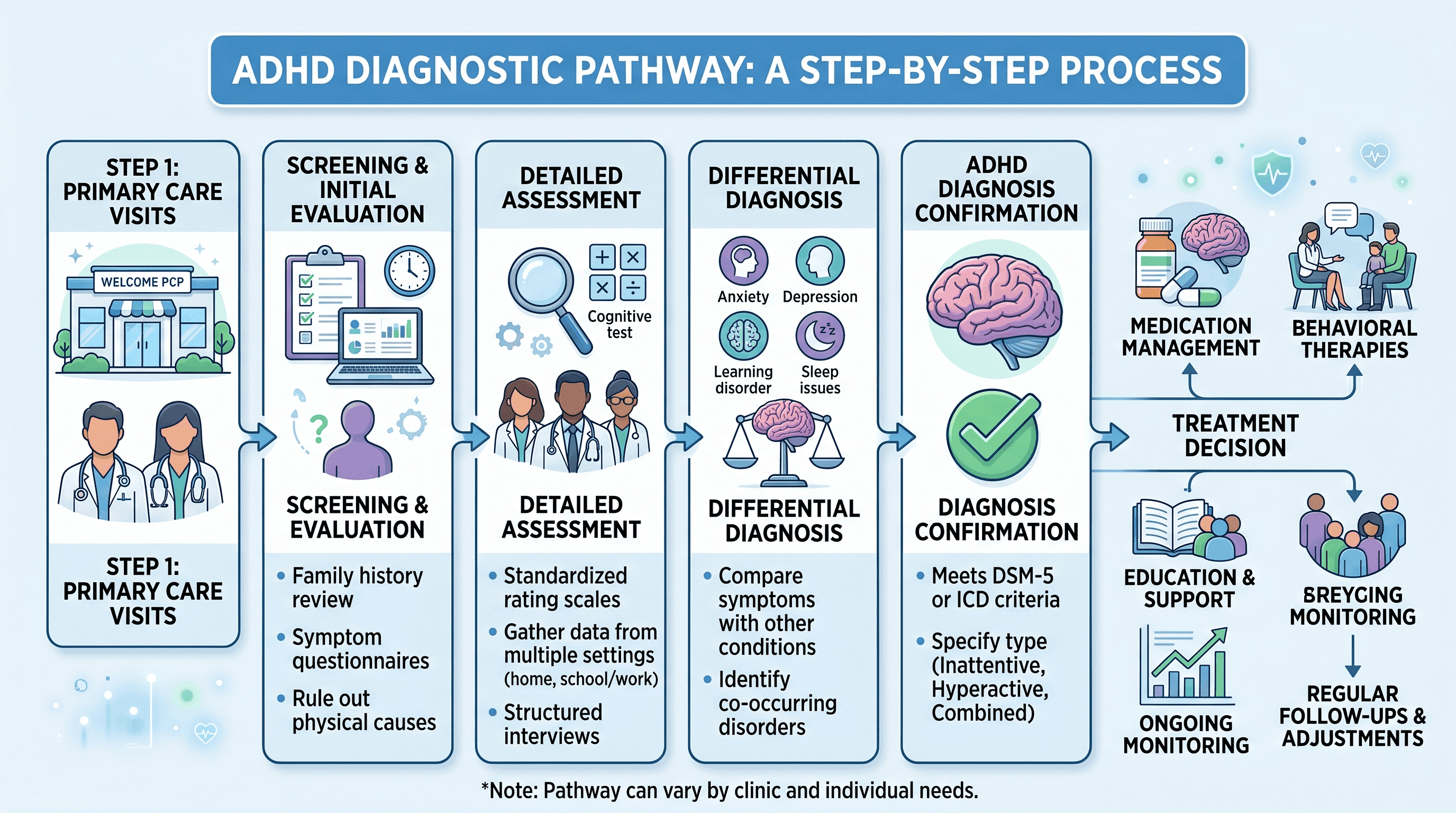
A PCP evaluation for ADHD medication is not a single conversation. It is a structured clinical process, and arriving prepared substantially increases the chance of a productive outcome.
What to Bring to Your First Appointment
Before the appointment, compile a written record of symptoms and their functional impact. This means specific, concrete examples: missed deadlines at work, inability to complete tasks that were started, chronic disorganization leading to financial consequences, or sustained difficulties in school that predated any adult stressors. Old report cards, academic records, or letters from employers documenting performance concerns can all strengthen the clinical picture. Standardized self-report tools such as the Adult ADHD Self-Report Scale (ASRS) are freely available and worth completing before the visit as a structured way to organize symptom history.
One practical note: walking into an appointment and asking directly for Adderall by name can inadvertently signal drug-seeking behavior to a prescriber who does not yet know the patient. Leading with specific functional impairments and asking what the evaluation process looks like is a more clinically productive framing.
How the Diagnostic Process Works (DSM-5 in Plain Terms)
A formal ADHD diagnosis in adults requires meeting criteria established in the Diagnostic and Statistical Manual of Mental Disorders, Fifth Edition (DSM-5), published by the American Psychiatric Association. The core requirement is a persistent pattern of inattention or hyperactivity-impulsivity that has been present since before age 12, shows up across multiple settings (work, home, social), and causes measurable functional impairment.
A PCP conducting this evaluation will typically use one or more standardized rating scales, such as the Conners Adult ADHD Rating Scales or the ASRS, alongside a detailed clinical interview. Some PCPs also request input from a family member or close colleague who can corroborate symptom patterns across settings. The evaluation also includes ruling out other conditions that produce similar symptoms, which leads directly to the next section.
When a PCP Will (and Won't) Prescribe Adderall
The most practically useful framework is not "will my PCP prescribe Adderall" as a yes/no question. It is understanding which patient presentations PCPs handle directly and which ones prompt a referral.
Cases Most PCPs Handle Directly
Primary care physicians are generally comfortable managing patients who carry an established ADHD diagnosis from a prior provider, have been stable on a stimulant medication for at least one treatment cycle, have no current psychiatric comorbidities that complicate the picture, and have no significant medical contraindications such as a history of cardiac arrhythmia or uncontrolled hypertension. In these situations, a PCP can handle ongoing prescription management efficiently and appropriately.
Adult patients presenting with a new suspected ADHD diagnosis, a straightforward symptom profile without significant psychiatric overlap, and no complex medical history are also frequently managed at the primary care level, particularly at practices that have a protocol in place for ADHD evaluation.
Cases That Warrant a Specialist Referral
Several clinical patterns reliably prompt a PCP to refer rather than prescribe. ADHD presenting alongside significant anxiety or depression introduces diagnostic and treatment complexity that most PCPs prefer a psychiatrist to manage, since stimulants can exacerbate anxiety and the symptom overlap between ADHD and mood disorders requires careful clinical differentiation.
Children with suspected ADHD and possible learning disabilities benefit from a comprehensive neuropsychological evaluation that a pediatric specialist is better positioned to coordinate. Patients who have not responded to one or more prior ADHD medications are considered treatment-resistant and warrant specialist evaluation. Patients with a cardiac history, structural heart disease, or significant elevation in blood pressure require cardiology clearance before stimulants can be safely initiated, per American Heart Association guidance.
What If Your PCP Won't Prescribe Adderall?
A PCP declining to prescribe is not the end of the road. It is a detour with several well-marked alternate routes.
The first step is to ask specifically for a formal referral to a psychiatrist or PMHNP. A referral from a PCP can reduce wait times at some practices and may improve insurance coverage for the specialist visit. If the PCP's hesitation is based on clinic policy rather than clinical judgment, asking for that referral is entirely appropriate.
The second option is self-referral to a psychiatrist, PMHNP, or a community mental health center. Federally Qualified Health Centers (FQHCs), which operate on sliding-scale fees based on income, are an underutilized resource for patients without robust insurance coverage who need access to mental health prescribers.
Telehealth is a third and increasingly practical pathway. Several telehealth platforms currently operate under the DEA's 2026 temporary extension rules, which permit Schedule II prescribing for new patients without a prior in-person visit through December 31, 2026. If managing ADHD through an in-person clinic feels logistically challenging, connecting with a primary care provider through a virtual visit may be a practical bridge while pursuing a longer-term specialist relationship.
Telehealth and Adderall Prescriptions: The 2026 Rules Explained
The regulatory landscape for telehealth prescribing of controlled substances has changed significantly since the original COVID-19 emergency rules expired, and the 2026 rules represent the most current framework patients and providers are operating under.
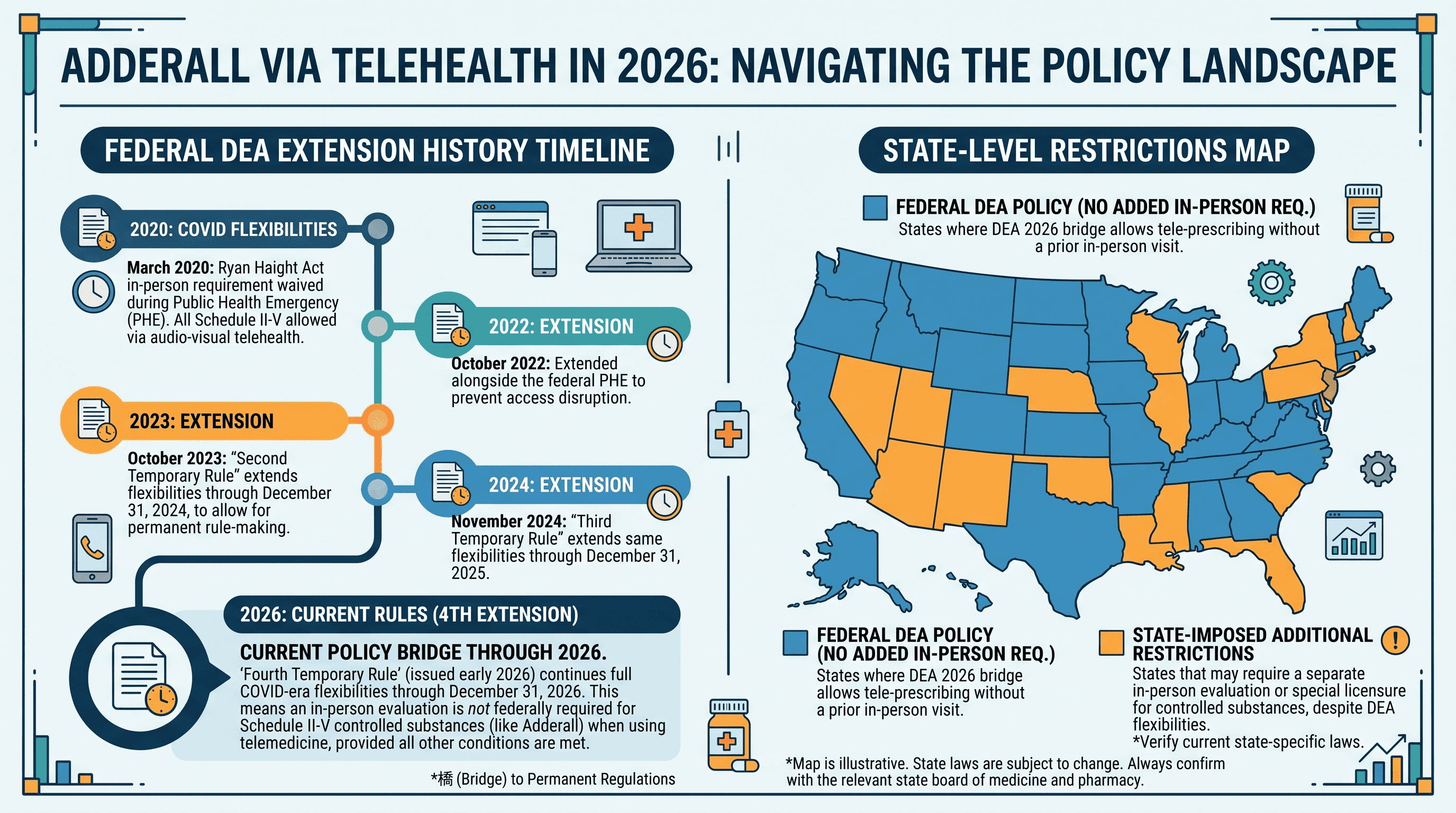
The DEA issued its fourth temporary extension of telemedicine flexibilities, effective January 1 through December 31, 2026, which allows practitioners to prescribe Schedule II controlled substances to new patients via telehealth without a prior in-person evaluation, provided the prescription is clinically appropriate and the practitioner holds DEA registration. According to the Department of Health and Human Services, over 7 million prescriptions for controlled medications were issued via telemedicine without a prior in-person visit in 2024 alone, reflecting how substantially this pathway has become embedded in standard care delivery.
State-level variation matters here. Some states impose restrictions on controlled substance prescribing via telehealth that are more stringent than the federal DEA rules, and the stricter rule always governs. Patients should verify their state's current telehealth prescribing regulations before assuming that a federal extension makes a telehealth stimulant prescription straightforward in their location.
Looking ahead, the DEA's Special Registration framework, which would establish a formal permanent pathway for telemedicine prescribing of controlled substances, remains under regulatory development. What comes after the 2026 extension ends is not yet finalized, making this an area where checking current rules before initiating a telehealth ADHD treatment relationship is worth the five minutes it takes.
Could Something Other Than ADHD Be Causing Your Symptoms?
A PCP who asks to rule out other conditions before initiating ADHD workup is not gatekeeping. That step is patient-protective, and understanding why can make the process feel less frustrating.
Several conditions produce symptom profiles that overlap substantially with ADHD. According to the Mayo Clinic, anxiety disorders frequently present with difficulty concentrating, restlessness, and impulsivity, all of which satisfy ADHD symptom criteria. Depression produces fatigue and cognitive slowing that can be misread as inattention. Sleep disorders, including obstructive sleep apnea, generate the daytime impairment, distractibility, and executive dysfunction that mirror ADHD so closely that undiagnosed sleep apnea is one of the most common causes of adult ADHD misdiagnosis.
Thyroid dysfunction, particularly hypothyroidism, produces cognitive fog, fatigue, and slowed processing that can present as concentration difficulties. A PCP ordering a thyroid panel before referring to psychiatry is applying sound diagnostic logic, not bureaucratic delay.
Chronic stress, particularly prolonged occupational or relational stress, can temporarily produce an ADHD-like cognitive profile that resolves when the stressor is addressed. Treating that presentation with a stimulant does not resolve the underlying cause and introduces medication risk unnecessarily.
None of this means that a patient's ADHD is not real or that their symptoms should be dismissed. It means that arriving at the right diagnosis is worth the additional steps, because the right treatment depends entirely on the right diagnosis.
Frequently Asked Questions
Will a PCP prescribe Adderall on the first visit?
It is uncommon for a PCP to prescribe Adderall at the first visit for a patient with no prior ADHD diagnosis. Most primary care practices require at least one structured evaluation appointment before initiating any stimulant prescription, and many require rating scale completion and a review of prior records as part of that process. Patients with an established diagnosis from a previous provider may have a different experience, as continuity-of-care refills often require less extensive re-evaluation.
Can a nurse practitioner prescribe Adderall?
Yes. In most US states, nurse practitioners with the appropriate DEA registration are authorized to prescribe Schedule II controlled substances including Adderall. Psychiatric mental health nurse practitioners (PMHNPs) in particular are well-qualified to diagnose ADHD and manage stimulant medications. State-level scope-of-practice laws vary, so verifying that the NP in question holds full prescriptive authority in that state is worth confirming.
How often do follow-up appointments happen after starting Adderall?
After initiating stimulant therapy, most prescribers schedule a follow-up within four to six weeks to assess medication response, side effects, and dosing. Once a patient is stable on a dose that is working, follow-up intervals typically extend to every one to three months, which aligns with the refill schedule. The American Academy of Pediatrics recommends follow-up at least twice yearly for pediatric patients on stimulant medications; adult follow-up intervals are determined by individual clinical judgment.
Is Adderall covered by insurance?
Generic amphetamine salts, which are the generic form of Adderall, are covered by most major health insurance plans including many Medicaid formularies, typically at a low or no copay tier. Brand-name Adderall and extended-release formulations vary significantly in coverage and copay cost. Insurance plans often require prior authorization for stimulant medications, which means the prescriber submits clinical documentation supporting medical necessity before the pharmacy can dispense the prescription. A doctor can advise on individual coverage situations and assist with prior authorization if needed.
How does the Adderall shortage affect getting a prescription?
The Adderall shortage that began in late 2022 has continued to affect supply chains into 2026, though availability varies significantly by region, pharmacy, and formulation. Generic amphetamine salts have been more consistently available than brand-name products in many markets. Patients affected by the shortage may benefit from calling pharmacies before filling a new prescription to confirm stock, asking their prescriber whether an alternative formulation or a different stimulant medication such as methylphenidate (Ritalin, Concerta) might be appropriate if Adderall is unavailable, and checking the FDA drug shortage database for current status.
What are non-stimulant alternatives if a PCP won't prescribe Adderall?
Several non-stimulant medications are FDA-approved for ADHD or used off-label with reasonable evidence supporting their use. Strattera (atomoxetine) is FDA-approved for both pediatric and adult ADHD and does not carry Schedule II classification, making it more accessible through primary care. Intuniv (guanfacine extended-release) and Kapvay (clonidine extended-release) are FDA-approved for pediatric ADHD and are sometimes used in adults. Wellbutrin (bupropion) is prescribed off-label by some PCPs for adult ADHD, particularly when depression is also present. A primary care doctor can advise on which option fits the patient's clinical profile.
If navigating these options feels complicated, using Momentary's AI health navigator to understand symptoms, explore what questions to bring to a provider, and get guidance on next steps can be a productive starting point before the appointment.
References
- Drug Enforcement Administration — Drug Scheduling — Cited for Schedule II classification of amphetamine salts.
- National Institute of Mental Health — ADHD — Cited for stimulant medication efficacy and DSM-5 diagnostic criteria context.
- U.S. Department of Health and Human Services — Telemedicine Prescribing Data — Cited for 2024 telemedicine controlled substance prescription volume data.
- Mayo Clinic — Adult ADHD: Symptoms and Causes — Cited for conditions that mimic ADHD including anxiety, depression, and sleep disorders.
- American Heart Association — Cited for cardiac evaluation guidance prior to stimulant initiation.
- American Academy of Pediatrics — Cited for pediatric follow-up frequency recommendations after stimulant initiation.
- FDA Drug Shortage Database — Cited for current Adderall shortage status tracking resource.