


Your primary care doctor is likely the first physician you call when something feels off. But a question that comes up more than most people expect is a surprisingly practical one: what can they actually write a prescription for? The answer is more expansive than most patients realize, covering everything from antibiotics and antidepressants to weight loss injections and addiction treatment. This guide breaks down the full scope of primary care prescribing authority so you know exactly what to expect before your next appointment.
At a Glance
| Topic | Key Facts |
|---|---|
| Prescribing authority | MDs and DOs hold full prescribing authority for nearly all FDA-approved medications |
| Controlled substances | Require valid DEA registration; Schedule II includes stimulants and opioids |
| Mental health | PCPs prescribe the majority of antidepressants dispensed in the US |
| Weight loss | GLP-1 medications like semaglutide can be prescribed by PCPs |
| Addiction treatment | PCPs can now prescribe buprenorphine for opioid use disorder without special certification |
| Limits | Chemotherapy, isotretinoin, and certain biologics require specialist oversight |
| Telehealth | Most non-controlled medications can be prescribed via virtual visits |
The Short Answer: Almost Everything (With Exceptions)
A primary care physician holds full prescribing authority under US law.
MDs and DOs who complete medical training and obtain a valid state medical license can prescribe the vast majority of FDA-approved medications, including controlled substances, provided they also hold a current DEA registration. This makes your PCP the medical hub of your healthcare system, not a gatekeeper who passes everything off to specialists.
The scope is genuinely broad: chronic disease medications, psychiatric medications, pain management, women's health, weight loss, and addiction treatment all fall within the PCP's legal and clinical wheelhouse. The limits that do exist are shaped by clinical complexity, specific federal regulations, and individual clinic policies rather than blanket restrictions.
What follows is a drug-class-by-drug-class breakdown of exactly what a PCP can prescribe, where the lines are drawn, and why.
Everyday Medications Your PCP Can Prescribe
The majority of prescriptions written in any given week come from primary care offices.
Infections and Short-Term Illnesses
When you show up with a sore throat, a sinus infection, or the flu, your PCP has a full toolkit ready.
Antibiotics for bacterial infections, including amoxicillin, azithromycin, and doxycycline, are standard PCP territory. Antivirals like oseltamivir (Tamiflu) for influenza, acyclovir and valacyclovir for shingles or HSV outbreaks, and prescription antifungals for oral or skin infections are all within scope. Prescription-strength ear drops, eye drops, and short-course oral corticosteroids to reduce severe inflammation round out the acute illness toolkit.
Chronic Condition Management
Long-term conditions are where the PCP's prescribing authority has the most daily impact on patients' lives.
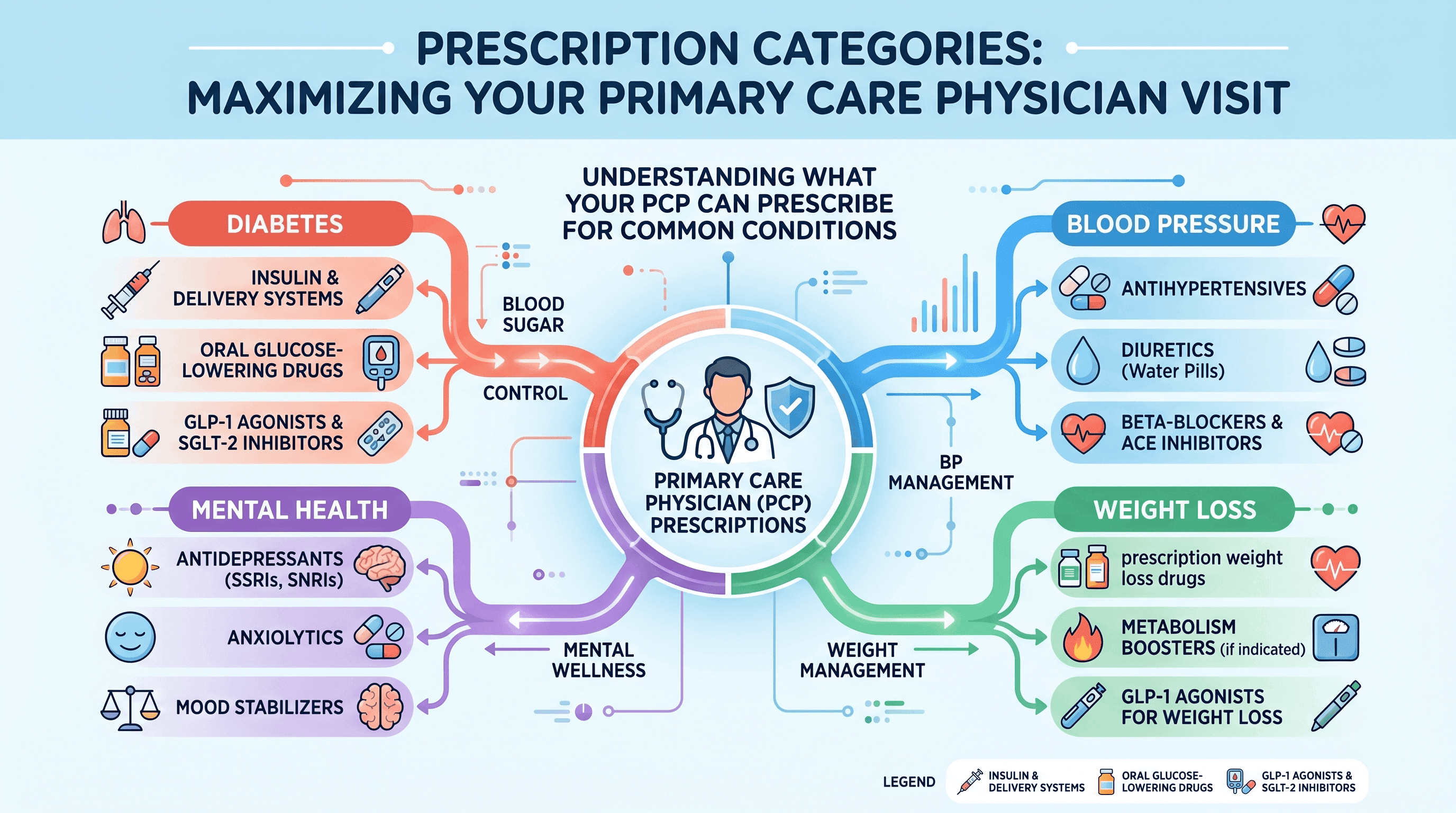
According to the Cleveland Clinic, primary care physicians serve as the principal managers of chronic diseases for most American adults. That means routine prescribing of metformin and other oral diabetes agents, ACE inhibitors and beta-blockers for blood pressure control, statins like atorvastatin (Lipitor) for cholesterol management, levothyroxine (Synthroid) for hypothyroidism, and inhaled bronchodilators and corticosteroids for asthma or COPD.
Summary Table: Common Medication Categories in Primary Care
| Condition | Medication Class | Example Drugs |
|---|---|---|
| Type 2 Diabetes | Biguanides, SGLT-2 inhibitors, GLP-1 agonists | Metformin, empagliflozin, semaglutide |
| Hypertension | ACE inhibitors, beta-blockers, diuretics | Lisinopril, metoprolol, hydrochlorothiazide |
| High Cholesterol | Statins | Atorvastatin, rosuvastatin |
| Hypothyroidism | Thyroid hormone replacement | Levothyroxine (Synthroid) |
| Asthma / COPD | Inhaled corticosteroids, bronchodilators | Fluticasone, albuterol, tiotropium |
| Bacterial infections | Antibiotics | Amoxicillin, doxycycline, azithromycin |
| Depression / Anxiety | SSRIs, SNRIs | Sertraline, escitalopram, venlafaxine |
Mental Health Medications a Primary Care Doctor Can Prescribe
Primary care physicians prescribe the overwhelming majority of antidepressants and anti-anxiety medications in the United States.
Research published in BMC Primary Care confirms that PCPs manage a significant portion of patients treated for depression and anxiety, often without referring to psychiatry. In practical terms, this means a PCP can initiate, adjust, and maintain prescriptions for SSRIs like sertraline (Zoloft) and escitalopram (Lexapro), as well as SNRIs like venlafaxine (Effexor) and duloxetine (Cymbalta). These medications treat both depression and anxiety disorders and are not scheduled controlled substances, which gives PCPs broad latitude in prescribing them.
Short-term benzodiazepines like lorazepam (Ativan) or clonazepam (Klonopin) can also be prescribed by PCPs, though most are cautious given their dependence potential. They are Schedule IV controlled substances, so a DEA registration is required.
When does a PCP refer to psychiatry instead of managing independently? Generally when a patient has treatment-resistant depression, a bipolar disorder diagnosis, schizophrenia, or a presentation that requires complex medication adjustments beyond first-line agents. For straightforward anxiety and depression, a primary care visit is often sufficient.
Can a Primary Care Doctor Prescribe ADHD Medication?
Yes, a primary care doctor can prescribe ADHD medications, including stimulants.
Stimulants like amphetamine salts (Adderall) and methylphenidate (Ritalin, Concerta) are Schedule II controlled substances under DEA classification, meaning they carry high potential for dependence and require careful prescribing. A PCP with an active DEA registration has full legal authority to prescribe them, though individual clinic policies vary. Some primary care practices prefer that an initial ADHD evaluation and diagnosis come from a psychiatrist or neurologist before the PCP takes over ongoing prescribing.
Non-stimulant options like atomoxetine (Strattera) and viloxazine (Qelbree) are also within the PCP's prescribing scope and carry fewer regulatory restrictions since they are not scheduled substances.
One context worth noting: a national shortage of stimulant medications that began in 2022 and continued into 2025 affected availability broadly, meaning PCPs and specialists alike faced supply constraints independent of prescribing authority.
Weight Loss Medications: Can Your PCP Prescribe Ozempic or Wegovy?
Yes, a primary care doctor can prescribe GLP-1 receptor agonists for both diabetes and weight loss.
This is one of the most searched questions in primary care right now, and the answer is straightforward. Semaglutide is FDA-approved under the brand name Ozempic for type 2 diabetes management and under the brand name Wegovy specifically for chronic weight management. Tirzepatide is approved as Mounjaro for diabetes and as Zepbound for weight loss. A PCP can prescribe any of these.
For weight loss prescribing, FDA approval criteria generally require a BMI of 30 or higher, or a BMI of 27 or higher with at least one weight-related comorbidity such as hypertension or type 2 diabetes. At a visit where GLP-1 therapy is being considered, the doctor will typically review metabolic labs, cardiovascular risk, prior weight loss attempts, and any contraindications like a personal or family history of medullary thyroid carcinoma.
Insurance coverage for GLP-1 medications varies significantly by plan and employer, and prior authorization is commonly required. A PCP can help navigate that process, but patients should be prepared for coverage variability.
Pain Management and Controlled Substances
Primary care doctors play an active role in both acute and chronic pain management, within defined limits.
For short-term pain, NSAIDs like ibuprofen and naproxen, muscle relaxants like cyclobenzaprine (Flexeril), and topical agents are standard first-line options that a PCP prescribes freely. For moderate to severe acute pain following an injury or procedure, short-course opioids like hydrocodone (Schedule III historically, now Schedule II) or oxycodone (Schedule II) may be appropriate, and a PCP with DEA registration can write those prescriptions.
For chronic pain, the picture is more nuanced. Most primary care practices have moved away from long-term opioid prescribing for non-cancer pain, reflecting both CDC clinical practice guidelines and growing awareness of dependence risk. Non-opioid approaches, including SNRIs, anticonvulsants like gabapentin, and physical therapy referrals, are often the preferred path.
Prescription Drug Monitoring Programs (PDMPs) are state-based databases that PCPs check before prescribing controlled substances. This is a routine safeguard, not a red flag, and patients should not feel scrutinized by it.
DEA Schedules at a Glance:
| Schedule | Meaning | Examples |
|---|---|---|
| Schedule II | High dependence potential, accepted medical use | Oxycodone, Adderall, fentanyl |
| Schedule III | Moderate dependence potential | Buprenorphine (some formulations), ketamine |
| Schedule IV | Lower dependence potential | Benzodiazepines, tramadol |
| Schedule V | Lowest potential, limited quantities | Cough preparations with low-dose codeine |
Women's Health Prescriptions From a Primary Care Doctor
Patients do not need a gynecologist appointment to obtain most routine women's health prescriptions.
A primary care doctor, whether a family medicine physician or an internist, can prescribe hormonal birth control in all its forms: oral contraceptive pills, the transdermal patch, the vaginal ring, and injectable contraceptives like Depo-Provera. UTI antibiotics, treatment for bacterial vaginosis, and topical antifungal prescriptions also fall squarely within PCP authority.
Hormone replacement therapy (HRT) for menopause symptoms, including estrogen and progesterone formulations, is another area where PCPs routinely manage care without requiring OB/GYN involvement, particularly for patients who are low risk. ACOG guidelines do recommend shared decision-making about HRT risks, which a well-prepared PCP can walk through.
Where a PCP typically refers to an OB/GYN is for procedural care (IUD insertion, colposcopy after an abnormal Pap), complex high-risk pregnancies, or gynecologic conditions requiring surgical evaluation. For the day-to-day prescription needs of most women's health care, a PCP visit is sufficient.
The Specialist Bridge: Taking Over Refills
One of the most underused aspects of primary care prescribing is the handoff from specialist to PCP for ongoing management.
Once a patient has been diagnosed and stabilized by a specialist, many complex medications can be transitioned to PCP oversight for routine refills. A cardiologist might initiate an antiarrhythmic; after the patient is stable, the PCP can manage refills and monitoring. A psychiatrist might establish a patient on a mood stabilizer; once the regimen is set, a PCP can handle ongoing prescribing. An endocrinologist might start a patient on a GLP-1; the PCP can continue it.
StatPearls on NCBI describes this coordination function as central to the PCP's role in longitudinal care. From the patient's perspective, this means fewer specialist appointments and a more streamlined prescription process for medications that are no longer in an active adjustment phase.
This applies to stable ADHD management, stable thyroid disease, stable heart failure medication regimens, and several other chronic conditions. If the specialist has established a clear treatment plan and monitoring protocol, the PCP is generally well-positioned to continue it.
Addiction Treatment: A Newly Expanded Role for PCPs
Primary care doctors now have broader authority to treat opioid use disorder (OUD) than at any prior point in US history.
In 2023, federal regulations eliminated the X-waiver requirement that previously required special certification before a physician could prescribe buprenorphine (Suboxone, Subutex) for OUD. Any DEA-licensed provider can now prescribe it. This is a meaningful policy shift because buprenorphine is one of the most effective pharmacological treatments for OUD and access had long been a barrier for patients in areas without addiction specialists.
NIDA data has highlighted the persistent gap in awareness: many Americans do not know that a primary care doctor can address addiction medication needs. For patients who feel stigma around seeking addiction care from a specialist clinic, having a trusted PCP as the prescriber lowers that barrier significantly.
Naltrexone (Vivitrol in injectable form, also available orally) is another OUD and alcohol use disorder treatment that a PCP can prescribe without any special certification. Together, buprenorphine and naltrexone represent real treatment options available through a standard primary care appointment.
If you are ready to start a conversation about addiction treatment and are not sure where to begin, you can see a doctor online through Momentary and discuss your options with a primary care provider from home.
What a Primary Care Doctor Cannot Prescribe (and Why)
The limits on PCP prescribing exist for clinical and regulatory reasons, not arbitrary gatekeeping.
Chemotherapy agents require oncology oversight because dosing depends on tumor type, staging, and protocols that change with ongoing clinical trial data. The risk of dosing errors is severe enough that most health systems restrict chemotherapy prescribing to oncologists regardless of a PCP's legal authority.
Isotretinoin (Accutane) requires enrollment in the iPLEDGE program, an FDA-mandated risk management program due to the medication's severe teratogenicity. Dermatologists almost universally manage this. While technically a PCP could enroll in iPLEDGE, it is rare in practice and most clinics defer to dermatology.
Complex biologics for rheumatoid arthritis, lupus, psoriasis, and inflammatory bowel disease, including medications like adalimumab (Humira) and rituximab, require specialist initiation because they involve screening for latent tuberculosis, hepatitis, and other conditions, plus ongoing immunologic monitoring. A rheumatologist or gastroenterologist typically initiates and oversees these.
Methadone for OUD is a special case: unlike buprenorphine, methadone for addiction treatment must be dispensed through a federally licensed Opioid Treatment Program (OTP) clinic. A PCP cannot prescribe it for OUD, even though methadone for pain management can be prescribed in some contexts.
Heavy antipsychotics for schizophrenia and related conditions, such as clozapine, require monitoring for severe adverse effects including agranulocytosis. Clozapine, in particular, has a mandatory registry (REMS program) that typically places it under psychiatry's management.
When to See a Specialist Instead
Consider asking your PCP for a specialist referral when: a diagnosis is unclear after initial workup, a first-line medication is not working after adequate trial, a condition requires a procedure or surgery, a medication requires specialized monitoring your PCP's office cannot perform, or symptoms are worsening despite treatment.
Does It Matter If Your PCP Is an MD, DO, NP, or PA?
Prescribing authority varies by credential and state, but the differences are narrower than most patients assume.
MDs and DOs hold equivalent full prescribing authority across all US states and can prescribe the complete range of FDA-approved medications with a valid DEA registration. DOs complete osteopathic medical training and are licensed identically to MDs for prescribing purposes.
Nurse Practitioners (NPs) have full independent prescribing authority, including for controlled substances, in approximately 24 states plus Washington DC, according to NCBI resources on prescribing scope. In the remaining states, NPs require some degree of physician collaboration or supervision, and Schedule II prescribing may be restricted depending on the state.
Physician Assistants (PAs) practice with physician collaboration agreements in most states, and their ability to prescribe Schedule II controlled substances independently varies by state law and individual practice agreement. Most PAs in primary care settings do have prescribing authority for the full range of common medications, but a PA in a restricted state may need physician co-signature for certain controlled substances.
For most standard primary care visits, whether the provider is an MD, DO, NP, or PA, the medications accessible to patients are functionally the same. The differences become relevant mainly for complex controlled substance cases or when independent authority is required.
Telehealth and Online Primary Care: What Can Be Prescribed Remotely?
Most non-controlled medications can be prescribed through a telehealth visit with a licensed primary care provider.
Chronic disease medications, antibiotics for straightforward infections, thyroid medication, birth control, mental health medications like SSRIs, and GLP-1 weight loss medications are all commonly prescribed via telehealth. A provider who can see and assess you through a video visit has the same prescribing authority they would in person for the majority of medication categories.
Controlled substances remain a more complex area. The Ryan Haight Act requires an in-person medical evaluation before a practitioner can prescribe controlled substances via telemedicine, with certain narrow exceptions. The DEA has maintained this requirement with limited carve-outs, meaning stimulants, benzodiazepines, and opioids generally cannot be initiated through a telehealth visit alone without a prior in-person evaluation.
The practical implication: if you need a refill on a maintenance medication, a prescription for an antibiotic, or want to discuss starting an antidepressant or GLP-1, a telehealth visit can often handle that without an in-office appointment. If you are seeking a new controlled substance prescription for the first time, an in-person visit is typically required.
How to Talk to Your Primary Care Doctor About a Specific Medication
Walking into a primary care visit with a medication in mind is completely reasonable. Doctors are used to it.
Come prepared with a clear description of your symptoms, how long they have been present, and what you have already tried. If you have read about a specific medication and want to ask about it, name it directly. A straightforward "I have been reading about sertraline for anxiety and wanted to ask whether it might be appropriate for me" is a better opener than vague symptom reporting. Your doctor can engage more usefully when the conversation is direct.
Asking about alternatives is always fair. If the medication you ask about is not right for you, ask what else might work. If your PCP is not comfortable prescribing a particular medication for clinical reasons, ask whether a referral to a specialist would be the right next step. That is not a confrontation; it is appropriate patient advocacy.
One realistic expectation to set: for complex or high-stakes medications, a PCP may want to run labs, review your full history, or schedule a dedicated follow-up visit before writing a prescription. That is good medicine, not obstruction.
If getting to a physical office is difficult or you want to explore your options from home first, you can use Momentary's AI health navigator to understand your symptoms, explore what conditions might be relevant, and get a clearer picture of what to bring to your next care conversation.
Frequently Asked Questions
What are the most common conditions treated in primary care?
Primary care offices most commonly manage hypertension, type 2 diabetes, hyperlipidemia (high cholesterol), depression and anxiety, hypothyroidism, asthma, COPD, urinary tract infections, obesity, and acute respiratory infections. Cleveland Clinic identifies chronic disease management as the central function of modern primary care.
Can an internal medicine doctor treat hypertension?
Yes. Internists, which is one of the most common types of primary care physicians, routinely diagnose and manage hypertension. They can prescribe antihypertensive medications including ACE inhibitors, beta-blockers, calcium channel blockers, and diuretics, and can coordinate referrals to nephrology or cardiology when blood pressure is difficult to control or when end-organ damage is present.
What are the four primary care services?
Primary care is organized around four core functions: preventive care (screenings, vaccinations, health maintenance), acute care (managing sudden illnesses and injuries), chronic disease management (ongoing treatment of long-term conditions), and care coordination (connecting patients to specialists and community resources). This framework comes from foundational primary care literature, including PMC research on primary care structure.
Can a primary care doctor prescribe anxiety medication?
Yes. PCPs prescribe SSRIs and SNRIs for anxiety disorders routinely. According to research in BMC Primary Care, primary care manages a substantial portion of anxiety care in the US. First-line medications like sertraline and escitalopram are commonly initiated at the primary care level without requiring a psychiatry referral.
What can a primary care doctor not prescribe?
The main categories outside PCP prescribing scope are chemotherapy agents, isotretinoin (due to the iPLEDGE program requirements), methadone for opioid use disorder (requires a licensed OTP clinic), clozapine and certain other heavy antipsychotics with REMS requirements, and complex biologics for autoimmune conditions that require specialist initiation and monitoring.
Does telehealth change what a PCP can prescribe?
For most non-controlled medications, telehealth prescribing is equivalent to in-person prescribing. The main exception involves controlled substances, where the Ryan Haight Act generally requires at least one in-person evaluation before prescribing via telemedicine. GLP-1 medications, antibiotics, SSRIs, thyroid medications, and birth control can all typically be prescribed through a virtual visit.
References
- Cleveland Clinic: Primary Care Physician — Cited for PCP role in chronic disease management and care coordination.
- PubMed: BMC Primary Care study — Cited for data on PCPs managing depression and anxiety, including antidepressant prescribing patterns.
- NCBI StatPearls: Prescribing scope and PCP coordination — Cited for PCP role in longitudinal medication management and specialist handoff.
- NCBI: Nurse practitioner and PA prescribing authority — Cited for NP independent prescribing states and PA collaboration requirements.
- PMC: Primary care structure and functions — Cited for four core primary care service functions framework.
- NIDA: Opioid use disorder treatment access — Cited for awareness gap data on buprenorphine prescribing in primary care.
- FDA: Drug approvals and GLP-1 criteria — Cited for FDA approval criteria for semaglutide and tirzepatide for weight management.
- CDC: Opioid prescribing clinical practice guidelines — Cited for PCP movement away from long-term opioid prescribing for non-cancer pain.
- ACOG: Menopause and HRT guidelines — Cited for shared decision-making recommendations on hormone replacement therapy.