


You're sick. Maybe it happened on a Saturday night, or the pain crept in on a Tuesday afternoon when every primary care slot is booked solid. The question is always the same: where do I actually go? Choosing between primary care, urgent care, and the emergency room is a practical decision that affects both your health outcomes and your wallet. This guide gives a clear, honest framework for making the right call, every time.
At a Glance
| Topic | Key Facts |
|---|---|
| Primary care best for | Chronic conditions, preventive visits, medication management, ongoing symptoms |
| Urgent care best for | Acute, non-life-threatening issues needing same-day attention |
| Telehealth best for | Minor infections, rash assessment, medication questions, weekend bridge care |
| ER best for | Chest pain, stroke symptoms, uncontrolled bleeding, loss of consciousness |
| Typical cost: Primary care | $40 to $300 (self-pay) |
| Typical cost: Urgent care | $125 to $300 (plus potential facility fees) |
| Typical cost: Telehealth | $40 to $90 without insurance |
| Typical cost: ER | $1,500 and above |
The 24-Hour Rule: Your First Mental Filter
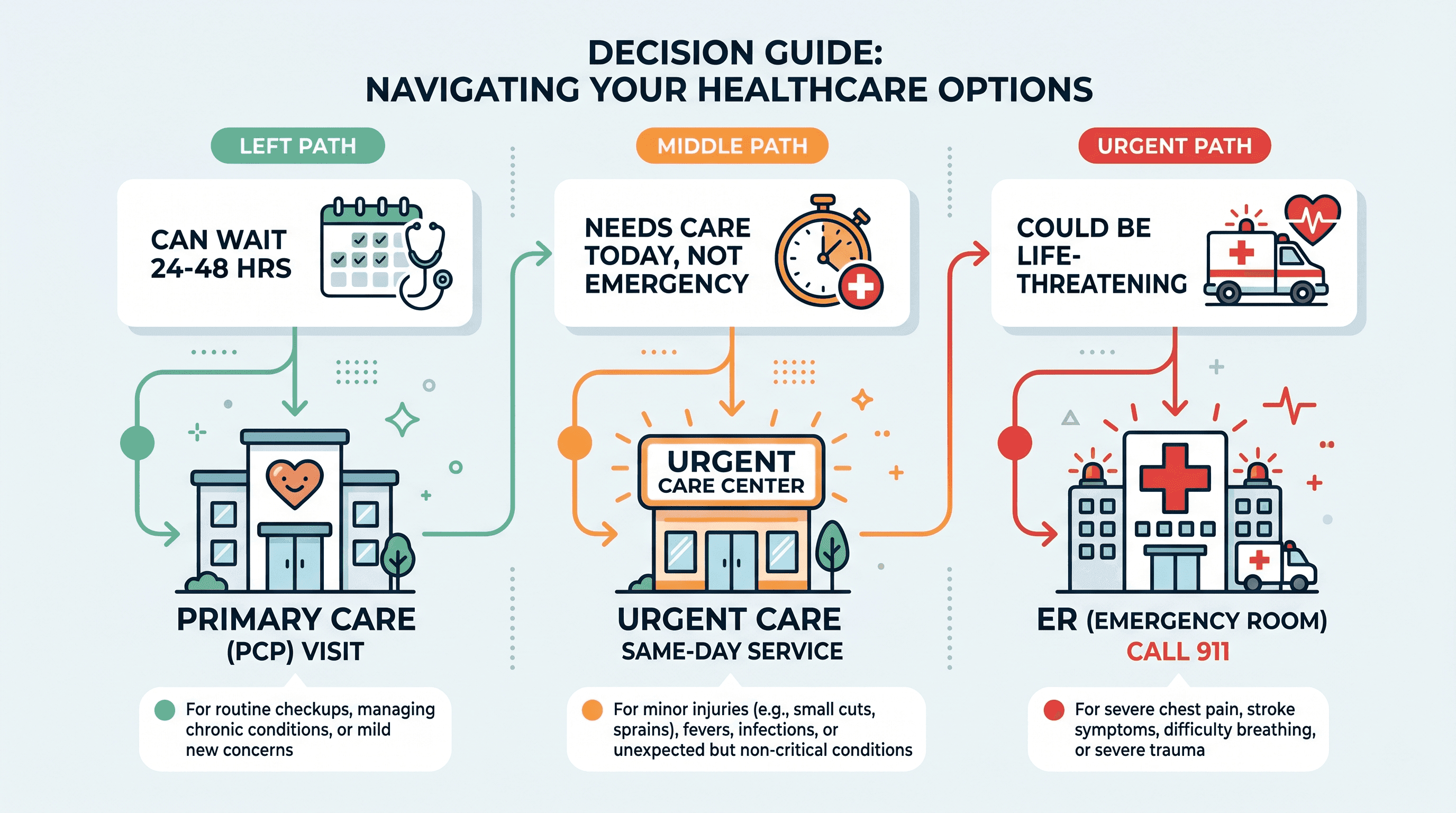
The fastest way to decide where to go is to ask one question: can this safely wait 24 to 48 hours?
If yes, call your primary care physician (PCP). A PCP is a doctor, nurse practitioner, or physician assistant who manages your overall health over time, including chronic conditions, preventive care, and referrals to specialists. Most practices hold same-day or next-day sick visit slots that patients rarely know to ask for, so a quick phone call to the front desk is always worth making first.
If the answer is no, the symptom needs attention today but is not putting your life at risk, urgent care is the right tier. Urgent care centers are walk-in clinics offering extended hours (often 8 AM to 8 PM, including weekends) with on-site diagnostics and the ability to treat a wide range of acute problems.
If the situation could be life-threatening, skip both and go straight to the emergency room or call 911. The ER section below covers those hard-stop symptoms.
The Primary Care Cheat Sheet: Slow Burn Symptoms
Primary care is built for continuity. A PCP holds your full medical history, manages your prescriptions, coordinates specialist referrals, and tracks patterns over time that a walk-in clinic simply cannot see.
Primary care is the right call for conditions that are chronic or have been building over days or weeks. A cough that has lasted three or more weeks, joint pain that comes and goes, unexplained fatigue, or a rash that has been present for a month all belong here, because diagnosing them requires context about your history, not just a rapid swab. Medication adjustments, including changing a dosage or switching to a different prescription, also require a PCP who knows why the original medication was prescribed and how it interacts with everything else you take.
Routine mental health check-ins, anxiety management, and follow-ups after a hospitalization all belong in primary care as well. Annual physicals, adult vaccinations, and cancer screenings are primary care visits by design. The relationship your PCP builds with you over time is what makes early detection of serious conditions possible. Research published in PRiMER found that patients with established primary care relationships were significantly less likely to use emergency departments for conditions that could have been managed earlier in a lower-acuity setting.
Specific conditions that belong at your PCP: diabetes management, blood pressure monitoring, asthma control plans, thyroid disorders, high cholesterol, recurring urinary tract infections, and new symptoms that are bothersome but not urgent (persistent headache, mild joint swelling, unexplained weight change).
The Urgent Care Cheat Sheet: The Sudden Hiccup
Urgent care is designed for acute, discrete problems that need attention the same day but are not dangerous enough to require an emergency room.
The clearest candidates are sudden-onset minor infections: a UTI, a suspected strep throat, an ear infection, or a sinus infection that has turned into pressure and green discharge. These are problems with a predictable workup and a likely antibiotic solution. Urgent care clinics are staffed and equipped for exactly this visit.
Minor trauma is another strong fit. A sprained ankle that is painful and swollen but weight-bearing can be evaluated, X-rayed, and wrapped at urgent care without the hours-long ER wait time. Deep cuts that may need a few stitches, minor burns (first-degree, covering a small area), sudden rashes with no breathing symptoms, and adult fever without red-flag signs all belong at urgent care. A Cochrane systematic review found that walk-in clinics delivered comparable quality of care to physician offices for acute, low-acuity conditions, with shorter wait times.
Weekend and after-hours illness is where urgent care earns its reputation. Getting sick at 7 PM on a Friday does not mean suffering until Monday morning. Going to urgent care for antibiotics is a medically appropriate decision when same-day access to your PCP is unavailable and the condition meets the criteria above.
The Diagnostics Divide: X-Rays, Swabs, and Labs
A common reason patients end up at the wrong setting is not knowing what tests are actually available at each location.
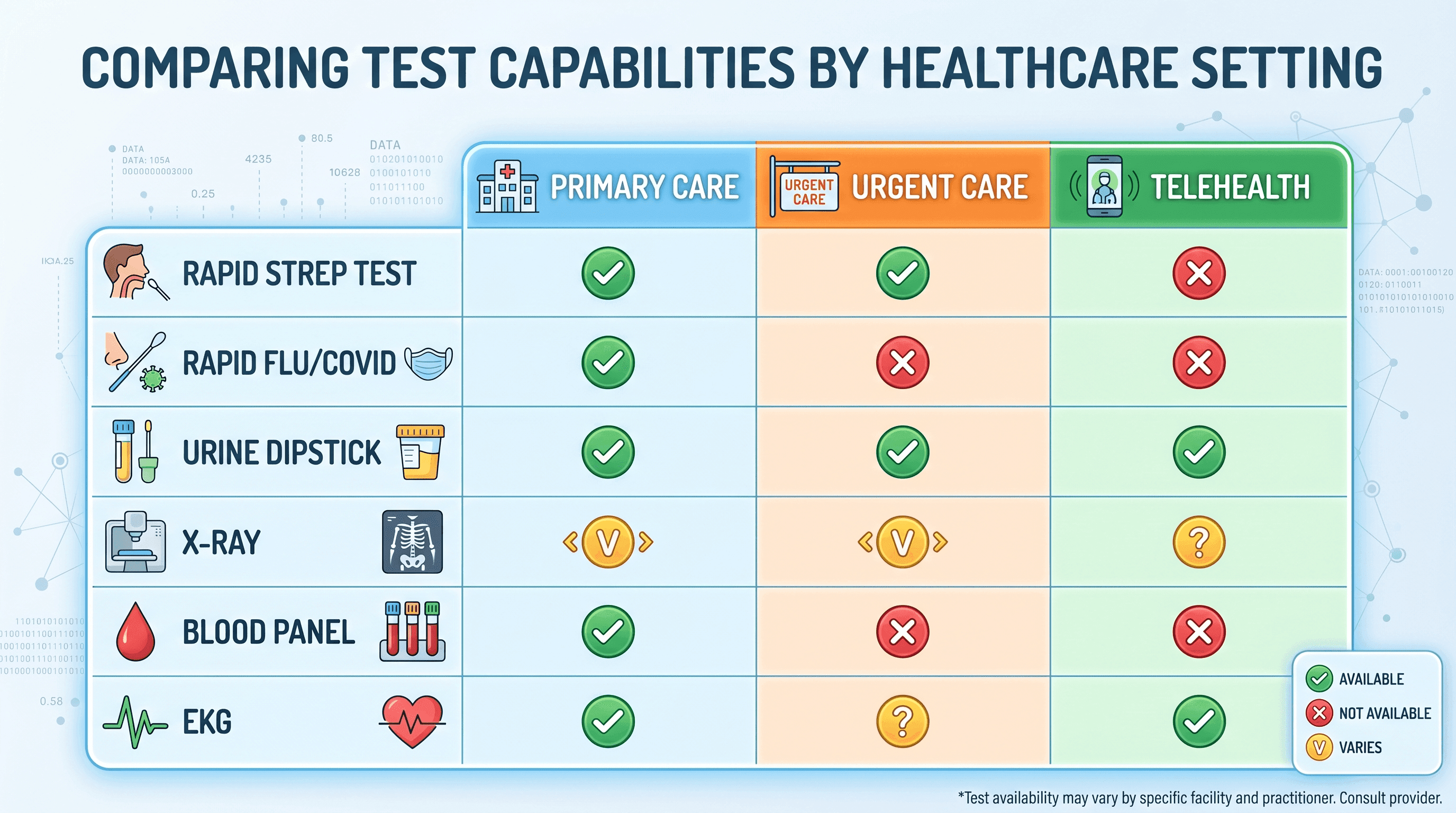
Urgent care clinics are practically built for immediate diagnostics. Most carry on-site X-ray machines capable of imaging suspected fractures of the ankle, wrist, foot, and hand. Rapid in-office swabs for strep, influenza, COVID-19, and RSV typically return results within 15 minutes. Basic urine dipstick testing for UTI confirmation is standard. Some urgent care locations also offer basic blood panels.
Primary care offices have more variability. Many can perform rapid strep and flu tests, basic urine analysis, and EKGs, but X-ray capability is less universal, and blood work typically goes to an outside lab with results returning in one to three days. If you suspect a broken bone and want same-day imaging, urgent care is usually the faster path.
Telehealth, the option most patients forget entirely, cannot perform any physical diagnostic test. But for conditions where the clinical picture is clear (a classic UTI symptom presentation in a woman with no fever, a mild pink-eye presentation, a known sinus infection pattern), a telehealth visit can result in a prescription within 30 to 45 minutes at a cost of $40 to $90 without insurance. If a prescription hinges on a positive swab result, a telehealth provider will redirect you to an in-person clinic.
The Weekend and After-Hours Trap
The most common logistical mistake patients make is waiting out a treatable condition because their doctor's office is closed.
When illness strikes on a Friday evening, Saturday, or a holiday, urgent care is not a second-best choice. For acute, discrete problems (a UTI, a suspected strep infection, a wound that needs closure), going to urgent care is medically appropriate and avoids both the suffering of waiting and the $1,500-plus price tag of an emergency room visit.
Some primary care practices now offer after-hours telehealth access for established patients, which is worth checking through the patient portal. Many insurance plans also include 24/7 nurse hotlines and telehealth apps as covered benefits. Connecting with a virtual primary care provider is another option that has grown substantially and can bridge non-emergency needs outside of office hours.
If you are uninsured or underinsured, Federally Qualified Health Centers (FQHCs) offer sliding-scale fees for primary care visits regardless of ability to pay. The HRSA Find a Health Center tool can locate the nearest FQHC by zip code.
The "Never Go to Urgent Care For..." List
Urgent care handles acute problems well. It is not built to manage complexity, and using it for the wrong reasons leads to incomplete care, conflicting treatment plans, or delays in diagnosis.
Never use urgent care to seek a diagnosis for a complex or chronic condition. If you have been experiencing fatigue for six weeks, intermittent chest pressure over the past month, or new neurological symptoms that come and go, these require a workup over time, full laboratory panels, specialist coordination, and knowledge of your history. An urgent care provider seeing you once cannot safely diagnose these.
Do not use urgent care to refill long-term psychiatric medications, including antidepressants, anxiolytics, or mood stabilizers. These require continuity of care from a prescribing clinician who knows your history and can monitor for side effects and dose changes appropriately. Some controlled substances (stimulants for ADHD, benzodiazepines) cannot be prescribed at urgent care at all under federal prescribing regulations.
Urgent care is also not the right place to seek a second opinion on an existing diagnosis, to manage a post-surgical complication (unless it is a clear wound infection), or to handle any ongoing specialist-managed condition. These situations need the provider who already holds your records.
The Emergency Room Override
Some symptoms bypass the primary care vs. urgent care decision entirely. These are the hard-stop red flags that require an emergency room or a 911 call immediately.
Chest pain or pressure, especially if it radiates to the arm, jaw, or back, warrants emergency evaluation. Stroke symptoms, remembered using the FAST acronym (Face drooping, Arm weakness, Speech difficulty, Time to call 911), cannot wait. Breathing difficulty that is severe or worsening, uncontrolled bleeding that does not slow with direct pressure, and head trauma with loss of consciousness all require emergency care. Severe abdominal pain with fever, high fever in an infant under three months, signs of a severe allergic reaction (throat tightening, hives spreading rapidly, difficulty swallowing), and overdose or poisoning are also ER-level situations.
The University of Maryland Medical System notes that patients often underestimate the urgency of stroke symptoms in particular, which is why acting on any FAST sign immediately is the standard recommendation.
No cost concern should delay an ER visit for these symptoms. If any of these apply, call 911 or have someone drive directly to the nearest emergency department.
How Much Does Each Option Cost?
Cost is not a secondary consideration. For many patients, it is the deciding factor, and knowing the actual numbers changes the calculus.
A self-pay primary care visit typically runs $40 to $300 depending on visit complexity and location. With insurance, copays are commonly $20 to $50 for an in-network PCP. Annual wellness visits are covered at no cost under most Affordable Care Act-compliant plans.
Urgent care self-pay costs generally land between $125 and $300 for the base visit, but this figure can climb when on-site procedures (laceration repair, X-ray reads, rapid tests with equipment fees) are added. Urgent care centers can also bill a separate facility fee, which patients often discover when the explanation of benefits arrives. With insurance, urgent care copays typically run $50 to $100 in-network.
Telehealth is the lowest-cost access point. Virtual visits cost $40 to $90 without insurance through direct-pay platforms. Many insurance plans cover telehealth at the same tier as a primary care visit, often a $20 to $30 copay. If the symptom can be assessed visually or through reported history, telehealth is worth trying first.
The emergency room is in a different financial category. The average ER visit exceeds $1,500 in facility fees alone before any procedures are billed. A patient presenting with a UTI at an ER instead of an urgent care clinic may face a bill five to ten times higher for the same antibiotic prescription.
Closing the Loop: The Mandatory Follow-Up
If an urgent care visit leads to a prescription, a diagnosis, or imaging results, your primary care physician has no automatic knowledge it happened.
Urgent care clinics do not transmit records to your PCP unless specifically instructed to do so. This gap creates real clinical risk: duplicate prescriptions, conflicting treatment plans, and lab results that inform a specialist referral but never reach the provider who would act on them. Preventing this is straightforward but requires the patient to take the step.
Before leaving the urgent care clinic, ask the front desk to forward the visit summary and any imaging results to your primary care physician's office. Get a copy of the visit notes for your own records. When a follow-up is recommended, schedule it with your PCP rather than returning to urgent care, since that is where ongoing management should live.
If a medication was prescribed at urgent care that interacts with something your PCP manages, looping them in quickly is the right move. A brief message through your patient portal describing the visit and listing the medication is enough. Keeping your permanent medical record accurate is a shared responsibility, and this is one of the most manageable ways to protect it.
For ongoing or complex conditions, consider connecting with a virtual primary care provider through Momentary's primary care services to maintain continuity between in-person visits and ensure care decisions are never made in isolation.
Use This 3-Question Framework in the Moment
When something goes wrong and the pressure of the decision is real, a short framework helps more than a long list of conditions.
Question 1: Could this be life-threatening? Chest pain, stroke symptoms, severe breathing difficulty, uncontrolled bleeding, infant fever under three months, loss of consciousness. If yes to any of these, call 911 or go directly to the ER.
Question 2: Can it safely wait 24 to 48 hours? If yes, call your primary care doctor and ask for a same-day or next-day sick visit slot. If you do not have a PCP, see the section below on establishing one.
Question 3: Do you need care today, and it is not an emergency? Urgent care or telehealth. If imaging is needed, urgent care. If the clinical picture is clear and a physical swab is not required, telehealth gets you there faster and cheaper.
This framework does not replace clinical judgment, and a doctor can advise on individual cases. But for the vast majority of everyday decisions, these three questions are enough.
What If You Do Not Have a Primary Care Doctor?
This is one of the most common situations patients face, and it is worth addressing directly.
Finding a PCP starts with your insurance directory, which lists in-network providers by location and specialty. The HRSA Health Center Finder locates federally funded community health centers that accept patients regardless of insurance status and use a sliding fee scale. Telehealth platforms that offer ongoing virtual primary care are another option, particularly for patients in areas with limited in-person availability.
Urgent care can serve as a short-term fallback when acute problems arise before a PCP is established, but it is not a substitute for long-term care. Research published in PRiMER found that patients who lacked a primary care relationship had higher rates of avoidable emergency department use, higher overall healthcare costs, and lower rates of preventive care utilization.
Establishing a PCP matters most for patients managing chronic conditions such as diabetes, high blood pressure, or thyroid disorders. For these patients, a care relationship that spans years is what makes medication management, complication prevention, and specialist coordination possible.
Frequently Asked Questions
Can urgent care treat shortness of breath?
Mild shortness of breath with a clear, stable cause (a known asthma flare with a rescue inhaler on hand) can be evaluated at urgent care. But shortness of breath that is severe, sudden, worsening, or accompanied by chest pain, rapid heart rate, or confusion is an emergency room presentation. Urgent care does not have the monitoring capacity, IV medications, or resuscitation equipment needed for respiratory emergencies. When in doubt, call 911.
Should I go to urgent care for abdominal pain?
It depends on the severity and accompanying symptoms. Mild to moderate abdominal pain that started recently, is localized, and is not accompanied by fever, vomiting blood, or jaundice can be assessed at urgent care. Severe abdominal pain, sudden-onset pain that is the worst you have experienced, pain with high fever or rigid abdomen, or any suspicion of appendicitis or bowel obstruction requires an emergency room visit. A doctor can advise on individual cases based on symptom history.
When should a 2-year-old go to urgent care for a fever?
The American Academy of Pediatrics recommends that any fever (100.4 degrees Fahrenheit or above) in an infant under three months of age go directly to an emergency room without delay. For children between three months and two years, a fever of 104 degrees Fahrenheit or above, or a fever lasting more than two to three days, warrants urgent evaluation. Urgent care is appropriate for a toddler fever that is within manageable range, the child is drinking fluids and responsive, and there are no signs of labored breathing, unusual lethargy, a stiff neck, or a rash. If any of those signs are present, go to the ER.
Can urgent care prescribe beta blockers?
Urgent care providers can prescribe a short course of a beta blocker in specific acute situations, such as managing a documented hypertensive urgency or treating acute anxiety with significant cardiovascular symptoms. However, starting a new long-term beta blocker prescription (for heart rate management, post-cardiac event care, or blood pressure control) requires a primary care physician or cardiologist who can monitor response, assess contraindications against your full medical history, and manage dosing over time. If you currently take a beta blocker and need a bridge refill while awaiting a PCP appointment, urgent care can often assist in that limited context.
Is telehealth appropriate for a UTI?
For a classic UTI presentation in an adult woman (burning, frequency, urgency without fever or back pain), telehealth is a medically appropriate and cost-effective option. A provider can take a symptom history and, in many states, prescribe a first-line antibiotic based on clinical presentation alone. If fever is present, the pain has moved to the flank (possible kidney involvement), or you have recurrent UTIs with prior culture-resistant bacteria, an in-person urine culture is the better path. If symptoms do not improve within 48 hours of starting an antibiotic, follow up in person.
Can urgent care serve as my primary care doctor?
Urgent care is not a substitute for primary care. A Cochrane systematic review found that while walk-in clinics are effective for acute, one-time problems, they cannot manage chronic conditions, provide coordinated referrals, or build the longitudinal care relationship that primary care delivers. Using urgent care as a primary care replacement means no one is tracking your labs over time, no one is adjusting your chronic disease medications, and no one is coordinating the bigger picture of your health. If you do not have a PCP, use urgent care as a bridge while establishing one.
Not sure where to start? Use Momentary's AI health navigator to explore your symptoms, understand your options, and get personalized guidance on the right next step for your situation.
References
-
Chen CE, Chen CT, Hu J, Mehrotra A. Walk-in clinics versus physician offices and emergency rooms for urgent care and chronic disease management. Cochrane Database Syst Rev. 2017. — Cited for comparative effectiveness of walk-in clinics vs. physician offices and emergency departments for acute, low-acuity conditions.
-
Emergency Department Versus Primary Care Use: A Patient Perspective. PRiMER. 2024. — Cited for data on primary care relationships and rates of avoidable ED utilization.
-
University of Maryland Medical System. When to Go to the ER. — Cited for guidance on stroke symptom recognition and ER indication thresholds.
-
HRSA Health Center Finder. Find a Health Center. — Cited for locating federally qualified health centers for uninsured and underinsured patients.