


You have a PCP appointment coming up, or maybe you've been waiting three months for an OB-GYN slot that still isn't open. Either way, you're wondering: can I just ask my primary care doctor for birth control while I'm there?
The short answer is yes, and for most people, that one appointment is all it takes. But the full picture is more useful than a quick yes. This guide covers exactly which methods a PCP can and cannot prescribe, why some decline even when they legally can, how specific health conditions change the options available, and what to actually say at the appointment to make it productive.
At a Glance
| Topic | Key Facts |
|---|---|
| Can a PCP prescribe birth control? | Yes, all licensed PCPs are trained and legally authorized to prescribe contraception |
| Which methods? | Pills, patch, ring, Depo-Provera shot, emergency contraception |
| What usually requires a specialist? | IUD insertion, contraceptive implant insertion |
| Do you need a pelvic exam first? | No, not for pills, patch, ring, or shot |
| What if your PCP declines? | NPs/PAs, telehealth services, and pharmacists (in 20+ states) are alternatives |
| Does insurance cover it? | Most plans cover contraception at $0 under the ACA |
Yes, Your PCP Can Prescribe Birth Control
Primary care physicians, which includes family medicine doctors and internal medicine doctors, are fully licensed and clinically trained to prescribe contraception. This is not a gray area. Prescribing birth control falls squarely within the standard scope of primary care practice, and the majority of PCPs handle it as a routine part of well-woman care.
What this article covers beyond that baseline: which specific methods are available through a PCP, why some PCPs still opt out in practice, and how to navigate the appointment confidently when your situation is less straightforward.
Which Birth Control Methods Can a PCP Prescribe?
The range is wider than many people expect, but it does have a clear boundary around procedures that require clinical insertion.
Hormonal Methods Your PCP Can Prescribe
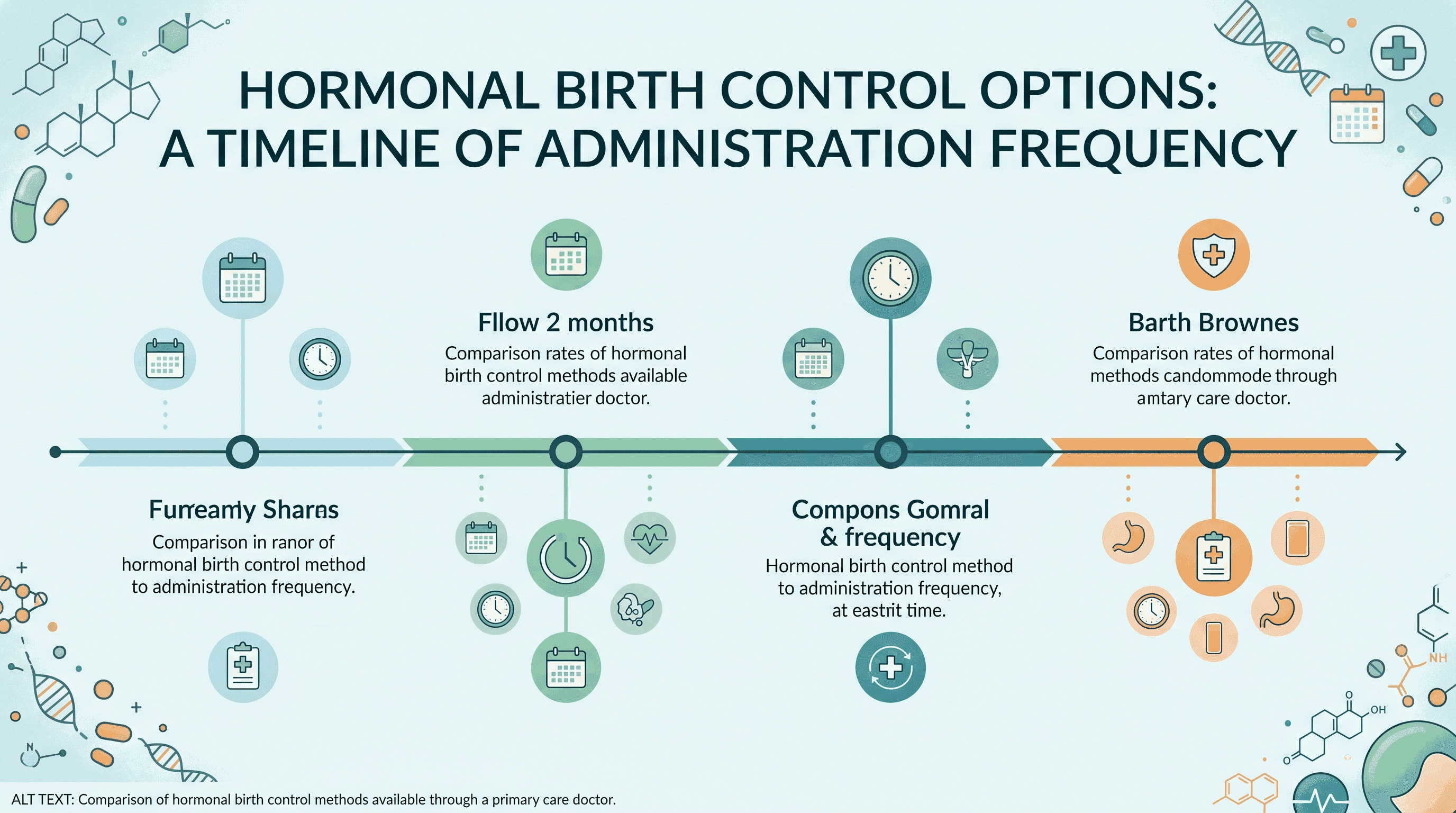
Combined oral contraceptive pills (estrogen plus progestin) and progestin-only pills are the most commonly prescribed methods in primary care settings. A PCP can counsel on efficacy, help select a formulation based on side effect profile, and write a refill prescription indefinitely.
The transdermal patch (brand name Xulane) and the vaginal ring (NuvaRing or Annovera) are also fully within PCP prescribing scope. Both are considered equivalent to the pill in terms of the prescribing process: a health history review and a blood pressure check, no pelvic exam required.
The Depo-Provera injection, a progestin-only shot given every three months, is likewise something most PCPs administer in-office. It is one of the more convenient options for patients who prefer not to manage a daily pill.
Methods That Usually Require an OB-GYN or Specialist
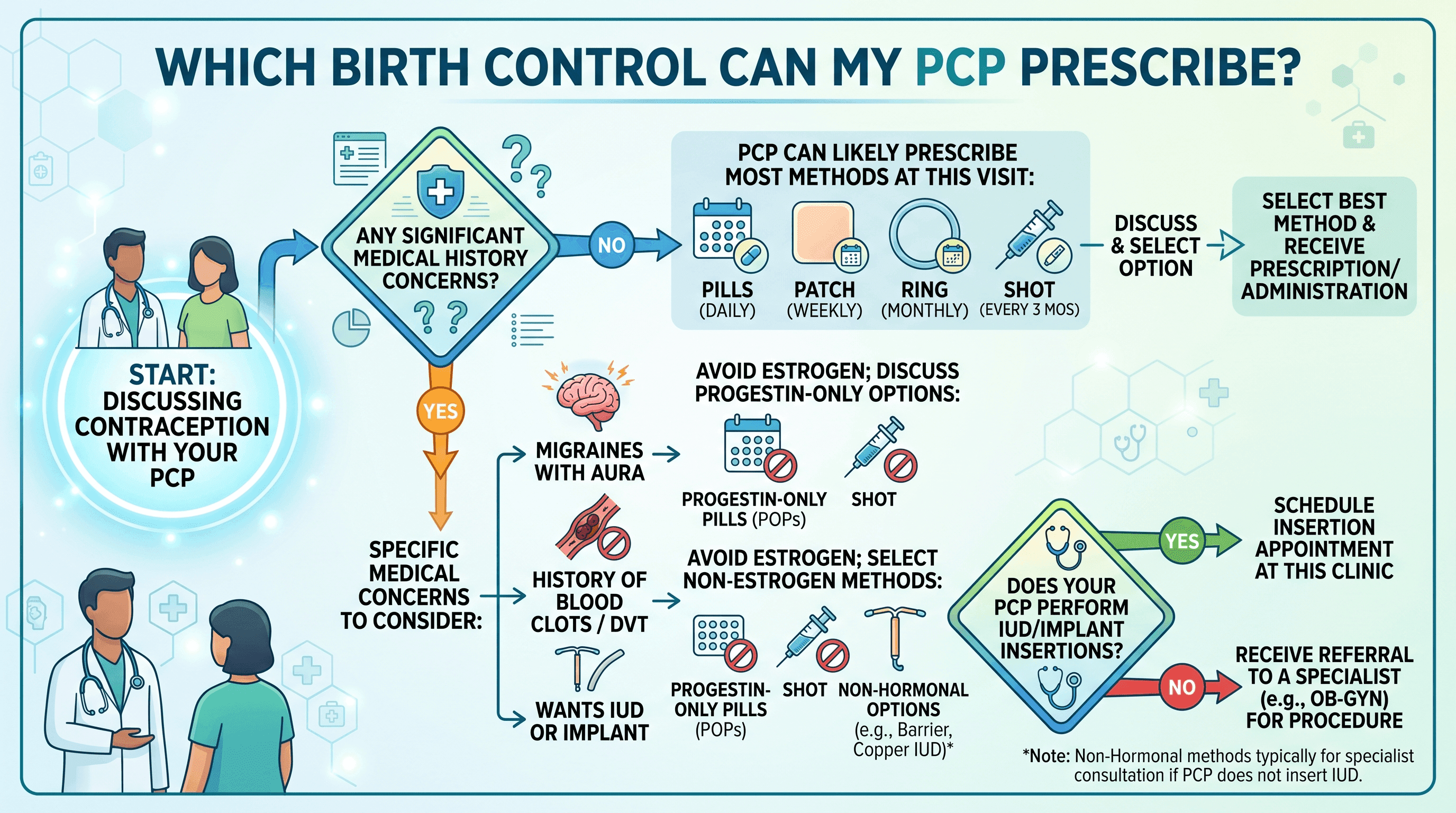
Intrauterine devices (IUDs), both hormonal types such as Mirena, Kyleena, and Liletta, and the copper non-hormonal Paragard, require in-office insertion. Historically that meant an OB-GYN or reproductive health clinic. That is changing. A growing share of family medicine physicians now perform IUD insertions: according to data published in MDEdge, the rate of IUD provision among family physicians rose from 16.4% to 25.5% between 2018 and 2022. So calling ahead to ask whether your specific family medicine practice inserts IUDs is worth doing before you assume a referral is necessary.
The contraceptive implant, sold as Nexplanon, is a small rod inserted under the skin of the upper arm that provides up to three years of protection. Some family medicine physicians are trained to insert it; most internal medicine doctors are not. Again, this is a practice-level question rather than a universal limitation.
If your PCP does not offer insertion services, they can still counsel on both options and facilitate a referral so you go in prepared.
Non-Hormonal Options Your PCP Can Discuss
Condoms and spermicide are available over the counter and do not require a prescription. Fertility awareness methods, which involve tracking cycle patterns to identify fertile days, are something any PCP can walk through with you. For the copper IUD specifically, a PCP who does not insert can refer and help you understand what to expect. The counseling piece is never off-limits, even when the procedure itself is.
The Honest Reason Some PCPs Won't Prescribe It (Even Though They Can)
This is the part most other resources skip, and it matters.
Technically, every licensed PCP in the US can prescribe contraception. In practice, only about 51% of family physicians and roughly 19.8% of internal medicine physicians actually do, according to survey data reported by MDEdge. If your PCP has ever sent you to an OB-GYN for something as routine as a pill refill, that data explains why.
Several real-world factors drive the gap. Residency training in contraception varies significantly, and some internal medicine training programs give it minimal time. Health system incentives also play a role: in some practice models, reproductive health visits are structured as OB-GYN referrals by default rather than primary care conversations. There is also a longstanding cultural assumption in American medicine that birth control "belongs" in OB-GYN, which is not a clinical guideline, just a habit.
If your PCP has declined to prescribe birth control in the past, that experience is valid and it does not mean you were wrong to ask. What it does mean is that you have other options within the same practice or elsewhere. Nurse practitioners and physician assistants working in the same primary care clinic are often more likely to prescribe contraception than the physician colleagues they work alongside. Asking to see a different provider in the same office is a reasonable first move.
When Your Medical History Changes What Your PCP Can Prescribe
Health history does not automatically disqualify you from getting birth control through a PCP. What it does is narrow the options or add a monitoring step. A PCP can work through this with you.
The CDC's Medical Eligibility Criteria for Contraceptive Use (US MEC) is the clinical reference US providers use to match contraceptive methods to individual health profiles. Here is how some common situations play out in practice:
Migraines with aura. Combined hormonal methods containing estrogen are contraindicated due to elevated stroke risk. Progestin-only options, including the mini-pill and the Depo-Provera shot, are generally considered safe. A PCP managing a patient with migraines will know this and can prescribe accordingly.
History of blood clots or stroke. Estrogen-containing methods carry additional clotting risk and are typically avoided in patients with a clot history. Progestin-only and non-hormonal methods remain viable.
High blood pressure. A blood pressure check is standard before prescribing combined hormonal contraceptives. Controlled hypertension may still allow for some formulations; uncontrolled hypertension typically does not. A PCP managing your blood pressure is actually well-positioned to make this call.
PCOS (polycystic ovary syndrome). A PCP can prescribe the combined pill for cycle regulation in PCOS, which is a common use case. If the hormonal picture is complex or fertility concerns are involved, a referral to an endocrinologist or reproductive specialist may follow, but starting with a PCP first is reasonable.
Smokers over 35. Combined estrogen-containing methods carry an elevated cardiovascular risk threshold for this group. Progestin-only options are generally preferred.
Breastfeeding. Estrogen can reduce milk supply; progestin-only methods are the standard recommendation postpartum for patients who are nursing.
None of these situations mean a PCP cannot help. What they mean is that the conversation gets more specific and the right method may be different from what you assumed you wanted going in.
What to Expect at Your PCP Birth Control Appointment
This section is almost entirely absent from other resources on this topic. Here is what actually happens.
Before writing a prescription, a PCP will typically ask about menstrual cycle history (regularity, flow, pain), current medications (some interact with hormonal contraceptives), smoking status, and any personal or family history of blood clots, stroke, or cardiovascular disease. A blood pressure reading is standard. That is usually the whole clinical workup for pills, the patch, the ring, or the shot. A pelvic exam or Pap smear is not required to prescribe any of these methods, and current guidelines from the American College of Obstetricians and Gynecologists (ACOG) confirm that point directly.
What to bring up proactively: if you have goals beyond pregnancy prevention, such as managing acne, controlling symptoms of PCOS, reducing period pain, or managing heavy bleeding, say so at the start. These are clinically relevant and may influence which formulation works best for the situation.
How to raise the topic if it does not come up naturally: "I'd like to talk about birth control options today" is a complete sentence that any primary care provider should be able to work with. If the provider responds by suggesting a referral without any clinical reason, asking "Is there a medical reason you're referring me rather than prescribing?" is a fair follow-up.
If you feel dismissed or sent to a specialist unnecessarily, connecting with a provider through a telehealth service is often the fastest path to a prescription without the friction. Many people see a doctor online for contraception consultations, which can be done same-day and covered under most insurance plans.
Other Providers Who Can Prescribe Birth Control
Getting birth control through your PCP is the focus here, but it's worth knowing the landscape if that route hits a wall.
Nurse Practitioners and Physician Assistants
In most states, nurse practitioners and physician assistants have full prescriptive authority for contraception. They operate with significant clinical independence and, as noted earlier, are statistically more likely than MD internists to prescribe contraceptives in the primary care setting. If your PCP is reluctant, asking to see the NP or PA in the same practice is a practical first step.
Telehealth Birth Control Services
Telehealth services such as Nurx, Wisp, and Hey Jane can prescribe pills, patches, and rings through video or asynchronous consult. They cannot prescribe LARCs (IUD or implant), since insertion requires an in-person procedure. These services are typically the fastest access path for hormonal methods, often delivering a prescription within 24 hours. Insurance coverage varies by plan and state.
Pharmacist Prescribing
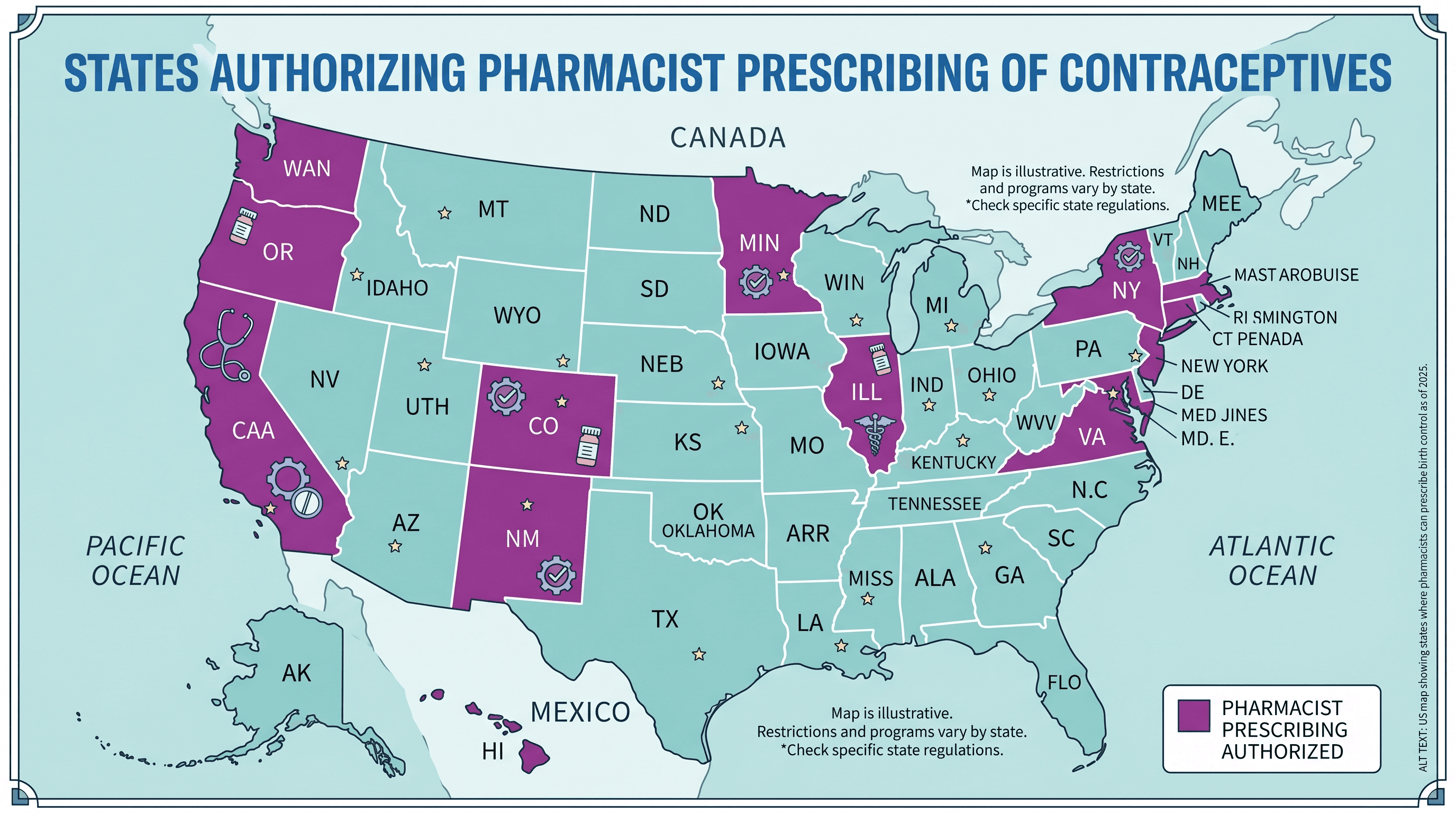
More than 20 states now authorize licensed pharmacists to prescribe hormonal contraceptives directly, including California, Colorado, New Mexico, and Hawaii. Post-2022, this access has expanded further. Most programs involve a self-screening questionnaire to identify contraindications. LARCs are not available through pharmacist prescribing, and coverage rules vary. The Guttmacher Institute maintains updated state-by-state data on pharmacist prescribing access.
Cost and Insurance: Does It Matter Who You See?
Under the Affordable Care Act (ACA), most private health insurance plans are required to cover FDA-approved contraceptive methods with no cost-sharing, meaning no copay, no deductible. This applies regardless of whether the prescription comes from a PCP, an OB-GYN, a telehealth provider, or an NP. The provider type generally does not change the insurance math.
Without insurance, the cost picture varies. Birth control pills run roughly $0 to $50 per month depending on brand and pharmacy. The patch and ring typically cost between $0 and $150 per month out of pocket. An IUD without insurance can run $500 to $1,300, though programs like Planned Parenthood offer sliding-scale pricing. Medicaid covers contraception in all states as a mandatory benefit.
One practical note: if your PCP is in-network but your plan has flagged contraceptive visits as OB-GYN-only, calling the insurer to confirm coverage before the appointment avoids surprise bills.
When to Go Straight to an OB-GYN Instead of Your PCP
This is a matter of patient preference and clinical need, not a rule.
Going directly to an OB-GYN makes sense if you want an IUD or implant and your PCP's practice does not perform insertions, if you have complex reproductive health concerns such as suspected endometriosis, unexplained pelvic pain, or fertility questions, if you have already had a frustrating or dismissive experience with a PCP on this topic, or if you simply prefer to consolidate all reproductive health care with one specialist. None of these are reasons to feel you failed to get what you needed from primary care. They are just different paths to the same outcome.
Conclusion
Most people reading this can get birth control from their primary care doctor in a single appointment. The clinical authority is there. The training is there. What varies is the specific methods a particular practice offers, how a patient's health history shapes the options, and whether the individual provider actively prescribes contraceptives. Going in with a clear sense of what you want and why, and knowing you can push back on an unnecessary referral, makes a real difference.
If the PCP route runs into friction, nurse practitioners, telehealth services, and pharmacist prescribing (where available) are all legitimate alternatives. To explore what fits your specific situation, use Momentary's AI health navigator to get a clearer picture of your options before your next appointment.
Frequently Asked Questions
Can a regular doctor prescribe birth control?
Yes. Any licensed primary care physician, including family medicine doctors and internal medicine doctors, is authorized to prescribe contraception as part of standard practice. A specialist referral is not required to get a prescription for the pill, patch, ring, or Depo-Provera shot.
Can birth control raise CRP levels?
Some research has suggested that combined oral contraceptives may increase C-reactive protein (CRP), a marker of inflammation, in some individuals. According to data reviewed by the NIH, the clinical significance of this change for otherwise healthy individuals is not firmly established. Patients with existing inflammatory conditions or cardiovascular risk factors should discuss this with their doctor before starting or continuing hormonal contraception.
Does birth control block DHT?
Some formulations, particularly those containing the progestin drospirenone (found in brands like Yaz and Yasmin), have anti-androgenic properties that may reduce the effects of dihydrotestosterone (DHT). This is the mechanism behind their use in managing acne and hirsutism. Not all birth control pills have this effect; the anti-androgen activity depends on the specific progestin in the formulation.
What is the best birth control for people with bipolar disorder?
There is no single universally recommended option, and individual response to hormonal medication varies. Some research suggests that hormonal fluctuations tied to the menstrual cycle can influence mood in people with bipolar disorder, which is worth discussing with both a prescribing physician and a mental health provider. Certain mood stabilizers used in bipolar treatment can interact with hormonal contraceptives by reducing their effectiveness. A doctor can advise on individual cases based on current medications and symptom patterns.
Do you need a gynecologist to get birth control?
No. A gynecologist is not required to obtain a birth control prescription. A PCP, NP, PA, telehealth provider, or pharmacist (in eligible states) can prescribe hormonal contraceptives. An OB-GYN becomes more relevant when insertion procedures like IUDs or implants are involved, or when complex reproductive health conditions are part of the picture.
Can a PCP prescribe emergency contraception?
Yes. A PCP can prescribe prescription-strength emergency contraception such as ella (ulipristal acetate), which is more effective than over-the-counter levonorgestrel options when taken later in the 120-hour window. Many practices also have telehealth or after-hours portals that can facilitate this on a same-day or next-day basis.
References
- CDC Medical Eligibility Criteria for Contraceptive Use (US MEC) — Clinical guidelines used to match contraceptive methods to individual health profiles, including conditions such as migraines with aura, hypertension, and clot history.
- NIH / PubMed Central — Research on hormonal contraception and inflammatory markers including CRP.
- American College of Obstetricians and Gynecologists (ACOG) — Guidelines confirming that a pelvic exam or Pap smear is not required to prescribe oral contraceptives.
- Guttmacher Institute — State-by-state data on pharmacist prescribing authority for contraceptives.