


If you have ever left a doctor's appointment feeling like you barely got ten minutes and a prescription — welcome to fee-for-service primary care. Direct Primary Care is the structural alternative to that experience, and it is quietly reshaping how millions of Americans get routine medical care.
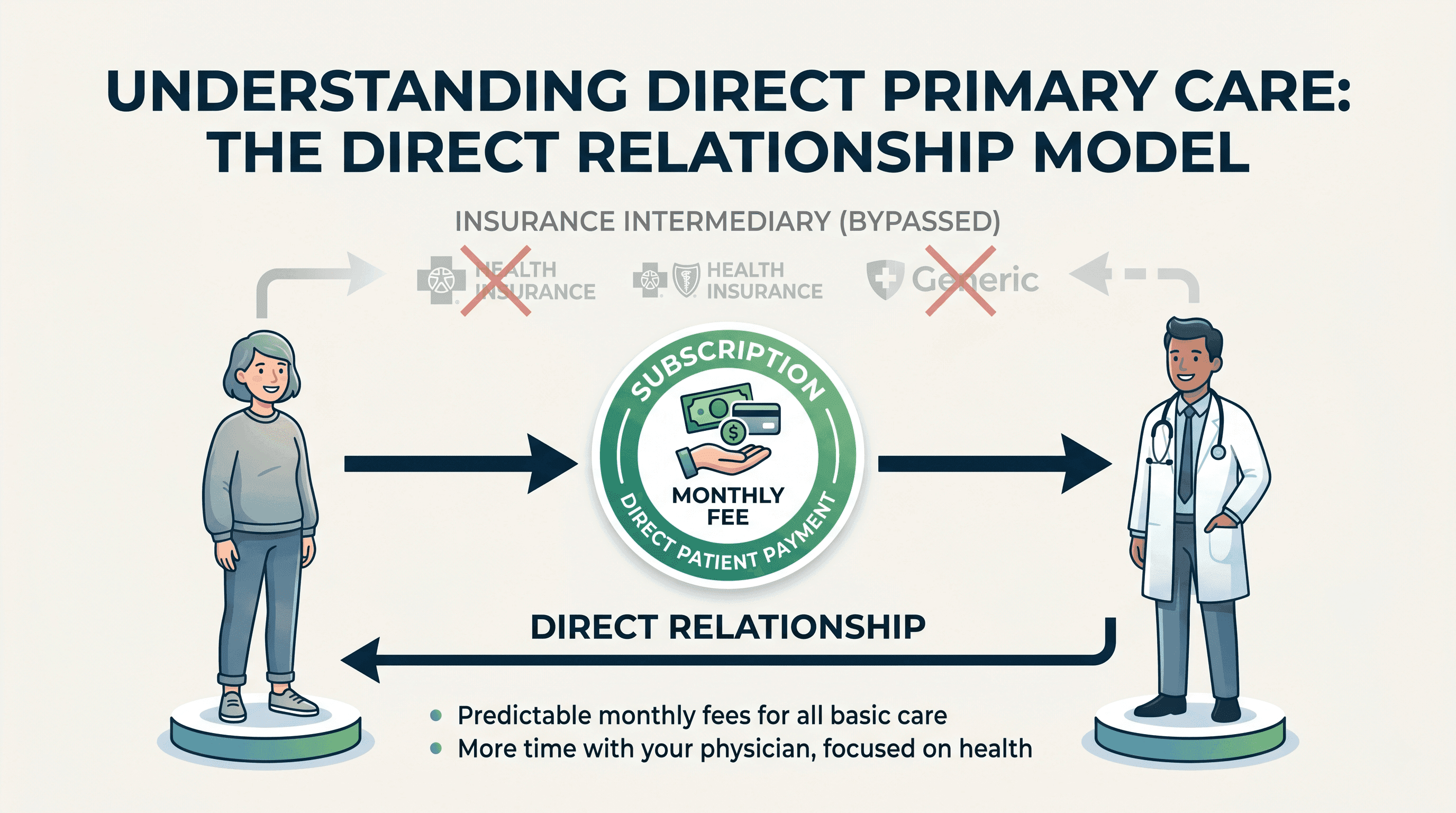
Direct primary care (DPC) is a subscription-based healthcare model where patients pay a flat monthly membership fee directly to their doctor in exchange for unlimited primary care access, with no insurance billing involved. No claims. No copays. No explaining your visit to a billing department. Just a doctor you can actually reach.
This guide covers exactly how the model works, what a membership costs, which patients benefit most, and what the 2026 HSA rule change means for people who have been sitting on the fence.
At a Glance
| Topic | Key Facts |
|---|---|
| Model type | Subscription-based, insurance-free primary care |
| Typical monthly cost | $50–$150/month for adults; $20–$75/month for children |
| What's included | Unlimited visits, telehealth, chronic care, basic labs, wholesale meds |
| What's not included | Specialist referrals, hospitalizations, surgery, imaging |
| Insurance still needed? | Yes — pairing with an HDHP is standard practice |
| HSA eligibility (2026) | Now qualified under the One Big Beautiful Bill Act |
| Practices in the US | 2,800+ as of 2026, available in all 50 states |
What Is Direct Primary Care? A Plain-English Definition
Direct primary care is best understood as the Netflix model applied to a doctor's office. Instead of paying per visit and running everything through insurance, a patient pays a predictable monthly fee and gets full access to primary care services for as long as the membership is active. No visit limits. No surprise bills afterward.
The model was designed from the ground up to remove insurance companies from the primary care equation entirely. According to the American Academy of Family Physicians (AAFP), DPC practices operate by charging patients directly and do not submit claims to insurers for primary care services. That one structural change cascades into a completely different care experience.
"Direct primary care is a practice and payment model where patients/consumers pay their physician or practice directly in the form of a periodic fee for a defined set of primary care services." — American Academy of Family Physicians
How DPC Differs from Traditional Fee-for-Service Care
The traditional primary care model is built around volume. To keep a practice financially viable while accepting insurance reimbursements, a conventional physician typically manages a panel of 2,000 to 3,000 patients, which translates to roughly 20 to 25 appointments per day and visits that average 10 to 15 minutes. The physician is, structurally, optimized to move people through.
Research published in JAMA found that administrative tasks consume a significant portion of physician time in fee-for-service settings, leaving less than half of a doctor's day for direct patient contact. That is not a complaint about individual physicians — it is the predictable output of a billing-first system.
DPC inverts that structure. A study from the University of Texas Health Science Center found that DPC physicians maintain panels of approximately 345 patients on average, compared to over 3,000 in traditional practices. That panel difference is why same-day appointments, 45-to-60-minute visits, and after-hours text access to a doctor are operationally possible in DPC. None of those things are perks — they are the natural result of serving fewer patients.
DPC vs. Concierge Medicine — Not the Same Thing
This is the most common point of confusion in the DPC conversation, and it matters.
Concierge medicine charges a retainer fee, often ranging from $150 to $300 or more per month, and still bills the patient's insurance for visits on top of that fee. The patient pays twice — once for access, and once per encounter through insurance. Concierge practices are designed for affluent patients who want premium access without giving up their existing coverage structure.
Direct primary care operates on a fundamentally different premise. The practice collects only the monthly membership fee. There is no insurance billing for covered services. The fee itself is the complete financial arrangement between patient and doctor, which is why DPC practices are far more affordable and accessible than concierge alternatives. Harvard Medical School's health research program notes this distinction directly when tracking the growth of both models.
What Does a DPC Membership Actually Cover?
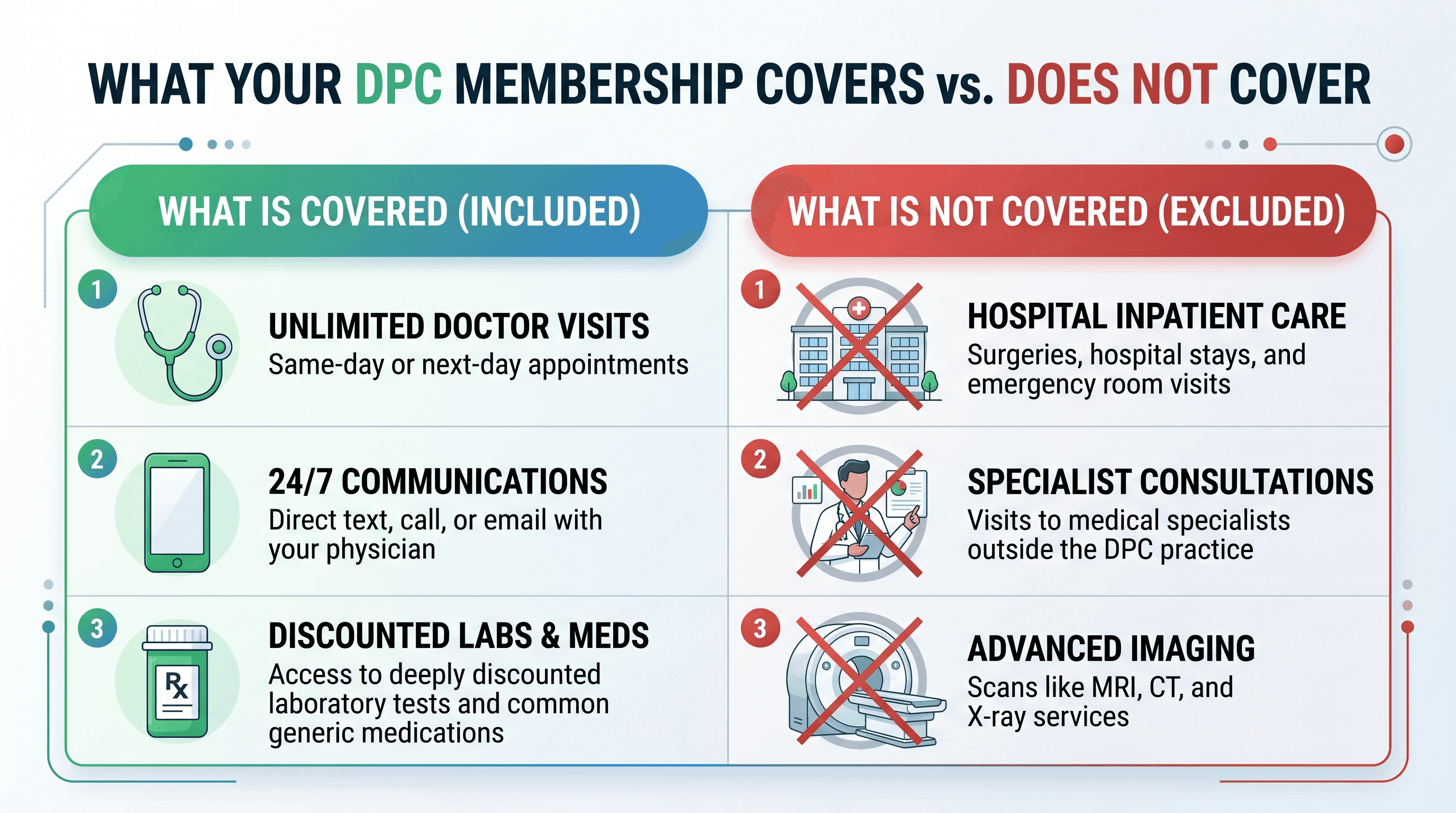
A DPC membership covers the full scope of primary care — not a menu of selected services.
Typically included in a standard DPC membership:
Unlimited in-person and telehealth visits with no per-visit fee, same-day or next-day appointment availability, chronic disease management for conditions like hypertension, diabetes, and thyroid disorders, preventive care including annual physicals and immunizations, in-office procedures such as wound care and splinting, basic lab work at heavily discounted rates, and wholesale pricing on generic medications.
Not covered by a DPC membership:
Specialist referrals and specialist visits, hospitalizations, emergency room care, surgical procedures, advanced imaging such as MRI or CT scans, and prescription drugs outside the practice's wholesale formulary.
The boundary is primary care. Anything that requires a specialist, a hospital, or a surgical suite is outside the DPC model's scope. That is not a gap unique to DPC — traditional primary care does not cover those things either. But it is the reason a DPC membership must be paired with some form of health insurance to protect against larger medical events.
How Much Does Direct Primary Care Cost?
The honest answer is that DPC is affordable for most households — and materially cheaper than most people assume once it is compared against the actual cost of using traditional primary care.
Monthly fees vary by age, geography, and practice. According to the AAFP, typical ranges break down as follows: children under 18 pay approximately $20 to $75 per month, adults between 18 and 44 generally pay $50 to $100 per month, and adults 45 and older typically fall in the $75 to $150 per month range. Urban markets in high-cost states tend toward the upper end of each band.
Three 12-Month Cost Scenarios
Scenario A: Healthy 28-year-old, individual. At $75/month for a DPC membership plus a low-premium HDHP at approximately $150/month, the annual cost is $2,700, not counting any deductible expenses. That same person, in a traditional PPO without employer subsidies, might pay $350 to $500/month in premiums, plus copays of $30 to $50 per visit on top of that.
Scenario B: Family of four. A DPC practice might charge $75/month for two adults and $25/month per child, or offer a family cap. At $125/month for the family membership plus a high-deductible family plan at approximately $400/month, the combined annual cost is $6,300. A family PPO without employer contribution routinely exceeds $1,200 to $1,500/month in premiums alone.
Scenario C: Individual managing a chronic condition. Someone with type 2 diabetes or hypothyroidism who visits a primary care doctor four to six times a year sees the most dramatic comparison. In a DPC practice, those visits, lab draws, and medication refills are included in the membership. In a fee-for-service setting, the same number of visits plus labs plus medication copays can easily total $600 to $1,500 annually, before deductibles.
DPC Plus a High-Deductible Health Plan — How the Pairing Works
Because DPC is not health insurance, patients need a separate plan to cover hospitalizations, specialist care, and emergencies. The standard pairing is a DPC membership alongside a high-deductible health plan (HDHP), often a bronze-tier plan, which carries lower monthly premiums in exchange for a higher out-of-pocket deductible.
The logic is straightforward: DPC handles the frequent, predictable costs (primary care visits, labs, medications), while the HDHP protects against the infrequent, unpredictable costs (ER visits, surgeries, specialist admissions). Together, the two replace what a traditional PPO or HMO does, often at a lower total annual cost for moderate-utilization patients, according to analysis published in Health Affairs.
The 2026 HSA Rule Change — What It Means for DPC Members
This is the section most DPC guides do not have, and it is the most consequential development in the space since the model went mainstream.
For years, one of the primary financial objections to DPC was an IRS rule that disqualified patients from contributing to a Health Savings Account (HSA) if they were enrolled in a DPC membership. An HSA is a tax-advantaged savings account available to people enrolled in a qualifying HDHP, and losing access to it was a real cost for people considering the DPC-plus-HDHP pairing.
That changed on July 4, 2025, when the One Big Beautiful Bill Act was signed into law. Effective January 1, 2026, DPC memberships are designated as HSA-qualified expenses, and the prior HSA contribution disqualification is removed for patients enrolled in a qualifying DPC arrangement.
Under the law, a qualifying DPC arrangement must charge a monthly fee of no more than $150 for an individual or $300 for a family. Most DPC practices fall well within these caps. The practical effect is that patients in 2026 can now pay their DPC membership fee directly from their HSA, use pre-tax dollars to cover it, and still make full HSA contributions alongside their HDHP.
For someone in a 22% federal tax bracket paying $100/month for DPC, the HSA eligibility is worth approximately $264 in annual tax savings on the membership fee alone, before counting any medications or labs purchased at wholesale through the practice.
Can Your Employer Pay for Your DPC Membership?
Yes, and the 2026 law makes the arrangement cleaner for both employers and employees.
Employers can now offer DPC memberships as a formal employee benefit alongside HDHPs and HSAs without triggering the prior HSA disqualification concern. For HR professionals, this creates a straightforward benefit structure: offer an HDHP as the base insurance plan, layer a DPC membership as an employer-paid benefit, and let employees use HSA contributions for additional healthcare expenses.
A 2024 analysis in the Journal of General Internal Medicine found that employers offering DPC-adjacent primary care benefits reported improvements in employee satisfaction with healthcare access, a metric that is increasingly relevant in competitive hiring markets. Post-OBBBA, the legal and tax clarity is likely to accelerate employer adoption through the remainder of 2026 and into 2027.
The Benefits of Direct Primary Care — For Patients and Physicians
The benefits of DPC flow in two directions, and understanding both sides helps explain why the model has grown to 2,800-plus practices across all 50 states.
For patients, the core advantages are access, continuity, and cost transparency. Same-day or next-day appointments are the norm, not the exception, because panel sizes are small enough to accommodate them. The relationship with a single physician builds over time, which has real clinical consequences: patients with consistent primary care relationships are more likely to have chronic conditions caught early and managed proactively, according to research published in BMC Primary Care via PMC. And because pricing is fixed and transparent, there are no surprise bills after a visit.
For physicians, the model removes the administrative layer that drives burnout in conventional practice. DPC doctors spend less time on insurance pre-authorizations, billing disputes, and documentation for reimbursement, and more time on direct patient care. The Sheps Center for Health Services Research at UNC has documented that DPC physicians report higher professional satisfaction and lower administrative burden compared to traditional practice settings.
The Honest Drawbacks of Direct Primary Care
Direct primary care has real limitations, and a guide that glosses over them does readers a disservice.
The first is cost layering. A DPC membership is a new monthly expense on top of whatever insurance premiums a patient already pays. For someone with comprehensive employer-sponsored insurance at low cost to them personally, adding a $75 to $100/month DPC membership may not produce net savings. The math only works clearly for patients with high-deductible plans, those paying full premiums on the individual market, or people who currently avoid primary care because of copay costs.
The second is geographic availability. While DPC has grown substantially, rural and underserved areas still have limited options. A patient in a small town may not have a DPC practice within a reasonable driving distance, which makes the model inaccessible regardless of cost.
The third is sole-provider dependency. A DPC practice often means one physician manages your care. If that physician leaves the practice, retires, or closes, continuity is disrupted. Traditional systems have more built-in redundancy.
The fourth is an equity concern that the DPC field is still actively working through. Critics have raised the valid question of whether a subscription model, even an affordable one, is accessible to lower-income patients who cannot absorb an additional monthly expense. DPC advocates point to practices with sliding-scale fees and employer-sponsored arrangements, but coverage for the lowest-income households remains uneven.
Is Direct Primary Care Right for You? A Simple Framework
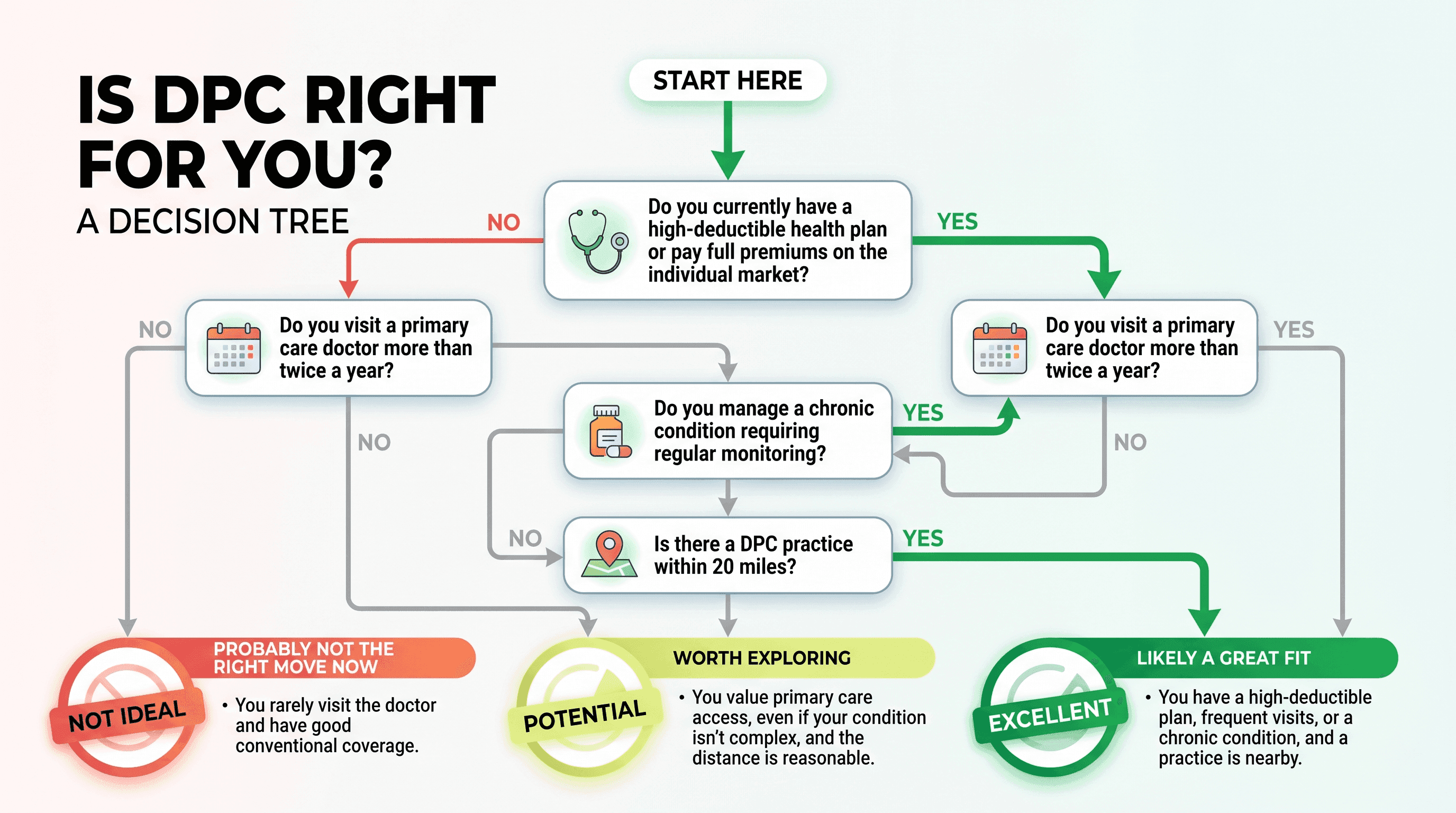
Four variables determine whether DPC makes sense for a specific person.
Visit frequency. Patients who see a primary care doctor two or more times a year get clear value from a membership model. At three or more visits annually, plus labs, the membership pays for itself in most markets. Low-utilization patients — people who visit once a year for a routine physical — may not see financial savings, though they still benefit from access.
Chronic condition management. Patients managing diabetes, hypertension, thyroid disorders, or mental health conditions that require regular follow-up are among the best candidates for DPC. The unlimited-visit structure means monitoring appointments are not a cost-benefit calculation each time.
Current insurance situation. Patients on HDHPs, those purchasing coverage on the individual market, freelancers, and self-employed individuals see the clearest financial benefit. Patients with heavily subsidized employer PPOs may find the math less compelling.
Local availability. DPC's value is highest for patients who can build a longitudinal relationship with a specific physician. If the nearest DPC practice is a distant drive, the model loses some of its practical advantage.
If you are unsure whether your specific health situation makes DPC a good fit, connecting with a primary care provider through Momentary's virtual care platform can help clarify what level of primary care access makes sense before committing to a membership.
Three reader profiles:
A 35-year-old freelance graphic designer paying $280/month for a bronze HDHP, visiting a doctor three times a year for a chronic skin condition, and paying lab fees out of pocket is likely a great fit. A family of four on employer insurance with an 80/20 plan and $20 copays who rarely uses primary care is probably not the right move now — the savings are not there. A 52-year-old managing hypertension and pre-diabetes, currently on an HDHP and dreading every specialist referral copay, is worth exploring, particularly in 2026 with the new HSA benefit in play.
How to Find a Direct Primary Care Practice Near You
Finding a DPC practice is straightforward. The DPC Frontier Mapper and the DPC Coalition's practice directory both offer searchable databases by zip code, with listings across all 50 states. As of 2026, more than 2,800 DPC practices are in operation nationally.
When evaluating a practice, four things are worth confirming before signing up. First, ask for the full service list in writing, since inclusions vary by practice. Second, ask about panel size — anything above 800 patients starts to compromise the access model. Third, ask about the communication policy: can you reach the physician by text or phone directly, and what is the typical response time? Fourth, review pricing transparency: is the monthly fee all-inclusive, or are there add-on charges for specific services?
If you want to explore your symptoms, understand a diagnosis, or get guidance on which type of care might suit your situation, Momentary's AI health navigator is a useful starting point before, during, or alongside a DPC membership.
Frequently Asked Questions
Why is direct primary care considered better than traditional primary care?
The structural difference is panel size. DPC physicians serve roughly 300 to 600 patients, compared to 2,000 to 3,000 in conventional practices, which is what makes same-day access, longer appointments, and direct physician communication operationally possible. Patients who have experienced both models consistently describe DPC as more attentive and less transactional. The AAFP notes that the model's design specifically targets the access and continuity problems that fee-for-service primary care structurally produces.
What are the four primary care services?
Primary care broadly covers four domains: preventive care (screenings, immunizations, wellness visits), acute care (illness and injury management), chronic disease management (ongoing monitoring and treatment of conditions like diabetes or hypertension), and care coordination (referrals and communication with specialists). DPC practices deliver all four domains under the membership model.
What does DPC mean in healthcare?
DPC stands for Direct Primary Care. It refers to the billing and practice model in which patients pay their physician directly through a monthly membership fee, bypassing insurance for primary care services. The term "direct" refers to the direct financial and care relationship between patient and physician, with no insurance intermediary.
Is direct primary care the same as a health-sharing ministry?
No. Direct primary care is a primary care delivery model that covers routine and preventive services. A health-sharing ministry is an alternative to insurance that members use to share costs for larger medical events. Some patients pair DPC with a health-sharing ministry instead of a traditional HDHP, though this carries different coverage risks and is not regulated as insurance. A doctor can advise on individual cases when evaluating coverage options.
Can I use my HSA to pay for a DPC membership in 2026?
Yes, starting January 1, 2026, under the One Big Beautiful Bill Act. DPC memberships at or below $150/month for individuals and $300/month for families are now HSA-qualified expenses, and enrollment no longer disqualifies patients from contributing to an HSA alongside an HDHP.
What happens if I need to see a specialist?
DPC covers primary care only. If a specialist visit is needed, a DPC physician will refer the patient just as any primary care doctor would. The patient is then responsible for specialist costs, which is why maintaining a health insurance plan alongside DPC membership is necessary. The DPC physician can often help coordinate care and communicate with the specialist directly, which is something that gets lost in high-volume traditional practices.
References
- American Academy of Family Physicians — Direct Primary Care Overview — Definition, model structure, and AAFP position on DPC billing practices.
- PMC / JAMA — Physician Time Use in Fee-for-Service Settings — Data on administrative burden and direct patient contact time in conventional primary care.
- University of Texas Health Science Center — DPC Panel Size Research — Analysis of DPC physician panel sizes vs. traditional primary care.
- Harvard Medical School — Concierge Medicine and DPC Growth — Comparative tracking of DPC and concierge medicine model growth.
- Health Affairs — DPC and HDHP Cost Comparisons — Analysis of total cost comparisons between DPC-plus-HDHP and traditional coverage structures.
- PMC — Longitudinal Primary Care Relationships and Clinical Outcomes — Evidence on chronic condition management outcomes with continuous primary care relationships.
- Sheps Center for Health Services Research, UNC — DPC Physician Satisfaction — Findings on administrative burden and professional satisfaction in DPC vs. traditional practice.
- Journal of General Internal Medicine — Employer DPC Benefit Adoption — Research on employer-sponsored DPC benefits and employee healthcare satisfaction.