


At a Glance
| Topic | Key Facts |
|---|---|
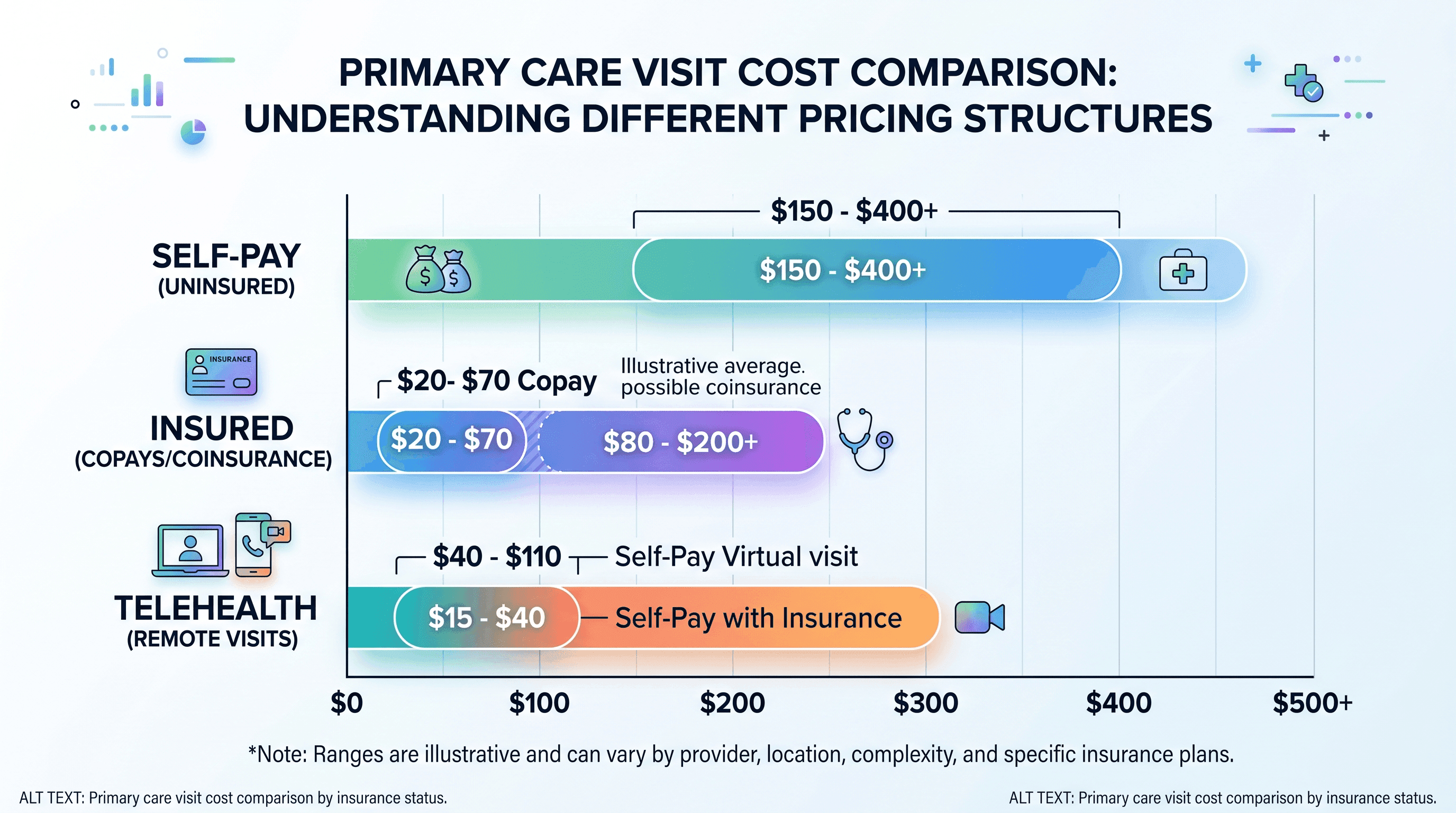
| Without insurance | $100 to $300 for a standard visit; $40 to $75 at community health centers |
| With insurance (copay plan) | $15 to $50 copay per visit |
| With insurance (high-deductible plan) | Full negotiated rate until deductible is met, often $100 to $200+ per visit |
| Annual physical (insured) | $0 under ACA mandate for preventive care; may trigger a bill if diagnostic topics arise |
| Telehealth visit | $40 to $90 self-pay; lower or equal copay if insured |
| New patient vs. established patient | New patients typically pay 20 to 40% more per visit |
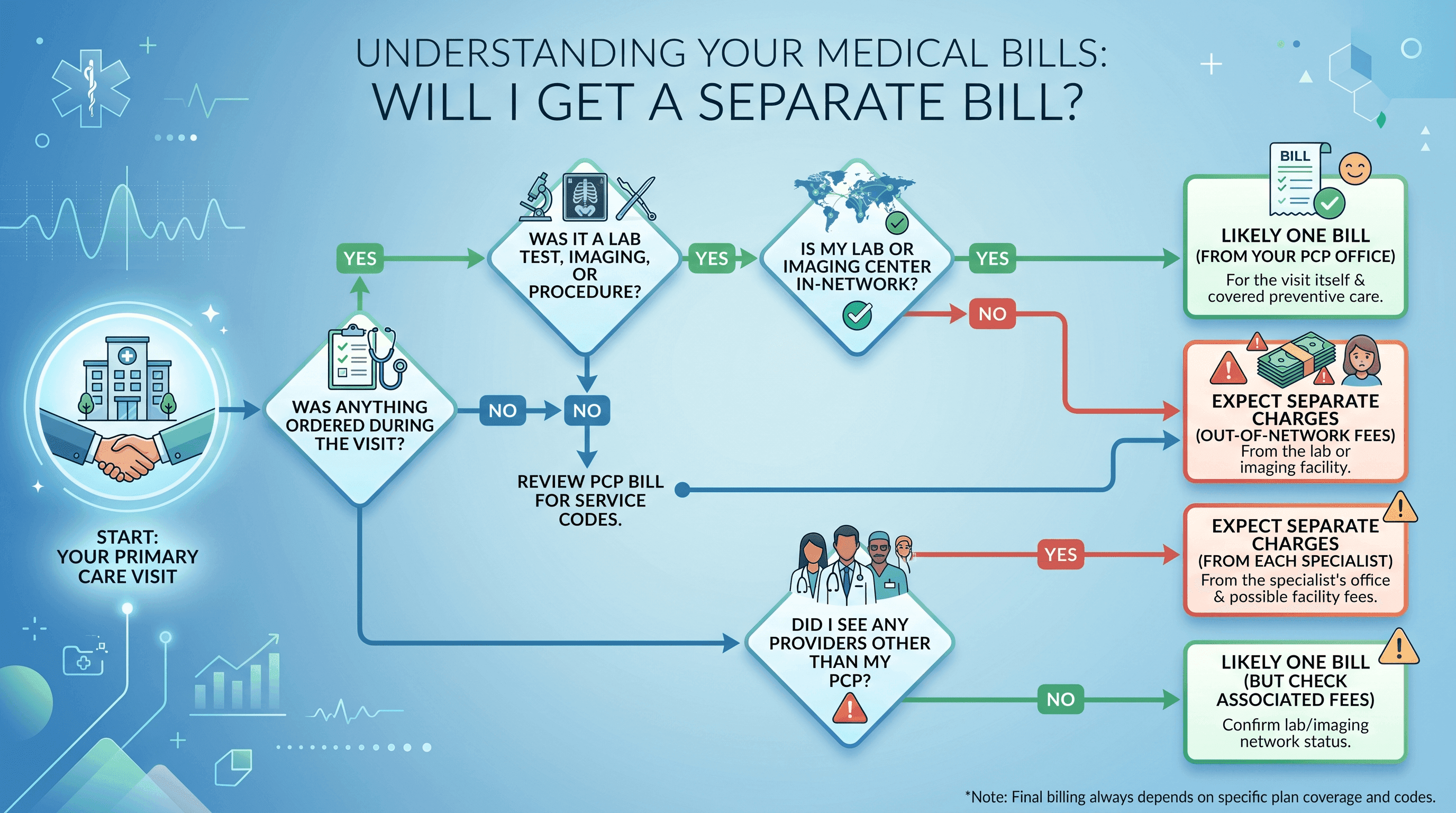
| Add-ons (labs, imaging) | Billed separately; can double or triple the visit cost |
The Short Answer on Primary Care Visit Cost
A primary care visit does not have a single national price. What patients pay varies based on insurance status, location, visit complexity, and what happens inside the exam room.
Without Insurance
Self-pay patients in the US typically pay between $100 and $300 for a standard primary care visit, according to data compiled by Johns Hopkins Bloomberg School of Public Health. In major metro areas like New York or Los Angeles, that figure can climb past $300. Community health centers and federally qualified health centers (FQHCs) charge on a sliding scale based on income, often bringing costs to $40 to $75.
With Insurance
Patients on a standard copay plan typically pay $15 to $50 per primary care visit regardless of what the doctor's negotiated rate is. Those on a high-deductible health plan (HDHP) pay the full negotiated rate out of pocket until their annual deductible is met, which can easily mean $100 to $200 or more per visit early in the plan year.
Telehealth
A telehealth visit with a primary care provider generally runs $40 to $90 for self-pay patients, according to Mayo Clinic. Most insurers now cover telehealth at the same copay as an in-person visit, though some plans charge a slightly lower rate for virtual appointments.
The "Free" Physical That Sends You a Bill
This is the most common and most frustrating surprise in primary care billing, and almost no one explains it clearly before it happens.
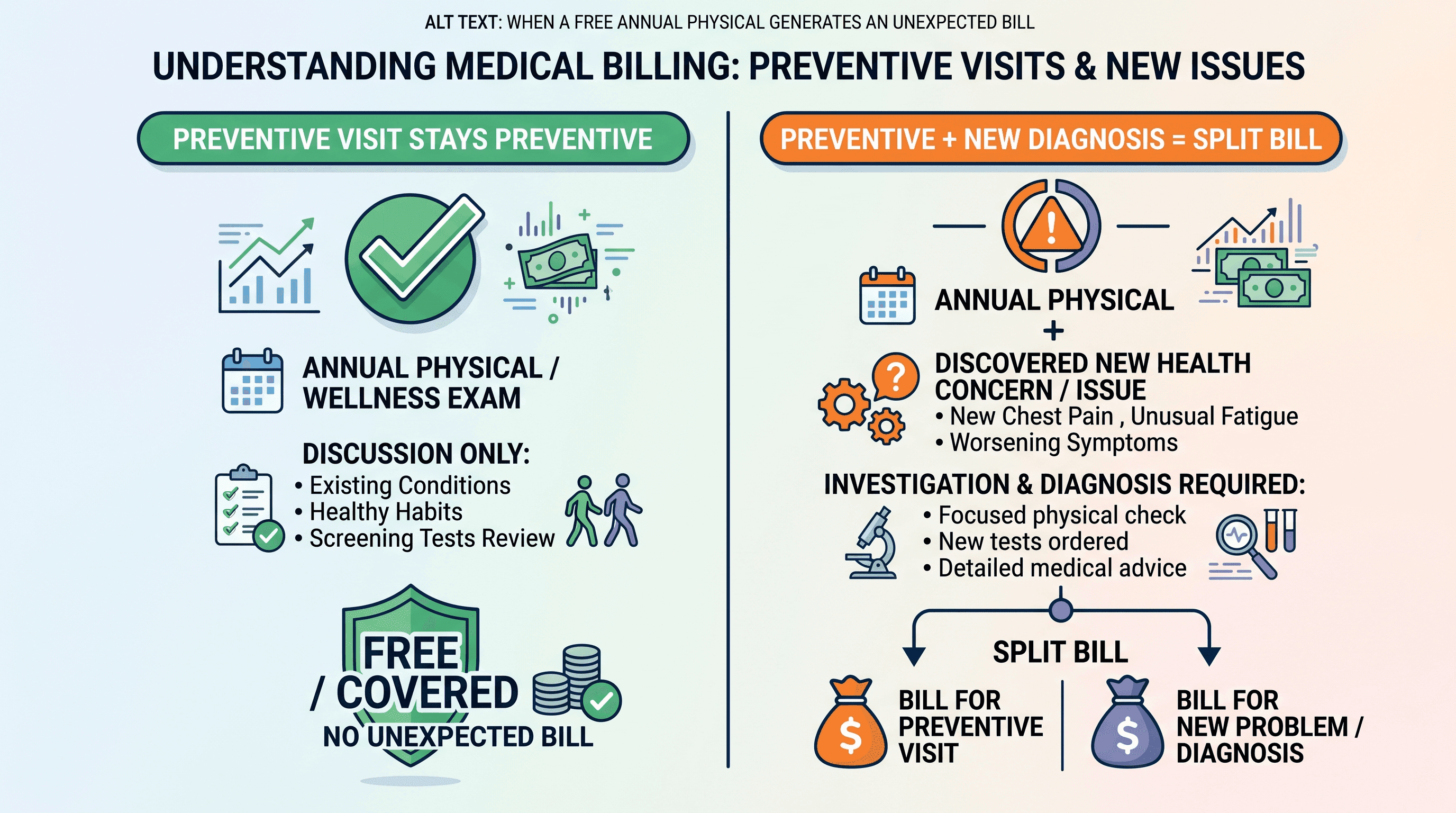
Under the Affordable Care Act, routine annual wellness exams are classified as preventive care and are fully covered by most insurance plans at $0 cost to the patient. No copay, no deductible, no cost-sharing at all, as long as the visit stays within the preventive care definition.
The problem starts the moment the conversation moves to a new symptom.
Say a patient books an annual physical and, while the doctor is reviewing medications, mentions a new rash that appeared last week. The physician evaluates it. At that moment, the visit now includes diagnostic medical decision-making, and billing guidelines require the physician to code that additional service separately. The patient receives two charges: one for the preventive wellness visit ($0), and one for the diagnostic evaluation of the rash (full copay or deductible applies).
This billing pattern is not a loophole or an error. It reflects how CPT codes are structured and how insurers require claims to be submitted. The Centers for Medicare and Medicaid Services outlines this distinction clearly in its coverage definitions.
What to do about it: At the start of any "annual physical," tell the front desk the visit is for preventive wellness only. If a new symptom needs attention, ask whether it should be scheduled as a separate appointment to keep the two billing categories clean. A doctor can advise on whether that is practical given the situation.
"Preventive visits that include chronic disease management or new problem evaluation are frequently billed as combination visits, which can generate patient cost-sharing even when the patient believed the visit would be free." — JAMA Internal Medicine, published findings on outpatient visit coding
Navigating Insurance: Copays, Deductibles, and Coinsurance
For insured patients, the type of plan determines how much of every visit comes out of pocket. These three terms cover most of the scenarios.
Copay Plans
A copay is a flat dollar amount paid at the time of service, regardless of the total cost of the visit. If the plan has a $30 primary care copay, the patient pays $30 whether the negotiated rate for that visit was $90 or $220. Employer-sponsored plans in the US averaged $26 to $27 for primary care copays as of recent data from the Kaiser Family Foundation.
High-Deductible Health Plans
An HDHP requires the patient to pay the full negotiated rate for most services until the annual deductible is met. The IRS defines an HDHP as a plan with a deductible of at least $1,650 for individual coverage in 2025. So if a patient's negotiated primary care visit rate is $160 and their deductible has not been met, they owe $160 that day, not a copay. After the deductible clears, most HDHPs shift to coinsurance.
Coinsurance
Coinsurance is a percentage split of costs between the insurer and the patient after the deductible is met. A plan with 80/20 coinsurance means the insurer pays 80% and the patient pays 20% of each covered service until the out-of-pocket maximum is reached. On a $160 visit, that is a $32 patient share. Coinsurance stops applying once the out-of-pocket maximum is hit for the year.
What CPT Codes Decide About Your Bill
Every primary care visit gets assigned a billing code that determines how much the visit costs, and most patients never see it until the explanation of benefits arrives.
The codes that apply to outpatient primary care visits are called Evaluation and Management (E&M) codes, running from 99202 to 99215 for office visits. Physicians assign a level based on the complexity of the visit and the time spent. The higher the level, the higher the charge.
| Visit Level | Typical Time | Patient Complexity | Approximate Self-Pay Range |
|---|---|---|---|
| Level 1 (99201/99211) | 5 to 10 min | Very simple, nurse visit | $40 to $70 |
| Level 2 (99202/99212) | 10 to 15 min | Straightforward | $70 to $110 |
| Level 3 (99203/99213) | 20 to 25 min | Low to moderate complexity | $110 to $175 |
| Level 4 (99204/99214) | 30 to 35 min | Moderate to high complexity | $175 to $250 |
| Level 5 (99205/99215) | 40+ min | High complexity | $250 to $350+ |
A Level 3 visit (CPT 99213) is the most common primary care encounter in the US, representing a routine sick visit or a follow-up for a managed chronic condition. If a patient calls to ask "what will this visit cost," asking the billing team which E&M level the visit is likely to be coded at is a precise way to get a better estimate than a general range.
The AMA Current Procedural Terminology guidelines provide the full framework physicians use to assign these levels.
Primary Care Visit Cost by Insurance Type
The cost calculation is different for every major coverage category, and combining them into one table is something most guides avoid. Here is the breakdown by payer.
Employer-Sponsored Insurance
Most American adults under 65 with insurance receive it through an employer. Copays for primary care on employer plans averaged around $26 to $27 per visit, with individual annual deductibles averaging more than $1,400 according to Kaiser Family Foundation employer health benefit surveys. Preventive visits are covered at $0 on nearly all employer plans under ACA requirements.
ACA Marketplace Plans
Marketplace plans are organized by metal tier, which reflects how costs are split between insurer and patient.
Bronze plans carry the lowest monthly premium but the highest out-of-pocket costs, often requiring patients to meet a deductible of $7,000 or more before any cost-sharing begins. Silver plans balance moderate premiums with moderate cost-sharing and are the only tier eligible for cost-sharing reduction subsidies. Gold plans carry higher premiums but lower deductibles and copays, making them better value for patients who visit the doctor frequently.
Medicaid
Medicaid-covered primary care visits are generally free or close to it for most enrollees. Most states set copays at $0 to $3 per visit under federal rules that cap cost-sharing for Medicaid beneficiaries. Income-eligible adults and children can access primary care at effectively no cost. Eligibility rules vary significantly by state. Medicaid.gov maintains current state-by-state information.
Medicare Part B
Medicare Part B covers outpatient primary care visits, but it does not mean free. In 2025, the Medicare Part B annual deductible is $257, after which Medicare covers 80% of approved charges and the patient pays 20% coinsurance, according to CMS Medicare 2025 cost data. Patients without a Medigap supplement plan carry that 20% with no cap unless they also have Part D or other secondary coverage. Annual wellness visits under Medicare are fully covered at $0 as a preventive benefit.
The Hidden Costs That Actually Drive Up Your Bill
The office visit charge is the foundation of the bill. What gets ordered during the visit can add hundreds of dollars on top of it, and those charges often arrive weeks later as separate claims.
Lab Tests Billed Separately
Blood panels, urinalysis, cultures, and other diagnostics ordered during a visit are billed independently through the laboratory that processes them, whether that is the clinic's in-house lab, Quest Diagnostics, or LabCorp. A basic metabolic panel runs $10 to $30 at a contracted lab for insured patients; a comprehensive panel can run $50 to $100 or more. Without insurance, those same tests can cost $100 to $400 or more depending on the lab and location.
In-Office Procedures
Any procedure performed in the exam room, including a wound culture, an EKG, a breathing test, or an injection, generates a separate CPT code and a separate charge. A single-lead EKG is typically $50 to $100. A cortisone injection can be $100 to $300 before facility overhead is added.
Facility Fees at Hospital-Affiliated Practices
This one surprises even experienced patients. When a primary care office is owned by or affiliated with a hospital health system, insurers often treat visits there as hospital outpatient services rather than physician office visits. That triggers a facility fee, an additional charge separate from the physician's professional fee, that can add $100 to $500 or more to a standard visit. The visit itself feels identical to any other office appointment, but the billing is categorically different.
Before scheduling at any primary care practice, asking whether the office bills as a physician office or as a hospital outpatient department can reveal whether facility fees apply.
Out-of-Network Surprises
If the primary care physician is in-network but refers to an out-of-network specialist, orders labs at an out-of-network lab, or works in a facility with an out-of-network hospital affiliation, any of those downstream services can be billed at out-of-network rates. Confirming network status before any referral or lab order is placed protects against this.
The Uninsured Guide to Self-Pay and Cash Discounts
Patients without insurance are not simply handed a bill at the full list price and sent home. There is a negotiating layer most patients never access because no one tells them it exists.
Ask for the Self-Pay or Cash-Pay Rate Upfront
Most primary care offices maintain a self-pay rate that is lower than the standard list price, sometimes significantly. Before booking, calling the billing department and asking: "Do you have a self-pay or cash-pay rate for a primary care visit?" is the single most effective step an uninsured patient can take. Discounts of 20 to 40% off the listed price are common, and some practices offer deeper prompt-pay discounts for patients who pay at the time of service.
FQHCs and Sliding-Scale Clinics
Federally Qualified Health Centers are community health clinics funded in part by the federal government to provide care on a sliding fee scale tied to household income. Patients at or below 100% of the federal poverty level often pay $20 to $40 per visit. The HRSA Health Center Finder locates the nearest FQHC by zip code.
Disputing or Negotiating a Bill After the Fact
If a bill arrives that feels unmanageable, calling the billing office and asking: "Can you help me set up a payment plan or reduce this balance based on financial hardship?" opens a conversation most billing departments are trained to have. Many hospital-affiliated practices have charity care or financial assistance programs that apply retroactively to already-issued bills. Medical billing advocates, who work on contingency or for a flat fee, can negotiate on behalf of patients who are not comfortable navigating this process alone.
If a visit is needed soon and the cost is a barrier, connecting with a primary care provider through a virtual visit is often a faster and more affordable path. Momentary's virtual primary care service offers access to licensed providers for straightforward concerns, often at a fraction of the cost of an in-person self-pay visit.
New Patient vs. Established Patient: Why Your First Visit Costs More
The first time a patient sees a primary care physician, the visit is coded as a new patient encounter (CPT codes 99202 through 99205). Subsequent visits to the same practice are coded as established patient encounters (CPT codes 99211 through 99215).
The difference matters financially. New patient visits require the physician to review and document a complete medical and social history, conduct a more comprehensive physical assessment, and establish a baseline care plan. This adds time and clinical complexity to the encounter, which pushes the E&M level higher. A routine new patient visit commonly codes at Level 3 or Level 4 (99203 or 99204), while a routine established patient visit for the same type of complaint often codes at Level 2 or Level 3 (99212 or 99213).
In practical terms, this means a first visit to a new primary care doctor for a straightforward concern can cost 20 to 40% more than a follow-up visit would cost for the same issue.
A patient is classified as established if they have received a professional service from the physician or another physician of the same specialty within the same practice group within the past three years. Changing to a new physician within the same practice can reset this status, so it is worth confirming before switching providers within the same clinic.
Telehealth vs. In-Person: The Cost Comparison
Telehealth has become a mainstream option for primary care, and for a significant portion of visits, it is a medically appropriate one.
| Visit Type | Self-Pay Range | Insured Copay (Typical) |
|---|---|---|
| In-person PCP visit | $100 to $300 | $15 to $50 |
| Telehealth PCP visit | $40 to $90 | $15 to $40 |
| Urgent care (in-person) | $80 to $280 | $35 to $75 |
| Emergency room | $800 to $2,700+ | Higher copay or deductible |
Telehealth is well-suited for common conditions including urinary tract infections, sinus infections, respiratory illness, skin concerns, mental health follow-ups, and medication refills. It is not appropriate for chest pain, difficulty breathing, severe abdominal pain, or any situation that requires a physical examination or diagnostic equipment.
From a cost standpoint, the self-pay savings on telehealth are meaningful, typically $50 to $150 less per visit than an in-person appointment. Insured patients may find copays identical between the two visit types, though some plans have lowered telehealth copays in recent years.
How to Avoid a Surprise Medical Bill: A Practical Checklist
Three steps, done before the appointment, prevent the majority of unexpected charges.
Verifying in-network status is the first. Calling the insurance member services number on the back of the card and confirming both the physician and the facility are in-network takes five minutes and eliminates the most common source of surprise bills. In-network status should be confirmed even when using a practice listed on the insurer's website, because that information can lag behind actual contract changes.
Confirming the lab's network status is the second. Asking the physician's office which lab they send specimens to, then verifying that lab is in-network, protects against out-of-network laboratory charges. Patients can also ask to have labs sent to a specific in-network lab.
Being clear about the visit type at check-in is the third. If the appointment is a preventive annual physical, stating that at check-in and asking the front desk to note it creates a record. If a diagnostic concern is going to be discussed, asking about whether it should be scheduled as a separate visit before the exam begins gives the billing team the information they need to code correctly.
If a bill does arrive unexpectedly, using Momentary's AI health navigator can help make sense of the charges, understand what was likely coded and why, and identify the right next questions to ask the billing department.
Frequently Asked Questions
How much does a primary care visit cost in the US?
Without insurance, a standard primary care visit costs between $100 and $300 in most parts of the US, though community health centers offer sliding-scale visits starting at $20 to $40 for income-eligible patients. With insurance, most patients pay a $15 to $50 copay per visit if they are on a copay plan. Patients on high-deductible plans may pay the full negotiated rate, typically $100 to $200 or more, until their annual deductible is met.
What is included in a primary care visit?
A primary care visit covers the physician's time and clinical assessment, including history review, physical examination, diagnosis, and treatment planning. Anything ordered during that visit, such as blood tests, imaging, or in-office procedures, is billed separately. The base visit charge reflects the physician's professional fee only.
Do Americans have to pay to see a doctor?
Yes, in most cases. The US does not have a universal healthcare system, so patients pay either through insurance cost-sharing (copays, deductibles, coinsurance) or out of pocket. Medicaid covers primary care at little to no cost for income-eligible individuals. Medicare covers preventive visits at no cost but charges a deductible and 20% coinsurance for most other primary care services.
Why was I charged for my preventive visit?
A preventive annual physical is covered at $0 by most insurance plans under the ACA. However, if a new symptom or problem was evaluated during the same appointment, the physician is required to bill that portion separately as a diagnostic service. This generates a separate charge, often a copay or deductible contribution, even though the patient believed the visit was free. Keeping the annual physical strictly preventive, or scheduling diagnostic concerns as a separate appointment, prevents this outcome.
What is a Level 3 office visit?
A Level 3 office visit corresponds to CPT codes 99203 (new patient) or 99213 (established patient). It represents a visit of low to moderate medical complexity, typically 20 to 25 minutes, covering concerns like a routine illness, a chronic disease follow-up with stable management, or a new complaint with a clear diagnostic path. It is the most commonly billed primary care code and typically costs $110 to $175 for self-pay patients.
What is the cheapest way to see a doctor without insurance?
The lowest-cost options for uninsured patients are federally qualified health centers (FQHCs), which charge on a sliding scale based on income and can bring visit costs to $20 to $40 for qualifying patients. Telehealth visits are the next most affordable, typically running $40 to $90. Asking any physician's office for their self-pay or cash-pay rate before scheduling often reveals a discount well below the standard list price.
References
- Johns Hopkins Bloomberg School of Public Health — Primary care visit availability and cost for uninsured patients.
- Centers for Medicare and Medicaid Services (CMS) — Medicare Part B 2025 deductible and cost-sharing data; preventive vs. diagnostic visit coverage definitions.
- JAMA / JAMA Internal Medicine — Findings on outpatient visit coding and combination visit billing patterns.
- Kaiser Family Foundation — Employer health benefit survey data on average copays and deductibles.
- AMA Current Procedural Terminology — CPT E&M code framework and office visit level criteria.
- HRSA Health Center Finder — Locator tool for federally qualified health centers with sliding-scale fees.
- Medicaid.gov — State-by-state Medicaid coverage rules and cost-sharing limits for primary care.

