


Switching doctors feels bigger than it is. Patients stay in medical relationships that stopped working years ago, not because they lack options, but because they feel guilty, unsure of the process, or afraid of an awkward confrontation. The truth is simpler: you are a voluntary participant in every medical relationship, and leaving one that no longer serves you is not rude, it is your right.
This guide covers the full picture, whether you have an HMO, a PPO, Medicare, or no insurance at all. Each path is slightly different, and knowing which one applies to you removes most of the confusion before it starts.
At a Glance
| Topic | Key Facts |
|---|---|
| Can you switch PCPs mid-year? | Yes, for most insurance plans, changing your PCP does not require open enrollment |
| Do you have to tell your doctor? | No, legally, there is no obligation to notify your current physician |
| How long does it take? | Typically 1 to 4 weeks depending on your plan type |
| Will you lose your medical records? | No, HIPAA gives you the legal right to request and receive them |
| What happens to prescriptions? | Your old doctor may bridge refills; controlled substances require earlier planning |
| Is it rude to switch? | No, physicians are professionals who understand patient needs change |
You Are the CEO of Your Health
The medical relationship only works when both sides are functioning. Your physician brings clinical expertise. You bring your history, your symptoms, and your willingness to follow through on a care plan. When that partnership breaks down, the person who pays the price is you.
Research published in the Journal of General Internal Medicine has documented that patients who feel heard and respected by their primary care physician show better adherence to treatment plans and report stronger health outcomes overall. A doctor who dismisses concerns, rushes appointments, or discourages second opinions is not just an annoyance. Over time, that dynamic produces real clinical harm through delayed diagnoses, undertreated conditions, and patients who stop seeking care altogether.
Switching primary care physicians is not a failure of the relationship. It is a recognition that your health needs a better fit. Most people who make the switch describe the same feeling afterward: relief that they did not wait longer.

Recognizing the Red Flags
Most patients do not leave on impulse. They leave after a pattern becomes undeniable. Knowing the specific signs helps separate a rough appointment from a genuinely poor fit.
Your concerns are consistently minimized. When a doctor repeatedly attributes new or worsening symptoms to stress, weight, or anxiety without clinical investigation, that is a form of medical dismissal. Studies in primary care settings have found that patients, particularly women and people of color, are more likely to have their reported symptoms discounted, leading to delayed diagnoses of serious conditions.
You wait weeks for routine appointments. Long wait times for non-urgent visits are a real signal about practice capacity. If getting a routine physical requires a two-month wait, access to timely care during a new or evolving health issue will likely be worse.
Follow-up on abnormal test results is inconsistent. A well-run primary care practice has a system for contacting patients when lab results require attention. If you are regularly the one tracking down results, that gap in communication creates genuine risk.
Second opinions are discouraged. Any physician who frames a second opinion as disloyalty is prioritizing the wrong thing. The Agency for Healthcare Research and Quality explicitly supports patients seeking second opinions as part of safe, informed care. A confident physician welcomes them.
Appointments feel rushed beyond reason. Brief appointments are a structural reality of many practices. But if every visit ends before your questions are answered and your chart has not been reviewed, the quality of care is genuinely compromised.
Treatment approaches feel outdated. Medicine changes. If your doctor is unfamiliar with current guidelines, newer medication options, or does not reference evidence-based protocols for conditions you are being treated for, that matters.
Your gut tells you something is wrong. Research on the patient-physician relationship consistently shows that trust and communication quality are among the strongest predictors of whether patients follow through on care. If you do not trust your doctor, that mistrust has clinical consequences.
Can You Change Your PCP at Any Time?
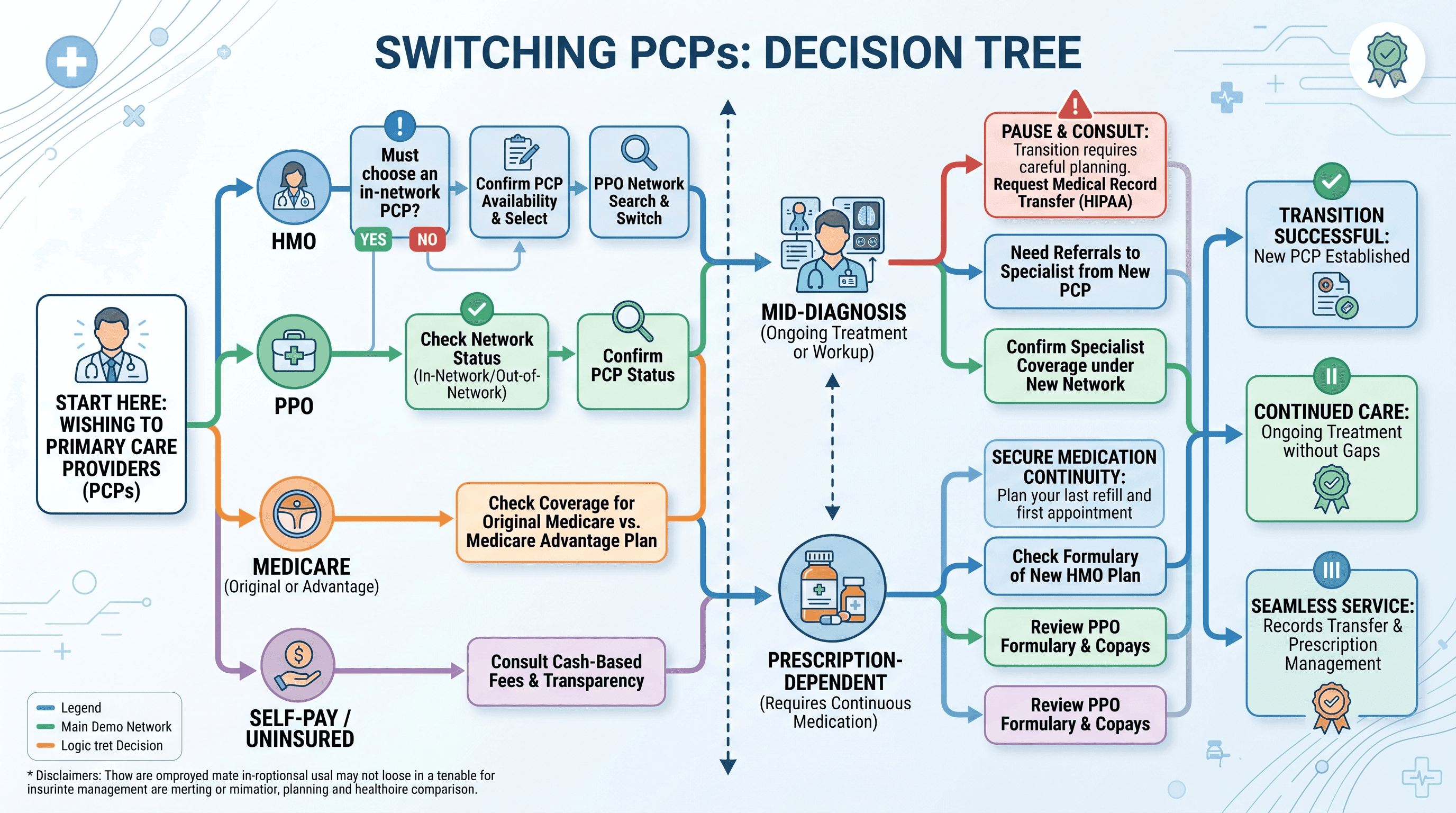
Yes, for the vast majority of insured Americans, changing your primary care physician does not require waiting for open enrollment. Open enrollment governs your insurance plan itself, not which physician you designate within that plan. You can update your PCP designation at any time, and the change typically takes effect on the first day of the following month.
HMO Plans
With an HMO (Health Maintenance Organization), you are required to have a designated PCP on file. To switch, log into your insurer's member portal or call member services and request the change. The new designation typically becomes effective on the first of the next month, though timelines vary by plan. Until the effective date, your current PCP is still on record for referral and claims purposes.
PPO Plans
With a PPO (Preferred Provider Organization), there is no mandatory PCP designation. You can see any in-network provider without a referral, so there is no formal change to file. That said, updating your insurer's records to reflect a new preferred physician prevents claims routing confusion and ensures your insurer's directory accurately reflects your care team.
Medicare
Original Medicare and Medicare Advantage operate very differently. With Original Medicare, there is no PCP designation requirement. You can see any Medicare-accepting physician at any time. With Medicare Advantage, the process mirrors an HMO: you have a designated PCP on file, and changes are made through your plan's member portal or member services. CMS guidance on designating a primary clinician in Medicare Advantage outlines the specific steps, and Humana's Medicare resources walk through plan-specific processes for members. Changes generally take effect the first of the following month.
No Insurance or Self-Pay
If you are uninsured or paying out of pocket, the process is the simplest of all. There is no insurer to notify and no designation system to update. The practical steps are securing your medical records from your current provider and establishing care with a new one. Community health centers, federally qualified health centers (FQHCs), and direct primary care practices are common options for self-pay patients.
How to Find a New PCP
The insurer's provider directory is the starting point, not the finish line. It tells you who is in-network and accepting new patients, but it tells you almost nothing about the quality, communication style, or availability of those physicians.
Build a short list using your directory, then layer in Healthgrades, Zocdoc, and Google Reviews. Read reviews critically: look for patterns, not outliers. One negative review from an angry patient means little; a recurring theme about long waits or poor communication across dozens of reviews means something.
Practical filters to apply before you call:
Languages spoken at the practice, telehealth availability for follow-ups, same-week appointment access for acute concerns, and evening or weekend hours if your schedule demands them.
Personal referrals from friends, family, or coworkers who share your health profile are often the most reliable signal. Asking your current physician for a recommendation is also completely appropriate, even if you are leaving the practice.
What Type of Primary Care Doctor Do You Need?
Family medicine physicians treat patients of all ages and can manage a broad range of conditions, including pediatric, adult, and geriatric care. Internal medicine physicians (internists) focus on adult medicine and are well-suited for patients managing multiple chronic conditions. Nurse practitioners (NPs) and physician assistants (PAs) practicing in primary care settings provide comparable care for most routine and preventive needs. Board certification can be verified through the American Board of Medical Specialties.
The Meet-and-Greet Visit
Many practices offer an introductory visit before you formally establish care. Use it. Questions worth asking include: How do you approach preventive care for someone with my health history? What is your experience managing this specific condition? How are referrals handled? What happens if I need advice after hours? These questions are not confrontational; they are exactly what a good physician expects from an engaged patient.
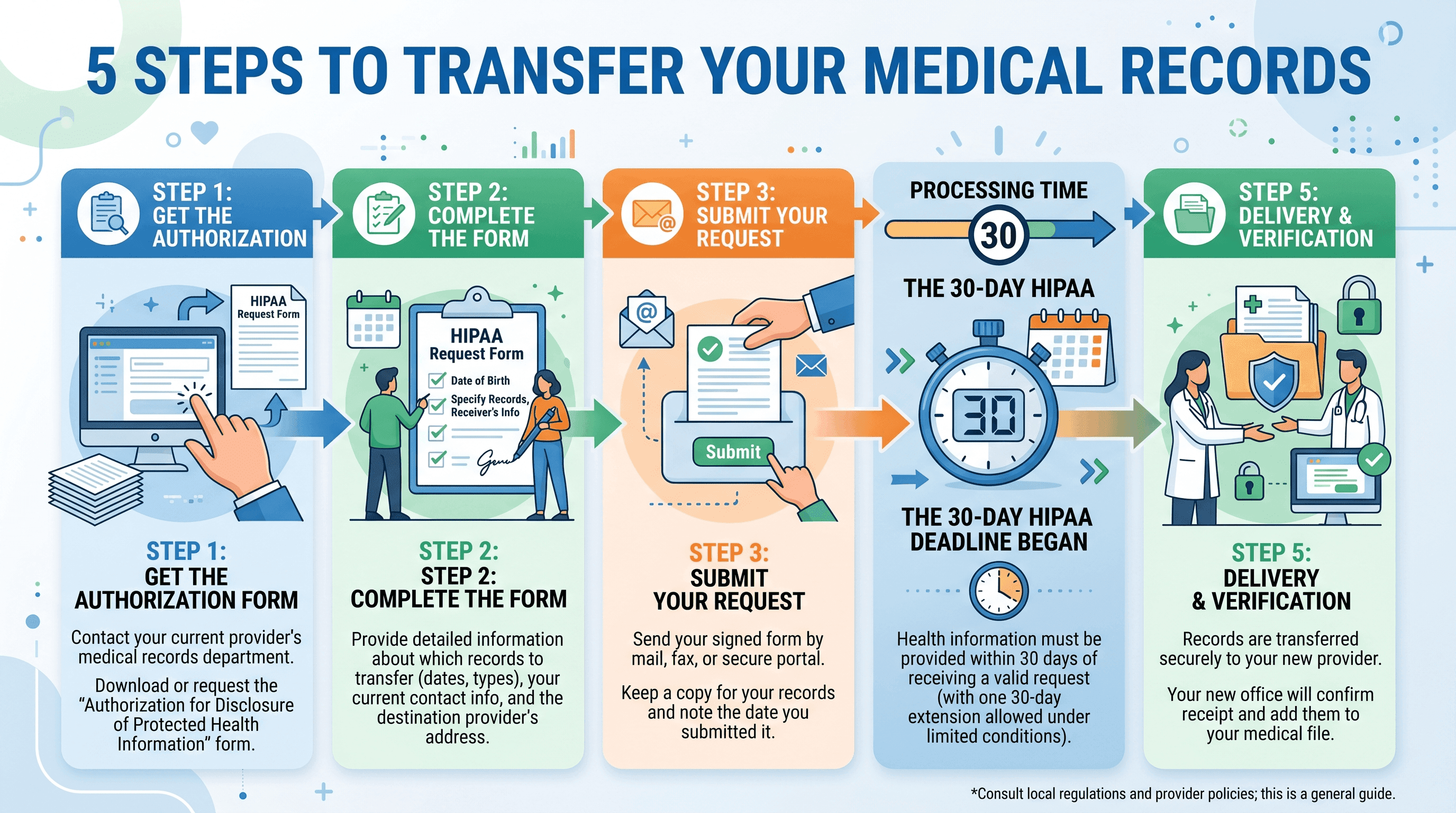
How to Transfer Your Medical Records
This is the section most patients underestimate, and it is also where most of the administrative friction lives. Getting ahead of it makes the transition much smoother.
Under HIPAA (the Health Insurance Portability and Accountability Act), you have a legal right of access to your medical records. Your current physician cannot withhold them, cannot refuse to transfer them because you are leaving the practice, and cannot use the records transfer process as a form of retaliation.
Step 1: Request the records release form. Most practices have a standard form. You can request it at the front desk, through the patient portal, or in writing.
Step 2: Specify what you need. You do not always need your full medical history going back decades. For most transitions, the last three to five years of notes, recent lab results, imaging reports, immunization records, and a current medication list cover what a new physician needs to establish care safely.
Step 3: Know the legal deadline. Under HIPAA, practices have 30 days to fulfill a records request, with one possible 30-day extension. Many practices in electronic health record (EHR) systems turn records around faster. If your request is delayed past 30 days without explanation, follow up in writing.
Step 4: Confirm any fees. Practices are permitted to charge a reasonable cost-based fee for copying records. Fees vary by state. If you are having records sent directly to your new physician electronically, many practices waive the fee.
Step 5: Request records for any active specialists. If you are currently seeing a cardiologist, endocrinologist, or other specialist through a referral from your current PCP, ensure those records are also accessible to your new physician.
Do You Have to Tell Your Current Doctor You Are Leaving?
The short answer is no. There is no legal or administrative requirement to notify your current physician that you are switching. You can request your records, establish care with a new provider, and quietly let the old relationship expire.
That said, there are practical reasons to communicate, even briefly.
The clean break. Request your records, establish care elsewhere, and move on. This is completely appropriate and more common than patients realize. If the relationship was poor enough to cause harm, no goodbye is owed.
The graceful exit. A brief note to the practice, through the patient portal or a short letter to the office manager, can smooth the records transfer process and prevent stray follow-up appointments or no-show fees. It does not need to explain why you are leaving. "I will be establishing care with a new provider" is sufficient.
The guilt most patients feel about leaving is real, but it is worth examining. Staying with a physician who does not serve your needs is not loyalty. It is a health risk. Research on patient-centered care consistently shows that patients who feel comfortable with their primary care physician are more likely to disclose symptoms early, follow through on referrals, and engage in preventive care. Prioritizing your comfort is not selfishness. It is good health strategy.
What Happens to Your Prescriptions During the Switch?
Prescription continuity is the practical concern that stops many patients from switching, particularly those managing chronic conditions. Here is how it actually works.
For most maintenance medications, including blood pressure medications, thyroid hormone, antidepressants, and similar long-term prescriptions, your current physician can issue a bridge refill of 30 to 90 days while you establish care with a new provider. This is standard practice and worth requesting explicitly when you notify the office of your transition.
Request a 90-day supply of any maintenance medication before your last appointment at the current practice. This gives enough time to get established with a new physician, have an intake visit, and have the medication reviewed and re-prescribed without a gap.
Controlled substances, including Schedule II medications such as stimulants for ADHD or certain pain medications, require more planning. These cannot typically be bridged by the old physician after care has been transferred, and a new physician will generally want to conduct their own evaluation before prescribing them. If you take a controlled substance regularly, begin the transition process earlier than you otherwise would, and be transparent with your new provider about what you have been prescribed and why.
If you are actively being treated by a specialist and your PCP was coordinating that care, notify the specialist's office that you are transitioning PCPs so they can route any follow-up communication to the correct provider.
Switching in the Middle of a Diagnosis
Transitioning while an active diagnostic workup is in progress requires additional care. If you are currently awaiting results from imaging, bloodwork, a biopsy, or a specialist referral, do not wait for the process to complete before starting your transition. Instead, take the following steps to protect continuity.
Obtain physical or digital copies of every test that has been ordered and every result that has already returned. Do not rely on your new provider receiving them through a future records transfer; carry them yourself to the first appointment.
If a specialist referral is pending, contact that specialist's office directly to confirm the referral details and update them on the change of PCP. Referrals in progress can sometimes lapse administratively when the originating physician is no longer your provider of record.
Be explicit with your new physician at the intake visit about what is in progress. Bring a written summary if the history is complex. A clear handoff note, even one you write yourself, is more reliable than hoping all records transfer completely.
Research on care transitions shows that communication gaps during provider changes are among the most common causes of delayed diagnoses and duplicated testing. The burden of bridging that gap, unfairly, often falls on the patient.
Leaving the Doctor vs. Leaving the Network
Before committing to a full change, consider whether the problem is with your physician specifically or with the entire practice culture.
If you like the clinic, the location, and the support staff but your relationship with a particular physician is not working, switching to another provider within the same health system is often the path of least disruption. Your records remain within the same electronic health record system, specialist relationships stay intact, and the administrative change is minimal.
If the culture of the clinic itself is the issue, whether that means systemic dismissiveness, chronic access problems, or a practice environment that does not reflect your values, then a clean break to a new health system is the right call. In that case, the records transfer process described above applies fully, and you start fresh.
Some patients discover that the issue is actually with their insurance network, not with any individual physician. If the in-network options in your area are limited or low-quality, reviewing your plan options during open enrollment or exploring whether a telehealth-based primary care model meets your needs may address the root problem more effectively than switching providers within the same constrained pool.
Setting the Standard With Your New Doctor
The first visit with a new primary care physician is not just an intake appointment. It is an opportunity to establish the kind of relationship you actually want.
What to bring:
A current medication list with dosages and prescribing physicians. Immunization records. A summary of relevant surgical or hospitalization history. Family health history for first-degree relatives, particularly for conditions with genetic components such as heart disease, diabetes, and certain cancers. A written list of your current concerns, ranked by priority.
What to expect:
A comprehensive intake visit is typically longer than a routine appointment. The physician may repeat labs or screenings that were done recently elsewhere, partly to establish their own baseline and partly because results from other systems do not always transfer with full context.
Questions worth asking at a first visit:
How do you prefer to communicate between appointments, through the portal, by phone, or by scheduling a visit? What is your approach to patients who want to understand the reasoning behind a recommendation? If I disagree with a treatment recommendation, how do you handle that? Who covers for you when you are unavailable? How do you manage referrals and follow up on specialist feedback?
One visit is not always enough to judge fit. Give the relationship two or three appointments before drawing conclusions, unless something in the first visit clearly signals a mismatch.
If you are managing ongoing health conditions and want support navigating next steps between appointments, you can connect with a primary care provider through Momentary for virtual visits that work around your schedule.
The Continuity of Care Checklist
Use this before, during, and after the transition to make sure nothing drops through the cracks.
Before your last appointment at the old practice:
Submit a formal medical records request covering the last three to five years, recent lab results, imaging, immunization records, and the current medication list. Request a 90-day bridge supply of all maintenance medications. Confirm any pending specialist referrals and notify those offices of the PCP change.
During the transition:
Carry copies of active test results and pending workups to your new provider personally. Update your insurance's member portal with the new PCP designation if you have an HMO or Medicare Advantage plan.
After establishing care with the new provider:
Cancel any lingering follow-up appointments at the old clinic to avoid no-show fees. Confirm that your new physician has received and reviewed the transferred records. Update your emergency contacts and pharmacy with the new provider's information.
FAQ
How long does it take to change primary care doctors?
For most insured patients, the administrative change takes one to four weeks. HMO and Medicare Advantage plans typically process PCP designation changes effective the first of the following month. Finding a new physician, scheduling an intake appointment, and receiving transferred records can add additional time, so starting the process a month before you need to be fully established is reasonable.
Will I lose my medical history when I switch?
No. Under HIPAA, you have a legal right to your records, and your current physician is required to provide them within 30 days of a formal request. Once transferred, your new physician has full access to your history. Carrying personal copies of critical records during the transition adds an additional layer of protection.
Can I change my PCP in the middle of the year?
Yes. For most plans, changing your designated PCP does not require open enrollment. Open enrollment governs your insurance plan itself. PCP designations can typically be updated at any time and take effect the first of the following month.
How often can I switch primary care doctors?
There is no legal or plan-based limit on how often you can change physicians. That said, frequent switching does affect the continuity of your care, particularly for chronic conditions that benefit from a physician who knows your full history over time. Switching when the relationship genuinely is not working is appropriate. Switching repeatedly without resolving the underlying issue is worth examining.
Is it rude to change doctors?
No. Physicians are healthcare professionals who understand that patients have varying needs, that insurance networks change, and that people relocate. A physician who would take it personally if a patient sought a better fit has misunderstood the nature of the relationship. Your obligation is to your own health.
What if my new doctor is not accepting new patients?
Ask to be placed on a waitlist and continue your search in parallel. Many practices that appear closed to new patients have occasional openings, particularly if you are flexible on seeing a nurse practitioner or physician assistant within the same practice. Telehealth-based primary care models have also expanded access significantly for patients in areas where in-person options are limited.
If you are still figuring out your symptoms or want to understand your options before booking anything, you can use Momentary's AI health navigator to explore your health questions and get guidance on what kind of care makes sense for your situation.
References
- Safran DG et al., "Switching Doctors: Why Patients Disenroll from Health Plans." Journal of General Internal Medicine. — Cited for data on patient outcomes related to physician trust and communication.
- Burgess DJ et al., "Implicit Bias and Clinical Decision Making." Journal of General Internal Medicine. — Cited for research on symptom dismissal patterns by demographic group.
- Agency for Healthcare Research and Quality. "Questions Are the Answer." — Cited for AHRQ support of patients seeking second opinions.
- Thom DH et al., "The Measurement of Patient Trust in Physicians." Medical Care. — Cited for research on physician trust as a predictor of care adherence.
- Centers for Medicare and Medicaid Services. "Register on MyMedicare.gov to Choose Your Primary Clinician." — Cited for Medicare Advantage PCP designation process.
- Humana. "How to Change Your Primary Doctor in Medicare." — Cited for plan-specific Medicare PCP change process.
- Dambha-Miller H et al., "Trust and Primary Care." British Journal of General Practice. — Cited for research on patient-centered care and health engagement outcomes.
- Karam M et al., "Care Transitions and Diagnostic Gaps." BMC Health Services Research. — Cited for research on communication gaps during provider transitions.