


Finding a primary care doctor used to be straightforward. Call a few offices, pick one close to home, done. That is not how it works anymore. The United States is facing a documented and worsening shortage of primary care physicians, which means more patients are competing for fewer open slots, longer wait times are becoming the norm, and "not accepting new patients" is increasingly the first answer you hear.
But a primary care doctor is still one of the most valuable things you can have in your healthcare life. A PCP coordinates your care, manages chronic conditions, catches problems early, and serves as your main contact point for the entire healthcare system. Finding one is worth the effort. This guide walks through every step of that process, whether you have insurance or not, whether you're new to a city or aging out of a pediatrician, whether a waitlist is the only door left open.
At a Glance
| Topic | Key Facts |
|---|---|
| Primary keyword | How to find a primary care doctor |
| PCP shortage | Projected shortfall of up to 86,000 physicians by 2036 (AAMC) |
| Insurance first step | Use your insurer's provider directory or call member services |
| Without insurance | FQHCs offer sliding-scale fees; Direct Primary Care skips insurance entirely |
| Biggest bottleneck | Insurance directories are often outdated; always call to confirm availability |
| New patient visit | Bring insurance card, medication list, vaccination records, and prior lab results |
Why Finding a Primary Care Doctor Is Harder Right Now
The shortage is real, and the numbers confirm it. According to the Association of American Medical Colleges (AAMC), the United States could face a shortfall of up to 86,000 physicians by 2036, with primary care absorbing a disproportionate share of that gap. Rural areas are hit hardest, but urban patients in high-demand zip codes are experiencing long wait times and closed panels too.
Several converging pressures are driving this: an aging physician workforce moving toward retirement, medical school graduates preferring higher-paying specialties, and a growing patient population with more complex chronic conditions. None of that is your fault, and this guide is not going to tell you to simply "try harder." The steps below are built around the reality you're working in, including what to do when the obvious paths are blocked.
What Is a Primary Care Doctor, and What Type Do You Need?
A primary care doctor is a physician who provides general, ongoing medical care to patients across a wide range of health needs. According to the Cleveland Clinic, a PCP manages preventive care, chronic disease management, and coordinates referrals to specialists when needed.
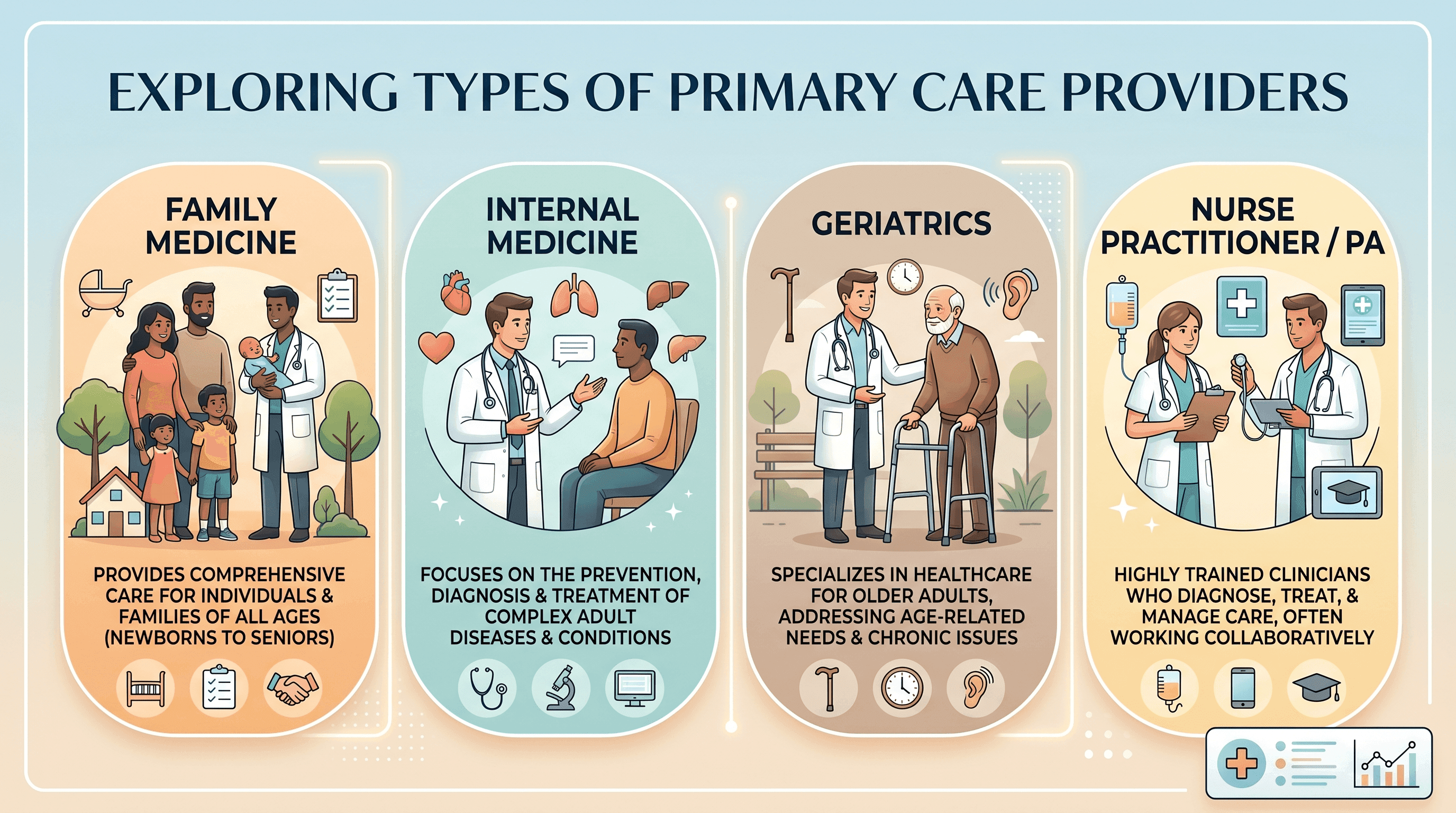
The main types you will encounter:
Family medicine physicians treat patients of all ages, from infants to older adults. They are the most versatile option and a good default for most adults.
Internal medicine physicians (internists) focus on adult patients and are well-suited to people managing multiple or complex chronic conditions.
Geriatricians specialize in care for patients typically over 65, with particular expertise in conditions that cluster with aging.
Nurse practitioners (NPs) and physician assistants (PAs) are licensed providers who can legally serve as your primary care provider in most states. They carry a full panel of patients, manage chronic conditions, prescribe medications, and order labs. They are not a lesser option; they are a valid and often more accessible one.
For most adults without complex medical histories, a family medicine physician or internist is the standard choice. If you are managing multiple chronic conditions and want a provider with deep expertise in adult medicine, an internist is often a stronger fit.
The Short Answer: Think of It as a Filter, Not a Search
Before the step-by-step walkthrough, here is the governing logic. Finding a primary care doctor is a process of elimination, not a single search. You start with the widest possible net (everyone in your insurance network) and filter down based on location, specialty type, availability, and patient reviews. Each step removes candidates who do not fit until you have a manageable shortlist of three to five doctors worth calling.
That framing matters because people often abandon the process after hitting one wall. The steps below are sequential, but each one also has a workaround built in for when the expected path is blocked.
Step One: Start With Your Insurance Provider Portal
If you have health insurance, the in-network provider directory is your mandatory starting line. Seeing an out-of-network doctor can result in dramatically higher out-of-pocket costs, or no coverage at all depending on your plan type. Starting in-network is not a preference; it is a financial protection.
Log in to your insurer's member portal and navigate to the "Find a Doctor" or "Provider Directory" section. Filter by specialty (primary care, family medicine, or internal medicine), your zip code, and a reasonable radius, typically five to ten miles for urban areas, broader for rural ones.
If the portal feels clunky or returns confusing results, call the member services number printed on the back of your insurance card. A representative can run the same search and confirm which doctors in your area are currently contracted with your plan.
One step to take before your first appointment: call the doctor's office directly and ask the receptionist to confirm the practice is in-network with your specific plan. Insurer directories are notoriously slow to update, and a doctor who appears in-network may have let their contract lapse. Confirming in advance prevents a billing surprise after the visit.
If You're on Medicare or Medicaid
Medicare beneficiaries can use the Medicare Care Compare tool at Medicare.gov to search for physicians who accept Medicare assignment. This tool also shows quality ratings and patient experience data.
Medicaid coverage varies by state. Search "[your state] Medicaid provider directory" to find your state's official managed care plan directory. If you receive your Medicaid benefits through a private managed care organization (MCO), that MCO will have its own provider portal, and you should use that one rather than a general state list.
Step Two: Search Through Hospital Network Affiliations
Here is a strategy that most people skip, but it matters if you ever expect to need specialist care or a hospital admission. Many doctors are affiliated with a specific hospital system, and your specialist referrals, imaging orders, and any future hospitalizations will often be routed within that same system.
If there is a hospital in your area with a strong reputation for cardiology, oncology, or any specialty you might need, finding a PCP who is affiliated with that system ensures that your care stays coordinated within one network. Fragmented records between competing hospital systems create real problems in complex care situations.
Most major hospital systems operate their own physician finder tools on their websites. Search "[hospital name] find a doctor" and filter by primary care specialty. The results will show you employed physicians and affiliated community physicians, both of whom can typically route referrals within that system.
Step Three: Use Third-Party Search Tools to Check Real-Time Availability
Insurance directories tell you who is in-network. They do not tell you who has an open appointment slot next week. That is where platforms like Zocdoc and Healthgrades become genuinely useful.
Zocdoc allows you to filter by insurance plan and see actual appointment availability in real time. If a doctor is listed as accepting new patients on Zocdoc, there is a high probability that is accurate, because the platform syncs with practice scheduling systems. This makes it a better signal of actual availability than an insurer's static directory.
Healthgrades and Google Reviews allow you to read patient feedback about communication style, wait times, staff responsiveness, and follow-up. Individual reviews should be read skeptically, but patterns across 30 or 40 reviews tend to be informative.
Use the two tools together: Zocdoc to find available doctors in your network, Healthgrades to screen them before calling.
The "Accepting New Patients" Bottleneck
This is the most frustrating part of the process, and it deserves its own section.
Insurance directories often lag behind reality by six to twelve months. A physician listed as "accepting new patients" may have closed their panel weeks ago, and the directory has not caught up. Calling ahead to confirm is not optional; it is the only way to know for certain.
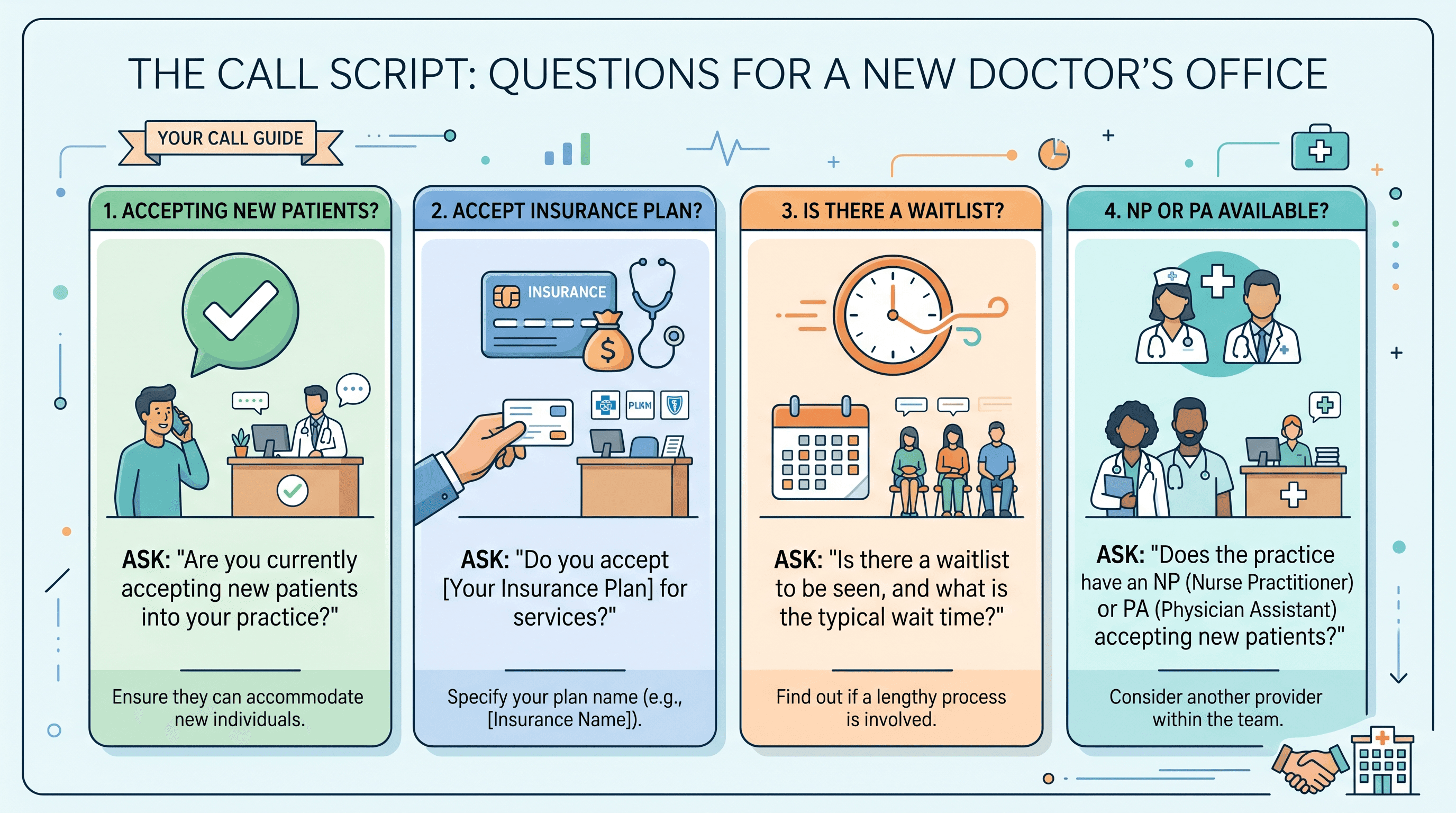
When you call, ask specifically: "Is [doctor's name] currently accepting new patients?" Then also ask: "Does the practice have a waitlist?" A waitlist is worth getting on. Patient panels turn over more often than people assume, particularly in practices with younger physicians, and being on a waitlist often results in an appointment within a few weeks to months.
A less obvious strategy: ask whether the practice has a nurse practitioner or physician assistant who is accepting new patients. In many practices, NPs and PAs carry their own panels and can serve as your primary care provider from day one. Building that relationship also positions you well if a physician slot opens in the same office later.
How to Find a Primary Care Doctor Without Insurance
Not having insurance does not mean going without a primary care doctor. It means using a different set of resources, and some of them are genuinely good.
Federally Qualified Health Centers (FQHCs) are community health centers funded by the federal government to provide primary care regardless of a patient's ability to pay. They charge on a sliding-scale fee structure based on income, meaning some patients pay very little or nothing. The HRSA Health Center Finder at hrsa.gov allows you to search by zip code to locate the closest FQHC. Services typically include primary care, preventive screenings, basic lab work, and prescription assistance.
Free and charitable clinics exist in many communities as a separate tier of safety-net care. The National Association of Free and Charitable Clinics maintains a searchable directory at nafcclinics.org.
Low-cost telehealth platforms have expanded access to primary care for uninsured patients. Many offer flat-fee appointments with licensed physicians for $50 to $100, covering a range of acute and chronic care needs.
What Is Direct Primary Care?
Direct Primary Care (DPC) is a membership model that bypasses insurance entirely. Patients pay a flat monthly fee, typically ranging from $50 to $150 depending on age and practice, and receive unlimited or near-unlimited primary care visits with their physician. DPC practices intentionally keep panels small, which means more time per appointment and same-day or next-day access in most cases.
DPC works well for people who are uninsured, underinsured, or healthy adults who want a close ongoing relationship with a physician without navigating insurance billing for every visit. The trade-off is that DPC does not cover specialist visits, hospitalizations, or labs beyond what the practice offers in-house. Many DPC patients pair it with a high-deductible catastrophic insurance plan to cover those scenarios.
Step Four: Research and Vet Your Shortlist
Once you have three to five candidates who appear to be accepting patients and are in-network, do a brief round of pre-call research on each.
Board certification tells you whether a physician has completed additional training and passed examinations in their specialty beyond the minimum licensing requirements. You can verify board certification through the ABMS Certification Matters tool at certificationmatters.org. It is a quick two-minute search and worth doing.
Review hospital affiliations (where the doctor admits patients if needed), medical school and residency training, and how long they have been in practice. None of these are disqualifiers on their own, but they fill out the picture of a provider's background and experience.
Read online reviews with the intent of identifying patterns. A single negative review about wait times is noise. A dozen reviews saying the doctor rushes through appointments or dismisses patient concerns is a signal worth taking seriously.
Step Five: Call the Office Before You Commit
The phone call is a low-effort vetting step that most people skip. Spending five minutes on this call before booking a new patient appointment can save you from a poor match.
When you call to schedule, work through this checklist. Ask whether the physician is currently accepting new patients and whether they accept your specific insurance plan (state the exact plan name and network tier, not just the insurer name). Ask about typical wait times for a routine new patient visit. Ask whether the practice has a patient portal for messaging, and whether there is on-call coverage or an after-hours line for urgent questions. Ask whether telehealth appointments are available for follow-up visits.
The way the front desk staff interacts with you on this call is also informative. A practice that is disorganized or unable to answer basic questions about insurance acceptance during the intake call often reflects a broader culture in that office.
Step Six: Evaluate the First Visit
The new patient appointment is a two-way evaluation. The doctor is assessing your health; you are assessing whether this is a provider you can work with long term.
Positive signs at a first appointment: the physician reviews your prior medical history before entering the room rather than cold-reading your chart in front of you; they ask open-ended questions and listen to your answers before redirecting; they explain their reasoning when recommending tests or treatments; the office is organized in its intake and follow-up processes.
Flags worth noting: the appointment feels rushed without medical justification; the physician dismisses symptoms without examination; or the staff cannot answer basic administrative questions about referrals or prescription coverage.
A first visit that feels off is not always a reason to leave immediately, but it is worth taking seriously. Most adults switch primary care providers at some point, and finding the right fit may take more than one try.

What to Do When You Cannot Get an Appointment Quickly
If every option you have tried has a wait time measured in weeks or months, you still have workable options for bridge care, meaning temporary coverage while you wait for a PCP slot to open.
Urgent care centers handle acute needs like infections, minor injuries, and same-day illness without an established care relationship. They are not a replacement for a PCP but they fill acute gaps effectively. Retail health clinics, typically located inside pharmacies, offer nurse practitioner-led care for routine needs like vaccinations, blood pressure checks, and common infections, and can often run basic labs as well.
Virtual-first primary care platforms offer ongoing relationships with providers via video visit, sometimes with same-week or same-day availability. For many routine chronic conditions, a well-structured telehealth visit covers the same ground as an in-person one. If you are managing an ongoing condition and need continuity while waiting for an in-person PCP appointment, you can see a doctor online through Momentary for a virtual primary care visit that keeps your care moving without requiring an in-person slot.
Special Situations: Moving, Switching Insurance, Aging Out of a Pediatrician
If you are moving: Ask your current PCP for a referral or recommendation in your new city if they have a professional network there. Request a summary of your medical records before your final visit so you have something to hand to a new provider immediately.
If you are switching insurance plans: Before finalizing any new plan during open enrollment, run your current doctor's name through the new plan's provider directory to confirm they are in-network. Switching plans without this check is a common way to unintentionally lose an existing care relationship.
If you are aging out of a pediatrician: Most pediatric practices transition patients to adult care between 18 and 21, depending on the practice's policy. Ask your pediatrician for a transition letter summarizing your medical history, vaccination records, and any ongoing conditions. Family medicine physicians are often the easiest landing point since they have experience receiving patients from pediatric settings.
If you have a long gap in care: Returning to primary care after years away can feel daunting. A good PCP will not judge a gap in care; they will take a baseline reading of your current health and build a plan forward from there.
How to Transfer Your Medical Records to a New Doctor
Under HIPAA, the Health Insurance Portability and Accountability Act, you have the legal right to request a copy of your medical records from any provider who has treated you. Most practices can fulfill this request within 30 days, as outlined in NIH MedlinePlus guidance on choosing a care provider.
To request records, contact your former provider's medical records department (often reachable through the patient portal or by phone), and submit a written authorization form with your name, date of birth, the records being requested, and the receiving provider's information. If your new doctor's office is willing, they can sometimes request records directly from the prior practice on your behalf.
At minimum, bring the following to your first appointment with a new PCP: a current medication list with dosages, your vaccination history, any recent lab results or imaging reports, and a summary of any surgeries or hospitalizations. Many patient portals allow you to export this data as a PDF.
Frequently Asked Questions
What is the best way to find a primary care physician? Start with your insurance provider's online directory to generate a list of in-network physicians near you, then cross-reference that list with Zocdoc to find who is actively accepting new patients with real-time appointment availability. Call each office to confirm in-network status and availability before booking. If you have no insurance, use the HRSA Health Center Finder to locate a federally qualified health center near you that charges on a sliding-scale fee.
What is a primary care doctor in the USA? A primary care doctor in the United States is a licensed physician, nurse practitioner, or physician assistant who provides general, ongoing medical care, including preventive screenings, chronic disease management, and referrals to specialists. The main physician specialties that function as primary care are family medicine, internal medicine, and geriatrics. The NIH MedlinePlus resource on choosing a provider notes that a PCP serves as the central coordinator of a patient's overall health.
What is the difference between a family doctor and a primary care doctor? A family medicine physician is one type of primary care doctor. The term "primary care doctor" is a broader category that includes internists, geriatricians, and in many states, nurse practitioners and physician assistants who carry independent patient panels. Family medicine physicians are specifically trained to treat patients of all ages, which distinguishes them from internists who focus on adults only.
What should I ask a new primary care doctor at my first appointment? Useful questions include: How does the practice handle after-hours urgent calls? What is the best way to communicate between appointments? How are specialist referrals managed? What is the typical wait time for a routine follow-up visit? Can appointments be conducted via telehealth? Asking these questions upfront helps set expectations and reveals whether the practice's workflows match how you prefer to manage your healthcare. The National Institute on Aging recommends thinking of the first appointment as a two-way conversation, not just an intake.
Can I use telehealth to establish primary care? Yes. Many virtual primary care platforms now offer ongoing care relationships, not just one-off urgent care visits. A telehealth PCP can order labs, manage prescriptions, and coordinate specialist referrals in most states. This can be a practical option for people with long wait times for in-person slots or those whose schedules make regular office visits difficult.
How long does it take to get an appointment with a new primary care doctor? Wait times vary widely. In high-demand areas or with popular practices, new patient appointments can take four to eight weeks or longer. In less saturated markets or with practices that use telehealth-first scheduling, wait times can be under two weeks. Getting on a waitlist at your preferred practice, combined with using urgent care or telehealth for bridge coverage, is the most practical strategy for managing this gap.
Closing
Finding a primary care doctor takes more persistence than it used to. But the process is manageable when it is broken into steps: start with your insurance directory, cross-reference with availability tools, confirm by phone, vet the shortlist, and evaluate the first visit honestly. If the first option does not work out, try the next one.
You do not need to find the perfect doctor in one attempt. You need to find a good one and build a care relationship over time. The steps above give you the map. The right fit may take a visit or two, and that is completely normal.
For help understanding your symptoms, navigating your health options, or figuring out what kind of specialist you might need before or between PCP appointments, you can use Momentary's AI health navigator to get personalized guidance on your next steps.
References
- Association of American Medical Colleges (AAMC) — Projected physician shortage data through 2036, including primary care shortfall estimates.
- Cleveland Clinic: Primary Care Physician — Definition and scope of primary care physician roles and responsibilities.
- NIH MedlinePlus: Choosing a Primary Care Provider — Overview of how to choose and work with a primary care provider, including HIPAA records rights.
- National Institute on Aging: How to Choose a Doctor You Can Talk To — Guidance on selecting a physician and communicating effectively at appointments.
- HRSA Health Center Finder — Federal tool for locating federally qualified health centers that offer sliding-scale fee primary care.
- Medicare Care Compare — CMS tool for finding Medicare-accepting physicians with quality ratings and patient experience data.
- ABMS Certification Matters — Board certification verification tool for physicians across all specialties.
- National Association of Free and Charitable Clinics — Directory of free and charitable clinics for uninsured and underinsured patients.
- NIH: Primary Care Access and Shortage Areas — Research context on primary care access, shortage zone characteristics, and federally qualified health center coverage.