


Switching your primary care physician is a completely normal part of managing your own healthcare. It happens every day, for entirely ordinary reasons: you moved, your insurance changed, your doctor retired, or the relationship simply stopped working for you. There is no form to fill out explaining yourself, no awkward conversation required, and no penalty for moving on. The process is mostly administrative, and this guide walks through every step so you can make the switch confidently, without gaps in care or coverage surprises.
At a Glance
| Topic | Key Facts |
|---|---|
| Legal right to switch | Patients may change their PCP at any time; no reason is required |
| HMO patients | Must formally update their designated PCP through the insurer's portal or by phone |
| PPO patients | Can book directly with any in-network provider; no formal designation needed |
| Medicare | Original Medicare allows any provider anytime; Medicare Advantage requires in-network selection |
| Medical records | Under HIPAA, providers have 30 days to release records after a signed request |
| Prescription bridge | Request a 90-day refill from the current doctor before the switch to avoid a treatment gap |
| Notification required? | No legal obligation to inform the old doctor; the choice is entirely the patient's |
You Do Not Need a Breakup Text
The single most common reason people delay switching doctors is the belief that they owe their current physician a formal conversation, a written notice, or some kind of explanation. They do not. Physicians understand that patient turnover is a routine part of running a practice. Staff process these transitions regularly. No one is waiting by the phone.
If the relationship was long and genuinely meaningful, a brief note or a final visit to close out care is a perfectly fine thing to do. But it is a courtesy, not an obligation. The decision to switch is yours alone, and the process on the clinical side is entirely administrative. Think of it less like ending a relationship and more like changing your preferred pharmacy.

The Golden Rule: Do Not Cancel Before You Confirm
Before doing anything else, book and complete a first appointment with the new physician. This single rule protects patients from a gap in care that can become a real problem, especially for anyone managing ongoing conditions or active prescriptions.
Do not formally disenroll from the current practice, cancel standing appointments, or request record transfers until the new relationship is actually established. Practices sometimes have onboarding delays. New patient waitlists are real. Insurance credentialing can take weeks. Confirming the new doctor is a working fit before exiting the old one eliminates the risk of being left without coverage or a prescribing physician during a transition.
The Insurance Mechanics: HMO vs. PPO
Understanding how your specific insurance plan handles PCP switches saves a significant amount of confusion. The rules differ depending on plan type.
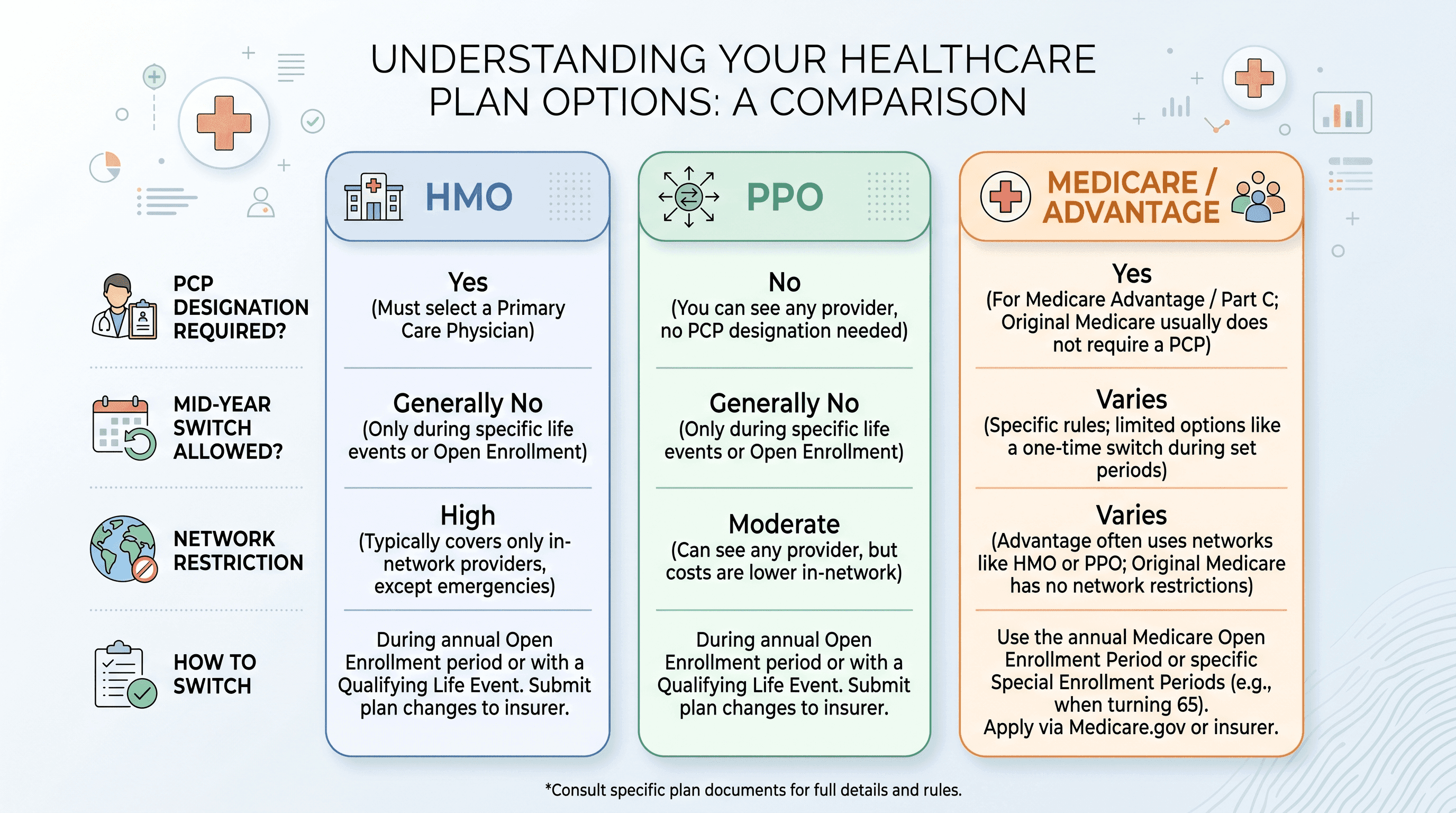
HMO Plans: How to Formally Change Your Designated PCP
Health Maintenance Organization plans require members to designate a specific PCP. That PCP acts as the gatekeeper for specialist referrals, and visits to any provider outside the designated PCP or network typically will not be covered.
To switch, log into your insurer's member portal (major carriers including Blue Cross Blue Shield, UnitedHealthcare, and Aetna all support this online), search for in-network primary care physicians, and submit a PCP change request. Most plans allow mid-year PCP changes at any time, and the change usually takes effect at the start of the following month. Calling the member services number on the back of your insurance card achieves the same result if the portal is unclear.
PPO Plans: Switching Is Simpler Than You Think
Preferred Provider Organization plans do not require a formal PCP designation. Members can see any in-network provider without prior authorization. To switch, find an in-network physician (through your insurer's directory or a tool like the AMA DoctorFinder), confirm they are accepting new patients, and book an appointment. That is the entire process.
Out-of-network visits are typically covered at a lower rate under PPO plans, so confirming network status before the first appointment avoids unexpected cost.
Medicare and Medicare Advantage: Specific Rules and Timing
Original Medicare (Parts A and B) imposes no network restrictions. Beneficiaries may see any Medicare-participating provider at any time, with no PCP designation required.
Medicare Advantage plans function more like HMOs. Members must choose a PCP within the plan's network, and PCP changes are allowed at any time within that network. Plan-level changes (switching from one Advantage plan to another) are restricted to the Annual Enrollment Period (October 15 through December 7) and the Open Enrollment Period (January 1 through March 31). For plan-specific questions, Medicare.gov and the plan's member services line are the most reliable sources.
The 90-Day Prescription Bridge
For anyone taking regular medications, a prescription gap during a provider switch is one of the most preventable and most frequently overlooked problems in this process.
Before the last appointment with the current physician, ask for a 90-day refill on all maintenance medications: blood pressure drugs, thyroid medications, diabetes management, antidepressants, and any other treatments that cannot be safely interrupted. Most physicians will accommodate this request when the reason is explained clearly. A 90-day supply provides enough runway for the new provider to complete onboarding, review the medical history, and issue their own prescriptions without any urgency.
Pharmacies cannot issue refills beyond what a prescription authorizes, and new physicians often require an in-person appointment before prescribing. Planning ahead removes that bottleneck entirely.
If managing a chronic condition and concerned about maintaining continuity through a provider switch, connecting with a primary care provider through a telehealth visit can be a practical way to bridge care quickly, including for prescription management, while the new in-person relationship is being established.
How to Transfer Your Medical Records: Your Legal Rights and Timeline
Under HIPAA, patients have a legal right to access and transfer their medical records. Providers are required to fulfill a records request within 30 days of receiving a valid written authorization. A single 30-day extension is permitted if the provider notifies the patient in writing with a reason for the delay.
To initiate a transfer, complete a Medical Records Release Authorization form (available from the old practice or the new one). This form authorizes the old practice to send the records directly to the new physician's office. Requested items typically include visit notes, lab results, imaging reports, vaccination history, and the medication list.
Providers may charge a reasonable fee for records in some states, though many now provide electronic records at no cost through patient portals. If a provider refuses to release records or misses the 30-day window without notice, patients may file a complaint with the U.S. Department of Health and Human Services Office for Civil Rights.
Research published in the Annals of Family Medicine has documented that patients who experience poor information transfer between providers report lower satisfaction and continuity of care outcomes, underscoring why taking an active role in this step matters.
Finding and Vetting a New Primary Care Doctor
Identifying the right new physician involves two distinct layers: clinical credentials and what might be called the "soft" operational factors that shape the day-to-day experience of being a patient at that practice.
How to Search for In-Network Providers
Start with the insurance carrier's online directory, filtered to primary care or internal medicine physicians within a reasonable distance. Cross-reference any name of interest against the American Board of Medical Specialties lookup to confirm board certification status. Patient review platforms such as Healthgrades and Zocdoc provide useful signals on communication style and wait times, though individual reviews should be weighed against volume and patterns rather than isolated comments.
The AMA DoctorFinder is a reliable tool for verifying credentials and specialty training independent of any insurance directory.
If preferred physicians are not accepting new patients, which has become more common given documented physician shortages tracked by the Association of American Medical Colleges, consider asking to be placed on a waitlist, looking at nearby practices within the same health system, or exploring a virtual primary care physician as a functional alternative during the interim.
Questions to Ask Before Committing
The initial call to a new practice reveals a great deal. Reasonable questions to raise before booking include: Does the physician offer telehealth appointments for routine concerns? What is the typical wait time for a non-urgent sick visit? How does the practice handle after-hours questions or urgent needs that do not require an ER? Who covers for the physician when they are unavailable? What is the process for specialist referrals, and does the physician prefer to stay actively involved in coordinating specialist care? For patients managing complex or multiple chronic conditions, asking directly whether the physician has experience with those conditions is entirely appropriate.
Should You Consider a Telehealth or Virtual Primary Care Doctor?
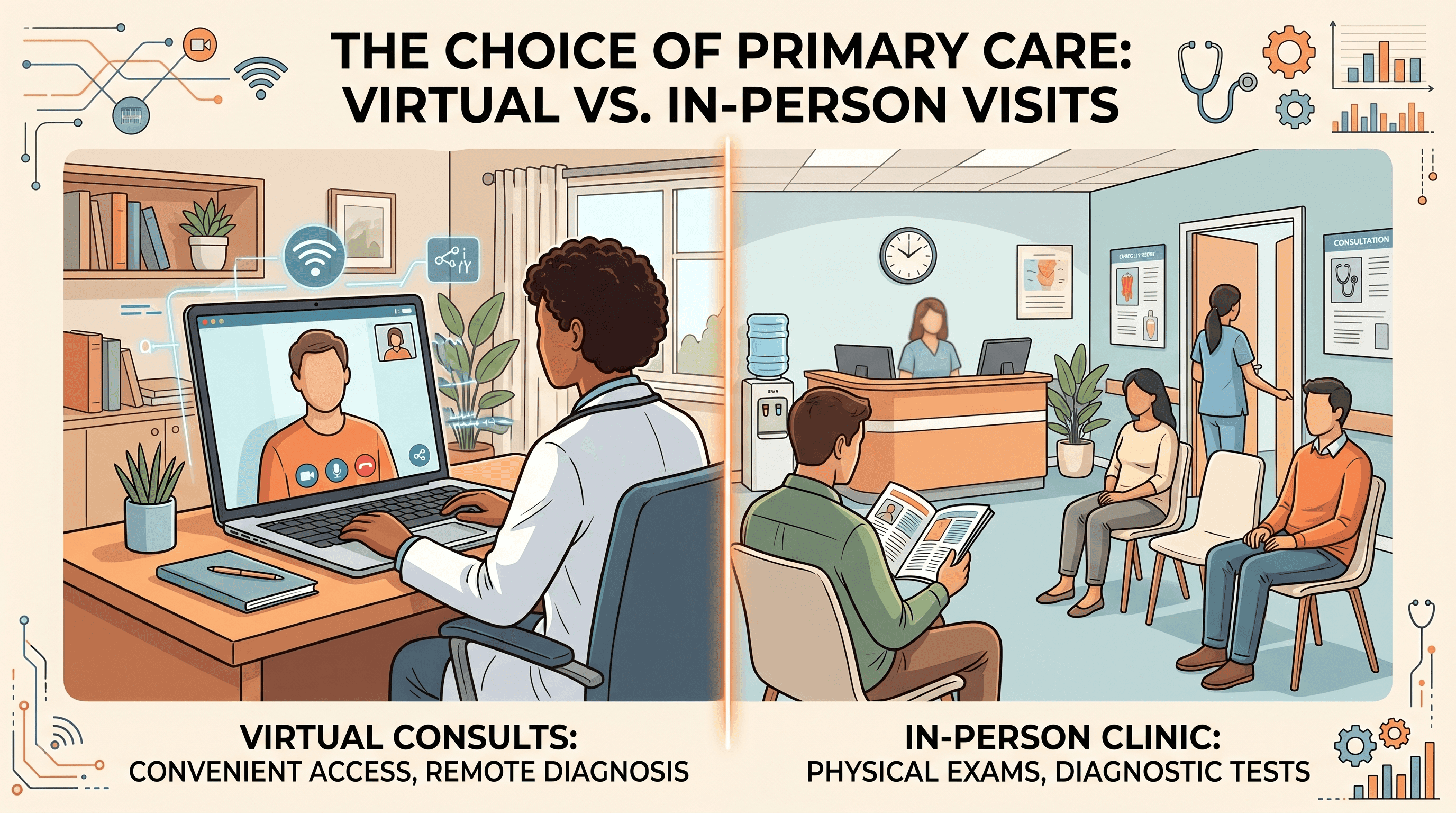
Virtual primary care has expanded significantly and now represents a legitimate long-term option for many patients, not just a stopgap. Virtual PCPs handle prescription renewals, lab order management, chronic disease monitoring, referrals, and preventive care screenings. The practical limitation is the inability to perform a physical examination, which matters more for some conditions than others.
For patients in areas with limited provider access, irregular schedules that make in-person appointments difficult, or those who simply prefer the format, a virtual primary care relationship may be a better fit than a geographically convenient but otherwise mismatched in-person option.
Switching With a Chronic Condition: Protecting Continuity of Care
Patients managing ongoing conditions, including diabetes, heart disease, hypertension, autoimmune disorders, or mental health conditions, face a higher-stakes version of this transition. Several specific steps reduce the risk of a gap in management.
Never stop medications mid-switch without physician guidance. Abrupt discontinuation of certain drug classes, including beta-blockers, corticosteroids, and SSRIs, can carry clinical risk. The 90-day refill strategy described earlier directly addresses this.
Active specialist relationships do not need to be interrupted by a PCP switch. Specialist appointments, referrals, and ongoing treatment plans can and should continue independently. Inform the specialist of the PCP transition and provide updated contact information for the new physician so that care coordination can be maintained without delay.
Bring a one-page medical summary to the first appointment with the new PCP. This document should list current diagnoses, all active medications with dosages, known allergies, the names and contact information for any current specialists, and the most recent lab values or imaging findings. A prepared summary accelerates the intake process meaningfully and reduces the likelihood that important history is missed during a time-constrained new patient visit.
Research in BMC Health Services Research has found that care continuity, defined as a patient's ongoing relationship with a consistent provider, is associated with better management of chronic conditions and lower rates of preventable hospitalizations. The transition itself does not have to interrupt that continuity if managed carefully.
Do You Need to Tell Your Old Doctor You Are Leaving?
No. There is no legal or ethical obligation to notify the current physician that care is being transferred elsewhere. Patients may simply stop scheduling appointments. The medical record remains available to them under HIPAA regardless.
That said, some situations make a brief communication worthwhile. If the physician has been managing a complex condition over many years, a final visit to review the current care plan and ensure documentation is complete can benefit the transition. If the decision to switch was triggered by a specific concern about the care received, some patients find value in sharing that feedback, while others reasonably prefer not to.
Switching within the same practice, where a patient prefers a different physician within the same medical group, involves a slightly more delicate step. In this case, a direct request to the front desk or practice manager is the cleanest path. Shared electronic medical records within the same system make this transition administratively simple. Framing the request as a matter of scheduling compatibility or communication preference tends to result in a smoother outcome than framing it as dissatisfaction.
Making the Most of the First Appointment With a New PCP
The first appointment with a new physician is longer than a standard sick visit by design. Its purpose is to establish a medical baseline, not to treat an immediate complaint. Coming prepared makes it significantly more productive.
First Appointment Checklist
Bring the actual medication bottles (or a typed list with drug names, dosages, and frequencies), not just a memory of what is taken. Include supplements and over-the-counter medications. Bring vaccination records if available, particularly for adults who received vaccines outside of a healthcare system and may not have documentation on file. Carry contact information for all current specialists. Have recent lab work or imaging results ready, either in printed form or accessible through a patient portal.
Be ready to discuss family history, since a new physician will be reconstructing the clinical picture from scratch. Share what worked well with the previous physician and what did not. That specific information helps a new provider calibrate their communication approach from the start.
Give the relationship two to three visits before drawing firm conclusions. First appointments frequently feel more procedural than relational because so much baseline information is being established. A clearer sense of fit typically emerges by the second or third interaction.
Frequently Asked Questions
How do I transfer to another doctor? Complete a Medical Records Release Authorization form at your current provider's office or through their patient portal. This authorizes them to send your records directly to the new physician. Under HIPAA, the provider must fulfill the request within 30 days. Simultaneously, confirm your insurance situation: HMO members need to update their designated PCP through the insurer's portal, while PPO members can simply book with the new physician directly.
What is the best way to find a new primary care physician? Start with your insurer's online provider directory filtered to primary care or internal medicine physicians accepting new patients. Cross-check credentials using the American Board of Medical Specialties lookup and the AMA DoctorFinder. Patient reviews on Healthgrades or Zocdoc can surface useful signals about communication style, but look at overall patterns across many reviews rather than individual outliers.
What are red flags for doctors? Patterns that warrant reconsideration include consistently dismissing patient concerns without explanation, difficulty reaching the practice for urgent questions, long waits for routine appointments without a systemic explanation, failure to follow up on abnormal test results, and resistance to sharing records or discussing referrals. A single difficult appointment is not necessarily a red flag; a recurring pattern is.
What do I say to a new doctor at a first appointment? Be direct and specific about your medical history. Share current diagnoses, medications, known allergies, and any specialists currently involved in your care. Mention what communication style has worked well for you in the past and what has not. If any health concerns prompted the switch, sharing those clearly helps the new physician understand what the patient is looking for in the relationship. A first visit is an exchange of information in both directions.
Can I change my PCP if I am mid-treatment or have an active referral? Yes. An active referral or ongoing treatment does not lock a patient to a specific PCP. The referral to a specialist stands independently of the PCP relationship. However, the new PCP will need to be briefed on any ongoing treatment, and coordination between the new PCP and any specialists should be re-established promptly to maintain continuity.
How often can I switch primary care doctors? There is no legal limit. Patients may change their PCP as often as needed. From a practical standpoint, frequent switches can disrupt care continuity, particularly for chronic condition management. When switching is prompted by specific solvable issues (communication style, access, waitlists), addressing those factors in the vetting process before selecting a new physician reduces the likelihood of needing to switch again soon.
If any symptoms or health concerns are prompting this transition and guidance on next steps would be helpful, use Momentary's AI health navigator to explore your symptoms and get personalized direction on what kind of care makes sense.
References
- U.S. Department of Health and Human Services: HIPAA Medical Records Rights — Cited for patient rights to access and transfer medical records within 30 days.
- Pham et al., Annals of Family Medicine (2004) — Cited for research on patient satisfaction and care continuity outcomes associated with information transfer between providers.
- BMC Health Services Research: Continuity of Care and Chronic Condition Outcomes — Cited for evidence linking ongoing provider relationships to better chronic disease management and lower hospitalization rates.
- American Board of Medical Specialties: Certification Verification — Cited as a resource for verifying physician board certification.
- AMA DoctorFinder — Cited as a tool for locating and verifying primary care physicians.
- Medicare.gov — Cited for Medicare and Medicare Advantage PCP switching rules and enrollment periods.
- HHS Office for Civil Rights: Filing Complaints — Cited as the avenue for patients to file complaints if records are not released within the required timeframe.

