


Most articles tell you what these doctors are. This one tells you which to actually choose — and how to find one when the system feels impossible to navigate.
If you have searched "internal medicine vs. primary care" and walked away more confused than when you started, you are not alone. The terminology in US healthcare overlaps in ways that genuinely trip people up, and most explainers do not help because they answer the wrong question. The real question is not what these terms mean in a textbook. It is which type of doctor makes sense for your body, your health history, and your life right now.
At a Glance
| Topic | Key Facts |
|---|---|
| Primary care | An umbrella term for any doctor (or clinician) who serves as your first point of contact for health |
| Internal medicine | A specific medical specialty focused exclusively on adult disease prevention, diagnosis, and management |
| Family medicine | A primary care specialty that treats patients of all ages, including children and pregnant patients |
| Internist as PCP | Yes, an internist can serve as your primary care doctor |
| NPs and PAs | Clinically valid primary care providers, especially important given ongoing primary care shortages |
| Age range for internists | Adults only, generally 18 and older |
| Subspecialty options | Internists can subspecialize in cardiology, endocrinology, gastroenterology, and more |
What "Primary Care" Actually Means (and Why It Confuses People)
Primary care is not a specific type of doctor. It is a role.
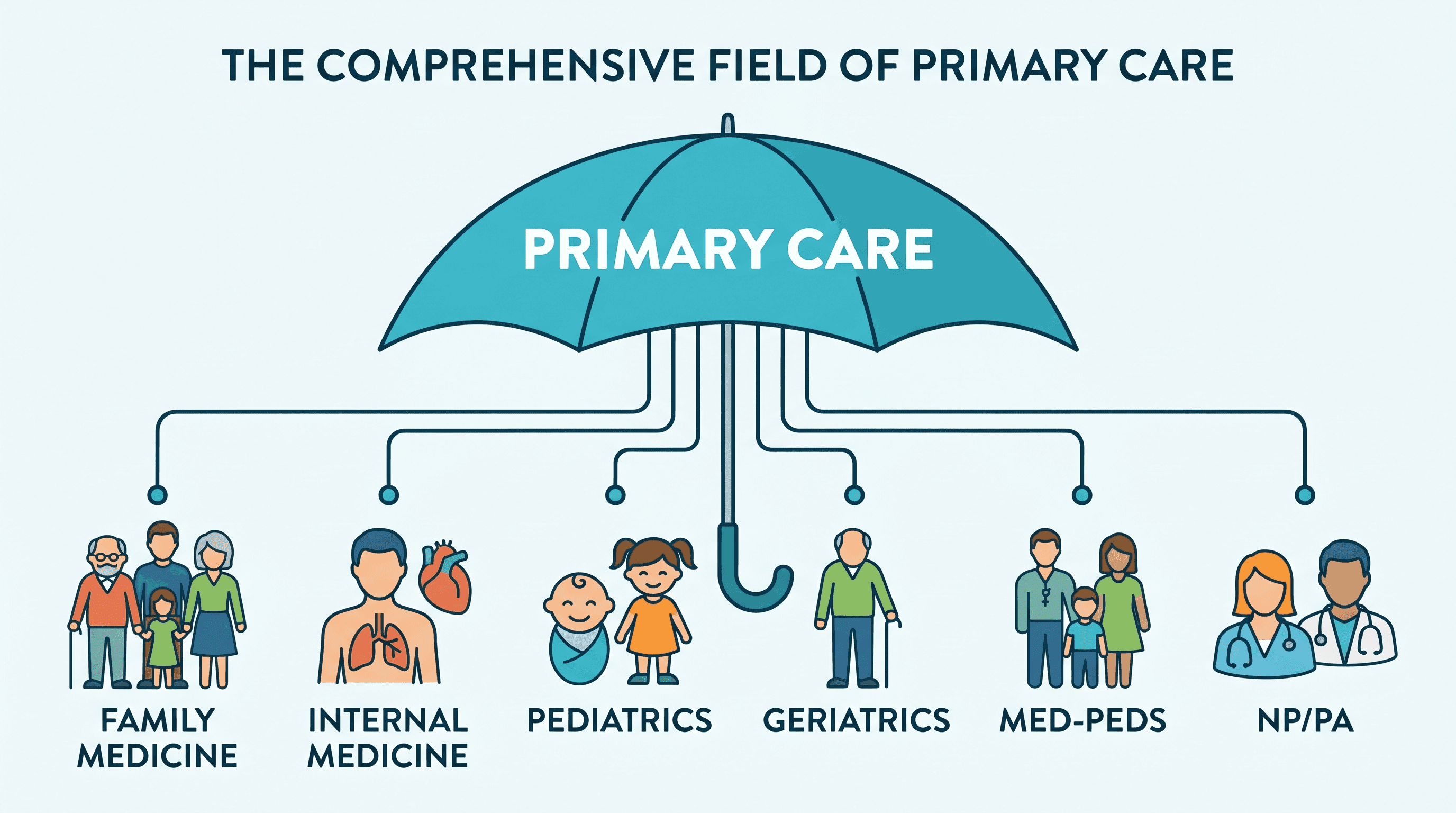
Think of a primary care provider (PCP) as the coordinator of your overall health: the person you call first when something feels off, the one who orders your annual labs, manages your blood pressure medication, and decides when you need to see a specialist. That role can be filled by several different types of clinicians, which is exactly where the confusion starts.
A PCP can be a family medicine physician, an internal medicine physician, a pediatrician (for children), a geriatrician (for older adults), a med-peds doctor (who trained in both internal medicine and pediatrics), a nurse practitioner (NP), or a physician assistant (PA). The term "primary care" describes the function, not the training. So when someone asks whether internal medicine is the same as primary care, the honest answer is: internal medicine is one path into primary care, but it is not the only one.
What Internal Medicine Doctors (Internists) Actually Do
An internist is a physician who completed a three-year residency specifically in internal medicine after medical school, and whose entire clinical focus is adult patients.
Internists are sometimes called the "doctor's doctor" because of their training in diagnostic reasoning across multiple organ systems simultaneously. Where a general practitioner might refer out when a patient's symptoms get complex, an internist is trained to sit with that complexity and work through it methodically. That makes them particularly strong at managing patients whose conditions interact with each other — for example, someone whose kidney disease is affecting their heart medication dosing.
One clarification worth making: a DO (Doctor of Osteopathic Medicine) who completed an internal medicine residency has equivalent clinical scope to an MD internist. The degree designation is less relevant than the residency training.
Outpatient vs. Inpatient Internists
This distinction almost never gets explained, and it matters.
Some internists work exclusively in outpatient clinics, seeing patients for routine physicals, chronic disease management, and preventive care. These are the internists most people picture when they think of a primary care doctor. Other internists work as hospitalists, meaning they practice entirely inside a hospital setting, managing patients who have been admitted. Hospitalists do not typically maintain long-term relationships with patients outside the hospital; they hand care back to the outpatient provider at discharge.
So if you are looking for a PCP, you want an outpatient internist, not a hospitalist. When searching for a new doctor, it is worth confirming that the internist you are considering has an outpatient practice.
How Training Differs
Both internists and family medicine physicians complete four years of medical school followed by a three-year residency, but those residencies look very different.
Internal medicine residencies concentrate on adult inpatient care: time in the ICU, cardiology wards, oncology, nephrology, and endocrinology rotations. The training is dense with adult pathophysiology and diagnostic complexity. Family medicine residencies are deliberately broader: residents rotate through obstetrics, pediatrics, behavioral health, and outpatient adult medicine so they graduate equipped to treat a four-year-old and a sixty-year-old in the same afternoon.
After residency, internists have an additional option that family medicine doctors generally do not: fellowship training. A fellowship is a two-to-three-year subspecialty program that transforms a general internist into a cardiologist, gastroenterologist, endocrinologist, rheumatologist, or one of several other specialists. This pathway is one reason internal medicine carries particular weight when a patient's case involves complex, multi-system disease.
"Physicians who practice general internal medicine provide a broad scope of primary care services for adults, including prevention, acute care and chronic disease management." — National Institutes of Health, PMC
The Key Differences, Side by Side
| Feature | Internal Medicine | Family Medicine | NP / PA (PCP role) |
|---|---|---|---|
| Patient age | Adults (18+) | All ages (birth onward) | All ages, varies by practice |
| Training focus | Adult disease, diagnostic complexity | Broad: pediatrics, OB, adult medicine | Graduate-level clinical training; scope varies by state |
| Typical setting | Outpatient clinic or hospital (hospitalist) | Outpatient clinic | Outpatient clinic, telehealth |
| Subspecialty options | Yes: cardiology, GI, endocrinology, etc. | Limited; some sports medicine, geriatrics | No fellowship pathway |
| Treats children | No | Yes | Often yes |
| Referral threshold | Higher tolerance for complexity before referring | Refers earlier for complex adult cases | Varies; may consult collaborating physician |
| When to consider | Complex chronic conditions, multi-system disease, adults without children | Whole-family care, healthy adults, pediatric needs | Primary care shortage areas, telehealth access, cost considerations |
Scenario Guide: Which Doctor Fits Your Situation
The comparison table above is useful, but most people do not search for care in the abstract. Here is how the choice plays out in real situations.
Scenario 1: You are a healthy adult in your 30s with no significant health history and no children. Either an internist or a family medicine doctor works well here. Both can handle annual physicals, vaccinations, minor illnesses, and routine labs. The choice often comes down to who is accepting new patients and who your insurance covers.
Scenario 2: You are an adult managing type 2 diabetes alongside hypertension and early kidney disease. An internist is the stronger fit. Managing three interconnected conditions requires the kind of systems-level thinking that internal medicine training specifically emphasizes. The relationship between hypertension, heart disease, and related complications across organ systems is precisely the terrain where internists train most intensively.
Scenario 3: You are looking for one doctor for your entire household, including two school-age children and two adults. Family medicine is the clear answer. An internist will not see your children, which means you would need separate pediatric care regardless. A family medicine physician can consolidate everyone under one practice.
Scenario 4: You have had months of fatigue, unexplained weight changes, and recurring joint pain that has not responded to previous treatment. An internist's diagnostic depth is an asset here. Multi-system symptoms that do not resolve cleanly often benefit from a clinician trained to hold several competing diagnoses at once.
Scenario 5: Your area has a primary care shortage and the next available MD appointment is months away. A nurse practitioner or physician assistant is a clinically valid, evidence-supported option for primary care. This is not a compromise — it is the modern healthcare landscape, and it deserves a fuller explanation.
What About Nurse Practitioners and Physician Assistants?
NPs and PAs now function as primary care providers across the United States, and in many communities they are the most accessible option available.
The Association of American Medical Colleges has consistently projected significant primary care physician shortages extending through the coming decade, with rural and underserved communities hit hardest. NPs and PAs fill much of that gap. Nurse practitioners complete graduate-level training (a master's or doctoral degree) with a clinical focus, and in many states they practice independently without physician oversight. Physician assistants complete a master's-level program that includes clinical rotations across specialties.
Research published in BMC Health Services Research has examined the cost and quality outcomes of NP-led primary care, with findings suggesting that for low-to-moderate complexity patients, outcomes are comparable to physician-led care. For patients with highly complex, multi-system conditions, a physician's diagnostic training may be more appropriate — and a good NP or PA will recognize and refer when a case exceeds their scope.
The practical takeaway: if you are relatively healthy or need preventive care, do not wait months for an MD when an NP can see you next week. If you have layered chronic conditions, it is worth seeking out a physician, ideally an internist.
If accessing care is a barrier right now, you can connect with a primary care provider through Momentary's virtual care platform and get seen without the wait.
Insurance, Referrals, and Access
Billing classification is one of the more confusing parts of this choice, and almost nothing written for patients explains it clearly.
When an internist or family medicine physician serves as your designated primary care provider, they bill your insurance at PCP rates regardless of their specialty designation. You will not pay specialist copays for routine visits just because your doctor is an internist. The billing rate follows the role, not the specialty title, as long as the physician is listed as your PCP in your plan.
Gatekeeper plans — typically HMOs — require a referral from your PCP before you see a specialist. PPO plans generally allow self-referrals. This distinction matters more than which type of PCP you choose: if you are on an HMO and need to see a cardiologist, your internist or family doctor needs to initiate that referral either way.
Wait times are a real consideration in 2025. Urban practices affiliated with large health systems can have new patient waits of several months. Telehealth-based primary care practices often have significantly shorter wait times and may be in-network with your plan. If you are starting from scratch, it is worth checking both traditional in-person practices and telehealth options simultaneously.
One thing to confirm: whether the doctor you are considering is in-network with your specific plan. "Accepts insurance" and "in-network" are not the same thing, and out-of-network costs for primary care add up quickly.
How to Actually Find and Switch Primary Care Doctors
Knowing which type of doctor you need is only half the task. Finding one who is actually available is the other half.
Start with your insurance carrier's online provider directory, filtered by specialty (family medicine or internal medicine) and whether the provider is accepting new patients. Confirm the information by calling the office directly; directories are often months out of date. If you are open to NP or PA-led care, filter for those credentials as well.
At a first appointment, a few questions help you assess fit: How do you handle same-day sick visits? What is your approach to managing chronic conditions over time? How do you coordinate with specialists? Do you offer telehealth appointments? The answers tell you a lot about how the practice operates, not just the clinician's credentials.
Switching doctors is normal and sometimes necessary. If your current PCP is not managing your conditions effectively, does not communicate clearly, or is simply too difficult to get an appointment with, requesting a transfer of your medical records is straightforward. You have a legal right to your records, and most practices can transfer them electronically.
Frequently Asked Questions
Which is better, primary care or internal medicine? Neither is categorically better. Primary care describes a role, and internal medicine is one type of training that qualifies a doctor to fill that role. For adults with complex chronic conditions, an internist's training often provides an advantage. For healthy adults or families with children, a family medicine doctor covers more ground.
What is the difference between a primary care physician and an internal medicine doctor? A primary care physician is any doctor (or NP/PA) whose role is to serve as your first point of contact for health. An internal medicine doctor is a physician who completed a specialty residency focused on adult disease. All internists can serve as PCPs, but not all PCPs are internists.
Why would someone see an internal medicine doctor? Adults managing multiple chronic conditions, patients with complex or difficult-to-diagnose symptoms, and anyone whose care involves coordinating between several organ systems often benefit from seeing an internist. Internists are specifically trained for diagnostic complexity in adult medicine.
Which is better, a general practitioner or internal medicine? In the US, the term "general practitioner" is less commonly used than in other countries; family medicine physicians fill a comparable role. For adult patients with complex health histories, an internist's depth of training in adult disease can be an advantage. For patients who want one doctor for an entire family, a family medicine physician is the better fit.
Can an internist be my primary care doctor? Yes. Many internists maintain outpatient practices where they serve as their patients' primary care provider for routine and preventive care, not just complex cases.
What is a med-peds doctor? A med-peds physician completed a combined residency in both internal medicine and pediatrics, typically four years instead of three. They are qualified to serve as a PCP for patients of any age, from infants through adults.
If you are trying to figure out which direction to go given your specific symptoms or health history, Momentary's AI health navigator can help you think through your situation and understand what kind of care makes sense as a next step.
References
- National Institutes of Health, PMC — PMC3177970 — Cited for the clinical scope of general internal medicine as a primary care specialty.
- National Institutes of Health, PMC — PMC10361894 — Cited for research on NP-led primary care outcomes and cost-effectiveness.

