

At a Glance
| Topic | Key Facts |
|---|---|
| Same-day discharge rate | More than 80% of total shoulder replacements in the US are now performed as outpatient procedures |
| Primary enabler | Interscalene nerve block numbs the arm for 12 to 24 hours post-surgery |
| Discharge criteria | Stable vitals, tolerated oral fluids, walking independently, caregiver present |
| Typical overnight stay triggers | COPD, CHF, poorly controlled diabetes, severe sleep apnea, revision surgery |
| Medicare outpatient coverage | CMS added total shoulder arthroplasty (TSA) to its Ambulatory Surgical Center Covered Procedures List in 2024 |
| Recovery milestone | Most patients regain functional use of the arm by 3 to 6 months |
Going home the same day as major joint surgery sounds like something that belonged to a future decade. But for shoulder replacement patients today, it is increasingly the default, not the exception. If you are scheduled for shoulder replacement surgery and wondering whether you can skip the hospital stay entirely, the answer for most healthy patients is yes. What matters is understanding exactly what puts you in that group and what preparation makes the transition safe.
This guide is written for patients making that decision before surgery, not after. The goal is to give you a clear picture of what qualifies you for same-day discharge, what the first 72 hours at home actually look like, and what to set up in your house before you ever walk through the surgical center doors.
The Short Answer: Most Patients Go Home the Same Day Now
Outpatient shoulder replacement is no longer a niche offering at academic medical centers. It is the standard of care at most high-volume orthopedic surgery centers across the United States.
In 2024, the Centers for Medicare and Medicaid Services (CMS) formally added total shoulder arthroplasty (TSA) to its Ambulatory Surgical Center (ASC) Covered Procedures List, making outpatient shoulder replacement Medicare-eligible for the first time. That policy change accelerated an existing trend: data published in peer-reviewed literature shows that same-day discharge is now associated with lower rates of medical complications compared to inpatient stays, largely because carefully selected outpatient candidates are healthier to begin with and avoid hospital-acquired risks.
If you have seen older sources online still quoting a three-to-five-day hospital stay after shoulder replacement, that guidance is outdated. The shift began after regional anesthesia techniques became widely adopted, and it has continued as surgical protocols tightened around patient selection and discharge criteria.
What Happens in the Hours After Surgery
Understanding the immediate post-operative window helps clarify why same-day discharge is safe for the right patient and why it is not appropriate for everyone.
Recovery Room
After surgery ends, patients move to the Post-Anesthesia Care Unit (PACU), where they typically spend one to two hours. During this time, the care team monitors blood pressure, heart rate, oxygen saturation, and pain levels. Because most shoulder replacement surgeries use a combination of general anesthesia and a regional nerve block, many patients wake up with a completely numb arm and limited finger movement on the surgical side. This is expected and temporary.
Nurses will assess whether patients can swallow water or juice, sit upright without dizziness, and move to standing with assistance. Nausea from anesthesia is common and is managed with anti-nausea medication before discharge is considered.
The Discharge Criteria Checklist
Surgeons and anesthesiologists use structured scoring tools to decide whether a patient is safe to leave. One widely referenced framework in joint replacement is the OARA (Outpatient Arthroplasty Risk Assessment) score, which assigns points based on comorbidities, BMI, age, and social support factors. Patients with lower OARA scores are stronger candidates for outpatient discharge.
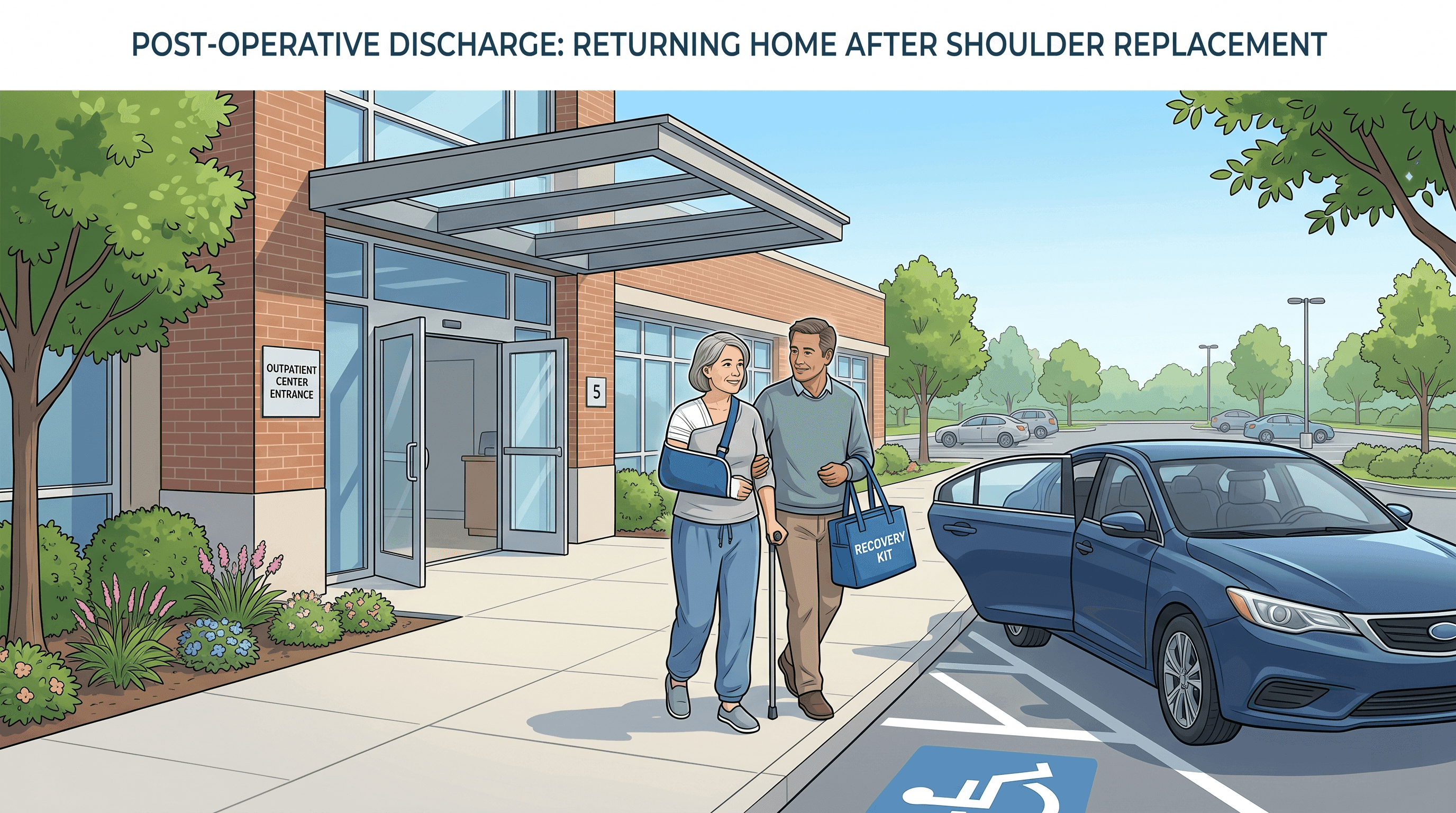
Beyond the scoring tool, the discharge checklist at most centers requires all of the following: stable vital signs for at least one hour, pain controlled with oral medication rather than IV narcotics, the ability to tolerate liquids without vomiting, independent ambulation with a walker or without assistance, and a confirmed responsible adult caregiver present to drive the patient home and stay with them overnight.
Factors That Affect Whether You Go Home the Same Day
Same-day discharge is not automatic. The decision is made based on a combination of preoperative health status, intraoperative findings, and immediate recovery room performance.
Health Conditions That May Require an Overnight Stay
Certain medical conditions raise the risk of complications in the hours after surgery and make inpatient monitoring the safer choice. Chronic obstructive pulmonary disease (COPD) is one of the most common reasons patients are kept overnight, because the combination of general anesthesia and a high nerve block can temporarily affect breathing mechanics. Congestive heart failure (CHF), poorly controlled diabetes requiring insulin, severe obstructive sleep apnea (particularly if the patient uses a CPAP machine and it cannot be brought to the surgical center), a BMI above 40, and age above 70 with multiple comorbidities are all factors that individual surgeons and anesthesiologists weigh carefully. None of these conditions automatically disqualify a patient, but each one raises the threshold for what qualifies as a safe outpatient discharge in that surgeon's judgment.
Revision shoulder replacement surgery, in which a previous implant is removed and replaced, generally involves longer operative time, greater blood loss, and higher anesthetic burden. Most revision cases are planned as inpatient procedures from the outset.
Surgery Type Matters: Anatomic vs. Reverse
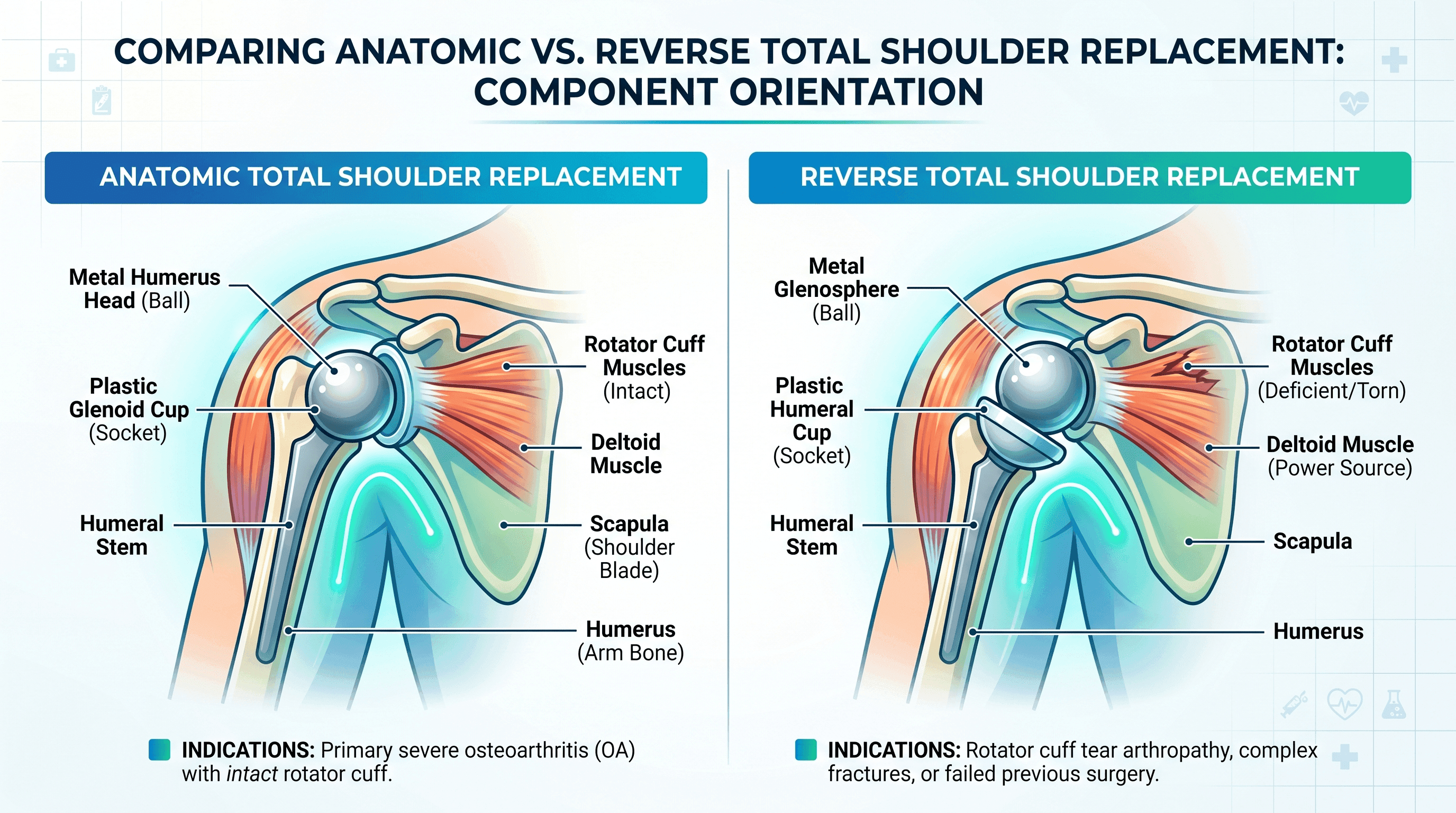
There are two main types of shoulder replacement performed in the US: total anatomic shoulder arthroplasty (TSA) and reverse total shoulder arthroplasty (rTSA). The difference matters for discharge planning.
In a reverse shoulder replacement, the ball-and-socket components are switched in orientation. This design is used when the rotator cuff is severely torn or irreparable, because it allows the deltoid muscle to take over the mechanical work of the shoulder joint. Patients with reverse replacements often experience less early post-operative pain from rotator cuff tension and can typically start gentle pendulum exercises sooner. These factors can make same-day discharge slightly more accessible for reverse replacement patients in some cases.
Anatomic total shoulder replacement requires more careful early protection of the subscapularis tendon, which is repaired during surgery. Early post-operative activity restrictions are stricter, but discharge timing is not necessarily longer if pain is well controlled with the nerve block.
The Role of Prehabilitation
Prehabilitation, meaning physical therapy and strengthening exercises completed before surgery, consistently improves post-operative outcomes in joint replacement patients. Patients who arrive for surgery with stronger shoulder-adjacent musculature and a baseline understanding of their post-operative exercises report better early pain control and reach discharge criteria faster. Most orthopedic surgeons recommend starting prehab four to six weeks before a scheduled shoulder replacement. A physical therapist can provide a targeted program focused on scapular stabilizers, core support, and the exercises that will be used immediately after surgery.
Does Going Home the Same Day Increase Your Risk?
This is the question patients ask most often, and the evidence is reassuring.
A 2022 systematic review published in the Journal of Shoulder and Elbow Surgery analyzed data across dozens of studies comparing outpatient and inpatient shoulder arthroplasty outcomes. Carefully selected outpatient candidates showed comparable or lower rates of 30-day complications and readmission compared to matched inpatient groups. The lower complication rates in outpatient cohorts are largely attributed to the rigorous pre-screening that excludes higher-risk patients from same-day discharge in the first place.
"Outpatient total shoulder arthroplasty in appropriately selected patients has been shown to be safe, with low rates of perioperative complications and readmissions." — PMC / Journal of Shoulder and Elbow Surgery, 2022
What this means practically: going home the same day is not a corner cut. It is a clinically validated pathway for patients who meet the criteria. For patients who do not meet those criteria, staying overnight is the right call, and that decision protects them.
A Note on Insurance and Medicare Coverage
The 2024 CMS decision to add TSA to the ASC Covered Procedures List was a meaningful policy shift, but it does not mean every insurer automatically covers outpatient shoulder replacement without a prior authorization review.
Patients should verify two things before surgery. First, confirm whether the surgical center where the procedure will be performed is Medicare-certified or in-network with their private insurer. Second, ask the insurance coordinator at the orthopedic practice whether the procedure code is being billed as an outpatient ASC case, because some insurers still default to inpatient authorization pathways for shoulder replacement and require an appeal or pre-certification to approve the outpatient setting.
If cost-sharing is a concern, outpatient ASC cases often carry lower facility fees than inpatient hospital stays, which can translate to lower out-of-pocket costs depending on plan design. A billing coordinator at the surgical practice can run a benefits check before the procedure date.
How to Prepare Your Home Before Surgery Day
The week before surgery is the window to set up a recovery environment that does not require overhead reaching, two-handed tasks, or trips to the store.
Setting Up Your Recovery Space
The single most important piece of furniture for the first two weeks after shoulder replacement is a recliner. Sleeping flat in a bed causes the shoulder to sag into a position that increases pain and stress on the surgical repair. A recliner keeps the torso at roughly a 45-degree angle, which most patients find significantly more comfortable. If a recliner is not available, stacking firm pillows to create a wedge in bed is an alternative, though less comfortable.
Stock the following before surgery day: loose-fitting front-opening shirts or button-down shirts (nothing pulled over the head), a shower chair or bench, pump-style soap dispensers in the bathroom, pre-prepared meals in single-serving containers, an ice pack or cooling unit if the surgeon provides one, and all prescribed medications filled and on hand. Move frequently used items, such as plates, cups, and snacks, to waist-height shelves so nothing requires reaching above shoulder level.
Your Caregiver Requirement
Rideshare services such as Uber and Lyft are not acceptable discharge transportation after shoulder replacement surgery. Surgical centers universally require a responsible adult, not a hired driver, to be present at discharge and to drive the patient home. The reason is clinical: if a patient experiences a sudden complication in the car, a rideshare driver is not equipped to respond. The caregiver must also be reachable and physically present for the first 24 to 48 hours post-discharge to assist with meals, medication administration, wound observation, and mobility support.
For the first one to two weeks, the caregiver should plan to help with driving to follow-up appointments, preparing food, and monitoring the surgical site for changes. This is not a minor commitment, and it is worth discussing logistics with family or friends before the surgery date.
What to Expect in the First 72 Hours at Home
The first three days at home are the highest-stakes window of outpatient shoulder replacement recovery, and the most important thing to understand is what happens when the nerve block wears off.
The interscalene nerve block numbs the arm by temporarily interrupting nerve signaling in the brachial plexus. It typically lasts 12 to 24 hours. As it fades, usually overnight on the day of surgery or the following morning, patients experience what is commonly called the "rebound pain window." The arm transitions rapidly from numb to painful, and patients who wait until they feel pain to take their oral medications often find themselves significantly behind on pain control.
The standard guidance from most orthopedic practices is to start prescribed oral pain medication four to six hours after surgery, before the block wears off, and to continue on a scheduled basis rather than waiting for pain to spike. Patients who follow this timing consistently report much more manageable first-night discomfort.
On the first night, sleep in the recliner. On day two, light hand, wrist, and elbow exercises (such as making a fist and straightening the fingers, and bending and straightening the elbow) are typically started to prevent stiffness in the rest of the arm. Most practices ask patients to wait 72 hours before showering, using a waterproof cover over the dressing in the meantime.
If questions come up during recovery that feel urgent but are not clearly emergencies, connecting with a provider through telehealth is often a faster option than waiting for a callback from the surgical office. Patients can see a doctor online through Momentary for guidance on medication concerns, wound appearance questions, or general recovery questions that do not require an in-person evaluation.
When to Call Your Surgeon After Going Home
Most patients recover without complications. But there is a clear set of warning signs that require an immediate call to the surgeon or a trip to the emergency department.
Contact your surgeon or go to the emergency department immediately if:
A fever above 101 degrees Fahrenheit develops, as this may signal infection. Wound drainage increases significantly, changes color, or produces an odor, particularly after the first 48 hours. Pain becomes uncontrollable despite taking prescribed medication as directed. Sudden shortness of breath or chest pain develops, as these can indicate a pulmonary embolism (blood clot in the lungs), which is a rare but serious post-surgical complication. New or worsening numbness, tingling, or weakness that is not explained by the fading nerve block appears. The arm becomes significantly more swollen, red, or warm in the days after surgery.
Scheduled restrictions to note: Driving is restricted for a minimum of six weeks after shoulder replacement, and most surgeons extend this to the full duration of sling use. Flying is generally restricted for a minimum of two weeks due to blood clot risk. Always confirm specific restrictions with the surgeon, because individual cases vary.
Recovery Timeline After You Leave the Hospital
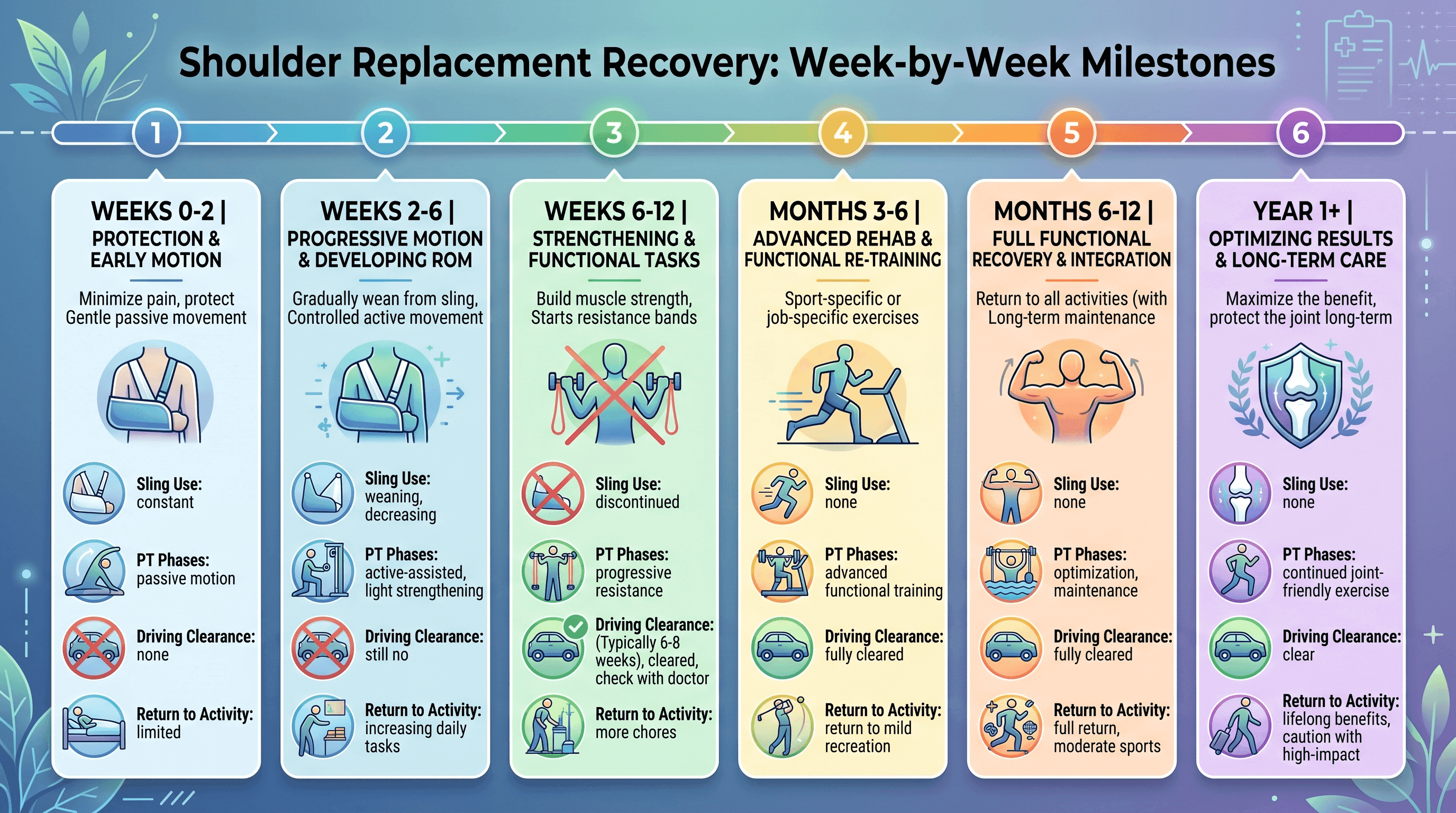
Recovery from shoulder replacement follows a predictable general arc, though individual timelines vary based on surgery type, patient health, and adherence to physical therapy.
| Timeframe | Expected Progress |
|---|---|
| Weeks 1 to 2 | Sling worn full-time; hand, wrist, and elbow exercises only; sleeping in recliner; caregiver assistance for daily activities |
| Weeks 4 to 6 | Pendulum exercises added; sling may be discontinued (anatomic TSA patients often wear sling longer); pain decreasing significantly |
| Weeks 6 to 8 | Active-assisted physical therapy begins; range of motion exercises progress; driving typically cleared by surgeon |
| 3 months | Most patients can lift light objects; significant pain reduction; return to desk work and light activity |
| 6 months | Majority of functional recovery achieved; continued strength building in PT |
| 12 months | Full recovery typically assessed; most patients report substantial improvement in pain and function compared to pre-surgery |
For reverse shoulder replacement patients, PT typically begins earlier, because the altered mechanics of the joint do not require the same level of early repair protection as anatomic TSA. For anatomic patients, subscapularis protection often delays the start of active shoulder exercises by four to six weeks.
Frequently Asked Questions
Can I take care of myself after shoulder replacement?
Most patients cannot fully care for themselves in the first one to two weeks after shoulder replacement, particularly if the dominant arm is the one being operated on. Single-handed tasks such as preparing meals, buttoning clothing, and driving are limited or impossible during sling use. A caregiver for at least the first 48 hours is a discharge requirement at most outpatient surgical centers, and practical help for two to four weeks makes recovery significantly safer and more comfortable.
Can I live alone after shoulder replacement?
Living alone after shoulder replacement is not recommended for the first one to two weeks without a plan for daily check-ins and meal support. Many patients who live alone arrange for a family member or close friend to stay with them for the first week, or they coordinate a temporary stay at someone else's home. Some areas have home health aide services that can cover daily assistance needs. A doctor can help assess what level of support an individual patient needs based on their specific circumstances.
What should I expect immediately after shoulder replacement surgery?
In the first hours after surgery, most patients feel little to no pain in the shoulder because of the interscalene nerve block. The arm will feel heavy, numb, and difficult or impossible to move. Mild nausea from anesthesia is common. The primary discomfort for many patients is general grogginess and the awkwardness of managing the arm in the sling. The more significant pain transition happens when the nerve block wears off, typically 12 to 24 hours after surgery, which is why starting oral pain medication before that window is so important.
Is shoulder replacement a big surgery?
Total shoulder arthroplasty is a major orthopedic procedure. It involves general anesthesia, removal of the damaged ball and socket of the shoulder joint, and implantation of prosthetic components. The average operative time is one to three hours depending on complexity. Recovery is measured in months, not weeks. At the same time, advances in surgical technique, regional anesthesia, and implant design have made it far less disruptive than it was two decades ago, and the majority of patients experience significant pain relief and functional improvement that they describe as life-changing. Cleveland Clinic and Johns Hopkins Medicine both note that patient satisfaction rates after shoulder replacement are among the highest for any orthopedic procedure.
How do I know if I qualify for same-day discharge?
The best source of this answer is the surgical practice and anesthesia team during the preoperative evaluation, typically two to four weeks before surgery. They will review health history, current medications, BMI, age, home support, and any prior anesthesia reactions. Patients can start by reviewing their own health conditions against the common disqualifiers listed in this article, but the final determination is always made by the clinical team. If there is uncertainty, it is appropriate to ask the surgeon directly: "Based on my health profile, am I a candidate for outpatient shoulder replacement?"
What is the OARA score and why does it matter?
The OARA (Outpatient Arthroplasty Risk Assessment) score is a preoperative screening tool that orthopedic surgeons use to estimate a patient's suitability for same-day discharge after joint replacement. It assigns numerical weight to comorbidities, BMI, age, and social support factors. A lower OARA score suggests lower perioperative risk and better outpatient candidacy. Patients do not need to calculate this themselves, but knowing it exists can be useful context when discussing outpatient eligibility with the surgical team.
Not sure what your symptoms mean before or after surgery? Use Momentary's AI health navigator to explore your health questions, understand what to discuss with your provider, and get personalized guidance on next steps.
References
- PMC / National Library of Medicine (PMC9516623) — Evidence on outpatient shoulder arthroplasty safety and perioperative outcomes.
- Penn State Bone and Joint Institute — Patient-facing guidance on going home after shoulder replacement surgery.
- PMC / National Library of Medicine (PMC10492523) — Systematic review of outpatient vs. inpatient shoulder arthroplasty complication rates.
- PubMed / Journal of Shoulder and Elbow Surgery (PMID 36189336) — Comparative outcomes data for outpatient total shoulder arthroplasty.
- NIH / National Library of Medicine, StatPearls (NBK561412) — Clinical overview of COPD and perioperative risk considerations.
- Cleveland Clinic: Shoulder Replacement — Overview of shoulder replacement procedure, recovery, and patient outcomes.
- Johns Hopkins Medicine: Total Shoulder Replacement — Clinical guidance on total shoulder arthroplasty recovery and patient expectations.