


At a Glance
| Topic | Key Facts |
|---|---|
| Safe sitting duration (first month) | 30 to 45 minutes per session; stand and walk briefly before sitting again |
| Primary risk of prolonged sitting | Deep vein thrombosis (DVT) and increased muscle spasm pain on standing |
| Posterior approach precaution | Hip must not flex beyond 90 degrees while seated |
| Anterior approach | Often fewer restrictions; confirm specifics with your surgeon |
| Raised toilet seat | Recommended for up to 6 weeks post-surgery |
| Full sitting freedom | Most patients achieve this by weeks 10 to 12 with surgical clearance |
You just got home from the hospital, and the recliner in the corner looks like the most welcoming piece of furniture on earth. Before you sink into it, here is the short answer: most patients can sit for 30 to 45 minutes per session in the first several weeks after surgery, then must stand up and move around before sitting again. But the full picture depends on which surgical approach your surgeon used and which week of recovery you are in. Read on and this guide will walk you through both.
The 45-Minute Rule: What It Means and Why It Exists
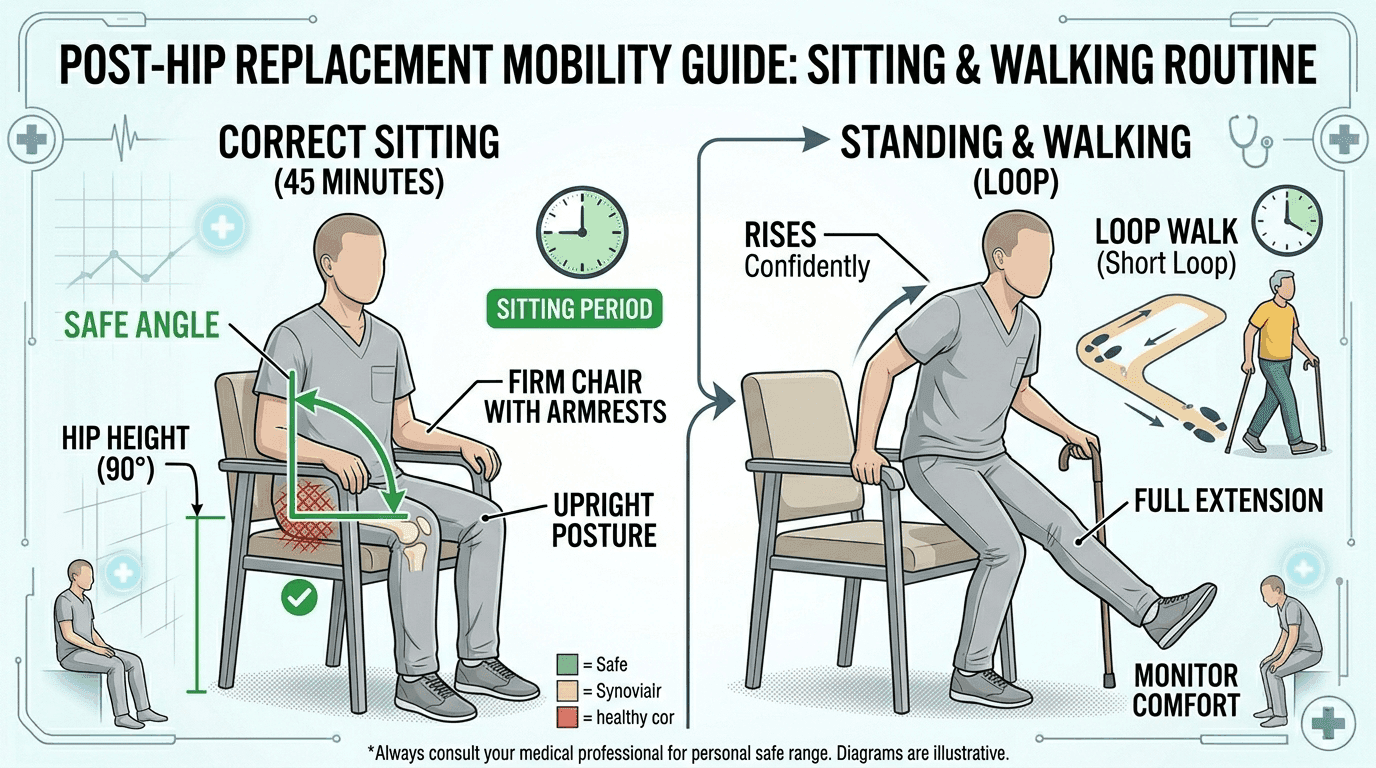
The core guideline for sitting after hip replacement is straightforward. In the first four to six weeks after surgery, sit for no more than 30 to 45 minutes at a stretch, then stand and take a short walk or gentle march in place before returning to your chair.
MedlinePlus, published by the National Institutes of Health, advises patients to avoid sitting in the same position for more than 30 to 40 minutes at a time following hip replacement surgery. This is not an arbitrary number. Two distinct biological processes make prolonged sitting genuinely risky during the early weeks of recovery, and understanding both of them makes it far easier to follow through.
Why Sitting Too Long Is Actually Risky After Hip Replacement
Two separate mechanisms put you at risk when you stay seated too long after surgery, and they are worth knowing by name.
Deep Vein Thrombosis (DVT). A DVT is a blood clot that forms in a deep vein, most often in the leg. When you sit still for extended periods after surgery, blood flow slows in the veins of the legs and pooling creates conditions for clots to form. According to the Cleveland Clinic, blood clots in the legs or lungs are among the recognized complications following hip replacement surgery. Getting up and moving every 30 to 45 minutes keeps blood circulating and significantly lowers that risk.
Severe "start-up" pain and muscle spasms. The muscles and soft tissue surrounding a new hip implant are in an active healing state. When you sit still for too long, those tissues stiffen. Standing up after an extended sit can trigger sharp muscle spasms and a painful lurch forward that many patients describe as worse than expected. Short, frequent movement breaks prevent that stiffness from setting in.
"Hip precautions are often prescribed for at least 6 weeks or until the soft tissue surrounding the hip has at least partially healed." NIH/StatPearls, Hip Precautions
Does Your Surgical Approach Change the Sitting Rules?
Yes, and this is the most important variable to understand.
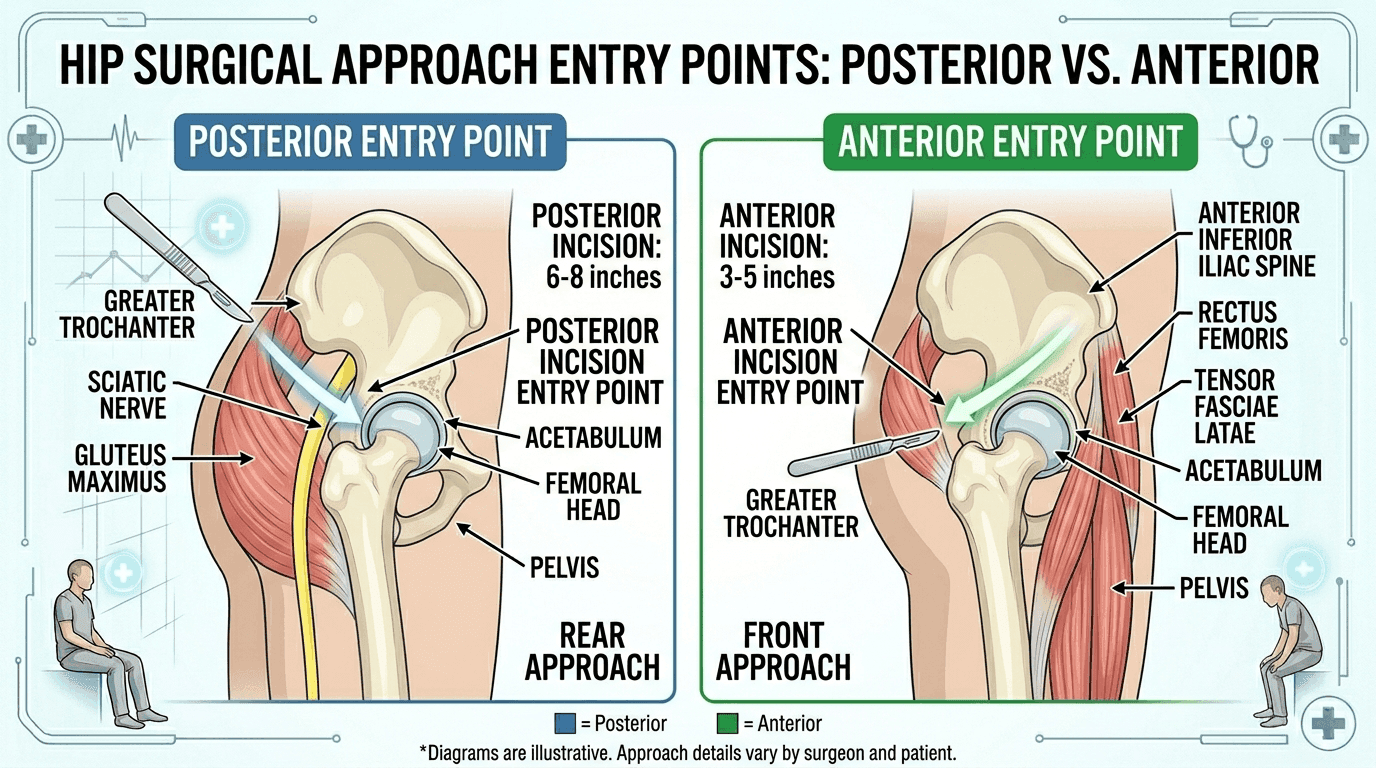
The two most common approaches to hip replacement surgery are the posterior approach and the direct anterior approach, and they come with different precaution sets. According to NIH StatPearls, hip precaution protocols are specifically tailored based on the surgical technique and approach utilized by the surgeon. If you are unsure which approach your surgeon used, that is the first question to ask at your follow-up appointment.
Posterior Hip Replacement: What to Watch for When Sitting
The posterior approach is the most commonly used technique in total hip arthroplasty in the United States, according to NIH StatPearls. Surgeons access the hip joint from the back of the hip, which means the posterior capsule and short external rotator muscles are disrupted during the procedure. Until those structures heal, the implant is more vulnerable to popping out of the socket in what is called a dislocation.
This is where the 90-degree rule comes in. Avoid bending the operated hip beyond 90 degrees (a right angle) while seated. Practically, that means:
Your knees must always stay at or below hip level when you sit. If a chair seat is low enough that your knees rise above your hips, do not sit in it. MedlinePlus specifically advises that patients sit in a firm chair with a straight back and armrests, and avoid soft chairs, rocking chairs, stools, or sofas where the hips can sink below the knees.
You must not cross your legs or ankles while seated, as crossing legs rotates the hip inward or outward in ways that stress the posterior capsule. You should keep your feet pointed straight ahead, about 6 inches apart. When rising from the chair, slide to the edge first and push up through the armrests rather than rocking forward.
Anterior Hip Replacement: Are the Rules Different?
The direct anterior approach accesses the hip from the front, working between muscle planes rather than cutting through them. Because the posterior capsule is left intact, many surgeons who use this approach prescribe fewer or no formal hip precautions post-operatively. As noted in NIH StatPearls, advocates of the direct anterior approach cite theoretically decreased hip dislocation rates in the post-operative period.
In practice, many anterior approach patients are allowed to sit in lower chairs sooner and do not need to follow the strict 90-degree rule. That said, every surgeon's protocol differs. Even without formal precautions, most clinicians still recommend building sitting duration gradually rather than jumping to two-hour sessions in the first week. Confirm your specific restrictions directly with your surgical team.
A Week-by-Week Sitting Timeline After Hip Replacement
Think of recovery as a series of unlocked milestones rather than a single distant finish line.
| Recovery Stage | Typical Sitting Guidance |
|---|---|
| Week 1 to 2 | Maximum 30 to 45 minutes per session. Firm chair only. Armrests required. Stand and walk 2 to 3 minutes between sits. No sofas. Raised toilet seat in use. |
| Week 3 to 6 | Gradual increase toward 60 minutes per session as tolerated. A sofa with a firm cushion added to raise seat height may be acceptable. Car trips allowed (shorter distances); stop every 30 to 45 minutes. |
| Week 6 to 10 | Most patients can sit for 60 to 90 minutes comfortably. Posterior approach precautions may still apply; confirm with your surgeon. Desk work in a properly adjusted chair becomes more manageable. |
| After Week 10 to 12 | With surgeon clearance, most restrictions on sitting duration are lifted. Sitting through a two-hour movie or a longer flight is achievable for most patients at this stage. |
This timeline reflects general clinical guidance. Individual recovery varies based on age, overall health, implant design, and how consistently post-operative physical therapy is followed.
The Best and Worst Places to Sit During Recovery
Surface-specific guidance answers some of the most common questions patients have at home.
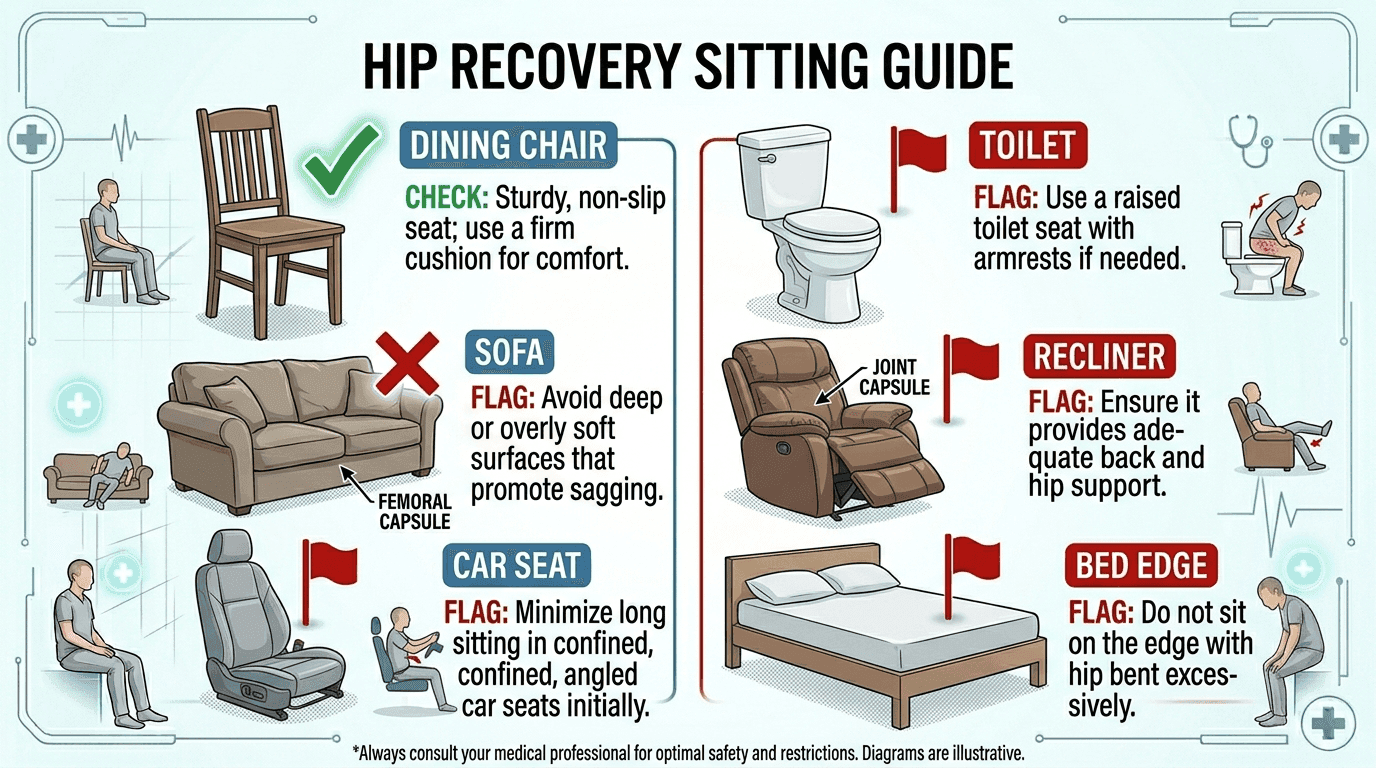
Dining chair. This is your best friend during recovery. A firm seat, a straight back, and side armrests make it the ideal recovery chair. If the height puts your knees above your hips, add a firm cushion to raise the seat.
Office or desk chair. Adjustable height chairs work well if raised so the hips sit above the knees. Chairs with wheels are convenient, but make sure they lock before you push up to stand. Lumbar support helps with the extended sitting that desk work requires.
Sofa. Avoid a soft, low-slung sofa in the first two to three weeks. The cushions compress under body weight, which causes the hips to sink below knee level and can push the hip into a flexion angle beyond the 90-degree limit. If you use a sofa later in recovery, place a firm cushion or folded blanket on the seat to raise and firm it up.
Recliner. Standard recliners that require a forward lean to operate the footrest mechanism can be a problem in the early weeks. Power lift recliners are a better option because they tilt the entire chair forward to assist standing, avoiding the need to push up from a deep lean.
Car seat. Most surgeons recommend waiting two to four weeks before riding in a car. When you do, push the seat as far back as possible to keep the knee below hip level, and stop to walk around every 30 to 45 minutes on any trip longer than that. MedlinePlus recommends breaking up long car rides by stopping and walking about every two hours.
Toilet. A standard toilet seat sits low enough that many patients will violate the 90-degree rule every time they use it. A raised toilet seat adds 3 to 4 inches of height and keeps the hip at a safe angle. MedlinePlus recommends using an elevated toilet seat to keep the knees lower than the hips during bathroom use. Most patients need this for up to six weeks.
Bed edge. When sitting on the side of the bed, keep feet flat on the floor and make sure the mattress is high enough that the hips are not dropping below knee level. If the bed is too low, sit on a folded blanket stacked on the edge.
Setting Up Your Home Workspace for Recovery
Returning to desk work is one of the most common questions from remote and hybrid workers, and it is almost completely absent from standard post-operative paperwork.
The goal is to create a seated work environment where the hips remain above the knees, movement breaks are built into the schedule, and getting up and sitting down does not require awkward bending or twisting.
Start with your chair. Raise it until the thighs are parallel to the floor or angled slightly downward, so the hips are level with or slightly above the knees. Add a firm seat cushion or wedge cushion if your chair does not adjust high enough. Lumbar support matters more than usual during recovery because your core and hip stabilizers are weaker than normal, and slouching increases load on the healing hip.
Set a 40-minute timer and stand when it goes off. A brief walk to the kitchen or bathroom is enough. Some patients find a standing desk helpful from around weeks four to six, once weight-bearing is more comfortable, but check with your surgeon before spending long periods standing in one place.
Keep your monitor at eye level so you are not hunching forward. Reaching for a mouse placed too far away creates the same subtle forward hip flexion that builds up over hours of desk work. Keep everything within a comfortable arm's reach.
If your job requires video calls, be ready to explain that you may stand up during the call. Most colleagues understand, and alternating between sitting and standing through a one-hour meeting is exactly the right behavior for early recovery.
Warning Signs: When Sitting Causes Real Trouble
Some discomfort after a long sit is expected, particularly in the first few weeks. What matters is knowing when a symptom crosses the line from normal recovery soreness into a red flag.
Calf swelling, redness, or tenderness. These can be signs of a deep vein thrombosis (DVT). If one calf is noticeably more swollen or tender than the other, or if you notice sudden shortness of breath, contact your surgeon immediately or go to the emergency room.
Severe hip pain during sitting that feels different from typical soreness. A sharp, clicking sensation followed by instability or a sense that something has shifted may indicate implant impingement or dislocation risk. Do not attempt to reposition the leg yourself. Call your surgical team.
Fever with redness or warmth around the incision. Post-operative infection is rare but serious. A fever above 101 degrees Fahrenheit combined with increasing redness, warmth, or drainage at the surgical site warrants a same-day call to your surgeon.
Inability to bear weight after a fall or abrupt movement. Even a gentle stumble can create problems in the first few weeks. If weight-bearing suddenly becomes painful after any impact, get evaluated.
If any of these occur, connect with a primary care provider or specialist online through Momentary for a quick triage or to get guidance on whether an in-person visit is needed right away.
Frequently Asked Questions
Is it better to sit or lie down after hip replacement surgery?
Both have a role, and neither should be done exclusively for long stretches. Lying down is appropriate for rest and sleep, particularly in the first week when fatigue is highest. Sitting promotes alertness, circulation, and the upright posture needed for eating and daily activities. The key with either position is changing it every 30 to 45 minutes. Lying still for hours carries the same DVT risk as sitting still. Follow your surgeon's specific guidance on sleeping positions, as posterior approach patients typically avoid sleeping on the operated side in the early weeks.
What are the three big restrictions for a hip replacement patient?
The three movement restrictions that matter most are: no hip flexion beyond 90 degrees (knees must stay at or below hip level), no crossing of the legs or ankles, and no internal rotation of the operated leg (turning the foot inward). These three restrictions apply most strictly to posterior approach patients and are generally in place for the first six weeks, though your surgeon may modify the timeline based on your individual progress.
How long after hip replacement can I sit on a normal chair?
A standard dining chair with a firm seat, straight back, and armrests is generally safe to use from day one of discharge, provided the seat height keeps the hips above or level with the knees. The issue is not the chair category but the geometry: knees must stay below hip level throughout the sit. Soft chairs, low chairs, and deep sofas are the problem, not firm upright chairs.
How far should I walk 10 days after hip replacement?
Walking distance at 10 days varies by individual, but most patients are encouraged to walk short distances several times per day rather than one long walk. The goal at this stage is consistency and gradual increase, not distance targets. Most post-operative physical therapy programs focus on controlled, supported walking that builds tolerance without overloading the hip. A physical therapist can give personalized milestones based on weight-bearing status and healing progress.
When can I sit for a full workday?
Most patients can return to a desk-based job with proper chair setup and mandatory movement breaks by weeks four to six, subject to their surgeon's clearance. Sitting through a full eight-hour day without breaks is not recommended at any point in recovery. The better target is working in 45-minute seated blocks with standing or walking intervals built in. By weeks ten to twelve, the need for rigid time limits typically decreases significantly.
If you are still unsure what your symptoms mean or want help understanding your next steps, you can use Momentary's AI health navigator to explore your questions and get personalized guidance before your next appointment.
References
- MedlinePlus, National Institutes of Health — Post-operative sitting, movement restrictions, raised toilet seat, and car ride guidance after hip replacement surgery.
- Cleveland Clinic: Hip Replacement Surgery — Overview of hip replacement surgery, recovery timeline, and complication risks including DVT.
- NIH/StatPearls: Hip Precautions — Clinical overview of hip precaution protocols by surgical approach, precaution duration, and movement restrictions post-THA.
- AAOS OrthoInfo: Activities After Total Hip Replacement — Activity guidance and restrictions following total hip arthroplasty from the American Academy of Orthopaedic Surgeons.