


Hip replacement is one of the most common major orthopedic surgeries in the United States, with more than 450,000 procedures performed each year according to the American Academy of Orthopaedic Surgeons. Recovery comes with a long list of instructions, and alcohol tends to sit in a gray zone. Most surgeons mention it briefly. Most discharge sheets say little. And most patients are left guessing.
This guide cuts through the vagueness. The timeline for safely drinking alcohol after hip replacement is not arbitrary. It is dictated almost entirely by the specific medications on board, the phase of bone healing, and the physical demands of early rehabilitation. Understanding the "why" behind each restriction makes the guidance far easier to follow, and to know when it genuinely no longer applies.
At a Glance
| Topic | Key Facts |
|---|---|
| Minimum wait before any alcohol | Until off all opioids and blood thinners — typically 5 to 6 weeks |
| Anticoagulant standard course | ~35 days post-op (Xarelto/Eliquis for hip replacement patients) |
| Peak DVT risk window | Days 2 to 10 post-surgery; elevated risk for up to 90 days |
| Alcohol and opioids | Combination can cause fatal respiratory depression |
| Bone healing window | Most critical in first 6 to 12 weeks (osseointegration period) |
| Official green light | Surgeon clearance at follow-up appointment, typically 6 weeks post-op |
The Short Answer: It Is About the Medication, Not the Calendar
Most patients can consider reintroducing alcohol once they are completely off all prescription opioids and have finished their full anticoagulant course, which typically lands somewhere between 5 and 8 weeks after surgery. But the calendar date means nothing by itself.
There is no universal "two-week rule" for alcohol after hip replacement. The real determinants are pharmacological: what medications are still active in the body, and what risks does alcohol amplify when combined with each of them. A patient who is off all narcotics, has completed their blood thinner protocol, is walking without assistive devices, and has received explicit surgeon clearance at their follow-up is in a very different position than one who is still managing pain with oxycodone at week four.
The sections below explain each barrier in turn, organized by severity and clinical timing. Working through them in order gives a clear picture of where any individual patient actually sits in their recovery.
The Absolute Barrier: Opioids and Narcotics
The single most serious reason to avoid alcohol after hip replacement surgery is opioid pain medication. This is not a conservative caution. It is a physiological reality with potentially fatal consequences.
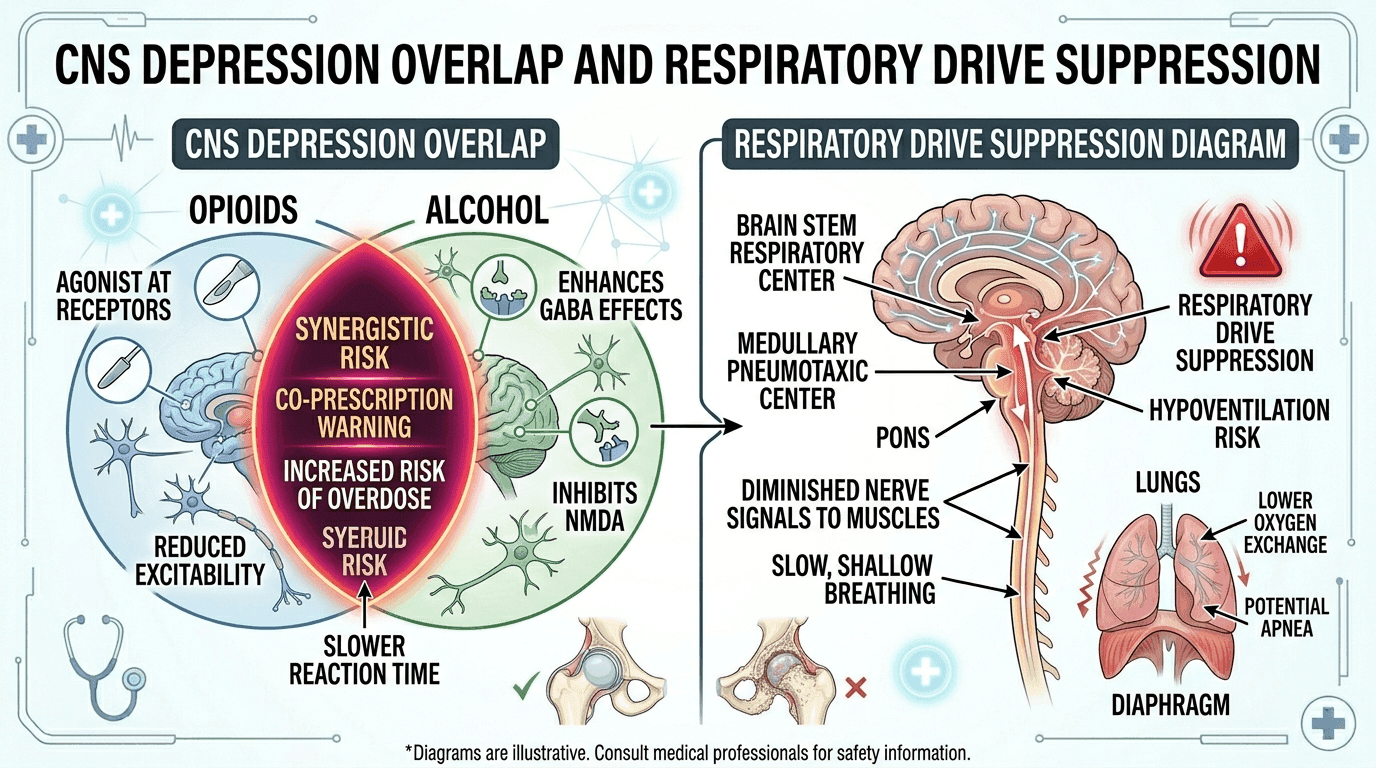
Both opioids (oxycodone, hydrocodone, tramadol) and alcohol are central nervous system depressants. When taken together, their sedative effects do not simply add — they multiply. The combination suppresses the brainstem's respiratory drive, which is the automatic signal telling the body to keep breathing. The result can be respiratory depression: breathing slows, oxygen drops, and in severe cases the person does not survive without emergency intervention. The FDA has issued explicit black-box warnings on all opioid prescriptions regarding this interaction.
Hip replacement patients are almost universally discharged with a short-course opioid prescription for acute pain management. Even as the dose tapers down in the second or third week, the risk does not disappear until the last dose has cleared the system. For most patients, this opioid window closes somewhere between weeks two and four post-surgery — but the timing varies by individual prescription, pain level, and tolerance.
The rule here is unambiguous: no alcohol while any opioid or narcotic pain medication is being taken, regardless of the dose or how well recovery appears to be going.
The Hidden Danger: Blood Thinners After Hip Replacement
After opioids, the second and most commonly overlooked pharmacological barrier is anticoagulant therapy. Nearly every hip replacement patient in the United States is discharged on a blood thinner, and most are not told clearly how seriously alcohol interacts with these medications.
Hip replacement surgery carries a high risk of deep vein thrombosis (DVT) because the operation directly disrupts venous blood flow in the lower extremity. Standard post-operative anticoagulation protocols for hip replacement patients typically run 35 days, with Rivaroxaban (Xarelto) and Apixaban (Eliquis) being the most commonly prescribed agents. Some patients are placed on Warfarin instead, particularly those with prior clotting histories or specific cardiac indications.
DVT Risk Window After Hip Replacement
The peak window for DVT formation is the first two to ten days post-surgery, but elevated risk persists for up to 90 days, according to guidance from the American Academy of Orthopaedic Surgeons. During this period, the anticoagulant is doing critical work, keeping blood viscosity in a therapeutic range that prevents clot formation without causing uncontrolled bleeding.
Alcohol disrupts this balance in multiple ways. With Xarelto and Eliquis, alcohol increases bleeding risk by adding its own blood-thinning effect to an already anticoagulated system. With Warfarin, the interaction is particularly unpredictable: alcohol destabilizes the INR (International Normalized Ratio), the measure used to monitor how thin the blood actually is. Even moderate drinking can push INR into dangerous territory, either too high (bleeding risk) or too low (clot risk) depending on the pattern of consumption.
Alcohol is also a diuretic. Dehydration thickens the blood, which directly counteracts the anticoagulant and raises DVT risk at exactly the window when that risk is already elevated. Staying well hydrated is one of the most practical DVT-prevention strategies during hip replacement recovery, and alcohol works against it.
How Alcohol Affects Bone Healing and Implant Fixation
A risk that receives almost no coverage in standard patient education is the effect of alcohol on osseointegration — the process by which bone grows into and around the metal implant to secure it permanently.
Modern hip implants are designed with porous surfaces that encourage bone tissue to infiltrate and lock the prosthesis in place. This process is biologically active and highly dependent on osteoblast function, the cells responsible for building new bone. Research published in peer-reviewed bone metabolism literature, including a study indexed in PubMed, shows that chronic or heavy alcohol consumption suppresses osteoblast activity and impairs bone mineral density. The most critical period for implant fixation is the first 6 to 12 weeks post-surgery. Significant alcohol intake during this window can compromise the quality of bone ingrowth and, over the long term, affect how securely the implant is anchored.
This is especially relevant for patients with a history of heavy drinking, who may already have reduced bone density entering surgery.
The Physical Risk: Balance and Catastrophic Falls
Even setting medication interactions aside, the biomechanical reality of early hip replacement recovery makes alcohol genuinely dangerous on purely physical grounds.
A new hip joint is surrounded by muscles and soft tissues that have been cut, repositioned, and sutured. For the first several weeks, walking requires deliberate concentration, careful weight distribution, and a finely tuned sense of balance that the body is actively relearning. Physical therapy sessions during this period are structured specifically to retrain gait mechanics and rebuild the muscular support around the implant.
Even a mild amount of alcohol is enough to blunt proprioception — the body's sense of where its limbs are in space — and slow reaction time. A momentary misstep on a threshold, a loose rug, or an uneven sidewalk can result in a fall. In the context of hip replacement recovery, a fall is not a minor event. Depending on the timing and force of impact, it can cause femur fracture around the implant stem, or hip dislocation, a complication that typically requires emergency reduction under sedation and in severe cases a return to the operating room.
The fall risk argument for avoiding alcohol does not disappear at the six-week mark. It attenuates progressively as muscular strength and balance return, which is why surgeon-assessed walking ability without assistive devices is one of the practical readiness criteria covered later in this guide.
Alcohol, Swelling, and Wound Healing
Hip replacement involves a substantial surgical incision with deep tissue disruption through muscle layers, the joint capsule, and periosteal structures. The healing of that wound depends on a well-functioning immune response, adequate microvascular circulation to the repair site, and controlled inflammation.
Alcohol impairs all three mechanisms. It causes systemic vasodilation, which worsens post-operative edema — the "log leg" swelling many hip replacement patients describe in their operated limb during the first two to three weeks. Research reviewed in PMC on perioperative alcohol use and wound outcomes shows that alcohol suppresses neutrophil and macrophage function, the immune cells responsible for clearing surgical debris and preventing early infection. Compromised immunity at the incision site raises the risk of superficial and deep wound infection, including the most feared orthopedic complication: periprosthetic joint infection (PJI), which can require explantation of the implant.
Even if the incision looks clean from the outside, deep tissue healing lags behind surface closure by several weeks. Alcohol's immune-suppressing effect is relevant throughout the early recovery window, not just while stitches or staples are visible.
The Dehydration and Blood Clot Connection
The relationship between alcohol, dehydration, and DVT risk deserves its own section because patients often think of these as separate concerns when they are directly linked.
Alcohol is a diuretic because it inhibits antidiuretic hormone (ADH), causing the kidneys to excrete more fluid than is being consumed. This diuretic effect persists even with moderate drinking. In a post-surgical patient who is already dealing with reduced mobility, fluid shifts from tissue edema, and the hemodynamic effects of anesthesia, the additional fluid loss from alcohol creates a state of relative dehydration that directly increases blood viscosity.
Thicker, more viscous blood is precisely the environment in which DVT formation becomes more likely, particularly in the deep veins of the operated leg, where blood flow is already sluggish due to reduced mobility and post-surgical venous trauma. Institutional patient education resources including those from Memorial Sloan Kettering Cancer Center consistently emphasize high fluid intake during recovery as an active DVT-prevention strategy, not merely a general wellness suggestion.
Drinking alcohol during the first six weeks of recovery actively undermines this strategy.
Tylenol, NSAIDs, and the Liver
Patients who have successfully tapered off opioids often assume the path is now clear for a drink. But many are still managing residual pain with acetaminophen (Tylenol) or nonsteroidal anti-inflammatory drugs (NSAIDs) like ibuprofen, and both create their own interactions with alcohol.
Acetaminophen is metabolized by the liver using the same enzymatic pathway that processes alcohol. When both are present, the liver produces elevated levels of a toxic metabolite called NAPQI. At high enough concentrations, NAPQI causes direct hepatocyte damage. The FDA guidelines specify that people consuming three or more alcoholic drinks per day should not take acetaminophen without consulting a doctor. Post-operative patients are often taking doses at the higher end of the daily limit to manage pain, a scenario where even moderate drinking creates meaningful liver stress.
NSAIDs carry a separate concern: both ibuprofen and naproxen irritate the gastric mucosa, and alcohol compounds this effect, increasing the risk of gastrointestinal bleeding and stomach lining erosion.
The transition away from opioids does not automatically mean alcohol is safe. A complete medication review, confirming zero reliance on prescription or over-the-counter analgesics, is part of the readiness assessment before considering reintroduction of alcohol.
The Green Light: When Is It Finally Safe?
A realistic, safe horizon for most hip replacement patients is somewhere between weeks 6 and 8, assuming a straightforward recovery. But "most patients" is not "all patients," and the calendar alone is not the clearance mechanism. The following five criteria are a practical readiness framework worth running through at or before the first post-operative follow-up appointment.
Full anticoagulant course complete. The blood thinner protocol must be entirely finished, not just close to the end, but the last dose taken and cleared. For standard hip replacement patients on Xarelto, this means day 35 has passed.
No opioids or narcotic pain medication remaining. The last opioid dose should be several days in the past, allowing sufficient clearance time. Transitional use of tramadol still counts.
Off all high-dose acetaminophen and NSAIDs. If pain is being managed without any medication, or only with very occasional, low-dose analgesics, the liver and GI interactions no longer apply.
Walking independently without a walker or cane, with good balance. This is the physical safety criterion. If assistive devices are still needed, the fall risk has not sufficiently resolved.
Explicit surgeon clearance at the follow-up visit. The surgeon reviewing range of motion, wound status, and imaging is the appropriate person to confirm that the recovery is on track. If the six-week appointment has not yet occurred, that appointment comes first.
If a patient can check all five boxes, a moderate, occasional drink — particularly wine or beer at low quantities — is unlikely to pose significant risk for most people. If any criterion is not met, the appropriate response is to wait until it is.
If any lingering symptoms or unexpected changes come up before that appointment, connecting with a care provider virtually is a practical option. Patients can see a doctor online through Momentary to discuss medication interactions, recovery concerns, or whether their timeline aligns with what their surgeon outlined.
What Happens If You Drink Too Soon: Specific Risks
Generic warnings about "complications" are not particularly useful. Here is what the specific risks actually look like in practice.
Drinking while on opioids creates the risk of respiratory depression, where breathing slows to a dangerous level, potentially without the patient recognizing what is happening. This can occur even with a single drink combined with a moderate opioid dose.
Drinking while on Xarelto or Eliquis amplifies bleeding risk in a system where surgical sites, including internal soft tissue and bone surfaces, have not fully consolidated. Internal bleeding around the implant is a serious complication that may not present obvious external symptoms until it becomes severe.
Drinking while on Warfarin destabilizes INR unpredictably, creating a window where clot risk and bleeding risk can alternate within the same treatment period, both in dangerous directions.
Dehydration from alcohol during the DVT risk window thickens blood in exactly the venous environment most prone to clot formation post-operatively.
Falls from alcohol-impaired balance during the physical therapy phase can cause implant dislocation or periprosthetic fracture, both of which are surgical emergencies requiring urgent care.
Alcohol's immune suppression during active wound healing raises infection risk at a time when the consequences of infection, particularly deep periprosthetic infection, are severe and difficult to treat.
Special Considerations for Heavy or Regular Drinkers
Patients with a history of regular or heavy alcohol use face a distinct set of concerns that are largely absent from standard post-operative patient education, and that deserve direct attention.
Acute alcohol withdrawal is a recognized in-hospital complication for patients who drink heavily and stop abruptly around the time of surgery. Withdrawal symptoms can include tremors, elevated blood pressure, confusion, and in severe cases, seizures. Any patient who drinks regularly should be honest with their surgical team before the procedure so that appropriate protocols can be put in place. This is a clinical safety issue, not a judgment.
Research published in PubMed on perioperative alcohol reduction has documented the benefit of reducing or stopping alcohol use in the weeks before elective surgery, including reductions in post-operative complication rates. This preparation window matters, and surgical teams are well-positioned to support it without judgment when patients are forthcoming.
Chronic alcohol consumption also reduces bone mineral density over time, which affects both how well the implant integrates initially and how resilient the bone around it remains over years of use. Patients with a heavy drinking history who are concerned about long-term implant durability have a legitimate medical reason to discuss alcohol reduction with their care team beyond the immediate recovery period.
What to Drink Instead During Hip Replacement Recovery
Recovery from hip replacement is physically demanding work. Nutrition and hydration during this period are not passive — they actively support outcomes.
Water is the single most important fluid during recovery. High fluid intake reduces DVT risk, supports kidney clearance of medications, and helps manage the constipation that is a common side effect of opioid pain medication.
Tart cherry juice has been studied for its anti-inflammatory properties and is a reasonable addition for patients looking for something flavorful with potential benefit. Bone broth provides collagen precursors and trace minerals that support connective tissue repair. Protein-rich smoothies or shakes help offset the muscle loss that occurs during periods of reduced activity and support the soft tissue healing around the implant.
Caffeinated beverages in moderate amounts are generally well-tolerated but should not displace water intake, particularly given the dehydration risk context throughout the recovery period.
Frequently Asked Questions
How long after a hip replacement can you drink alcohol?
For most patients following a standard recovery course, the realistic window is between 5 and 8 weeks post-surgery. The key thresholds are completion of the anticoagulant course (typically 35 days for hip replacement), cessation of all opioid and narcotic pain medication, adequate balance and independent walking ability, and explicit surgeon clearance at the follow-up appointment. Patients who experience complications, extended opioid use, or delayed healing may need to wait longer. The calendar week matters less than whether each of these criteria is met.
What alcohol is safest to drink after surgery?
There is no type of alcohol that is inherently safer during the active recovery window — the risks apply to the ethanol content regardless of whether it comes from wine, beer, or spirits. Once surgeon clearance has been given, moderate amounts of lower-alcohol beverages (wine, standard beer) are generally less likely to cause the acute dehydration or blood-sugar disruption associated with high-proof spirits. But the category of drink is far less important than the timing and quantity.
What happens if you accidentally have a drink during recovery?
A single drink in isolation is unlikely to cause a catastrophic event for most patients, but the risk profile depends entirely on which medications are currently active. Drinking while on opioids, Warfarin, or Xarelto carries real pharmacological risk even from one drink. If a patient has had a drink during recovery and is concerned, the appropriate step is to contact their surgeon or care team to report it, describe any symptoms, and confirm whether any monitoring is warranted.
Will one glass of wine affect wound healing?
A single glass of wine will not catastrophically halt wound healing in an otherwise healthy patient, but it will temporarily suppress some of the immune activity involved in tissue repair and cause a degree of vasodilation that may worsen local swelling. The cumulative effect matters more than any single exposure. The concern about wound healing is most relevant in the first three to four weeks when the incision is consolidating, and again if any signs of infection or delayed healing are already present.
Does moderate drinking affect hip replacement outcomes long-term?
Research has examined this question with nuanced findings. A large registry study on hip arthroplasty patients found that heavy drinking was associated with worse outcomes, while the effects of moderate consumption showed less consistency. A separate PubMed study has contributed to this body of evidence. The more clearly established concern is that chronic alcohol use suppresses bone metabolism and reduces bone mineral density, which can affect how well implant fixation holds over years of use. Moderate drinking after full recovery, with surgeon knowledge and approval, is unlikely to be a significant independent risk factor for most patients, but individual circumstances matter and a surgeon's guidance applies.
If there is uncertainty about symptoms, medication interactions, or where a particular recovery stands relative to these guidelines, using Momentary's AI health navigator is a practical starting point for understanding what questions to bring to the surgical team.
References
-
American Academy of Orthopaedic Surgeons — Activities After Hip Replacement — Cited for DVT risk window, standard post-operative protocol guidance, and activity recommendations.
-
FDA — Black Box Warning on Opioids and CNS Depressants — Cited for respiratory depression risk from combining opioid medication with alcohol.
-
PMC — Perioperative Alcohol Use and Surgical Complications — Cited for immune suppression and wound healing impairment from alcohol; review of perioperative alcohol outcomes.
-
Memorial Sloan Kettering Cancer Center — Hip Replacement Patient Education — Cited for hydration recommendations as DVT prevention strategy during recovery.
-
FDA — Acetaminophen and Alcohol — Cited for liver interaction risk between acetaminophen and alcohol.
-
PubMed — Alcohol and Bone Metabolism / Osteoblast Suppression — Cited for alcohol's effect on osteoblast activity and bone mineral density during implant fixation window.
-
PubMed — Perioperative Alcohol Reduction (ASPIRE Trial Reference) — Cited for perioperative alcohol reduction and post-operative complication rate data.
-
PubMed — Alcohol Use and Arthroplasty Outcomes — Cited for long-term hip replacement outcome data in relation to alcohol consumption patterns.