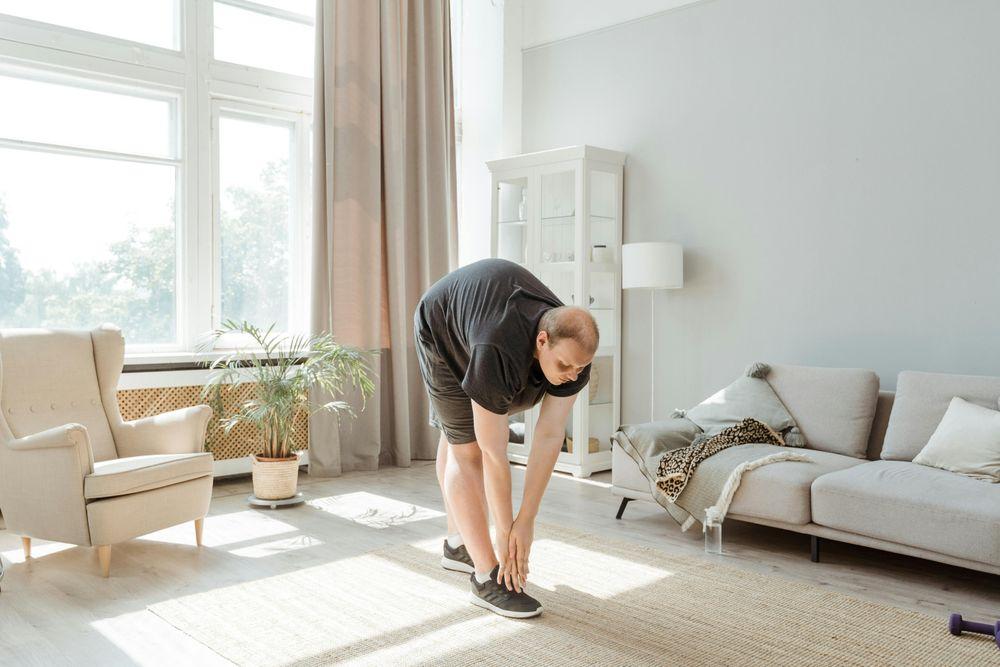


Hip replacement patients consistently ask the same question in their first week home: how long after hip replacement surgery can I bend down? The honest answer is that the timeline is not universal. It depends on which surgical approach the surgeon used, and getting that distinction wrong is one of the most common reasons for early joint dislocation.
At a Glance
| Topic | Key Facts |
|---|---|
| Primary keyword | How long after hip replacement surgery can I bend down |
| Surgery types | Anterior (front) vs. posterior (back) approach |
| Posterior bending restriction | No bending past 90 degrees for 6 to 12 weeks |
| Anterior bending restriction | Often none, or significantly reduced |
| 90-degree rule | Hip angle must stay at or wider than a right angle |
| Most common dislocation cause | Bending to pick up dropped items |
| Safe bending technique | Golfer's reach method |
| Essential tools | Grabber, sock aid, long-handled shoehorn, raised toilet seat |
The Short Answer: It Depends on Your Surgery Type
The 6 to 12-week window is the most commonly cited guideline, but it applies specifically to patients who had a posterior hip replacement. Patients who had an anterior (front) approach often face far fewer restrictions and in many cases none at all. Most online resources skip this distinction entirely, which is why so many patients receive conflicting information.
Understanding which approach your surgeon used is the single most important variable in answering this question for your specific situation.
Anterior Hip Replacement: Few or No Bending Restrictions
In an anterior approach, the surgeon accesses the hip joint from the front of the body. Because this technique does not cut through or detach the muscles and tendons at the back of the hip, the posterior capsule (the tissue that holds the ball in the socket from behind) stays intact. That intact capsule means bending forward does not carry the same dislocation risk.
Many surgeons who perform anterior hip replacements impose no formal bending precautions. Others may recommend a brief period of caution for the first two to four weeks while soft tissue swelling resolves. Always confirm directly with your surgeon what restrictions, if any, apply to your case.
Posterior Hip Replacement: The 6 to 12-Week Rule
In a posterior approach, the surgeon enters the hip from the back. The posterior capsule is disrupted during this process, and until it heals, the new ball-and-socket joint is vulnerable to dislocation if the hip is flexed past a specific angle.
According to AAOS OrthoInfo, hip precautions after posterior surgery typically last six weeks at minimum, and many surgeons extend them to 12 weeks depending on the patient's anatomy and how well the capsule was repaired. Some capsular repair techniques introduced in recent years may shorten this window, but that is a conversation to have explicitly with your surgical team.
The 90-Degree Rule Explained
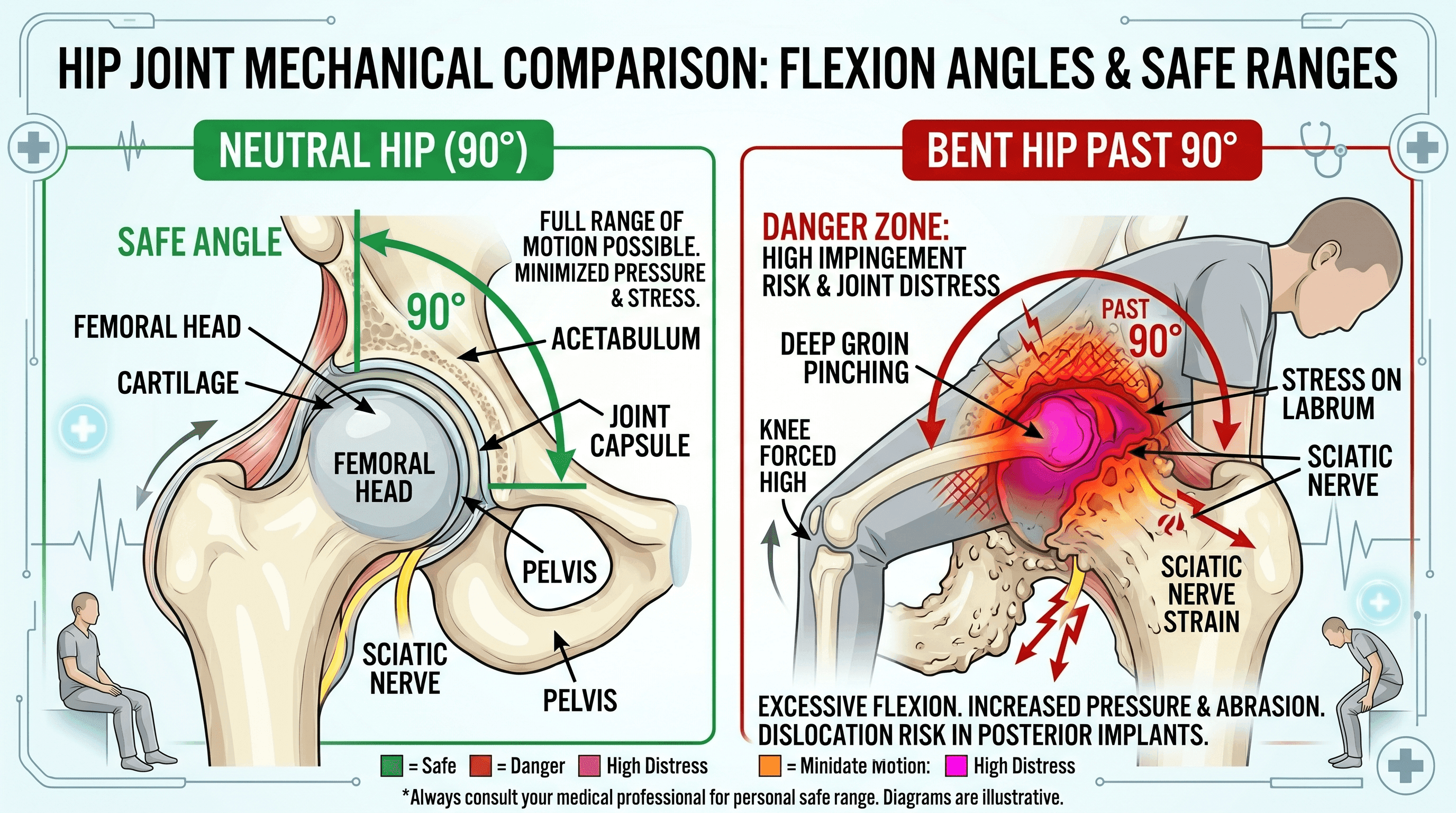
The "90-degree rule" is the most referenced hip precaution, but very few sources explain what it physically means in daily life.
Ninety degrees is a right angle. When applied to your hip, it means the angle between your torso and your thigh must stay at 90 degrees or wider at all times. Bending forward past that point, or bringing your knee higher than your hip while seated, closes that angle and puts stress on the posterior capsule. When the capsule has not yet healed, that stress can pop the titanium ball out of the socket.
In practical terms: if you are seated and your knee rises above the level of your hip, you have likely violated the 90-degree limit. If you lean forward from a chair to pick something off the floor, you have violated it. The rule governs both sitting and reaching simultaneously.
Posterior vs. Anterior: Why the Approach Changes Everything
A comparison table makes this clearer for anyone who is weighing approaches or confirming what restrictions apply after surgery.
| Anterior Approach | Posterior Approach | |
|---|---|---|
| Entry point | Front of the hip | Back of the hip |
| Posterior capsule | Preserved | Disrupted |
| 90-degree rule applies | Rarely or not at all | Yes, strictly |
| Typical restriction period | Little to none | 6 to 12 weeks |
| Most common daily limitation | Minimal | Cannot tie shoes, pick up items, sit low |
According to research published in PMC, the anterior approach is associated with fewer dislocation events in the early postoperative period, which aligns with the clinical rationale for reduced precautions in that patient group.
The Danger Zone: Tying Shoes and Picking Up Dropped Items
Two everyday tasks cause the most anxiety for post-op patients, and for good reason. Reaching down to tie shoes and grabbing a dropped item from the floor both involve bending the hip toward or past 90 degrees, sometimes before the patient realizes it is happening.
Bending to retrieve a dropped TV remote is one of the most commonly cited causes of early dislocation in posterior hip replacement patients. The reach is reflexive. The floor seems close. And the hip angle moves before there is any time to think about it.
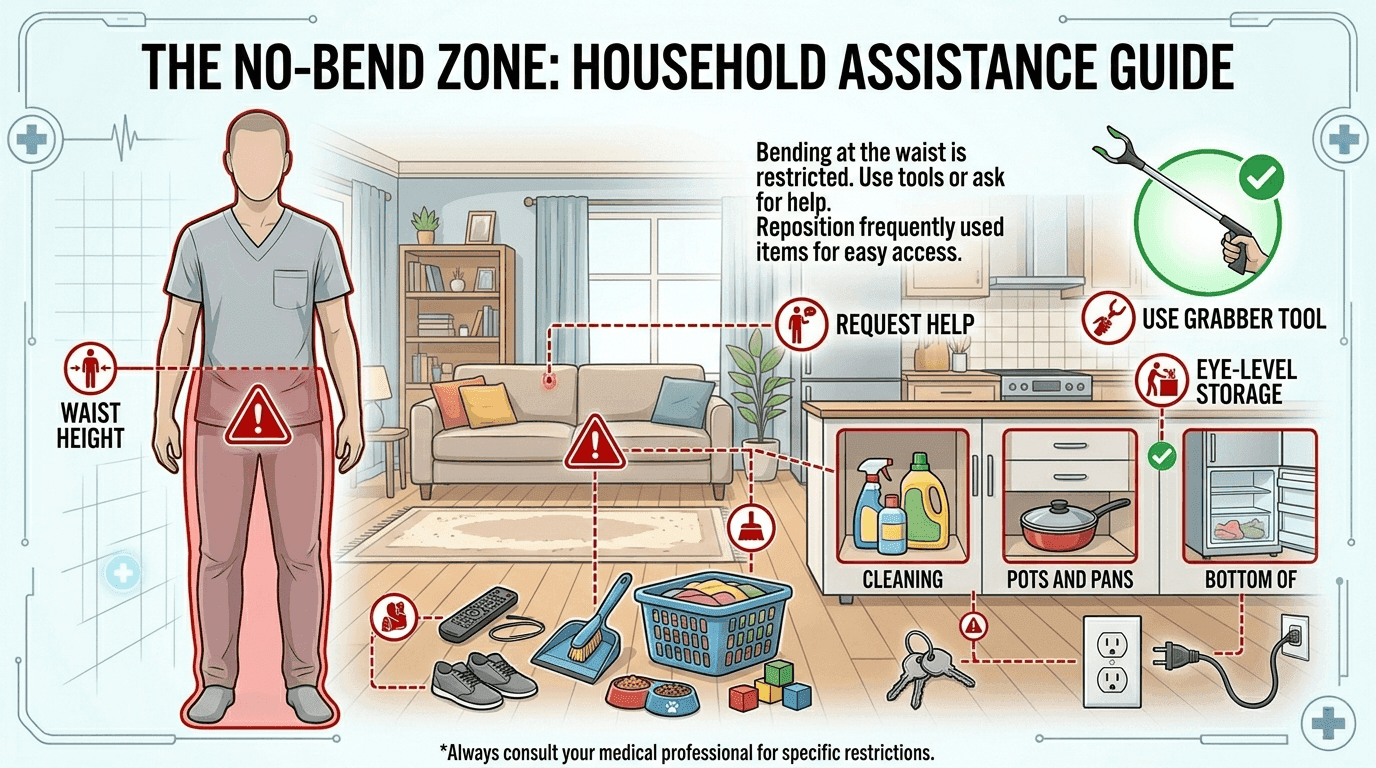
The practical reality for the first 6 to 12 weeks is this: anything below waist height is off-limits without assistive devices or a safe technique. That includes shoes, socks, anything dropped on the floor, items in low cabinets, and pets that want a greeting.
Your Survival Toolkit: Grabbers and Sock Aids
The right assistive devices turn a frustrating restriction period into a manageable one. The items below make up what occupational therapists typically call a "hip kit," and having them set up before the patient comes home from the hospital makes the first week significantly easier.
A long-handled reacher or grabber (32 inches or longer) is the single most important item. It substitutes for any bending motion and can retrieve most dropped items, pull on pants, and manage light objects from floor level without any hip flexion.
A rigid sock aid allows socks to be put on without leaning forward. The patient loads the sock onto a plastic or foam shell, drops it to the floor by a cord, and slides the foot in while keeping the torso upright.
An extended shoehorn (18 inches or longer) is paired with slip-on shoes or shoes with elastic laces. Together they eliminate the need to bend toward the foot entirely.
A raised toilet seat (3 to 4 inches above the standard seat height) keeps the hip above the knee while using the toilet, which is otherwise one of the most reliable ways to violate the 90-degree rule without meaning to.
A tub transfer bench allows bathing without stepping over a tub wall and without sitting at a depth that forces the hip into dangerous flexion. Grab bars installed near the toilet and shower add stability during the early weeks when balance is affected by pain and medication.
The Golfer's Reach: How to Safely Bend When You Have To
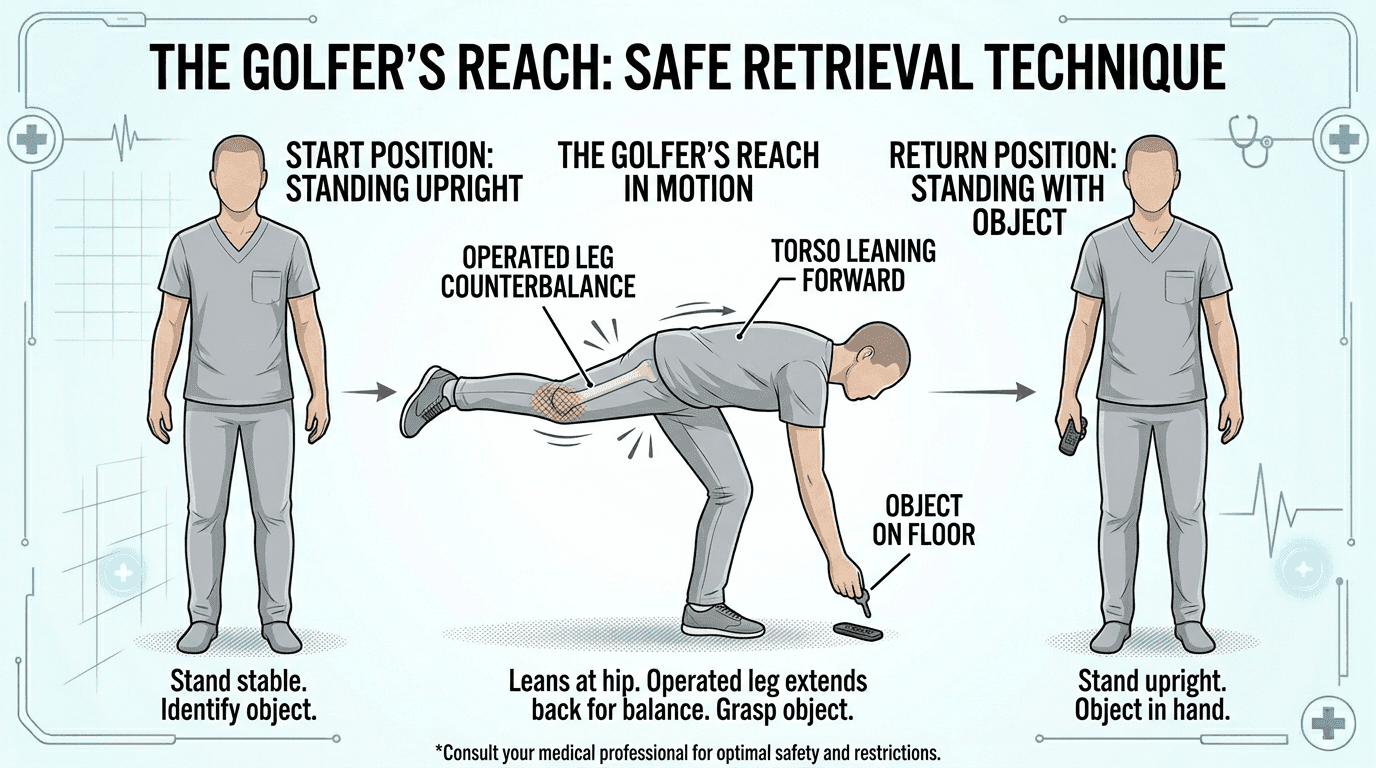
Even with a full hip kit, there are moments when a patient needs to reach lower than waist height without any device. The golfer's reach (also called the golfer's lift) is the technique physical therapists teach for exactly this situation.
Here is how it works, step by step:
Stand near the object to be picked up, on the non-operated side. Plant the non-operated leg firmly and shift weight onto it. Simultaneously lean the torso forward and extend the operated leg straight behind the body as a counterbalance. The torso and operated leg form a single straight line, like a golfer finishing a putt, and the hip remains open rather than flexing. Reach down with the arm closest to the object, retrieve it, and return to standing by bringing the operated leg forward while raising the torso.
The key mechanical point is that the operated hip never closes past 90 degrees during this movement because the extended leg behind the body keeps the angle open. This is safe to practice once a physical therapist has cleared the patient for standing activities, which typically happens by the end of the first week.
The Toilet Trap: A Hidden Bending Hazard
Standard toilet seats sit at roughly 14 to 16 inches from the floor. For a tall adult, this means the knee ends up above the hip when seated, which violates the 90-degree rule immediately. Many patients who navigate the first week carefully still catch themselves on a standard toilet or low sofa without realizing the position they are in.
Raised toilet seats that add 3 to 4 inches correct this. So does choosing seating that keeps the hips above knee height at all times. Firm chairs with arms are safer than soft sofas or recliners during the restriction phase. Deep bucket seats in cars pose the same risk, which is why car transfers should be practiced with an occupational or physical therapist before discharge.
The NHS guidance on recovering from hip replacement also advises patients to raise the height of chairs and use a firm cushion to maintain safe seating position during early recovery.
Week-by-Week Bending Timeline After Posterior Hip Replacement
The following timeline reflects general clinical patterns for posterior approach patients. Individual surgeon instructions always take precedence, and no milestone should be assumed without explicit sign-off at the appropriate follow-up appointment.
Weeks 1 and 2: Hospital and Early Home Recovery
No bending past 60 to 70 degrees is the working limit during this phase. A walker is required for mobility. Every floor-level task must be managed with assistive devices or the golfer's reach. The hip kit must be fully deployed from day one. Wound care, swelling management, and inflammation control take priority alongside early gentle exercises.
Weeks 3 to 6: Early Home Independence
The 90-degree limit is maintained strictly. The walker may begin transitioning to a cane for outdoor use, as directed by the physical therapist. Desk work is typically possible. Physical therapy exercises begin in earnest. Tying shoes by bending down remains prohibited. The ankle-over-knee method for putting on shoes is not appropriate until at minimum week 6, and only after surgeon confirmation.
Weeks 6 to 12: Active Recovery and Surgeon Clearance
The six-week follow-up appointment is the first formal checkpoint for restrictions. Do not assume any precaution has been lifted without explicit surgeon sign-off at this visit. Range of motion expands gradually under physical therapy guidance. Many posterior patients remain under the 90-degree restriction until the 12-week mark, particularly those with larger BMI, reduced bone density, or more complex surgical histories.
After 12 Weeks: Approaching Full Movement
Most posterior hip replacement patients reach full bending clearance around the 12-week mark, as directed by their surgeon. This typically includes picking up objects from the floor, floor-level household tasks, and tying shoes. However, individual factors including implant head size, the quality of capsular repair, age, and physical therapy progress can shift this window earlier or later.
If you are approaching the midpoint of your recovery and have questions about what you should and should not be doing, connecting with a virtual primary care provider is a practical way to get clinical input between in-person appointments.
What If You Accidentally Bent Too Far?
This happens. A patient reaches for something reflexively, or lowers onto a seat that turns out to be lower than expected, and immediately realizes the hip went past 90 degrees. The anxiety that follows is predictable and understandable.
For a minor precaution violation with no symptoms, the appropriate response is to monitor, avoid repeating the motion, and resume normal activity. A single overreach is unlikely to cause dislocation in most cases. Report it at the next appointment.
Watch for dislocation warning signs: a sudden severe pain that does not resolve, an audible pop or click at the hip, a leg that appears visibly shorter or rotated outward compared to the other leg, or an inability to bear any weight. These are emergency signals. Go to an emergency department immediately if any of these occur. Do not wait for a callback from the surgeon's office.
Are Hip Precautions Still Necessary? What the Latest Evidence Says
This is where the conversation is evolving, and where patients deserve an honest account of what the research actually shows.
A December 2024 meta-analysis published in the journal Medicine examined 1,215 patients and found no statistically significant difference in dislocation rates between patients who followed formal hip precautions and those who did not, in the context of modern implant and surgical technique standards. A July 2024 study using the Danish Hip Register found similar results in patients receiving 36mm implant heads, which are now far more common than the smaller heads used in earlier research. A scoping review published in SAGE Journals in April 2025 drew comparable conclusions.
The takeaway is not that precautions are unnecessary. It is that the evidence base behind the traditional 6 to 12-week restriction is being actively re-examined as surgical techniques, implant sizes, and capsular repair methods have improved. Some surgeons are already modifying their precaution protocols in response. Others are not.
This is a conversation to have directly with the surgeon who performed the procedure. Ask: "Given my implant size and approach, do the current precautions still apply to me?" That question is now clinically appropriate.
Factors That Affect a Personal Bending Timeline
The timeline provided in this article reflects general clinical patterns, not a fixed schedule. Several individual variables can shift the window significantly.
Surgical approach is the primary variable, as covered above. Implant head size matters as well. Larger femoral heads (36mm and above) provide greater joint stability and a wider range of motion before dislocation risk increases. This is partly why the newer research on precautions is focused on modern implants specifically.
Capsular repair quality is another factor that varies by surgeon technique. Some approaches include a structured repair of the posterior capsule that restores stability earlier. Patient age and BMI both affect soft tissue healing rates and joint loading. Bone density influences how the implant integrates with the surrounding structure. And physical therapy attendance and progress directly affects how quickly functional strength and balance return, which supports safe movement at every stage.
For these reasons, a neighbor who had the same surgery but returned to full activity at eight weeks is not a valid benchmark for any individual's recovery.
Frequently Asked Questions
What three things should be avoided after hip replacement surgery?
For posterior approach patients during the restriction phase, the three most important avoidances are bending the hip past 90 degrees (including forward leaning from a chair), crossing the operated leg over the other leg, and rotating the foot of the operated leg inward. These three movements consistently represent the highest dislocation risk during the recovery period, according to AAOS OrthoInfo guidance on hip replacement activity.
When can I sit on a normal chair after hip replacement?
For posterior approach patients, standard-height chairs are generally avoided during the restriction phase because they allow the hip to drop below the knee. Most patients can safely return to normal chairs once the surgeon confirms clearance, typically around the six-week mark for uncomplicated recoveries. Until then, firm chairs with arm support and a cushion to raise seat height are the safer choice. Always confirm the specific timeline with the treating surgeon.
When can I bend to put my socks on after hip replacement?
Bending forward to pull on socks is not safe during the restriction phase. A rigid sock aid allows socks to be put on without any hip flexion from week one onward. The ankle-over-knee method, where the foot is rested on the opposite knee to access it from the side, is generally permitted after week six for posterior approach patients, but requires explicit surgeon sign-off before attempting. Direct forward bending to the foot is typically cleared around the 10 to 12-week mark.
How long does it take for stiffness to go away after hip replacement?
Some stiffness is normal for the first three to six months as the surrounding tissue heals and muscle strength returns. According to research on hip replacement outcomes published in PMC, functional improvement continues well beyond the initial recovery phase, with many patients seeing gains up to 12 months post-surgery. Physical therapy attendance significantly affects how quickly stiffness resolves.
Can I sit in a low chair after hip replacement?
Not during the restriction phase if the posterior approach was used. A low chair drops the hips below knee height, which reliably pushes the hip past 90 degrees. Firm, raised seating with arm support is required until the surgeon provides formal clearance. After clearance, patients can gradually return to lower seating as comfort and stability allow.
How do I know if my hip has dislocated?
Dislocation typically presents as sudden severe pain at the hip that does not resolve, often accompanied by an audible pop or click at the moment of injury. The affected leg may appear visibly shorter than the other leg or rotated outward. Weight-bearing on the operated leg becomes impossible or extremely painful. These symptoms require immediate emergency evaluation. Do not attempt to resolve the situation at home.
If any of those symptoms are uncertain or if questions arise between appointments, Momentary's AI health navigator can help explore symptoms and guide the next appropriate step.
References
- AAOS OrthoInfo: Activities After Hip Replacement — Cited for hip precautions guidance, 90-degree rule, and restriction timelines.
- NHS: Recovering from a Hip Replacement — Cited for seating guidance and general recovery advice.
- PMC: Anterior vs. Posterior Hip Replacement Outcomes — Cited for comparison of dislocation rates by surgical approach.
- PMC: Hip Replacement Functional Outcomes — Cited for stiffness resolution timeline and functional recovery data.
- PMC: Hip Arthroplasty and Rehabilitation — Cited for physical therapy role in recovery.
- PMC: Hip Replacement Biomechanics and Precautions — Cited for biomechanical context around 90-degree precautions.