


Cycling after hip replacement surgery is not only possible — it is one of the most medically supported exercises a recovering patient can pursue. Surgeons and physical therapists routinely recommend it early in recovery because the pedaling motion loads the hip joint at a fraction of the force that walking, running, or climbing stairs does. But when it is safe to ride, and on which kind of bike, depends heavily on where in recovery a patient sits and what surgical approach was used.
This guide breaks down every phase of cycling recovery after hip replacement surgery — from the first stationary bike session to clipping back into road pedals — and translates clinical guidance into practical decisions for cyclists.
At a Glance
| Topic | Key Facts |
|---|---|
| Earliest stationary bike use | Week 2 post-op (with surgical clearance) |
| Initial technique | Half-pedal rotations before full revolutions |
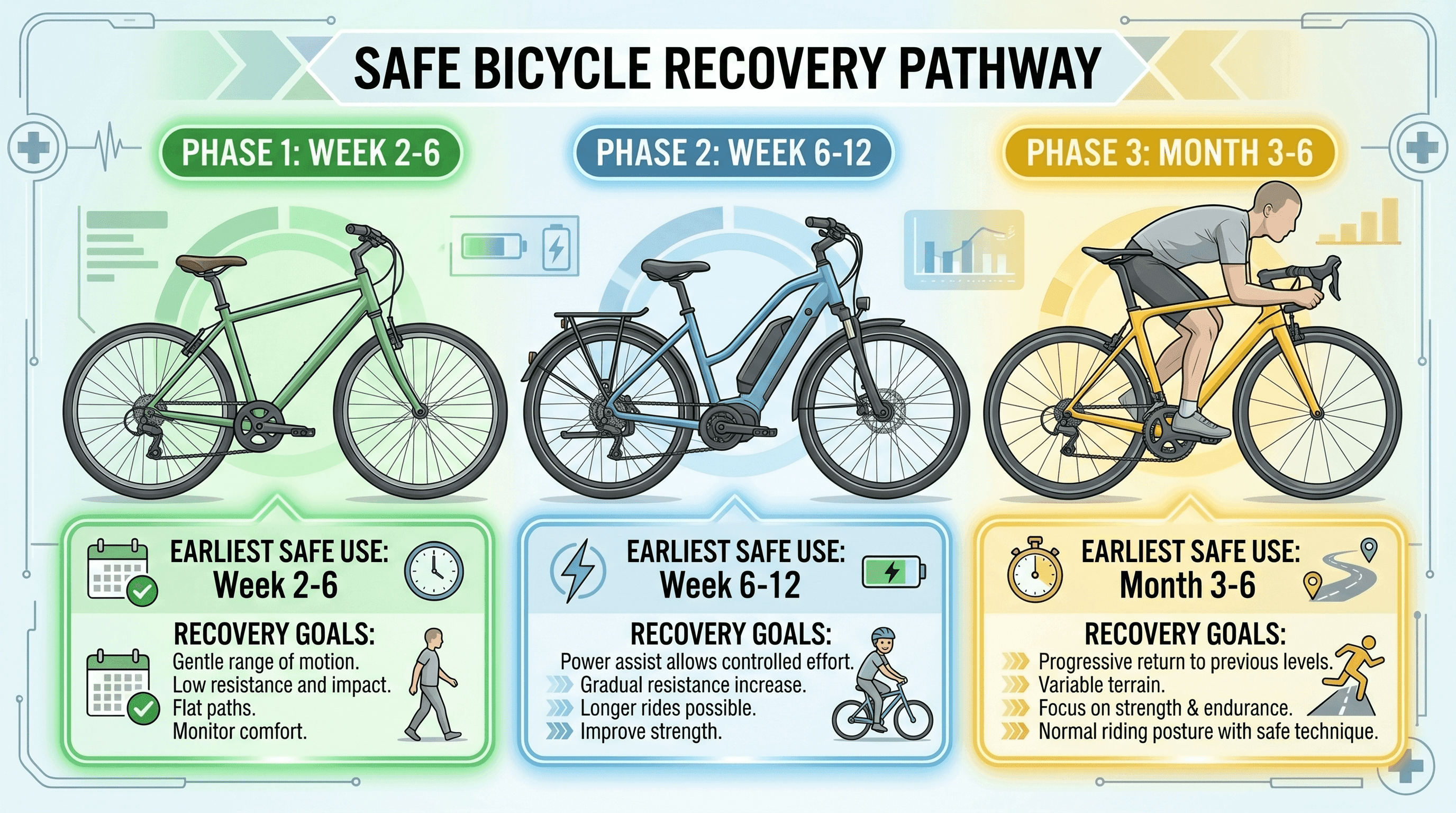
| Outdoor cycling clearance | Typically 8 to 12 weeks post-op |
| Seat height adjustment | Must be raised to prevent hip flexion beyond 90 degrees |
| Clipless pedals | Avoid until 12+ weeks; risk of rotational stress on the hip capsule |
| Spin classes (e.g., Peloton) | Permitted once fully cleared, generally 12 to 16 weeks |
| Mountain biking | Delayed longest due to fall risk and unpredictable terrain |
| Primary surgical approach impact | Posterior approach carries stricter early flexion and rotation restrictions |
Why Cycling Is One of the Best Things You Can Do After Hip Replacement
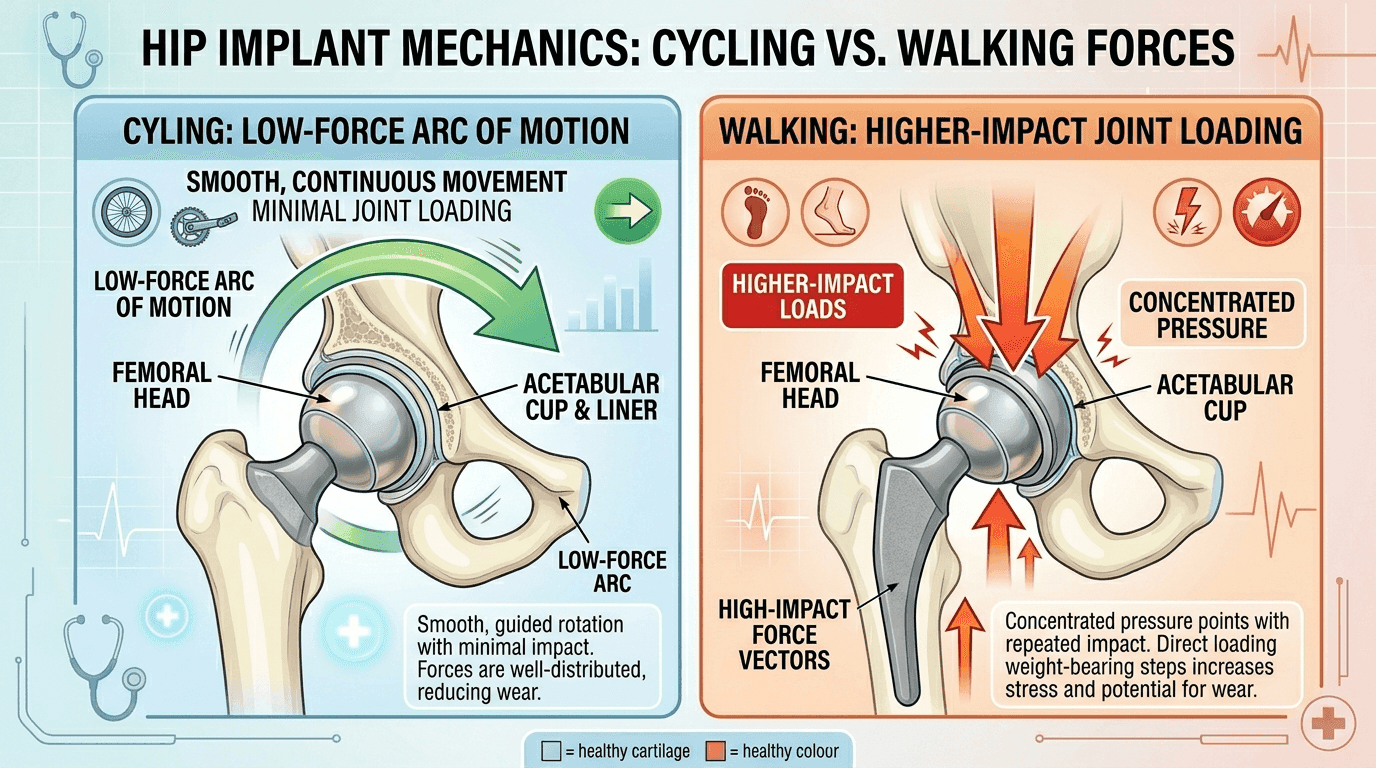
Cycling earns its reputation as a post-surgical gold standard because of what it does not do: it does not pound the hip joint. Hip joint contact force during cycling on a stationary ergometer ranges from roughly 0.5 to 1.4 times body weight, according to biomechanical research published in peer-reviewed literature. Compare that to walking, which generates forces between 2.9 and 4.7 times body weight, and the case for the bike becomes clear.
A landmark randomized controlled trial by Liebs et al., published in JAMA, found that patients who used an ergometer bicycle as part of their post-operative rehabilitation reported significantly better hip function scores on the WOMAC (Western Ontario and McMaster Universities Osteoarthritis Index) at both 3 months and 24 months compared to patients who did not. The research established cycling as a legitimate therapeutic intervention, not just a recreational indulgence for active patients.
The motion itself is what makes cycling so well-suited to hip recovery. The circular pedal stroke keeps the femoral head (the ball of the ball-and-socket joint) moving through a smooth, controlled arc without the shear forces and sudden loading spikes that characterize weight-bearing activities. Strong quadriceps and glutes — the muscles most taxed by cycling — are also the primary stabilizers of a newly implanted hip, so building them early accelerates functional recovery.
What the Research Says About Cycling and Implant Wear
The most common anxiety among active patients is not the pain or the recovery timeline. It is whether consistent cycling will wear out the implant. Modern total hip replacements use highly cross-linked polyethylene (XLPE) bearing surfaces that demonstrate dramatically reduced wear rates compared to earlier generations of implants.
Finite element modeling (FEM) research, including a study published in the Journal of Orthopaedic Research, assessed wear patterns in hip implants under cyclical mechanical loading conditions representative of sustained athletic activity. The data consistently shows that XLPE implants are engineered to withstand decades of active use, with modern designs performing well even in patients engaged in regular low-impact sport.
Wear is not a reason to avoid cycling after total hip arthroplasty. High-impact, high-torsion activities carry more concern than steady-state pedaling.
Anterior vs. Posterior Approach — What It Means for Getting Back on the Bike
The surgical approach used to perform a hip replacement determines which muscles were divided or retracted during the procedure and, critically, which movements carry dislocation risk in the early weeks. For cyclists, this distinction directly shapes the first 12 weeks of recovery.
Anterior approach: The surgeon accesses the hip from the front of the body, working between muscle groups rather than cutting through them. This approach typically involves fewer restrictions on hip extension and external rotation but limits deep hip flexion in the early weeks. Most patients cleared for stationary cycling sooner, and return to an upright bike geometry is generally faster.
Posterior approach: The surgeon accesses the hip from the back of the body. This approach requires the greatest caution around three movements in the early post-operative period: hip flexion beyond 90 degrees, internal rotation, and adduction (crossing the leg past midline). These restrictions are sometimes called posterior hip precautions. Cyclists need to take these seriously because they affect saddle setup, clip-in mechanics, and body position on the bike.
Hip Precautions Translated for Cyclists
| Movement | Posterior Approach | Anterior Approach |
|---|---|---|
| Hip flexion beyond 90 degrees | Restricted weeks 0 to 6 — seat must be raised | Generally less restricted; confirm with surgeon |
| Internal rotation of the leg | Restricted weeks 0 to 12 — affects clip-out mechanics | Lower restriction; still avoid aggressive rotation |
| Forward lean on the bike | Limit drop bars or aggressive cockpit setup until 8 to 12 weeks | Can progress forward position sooner |
| Out-of-saddle efforts | Avoid weeks 0 to 8; introduces rotational and extension forces | Earlier clearance possible, discuss with surgeon |
| Mounting and dismounting | Step-through or low-standover bikes preferred early | Same recommendation applies |
These restrictions ease progressively as the soft tissue around the hip joint heals and the risk of dislocation diminishes. By 12 weeks for most posterior approach patients, and sometimes earlier for anterior, the restrictions are largely lifted.
Phase 1 — The Stationary Bike (Weeks 2 to 6)
Physical therapists introduce the stationary bike earlier in hip replacement recovery than most patients expect, and earlier than almost any other cardiovascular exercise. The typical window for the first supervised session is week two post-operation, contingent on surgical clearance and individual healing progress.
The first goal is not cardiovascular fitness. It is joint mobility.
Patients begin with a technique called half-pedal rotations: rather than completing full circles, the pedal is rocked forward and backward through a short arc. This motion moves the femoral head gently through its range of motion, reduces stiffness, and builds confidence in the joint before any real resistance is applied. Most patients can progress to full revolutions by the end of week three or week four. The AAOS total hip replacement exercise guide outlines the general progression framework that physical therapists follow.
Sessions at this stage are short, typically 10 to 15 minutes, and resistance is kept at zero. Cadence is the only variable — a smooth 60 to 70 rpm is sufficient to achieve the therapeutic benefit.
Seat Height Is the Most Important Setup Variable
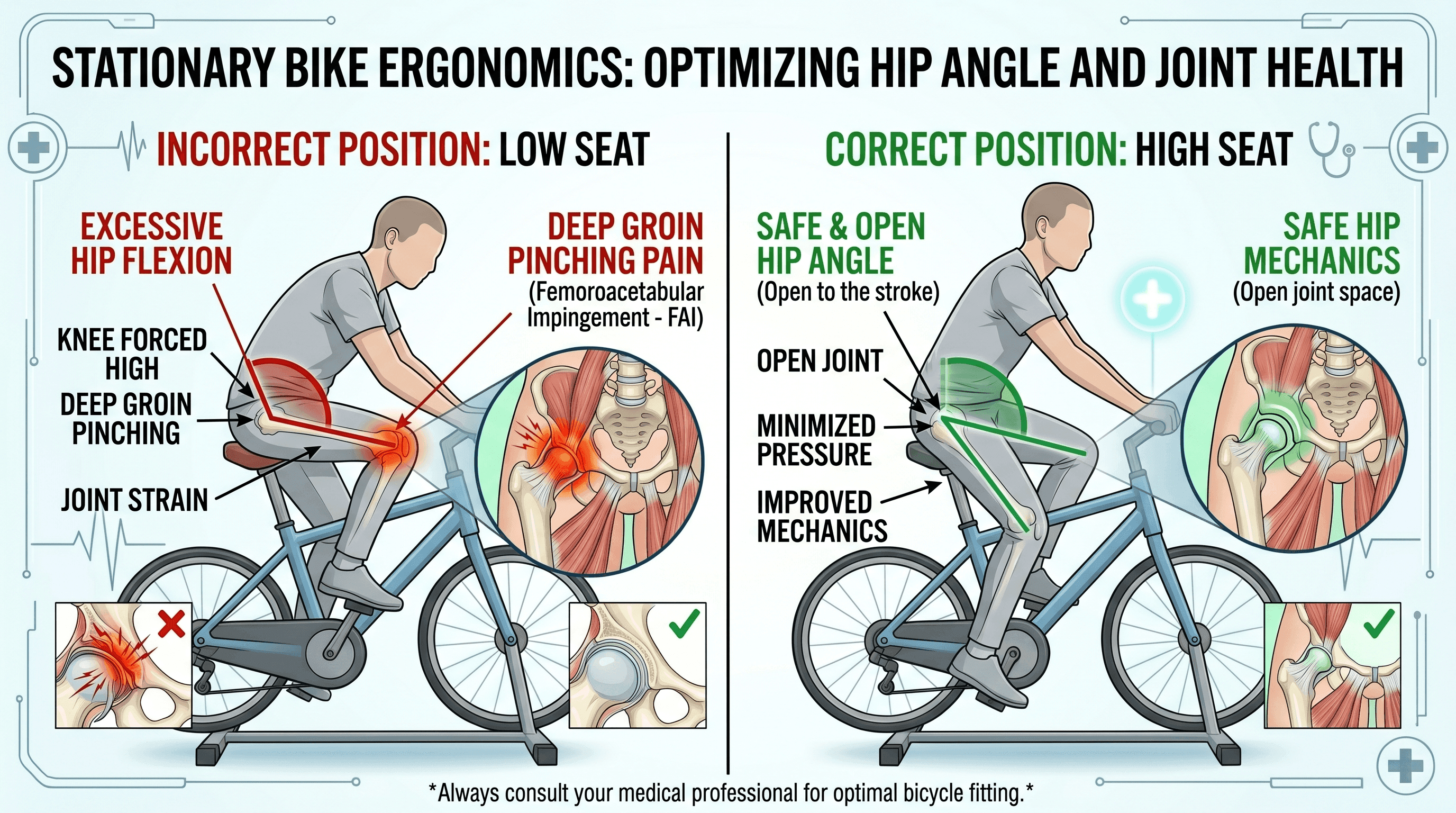
The single most consequential mechanical adjustment for a recovering hip patient on a stationary bike is seat height, and most patients and gym staff set it too low.
When the seat is positioned at the height appropriate for a healthy person, the knee rises well above the hip crease at the top of each pedal stroke. For a patient with posterior hip precautions, this means the hip is flexing beyond 90 degrees on every single revolution, which is precisely the position they were told to avoid. The solution is to raise the seat significantly above the standard position so that at the top of the pedal stroke, the thigh remains below parallel and the hip angle stays comfortable.
A physical therapist or rehabilitation specialist can set this correctly at the first session. The seat height will be gradually lowered back toward normal over the following weeks as the restriction on hip flexion eases.
Upright vs. Recumbent Bikes — Choosing the Right Machine
The choice between an upright stationary bike and a recumbent bike is more nuanced than most recovery guides acknowledge. Both are valid, and the right choice depends on the patient's specific surgical approach, balance confidence, and physical therapy goals.
Upright stationary bikes are the preferred starting point for most patients. The upright position requires active core engagement and places the hip in a more extended, anatomically natural position throughout the stroke. This promotes hip flexor lengthening and glute activation, which are both priorities in early rehabilitation. An upright bike also more closely mimics outdoor cycling mechanics, which smooths the eventual transition to the road.
Recumbent bikes — where the rider sits back in a supported chair-like seat with feet extended forward — reduce balance demands almost entirely. For patients who are not yet confident in their core stability, are managing dizziness from medications, or who had complications that slow mobility, a recumbent bike is a safer entry point. The tradeoff is that the more reclined position can increase hip flexion angle at the front of the stroke, so seat position still needs careful setting.
The upright format is generally recommended once the patient can sit and stand safely without assistive devices. The recumbent format buys additional time for those who need it, without sacrificing the joint mobility benefits of early pedaling.
Phase 2 — Returning to Outdoor Cycling (Months 2 to 3)
The delay between stationary cycling clearance and outdoor cycling clearance has nothing to do with the hip joint's ability to handle pedaling. It has everything to do with falls.
A fall onto a freshly replaced hip is a surgical emergency. The femur around the implant stem is vulnerable to fracture in the first months after surgery as bone integration with the implant consolidates. A sudden loss of balance, an unexpected curb, a patch of gravel, or a moment of bike instability could result in a periprosthetic fracture requiring another operation. This is why outdoor cycling clearance typically comes later than stationary clearance, usually between 8 and 12 weeks, and only when the patient demonstrates stable gait and balance on foot.
When outdoor cycling is cleared, the first rides should be deliberately low-stakes. Flat terrain, minimal traffic, short distance (20 to 30 minutes maximum), and calm conditions are the appropriate setting. Hills are specifically problematic because climbing forces out-of-saddle effort and descent increases speed unpredictably. Neither belongs in the first month of outdoor riding.
If there is any uncertainty about readiness or you want to talk through your recovery progress with a clinician before getting back on the road, connecting with a primary care provider through Momentary's virtual care service is a convenient way to review your rehab timeline without needing an in-person appointment.
Road Bikes vs. Flat-Bar Hybrids vs. E-Bikes — Which Should You Ride First?
Not every bicycle is equally appropriate during hip replacement recovery, and the geometry of the frame matters as much as the rider's fitness level.
Drop-handlebar road bikes force the rider into a forward-leaning aerodynamic position. This position significantly increases the angle of hip flexion and compresses the anterior hip capsule on every pedal stroke. For anterior approach patients, this may be tolerable earlier. For posterior approach patients, the forward lean introduces risk of impingement and violates posterior precautions. Road bikes with aggressive cockpit setups should be considered a later-stage return, not a first ride.
Flat-bar hybrids and upright-geometry bikes place the rider in a more neutral, upright position. Hip flexion angle is reduced, core demand is manageable, and balance is easier to maintain. These are the appropriate first bikes for outdoor riding during recovery.
E-bikes are an underappreciated recovery tool. The motor assist reduces the muscular demand on the recovering hip and leg, eliminates the pressure of maintaining momentum on inclines, and effectively removes the incentive to push through fatigue or discomfort. Research published in BMC Musculoskeletal Disorders has investigated physical activity and joint loading in patients using assisted cycling, and the lower-intensity profile of e-bikes maps well to early outdoor rehabilitation. An e-bike allows patients to cover meaningful distance and rebuild cardiovascular fitness without overloading the healing joint.
Mountain bikes should be the last category of bike considered. Unpredictable terrain, unavoidable jolts and impacts, sudden dismounts, and the technical demands of trail riding all create fall risk and joint stress that is inappropriate for at least six months post-operatively, and sometimes longer depending on the surgeon's assessment.
The Clipless Pedal Problem — When and How to Return to Cleats
For serious cyclists, the question of clipless pedals is not an afterthought. It is a central concern. The mechanics of clipping out require a quick, outward twisting motion of the heel, which produces internal rotation and abduction of the hip. In the early weeks after hip replacement, particularly following a posterior approach, this is precisely the movement most likely to stress the hip capsule and, in rare cases, contribute to instability.
The recommendation from most orthopedic surgeons and physical therapists is to ride on flat platform pedals for the first 12 weeks post-operatively, and to only return to clipless pedals once hip precautions have been formally lifted and the motion of clipping out can be performed smoothly without sharp rotation.
When returning to clipless pedals, cleat float is worth particular attention. Float refers to the degree of rotational freedom the cleat allows before it disengages from the pedal. Higher float (6 degrees or more) reduces the rotational stress on the hip during the clip-out motion. Many cyclists use zero-float cleats for efficiency and pedaling precision, but during hip replacement recovery, a more forgiving cleat is the appropriate choice.
The process of clipping in — placing the foot into the pedal — is generally less problematic than clipping out, which involves the sudden twisting motion. Practicing the unclipping motion while stationary, over the trainer or while holding a wall, is a sensible step before attempting it in traffic.
Smart Trainers and Indoor Cycling Platforms — A Word for Serious Cyclists
Indoor training platforms such as Wahoo KICKR, Tacx, and Zwift have become integral to many cyclists' year-round training. They are also exceptionally well-suited to hip replacement recovery, for reasons that extend beyond simple stationary cycling.
A smart trainer accepts the patient's own bicycle, which means bike fit is preserved from the start. The rider's saddle height, cleat position, and handlebar setup are already optimized for their body, removing the guesswork of adjusting a gym stationary bike. Resistance is programmable and tightly controlled, so wattage caps (early rehabilitation typically works below 150W) can be enforced without relying on perceived exertion alone.
Cadence is one of the most important variables during smart trainer recovery sessions. Targeting 80 to 90 revolutions per minute reduces the muscular effort required per pedal stroke (which is governed by torque demand), keeps joint forces low, and promotes smooth motor patterns. Beginners often default to lower cadences because it feels more manageable, but high cadence at low resistance is the therapeutic goal.
Zwift and similar platforms introduce social elements and structured workouts that help with motivation during what can be a long and psychologically frustrating recovery period. The ability to ride without traffic, stops, or terrain unpredictability makes the smart trainer the safest transition between stationary rehab cycling and full outdoor riding.
Mountain Biking and Spin Classes — Setting Realistic Limits
Controlled indoor cycling classes — including Peloton and similar instructor-led formats — are generally suitable once a surgeon has issued full clearance from hip precautions, which often occurs between 12 and 16 weeks post-operation. The key word is controlled. The bike is fixed, the terrain is flat, cadence is adjustable, and there is no fall risk beyond dismounting the stationary platform.
Standing sprints and aggressive out-of-saddle climbing efforts in spin class should be approached cautiously even after full clearance, because these efforts introduce more rotational stress and muscular demand than steady seated pedaling. Discussing the specific demands of spin class with a physical therapist before returning is worthwhile, particularly if the class includes intervals with high resistance.
Mountain biking occupies a different category entirely. Trail riding involves unpredictable terrain, sudden braking, technical dismounts, drops, roots, rocks, and a near-constant demand for rapid positional adjustment. These conditions are incompatible with the early and mid-stage recovery of a hip replacement. Falls are not occasional; they are a predictable part of trail riding. The risk of a periprosthetic fracture in the first six to twelve months post-surgery makes this an activity to delay significantly, and some surgeons counsel patients to permanently avoid extreme technical trails.
Recreational gravel riding, which is a middle ground between road cycling and true mountain biking, can be revisited at the six-month mark for most patients with good surgical outcomes, with the surgeon's clearance.
Pre-Surgery Cycling — Training Before Your Hip Replacement
The condition a patient is in on the day of surgery strongly predicts recovery speed, and cycling is one of the most effective ways to build that condition. Surgeons increasingly refer to this as "prehabilitation."
Strong quadriceps and hip abductors reduce the work that the replaced joint must do in the first weeks of recovery. Patients who enter surgery with well-developed leg muscles tend to progress faster through physical therapy, achieve independence in walking sooner, and report better functional outcomes at the six-month mark. Cycling provides an efficient, low-impact way to build these muscle groups without aggravating the arthritic hip that necessitated the replacement.
Pre-surgery cycling should be moderate in intensity. The goal is muscle development and cardiovascular conditioning, not personal records. If the existing hip pain limits range of motion or causes distress during outdoor rides, a stationary bike or trainer allows controlled effort without the complications of traffic or terrain. Session duration of 30 to 45 minutes at a conversational pace, three to four times per week, is a reasonable pre-operative target for most patients.
Pairing cycling with hip abductor exercises (such as clamshells and side-lying leg raises) and glute bridges builds the specific muscular support that the replaced joint will rely on during rehabilitation.
Long-Term Cycling After Hip Replacement — What Is Realistically Possible
The aspirational close of a hip replacement recovery story is often more encouraging than patients expect. According to research cited in PMC, return-to-sport rates after total hip arthroplasty are high among patients who were active before surgery, and cycling specifically is among the most commonly approved activities.
Road cycling, gravel riding, and sustained distance rides are realistic goals for most patients by the six to twelve month mark, with consistent rehabilitation and medical clearance. Masters-level competitive cyclists have returned to training and racing after hip replacement. Long-distance gravel events and endurance sportives are within reach for motivated, medically cleared patients.
The permanent modification for most patients is high-fall-risk activities: aggressive mountain biking on technical trails, cyclocross involving repeated dismounts, and activities that combine cycling with jumping or high-velocity terrain changes. Modern implants are designed for active lifestyles, not sedentary ones. Avoiding cycling entirely out of anxiety about implant wear is not supported by the evidence and trades a recoverable short-term risk for a definite long-term decline in fitness and joint function.
FAQ
How long after hip replacement surgery can you ride a bicycle?
Most patients are introduced to a stationary bike as early as two weeks post-surgery, under physical therapy guidance, beginning with gentle half-pedal rotations before progressing to full revolutions. Outdoor cycling clearance typically follows at eight to twelve weeks, depending on surgical approach, individual healing progress, and surgeon assessment. Mountain biking and technical trail riding are generally delayed for six months or longer.
Is cycling or walking better after hip replacement?
Both are beneficial and are typically incorporated at different points in recovery. Walking begins almost immediately post-surgery and rebuilds basic functional mobility. Cycling follows shortly after as a low-impact way to build strength and cardiovascular fitness. From a joint loading perspective, cycling applies considerably less force to the hip than walking does, making it particularly useful in the weeks when the hip is still healing and walking distances are limited.
What is the most important exercise after hip replacement surgery?
Physical therapy protocols after hip replacement generally prioritize hip abductor strengthening, quadriceps activation, and hip extensor work as the foundational exercises. The AAOS exercise guide for total hip replacement recovery outlines the standard progressive program. Stationary cycling fits into this framework as an early cardiovascular and mobility exercise, while walking and functional strengthening form the core of land-based rehabilitation.
Is cycling hard on the hip joint?
Cycling is one of the gentlest activities for the hip joint relative to most everyday movements. The contact forces generated during stationary cycling are a fraction of those produced by walking, stair climbing, or running. Research supports cycling as a low-wear, low-impact activity compatible with total hip arthroplasty, including for patients who ride regularly over long distances. The key caveat is that setup matters: seat height, cleat float, and handlebar position all influence how the hip moves through each pedal stroke.
Can I use my own road bike on a smart trainer after hip replacement?
Yes, and this is often the best option for serious cyclists. Using a personal bicycle on an indoor smart trainer preserves an optimized bike fit from the beginning of recovery, allows precise control of resistance and wattage, and eliminates the fall risk of outdoor riding during the early return-to-cycling phase. Sessions should begin with low resistance and high cadence (80 to 90 rpm) to minimize joint loading.
When can I clip back into clipless pedals after hip replacement?
Most surgeons and physical therapists recommend flat platform pedals for the first twelve weeks after surgery. Clipless pedals require an outward heel-twist to disengage, which produces rotation at the hip and stresses the healing capsule. Returning to cleats should only occur after hip precautions are formally lifted and the unclip motion can be performed smoothly without sharp or forced rotation. Higher cleat float (6 degrees or more) is recommended when returning.
Not sure whether your recovery timeline is on track? Using Momentary's AI health navigator to explore your symptoms or understand your next steps is a fast, accessible way to get personalized guidance before your next orthopedic visit.
References
- Liebs TR, et al. — JAMA, 2010 — Randomized controlled trial demonstrating superior WOMAC hip function outcomes in patients using ergometer cycling post total hip arthroplasty at 3 and 24 months.
- Toh et al. — Journal of Orthopaedic Research, 2023 — Finite element modeling study assessing wear in hip implants under cyclical loading conditions representative of athletic activity.
- American Academy of Orthopaedic Surgeons — Total Hip Replacement Exercise Guide — Standard post-operative exercise protocol for total hip replacement patients, cited for rehabilitation framework.
- BMC Musculoskeletal Disorders, 2023 — Research on physical activity and joint loading in patients using assisted cycling; referenced in context of e-bike suitability for post-surgical recovery.
- PMC — Return to Sport After Total Hip Arthroplasty — Evidence review of return-to-sport outcomes after total hip arthroplasty, supporting long-term activity prognosis for active patients.