


At a Glance
| Topic | Key Facts |
|---|---|
| Minimum wait time | 4 to 6 weeks for most patients |
| Primary hard barrier | Prescription opioid or narcotic use |
| Surgery type matters | Anatomic TSA patients often clear earlier than reverse TSA patients |
| Arm dominance matters | Dominant-arm surgery carries a longer restriction |
| Transmission matters | Manual transmission requires additional recovery time |
| Legal risk | Driving on opioids may constitute a DUI in most US states |
| First step back | Surgeon clearance at the 4-to-6-week follow-up appointment |
The question most patients ask the moment they come out of recovery is some version of: When can I drive again? The short answer is that most people wait 4 to 6 weeks. But that number does not mean much on its own, because the real timeline depends on at least three things the one-liner leaves out: what type of surgery was performed, which arm was operated on, and whether prescription pain medications are still being taken. This guide breaks down each of those variables so the answer stops being generic and starts being useful.
The Short Answer and Why It Is Not That Simple
Most shoulder replacement patients cannot safely or legally drive for roughly 4 to 6 weeks after surgery. MedlinePlus, a resource of the National Institutes of Health, confirms that patients will "probably not be able to drive for at least 4 to 6 weeks after surgery" and must not drive while taking narcotic medications.
That window is a reasonable starting estimate, but it is not a finish line. Three variables can shift the timeline forward or backward in ways that matter a great deal:
Surgery type. Anatomic total shoulder arthroplasty (aTSA), which replaces the joint while preserving a functioning rotator cuff, tends to produce earlier return-to-driving readiness than reverse total shoulder arthroplasty (rTSA), a procedure designed for patients whose rotator cuff is severely torn or nonfunctional. The mechanics of each surgery create genuinely different rehabilitation arcs.
Which arm was operated on. The dominant arm is more involved in steering, emergency corrections, and general vehicle control. Surgery on the dominant arm requires a longer restriction than the same procedure on the non-dominant side.
Medication status. This is non-negotiable. No patient should drive while taking prescription opioids, muscle relaxants, or sedating medications, regardless of how physically capable they feel. That point gets its own section below because it is the most commonly underestimated factor.
The Absolute Barrier: Narcotic Pain Medication
Before any physical readiness question is even worth asking, medication status must be resolved. Prescription opioids such as oxycodone and hydrocodone impair reaction time, judgment, depth perception, and the ability to perform emergency maneuvers. In most US states, driving while under the influence of prescription narcotics is legally treated the same as driving under the influence of alcohol.
This is not a gray area. MedlinePlus is explicit: patients "should not drive when taking narcotics."
Beyond the legal exposure, the cognitive impairment caused by opioids is real even when a patient does not feel impaired. The absence of a perceived buzz does not mean reaction time has returned to baseline. Most surgeons advise patients to be off all opioid medications for a minimum of 24 to 48 hours before attempting to drive, and some will request longer clearance periods depending on the medication and dose used during recovery.
If there is any doubt about whether a medication affects driving ability, the prescribing surgeon or pharmacist can clarify before a patient gets behind the wheel.
The Sling Rule: Why One-Arm Driving Is a Bad Idea
Many patients think they have found a workaround: the operated arm is in a sling, but the other arm is fine, so why not just drive using the good arm? This reasoning is understandable and also quite dangerous.
MedlinePlus notes that slings are typically worn for the first 2 to 6 weeks after shoulder replacement, and that patients should avoid "sudden jerking movements" during this phase. Safe driving requires exactly those movements. A child stepping off a curb, a car merging without signaling, or a dog running into the road all demand a bilateral, immediate steering response that a single arm simply cannot execute reliably.
Beyond the physical limitation, liability exposure is real. If a patient drives in a sling before receiving medical clearance and is involved in an accident, auto insurers may dispute or deny the claim on the grounds that the patient was driving against medical advice. Operating a vehicle in a restricted medical device is not the same legal territory as operating it with full physical function.
The sling is on for a reason. The timeline for driving mirrors the timeline for sling removal, and not by coincidence.
The Physical Requirement: Evasive Maneuvers
The question of whether a patient is physically ready to drive is not really about cruising down an open highway. Highway driving is low-demand. The question is whether the shoulder can perform an evasive maneuver, which is the single most physically demanding thing a driver does.
Evasive maneuvers require sudden, forceful bilateral rotation of the steering wheel. They engage the shoulder through its full available range of motion, under load, in less than a second. A shoulder that handles gentle daily movements without pain may still fail this test entirely.
Research published in the Journal of Shoulder and Elbow Surgery using a driving simulator found that collision rates nearly doubled at the 6-week mark for patients who had undergone dominant-arm shoulder surgery, compared to controls. Statistically significant improvement was observed at the 12-week mark, making that milestone the gold standard for confirmed driving safety in the research literature. Simulator-based studies like this one provide the most rigorous data available on return-to-driving readiness after shoulder arthroplasty, because they measure actual driving performance rather than self-reported confidence.
Physically, the shoulder needs to be able to do three things before driving is genuinely safe: hold the arm at steering wheel height without pain, generate enough rotational force to execute an emergency turn, and maintain that capacity repeatedly without fatigue.
Anatomic vs. Reverse Total Shoulder Replacement: Does Surgery Type Change the Timeline?
This is the most under-discussed variable in most patient education resources, and it makes a meaningful difference.
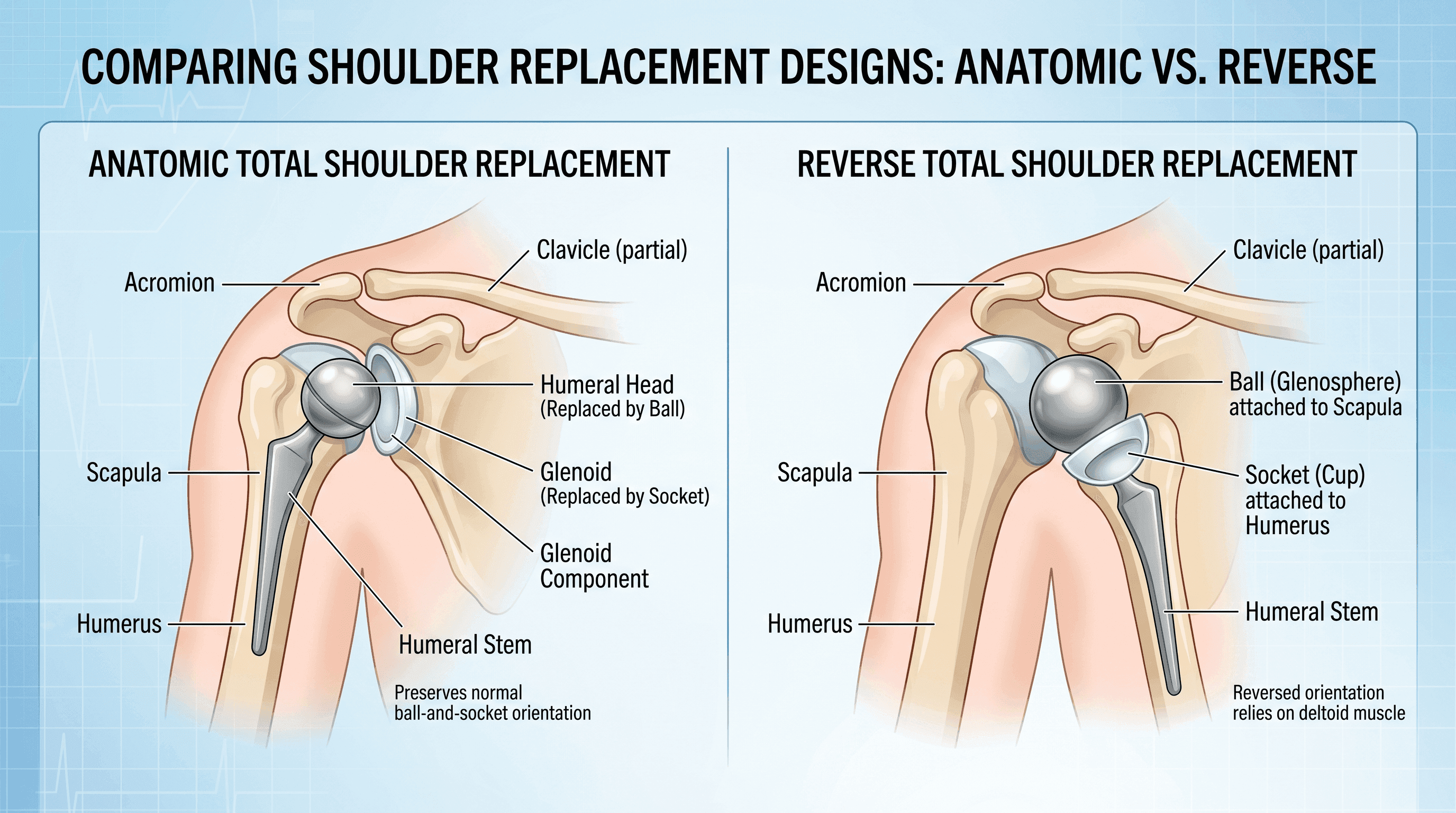
Anatomic total shoulder arthroplasty (aTSA) replaces the humeral head and glenoid socket while working with an intact rotator cuff. Because the rotator cuff is preserved, rehabilitation can often begin earlier, and patients tend to regain functional range of motion sooner.
Reverse total shoulder arthroplasty (rTSA) flips the anatomy deliberately: the ball is placed on the shoulder blade side and the socket on the humerus. This configuration offloads function from the damaged rotator cuff to the deltoid muscle. Recovery follows a different arc. Physical therapy for rTSA patients often begins in earnest around 6 weeks post-surgery rather than immediately, which aligns with a longer driving restriction for most patients.
A 2023 study published in the Journal of Shoulder and Elbow Surgery found that aTSA patients returned to driving sooner than rTSA patients, and that additional factors including sex, age, BMI, and narcotic use all independently influenced the timing. The data showed that approximately 34% of aTSA patients returned to driving within 2 weeks, compared to roughly 20% of rTSA patients. Those early returners were predominantly younger, had non-dominant arm surgery, and had already stopped narcotic use.
As a rough guide: aTSA patients who have favorable individual factors may be cleared as early as 4 to 6 weeks, while rTSA patients should generally expect a 6 to 8-week minimum, with some requiring longer depending on rehabilitation progress.
Right vs. Left Arm: Does It Make a Difference?
Yes, and it is a bigger difference than most patients expect.
The dominant arm is more heavily involved in steering corrections, signal activation, and emergency responses. Simulator research found that dominant-arm shoulder surgery nearly doubles collision rates at 6 weeks compared to controls, while the same procedure on the non-dominant arm carries less risk because braking and primary steering control remain largely intact.
For right-handed patients who had right shoulder surgery, the timeline is typically longer than for those who had left shoulder surgery. The non-dominant arm recovery does not eliminate driving risk entirely, but the physical demand on that side during routine driving is substantially lower.
This variable should be discussed explicitly at the surgical follow-up appointment. Surgeons may apply different clearance criteria depending on which side was operated on, and that conversation is worth having directly rather than assuming a standard timeline applies.
Automatic vs. Manual Transmission: An Important Distinction
This distinction is almost never covered in standard post-surgical guidance, but it matters for a straightforward mechanical reason.
Manual transmission vehicles require the driver to shift gears throughout the drive, coordinate clutch engagement with the non-dominant foot and the gear-shifting hand, and hold the steering wheel with one hand during gear changes. For right-shoulder surgery patients, shifting a manual transmission requires reaching down and across with the operated arm. For left-shoulder surgery patients, the clutch coordination is less of a barrier but bracing the wheel during shifts still demands bilateral shoulder engagement.
Automatic transmission vehicles eliminate the gear-shifting demand entirely and reduce the need to brace or stabilize with the secondary hand. For patients recovering from shoulder replacement, automatic transmission is meaningfully less demanding and may allow an earlier return to driving for otherwise qualified patients.
If a patient drives a manual vehicle and is considering borrowing an automatic during recovery, that is a conversation worth having with the surgeon. It is one practical adaptation that can shorten the independence gap during recovery without compromising safety.
Your Self-Assessment Readiness Checklist
This checklist is designed to be used at home before a surgical follow-up appointment, not as a substitute for surgeon clearance but as a structured way to assess where recovery stands.
Physical Readiness
Can the operated arm be held at steering wheel height for 60 seconds without significant pain? Can the head be turned fully in both directions to check blind spots? Can the steering wheel be gripped firmly with both hands simultaneously? Can the braking foot press down with full force while the upper body remains stable? If any of these produce sharp pain, instability, or hesitation, driving readiness has not been reached.
Medication Clearance
Has the last opioid or narcotic medication been taken more than 24 to 48 hours ago? Are any currently prescribed medications labeled with a warning about operating heavy machinery? If either answer raises a concern, the prescribing surgeon or pharmacist should be consulted before driving.
Confidence and Reaction Time
Would a sudden lane change by another driver feel manageable right now? Does the shoulder feel stable under unexpected load, not just during gentle planned movements? Confidence is not arrogance here; it is a functional signal that the shoulder has recovered enough to respond to unscripted demands. If the honest answer is uncertainty, more recovery time is the right call.
If the checklist produces hesitations in any category, bringing those specific concerns to the surgical follow-up appointment allows the surgeon to address them directly rather than making a general clearance decision.
If symptoms have not resolved as expected or something feels off before the scheduled follow-up, connecting with a primary care provider through Momentary's virtual care platform is a practical way to get questions addressed without waiting.
Physical Therapy Milestones and Driving Readiness
Physical therapy progression provides another useful framework for gauging where a patient stands. These are approximate timelines; individual surgeons and therapists may vary the protocol based on the procedure type and patient response.
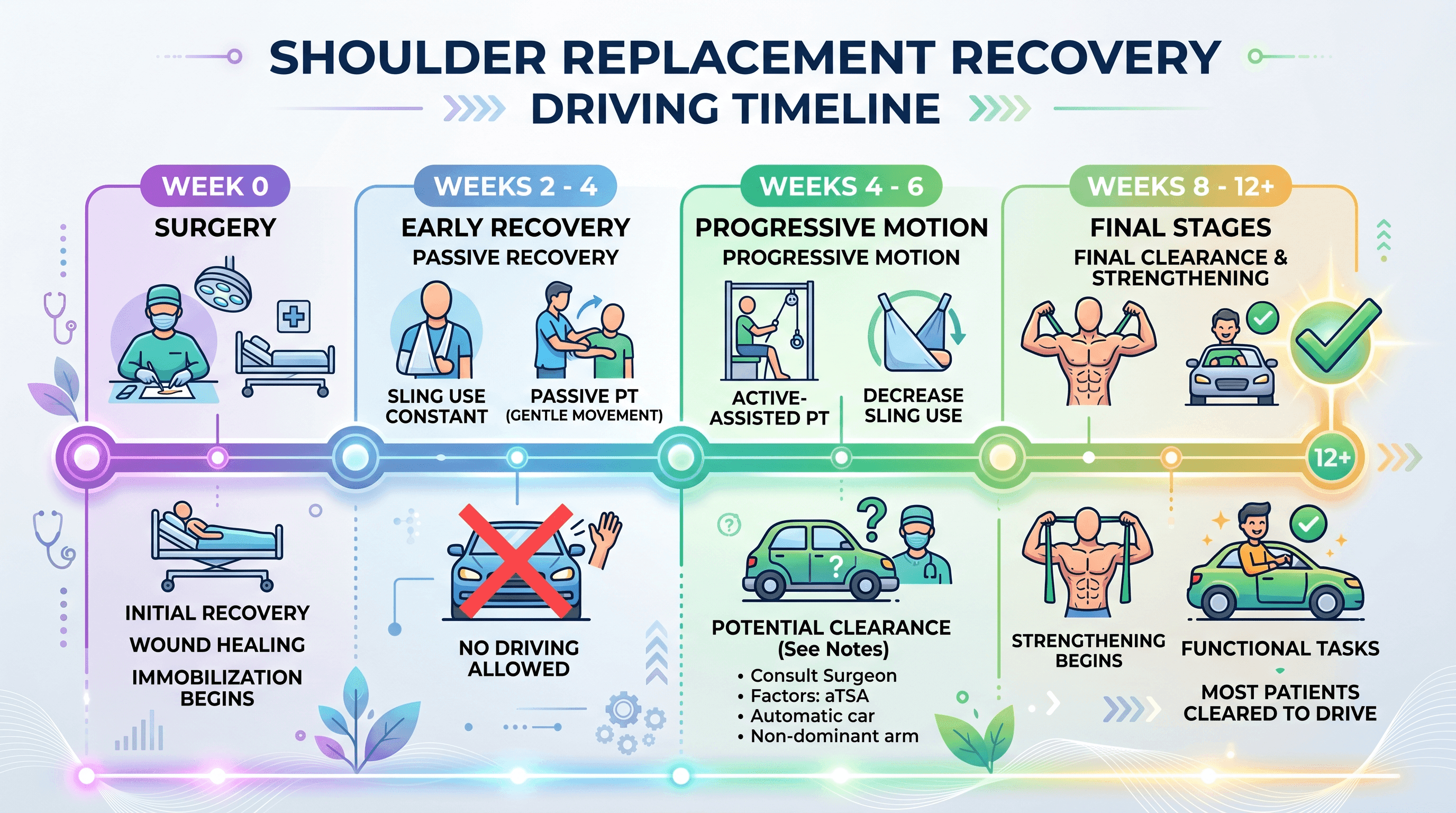
Weeks 2 to 4: Passive range-of-motion phase. The therapist moves the arm; the patient's muscles are not actively engaging the shoulder. At this stage, driving readiness has not been reached by any measure.
Weeks 4 to 6: Active-assisted motion begins. The patient starts participating in shoulder movement with supported assistance. Some aTSA patients with non-dominant arm surgery and automatic vehicles may approach clearance eligibility in this window, but only with explicit surgeon confirmation.
Weeks 8 to 12: Strengthening begins. This phase marks the period when most patients approach or achieve clearance. MedlinePlus confirms that "strengthening of shoulder muscles" typically starts at 12 weeks after surgery. The simulator research cited earlier found that the 12-week mark corresponds to statistically meaningful reduction in simulated collision rates, which is why many surgeons treat this as the benchmark for confident driving readiness.
These milestones connect directly to the self-assessment checklist above: a patient at week 4 who cannot hold the steering wheel position without pain is not yet in the strengthening phase and should not be driving regardless of the general timeline.
Insurance, Liability, and the Legal Side of Driving After Surgery
This angle is almost entirely absent from standard patient education on shoulder replacement recovery, yet it carries real financial and legal consequences.
Opioid use and DUI risk. In most US states, driving while impaired by prescription medication, including legally prescribed opioids, can constitute a DUI charge. The prescription does not provide legal protection if the medication impairs driving ability. A patient who takes oxycodone in the morning and drives to an appointment that afternoon is not legally protected by the fact that the medication was prescribed.
Auto insurance and medical clearance. If a patient drives before receiving documented medical clearance and is involved in an accident, the auto insurer may investigate whether the driver was operating the vehicle against medical advice. Depending on the policy language and state laws, this can result in claim denial or reduced coverage. Calling the insurer before resuming driving, particularly if the surgeon's clearance is informal or undocumented, is a reasonable protective step.
The surgeon's legal position. Surgeons are not able to officially certify driving clearance in a legally binding sense. They can assess functional readiness and document the conversation, but the final decision rests with the patient and the patient's insurer. Understanding this distinction matters: surgical clearance is a clinical opinion, not a legal immunity document.
Asking the insurer what documentation they require before a post-surgical patient resumes driving is a five-minute call that can prevent a complicated claim dispute later.
Practical Tips for Staying Independent During Recovery
The urgency behind "how soon can I drive" is often really about something else: the fear of losing independence for weeks. That fear is legitimate, and it deserves a practical response.
Rideshare apps (Uber, Lyft) provide on-demand transportation for medical appointments, grocery trips, and other errands without requiring advance planning. Many communities also offer medical transport assistance through county health departments or community organizations for patients with limited mobility.
Grocery delivery services have become reliable and widely available. Setting up a regular delivery schedule during the recovery period removes one of the most common driving dependencies. For patients with family or friends nearby, batching errands around PT appointment days reduces the number of separate requests.
When riding as a passenger during recovery, sitting in the back seat, away from the front passenger airbag, lowers the risk of shoulder impact if the airbag deploys. A small pillow placed under the seatbelt on the operated side reduces direct pressure on the healing joint during longer rides.
These are not substitutes for getting back behind the wheel; they are bridges that protect the recovery while keeping daily life functional.
The Test Drive Protocol: First Time Back Behind the Wheel
Once surgical clearance has been received, the return to driving does not have to happen all at once. A structured first drive significantly reduces the anxiety and risk associated with the transition.
Before getting into the car: confirm that no opioid or sedating medication has been taken in the past 24 to 48 hours, and that the self-assessment checklist has been completed successfully.
The first drive should be 10 to 15 minutes in a quiet environment: an empty parking lot, a low-traffic neighborhood street, or a similar low-demand setting. A fully licensed adult should be in the passenger seat for the first outing, not as a co-pilot but as a safety measure if something feels unexpectedly wrong.
During the test drive, practice braking from a slow roll, checking blind spots with full head rotation, and making low-speed steering corrections. If any of these produce pain, instability, or hesitation, the test drive ends there. This is information, not failure. A surgeon or physical therapist can address the specific limitation at the next appointment.
Highway or high-traffic driving should follow only after several successful local test drives confirm consistent, pain-free performance.
When to Call Your Surgeon Before Getting Behind the Wheel
Certain situations warrant a direct call to the surgical team before attempting to drive, rather than waiting for the scheduled follow-up.
Pain that has not resolved on the expected timeline is the clearest signal. If the shoulder is still significantly painful at week 5 or 6 and the follow-up is still a week away, a call to the surgeon's office to flag the concern is appropriate. Similarly, if opioid use has extended beyond what was initially anticipated because pain is not controlled, the surgeon needs to know before a driving decision is made.
Struggling to meet PT milestones, particularly the active-assisted motion benchmarks expected by weeks 4 to 6, is another reason to seek guidance before attempting to drive. And any patient scheduled for bilateral shoulder surgery, or who has had prior shoulder surgery on the opposite side affecting that arm's function, should have an explicit conversation with the surgeon about how that affects the driving timeline.
For navigating these questions between appointments, Momentary's AI health navigator can help explore symptoms, understand what the recovery timeline means for a specific situation, and identify when a follow-up call to a provider is warranted.
FAQ
Can I drive an automatic car after shoulder surgery?
Automatic transmission vehicles are less physically demanding than manual transmission cars because they eliminate the need for gear shifting and reduce the need to brace the wheel during gear changes. However, automatic transmission alone is not sufficient to clear a patient for driving. Surgeon clearance, medication status, and physical readiness still apply. For some patients with favorable factors, driving an automatic may be appropriate slightly earlier than driving a manual, but this should be discussed with the surgeon.
How long will I be in a sling after shoulder replacement surgery?
Most patients wear a sling for 2 to 6 weeks after shoulder replacement surgery. The exact duration depends on the type of surgery performed and the individual's healing progress. MedlinePlus notes that patients "will need to wear a sling for the first 2 to 6 weeks after surgery" and that the surgeon will specify the appropriate duration. The timeline for driving generally tracks closely with the timeline for sling removal.
Is shoulder replacement a major operation?
Shoulder replacement is a significant surgical procedure performed under general or regional anesthesia. It involves replacing the ball-and-socket components of the shoulder joint with prosthetic implants. Recovery typically spans several months, with active physical therapy beginning within days to weeks of the operation and strengthening exercises commencing around 12 weeks post-surgery. Most patients experience meaningful improvement in pain and function, but the recovery arc is genuinely long and should not be underestimated.
What activities are off-limits after shoulder replacement surgery?
During recovery, patients are advised to avoid activities that involve repetitive overhead movement, weight-bearing through the operated hand, sudden jerking motions, and impact or contact sports. MedlinePlus lists specific restrictions including lifting objects heavier than a cup of coffee in the early weeks, reaching repeatedly with the shoulder, and any activity requiring quick stop-start or twisting motions through the shoulder joint. Driving falls into the restricted category until surgeon clearance is obtained.
Is it illegal to drive after shoulder surgery?
Driving after shoulder surgery is not categorically illegal, but two specific conditions can make it legally problematic. Driving while taking opioid or narcotic pain medications is treated as impaired driving in most US states and can result in DUI charges. Driving before medical clearance and causing an accident while wearing a sling or before documented readiness can create liability and insurance complications. The safest and legally cleanest path is to wait for explicit surgeon clearance and to be off all sedating medications before resuming driving.
When can I drive after reverse total shoulder replacement specifically?
Reverse TSA patients generally face a longer driving restriction than anatomic TSA patients because the rehabilitation arc is different. Passive physical therapy begins earlier, but active strengthening is typically delayed until closer to 6 weeks. Most rTSA patients should expect a minimum of 6 to 8 weeks before driving is considered, with some requiring longer depending on age, BMI, medication status, and arm dominance. A 2023 study found that only approximately 20% of rTSA patients returned to driving within 2 weeks of surgery, versus 34% of aTSA patients.
References
-
MedlinePlus (NIH National Library of Medicine) — Shoulder replacement surgery post-operative patient instructions, including sling duration, activity restrictions, and driving guidance.
-
DeBernardis DA et al., Journal of Shoulder and Elbow Surgery (2023) — Study examining return to driving after anatomic vs. reverse total shoulder arthroplasty, including influence of sex, age, BMI, and narcotic use on timing.
-
Shoulder arthroplasty and driving simulator study — Simulator-based study on collision rates and return-to-driving readiness after shoulder surgery; found nearly doubled collision rates at 6 weeks for dominant-arm surgery.
-
University of Rochester Medical Center — Clinical guidance on return to driving after joint replacement surgery, including medication restrictions and surgical clearance.
-
PMC Article on Shoulder Arthroplasty and Driving — Peer-reviewed evidence on biomechanical and functional readiness criteria for return to driving after shoulder replacement.
-
PMC Review on Return to Activity After Shoulder Arthroplasty — Broader review of return-to-activity benchmarks including driving, physical therapy milestones, and patient-reported outcomes.