

Hip replacement surgery recovery time is one of the most searched questions by patients preparing for the procedure — and the most commonly misunderstood. The short version: you will probably walk the same day as surgery. The complete version: full biological recovery takes closer to a year. Both are true at the same time, and that paradox is what this guide is built to untangle.
This is a week-by-week, phase-by-phase roadmap for patients who have already decided to have surgery and want to know exactly what to expect, what to push through, and what to respect.
At a Glance
| Topic | Key Facts |
|---|---|
| First steps post-op | Often within hours of surgery, with a walker |
| Functional independence | 2 to 4 weeks for most daily tasks |
| Driving eligibility | 3 to 6 weeks, depending on surgical side and opioid use |
| Return to desk work | 2 to 4 weeks |
| Return to physical labor | Up to 3 months |
| Full bone integration | 6 to 12 months |
| Return to low-impact sports | 3 to 6 months |
| Return to high-impact activity | 6 months or later, surgeon-dependent |
The Big Picture: Fast Mobility, but a Year-Long Biological Recovery
Most patients are surprised to learn that "recovered" means two very different things depending on whether you are talking about daily function or bone biology.
Within two to four weeks, the majority of patients can manage basic daily tasks, walk short distances without an assistive device, and sleep through the night. That functional window is what most people mean when they ask how long recovery takes, and it is genuinely fast compared to older surgical techniques.
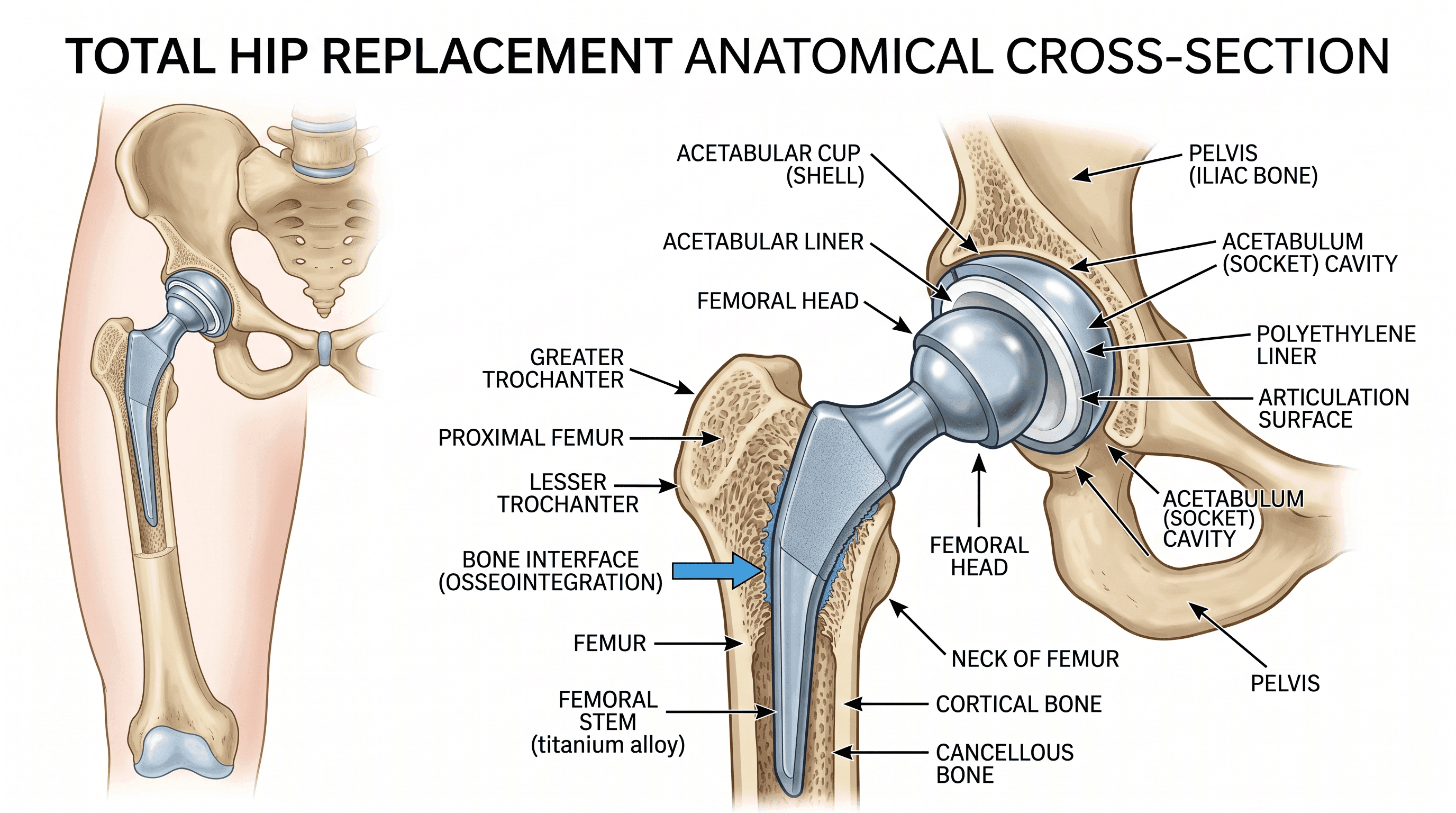
But underneath the surface, the titanium or ceramic implant is undergoing a process called osseointegration, where the surrounding bone grows into and fuses with the implant's porous surface. According to the National Institute of Arthritis and Musculoskeletal and Skin Diseases, this biological bonding process continues for six to twelve months after surgery. Until it is complete, the joint is not fully stable under load, and overexertion during this window is one of the most common reasons patients stall or regress in their recovery.
So when a surgeon says "you'll be back on your feet in a few weeks," they are telling the truth. When you feel great at week eight and decide to go back to tennis, your bone is still bonding to a foreign implant. Both facts coexist.
Days 1 to 14: Survival Mode and the Walker
The first two weeks are the most physically demanding part of recovery, and also the most critical for setting the trajectory of everything that follows.
Day of Surgery and the First 24 Hours
Physical therapy begins on the same day as surgery at most hospitals. A physical therapist will help the patient stand and take a few assisted steps within hours of coming out of anesthesia, typically using a walker. This is not optional or overly aggressive; early mobilization is clinically proven to reduce the risk of deep vein thrombosis (DVT), a blood clot that can form in the legs when circulation is sluggish.
According to the Cleveland Clinic, most patients who undergo total hip replacement are discharged within one to three days, with many going home the same day thanks to improvements in anesthesia, pain management, and minimally invasive techniques. The discharge decision depends on how well the patient is mobilizing, whether pain is controlled without IV medications, and the strength of their at-home support system.
Weeks 1 and 2: Managing Pain, Swelling, and Wound Care
Pain at home during the first two weeks is real but manageable. Most patients describe it as a deep ache around the incision site, often accompanied by bruising and swelling that migrates down the thigh and into the knee. That traveling swelling is normal and can alarm patients who are not expecting it.
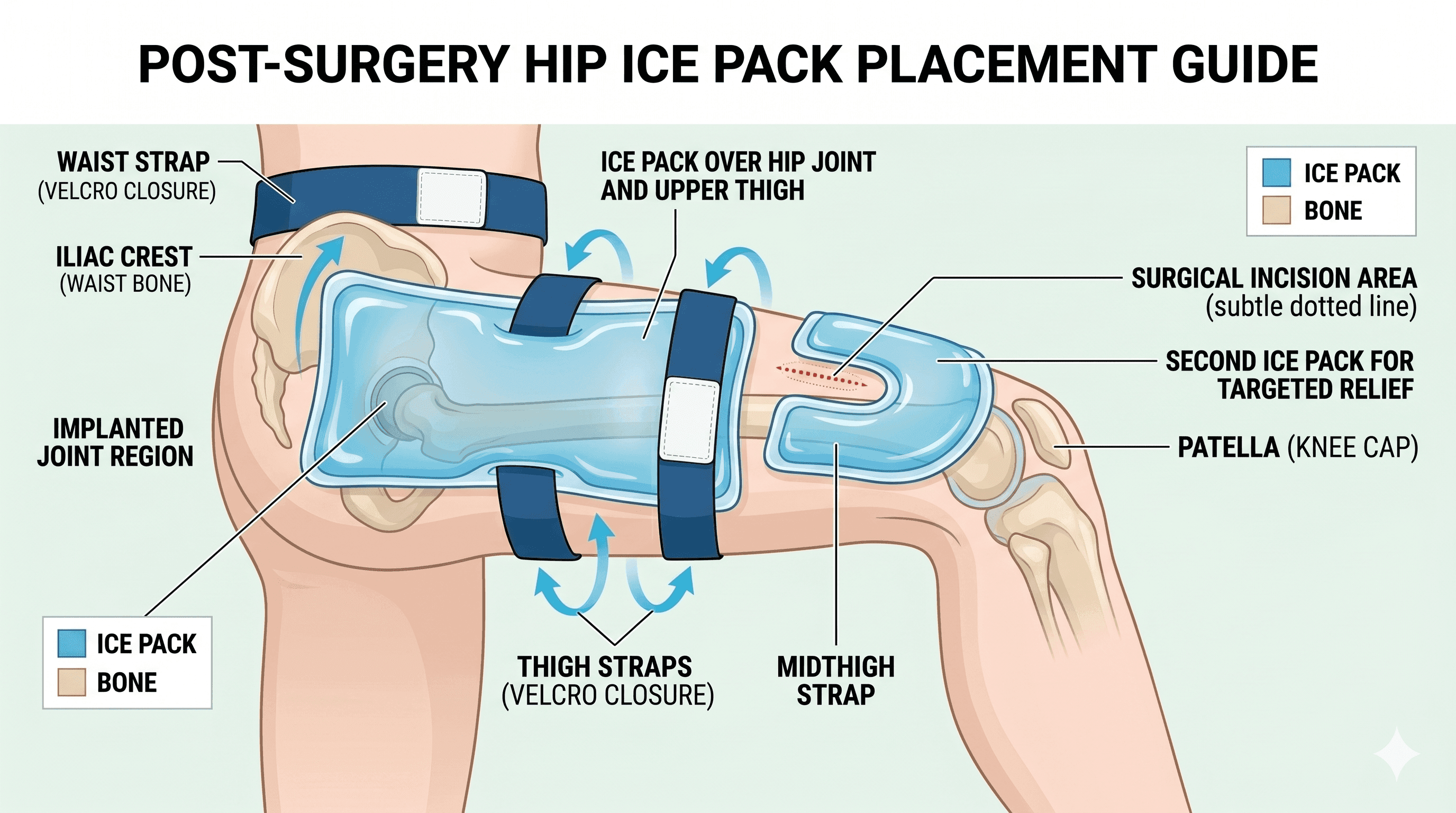
Ice therapy applied in 20-minute intervals throughout the day is one of the most effective tools for controlling this swelling. Elevation, keeping the leg propped above heart level when sitting, helps drain excess fluid as well.
During this phase, all mobility is walker-assisted. The goals are narrow and deliberate: getting to the bathroom and back, completing short prescribed walks inside the home a few times per day, and keeping the incision dry and clean. Surgeons typically recommend keeping the incision away from full water submersion until the wound closes, usually around 10 to 14 days post-op.
Pain medication during this phase often includes a short course of opioids. It is worth knowing that the continuation of opioids beyond the first week or two is one of the strongest contraindications for returning to driving, regardless of how the patient feels physically.
Anterior vs. Posterior: Do Your Hip Precautions Change?
The surgical approach used for a hip replacement does more than determine where the incision is placed. It directly determines which movements are restricted during the early recovery phase and for how long.
Posterior Approach
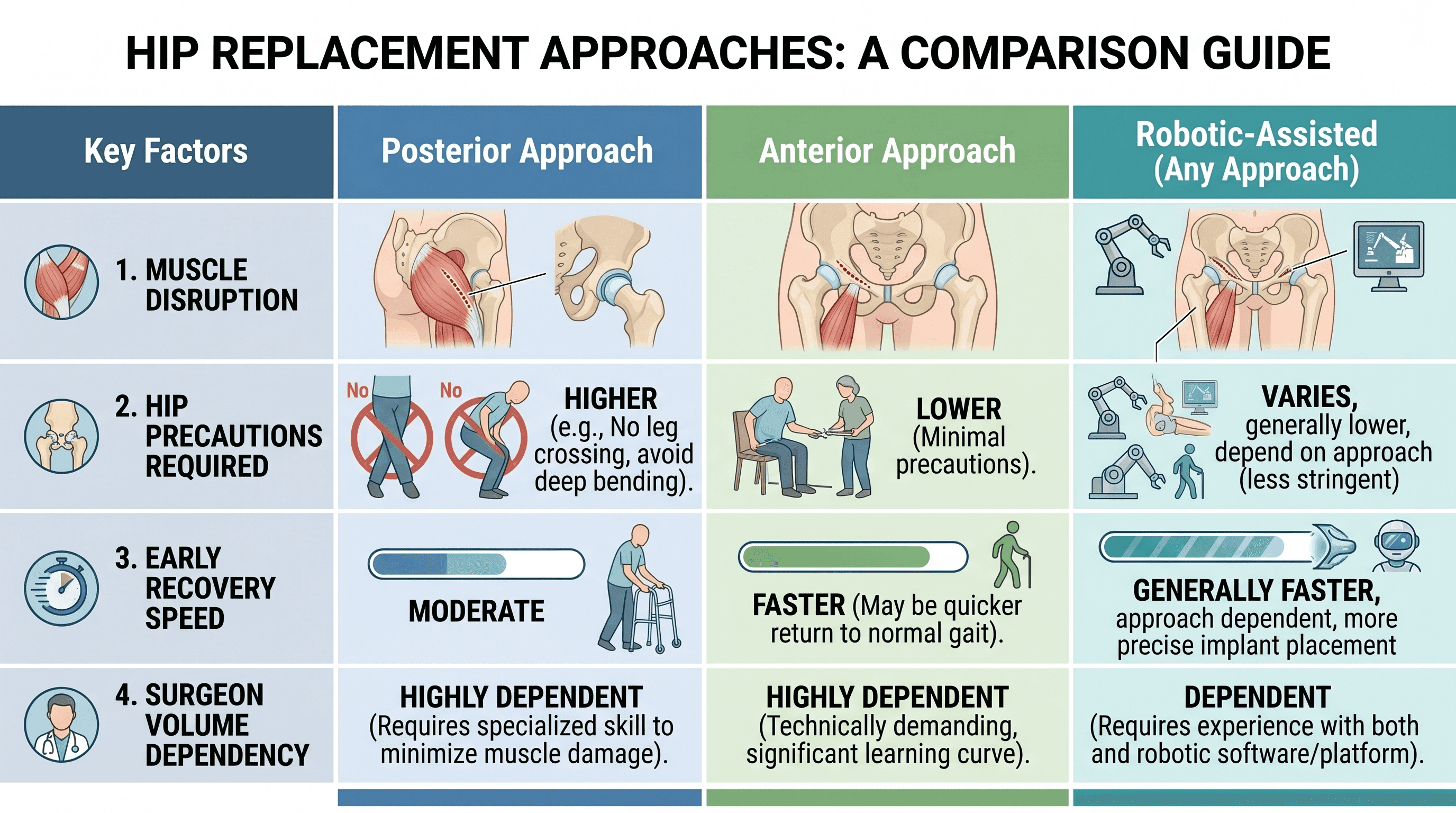
The posterior approach is the most commonly performed surgical technique for total hip replacement. The surgeon accesses the hip joint from the back, which requires cutting through or detaching some of the short external rotator muscles. While these muscles reattach and heal over time, they leave the joint temporarily vulnerable to dislocation in specific positions.
This is why posterior approach patients receive the well-known set of hip precautions, typically maintained for 6 to 12 weeks. The three core restrictions are: do not bend the hip past 90 degrees (no deep sitting or leaning forward sharply), do not cross the legs or feet, and do not rotate the foot inward. Breaking any of these rules before the soft tissue has healed creates a genuine risk of dislocation, which is a medical emergency requiring urgent intervention.
Anterior (Front) Approach
The anterior approach, also called the direct anterior approach (DAA), accesses the hip joint from the front of the thigh, working between muscle planes rather than cutting through them. Because no major muscles are detached, the tissue trauma is lower and the stability of the replaced joint is maintained more naturally in the early recovery period.
A large meta-analysis of over 46,000 hip replacements cited in PubMed found that the anterior approach was associated with faster early functional recovery and reduced hospital stay length compared to the posterior approach. Patients who undergo DAA are frequently given fewer or no formal hip precautions, allowing a more natural return to daily movement.
The tradeoff is that the anterior approach is technically more demanding for the surgeon, and outcomes are highly sensitive to surgeon experience and volume. A high-volume posterior surgeon will consistently outperform a low-volume anterior surgeon. The approach itself is only one part of the equation.
Robotic-Assisted Hip Replacement
Robotic-assisted total hip replacement is a newer but increasingly available technique in which the surgeon uses a robotic system to pre-plan implant positioning with greater precision and execute the procedure with guided instruments that reduce the risk of unintended soft tissue damage.
Research published in PMC indicates that robotic-assisted surgery reduces early post-operative pain and soft tissue trauma compared to conventional techniques, which can translate to faster early-phase mobility and a shorter hospital stay. Long-term outcomes remain comparable to conventional surgery, but the reduction in collateral tissue disruption makes the first two weeks noticeably more comfortable for many patients.
Weeks 3 to 6: The Major Milestones
This is the phase where recovery starts to feel like progress rather than endurance.
Transitioning from Walker to Cane
Most patients are ready to transition from a walker to a single cane somewhere between weeks three and four, although the exact timing should be confirmed with the physical therapist. The transition is not about pain tolerance; it is about gait stability. A patient who transitions too early and develops a compensatory limp is training the wrong muscle pattern, which can persist for months.
The cane is held in the hand opposite to the surgical leg and used to shift weight away from the new joint as it continues to strengthen.
Returning to Driving
Driving after hip replacement depends on three things: which hip was operated on, whether the patient is still taking opioid pain medications, and whether reaction time has returned to a level where emergency braking is reliable.
For right-hip patients, returning to driving is typically cleared between four and six weeks. Left-hip patients who drive an automatic transmission vehicle are often cleared earlier, around three to four weeks, because the right foot (the operative-side foot for most) is the one that performs emergency braking. A physical therapist can administer a brake reaction test to confirm readiness. Patients who are still using opioids should not drive, regardless of which hip was operated on.
Returning to Desk Work
For patients with sedentary jobs, most surgeons clear a return to work at two to four weeks post-operatively, with the ability to take breaks, change positions frequently, and avoid sitting in low or deep chairs. An ergonomic setup that keeps hips at 90 degrees or above (not below) matters during this period, particularly for posterior-approach patients still observing precautions.
The Sleep Struggle: When Can You Sleep Normally?
Sleep disruption is one of the most commonly mentioned frustrations during hip replacement recovery, and it is one that most online resources barely address.
For the first six weeks, sleeping on the back is the safest and most commonly recommended position. Posterior-approach patients who roll onto the surgical side risk violating the 90-degree hip flexion restriction, and even anterior-approach patients may find side-sleeping painful due to incision tenderness and muscle soreness.
The standard recommendation during this phase is to sleep with a pillow placed firmly between the knees. This keeps the leg in neutral alignment, prevents accidental internal rotation, and reduces strain on the healing joint capsule.
By weeks six to eight, most patients with an anterior approach can begin cautiously attempting to sleep on the non-operative side, using the knee pillow for support. Posterior-approach patients should wait for explicit clearance from their surgeon before sleeping on either side. Sleeping on the operative side itself typically becomes comfortable somewhere between three and six months, once the surrounding soft tissue has fully healed and the implant is securely integrated.
Months 2 to 3: Physical Therapy and Returning to Work
Between weeks six and twelve, recovery transitions from healing-focused to strength-focused.
What Physical Therapy Looks Like in This Phase
Early PT after hip replacement focuses on safe mobilization, wound monitoring, and preventing complications. By weeks six to twelve, the emphasis shifts to rebuilding the gluteal and quadriceps muscles that weakened during the period of reduced activity and during the surgery itself.
Research published in PMC found that a structured home exercise program can produce outcomes equivalent to formal outpatient PT for motivated patients who have access to appropriate instruction. That does not mean skipping therapy; it means that consistency and effort matter more than the specific setting. What stalls recovery in this phase is almost always inadequate muscle strengthening, not the number of clinic visits.
Key exercises in this phase typically include supine heel slides, clamshells, mini-squats, straight leg raises, and progressive walking distance targets. A PT will adjust the program based on the individual's progress.
Returning to Physical and Manual Labor
Patients with desk jobs can typically return to work two to four weeks post-operatively, as noted above. Patients with physically demanding jobs, those involving prolonged standing, climbing ladders, lifting, or operating heavy equipment, are typically cleared somewhere between two and three months after surgery. This clearance depends on restored strength, stable gait, and an absence of persistent pain or swelling after activity.
Months 6 to 12: The New Normal and Returning to Sports
By the six-month mark, most patients have what orthopedic surgeons call Maximum Medical Improvement (MMI). The joint is functioning well, the bone has integrated with the implant, and daily life no longer requires conscious accommodation of the hip.
The final phase of recovery is about rebuilding stamina and returning to the activities that motivated the surgery in the first place.
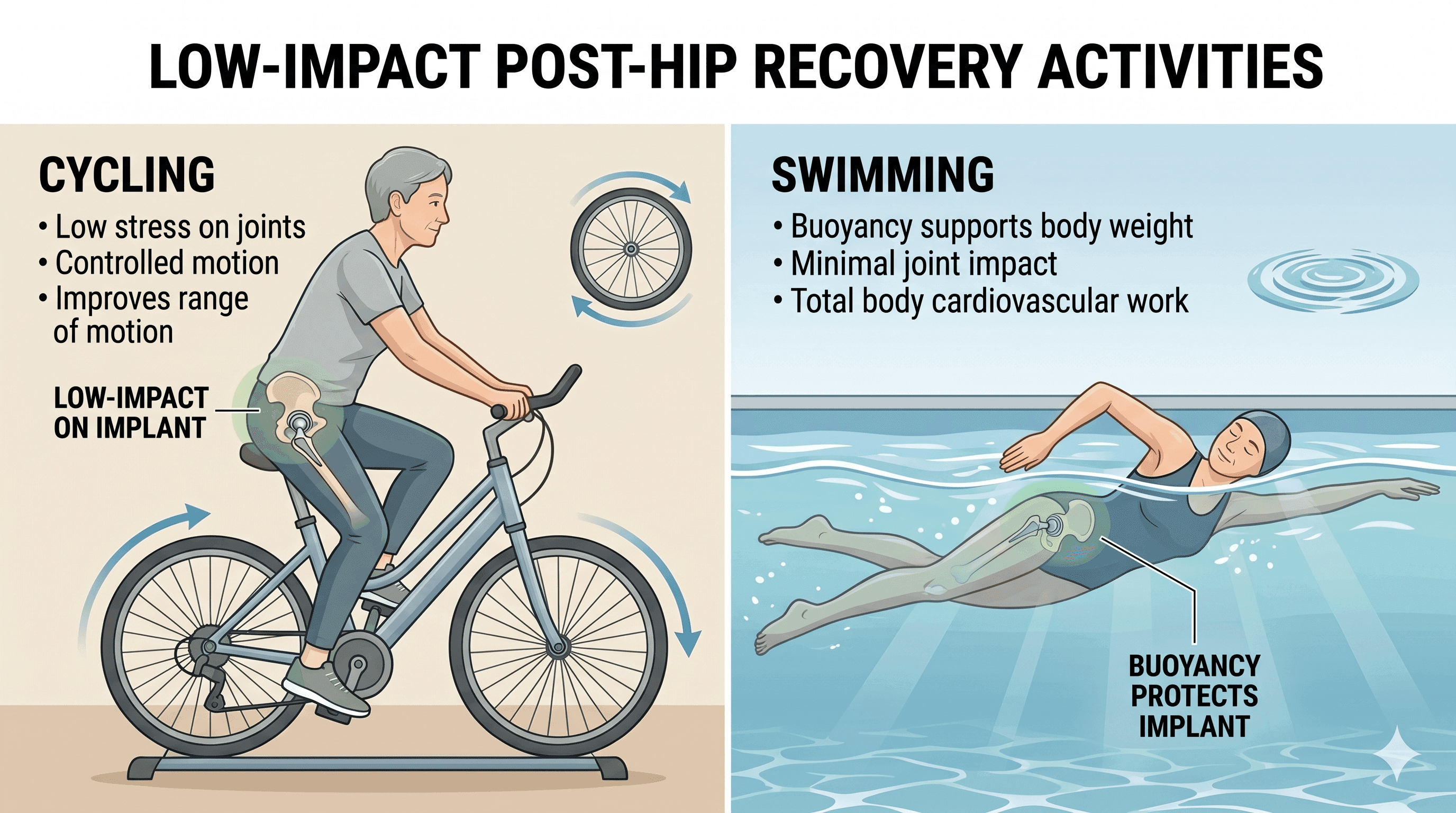
Low-impact sports are typically cleared at three to six months. Cycling, swimming, walking for distance, golf, and doubles tennis are among the activities most commonly recommended for patients returning to athletic activity after hip replacement. Research published in PMC confirms that patients who underwent total hip replacement report high rates of satisfaction with their return to recreational activities by the six-month mark.
High-impact activities, including running, single-leg jumping sports, and contact sports, remain surgeon-dependent. Many orthopedic surgeons permit a gradual return to running for appropriately conditioned patients after six months, while others recommend avoiding high-impact loading indefinitely to protect implant longevity. A conversation with the operating surgeon about long-term activity goals is worthwhile well before the six-month mark.
Pacing Yourself: The Danger of the Honeymoon Phase
One of the least-discussed risks in hip replacement recovery is the honeymoon phase, and it catches a significant number of patients off guard.
For many people who had moderate to severe hip arthritis before surgery, the moment they wake up from the procedure they notice something unexpected: the grinding, constant arthritic pain is gone. The hip replacement addresses the source of that particular pain immediately. What remains is surgical soreness, which feels entirely different and often seems manageable.
So by week six or eight, patients feel dramatically better than they did before surgery. Better, in fact, than they have felt in years. This is where the danger begins. Patients in the honeymoon phase tend to overestimate their structural readiness and begin ramping up activity well beyond where their healing muscles and healing bone can support it. The result is often severe tendinitis around the hip, gluteal or IT band flare-ups, and a sharp reversal in progress that can set the recovery timeline back by weeks.
The biological reality is that feeling well and being healed are not the same thing. The titanium implant has no pain receptors. The healing soft tissue around it does, but only once it is genuinely inflamed. The window between "feels fine" and "seriously overloaded the repair" is narrower than patients expect.
The practical rule is straightforward: follow the PT-prescribed activity progression even when it feels unnecessarily conservative. If a program says three short walks per day, do three short walks. The patients who push past prescribed milestones because they feel ready are the same patients who call the clinic at week ten wondering why they suddenly cannot walk to the mailbox.
If concerns arise mid-recovery or a symptom feels unclear, connect with a primary care provider through Momentary's virtual care platform to get a clinical assessment without waiting for an in-office appointment.
Warning Signs and Complications to Watch For
Complications after hip replacement are uncommon, but knowing the warning signs allows for fast intervention that prevents a minor issue from becoming a major one.
Deep Vein Thrombosis (DVT): Symptoms include new calf pain, warmth, redness, or swelling in the lower leg. A clot that travels to the lungs becomes a pulmonary embolism, which is a medical emergency. Blood thinners prescribed after surgery significantly reduce this risk, but any sudden leg swelling warrants an urgent call to the care team.
Infection: Redness, warmth, or discharge at the incision site beyond normal healing, combined with fever above 101.5 degrees Fahrenheit, are signs of a possible wound infection. Deep joint infection is rare but serious, and any fever in the first few weeks of recovery should be reported promptly.
Dislocation: A sudden pop followed by severe pain, an inability to bear weight, and an abnormal appearance of the leg position are the hallmarks of hip dislocation. This requires immediate emergency care.
Pain that does not improve: According to Johns Hopkins Medicine, pain that consistently registers at a 6 or above on a 1-to-10 scale despite medication, or pain that was improving and has suddenly worsened, warrants contact with the surgical team.
FAQ
What can't you ever do again after a hip replacement?
Most patients can return to a full, active life after hip replacement, including recreational sports. The activities typically avoided long-term are high-impact sports with significant repetitive joint loading, such as competitive running, jumping, or contact sports, because they accelerate implant wear. Activities like swimming, cycling, golf, and walking have no meaningful restrictions for most patients. The specific limits depend on the type of implant used and the guidance of the operating surgeon.
How many days of bed rest are required after hip replacement surgery?
Extended bed rest is actively discouraged. According to the Cleveland Clinic, physical therapy begins on the day of surgery and the goal is to be out of bed and walking with a walker within hours of the procedure. Rest between activity sessions is appropriate in the first two weeks, but lying in bed for extended periods increases the risk of DVT, pneumonia, and deconditioning.
What are the three rules after hip replacement?
The three rules apply specifically to patients who had a posterior-approach hip replacement. They are: do not bend the hip past 90 degrees, do not cross the legs or feet, and do not rotate the foot inward toward the midline. These restrictions protect the repaired joint capsule from dislocation during the six to twelve weeks it takes to heal. Patients who had an anterior-approach surgery are often given fewer or no formal restrictions, though this varies by surgeon.
How far should I be walking one week after hip replacement?
One week after surgery, most patients are walking short, frequent distances inside the home with a walker, typically three to four times per day. The target is often expressed in minutes rather than steps: ten to fifteen minutes per walk, three or four times daily. Outdoor walking on even surfaces may begin toward the end of week one for patients whose pain is well-controlled, but there are no universal distance milestones at this stage. The physical therapist sets the individual target based on how the specific recovery is progressing.
Does surgical approach affect total recovery time?
Yes, but primarily in the early phase. Anterior-approach patients typically achieve functional independence faster in the first four to six weeks and face fewer movement restrictions during that time. By the three-month mark, outcomes between anterior and posterior approaches are largely equivalent for most patients, according to research published in PubMed. Long-term results at one year show minimal difference between approaches.
When is it safe to sleep on the operative side?
Sleeping on the operated hip comfortably and safely typically becomes possible between three and six months post-surgery, once the joint capsule has healed and the surrounding muscles have regained adequate strength. Sleeping on the non-operative side is usually permitted earlier, at six to eight weeks, with a pillow between the knees for support. Back sleeping with a pillow under the knees is the recommended position for the first six weeks.
If symptoms or questions arise at any point during recovery, use Momentary's AI health navigator to explore your symptoms and understand your next steps before or between clinical appointments.
References
- National Institute of Arthritis and Musculoskeletal and Skin Diseases — Hip replacement surgery overview, including osseointegration and recovery expectations.
- Cleveland Clinic: Hip Replacement — Hospital discharge timeline, early mobilization protocols, and post-operative care guidance.
- PubMed: Anterior vs. Posterior Approach Meta-analysis — Large-scale comparative study of surgical approaches and early functional recovery outcomes.
- PMC: Home Exercise vs. Outpatient PT After Hip Replacement — Evidence on equivalence of home-based and clinic-based rehabilitation programs.
- PMC: Robotic-Assisted Hip Replacement Outcomes — Clinical evidence on soft tissue preservation and early recovery benefits of robotic-assisted surgery.
- PMC: Return to Recreational Activity After Total Hip Replacement — Patient-reported outcomes on returning to sports and recreational activities at six months.
- Johns Hopkins / NCBI: Post-Operative Pain and Complication Monitoring — Clinical guidance on pain management thresholds and complication warning signs.
- PubMed: Anterior vs. Posterior Approach Functional Outcomes — Long-term comparison of functional outcomes between surgical approaches at three months and one year.