


Hip replacement surgery takes between one and two hours from the first incision to the final stitch, but your total time at the hospital on the day of surgery is closer to five to eight hours once you factor in pre-op preparation and the recovery room. Understanding both numbers matters, because the gap between them is where most patients' anxiety lives.
At a Glance
| Topic | Key Facts |
|---|---|
| Surgical time (incision to close) | 60 to 120 minutes |
| Total OR time (including setup and anesthesia) | Approximately 2 hours |
| Pre-op preparation | 1 to 2 hours |
| Post-anesthesia recovery (PACU) | 1 to 2 hours |
| Outpatient same-day discharge | Common for healthy patients |
| Robotic vs. manual time difference | Mean 8.43 additional minutes |
| Full recovery | 6 weeks to 6 months, depending on activity level |
The Short Answer: The 1 to 2-Hour Surgical Window
The actual surgery, meaning the time your orthopedic surgeon spends operating, is usually done between 60 and 120 minutes. That range comes directly from Cleveland Clinic and the NHS, and it holds true across most straightforward total hip replacements.
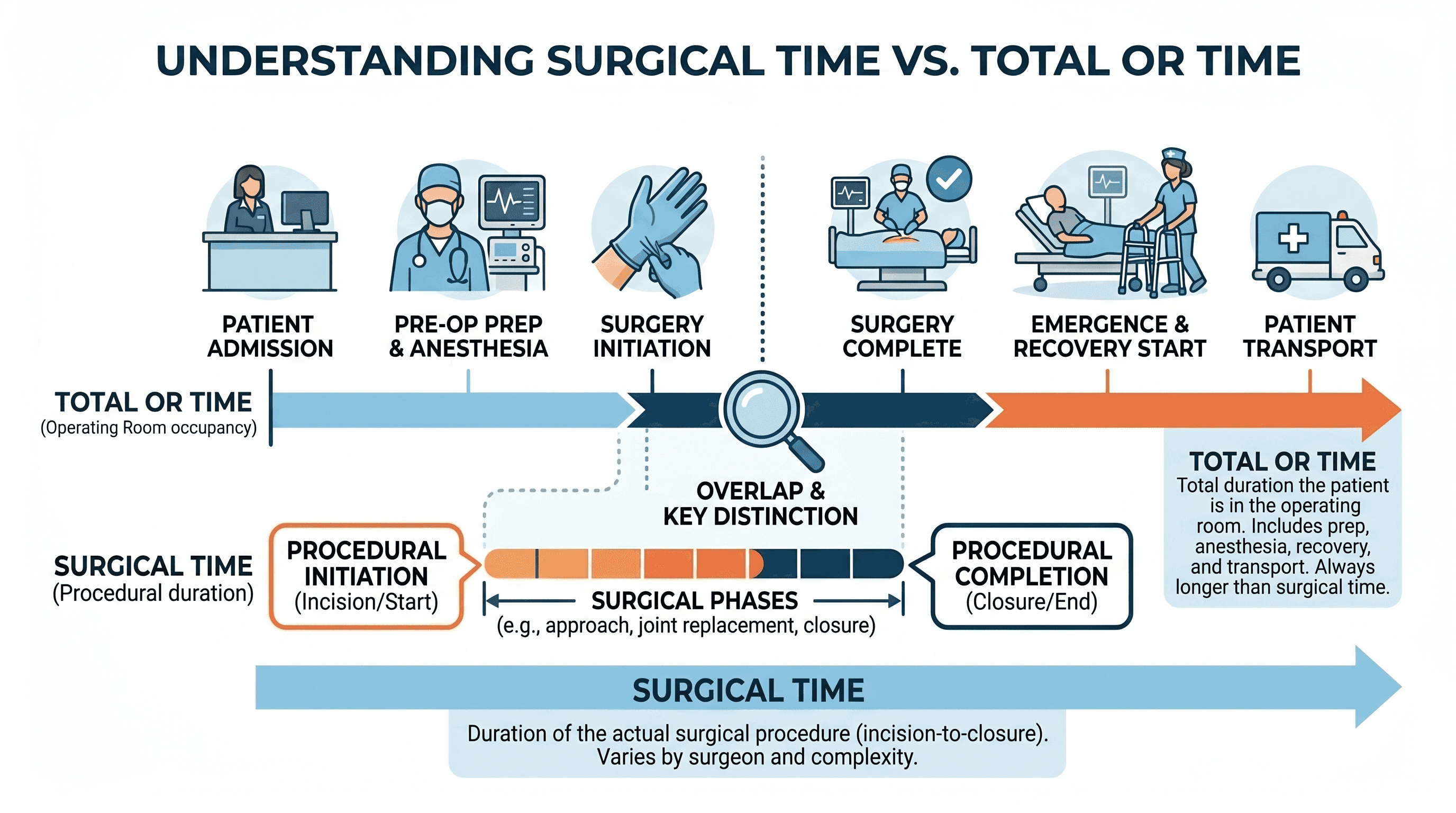
What patients often confuse with surgical time is total OR time, which includes positioning, draping, anesthesia induction, and post-closure counts. Total OR time typically runs closer to two full hours even when the hands-on operating falls in the lower half of the range.
"Hip replacements usually take one to two hours. Your surgeon will tell you how long your surgery will take based on the type you need." — Cleveland Clinic
One clear declarative fact worth anchoring early: the surgeon's time in the operative field and the clock on the OR door are two different measurements, and your care team is tracking both.
Pre-Op Prep: The First 1 to 2 Hours of Your Day
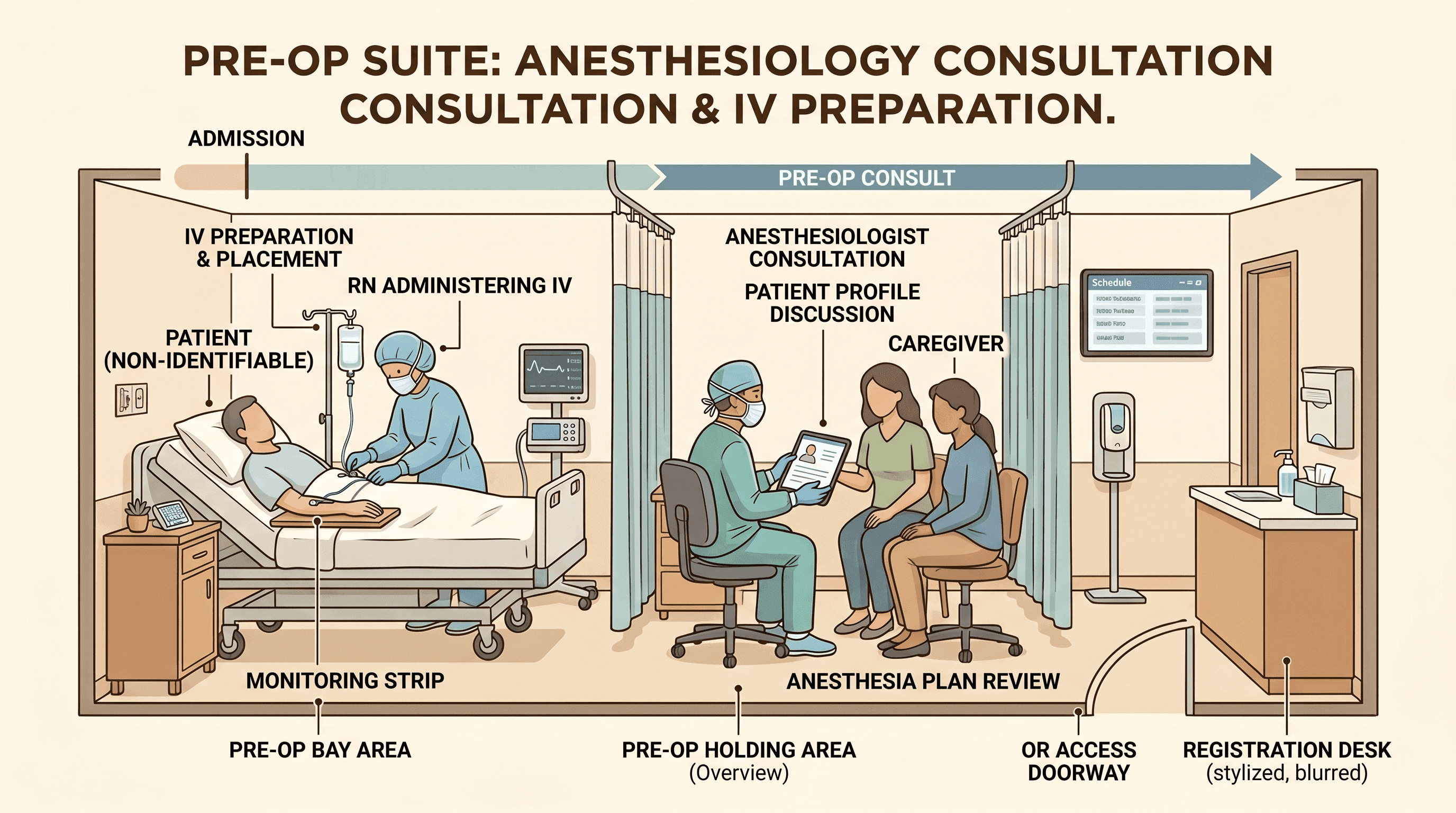
Long before the surgeon picks up a scalpel, your care team is busy. Most hospitals ask patients to arrive one to two hours before the scheduled start of surgery, and that window fills up quickly.
Check-in, wristband verification, and surgical site marking happen in the first few minutes. After that, a nurse places an IV line, draws any final blood work, and reviews your medication history. Your anesthesiologist, one of the most important people you'll meet that morning, arrives to discuss your anesthesia plan.
The most common choice for hip replacement is a spinal block, also called regional anesthesia. According to Cleveland Clinic, regional anesthesia blocks sensation in a large area of the body without putting you fully to sleep, though a mild sedative is often added so patients feel relaxed rather than aware. General anesthesia, where you are completely asleep, is an option when spinal anesthesia is not appropriate.
Administering a spinal block takes roughly 10 to 20 minutes, and the anesthesiologist will spend additional time confirming it has taken effect before the surgical team proceeds. This is not lost time; it is the foundation of a smooth, pain-controlled operation. Patients who feel calm and informed going into this step consistently report a better experience once they are in the OR.
The Mechanics: What Happens Inside the Operating Room
Understanding what the surgical team is actually doing helps explain why the 60 to 120-minute window exists and why some cases land at the shorter end while others stretch longer.
A total hip replacement follows a defined sequence, described by University of Utah Health as including six specific steps. The surgeon first separates the femoral head (the ball at the top of the thigh bone) from the socket. Damaged cartilage and bone are cleared away. A metal cup is then pressed or cemented into the hip socket. A metal stem is secured down the femur. A new ceramic or metal ball is fitted onto the stem and seated into the liner of the cup. Finally, the surgical team confirms sizing, leg length, tension, and fit before closing.
Each step involves both skill and time. Reaming the pelvis to the precise diameter for a secure cup fit, for example, requires checking implant stability through a range of motion before moving on. This is not a procedure that can be rushed, which is why experienced surgeons treat time in the OR as a variable to manage, not a target to minimize at the expense of accuracy.
The NHS describes the closure as a final step that includes stitches or clips followed by dressings and bandaging before you are transferred to the recovery room.
Time by Surgery Type: Total, Partial, Bilateral, and Revision
Not every hip replacement is the same operation. The type of procedure is the single biggest driver of how long you will be in the OR.
| Surgery Type | Approximate OR Duration | Notes |
|---|---|---|
| Total Hip Replacement | 60 to 120 minutes | Most common; replaces ball and socket |
| Partial Hip Replacement | 45 to 90 minutes | Replaces ball only; usually for fractures |
| Bilateral Hip Replacement | 3 to 4+ hours | Both hips in one operation |
| Revision Hip Replacement | 2 to 4+ hours | Replaces a failed prior implant; highly variable |
A partial hip replacement, called a hemiarthroplasty, involves replacing only the femoral head while leaving the natural socket in place. The NHS notes this is typically offered to patients who are frail or who have had a serious hip injury. Because the operation involves fewer components and less bone preparation, it generally takes less time than a total replacement.
A bilateral hip replacement, where both hips are addressed in a single anesthesia session, roughly doubles OR time. This option is sometimes appropriate for patients with severe disease in both hips, but it comes with a more demanding recovery and requires careful medical assessment before it is considered.
Revision surgery is the most time-intensive of all. Removing an existing implant, cleaning up bone loss, and re-establishing stable fixation with new components can take two to four hours or more. The exact duration depends on why the original implant failed and what condition the surrounding bone is in.
Does Anterior or Posterior Approach Change the Time?
The entry point your surgeon uses to access the hip joint does affect OR duration, though the difference is smaller than many patients expect.
The posterior approach, where the incision is made on the side and back of the hip, has been the traditional method for decades. It provides a broad view of the joint, and surgeons with deep posterior-approach experience can often complete the procedure in 60 to 70 minutes. The tradeoff, as University of Utah Health explains, is that more soft tissue and muscle must be moved to access the joint, which can affect early recovery.
The anterior approach enters from the front of the hip, working between muscles rather than cutting through them. According to University of Utah Health, this can speed up recovery since fewer muscles are disrupted. However, the anterior approach provides a narrower surgical window and typically requires a specialized operating table and real-time X-ray guidance. The setup adds time, and surgeons newer to the technique can see OR duration run closer to 90 to 100 minutes until their volume and experience reach a steady state.
The bottom line: approach affects time at the margins, but in experienced hands, both methods generally land inside the same one to two-hour window.
How Long Does Robotic Hip Replacement Take?
Robotic-assisted hip replacement is one of the fastest-growing areas in orthopedic surgery, and it comes with a question that nearly every patient asks: does the technology add time to my day?
The honest answer is: slightly, and the tradeoff is worth understanding. A 2026 systematic review and meta-analysis published in Cureus and indexed on PubMed, analyzing 15 comparative studies, found that robotic-assisted total hip arthroplasty required a mean of 8.43 additional minutes compared to manual techniques. That is roughly the length of a TV commercial break.
Where that extra time goes matters. Systems like the Mako (Stryker) and ROSA Hip (Zimmer Biomet) require the surgeon to digitally map the joint and confirm the operative plan before making a single cut. That mapping step is where precision is baked in, not added retroactively. A separate NHS Scotland study published in BMC Musculoskeletal Disorders and available on PMC found that robotic procedures demonstrated narrower variation in operative times and fewer outliers than manual cases, suggesting the technology produces more predictable scheduling as well as more precise outcomes.
Slightly longer OR time does not mean a longer day for the patient. The PACU recovery timeline and discharge criteria are the same regardless of whether the surgeon used robotic assistance.
Your Complete Day-of-Surgery Timeline
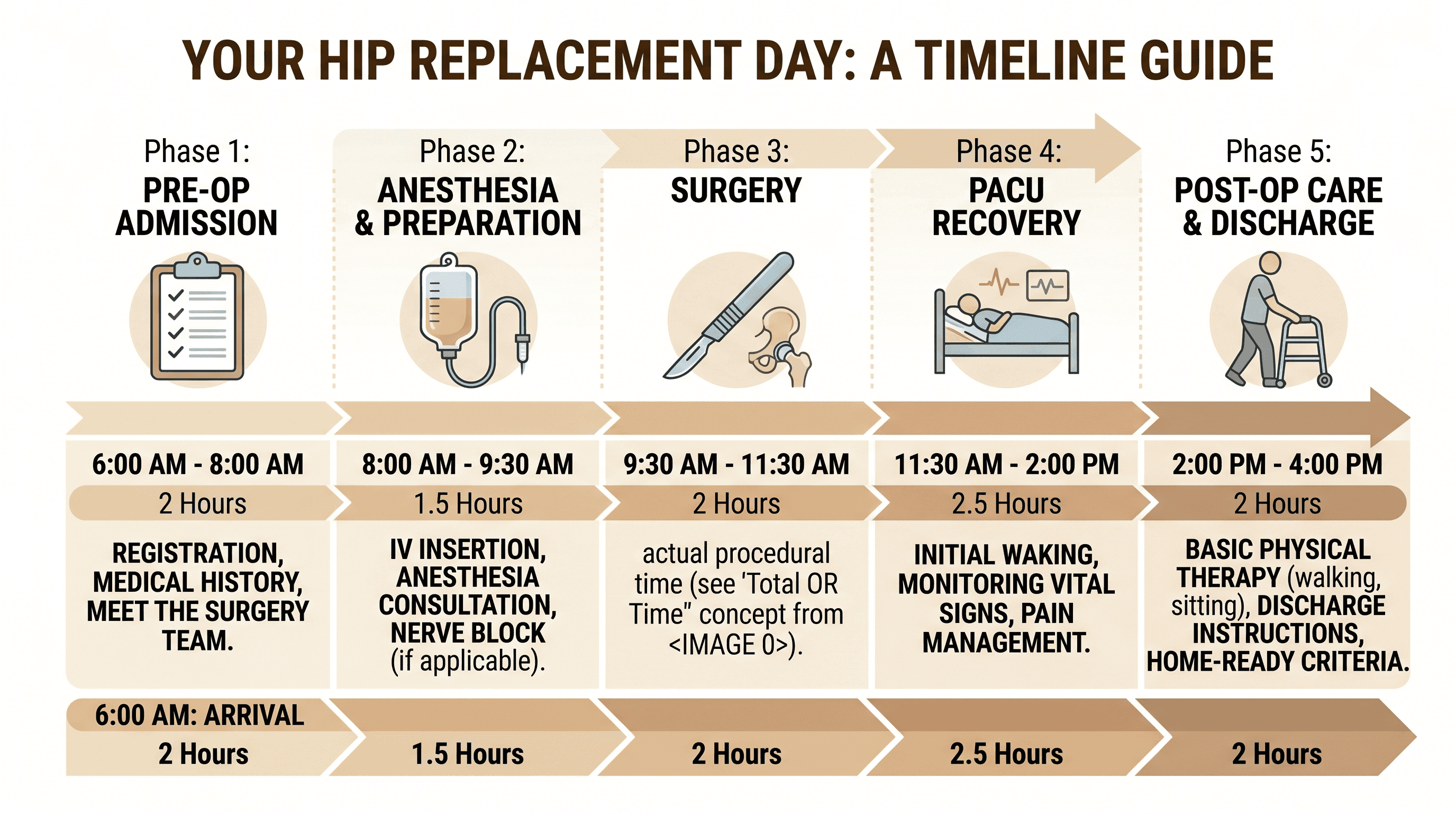
This is the section that competitors almost universally skip, and it is the one most patients search for. Here is what a typical hip replacement day looks like from start to finish.
Arrival and Check-In (T minus 90 to 60 minutes) You arrive at the surgical center or hospital, complete admission paperwork, and change into a gown. A nurse places your IV, reviews your allergy list, and confirms your surgical site.
Pre-Op Bay (T minus 60 to 30 minutes) Your anesthesiologist visits to discuss your anesthesia plan and answer questions. The spinal block is typically administered here. Your surgeon may stop by for a final check and to mark the operative leg.
Operating Room (0 to 120 minutes) You are moved to the OR. Positioning, draping, and final anesthesia confirmation take 15 to 20 minutes before the incision begins. The surgical procedure runs 60 to 120 minutes depending on complexity and approach. Closure and dressing take another 10 to 15 minutes.
Post-Anesthesia Care Unit (PACU) (1 to 2 hours) This is the recovery room. If you had a spinal block, you will have no sensation in your lower body for some time after surgery. Nurses monitor your vital signs, pain level, and neurological status closely. Feeling will return gradually in the legs, a process that often begins within one to two hours and is complete within a few hours after that. Pain is actively managed throughout this stage so that you are comfortable when sensation returns.
Room Transfer or Discharge (2 to 4 hours post-OR) Many healthy patients now qualify for same-day discharge. According to Cleveland Clinic, most hip replacements are outpatient surgeries. For those staying overnight, a hospital room becomes available once PACU monitoring is complete.
First Steps A physical therapist will help you sit up, stand, and take your first steps the same day as surgery, as noted by University of Utah Health. Walking on the new joint the same afternoon is now standard practice at most joint replacement centers.
What Makes Hip Replacement Surgery Take Longer?
For most patients going into a straightforward primary total hip replacement, the surgeon finishes in under 90 minutes. But a meaningful minority of cases run longer, and understanding why is more reassuring than alarming, because the factors that extend OR time are almost always identified and planned for before the first incision.
Patient anatomy and bone quality. Patients with significant osteoporosis may require cement fixation of implant components, which adds steps and curing time. Unusual anatomical variants, such as a misshapen femoral canal or prior pelvis surgery, require the surgeon to adjust the standard operative sequence.
Prior hardware. If a patient has screws, plates, or an old hip implant from a previous surgery, removing that hardware before placing the new implant adds time. Revision surgery for this reason routinely runs two hours or more.
Deformity and complexity. Patients with advanced hip dysplasia, severe arthritis-related deformity, or prior fractures that have healed in a displaced position require additional intraoperative planning. These cases are typically flagged during pre-op imaging, and surgeons schedule additional OR time accordingly.
BMI and soft-tissue depth. In patients with higher BMI, reaching and visualizing the joint requires additional retraction and may extend the length of each operative step. This is a physiological reality, not a reflection of surgical skill.
Surgeon volume and technique. Both robotic and anterior techniques have documented learning curves. As noted in a PMC overview of robotic outcomes, earlier cases with newer systems tend to run longer than later cases at the same surgeon's hands. High-volume centers have largely closed this gap.
None of these factors should cause alarm. They are variables your surgical team accounts for during planning, and they explain why your pre-op appointments involve detailed imaging, blood work, and a frank conversation about your specific anatomy.
From OR to Home: Your Recovery Timeline
The recovery from hip replacement surgery unfolds in phases, each with its own milestones. This section covers the road from discharge to full activity, but does not revisit OR timing covered in earlier sections.
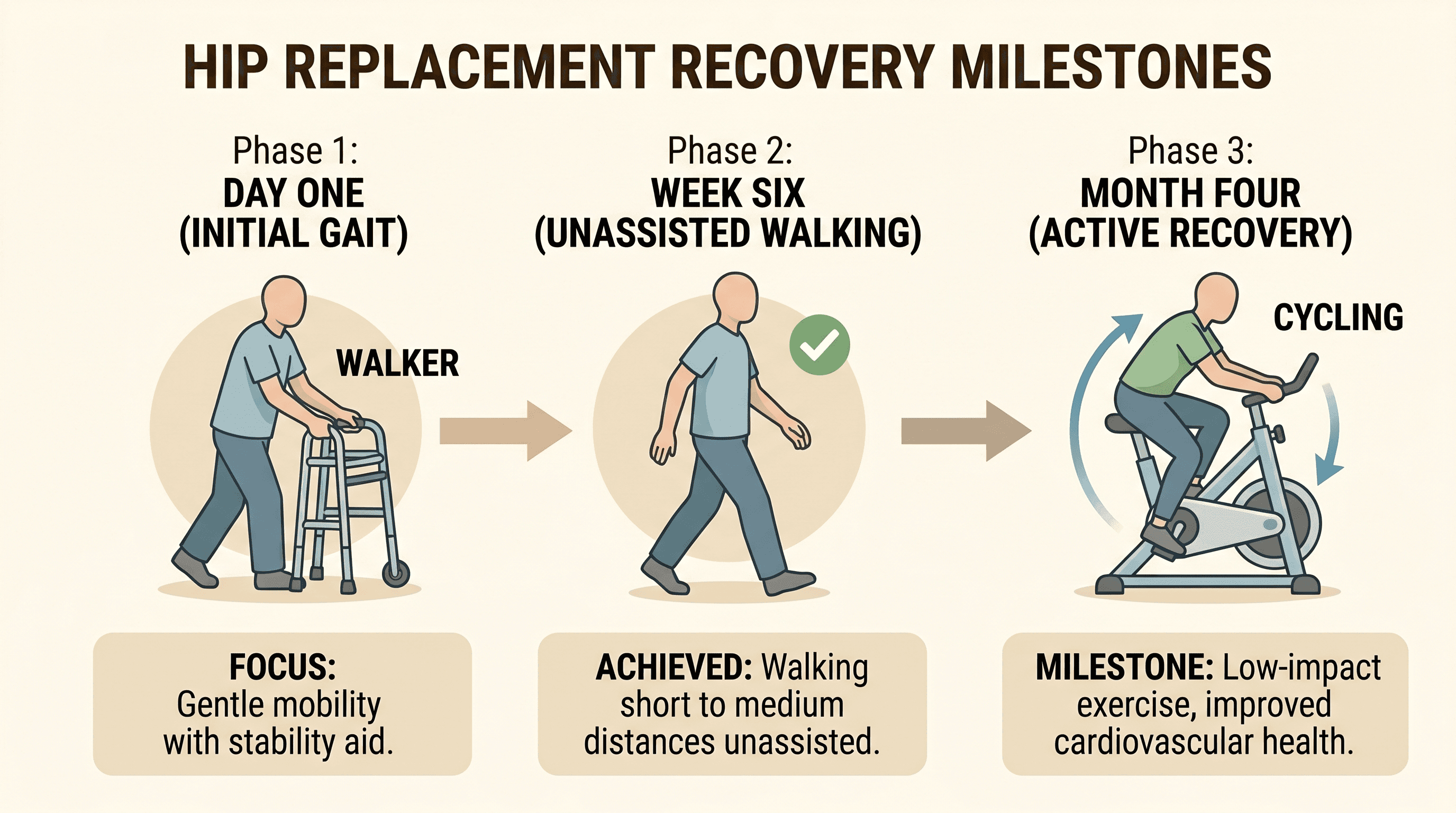
Day of Surgery Most patients stand and walk short distances within hours of leaving the OR. Pain is managed with a combination of medications that your care team tailors to your situation. The goal on day one is not distance, it is proving that the joint works and that you can move safely.
Weeks 1 to 2 You are home, moving carefully, and building on the exercises your physical therapist has given you. Most patients manage daily activities like bathing, dressing, and using the bathroom independently by the end of the first two weeks, with the assistance of grab bars and modified techniques.
Weeks 2 to 6 Walking distance increases steadily. Most patients are off a walker or cane within four to six weeks. Cleveland Clinic notes it may be six to twelve weeks before everyday activity feels normal.
Weeks 6 to 12 Desk workers often return to work around this point. Driving typically resumes after four to six weeks on the non-operative side and six to eight weeks or longer on the operative side, once brake-reaction time is reliably restored. A doctor can advise on individual cases based on which hip was operated on and what kind of vehicle you drive.
3 to 6 Months Physical labor, vigorous exercise, and sports activity are typically cleared somewhere in this range. Swimming and cycling are generally approved earlier than high-impact activities.
Beyond 6 Months Most patients have returned to the full range of activities they want to do. Hip implants are designed to last well over fifteen years in the majority of patients, and many last the full lifetime of the recipient.
Does Recovery Take Longer for Older Patients?
Age alone is not the primary predictor of recovery pace. Pre-surgery fitness level, cardiovascular health, and muscle strength matter considerably more than the number on a birthday cake. A 72-year-old who has stayed active and managed chronic conditions well may recover faster than a sedentary 58-year-old with multiple comorbidities. That said, older patients can experience slower wound healing and may need more time before returning to strenuous activity. A doctor can advise on individual recovery expectations based on the full clinical picture.
The Waiting Room Survival Guide for Family
If you are the person sitting in the waiting area while a loved one is in surgery, here is what to expect and how to stay calm when the clock ticks past the two-hour mark.
Most hospitals with active joint replacement programs have a surgical tracker board, either a physical display in the waiting room or a digital link you can check on a phone. These boards show anonymized status codes moving through stages: prep, in OR, in recovery. The language varies by hospital, but the stages are consistent.
Your first surgeon update will usually come shortly after the procedure ends. The orthopedic surgeon or a member of the care team will find you to explain how the surgery went, what implants were placed, and what to expect in the recovery room. This conversation is brief but informative.
You will not typically be allowed back with your loved one until they have moved out of the PACU and into a hospital room or a discharge bay. That separation can feel long, especially if the PACU stay runs toward the two-hour end of the normal range. This is not a signal that something went wrong. It simply means the nursing team is completing their monitoring protocol before transferring care.
If you have been waiting for three hours without an update and the tracker board has not moved, it is entirely appropriate to ask the front desk or waiting room coordinator for a status check. Do not interpret elapsed time as bad news. Revision cases, bilateral procedures, and cases where unexpected anatomy required additional steps all take longer than a straightforward primary replacement, and longer OR time is often the result of a surgeon being careful, not a surgeon facing a crisis.
Bring something to do. Bring a phone charger. Bring snacks. And if you notice the hospital has a cafeteria, use it. Patients consistently report that their family's calm presence in the immediate post-op period helps them feel settled, and that calm is easier to maintain if you are not hungry and tired.
If questions come up about next steps or what the recovery at home should look like, you can use Momentary's AI health navigator to explore symptoms, review general health information, and prepare a list of questions for the care team before or after the appointment.
Frequently Asked Questions
Is a hip replacement a major operation?
Yes. Hip replacement is classified as major surgery because it involves general or regional anesthesia, the removal of bone and cartilage, and the permanent placement of a prosthetic implant. That said, it is one of the most commonly performed and most successful elective procedures in orthopedic surgery. Complication rates are low, and the vast majority of patients report significant pain relief and improved mobility.
How soon do you walk after total hip replacement?
Most patients take their first assisted steps the same day as surgery. University of Utah Health notes that a physical therapist helps patients sit, stand, and walk around with the new joint on the day of the procedure. Early walking is part of the recovery protocol and helps prevent blood clots and muscle loss.
How painful is hip replacement surgery?
You will not feel the surgery itself because of anesthesia. Post-operatively, most patients describe moderate pain that is managed effectively with a combination of medications. The first few days tend to be the most uncomfortable, and pain typically decreases significantly over the first two weeks. If your pain feels uncontrolled or worsening after discharge, contact your care team. You can also see a doctor online through Momentary's virtual primary care for guidance on pain management questions during recovery.
How long are you in the recovery room after hip replacement?
The post-anesthesia care unit (PACU) stay runs approximately one to two hours for most patients. Nurses monitor vital signs, pain levels, and the return of sensation and movement in the legs. Patients who received a spinal block will remain in the PACU until feeling begins to return to the lower extremities. Once the team confirms stability, patients are moved to a hospital room or a discharge preparation area.
Does robotic hip replacement take longer to recover from?
No. Recovery timelines after robotic-assisted hip replacement are comparable to those after conventional manual techniques. The 2026 meta-analysis published in Cureus found that while robotic procedures require a mean of 8.43 additional minutes in the OR, outcomes and recovery trajectories are similar between approaches. Some evidence suggests improved implant placement accuracy with robotic assistance, which may support better long-term function.
What if my surgery takes longer than expected?
Most extended OR times are explained by anatomy, not complications. Denser bone, unexpected soft tissue considerations, or a need to re-check implant fit and stability can all add time. Your surgeon will share a detailed account of what happened and why once you are in recovery. If you have concerns about specific aspects of the procedure or your recovery, your care team is your best resource.
References
- Cleveland Clinic — Surgical duration, anesthesia type, outpatient discharge protocol, and recovery timeline for hip replacement.
- NHS — Step-by-step description of total and partial hip replacement surgical procedure and anesthesia options.
- University of Utah Health — Surgical steps, anterior vs. posterior approach comparison, same-day walking protocol, and discharge expectations.
- PubMed — Aamir M et al., Cureus 2026 — Meta-analysis of 15 comparative studies finding robotic THA required a mean of 8.43 additional minutes vs. manual technique.
- PMC — NHS Scotland Robotic Arthroplasty Study, BMC Musculoskeletal Disorders — Operative time comparison for robotic vs. manual hip and knee replacement across NHS Scotland 2020 to 2024, finding comparable median durations and narrower variance in robotic cases.