

Reverse shoulder replacement surgery takes about 1.5 to 3 hours from the first incision to the final stitch. But if that number is what you came here for, here is the more useful truth: your actual day at the hospital will run somewhere between 5 and 8 hours from arrival to discharge. For patients and their caregivers, that full timeline is what actually matters.
This guide walks through every phase of that day, explains what can stretch or shrink the clock, and gives family members in the waiting room a realistic picture of what to expect.
At a Glance
| Topic | Key Facts |
|---|---|
| Surgery duration | 1.5 to 3 hours (incision to closure) |
| Total hospital time | 5 to 8 hours |
| Pre-op prep | 1 to 2 hours before entering the OR |
| Recovery room (PACU) | 1 to 2 hours post-surgery |
| Outpatient vs. inpatient | Many patients go home same day; some stay one night |
| Revision surgery duration | 3 to 5 hours (vs. 1.5 to 3 for primary) |
| Nerve block duration | 18 to 72 hours of numbness after surgery |
| Anesthesia type | General anesthesia plus interscalene nerve block |
The Short Answer: How Long Does Reverse Shoulder Replacement Take?
The surgery itself takes approximately 1.5 to 3 hours from incision to wound closure, according to Cleveland Clinic. Most straightforward primary cases finish closer to the 1.5 to 2-hour mark. Revision surgeries and cases involving significant bone damage can run longer.
What patients and caregivers often underestimate is everything surrounding those two hours. Pre-operative preparation, anesthesia induction, and post-anesthesia recovery each add substantial time. When you account for the full sequence, most patients spend between 5 and 8 hours at the hospital on surgery day, even if everything goes smoothly.
The rest of this article breaks down each phase so you and whoever is driving you home can plan accordingly.
Your Full Day at the Hospital: What the Clock Actually Looks Like
No competitor fully frames the total hospital experience for patients. This section does exactly that, in order, so you can show it to your caregiver and work through the logistics together.
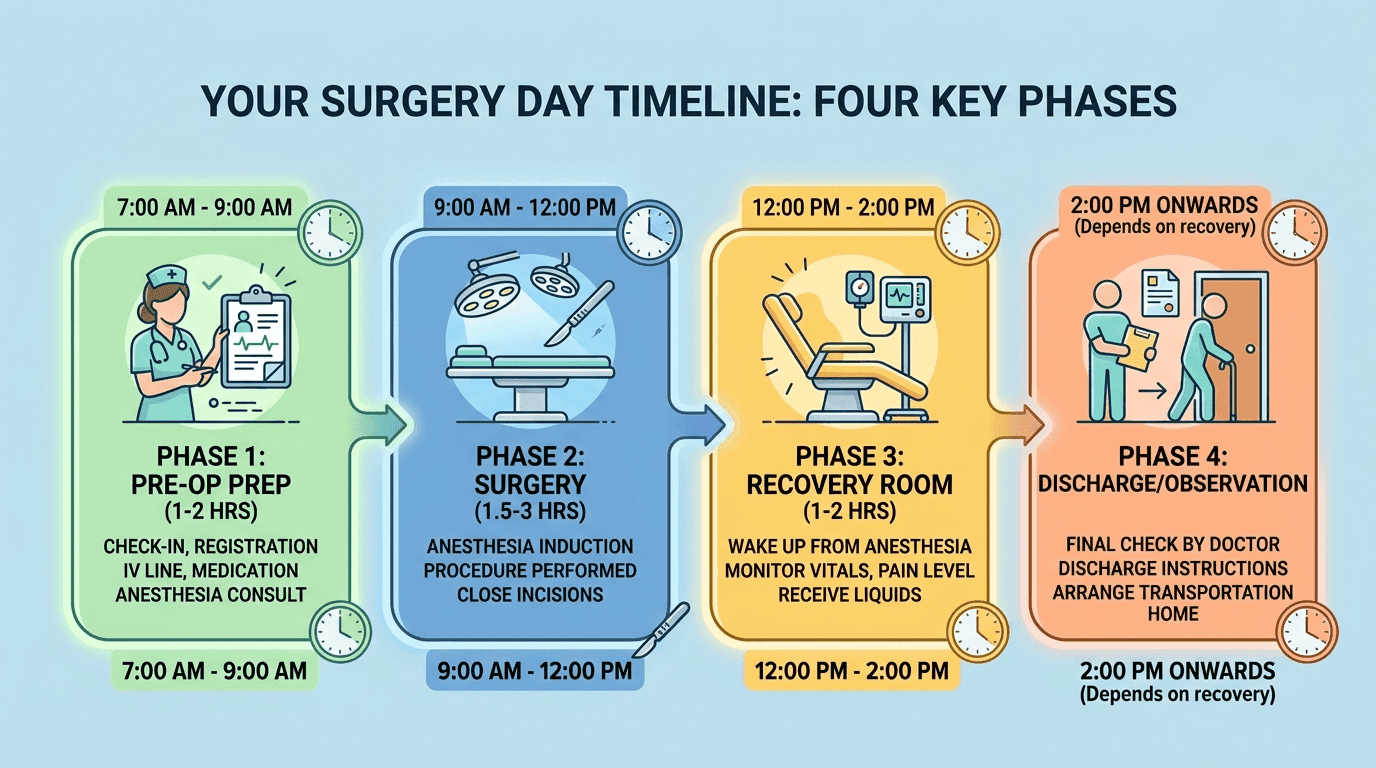
Arrival and Pre-Op Prep (1 to 2 Hours Before Surgery)
Pre-op is where most of the paperwork, monitoring, and preparation happens, and it takes longer than most patients expect.
After check-in, a nurse will record your vitals, place an IV line, and review your medications and allergies. An anesthesiologist will visit to discuss the anesthesia plan and, in most cases, administer an interscalene nerve block before the procedure even begins. This nerve block, which numbs the arm and shoulder region, is typically given in pre-op so it has time to take full effect by the time surgery wraps up. Your surgical team will mark the operative shoulder, conduct a pre-procedure safety checklist, and give a pre-operative antibiotic through the IV.
Count on arriving 1 to 2 hours before your scheduled OR time, and know that OR schedules can shift. If the surgeon is running ahead or behind, pre-op time adjusts accordingly.
The Surgery Itself (1.5 to 3 Hours)
Once you are in the operating room, the clock starts with positioning. The surgical team will place you in a modified beach chair position, with the operative shoulder accessible and the arm free to move. General anesthesia is administered, and once confirmed, the surgeon makes an incision along the front of the shoulder.
Hopkins Medicine describes the procedure as involving the removal of the damaged joint surfaces, preparation of the glenoid (shoulder socket) and humerus (upper arm bone), and precise placement and securing of the implant components. After implant fixation, the surgeon tests range of motion and stability before closing the wound in layers.
The 1.5 to 3-hour window reflects incision-to-closure time. It does not include anesthesia induction at the start or the time it takes to bring you safely out of anesthesia at the end.
Recovery Room (1 to 2 Hours After Surgery)
After the final stitch, you are transferred to the Post-Anesthesia Care Unit (PACU), where a nursing team monitors your vitals, pain level, and consciousness as the general anesthesia wears off. This phase typically runs 1 to 2 hours.
If your interscalene nerve block is working well, the operative shoulder and arm will feel numb or even completely painless during this period. That numbness is doing important work: it allows the anesthesia team to transition your pain management from OR-level sedation to oral or IV medications that you will continue at home. Family members are typically allowed into the recovery area once you are alert and stable.
What Can Make Your Surgery Take Longer (or Shorter)?
Duration variability is one of the most under-discussed aspects of reverse shoulder replacement. Knowing the factors that affect case length helps you set realistic expectations and ask the right questions during your pre-operative appointment.
Primary vs. Revision Surgery: A Major Time Difference
A first-time (primary) reverse shoulder replacement generally takes 1.5 to 3 hours. A revision procedure, meaning one that involves removing a previously implanted shoulder prosthesis before placing a new one, can take 3 to 5 hours.
Revision surgery is longer because the surgeon must carefully extract hardware that has often fused or integrated with bone tissue over years. Scar tissue from the first operation adds another layer of complexity. If bone loss around the original implant site is significant, a bone graft may also be required before the new implant can be placed. Patients who have had a prior shoulder replacement and are now considering revision surgery should specifically ask their surgeon for a case-specific time estimate, because the range is wide.
Surgeon Experience and OR Team Consistency
Fellowship-trained shoulder surgeons who perform a high annual volume of reverse shoulder replacements typically complete cases in less time and with fewer intraoperative complications, according to research published in JAMA. Equally important is OR team consistency: surgeons who work with the same scrub technician, circulating nurse, and anesthesiologist develop a coordinated rhythm that reduces transition times and problem-solving delays. When evaluating a surgeon, asking about annual case volume and whether they work with a consistent OR team is a practical, not alarmist, line of inquiry.
Complexity of the Joint Damage
Severe bone loss, prior fractures around the shoulder, or extensive scar tissue from previous surgeries can all extend OR time beyond the standard estimate. A surgeon who identifies significant glenoid bone erosion on pre-operative imaging, for example, may plan in advance for augmentation or grafting, which adds time. Patients with a complicated shoulder history should ask their surgeon to review imaging together and provide a realistic case-specific duration, rather than relying on a generic estimate.
Bone Graft Considerations
When bone loss is too severe to support the implant without additional structure, a bone graft may be required. Autografts (bone taken from the patient's own body) and allografts (donor bone) are both used in shoulder arthroplasty, according to NIH research. Adding a bone graft step increases OR time and typically moves the case toward the longer end of the range.
Reverse vs. Anatomic Shoulder Replacement: Does the Timeline Differ?
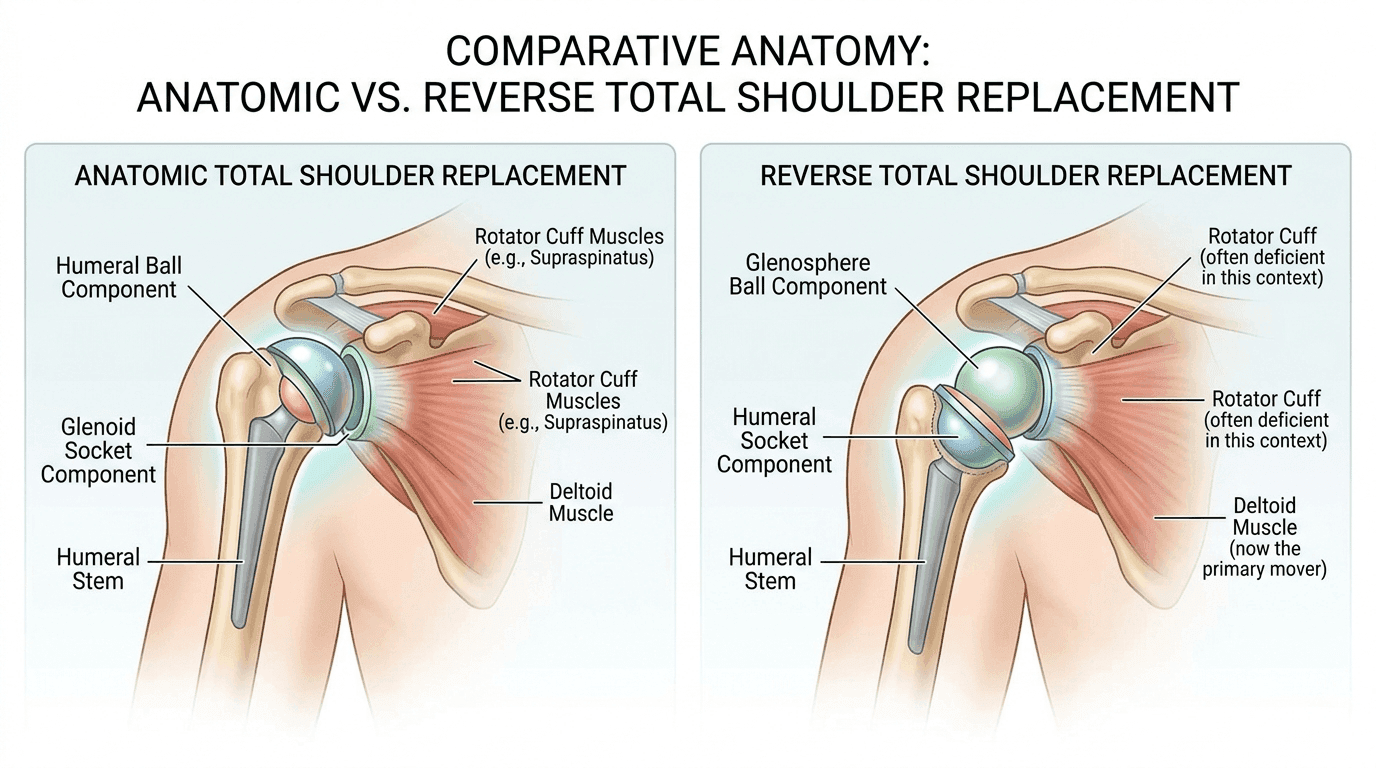
An anatomic total shoulder replacement (TSA) mirrors the natural shoulder anatomy, placing a ball component on the humerus and a socket liner on the glenoid. A reverse total shoulder arthroplasty (rTSA) flips this configuration: the ball is fixed to the shoulder blade side (glenoid) and the socket is fixed to the arm bone side (humerus).
The anatomic procedure is generally slightly faster when shoulder anatomy is straightforward. The reverse procedure requires meticulous tensioning of the deltoid muscle because the deltoid becomes the primary driver of shoulder movement when the rotator cuff is no longer functioning. That tensioning step takes additional time and precision. For patients with a failed or irreparable rotator cuff, a massive cuff tear, or proximal humeral fractures, the reverse configuration is often the only viable option, so the choice of procedure is not primarily a timeline decision but a clinical one.
Step-by-Step: What Happens During the Procedure
Walking through the mechanics of what happens inside the OR is one of the most effective ways to reduce pre-surgical anxiety. Here is a plain-language sequence of the 1.5 to 3-hour procedure, based on the Cleveland Clinic and Hopkins Medicine clinical descriptions.
The patient is positioned in a beach chair configuration with the operative shoulder exposed. After anesthesia induction, the surgeon makes an incision along the front of the shoulder joint, typically 3 to 4 inches long. Soft tissue is carefully moved aside to expose the joint.
The damaged humeral head (the ball at the top of the arm bone) is removed. The glenoid surface (the shoulder socket on the shoulder blade) is then prepared and fitted with a metal baseplate and attached glenosphere (the new ball component). On the humeral side, the bone is shaped to accept a stem and socket insert (the new socket component).
With both components in place, the surgeon tests the joint's range of motion and confirms that it is stable and properly tensioned. Any additional repairs to surrounding tissue are completed at this stage. The incision is then closed in multiple layers, and a sterile dressing is applied. The arm is placed in a sling before the patient leaves the OR.
How Anesthesia Affects Your Experience Before, During, and After
The anesthesia plan for reverse shoulder replacement typically combines two distinct approaches, and understanding both helps patients plan their recovery more practically.
General anesthesia renders you fully unconscious during surgery. The interscalene nerve block targets the brachial plexus nerve cluster in the neck, numbing the shoulder, arm, and hand on the operative side. Most patients receive both, according to Cleveland Clinic. The nerve block is usually placed before surgery begins so it is fully active when you wake up.
The practical consequence of the nerve block is significant: you may have 18 to 72 hours of numbness in the operative arm following surgery. That window is a planning opportunity. Fill all prescriptions before surgery day, because picking up medications with one numb arm and post-operative fatigue is harder than it sounds. Prepare your sleeping arrangement, meal plan, and any assistive equipment (shower chair, reaching tool, pre-cut foods) before the nerve block wears off and pain potentially increases.
Some patients experience temporary weakness in the non-operative hand and a mild sensation of shortness of breath due to the nerve block's proximity to the phrenic nerve. These effects are generally short-lived and expected, but worth mentioning to your anesthesiologist if they concern you.
Outpatient vs. Inpatient: Will You Go Home the Same Day?
Historically, shoulder replacement required a multi-day hospital stay. That has changed. Research published in the Journal of Shoulder and Elbow Surgery found that outpatient reverse shoulder replacement has comparable outcomes to inpatient surgery in appropriately selected patients.
Candidates for same-day discharge typically include patients who are medically stable, have a reliable caregiver at home, live within a reasonable distance of the surgical facility, and do not have significant complicating medical conditions. Patients with poorly controlled cardiac conditions, significant respiratory compromise, or complex surgical histories may be better suited for a one-night inpatient stay.
Ask your surgeon and surgical team directly: "Am I a candidate for outpatient surgery, and what criteria would change that?" If the answer is yes, plan around an afternoon or early evening discharge rather than an extended stay.
If you need a doctor to help evaluate whether outpatient surgery is right for your situation, connect with a primary care provider through Momentary's virtual care platform to discuss your health history before your pre-operative appointment.
Recovery Timeline After Reverse Shoulder Replacement
The surgery day timeline is just the beginning. Here is a milestone-based progression through the months that follow, according to Hopkins Medicine and University of Washington Orthopaedics.
Weeks 1 to 2: The arm remains in a sling at all times except during physical therapy exercises and hygiene. Pain and swelling are typically most noticeable during this phase. Most patients begin supervised physical therapy within the first one to two weeks.
Weeks 3 to 6: Sling use continues, with gradual introduction of passive range-of-motion exercises. Driving is not permitted during this period, as shoulder control and reaction time are insufficient.
Weeks 6 to 12: Many patients transition out of the sling around weeks 6 to 8 and begin more active-assisted and then active exercises. Driving may resume once cleared by the surgeon, typically no earlier than 6 weeks.
Months 3 to 6: Strength returns progressively. Most activities of daily living, such as reaching overhead for lightweight objects and basic self-care, become possible. Physical therapy typically continues through this period.
Months 6 to 12 and beyond: Full functional recovery for most patients. Return to low-impact recreational activities such as swimming or golf is typically possible after 6 months, depending on the surgeon's guidelines. High-impact or overhead-loading activities may be permanently restricted to protect implant longevity.
Revision surgery patients generally follow a longer recovery timeline due to the increased complexity of the procedure and potentially greater tissue disruption.
Questions to Ask Your Surgeon Before Surgery
A focused pre-operative conversation with your surgeon can close a lot of uncertainty before surgery day. These questions are worth raising at your pre-op appointment.
How long do you expect my specific case to take? Ask for a personalized estimate, not a generic range. Your imaging and surgical history may shift the answer significantly.
Am I a candidate for outpatient surgery? Know in advance whether you should plan for same-day discharge or an overnight stay.
Is this a primary or revision procedure, and does that change the timeline? If you have had prior shoulder surgery, confirm which category your case falls into and how it affects duration and recovery.
What type of anesthesia will I receive, and how long should I expect the nerve block to last? Understanding the nerve block window helps you prepare your home environment before the pain-free period ends.
What factors during surgery might extend the case? Asking this question shows your surgeon that you want realistic information, not reassurance, and gives them an opening to discuss any known complexities.
When should my caregiver expect to hear from you after surgery? Surgeons typically speak with family members shortly after the procedure. Knowing the expected timeframe prevents unnecessary anxiety in the waiting room.
When can I start physical therapy, and what does the first month look like? Getting a general outline of the post-operative rehabilitation plan before surgery makes the recovery less disorienting.
The Waiting Room Survival Guide for Family
Family members sitting in a surgical waiting room have a harder job than people acknowledge. Here is what to know.
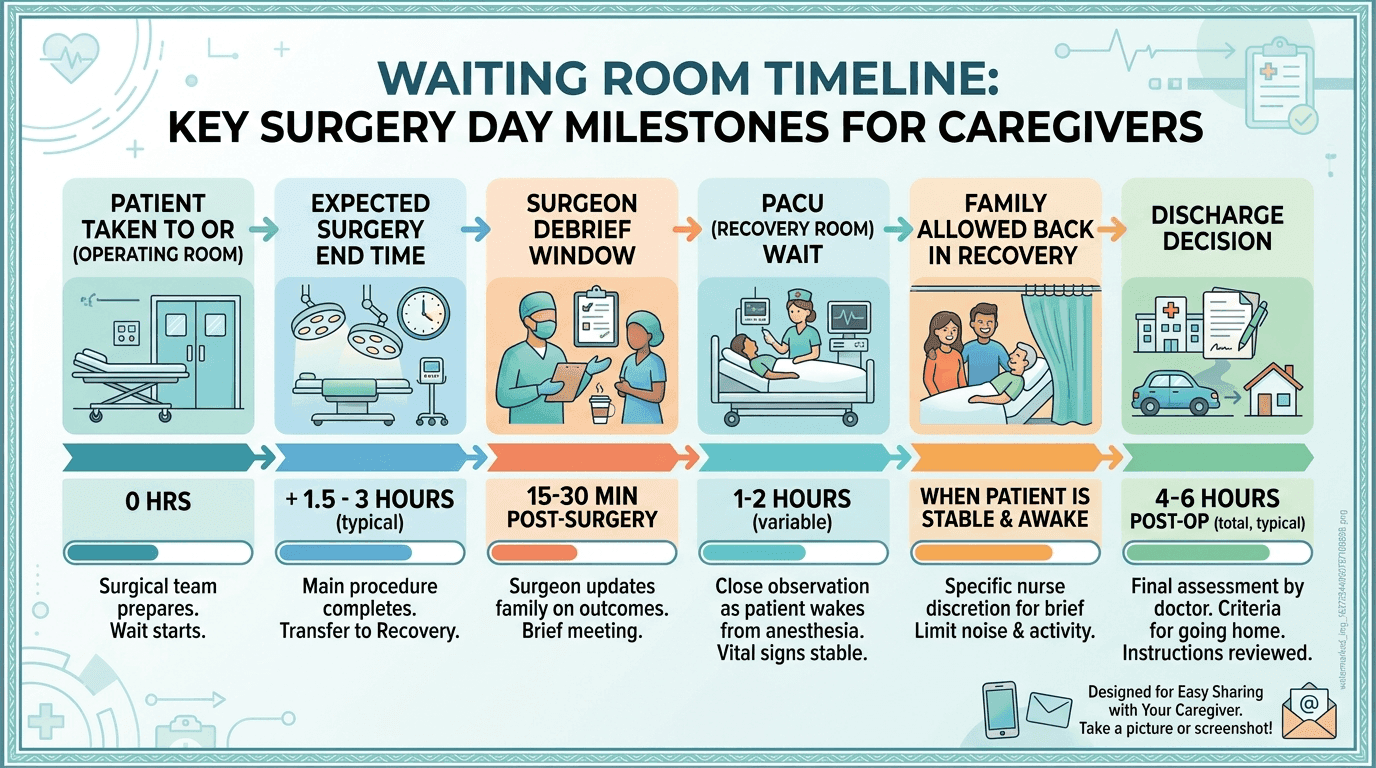
Most surgical facilities use a real-time patient tracking board, accessible either as a screen in the waiting area or as a text-based notification system. These boards typically show anonymized status codes (such as "In OR," "Closing," "In Recovery") rather than detailed updates, so the information is sparse by design. Do not interpret silence as a problem. No news from the OR team during the case is standard operating procedure.
Expect the surgeon to come out to speak with you within 15 to 30 minutes of surgery completion. This conversation is typically brief but meaningful: the surgeon will describe how the procedure went, confirm implant placement, and outline the immediate post-operative plan. Bring a notebook or prepare to record a voice memo.
Your loved one will not be available to see you immediately after surgery. PACU nurses need time to monitor vitals and manage the transition out of anesthesia before family members are brought back. This phase typically runs 1 to 2 hours. If you reach the 3-hour mark from the estimated surgery end time without an update, that is a reasonable point to ask a staff member for a status check.
Frequently Asked Questions
How long is the full hospital visit for a reverse shoulder replacement?
Most patients spend 5 to 8 hours at the hospital on surgery day, even if the surgery itself takes only 1.5 to 3 hours. Pre-operative preparation and the post-anesthesia recovery period each add 1 to 2 hours to the total.
How painful is a total reverse shoulder replacement?
Pain levels vary, but most patients report that the immediate post-operative period is managed effectively by the interscalene nerve block, which can provide 18 to 72 hours of numbness. As the block wears off, a prescribed pain management regimen takes over. Cleveland Clinic notes that patients typically experience the most discomfort in the first few days after surgery, with gradual improvement through the first weeks.
Is a reverse shoulder replacement considered major surgery?
Yes. Reverse shoulder replacement is a major orthopedic procedure performed under general anesthesia, involving removal of damaged joint tissue and placement of a prosthetic implant. It carries the standard risks associated with major surgery, including infection, anesthesia complications, and a recovery period measured in months.
How long is revision shoulder replacement surgery compared to primary?
Revision shoulder replacement typically takes 3 to 5 hours, compared to 1.5 to 3 hours for a primary procedure. The difference reflects the additional time required to safely remove existing hardware and address any bone loss or scar tissue before placing the new implant.
How long are you in a sling after a reverse shoulder replacement?
Most patients wear a sling for 4 to 6 weeks following surgery, according to University of Washington Orthopaedics. The sling is typically removed during physical therapy sessions and eventually phased out entirely as strength and stability improve.
When can I drive after reverse shoulder replacement?
Most surgeons clear patients to resume driving no earlier than 6 weeks after surgery. The decision depends on whether the operative arm has sufficient strength and control for safe vehicle operation, and whether you are still taking opioid pain medications that impair reaction time. Always get explicit clearance from your surgeon before getting behind the wheel.
If you want to better understand your symptoms, recovery signs, or next steps after surgery, explore Momentary's AI health navigator for personalized guidance on what to expect and when to reach out to your care team.
References
- Cleveland Clinic: Reverse Shoulder Replacement — Clinical overview of procedure, anesthesia, and recovery expectations.
- Johns Hopkins Medicine: Reverse Total Shoulder Replacement — Step-by-step procedure description and recovery milestones.
- University of Washington Orthopaedics: Reverse Shoulder Replacement — Sling duration, physical therapy timeline, and activity restrictions.
- NIH StatPearls: Reverse Shoulder Arthroplasty — Bone graft use and indications for reverse shoulder replacement.
- PMC: Outpatient vs. Inpatient Reverse Shoulder Replacement Outcomes — Research comparing outcomes for same-day discharge versus inpatient stay.
- JAMA: Surgical Volume and Outcomes in Shoulder Arthroplasty — Evidence linking surgeon volume and team consistency to case duration and outcomes.