

Most people hear "two hours" and stop researching. But that number only covers what happens inside the operating room. The full story, from the moment you check in to the moment you leave the building, looks quite different. This guide walks through every phase of shoulder replacement surgery, broken down by procedure type, patient factors, and what your family in the waiting room should actually expect.
At a Glance
| Topic | Key Facts |
|---|---|
| OR time (total shoulder replacement) | 1.5 to 2 hours |
| OR time (reverse shoulder replacement) | 2 to 2.5 hours |
| OR time (partial/hemiarthroplasty) | 1 to 1.5 hours |
| Pre-op preparation | 1 to 2 hours |
| Recovery room (PACU) | 1 to 2 hours |
| Total hospital day | 4 to 8 hours |
| Same-day discharge | Increasingly common for healthy candidates |
| Overnight stay | 1 night for most; longer for complex cases |
The Short Answer: How Long Shoulder Replacement Surgery Takes
The surgical portion of a shoulder replacement takes between 1.5 and 2.5 hours, depending on the procedure type. When pre-op preparation and post-anesthesia recovery are included, patients should plan for a full day of 5 to 8 hours at the surgical facility.
Here is the quick breakdown by procedure:
| Procedure Type | OR Time | Total Hospital Day |
|---|---|---|
| Total shoulder replacement (TSA) | 1.5 to 2 hours | 5 to 7 hours |
| Reverse total shoulder replacement (RTSA) | 2 to 2.5 hours | 6 to 8 hours |
| Partial shoulder replacement (hemiarthroplasty) | 1 to 1.5 hours | 4 to 6 hours |
These ranges assume no complications and a reasonably healthy patient. The sections below explain exactly what drives those numbers, and what can push them higher.
The Pre-Op Prep Window
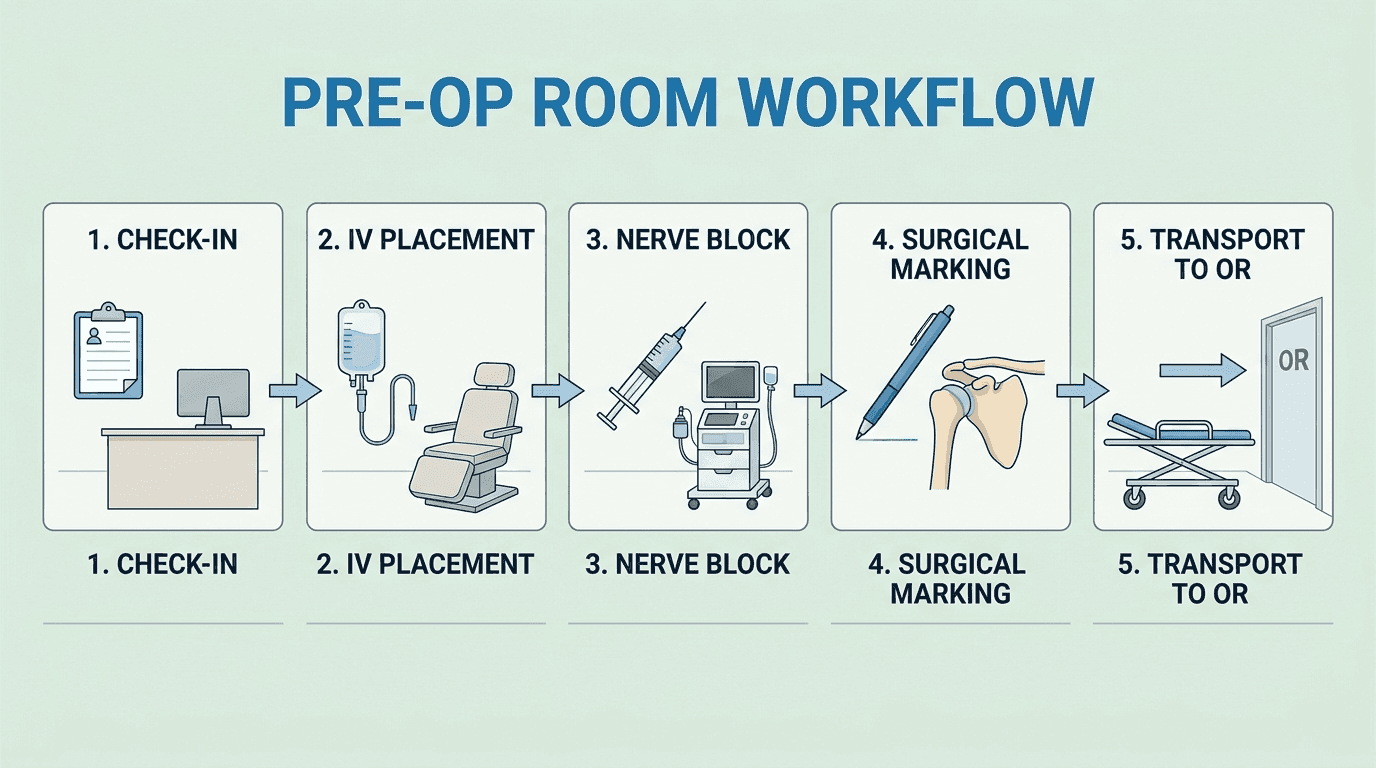
Patients typically arrive 1 to 2 hours before the scheduled OR start time. That window is not empty waiting. It is a structured sequence of clinical preparation.
What Happens Before You Roll In
After check-in, nursing staff complete vital signs, place an IV line, and review the surgical consent documentation. An anesthesiologist meets with the patient to discuss anesthesia type, review medications, and answer questions about sedation risks.
One of the most consequential steps in this window is the interscalene nerve block, a regional anesthesia technique used for most shoulder replacement procedures. According to Cleveland Clinic, nerve blocks are placed before general anesthesia to reduce intraoperative opioid use and provide pain control for 12 to 24 hours after surgery. Placing the block correctly takes 15 to 30 minutes and requires ultrasound guidance. The arm will feel heavy and numb before the patient is even brought to the OR.
The surgical site is also shaved if needed, marked with a surgical pen to confirm laterality, and scrubbed with antiseptic solution.
The Mechanics: What Is Happening in the Operating Room?
The surgical team is not moving slowly during those 1.5 to 2.5 hours. The OR phase is highly sequenced, and each step builds on the last.
The Step-by-Step Surgical Process
Once the patient is positioned and general anesthesia is confirmed, the surgeon makes an incision along the front of the shoulder, typically 4 to 6 inches long. The deltoid and pectoralis muscles are carefully separated (not cut) to reach the joint.
The arthritic humeral head, the ball portion of the ball-and-socket joint, is resected using a precise bone saw. The surgeon then prepares the medullary canal of the humerus (the upper arm bone) to accept the metal stem component. Depending on patient bone quality, this stem is either press-fit or cemented in place.
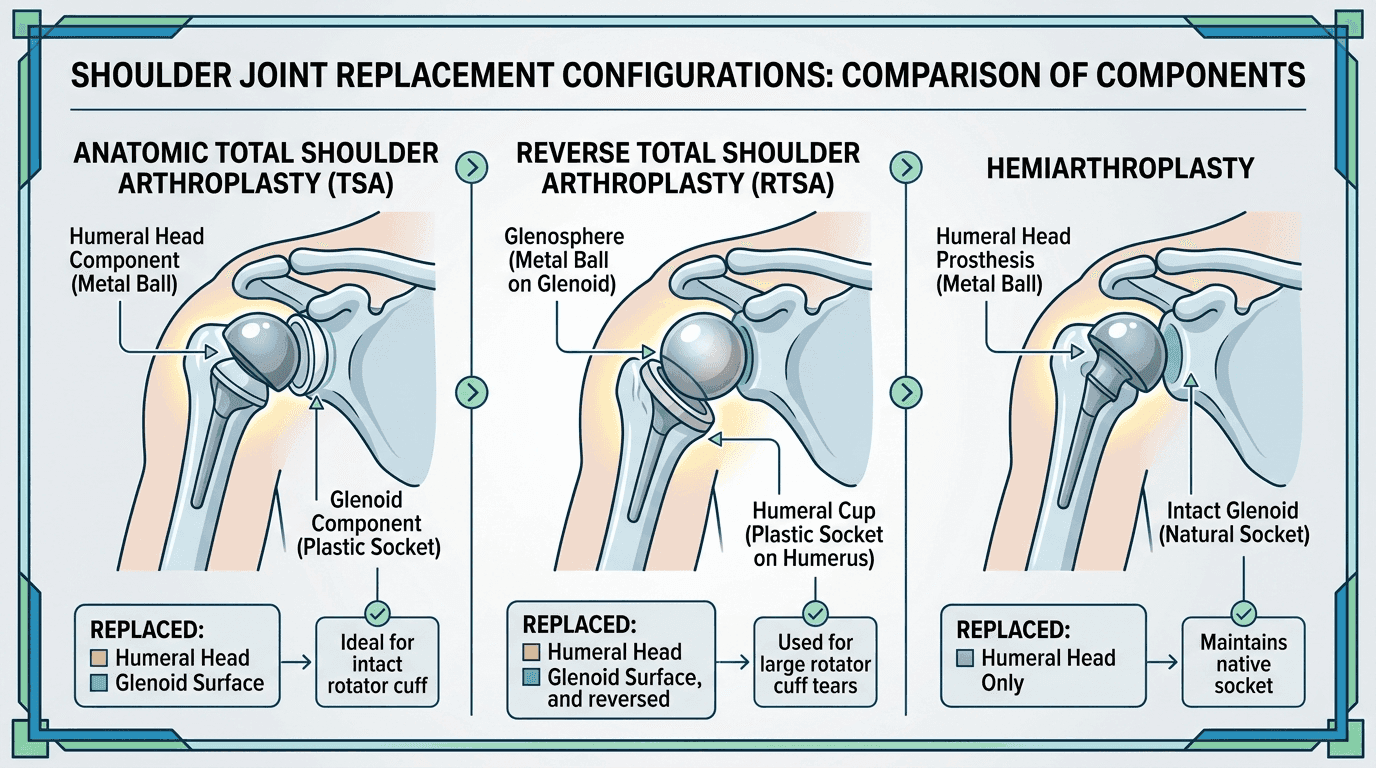
Next, the glenoid, which is the socket on the shoulder blade, is reamed to a smooth, consistent surface and fitted with a high-density polyethylene (plastic) cup in a total shoulder replacement. In a reverse total shoulder replacement, the configuration flips: a metal ball is fixed to the glenoid and a plastic socket is fixed to the humeral stem.
Throughout the procedure, the surgical team takes intraoperative X-rays to confirm component positioning before closing. Wound closure involves layered suturing of the soft tissue, followed by skin closure and sterile dressing.
According to Johns Hopkins Medicine, the entire surgical repair is intended to restore natural joint mechanics while eliminating the bone-on-bone contact that causes pain.
Anatomic vs. Reverse: Does the Procedure Change the Clock?
Yes, but the difference is more mechanical than dramatic. Both procedures use the same incision and the same general surgical approach. The time difference comes down to what gets reconstructed.
Total Shoulder Replacement (Anatomic TSA)
An anatomic TSA mimics the natural joint configuration, replacing both the ball and the socket while preserving their original orientation. According to Cleveland Clinic, this procedure is best suited for patients with an intact and functional rotator cuff. OR time runs 1.5 to 2 hours in most cases.
Reverse Total Shoulder Replacement (RTSA)
A reverse total shoulder replacement swaps the ball and socket positions. The metal ball is fixed to the shoulder blade, and the plastic cup sits on the humerus. This design is used when the rotator cuff is severely torn or non-functional, because it shifts the mechanical load to the deltoid muscle instead. According to Cleveland Clinic's RTSA page, this is the preferred approach for rotator cuff arthropathy and certain complex fractures. The additional step of tensioning the deltoid to achieve proper joint stability adds time, bringing typical OR duration to 2 to 2.5 hours.
Partial Shoulder Replacement (Hemiarthroplasty)
A hemiarthroplasty replaces only the humeral head (the ball), leaving the natural glenoid socket intact. This is a faster procedure because only one surface requires replacement. OR time generally runs 1 to 1.5 hours. It is typically considered for younger, active patients with isolated humeral head damage and a healthy glenoid, where preserving as much native anatomy as possible is a priority.
Variables That Can Extend the Surgery
Understanding average OR times is only part of the picture. Several patient-specific and case-specific factors can push a procedure past its expected window.
Extent of Joint Damage and Bone Quality
Severe osteoporosis or significant bone loss at the glenoid can require a bone graft before the socket component can be placed securely. Harvesting and shaping graft material, or placing a structural allograft, adds meaningful time to the case. Poor bone stock also affects how components are seated, and the surgical team may need to trial multiple implant sizes before committing to a final fit.
Prior Surgeries and Revision Procedures
Revision shoulder arthroplasty, meaning a procedure to replace a previously implanted shoulder joint, represents the most time-intensive category. According to a large-scale study published in BMC Musculoskeletal Disorders, revision cases involve removing a well-fixed implant, managing any bone loss created by that removal, and re-establishing stable fixation, all of which can extend OR time significantly compared to a primary replacement.
Surgeon Experience and OR Team Coordination
Operative efficiency is not just about individual skill. A well-coordinated OR team, including scrub technicians familiar with the specific implant system and an anesthesia team experienced with regional blocks, reduces non-operative time between steps. Research published in JAMA Surgery has examined the relationship between prolonged operative time and postoperative infection risk in joint replacement surgery, underscoring why experienced, high-volume centers prioritize OR efficiency as a patient safety metric.
Patient Factors: BMI, Blood Pressure, and Anesthesia Response
Elevated BMI can affect positioning, visualization, and the depth of dissection required to reach the joint. Intraoperative blood pressure fluctuations may require the anesthesia team to pause or slow the surgical pace. Some patients metabolize anesthetic agents unusually quickly or slowly, which affects the management of anesthesia depth throughout the case. None of these scenarios signals a complication; they are variables the surgical team manages in real time.
Waking Up: The Post-Anesthesia Care Unit
The PACU, or recovery room, is where patients spend 1 to 2 hours immediately after leaving the OR. The primary goals in this phase are safe anesthesia reversal, pain and nausea management, and baseline monitoring.
What to Expect When You Wake Up
Most patients wake up feeling groggy, cold, and disoriented for the first 15 to 30 minutes. The nerve block placed pre-operatively typically means the operative arm feels completely numb and heavy, which can be unsettling if not expected. Nursing staff will explain this and confirm that sensation will return gradually over 18 to 24 hours.
Vitals are monitored continuously. A post-operative X-ray is taken while in the PACU to confirm component positioning before the patient is cleared to move to the next phase of recovery.
Pain is typically well-controlled in the immediate post-op period because the nerve block is still active. As the block begins to wear off, usually the evening of surgery or the following morning, breakthrough pain is managed with oral medications.
Family members are typically brought back to see the patient once the patient is awake, communicating clearly, and hemodynamically stable. That usually occurs 45 to 90 minutes after the patient leaves the OR.
The Final Timeline: Inpatient vs. Outpatient
Whether a patient goes home the same day or stays overnight has shifted significantly in recent years.
Same-Day Discharge
Outpatient shoulder replacement has become standard practice at many ambulatory surgery centers and hospital-based outpatient facilities for appropriate candidates. Criteria for same-day discharge generally include: age and overall health stability, absence of significant comorbidities, adequate home support, pain controlled on oral medications, and no intraoperative complications.
According to Cleveland Clinic, many patients undergoing primary shoulder replacement are now discharged the same day as surgery when they meet these criteria, reflecting a broader shift toward outpatient arthroplasty across the orthopedic field.
Overnight or Extended Stay
Patients with significant cardiovascular or pulmonary conditions, those who underwent complex revision procedures, or those with limited support at home are more likely to remain inpatient for one night. Extended stays beyond 24 hours are uncommon for primary shoulder replacement in otherwise healthy adults.
If you are uncertain whether you qualify for same-day discharge, asking your surgeon directly during your pre-operative appointment will give you the clearest answer for your specific case. If access to a surgeon feels difficult, connecting with a primary care provider through Momentary can help you prepare your questions and understand your medical history before the surgical consultation.
The Waiting Room Survival Guide for Family
For the people in the waiting room, the hardest part is not knowing what "on time" looks like.
How Hospital Tracking Systems Work
Most major surgical facilities use a digital patient tracking board, either displayed on waiting room monitors or accessible via a text-based update system. These boards show status updates such as "In pre-op," "In OR," "In recovery," and "Ready for family." Families should ask the front desk at check-in how the specific facility communicates updates.
When to Expect the Surgeon
After the case is complete, the surgeon typically comes to speak with the family within 20 to 40 minutes of the patient leaving the OR. This is a brief conversation, usually 5 to 10 minutes, covering how the procedure went, any intraoperative findings, and what to expect in the first 24 hours.
When Not to Panic
If the waiting room clock ticks past the expected window by 30 to 45 minutes, that is not an automatic cause for concern. Setup time, implant sizing decisions, and careful wound closure all contribute to cases running slightly longer than projected. A facility staff member can check in with the OR coordinator if families are concerned. True surgical emergencies in elective joint replacement are rare, and the surgical team will communicate proactively if anything significant has occurred.
How Successful Is Shoulder Replacement Surgery?
Outcomes for shoulder replacement are strong across both procedure types. Pain relief is the most consistent result, with the majority of patients reporting substantial improvement.
A 2024 study published in the BMJ comparing RTSA and anatomic TSA for shoulder osteoarthritis found that both procedures delivered equivalent long-term functional outcomes and pain relief, with the choice of procedure primarily driven by rotator cuff integrity rather than expected results. This finding supports shared decision-making between patients and surgeons when both options are clinically viable.
"Both total and reverse shoulder arthroplasty yielded comparable patient-reported outcomes at medium-term follow-up for glenohumeral osteoarthritis." BMJ, 2024
Implant longevity data is also encouraging. According to Johns Hopkins Medicine, shoulder replacement implants typically last 15 to 20 years in most patients, and revision rates at 10 years remain relatively low for primary procedures.
Risks to Be Aware Of Before Surgery
Every surgical procedure carries risk, and shoulder replacement is no exception. The standard risk profile includes infection, nerve or blood vessel injury, implant dislocation (more common in RTSA), and long-term component loosening.
One underappreciated post-operative precaution: patients with a joint replacement are typically advised to inform their dentist and take prophylactic antibiotics before certain dental procedures for up to two years after surgery, due to the small risk of bacteremia (bacteria entering the bloodstream during dental work) seeding the implant. According to Cleveland Clinic, patients should discuss this precaution with both their orthopedic surgeon and their dentist.
Questions to Ask Your Surgeon Before Scheduling
Asking the right questions before surgery is one of the most effective ways to reduce anxiety and set realistic expectations.
Ask your surgeon how many shoulder replacements they perform annually, because high-volume surgeons are generally associated with better outcomes and shorter OR times. Ask specifically whether you are a candidate for same-day discharge or whether your health history suggests an overnight stay is more appropriate. Ask whether an interscalene nerve block will be used and how long it will last, since this directly affects your post-op pain experience. Ask which implant system will be used and whether it is press-fit or cemented, as this affects recovery restrictions. Ask what your specific estimated OR time is based on your imaging and surgical plan, not a generic average. Finally, ask who to call if you have concerns the evening after surgery, because having a clear answer to that question at discharge matters.
Recovery Timeline After Shoulder Replacement: Week by Week
Recovery unfolds in stages. Understanding the milestones helps set realistic expectations and reduces the anxiety that comes from comparing your progress to others.
Days 1 Through 4
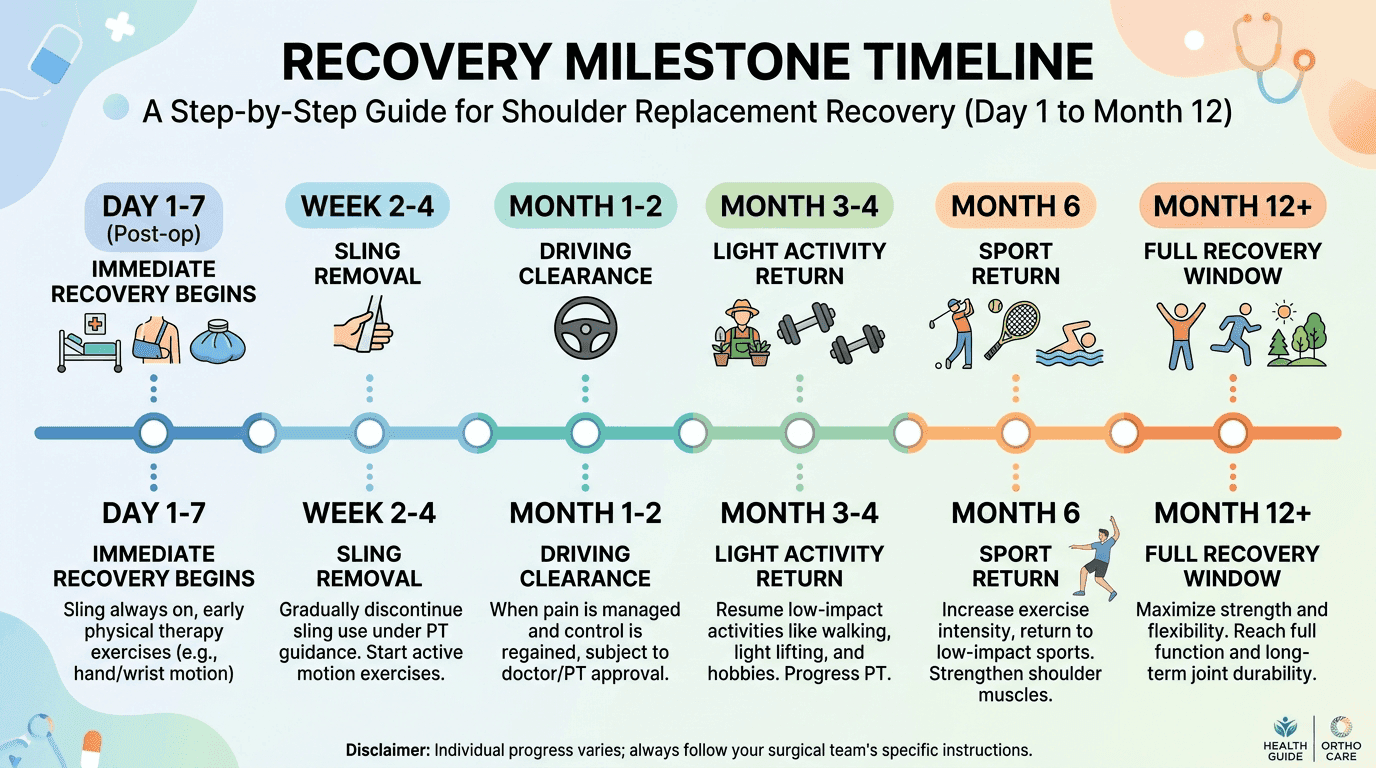
The arm will be in a sling immediately after surgery. Most patients manage pain with oral medications at home during this window. Gentle pendulum exercises, where the arm hangs freely and swings in small circles, may be introduced within the first day or two to prevent stiffness. Sleep is frequently disrupted by positional discomfort, and sleeping in a recliner or with a wedge pillow is often more comfortable than lying flat.
Weeks 1 Through 6
Sling use continues, typically full-time for the first three to four weeks and then tapered based on surgeon protocol. No lifting, pushing, or pulling beyond the weight of a light cup is permitted during this phase. Wound care involves keeping the incision dry until cleared by the surgical team. Formal physical therapy usually begins within the first two weeks, focusing on passive range of motion exercises.
Months 2 Through 4
Active motion replaces passive range of motion exercises as the repaired tissues heal. Most patients receive clearance to drive again between four and six weeks post-operatively, assuming they are not using narcotic pain medications and have adequate arm function for steering. Light daily activities, including personal hygiene and meal preparation with the operative arm, become possible during this phase.
Months 4 Through 12
Return to recreational activities varies by patient and procedure. Golfers and tennis players typically resume their sports between four and six months, though with modified intensity early on. By nine to twelve months, the majority of patients describe their shoulder as feeling natural enough that they no longer think about the surgery in daily life.
Frequently Asked Questions
Is shoulder replacement a major surgery?
Yes, shoulder replacement is classified as a major orthopedic surgery. It involves general anesthesia, bone resection, and implantation of prosthetic components. That said, advances in surgical technique, regional anesthesia, and ambulatory protocols have significantly reduced the recovery burden compared to a decade ago, and same-day discharge is now a realistic option for many patients.
How long does it take to recover from a full shoulder replacement surgery?
Full functional recovery from a total shoulder replacement takes approximately 9 to 12 months. Most patients see significant pain relief and functional improvement within 3 to 6 months, but full strength, range of motion, and the ability to return to all activities generally takes closer to a year. Physical therapy participation throughout recovery has a strong influence on the final outcome.
What can you never do again after shoulder replacement?
Most shoulder replacement patients are advised to avoid high-impact or heavy overhead activities permanently, including contact sports, heavy powerlifting, and repetitive overhead labor. These restrictions are intended to protect implant longevity. Lower-impact recreational activities such as swimming, golf, hiking, and cycling are generally compatible with a shoulder replacement over the long term.
Is shoulder replacement surgery very painful?
The immediate post-operative period is well-controlled for most patients because the interscalene nerve block remains active for 12 to 24 hours. The transition as the block wears off, typically the first night or morning after surgery, is often described as the most uncomfortable window. Oral medications manage this phase for the majority of patients. Chronic, daily pain from the arthritic joint is typically gone quickly, and most patients find the early recovery discomfort far easier to manage than the pre-operative pain they lived with before surgery.
How long does the nerve block last after shoulder surgery?
The interscalene nerve block used for shoulder replacement typically lasts 18 to 24 hours after placement. During this time, the arm may feel completely numb and unable to move voluntarily. This is expected and temporary. Patients are advised to begin their oral pain medication before the block wears off, rather than waiting for pain to break through.
Can shoulder replacement be done as outpatient surgery?
Yes, and increasingly it is. Appropriate candidates, generally healthy adults undergoing primary shoulder replacement with reliable home support, are now commonly discharged the same day at high-volume centers and ambulatory surgery facilities. Whether you qualify depends on your health status, the complexity of your procedure, and your surgeon's protocol.
If you want to understand your symptoms, explore what a shoulder replacement involves, or prepare for a conversation with an orthopedic specialist, Momentary's AI health navigator can help you clarify your questions and understand your options before your appointment.
References
- Cleveland Clinic: Shoulder Replacement — Source for pre-op nerve block information, same-day discharge criteria, implant longevity, and dental precaution guidance.
- Johns Hopkins Medicine: Total Shoulder Replacement — Source for surgical repair goals and implant longevity data.
- Cleveland Clinic: Reverse Shoulder Replacement — Source for RTSA indication and deltoid tensioning detail.
- BMJ 2024: RTSA vs. TSA for Glenohumeral Osteoarthritis — Source for equivalence of RTSA and TSA outcomes in shoulder osteoarthritis.
- BMC Musculoskeletal Disorders: Revision Arthroplasty — Source for revision shoulder replacement complexity and OR time implications.
- JAMA Surgery: Operative Time and Infection Risk in Joint Replacement — Source for the relationship between prolonged OR time and postoperative infection risk.