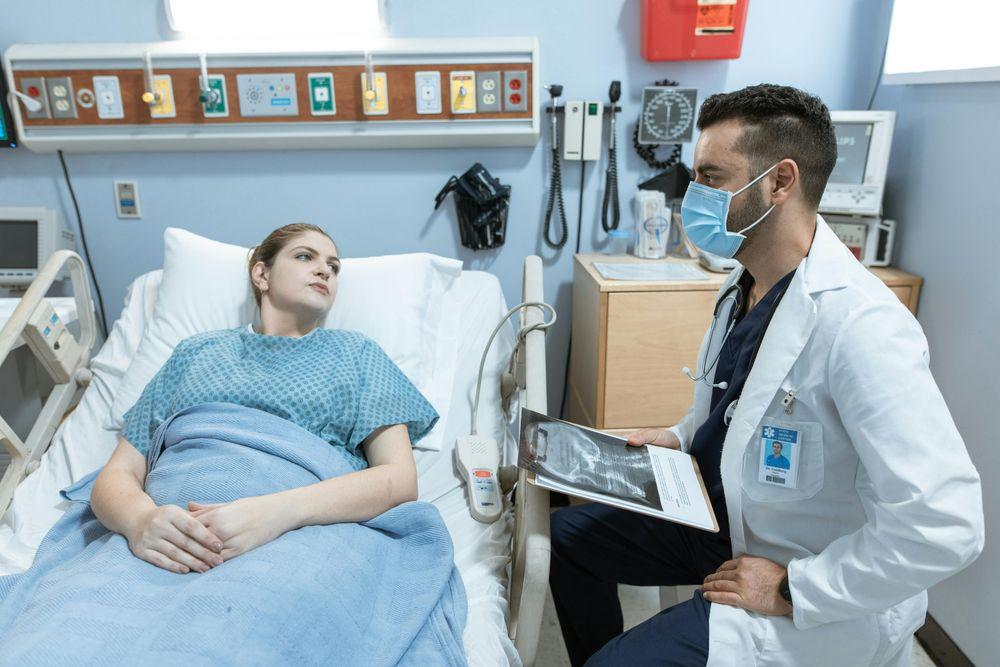


Waiting for someone you love to come out of a spinal fusion is one of the harder things a family can sit through. The clock on the waiting room wall stops making sense around hour three. And if you are the patient heading into surgery, the unknown stretch of time under anesthesia can feel heavier than the diagnosis itself.
So here is the plain answer before anything else: spinal fusion surgery takes anywhere from 2 to 7 hours in the operating room, and your total hospital day runs considerably longer than that. Where your surgery lands in that range depends on factors your surgeon can walk through with you in detail, but this guide breaks down the full picture so you know exactly what to expect.
At a Glance
| Topic | Key Facts |
|---|---|
| Typical OR time | 2 to 7 hours depending on levels and approach |
| Pre-op preparation | 90 to 120 minutes before incision |
| Recovery room (PACU) | 1 to 2 hours after surgery ends |
| Single-level fusion | 2 to 3 hours in the OR |
| Multi-level fusion (3+ levels) | 4 to 7 hours in the OR |
| Hospital stay | Same-day discharge to 3 nights depending on complexity |
| Anesthesia type | General anesthesia in most cases |
The 2 to 7-Hour Window: Why the Range Is So Wide
The most common question surgeons field before a spinal fusion is some version of "so how long will this actually take?" The honest answer is that spinal fusion surgery spans a wider clock range than most procedures, and that range is not a sign of uncertainty. It reflects how differently spines present from one patient to the next.
A single-level lumbar fusion on a healthy adult with straightforward anatomy might be finished in under 3 hours. A three-level revision surgery on a spine with significant scar tissue from a prior procedure can run 6 to 7 hours, and that outcome is still well within normal. According to Cleveland Clinic, spinal fusion is a major surgical procedure that connects two or more vertebrae together to reinforce the spine's structure, and the complexity of that task scales directly with the number of levels involved and the condition of the surrounding tissue.
Surgical time by complexity at a glance:
| Fusion Type | Estimated OR Time |
|---|---|
| Single-level (e.g., L4-L5) | 2 to 3 hours |
| Two-level (e.g., L3-L5) | 3 to 4 hours |
| Three or more levels | 4 to 6 hours |
| Complex or revision surgery | 5 to 7+ hours |
The takeaway: a long surgery is not automatically a troubled surgery. What matters is that the surgeon has the time and conditions to do the work correctly.
The Pre-Op Waiting Game: 90 to 120 Minutes Before Incision
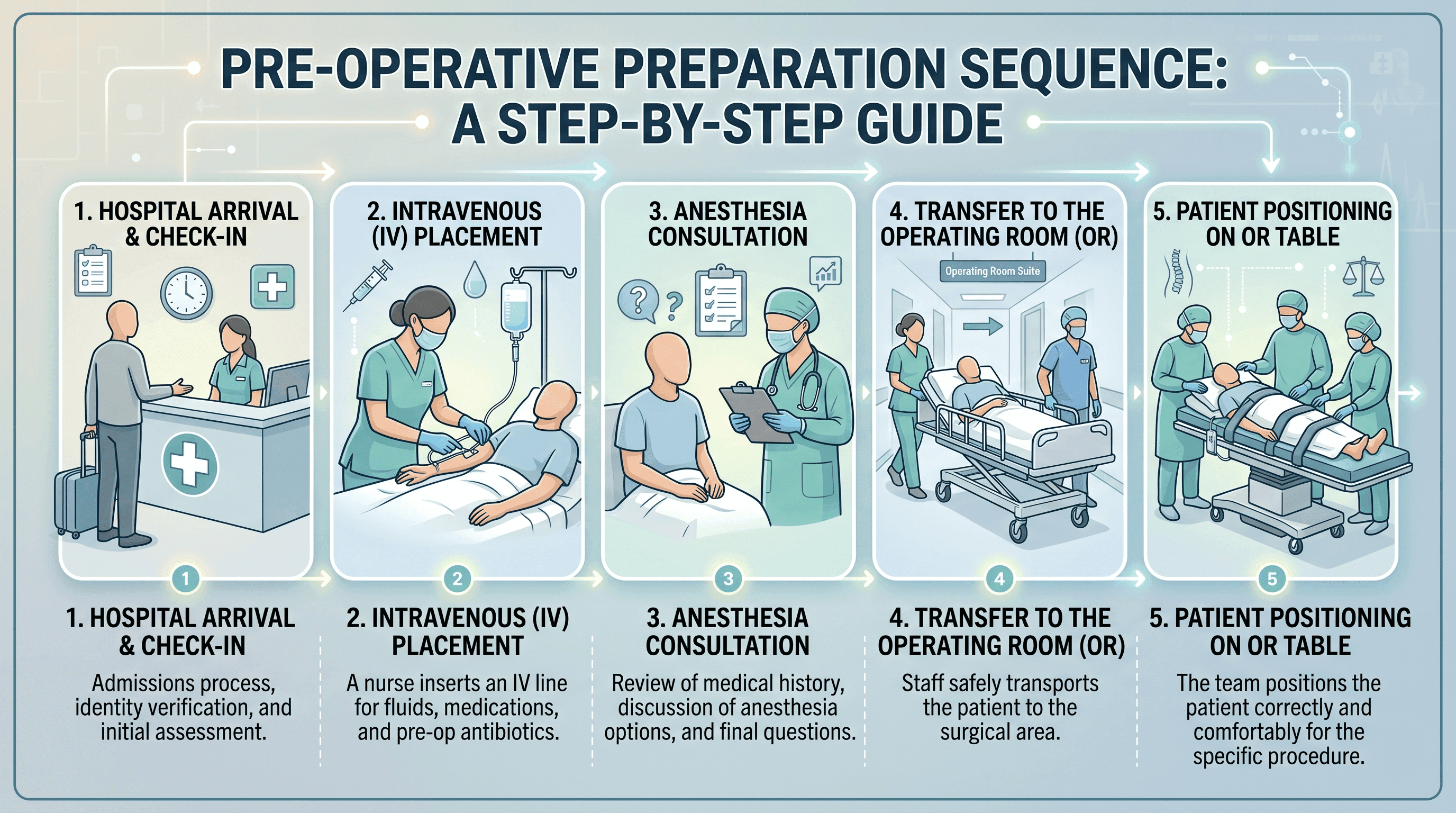
Most patients are surprised by how much happens before a single instrument touches their spine. From the moment you arrive at the hospital to the moment the surgeon makes the first incision, expect 90 minutes to 2 hours of preparation.
During this window, a nurse will review your medical history, confirm your medications, and place an intravenous line, most often in your hand or forearm. Your anesthesia team will meet with you separately, review your chart, and explain what to expect as sedation begins. The surgical team will confirm the procedure site and obtain your signed consent. Then comes positioning, which matters more in spine surgery than in almost any other procedure. Getting the patient's body aligned correctly on the table so the spine is accessible while protecting all pressure points can take 20 to 30 minutes on its own.
All of that time is preparation that directly protects your outcome. Rushing pre-op is where complications begin.
The Biggest Variable: How Many Levels Are Being Fused?
The spine is made up of 33 vertebrae, and spinal fusion targets a specific segment. Each "level" refers to the joint between two adjacent vertebrae. Fusing one level is a fundamentally different operation than fusing three.
More levels mean more hardware to place, more bone graft to harvest or position, more tissue to navigate, and more meticulous alignment work at each step. A single-level L4-L5 fusion, one of the most common spinal fusion procedures, typically takes 2 to 3 hours in the OR. Adding a third level to that same surgery can extend the operative time by 2 hours or more. When surgeons describe complex multi-level fusions spanning L3 to S1, OR times of 5 to 6 hours are common.
Bone grafting adds another layer to this. The fusion itself requires bone material to bridge the two vertebrae and encourage them to grow together. In some cases, this material comes from a donor source or a synthetic substitute and is placed quickly. In others, the surgeon harvests bone from the patient's own iliac crest (the upper rim of the pelvis), which adds a separate surgical step and 30 to 60 minutes to the overall time.
The Surgical Approach: Front, Back, or Both?
How a surgeon accesses the spine determines a significant portion of the timeline. There are several established approaches, and each one carries its own time profile.
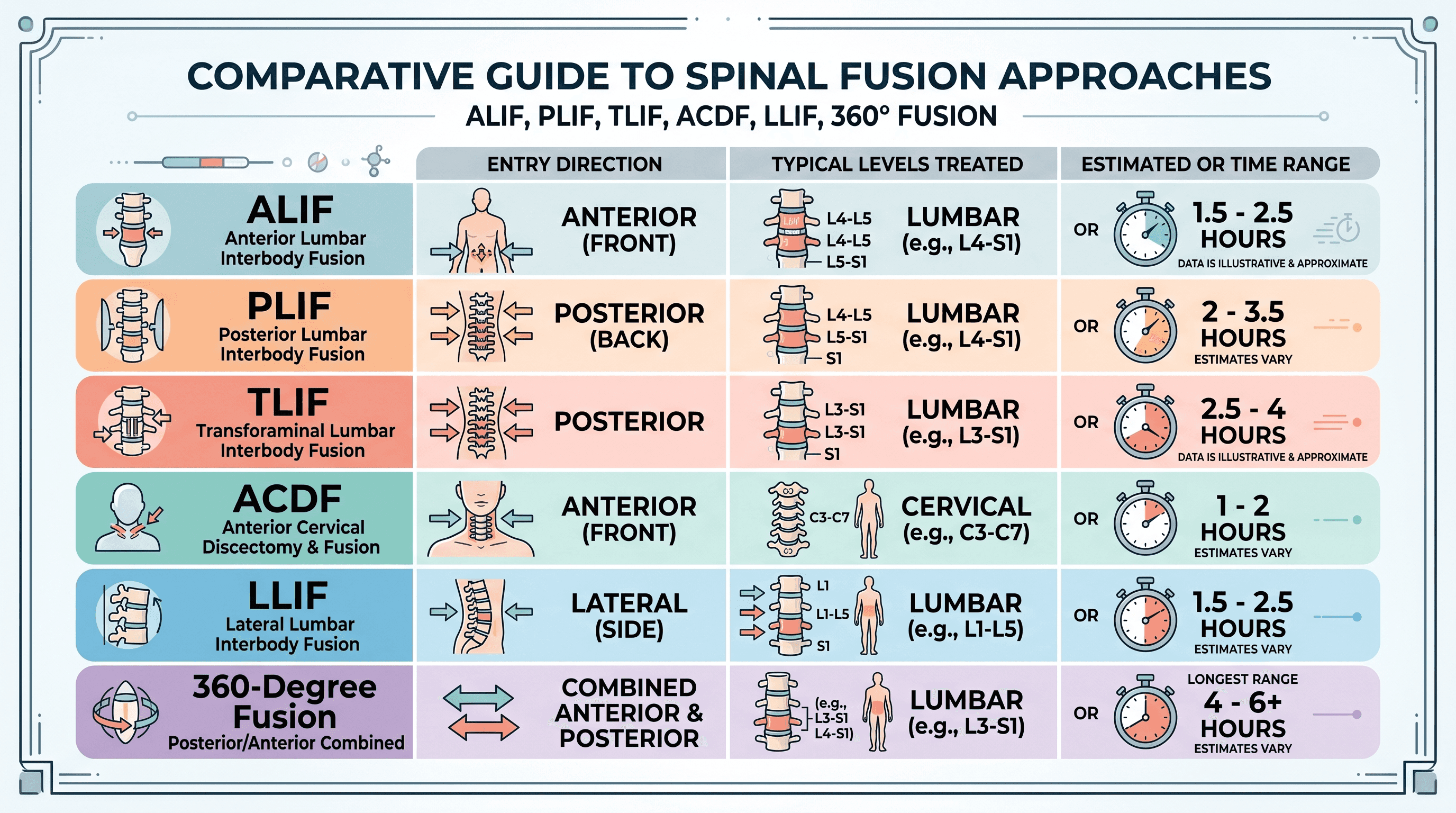
ALIF (Anterior Lumbar Interbody Fusion): The surgeon enters from the front of the body, moving through the abdomen to reach the lumbar spine. Because the approach avoids the back muscles entirely, it can reduce some tissue disruption, but it requires a vascular surgeon to assist in moving major blood vessels out of the way. ALIF procedures for one or two levels typically run 2 to 3 hours.
PLIF (Posterior Lumbar Interbody Fusion): The surgeon enters from the back, moving through the muscles of the lower back to reach the disc space from both sides. PLIF is highly versatile but involves more muscle retraction, which adds time and contributes to post-operative soreness. Single-level PLIF runs 2 to 4 hours; multi-level cases extend further.
TLIF (Transforaminal Lumbar Interbody Fusion): TLIF is a refinement of the PLIF technique that enters the disc space from a single side at an angle, reducing the retraction required. Single-level TLIF typically takes 2 to 4 hours.
ACDF (Anterior Cervical Discectomy and Fusion): For the neck (cervical spine), the surgeon works from the front. ACDF is one of the more efficient fusion approaches; single-level procedures run 1.5 to 2.5 hours, and two-level cases typically finish within 3 hours.
LLIF or XLIF (Lateral Approach): The surgeon reaches the lumbar spine from the side of the body, between the ribs and pelvis. This approach works well for certain lumbar levels and typically runs 1.5 to 3 hours per level.
360-Degree Fusion (Combined Anterior-Posterior): When a surgeon performs both an anterior approach and a posterior approach in the same surgery, the patient must be repositioned on the table mid-procedure. That repositioning step alone adds 30 to 60 minutes. Total OR time for a 360-degree fusion ranges from 5 to 8 hours. This approach is reserved for cases requiring maximum stability, such as severe spondylolisthesis or significant deformity correction.
The Decompression Phase: Cleaning Up the Spine First
Many patients do not realize that spinal fusion surgery often has two distinct phases, and the second one cannot begin until the first is finished. Before a surgeon can fuse any vertebrae together, the spine frequently needs to be decompressed first.
Decompression means removing whatever is pressing on the spinal cord or the nerve roots branching off it. That could mean shaving off bone spurs that have grown around a joint over decades of wear. It might mean removing part or all of a herniated disc. In cases of spinal stenosis (narrowing of the spinal canal), it involves carefully removing portions of the bony arch around the canal to give the nerves room to breathe.
This work is meticulous by necessity. Surgeons operate near nerve roots that run millimeters from the instruments. A thorough decompression can add 45 minutes to more than 2 hours to the overall procedure, depending on how extensive the compression is and how many levels are involved. Patients who come into surgery with significant nerve symptoms, such as radiating leg pain or numbness, often require more extensive decompression before fusion can proceed.
Open vs. Minimally Invasive Surgery: Does It Change the Clock?
Minimally invasive spinal surgery (MIS) uses smaller incisions, a camera system, and specialized retractors to reduce the amount of muscle and tissue the surgeon moves aside. This causes less damage to the surrounding tissue and typically shortens the hospital stay and recovery period. But MIS does not always shorten the OR time itself, and in some cases it adds time in the hands of a surgeon still building experience with the technique.
Open surgery gives the surgical team direct visual and physical access to the spine, which can move faster for complex multi-level or revision cases. MIS tends to be faster for straightforward single-level cases where the anatomy is predictable and the surgeon is highly experienced with the approach.
The practical difference for patients: MIS is associated with less post-operative pain, less blood loss, and shorter hospital stays, according to research published in PubMed-indexed studies on lumbar fusion outcomes. The time you spend under anesthesia depends more on the complexity of your specific anatomy than on the choice of open versus minimally invasive technique.
Robotic-assisted navigation is a newer development in spine surgery. Systems that provide real-time intraoperative imaging help surgeons place screws and hardware with greater precision. The setup for robotic guidance adds time at the start of the procedure, but precision placement reduces the chance of hardware malpositioning, which would otherwise require correction mid-surgery.
Waking Up: What Happens in the Recovery Room
When the surgeon closes the incision and the final instrument leaves the field, the surgical clock stops. But your time under medical supervision does not. You will spend 1 to 2 hours in the Post-Anesthesia Care Unit, commonly called the PACU or recovery room, before being moved to a regular hospital room or discharged.
During that time, nurses monitor your vital signs closely as the general anesthesia clears your system. Most patients wake up gradually during this phase, passing through a period of confusion, shivering, or nausea before becoming fully alert. Pain management begins immediately in the PACU, because the nerve blocks and anesthetic agents used during surgery are wearing off at the same time your awareness is returning.
A nurse will assess your pain level, breathing, blood pressure, and whether you can feel and move your legs normally. That motor check is not routine paperwork. It is the first post-operative confirmation that the surgery achieved its intended goal.
If you are on a same-day outpatient pathway, the PACU team will also begin evaluating whether you meet the criteria to go home: controlled pain, stable vitals, ability to walk a short distance with assistance, and reliable discharge support at home. If you are staying overnight, the PACU team will coordinate your transfer to the inpatient floor.
Whether you stay one night or three depends primarily on how many levels were fused, your age, your overall health going into surgery, how well your pain is controlled in the first hours after waking, and whether your surgical team is using an Enhanced Recovery After Surgery (ERAS) protocol. ERAS pathways, which optimize everything from pre-operative nutrition to post-operative mobilization, have been associated with shorter hospital stays and faster functional recovery in spine surgery patients.
The Waiting Room Survival Guide for Family
For the people sitting in the waiting room, the clock runs differently. A surgery scheduled for 3 hours may feel like 5. And if the surgeon does not appear exactly when expected, the mind fills that space with the worst interpretations.
Most hospitals have a patient tracking system, often a board in the waiting area with coded status updates, or a text or phone notification system. Before your loved one goes back, ask the pre-op nurse how updates are communicated and who to ask if the system goes quiet. You will generally receive at least one intraoperative update through the nursing staff when the patient is positioned and surgery has formally begun.
If the surgery runs longer than the original estimate, that does not mean something went wrong. Surgeons encountering unexpected anatomy, more extensive decompression than anticipated, or a need to harvest additional bone graft will take the time needed rather than rush. A longer-than-expected surgery is often a sign of thoroughness, not complication.
Ask the care team for a realistic discharge estimate before you leave the waiting area. Know where the family waiting room for the surgical floor is, and confirm whether the surgeon will come speak with you directly after the procedure ends or whether a resident or nurse practitioner will provide the update. Both are common depending on the hospital.
Once the patient is moved from the PACU to a room, you will most likely be allowed back. That transition can take 30 to 60 minutes after the surgery ends, so patience in that final window matters.
Factors That Can Extend Your Surgery Beyond the Original Estimate
Six factors consistently shift the surgical clock beyond the planned window, and knowing them in advance reduces the anxiety that comes when a surgery runs long.
Number of levels being fused is the most reliable predictor of operative time. Each additional level adds roughly 45 to 90 minutes to the procedure.
Prior spine surgeries and scar tissue are a significant wildcard. When a surgeon opens tissue that has already been operated on, the anatomy does not look like a textbook. Adhesions, or bands of scar tissue from prior procedures, must be carefully separated from the nerves and dura (the membrane surrounding the spinal cord). This adds time and demands heightened precision, as detailed in research on lumbar fusion outcomes published via PubMed.
Degree of spinal deformity matters because correcting an abnormal curve while fusing requires more steps than a straightforward single-level fusion on a stable spine.
Body mass index and tissue depth affect access. In patients with higher BMI, reaching the spine requires navigating through more tissue layers, which extends both the opening and closing phases of surgery.
Bone density affects how securely hardware can be placed. In patients with osteoporosis, surgeons may use augmentation techniques to anchor screws more reliably, adding procedural steps.
Intraoperative findings are unpredictable by definition. A surgeon who discovers the disc space is more collapsed than imaging suggested, or that a nerve root is more compressed than anticipated, will address those findings rather than leave them. Research published in PubMed on lumbar interbody fusion highlights how anatomical variability at the surgical site directly influences operative time and technique selection.
If you want to understand what specific factors apply to your case, connecting with a spine specialist who can review your imaging and surgical history will give you a far more accurate estimate than any general range.
Frequently Asked Questions
How long does a 2-level spinal fusion take?
A two-level spinal fusion typically takes 3 to 4 hours in the operating room, assuming a standard posterior or transforaminal approach with no unusual complications. Add 90 to 120 minutes for pre-operative preparation and another 1 to 2 hours in the post-anesthesia care unit, and a two-level fusion patient should expect a total hospital day of 6 to 8 hours before discharge or room transfer.
Can spinal fusion be done as same-day outpatient surgery?
Single-level minimally invasive fusions in healthy patients are increasingly performed on an outpatient basis, with same-day discharge. Multi-level fusions and cases involving significant decompression or bone graft harvest typically require at least one overnight stay. Your surgical team will determine eligibility based on the procedure's extent, your health status, and whether your post-operative pain can be controlled to a level safe for discharge.
How long is recovery after spinal fusion compared to the surgery itself?
The surgery itself lasts hours. The recovery lasts months. Most patients return to light activity within 4 to 6 weeks and resume more demanding tasks between 3 and 6 months. Full bone fusion, where the vertebrae have genuinely grown together, takes 6 to 12 months. Your surgeon will monitor this progress through imaging at follow-up appointments.
Does surgeon experience affect how long the surgery takes?
Yes, and in both directions. A highly experienced surgeon working on a straightforward single-level case will often complete it more efficiently than a less experienced surgeon. But experienced surgeons also recognize intraoperative complications earlier and respond more effectively, which can extend the time when an unexpected finding arises. Experience does not mean faster at all costs. It means better judgment about when to proceed carefully and when to make adjustments.
How long will I be under anesthesia for spinal fusion?
Anesthesia is administered slightly before surgery begins and maintained until the incision is closed, so total anesthesia time is the OR time plus approximately 15 to 30 minutes on either end. For a typical 3-hour single-level fusion, total anesthesia duration runs 3.5 to 4 hours. For a complex multi-level procedure, 7 or more hours under general anesthesia is not unusual.
How long does cervical spinal fusion take compared to lumbar?
Cervical fusions, particularly ACDF procedures on one or two levels, are among the more time-efficient spinal fusions. Single-level ACDF typically finishes in 1.5 to 2.5 hours. Lumbar fusions generally run longer because the lumbar vertebrae are larger, the hardware is bigger, and multi-level lumbar fusion is more common. A single-level lumbar fusion takes 2 to 3 hours, making the difference between cervical and lumbar roughly 30 to 60 additional minutes for comparable level counts.
References
- Cleveland Clinic: Spinal Fusion — Overview of spinal fusion procedure, preparation, treatment details, and recovery information.
- Curto RA, Edwards CC. Lengthy complex lumbar fusion surgery in high-risk elderly patient under spinal anesthesia. Int J Surg Case Rep. 2019. PMC6920206 — Case report documenting extended operative times in complex multi-level lumbar fusion.
- PubMed: Minimally invasive versus open lumbar fusion outcomes — Comparative outcomes data for minimally invasive and open lumbar fusion, including hospital stay and recovery duration.
- PubMed: Revision lumbar spine surgery and scar tissue considerations — Research on operative challenges and time implications of revision lumbar surgery.
- PubMed: Lumbar interbody fusion anatomy and technique — Foundational reference on anatomical variability and technique selection in lumbar interbody fusion procedures.
- PMC6448197: ERAS protocols in spine surgery — Evidence on Enhanced Recovery After Surgery pathways and their effect on hospital stay and recovery time in spinal fusion patients.