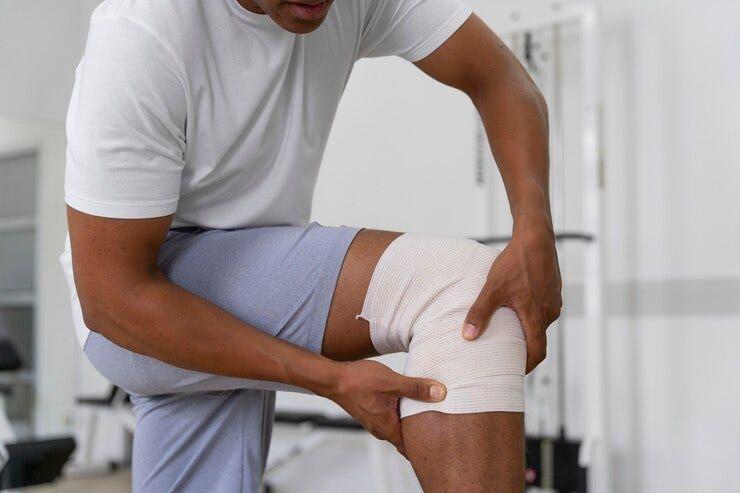


For most meniscus surgeries, the original surgical dressing and ace bandage stay on for 2 to 3 days. After that, most patients rewrap with a fresh ace bandage through their first follow-up visit, typically around days 5 to 14. The exact duration depends heavily on whether the procedure was a meniscectomy or a meniscal repair, and that distinction is the one thing no discharge sheet explains clearly enough.
At a Glance
| Topic | Key Facts |
|---|---|
| Initial dressing removal | Days 2 to 3 post-op |
| Ace bandage duration (meniscectomy) | Approximately 3 to 7 days; through first follow-up |
| Ace bandage duration (meniscal repair) | 7 to 14 days; often alongside a hinged brace |
| First follow-up appointment | Typically days 5 to 14 |
| Compression sleeve transition | Week 2 onward for most patients |
| When to stop compression entirely | When visible pitting edema resolves and kneecap definition returns |
| DVT risk window | Highest in first 14 days post-op |
| Warning signs requiring a call to your surgeon | Fever above 101°F, purulent drainage, numbness in toes, calf pain |
The Critical First 72 Hours: Leave the Original Dressing Alone
The hospital dressing is doing more work than it looks like. During the first 48 to 72 hours after knee arthroscopy, your knee continues to weep blood-tinged fluid from the incision sites, and the bulky dressing already applied in the operating room or recovery room is designed to absorb that output and keep the wound environment clean.
Multiple orthopedic post-operative protocols specify that the initial dressing should stay clean, dry, and completely intact for the first three days after surgery. Peeling back any part of it early disrupts wound healing and increases infection risk. If blood or clear fluid soaks through to the outer layer of the bandage, that is expected and not a reason to remove it. Simply reinforce the outer layer with additional gauze or a fresh layer of ace wrap on top. The dressing beneath should remain undisturbed.
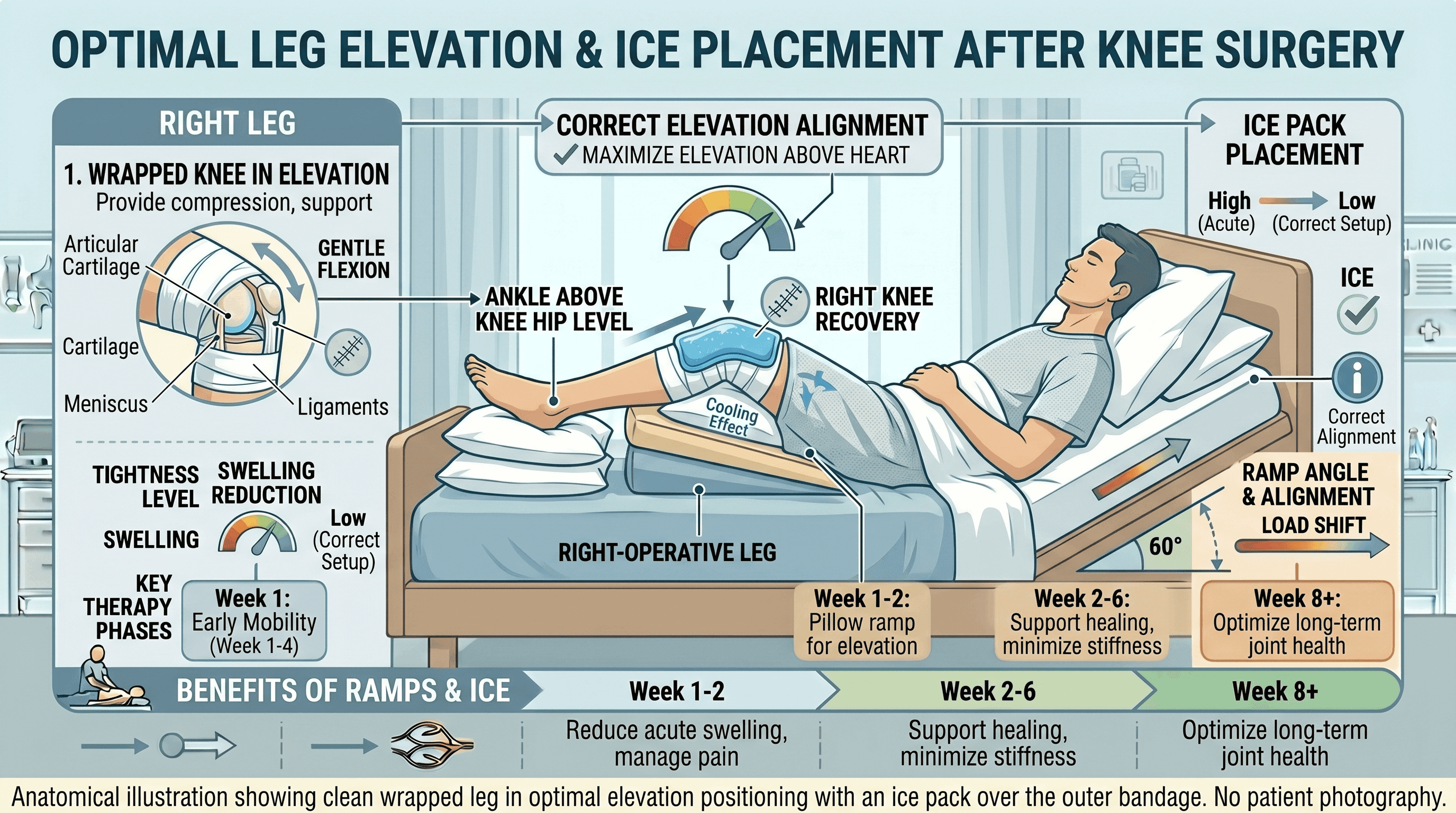
Icing over the dressing is standard. Most protocols recommend 20 to 30 minutes of ice every one to two hours during the first 24 to 48 hours. Keep a towel between the ice and the bandage to prevent skin damage. Elevate the leg above heart level as much as possible during this window, as elevation accelerates fluid drainage out of the joint. Pump the ankle up and down regularly, a movement called ankle pumps, to keep blood circulating in the lower leg.
Why Compression Is Your Best Friend During Recovery
Compression after knee arthroscopy serves three distinct clinical functions, and understanding each one helps make sense of why the ace bandage stays on longer than most patients expect.
The first function is swelling control. When the knee joint is manipulated during surgery, the body responds with an inflammatory reaction that drives fluid into the joint and surrounding soft tissue. This is called joint effusion, and it causes the puffy, tight feeling that sets in within hours of the procedure. Compression physically limits how much space that fluid has to expand into, pushing it back through the lymphatic channels and reducing the swelling response. This is why the ace wrap is started below the knee and brought upward rather than applied directly around the knee first.
The second function is wound protection. During the first few days, the ace bandage holds the gauze pads over the arthroscopic incision sites in place and protects the steri-strips underneath from being disturbed by clothing or movement.
The third function is blood clot prevention. Deep vein thrombosis (DVT) is a potential complication after knee arthroscopy. A systematic review published in Knee Surgery and Related Research found that compression stockings are among the recognized mechanical options for DVT prophylaxis in patients undergoing knee arthroscopy, alongside aspirin and anticoagulant medications. Eighty percent of post-arthroscopy DVTs occur within the first 14 days after surgery, which aligns directly with the compression timeline most orthopedic protocols follow.
Meniscectomy vs. Meniscal Repair: Two Surgeries, Two Different Timelines
This is the section that no other result on this topic gets right, and it is the most important thing to understand before figuring out how long to wear an ace bandage after meniscus surgery. The surgery type determines the timeline.
According to the American Academy of Orthopaedic Surgeons (AAOS), rehabilitation time for a meniscal repair is approximately 3 to 6 months, while a partial meniscectomy requires only about 3 to 6 weeks of healing time. That is a significant difference, and it shows up in the ace bandage protocol too.
| Feature | Partial Meniscectomy | Meniscal Repair |
|---|---|---|
| What happens | Damaged tissue trimmed away | Tear sutured back together |
| Weight-bearing | Typically immediate or same day | Non-weight-bearing 4 to 6 weeks |
| Brace required | Usually not required | Hinged brace for up to 6 weeks |
| Ace bandage duration | 3 to 7 days (through first follow-up) | 7 to 14 days alongside brace |
| Total recovery | Approximately 3 to 6 weeks | Approximately 3 to 6 months |
| Physical therapy start | Within 1 to 2 weeks | Typically after 6 weeks |
Not Sure Which Surgery You Had? Here's How to Tell
Check the procedure name on your discharge paperwork or hospital visit summary. If it says "partial meniscectomy" or "arthroscopic meniscectomy," tissue was trimmed away. If it says "meniscal repair" or "meniscus repair with sutures," the surgeon stitched the tear together. The key difference functionally: a meniscectomy removes damaged tissue that is already gone, while a repair holds living tissue together while it heals, requiring far more protection during recovery. If the paperwork is unclear, a quick call to the surgeon's office before a follow-up will give a definitive answer.
Day-by-Day Ace Bandage Timeline After Meniscus Surgery
Days 0 to 2: Leave the Original Dressing Alone
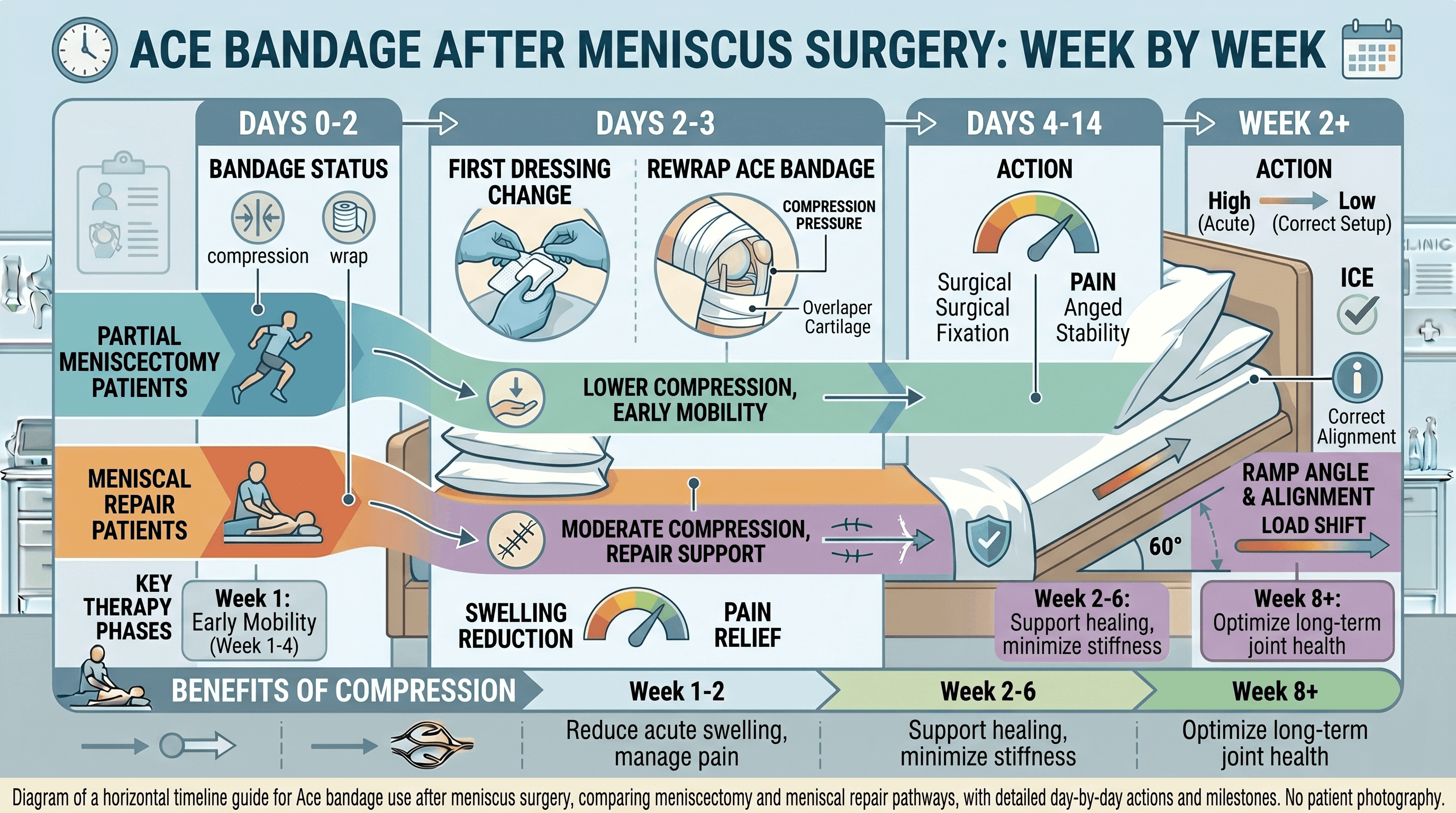
The ace bandage applied in the operating room or recovery room stays exactly as placed. Keep it dry. Do not loosen it unless it feels so tight that the toes are turning blue or feel numb. Standard post-operative instructions specify keeping the dressing clean, dry, and intact for the first 3 days, though some surgeons extend this to 4 days for meniscal repair patients. Ankle pump exercises, leg elevation, and icing continue over the dressing during this window.
Days 2 to 3: First Dressing Change and Rewrap
At this point, the initial surgical dressing comes off. Remove the outer ace bandage and the gauze pads carefully, working from the top down. The steri-strips, those thin white adhesive strips directly over each incision, stay in place until the first post-operative appointment. Cover them loosely with fresh 4x4 gauze pads and reapply a clean ace bandage starting below the knee, wrapping upward toward mid-thigh. Most protocols permit showering at this stage, but direct water pressure from the showerhead to the knee should be avoided. Baths, pools, and soaking are off-limits for at least 3 weeks.
Days 4 to 14: Continued Compression and Swelling Management
By day four, the ace bandage is no longer primarily about wound protection. Its job now is swelling management. The knee will feel stiffer and more swollen in the mornings and after activity, and the compression wrap helps counteract that fluid shift. Some degree of swelling, bruising, and discomfort is expected for several weeks after meniscus surgery and does not indicate a complication. Concerning swelling is swelling that increases significantly after day 5 and does not respond to elevation, or that is accompanied by redness, warmth, and pain in the calf rather than the knee.
After 2 Weeks: Transitioning Away From the Ace Bandage
Meniscectomy patients are typically done with the ace bandage at or before their first follow-up visit. By this point, swelling has usually reduced to a level where a compression sleeve handles the remaining fluid management more comfortably. Meniscal repair patients may continue using the ace bandage alongside their hinged brace for a longer period, transitioning based on surgeon guidance at their follow-up appointments.
How to Correctly Rewrap Your Ace Bandage After Meniscus Surgery
Wrapping technique matters more than most patients realize, and an incorrect wrap can restrict blood flow rather than support it.
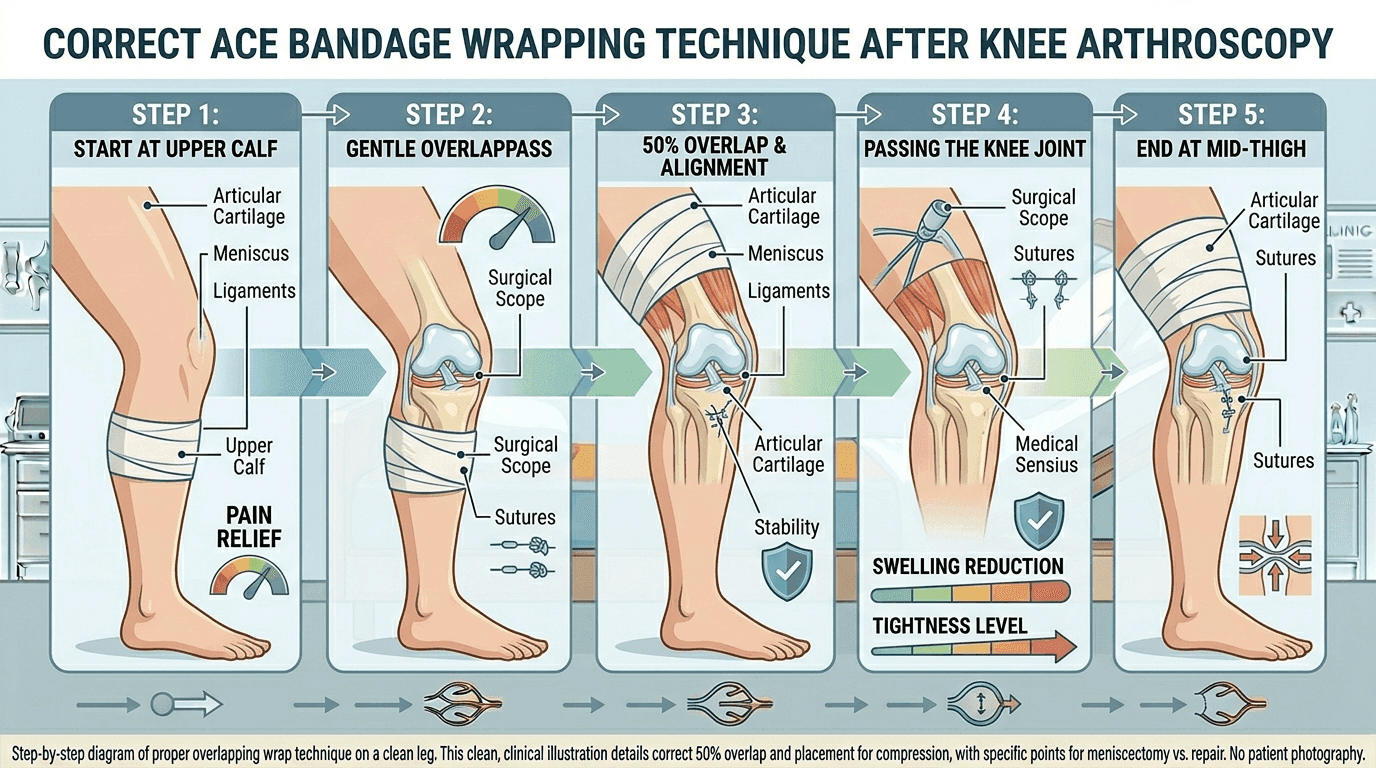
Start below the knee, at the upper calf or just below the joint line. Hold the bandage roll with the excess fabric facing upward. Wrap with roughly 50 percent overlap on each pass, meaning each new layer covers half of the layer beneath it. Move upward in a spiral pattern toward mid-thigh. The wrap should feel firm and supportive, similar to a snug handshake, but not constrictive. After finishing, check the toes. They should be warm, their normal color, and have normal feeling. If any of those change, the wrap is too tight.
One orthopedic post-operative protocol describes reapplying the ace bandage as "snug, not tight," which is a useful mental distinction. The bandage is there to support fluid drainage, not to act as a tourniquet. Rewrap once or twice a day, or whenever the bandage slips significantly or becomes loose. A washed and dried ace bandage can be reused for the duration of the recovery period.
Signs Your Ace Bandage Is Too Tight
A too-tight ace wrap restricts arterial and venous circulation in the lower leg, and the signs of that restriction are specific. Watch for numbness or tingling in the toes, a feeling of throbbing beneath the bandage, visible swelling or discoloration in the toes or at the edges of the wrap, and increased pain rather than reduced pain. Any of those signs mean the bandage should be loosened immediately. Unwrap, re-elevate the leg, and rewrap with less tension. If the numbness or discoloration does not resolve within 30 minutes of loosening the wrap, contact the surgeon's office.
Should You Sleep With an Ace Bandage On After Meniscus Surgery?
Yes, for the first 5 to 7 days. Most orthopedic post-operative protocols specify wearing the ace bandage at all times during the early recovery period, including during sleep, because the DVT risk window and swelling management are both 24-hour concerns. Before bed, loosen the bandage very slightly to account for the reduced movement that occurs during sleep. Keep the leg elevated on a pillow stack with the foot higher than the knee. Check the toes when waking. For meniscal repair patients with a hinged brace, the brace should also remain on during sleep until the surgeon advises otherwise. One post-operative protocol from a meniscal repair specialist practice specifies keeping the brace locked during all periods of rest and always at nighttime until the first post-operative appointment.
Ace Bandage, Compression Sleeve, or Brace: What You Need at Each Stage
The support progression after meniscus surgery follows the biology of healing, not an arbitrary schedule.
The ace bandage is the right tool for the first one to two weeks because it is adjustable. Swelling fluctuates significantly during this phase, and the ace wrap can be loosened or tightened day to day as needed. Its ability to cover from below the knee to mid-thigh also makes it effective at addressing swelling across the full operative region.
A compression sleeve becomes the better choice around week two for most meniscectomy patients because swelling has stabilized enough that a fixed-compression garment is practical. Sleeves are easier to put on and take off, more comfortable during daily activity, and less likely to slip. Medical-grade compression sleeves, typically 15 to 20 mmHg, provide comparable fluid management to an ace wrap once the acute swelling phase is over.
A hinged brace is specific to meniscal repair patients and serves a completely different purpose: it controls the range of motion at the knee to protect the sutured tissue while it knits together. The brace is kept locked in full extension during walking and sleeping and may be unlocked to 90 degrees during seated rest, depending on protocol. This brace is typically worn for up to 6 weeks following meniscal repair. It coexists with the ace bandage during the first two weeks rather than replacing it.
If concerns arise about which type of support is appropriate for a specific procedure or stage of recovery, connecting with a specialist through Momentary Lab's doctor directory can help locate an orthopedic provider who can review post-operative instructions directly.
Showering and Incision Care
Showering is generally permitted starting on day 3 after surgery, though some surgeons extend this to day 4 for meniscal repair. The process is straightforward: remove the ace bandage and outer gauze, let warm soapy water run over the knee without scrubbing over the incisions, and pat the area dry. Do not aim the showerhead directly at the incisions. The steri-strips should stay on until the first follow-up appointment, though they may peel at the edges on their own, which is fine. After drying the knee thoroughly, place fresh gauze pads over each incision site, cover with waterproof bandages if preferred, and reapply the ace bandage before returning to activity.
No baths, hot tubs, pools, or lake or ocean water for a minimum of 3 weeks post-surgery, as submerging the incisions before full closure dramatically increases infection risk.
When Can You Stop Using Compression Entirely?
The answer is visual, not calendar-based. Compression is no longer necessary when the knee looks and behaves normally at rest. Specifically, look for two markers: the return of the kneecap's visible definition, meaning it is no longer obscured by generalized puffiness, and the absence of pitting edema, which is where pressing a finger into the skin around the knee leaves an indentation that takes several seconds to refill. When those two signs are gone, the swelling that required compression has resolved. For most meniscectomy patients, this happens somewhere between weeks 2 and 4. For meniscal repair patients, mild swelling can persist for several months, and the transition from sleeve to no support is gradual and guided by the treating surgeon and physical therapist.
Warning Signs to Call Your Surgeon About
Some symptoms after meniscus surgery warrant a call to the surgical team the same day, not at the next scheduled visit.
A fever above 101 degrees Fahrenheit suggests a possible infection. Purulent discharge, meaning thick white or green fluid from any of the incision sites, combined with increasing redness and warmth around the wound is another indicator of infection. These symptoms require prompt evaluation.
Persistent numbness that began after rewrapping the ace bandage and does not resolve within 30 minutes of loosening the wrap should also prompt a call. This points to vascular compression from a wrap that is too tight.
Increasing pain or swelling specifically in the calf rather than the knee, or calf pain that worsens when the foot is flexed upward, can indicate a deep vein thrombosis and should be reported immediately. This is distinct from the expected soreness in the quadriceps and around the knee. Some swelling and bruising around the knee is normal for several weeks following meniscus surgery and is not, on its own, a cause for concern.
Frequently Asked Questions
When can I take the ace bandage off after meniscus surgery?
For most partial meniscectomy patients, the ace bandage can come off after the first post-operative visit, typically between days 5 and 14, once the surgeon confirms the wounds are healing properly and swelling is being managed. Meniscal repair patients often continue wrapping for up to two weeks and then transition to a compression sleeve based on surgeon guidance.
Why does my knee still hurt 3 months after arthroscopic surgery?
Persistent pain at three months is more common after meniscal repair than after partial meniscectomy, as the repaired tissue is still actively healing. Some stiffness, aching with activity, and residual swelling can be expected for up to six months following repair. That said, persistent or worsening pain outside the expected recovery pattern should be discussed with an orthopedic surgeon. A doctor can advise on whether imaging or a rehabilitation adjustment is needed.
How long do I leave a bandage on after a knee arthroscopy?
The initial surgical dressing stays on for 2 to 3 days. After the first dressing change, a fresh ace bandage is worn for approximately 5 to 14 days depending on the procedure type and swelling. Most patients transition from the ace wrap to a compression sleeve around week two.
How long after meniscus surgery can I sleep without my brace?
For partial meniscectomy patients who were not given a brace, sleeping without one is fine from the start. For meniscal repair patients, most protocols specify keeping the hinged brace on during sleep until at least the first post-operative appointment, and often through the first 6 weeks. One protocol reviewed specifies the brace should remain locked in full extension at all times when upright or sleeping until the first post-operative visit. Follow the specific instructions given at discharge and confirm at the first follow-up.
Can I shower with an ace bandage after meniscus surgery?
No. Remove the ace bandage before showering, keep the knee out of direct water pressure, pat it dry thoroughly, and then reapply a fresh wrap. Do not leave the bandage on and try to keep it dry during a shower because moisture trapped under compression bandaging creates a warm, dark environment that increases infection risk.
What if my ace bandage keeps slipping down?
A bandage that consistently slips usually means it was applied with insufficient tension or started too close to the knee rather than below it. Start the wrap at the upper calf, use consistent 50 percent overlap on each pass, and finish each round slightly firmer than feels necessary. Self-adhesive or cohesive ace bandages, which cling to themselves without clips, are far less prone to slipping and are worth purchasing if the standard elastic version keeps migrating.
References
- American Academy of Orthopaedic Surgeons. Meniscus Tears. — Cited for AAOS recovery timelines for partial meniscectomy (3 to 6 weeks) and meniscal repair (3 to 6 months).
- American Academy of Orthopaedic Surgeons. Meniscus Repair. — Cited for the clinical rationale for meniscal repair versus trimming and long-term joint preservation.
- Cleveland Clinic. Meniscus Surgery. — Cited for the overview of meniscus surgery types and recovery duration comparisons.
- Knee Surgery and Related Research. Deep vein thrombosis prophylaxis in patients who undergo knee arthroscopy: a systematic review. — Cited for compression stockings as a recognized mechanical DVT prophylaxis option after knee arthroscopy.
- PubMed. Prevention of deep-vein thrombosis in ambulatory arthroscopic knee surgery: a randomized trial. — Cited for the finding that 80 percent of post-arthroscopy DVTs occur within the first 14 postoperative days.
Not sure whether your symptoms are part of normal healing or something to flag? Momentary Lab's AI healthcare navigator can help you understand what you're experiencing and guide you toward the right next step.