


Sleeping after shoulder replacement surgery is, for most patients, the hardest part of the entire recovery. Not the physical therapy. Not the sling. Not even the first few post-op days in the hospital. It's the nights at home, when the house is quiet, the medication is wearing thin, and the shoulder that was supposed to feel better still throbs every time you shift position.
If that describes where you are right now, this guide was written for you. Not for a general "shoulder surgery" patient, but specifically for someone who has just had a shoulder replacement and is trying to figure out how to get through the night without waking up five times in pain.
What follows is the information most surgical teams do not have time to cover in a 10-minute post-op appointment: why sleep is so hard after this particular procedure, which positions actually work and when, how total and reverse replacement patients differ in their recovery arc, and what to do at 3 a.m. when the pain wakes you up and you have no idea if something is wrong.
At a Glance
| Topic | Key Facts |
|---|---|
| Primary sleep position | Reclined at 30 to 45 degrees (recliner or wedge pillow) |
| How long in recliner | 4 to 6 weeks for total replacement; 6 to 8 weeks for reverse replacement |
| Sling while sleeping | Yes, worn 24/7 for the first 4 to 6 weeks unless surgeon advises otherwise |
| Elbow support | Small pillow or folded towel under the elbow prevents joint pull |
| Side sleeping (non-operative) | Often safe from weeks 3 to 4 with pillow support |
| Side sleeping (operative) | Generally 6 to 10 weeks minimum; reverse replacement may take longer |
| Medication timing | Take prescribed pain relief 30 to 45 minutes before bed |
| Ice before bed | 15 to 20 minutes on the shoulder to reduce end-of-day inflammation |
| Normal return to flat bed | Most patients by weeks 5 to 8 |
Nighttime Is the Hardest Part of Recovery
The first thing to understand is that severe night pain after shoulder replacement is not a sign that something went wrong. It is a documented and expected part of recovery, particularly in the first four to six weeks.
Several things converge to make nighttime uniquely miserable after this surgery. First, the shoulder capsule and surrounding soft tissue are in an active healing phase, and lying still for hours means the joint stiffens. Any unplanned arm movement, even a small roll during sleep, can yank the healing tissue and wake you abruptly. Second, inflammation follows a natural diurnal pattern, often peaking in the late afternoon and overnight hours, which is why pain tends to feel worse at night than during the day.
The most disorienting moment for many patients comes around days two and three post-op, when the nerve block placed during surgery begins to wear off. Before that point, many patients feel surprisingly comfortable. Then the block clears, the shoulder's actual pain signal comes back online, and the first real night of recovery begins. Knowing this is coming makes it less frightening.
The good news is direct: week one is the hardest week. Most patients report meaningful improvement in sleep quality by weeks three to four as inflammation decreases and the body adapts to the new joint. Optimizing the sleep setup from day one compresses that timeline and reduces the overall severity.
Total vs. Reverse Shoulder Replacement: Does the Surgery Type Change How You Sleep?
The short answer is yes, and no competitor article covers this distinction in any useful way.
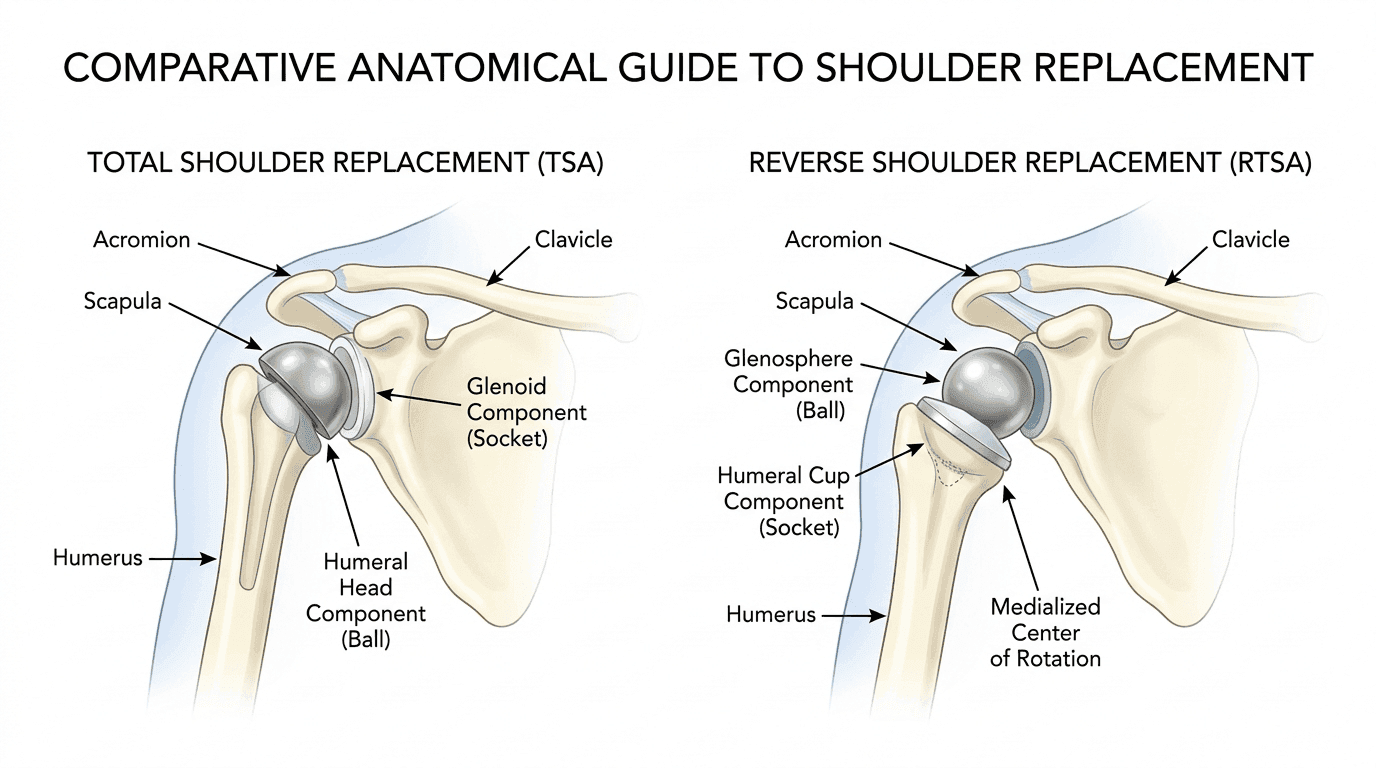
A total shoulder replacement replaces the ball (humeral head) and socket (glenoid) with prosthetic components. It is typically performed in patients with a functioning rotator cuff, and the repaired anatomy provides reasonable stability fairly quickly.
A reverse shoulder replacement flips the joint's architecture, placing the ball on the socket side and the socket on the arm side. It is designed for patients with a significantly torn or non-functional rotator cuff. Because the deltoid muscle now bears more of the load that the rotator cuff previously handled, the surrounding muscle fatigue is more pronounced and the healing arc is longer.
From a sleep standpoint, the practical differences are meaningful:
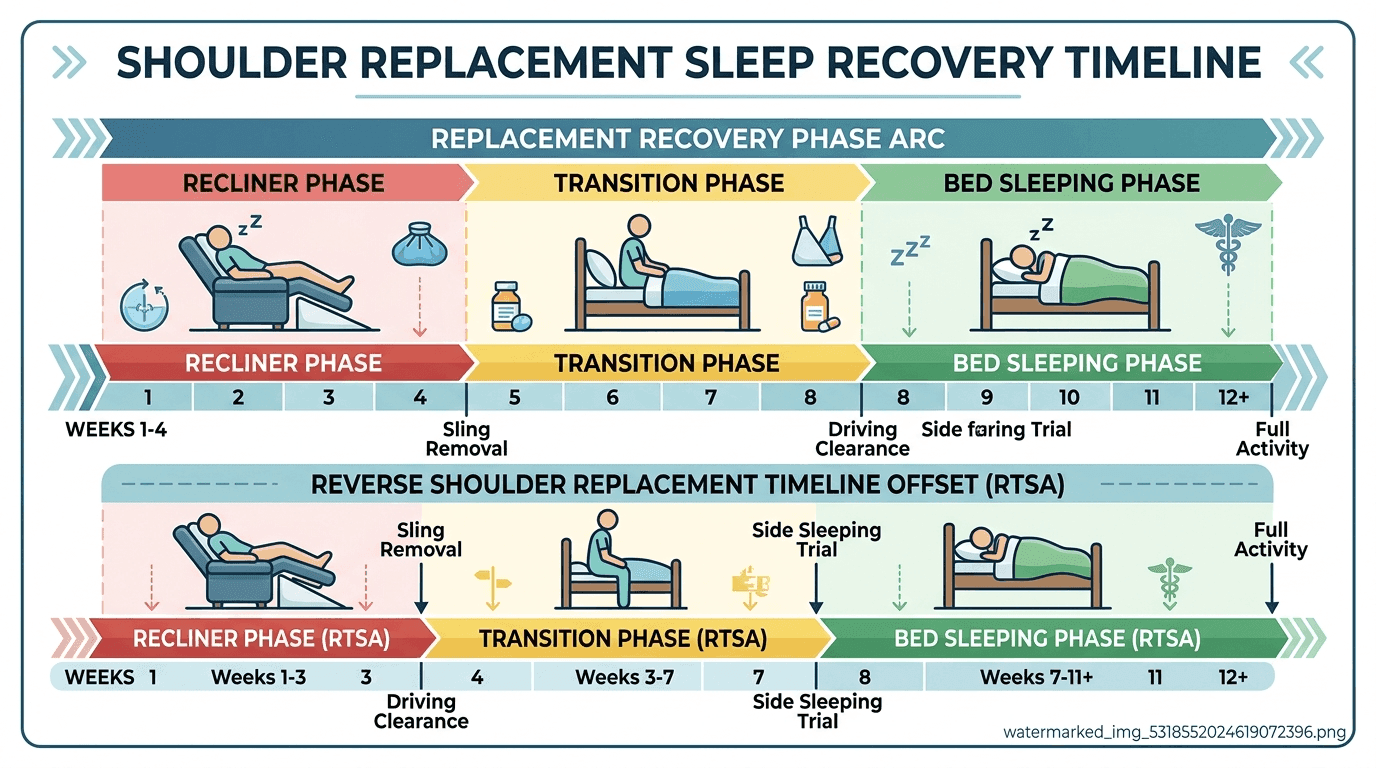
Reverse replacement patients typically need to sleep in a reclined position for six to eight weeks, compared to four to six weeks for total replacement patients. The arm position restrictions are often stricter. Reaching or rotating the arm too far in sleep carries a greater risk of discomfort in the early weeks. And full return to a preferred sleeping position, including the operative side, may take up to 12 months for reverse replacement patients, compared to four to six months for most total replacement patients.
Throughout this guide, wherever the advice differs by surgery type, that distinction is noted explicitly.
The Best Sleeping Positions After Shoulder Replacement Surgery
Getting the position right is the single biggest lever patients have over their nighttime pain. Here is what the evidence and clinical experience support.
Reclined Position
The reclined position, ideally in a recliner chair set to approximately 30 to 45 degrees, is the gold standard for the first weeks of recovery. At this angle, gravity keeps the arm gently forward and prevents it from falling back toward the mattress, which is the primary mechanical cause of the deep, aching pain patients describe when trying to sleep flat.
A recliner has one significant practical advantage over a wedge pillow in bed: if you are an active sleeper who rolls or shifts during the night, a recliner physically constrains that movement in a way a bed cannot. For patients who know they move a lot during sleep, the recliner is the safer choice for the first two to three weeks.
To set up the recliner for overnight comfort, place a small pillow or folded bath towel beneath the elbow of the surgical arm. This is a step most patients skip and most guides omit, but it makes a significant difference. Without it, the weight of the arm pulls the shoulder slightly backward and downward even in a reclined position, creating a constant low-grade stretch on the joint capsule. Elevating the elbow by even one to two inches pushes the shoulder slightly forward and removes that tension. The wrist and hand should rest at roughly elbow height or slightly above.
Use a light blanket for warmth without weight, and consider placing a small rolled towel behind the surgical shoulder for additional forward support if needed.
Sleeping on Your Back in Bed
Once transitioning to a bed, sleeping on your back with a wedge pillow maintaining the 30 to 45 degree incline is the next step for most patients. The wedge should run the full length of the torso, not just support the head, to avoid creating a forward neck flexion that causes a different kind of pain.
Place a standard pillow on each side of the body to prevent rolling. Under the elbow of the surgical arm, use a folded pillow or towel to maintain the slight elevation described above. Some patients find a small pillow tucked under the wrist uncomfortable; the support point should be the elbow, not the wrist.
Sleeping on Your Non-Operative Side
Sleeping on the non-operative side is typically safe to attempt beginning around weeks three to four, though your surgeon's guidance takes precedence over any general timeline.
The key is preventing any forward roll that would end with weight on the surgical arm. Stack two to three pillows behind your back to act as a physical block. Place the surgical arm on a pillow in front of the body, at approximately chest height, to keep it supported and slightly elevated. The sling should still be worn during this phase.
When Can You Sleep on the Operated Side?
This is one of the most searched questions, and the honest answer is: later than most patients hope, but the reason is not what most people assume.
Lying on the operative side does not risk damaging the implant itself. The implant is mechanically secure. What is happening is that the surrounding soft tissue, the capsule, repaired muscles, and tendons, is still healing, and the compressive weight of the body on that shoulder is simply painful for most patients in the early weeks.
The realistic timeline for most total shoulder replacement patients is six to ten weeks before operative-side sleeping becomes comfortable. For reverse shoulder replacement patients, the timeline is often longer, sometimes not until three to six months post-op, depending on the individual's healing and the surgeon's specific protocol. Attempting this too early does not cause structural damage, but it will likely result in significant pain and poor sleep quality, which delays recovery in other ways.
A Week-by-Week Sleep Timeline After Shoulder Replacement
This is the section no existing article provides, and it is exactly what patients search for in forums and Facebook groups at midnight. Consider this the map your surgical team did not have time to draw.
| Timeframe | What to Expect | Sleep Setup |
|---|---|---|
| Weeks 1 to 2 | Nerve block wears off days 2 to 3; highest pain intensity period; multiple nighttime wakeups are normal | Recliner at 30 to 45 degrees; sling on 24/7; elbow propped on folded towel |
| Weeks 3 to 4 | Inflammation begins to decrease; transition attempt to bed with wedge pillow is appropriate for most patients | Wedge pillow in bed or continued recliner; non-operative side sleeping may begin with pillow support |
| Weeks 5 to 6 | Most patients sleeping in bed; recliner still an option for difficult nights | Wedge incline may reduce slightly; sling typically still worn to bed |
| Weeks 7 to 12 | Most total replacement patients sleeping in bed comfortably; operative-side sleeping may begin around week 6 to 10 | Wedge optional; body positioning becomes more flexible |
| Months 3 to 6 | Most total replacement patients have returned to preferred sleep position | Normal sleeping positions restored for most; reverse replacement patients may still have some limitation |
| Months 6 to 12 | Reverse replacement patients typically achieve full sleep position freedom in this window | Normal sleeping positions fully restored |
A few important notes on this timeline. First, it represents the typical arc, not a guarantee. Individual healing, pain tolerance, and surgical specifics vary. Second, reverse replacement patients should shift every milestone in this table approximately two to four weeks later as a working assumption. Third, setbacks are normal. A night of worse sleep after a few good nights does not mean regression. It usually means the shoulder was more active during the day, which drove up end-of-day inflammation.
How to Manage Pain Before Bed
Pain management before bed is a protocol, not a list of tips. The difference matters because the timing of each step interacts with the others.
Step one is medication timing. If a prescription pain reliever or muscle relaxant has been prescribed, take it 30 to 45 minutes before getting into the recliner or bed. This allows the medication to reach its effective concentration in the bloodstream at the moment sleep is being attempted, rather than half an hour into a restless, painful wait. Taking medication reactively, after pain has already peaked, means chasing the pain rather than staying ahead of it. A pharmacist or surgeon can advise on the specific timing for individual prescriptions.
Step two is ice therapy. Apply a cold pack or cold therapy device to the surgical shoulder for 15 to 20 minutes approximately 30 minutes before bed. Cold therapy reduces localized inflammation and numbs the superficial nerve endings around the joint, which decreases the intensity of the background ache that makes falling asleep difficult. Do not sleep with a cold pack in place; remove it before getting into the recliner. According to the Mayo Clinic, cold application should be limited to 15 to 20 minutes at a time to avoid tissue damage.
Step three is gentle movement earlier in the day. Physical therapy exercises prescribed for the recovery period should be completed well before the evening, ideally in the morning or early afternoon. Doing PT exercises close to bedtime activates the healing tissue and elevates inflammation at exactly the wrong time. If exercises are causing a predictable spike in evening pain, raise this with the physical therapist; timing adjustment is a simple and effective fix.
Step four is passive range-of-motion for the elbow, wrist, and hand. The operated shoulder is immobilized, but the elbow, wrist, and fingers are not. Gently flexing and extending these joints for a few minutes before bed prevents the cramping and stiffness that many patients experience from keeping the arm in one position throughout the night.
Setting Up Your Bedroom for Post-Replacement Recovery
The environment where sleep happens matters as much as the position used, and this is a practical area most recovery guides skip entirely.
If using a recliner, position it near a power outlet if it is electric. Keep the cold pack or cold therapy device within arm's reach of the non-surgical hand. Place a small side table with water, any overnight medications, and a phone within reach so that waking up at night does not require standing up and navigating a dark room. Placing a dim nightlight within line of sight of the recliner reduces the disorientation of nighttime wakeups.
Clothing for sleep is often overlooked. Loose-fitting shirts that can be put on and taken off without raising the arm above shoulder height are important. Many patients use oversized button-front shirts or zip-up hoodies that do not require overhead dressing. Avoid anything with tight sleeves, which can restrict circulation and make sling wearing uncomfortable.
Room temperature is worth considering. A slightly cool room, around 65 to 68 degrees Fahrenheit, promotes deeper sleep. This is particularly useful in the first weeks when discomfort makes the nervous system hypervigilant.
Getting in and out of the recliner safely is a practical skill that no guide addresses directly. To get into the recliner, back up to it, lower yourself slowly using the non-surgical arm on the armrest, then recline slowly once seated. Keep the surgical arm close to the body during the transition. To get out, bring the recliner upright first, then push up using the non-surgical arm. Never use the surgical arm to push or bear weight during transfers in the first four to six weeks. For getting in and out of bed, the same principle applies: lead with the non-surgical side, and lower or raise the body using leg strength and the non-surgical arm.
An adjustable bed, if available, is an underutilized recovery tool. The head elevation function replicates the wedge pillow angle without the risk of slipping off a wedge during the night, which is a surprisingly common complaint.
What to Do When You Wake Up in Pain at Night
This is the scenario every shoulder replacement patient encounters and no article has ever answered directly. Here is the 3 a.m. protocol.
First, check the sling position. The most common cause of sudden nighttime pain is that the sling has shifted during sleep, allowing the arm to rotate or the elbow to drop. Before doing anything else, reposition the sling so the arm is back in the neutral position, elbow bent at roughly 90 degrees, forearm supported, shoulder close to the body. In many cases, this alone reduces the pain within a minute or two.
Second, reposition the elbow support. If the pillow or towel under the elbow has shifted, replace it. Restoring that slight elevation takes the gravitational pull off the shoulder joint.
Third, apply cold if accessible. If a cold pack is within reach of the non-surgical hand, apply it for 10 to 15 minutes. Do not sleep with it on.
Fourth, consider medication timing. If the next scheduled dose is due within an hour and pain is significant, take it at that point rather than waiting. If the dose was recently taken and pain remains severe, sit with the cold pack applied for 10 to 15 minutes and allow the medication to reach full effect.
Fifth, use controlled breathing. Slow, diaphragmatic breathing activates the parasympathetic nervous system and reduces the pain amplification that comes from a stress response. Breathe in for four counts, hold briefly, exhale for six counts. This is not a distraction technique; it is a physiological response that genuinely reduces perceived pain intensity.
The important reassurance here is this: waking up in pain does not mean the implant has shifted, that the surgery failed, or that something is structurally wrong. Pain at night in the first four to six weeks is an expected part of the healing process. The goal is to manage it efficiently and return to sleep, not to panic.
If sleep disruption and pain are significantly affecting quality of life or daily functioning, connecting with a provider is always appropriate. Seeing a primary care provider or orthopedic specialist through a telehealth visit can be a practical option for discussing pain management adjustments without requiring an in-person trip during early recovery weeks.
When to Call Your Surgeon About Sleep-Related Pain
Most nighttime pain after shoulder replacement is normal. But some symptoms warrant a call to the surgical team, and knowing the difference reduces unnecessary anxiety while also ensuring that genuine warning signs are not dismissed.
Call your surgeon if you experience any of the following:
A sudden, severe pain accompanied by an abnormal change in arm position or a visible deformity at the shoulder may indicate dislocation. This is relatively rare with modern implants but requires immediate evaluation.
A fever above 101 degrees Fahrenheit, increasing warmth or redness around the incision, or swelling that is worsening rather than improving can indicate infection. Infection after joint replacement requires prompt medical attention.
Numbness, tingling, or progressive weakness in the hand or fingers that was not present in the days immediately after surgery may indicate nerve compression. This is distinct from the numbness that accompanies normal nerve block wear-off in the first few days.
Pain that was clearly improving and then suddenly becomes significantly worse without an obvious cause, such as overexertion or a fall, is worth a call.
For questions that feel urgent but do not require an emergency room visit, using Momentary's AI health navigator can help you think through whether what you are experiencing warrants a same-day call to your surgeon or can wait until the next business day.
FAQ
How long do you have to sleep upright after shoulder surgery?
Most total shoulder replacement patients sleep in a reclined position (recliner or wedge pillow at 30 to 45 degrees) for four to six weeks. Reverse shoulder replacement patients typically need six to eight weeks in a reclined position before transitioning to a flat bed is comfortable. Individual timelines vary, and the surgeon's specific guidance should always take precedence over general estimates.
What is the fastest way to recover from shoulder replacement surgery?
Consistent adherence to the physical therapy program, adequate sleep in a position that protects the joint, staying ahead of pain with properly timed medication, and managing inflammation with consistent ice therapy are the four factors most within a patient's control. Skipping PT, attempting full activity too early, or chronically poor sleep all extend recovery timelines. According to the American Academy of Orthopaedic Surgeons, following the prescribed activity restrictions in the early weeks is a primary factor in achieving the best long-term outcome.
Can I take my sling off while sleeping?
For most patients, no. The sling should be worn 24 hours a day, including during sleep, for the first four to six weeks post-op (or longer for reverse replacement patients). The reason is not discomfort; it is protection. During deep sleep, involuntary arm movements are common. A sudden rotational movement or the arm dropping off a pillow can stress the healing capsule and rotator cuff repair. The surgeon will advise when sling removal during sleep is appropriate for the individual case.
Why can't I sleep at all after shoulder surgery?
Insomnia after shoulder replacement is more common than most patients are told before surgery. The causes include pain, disrupted sleep architecture from narcotic pain medications, anxiety about recovery, and the physical challenge of sleeping in an unfamiliar position. Research published in the Journal of Shoulder and Elbow Surgery has documented that sleep disturbance is a significant and underaddressed aspect of shoulder arthroplasty recovery. If insomnia is severe or prolonged, discussing it with the surgical team is appropriate. Short-term sleep support, whether through medication adjustment or behavioral strategies, is a legitimate part of recovery management.
Does the type of shoulder replacement affect how long recovery takes?
Yes, meaningfully. Total shoulder replacement patients typically return to their preferred sleeping position within four to six months. Reverse shoulder replacement patients often take six to twelve months to achieve the same, and the reclined sleeping phase is typically two to four weeks longer. The underlying reason is that reverse replacement alters the mechanics of the shoulder more substantially and requires greater muscular adaptation, particularly of the deltoid.
Is it normal for shoulder pain to feel worse at night than during the day?
Yes. Increased nighttime pain is a well-recognized phenomenon in musculoskeletal recovery. Contributing factors include reduced cortisol levels at night (cortisol has natural anti-inflammatory effects), positional changes during sleep, and the fact that there are fewer distractions at night to redirect attention away from pain signals. This pattern typically improves as overall inflammation decreases through the recovery arc.
References
- Cancienne JM et al., Journal of Shoulder and Elbow Surgery, 2025 — Study on post-operative outcomes and recovery variables in shoulder arthroplasty patients.
- Puzzitiello RN et al., PubMed, 2023 — Research on sleep disturbance following shoulder surgery and its clinical implications.
- Journal of Shoulder and Elbow Surgery, 2022 — Clinical data on insomnia and sleep disruption as an underaddressed outcome measure in shoulder arthroplasty recovery.
- Shoulder Arthroplasty Outcomes, PMC, 2025 — Research on functional recovery timelines following total and reverse shoulder replacement.
- Mayo Clinic — Guidance on safe use of ice/cold therapy for musculoskeletal recovery.
- American Academy of Orthopaedic Surgeons — Clinical recommendations for activity restrictions and recovery following shoulder replacement surgery.