


Knowing the answer to "how long does it take to do knee replacement surgery" is one of the first things patients want before scheduling. The operating room time is one number. Your actual day at the hospital is another. And full recovery is a third timeline altogether. This article breaks all three down clearly so you can plan with confidence, not guesswork.
At a Glance
| Topic | Key Facts |
|---|---|
| Surgical time (total knee) | Approximately 1 to 2 hours |
| OR time (skin-to-skin plus setup) | Approximately 2 to 3 hours |
| Total hospital day | 6 to 8 hours for most patients |
| Partial knee replacement | Approximately 45 to 60 minutes |
| Robotic-assisted knee replacement | Approximately 1.5 to 2.5 hours |
| Bilateral knee replacement | Approximately 3 to 4 hours |
| Revision knee replacement | Approximately 2 to 3 hours or longer |
| Hospital stay | Same-day discharge to 1 to 3 nights |
| Walking with assistance | Within 24 hours post-surgery |
| Full functional recovery | 6 to 12 months |
The Short Answer: How Long Does Knee Replacement Surgery Take?
For most patients, the operating room time for a total knee replacement runs between 1 and 2 hours, though your entire hospital day will be considerably longer. The table below gives a fast reference by procedure type, targeting the specific question most patients search first.
| Procedure Type | Typical Surgical Time |
|---|---|
| Total knee replacement (TKA) | 1 to 2 hours |
| Partial (unicompartmental) knee replacement | 45 to 60 minutes |
| Robotic-assisted total knee replacement | 1.5 to 2.5 hours |
| Bilateral knee replacement (both knees) | 3 to 4 hours |
| Revision knee replacement | 2 to 3 hours or more |
These figures cover skin-to-skin surgical time. They do not include pre-operative preparation, anesthesia administration, or recovery room time. The full picture is longer, and that context matters when you are arranging transportation, childcare, or time off work.
Pre-Operative Preparation: What Happens Before the Clock Starts?
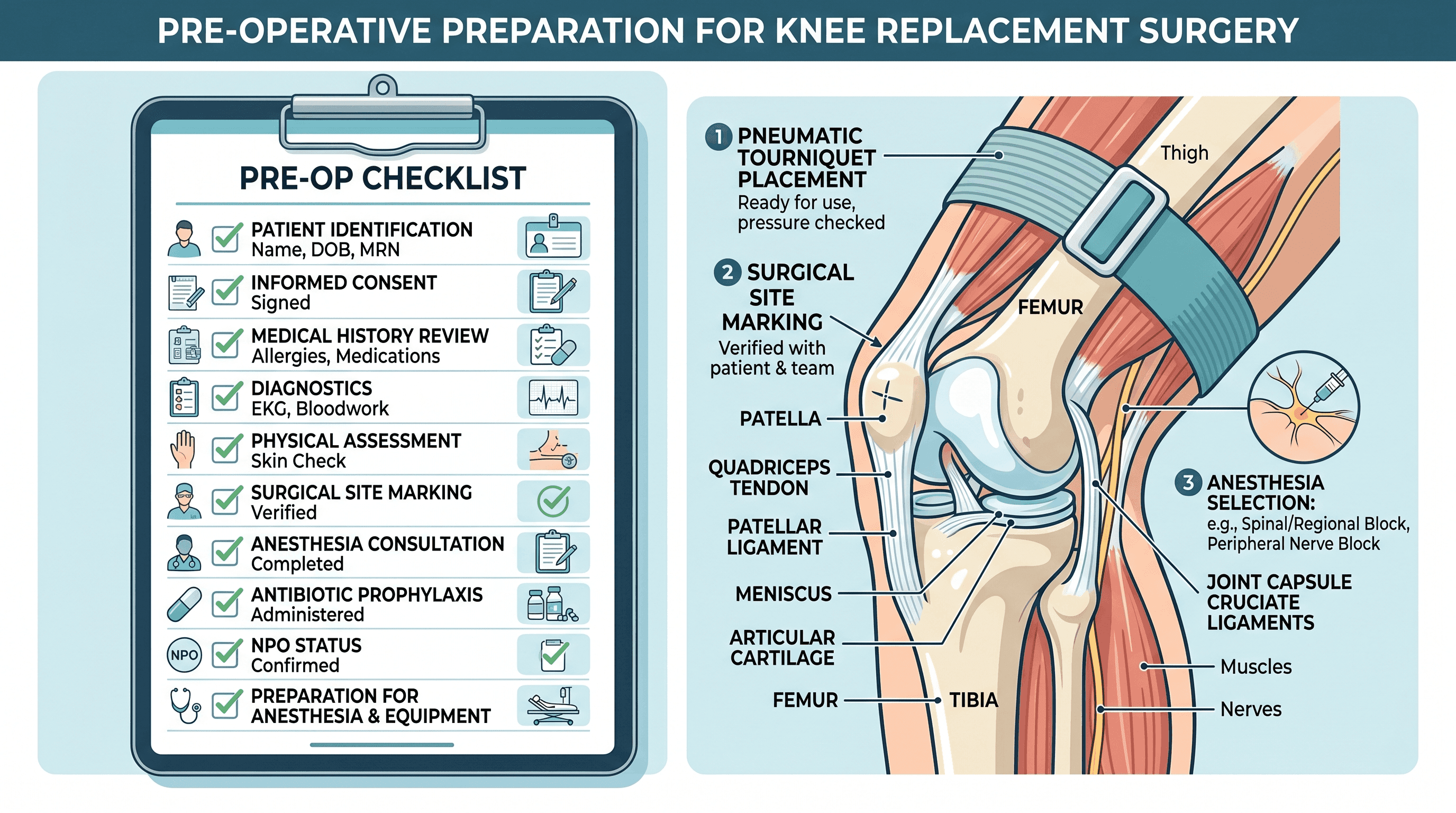
Your surgical clock starts well before the first incision. Pre-operative preparation typically begins 60 to 90 minutes before the scheduled surgery time and involves several steps that directly affect how smoothly the operation runs.
Nursing staff will place an intravenous line and begin any required pre-operative medications. Anesthesia will be administered during this window. Patients undergoing knee replacement typically receive one of two types: general anesthesia, which puts you fully under, or a spinal block (also called regional anesthesia), which numbs the lower body while you remain conscious or lightly sedated. Cleveland Clinic notes that spinal anesthesia is increasingly preferred for knee replacement because it reduces blood loss and the risk of post-operative nausea.
The surgical site will be shaved, cleaned, and draped. Positioning on the OR table takes time, particularly because the leg must be secured precisely for the procedure. A tourniquet is typically applied to the upper thigh to reduce blood loss during surgery. All of this setup adds 30 to 45 minutes to OR time before the surgeon makes the first cut.
Step-by-Step: What Happens During Total Knee Arthroplasty?
A total knee arthroplasty (TKA) involves removing damaged cartilage and bone from the knee joint and replacing it with artificial joint components made of metal and high-grade plastic. Each phase of the surgery takes a predictable amount of time, and understanding the sequence makes the procedure feel less uncertain.
Incision and exposure (approximately 10 minutes). The surgeon makes an incision typically 6 to 10 inches long along the front of the knee and moves soft tissue aside to access the joint.
Bone resurfacing of the femur (approximately 15 to 20 minutes). The lower end of the thighbone (femur) is shaped using specialized cutting guides so that a metal cap, the femoral component, fits precisely. This is one of the most time-sensitive steps because alignment determines long-term outcomes.
Tibia resurfacing (approximately 10 to 15 minutes). The top of the shinbone (tibia) is cut flat and prepared to receive the tibial component, a metal tray topped with a durable plastic spacer that acts as the new joint surface.
Patella resurfacing (approximately 10 minutes, when performed). The undersurface of the kneecap may be resurfaced with a plastic button, depending on the degree of damage and the surgeon's protocol.
Trial fit and implant placement (approximately 20 minutes). Trial components are inserted first to check range of motion and alignment before the final prosthetic implants are cemented or press-fit into place using bone cement or biological fixation.
Closure (approximately 15 minutes). The wound is closed in layers using sutures or staples, a drain may be placed, and the leg is bandaged.
According to UW Medicine, the average skin-to-skin operative time for a total knee replacement is approximately 80 minutes for an experienced surgical team, though this varies with patient anatomy and complexity.
Partial vs. Total Knee Replacement: Does It Change the Surgery Duration?
A partial knee replacement, or unicompartmental knee replacement (UKR), is shorter because only one section of the knee joint is resurfaced rather than the entire joint. Most partial replacements are completed in 45 to 60 minutes of surgical time.
The knee has three compartments: the medial (inner) side, the lateral (outer) side, and the patellofemoral (front) compartment. When arthritis is confined to one area, a partial replacement addresses only that section. Because bone removal is more limited and soft tissue disruption is reduced, the procedure qualifies as minimally invasive knee surgery relative to a total replacement.
The recovery arc also differs. Patients undergoing partial knee replacement typically experience shorter hospital stays and faster return to daily activities, though total knee replacement remains more common and has a longer track record. A doctor can advise on individual cases based on imaging, arthritis distribution, and patient activity goals.
| Feature | Partial Knee Replacement | Total Knee Replacement |
|---|---|---|
| Surgical time | 45 to 60 minutes | 1 to 2 hours |
| Incision size | Smaller (3 to 5 inches) | Larger (6 to 10 inches) |
| Hospital stay | Often same-day or 1 night | 1 to 3 nights |
| Recovery timeline | 6 weeks to 3 months | 3 to 6 months for most activities |
| Candidate criteria | Single-compartment arthritis | Multi-compartment arthritis |
Bilateral Knee Replacement: Timeline for Having Both Knees Done at Once
A simultaneous bilateral knee replacement replaces both knees during a single surgical session and typically runs 3 to 4 hours in the operating room. It is not available to every patient, and the decision involves a careful tradeoff.
The appeal is obvious: one surgery event, one anesthesia exposure, one recovery period instead of two separate hospitalizations months apart. For patients with severe arthritis in both knees and strong overall health, the combined approach can reduce total time away from work and life.
The candidacy criteria are strict. Surgeons typically require that patients have good cardiac function, no significant comorbidities such as obesity-related complications or uncontrolled diabetes, and strong home support for the more demanding recovery. According to the Cleveland Clinic, simultaneous bilateral TKA carries a higher short-term risk of blood transfusion and cardiovascular stress compared to staged bilateral procedures.
Staged bilateral replacement, where each knee is operated on separately with weeks or months between procedures, is the more conservative path and is recommended more often. A surgeon can weigh the risks and benefits based on a patient's full medical picture.
Immediate Post-Operative Recovery: Waking Up in the Recovery Room
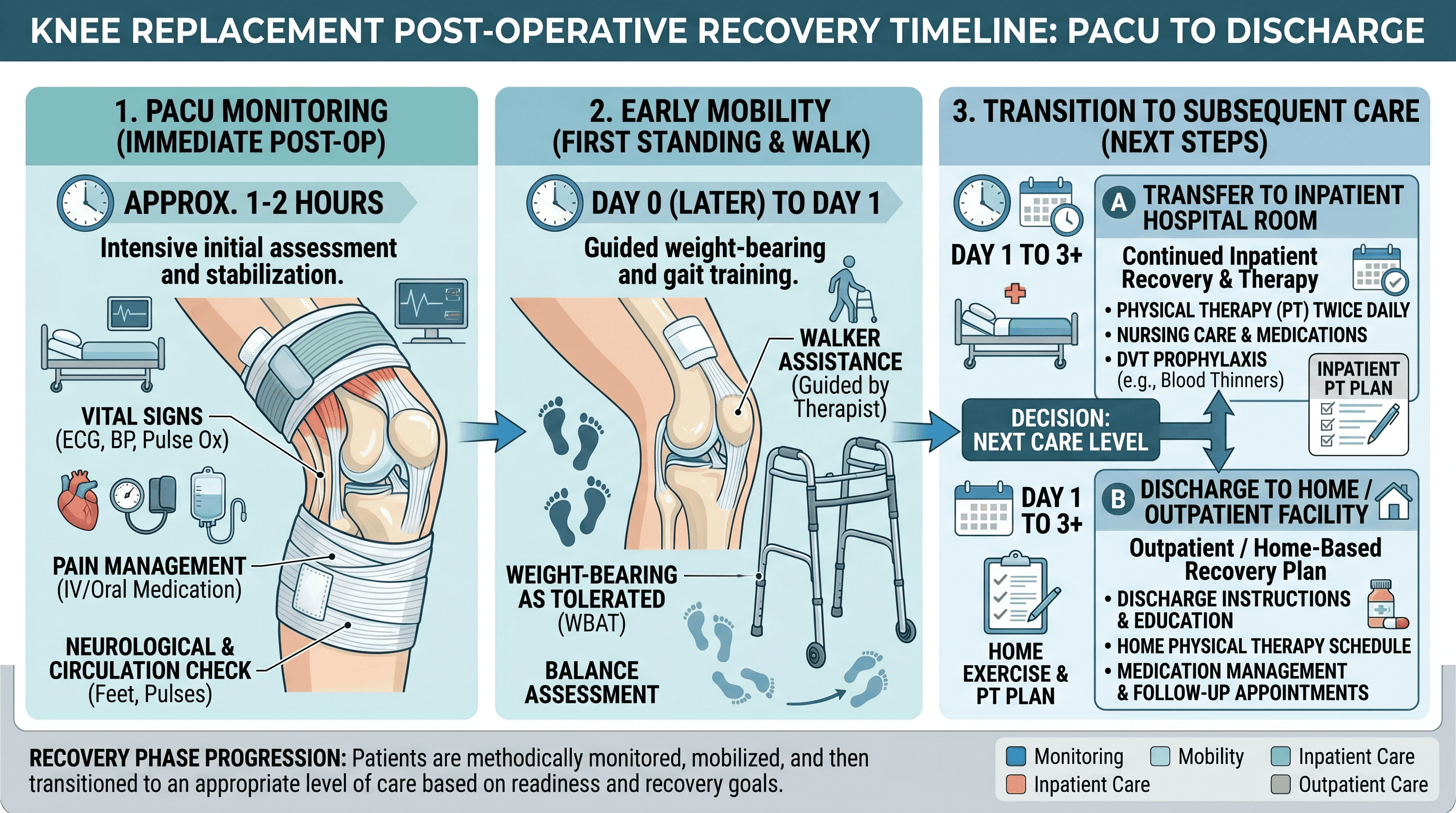
The moment surgery ends, the clock shifts to post-operative recovery. Most patients spend 1 to 2 hours in the Post-Anesthesia Care Unit (PACU), also called the recovery room, before moving to a regular hospital room or beginning discharge preparation.
In the PACU, nursing staff monitor vital signs, oxygen levels, and pain levels as anesthesia wears off. Patients who received a spinal block may still feel numbness in the legs during this phase. Pain management begins immediately, typically with a combination of regional nerve blocks, oral medications, and ice therapy. The Cleveland Clinic notes that multimodal pain management, using several approaches together, significantly reduces opioid requirements after knee replacement.
Early mobilization begins within 24 hours of surgery in most hospital protocols. Physical therapy will have you standing and taking initial steps with a walker or crutches on the day of or the day after surgery. This early movement reduces the risk of blood clots and stiffness.
Hospital Stay Length: Inpatient vs. Outpatient Knee Replacement
Whether you go home the same day or stay in the hospital for several nights depends on the procedure type, your overall health, and the surgical facility's protocol.
Inpatient knee replacement has traditionally involved a 1-to-3-night hospital stay. During that time, physical therapy begins, pain is managed, and nursing staff monitor for complications such as blood clot formation, infection, and excessive swelling. Most patients who are older, have multiple health conditions, or have limited home support will follow this path.
Outpatient knee replacement (same-day discharge) has grown substantially over the past decade. Advances in pain management, anesthesia protocols, and accelerated rehabilitation pathways have made same-day discharge a safe option for carefully selected patients. The Cleveland Clinic identifies younger age, good baseline health, strong social support at home, and no significant comorbidities as key candidacy factors for same-day discharge.
For outpatient cases, patients typically leave the facility 5 to 6 hours after surgery begins, once pain is controlled, they have stood and walked a short distance with assistance, and a responsible adult caregiver is confirmed. This does not mean recovery is faster; it means the recovery continues at home with close follow-up.
If same-day discharge is something that interests you, ask your surgeon early in the planning process whether you are a candidate.
What's Next: Transitioning to Physical Therapy and Long-Term Recovery
Recovery from knee replacement surgery follows a predictable progression, though individual pace varies. The milestones below reflect typical timelines based on guidance from the Cleveland Clinic and Mayo Clinic.
| Milestone | Typical Timeframe |
|---|---|
| Standing and walking with walker | Within 24 hours post-surgery |
| Discharge home | Same day to 3 days post-surgery |
| Independent showering | Approximately 1 week |
| Return to desk or office work | 1 to 2 weeks |
| Driving (right knee replacement) | 6 to 8 weeks |
| Physical and manual labor | 3 to 6 months |
| Full functional recovery | 6 to 12 months |
Physical therapy is the engine of recovery. Sessions typically begin in the hospital and continue outpatient for 6 to 8 weeks, often supplemented by a home exercise program. A continuous passive motion (CPM) machine, a device that gently flexes and extends the knee while the patient rests, is sometimes used in the early days to promote range of motion, though its routine use varies by surgeon and institution.
Return-to-work timelines differ significantly by job type. Someone with a sedentary office role may return within 2 weeks if pain is well managed and transportation is arranged. Someone whose work involves standing, kneeling, or lifting typically needs 3 to 6 months before that level of activity is safe and comfortable.
If you are ready to find a specialist who can build a personalized surgery and recovery plan around your lifestyle, search for a qualified orthopedic surgeon near you to get started.
Your Surgery Day: An Hour-by-Hour Timeline
No competitor maps out what a full knee replacement surgery day actually looks like. Here is a realistic sequence for a standard total knee replacement at a hospital or surgical center.
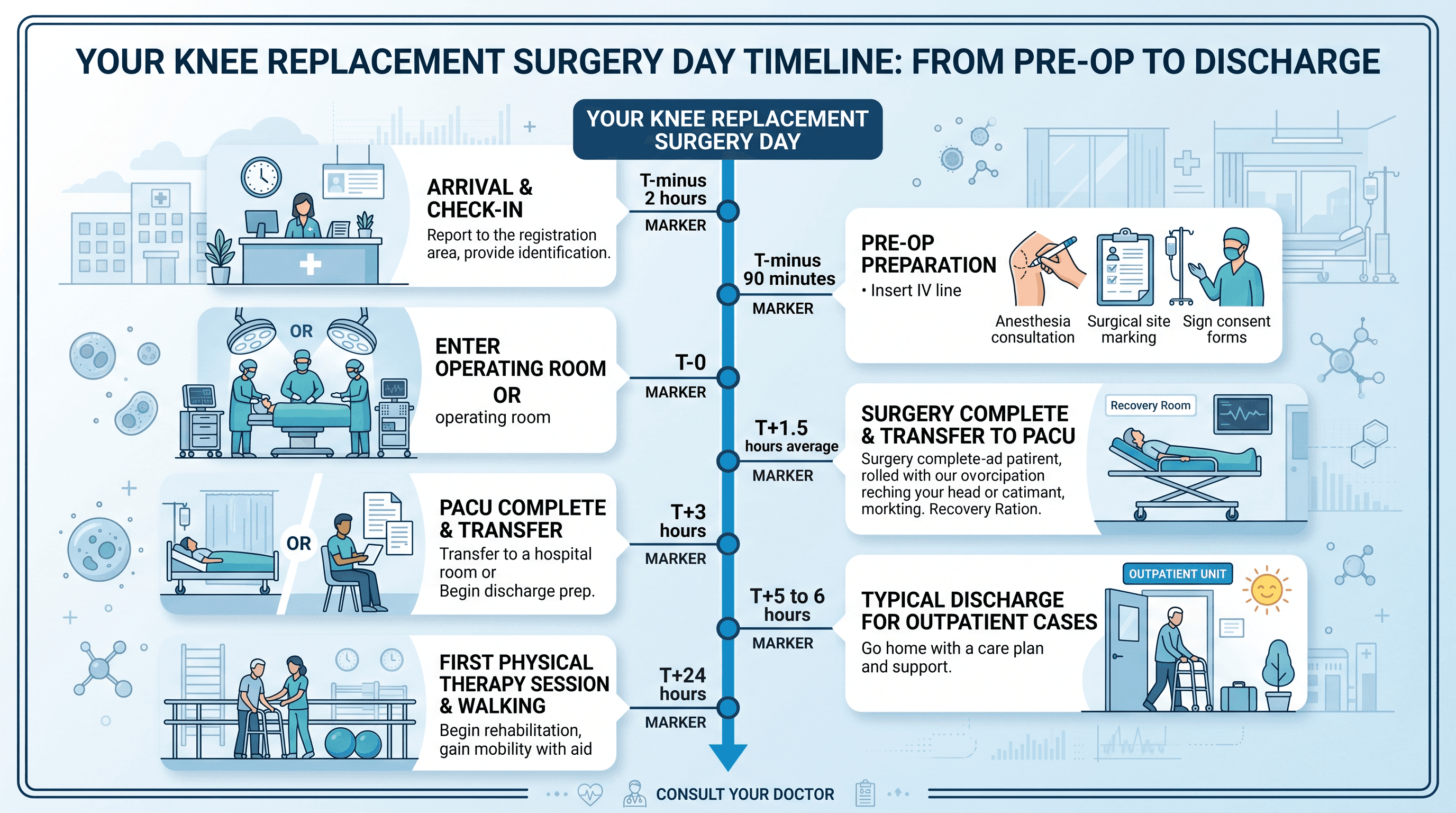
Arrival (T minus 2 hours). Check in at the registration desk. Nursing staff review your medical history, confirm medication holds, and begin pre-operative paperwork.
Pre-op prep (T minus 90 minutes). An IV line is placed. Anesthesia is discussed and administered. The surgical site is cleaned and marked. You may speak briefly with your surgeon before entering the OR.
Operating room (T-0 to T plus 1.5 to 2 hours). Surgery proceeds from incision through closure. For a standard total knee replacement, this window averages approximately 80 minutes of surgical time.
Recovery room or PACU (T plus 1.5 to T plus 3 hours). Vital signs are monitored, pain is managed, and anesthesia clears. You begin to feel the leg again if a spinal block was used.
Hospital room or discharge prep (T plus 3 to 5 hours). Inpatient patients are transferred to a room. Outpatient patients begin the discharge checklist, which includes a first walk, pain assessment, and caregiver confirmation.
Discharge or overnight stay (T plus 5 to 6 hours for outpatient). Outpatient patients go home with prescriptions, wound care instructions, and a follow-up appointment scheduled. Inpatient patients begin overnight monitoring and the next morning's PT session.
7 Factors That Can Make Your Surgery Run Longer
Seven patient- and procedure-specific variables commonly extend knee replacement surgery duration, and understanding them helps set realistic expectations.
Body size and BMI. Larger anatomy requires more tissue exposure and retraction to access the joint, which adds time to every phase from incision through closure.
Prior knee surgeries. Scar tissue from previous procedures, including ACL repairs or meniscus surgeries, must be carefully managed during the approach. Each layer of scar tissue slows the dissection.
Intraoperative findings. Unexpected bone density issues, cartilage damage beyond what imaging showed, or compromised soft tissue may require the surgical team to adapt the plan mid-procedure.
Severity of deformity. Significant varus (bowleg) or valgus (knock-knee) alignment requires soft tissue releases and additional bone cuts to restore proper alignment, adding 20 to 40 minutes in severe cases.
Surgeon experience and volume. High-volume orthopedic surgeons who perform knee replacements frequently tend to complete procedures in less time than lower-volume surgeons, while maintaining or improving outcome quality. This is supported by research published in the Journal of Bone and Joint Surgery.
Technology used. Robotic-assisted systems require pre-operative imaging and intraoperative mapping that add upfront time. The precision gained often reduces complications and may shorten hospital stay even when OR time is longer.
Anesthesia type. Administering a spinal block with sedation can take longer than inducing general anesthesia, depending on patient anatomy and anesthesiologist experience. The time cost is often worth it given the recovery benefits.
FAQ
How painful is a complete knee replacement?
Pain after total knee replacement is real and expected, but modern pain management protocols have significantly reduced how severe it is and how long it lasts. Most patients describe the first 3 to 5 days as the most uncomfortable phase. Multimodal pain management, combining nerve blocks, anti-inflammatory medications, and ice therapy, reduces reliance on opioids and helps most patients manage pain at home within the first week. Pain progressively improves as the inflammatory response from surgery resolves, typically over 3 to 6 weeks. A doctor can advise on individual pain management strategies based on medical history and tolerance.
How many hours is a full knee replacement surgery?
The skin-to-skin surgical time for a total knee replacement averages approximately 1 to 2 hours, with UW Medicine citing approximately 80 minutes as a reference point for experienced surgical teams. Total OR time, which includes setup, anesthesia, and draping, typically runs 2 to 3 hours. Your full hospital day from arrival to discharge or transfer to a room is generally 6 to 8 hours.
How long does it take to walk after total knee replacement surgery?
Most patients stand and take their first steps with a walker within 24 hours of surgery, often on the same day if the procedure is completed in the morning. Walking short distances independently, without a walker, typically takes 3 to 6 weeks. Walking comfortably for longer distances, such as through a grocery store, is usually possible by 6 to 8 weeks post-surgery.
Is a knee replacement a big operation?
Yes, total knee arthroplasty is considered major surgery. It involves general or spinal anesthesia, significant bone resection, implantation of prosthetic components, and a recovery period measured in months. That said, it is also one of the most commonly performed and well-studied orthopedic procedures in the United States, with more than 700,000 procedures performed annually according to the American Academy of Orthopaedic Surgeons. For patients with severe arthritis who have not responded to conservative management, the functional improvement and pain relief outcomes are well established.
What is the difference between inpatient and outpatient knee replacement recovery?
Inpatient patients stay in the hospital for 1 to 3 nights for monitoring, pain management, and initial physical therapy. Outpatient patients, who must meet specific health and support criteria, are discharged 5 to 6 hours after surgery and continue recovery at home with close follow-up. The total recovery timeline is similar for both groups; the difference is where the first phase of that recovery takes place.
Can I use Momentary Lab to learn more about my care options?
Yes. If you are researching knee replacement or trying to understand what to expect from orthopedic care, the Momentary Lab AI Healthcare Navigator can help you explore your options and find the information that applies to your situation.
References
- Cleveland Clinic. Knee Replacement Surgery. — Cited for anesthesia types, pain management protocols, same-day discharge criteria, and post-operative recovery milestones.
- Mayo Clinic. Knee Replacement Overview. — Cited for long-term recovery milestones and return-to-activity timelines.
- UW Medicine. Knee Replacement Surgery Information. — Cited for the 80-minute average surgical time reference for experienced surgical teams.
- Journal of Bone and Joint Surgery. Surgeon Volume and Outcomes in Total Knee Arthroplasty. — Cited for the relationship between surgeon experience level and operative time and outcomes.
- PubMed. Robotic-assisted versus conventional total knee arthroplasty: a meta-analysis of randomized controlled trials. — Cited for robotic-assisted TKA operative time data.
- PubMed. Outcomes of outpatient versus inpatient total knee arthroplasty. — Cited for outpatient knee replacement candidacy and same-day discharge trends.
- PubMed. Bilateral versus staged total knee arthroplasty: comparative analysis. — Cited for bilateral knee replacement duration, risks, and candidacy criteria.
- American Academy of Orthopaedic Surgeons. Total Knee Replacement. — Cited for annual procedure volume statistics in the United States.