


At a Glance
| Topic | Key Facts |
|---|---|
| Primary keyword | Leg and buttock pain after spinal fusion surgery |
| Who this affects | Post-fusion patients, typically weeks to months after lumbar surgery |
| Most common cause | Post-surgical nerve inflammation (weeks 1 to 8) |
| Frequently missed cause | Sacroiliac (SI) joint dysfunction (up to 43% of persistent buttock pain cases) |
| Nerve healing timeline | 3 to 12 months; can continue up to 2 years in some cases |
| Red flag symptoms | Saddle anesthesia, bowel or bladder dysfunction, rapid progressive weakness |
| First-line treatment | Physical therapy, nerve-targeted medications, targeted injections |
If you had spinal fusion surgery and you are still dealing with burning, shooting, or aching pain in your leg or buttock weeks later, the first thing to know is this: you are not alone, and the surgery almost certainly did work. Post-operative leg and glute pain is one of the most common experiences after lumbar fusion, and in most cases, it signals biology doing its job rather than something going wrong.
But not all post-fusion pain is the same. Understanding which specific structure is causing your symptoms can make the difference between months of unnecessary anxiety and a targeted treatment plan that actually moves the needle. This guide walks you through the anatomy, the most likely culprits, a realistic recovery timeline, and what each pain pattern tells you about what to do next.
Why Leg and Buttock Pain Happen After Spinal Fusion: The Short Anatomy Lesson
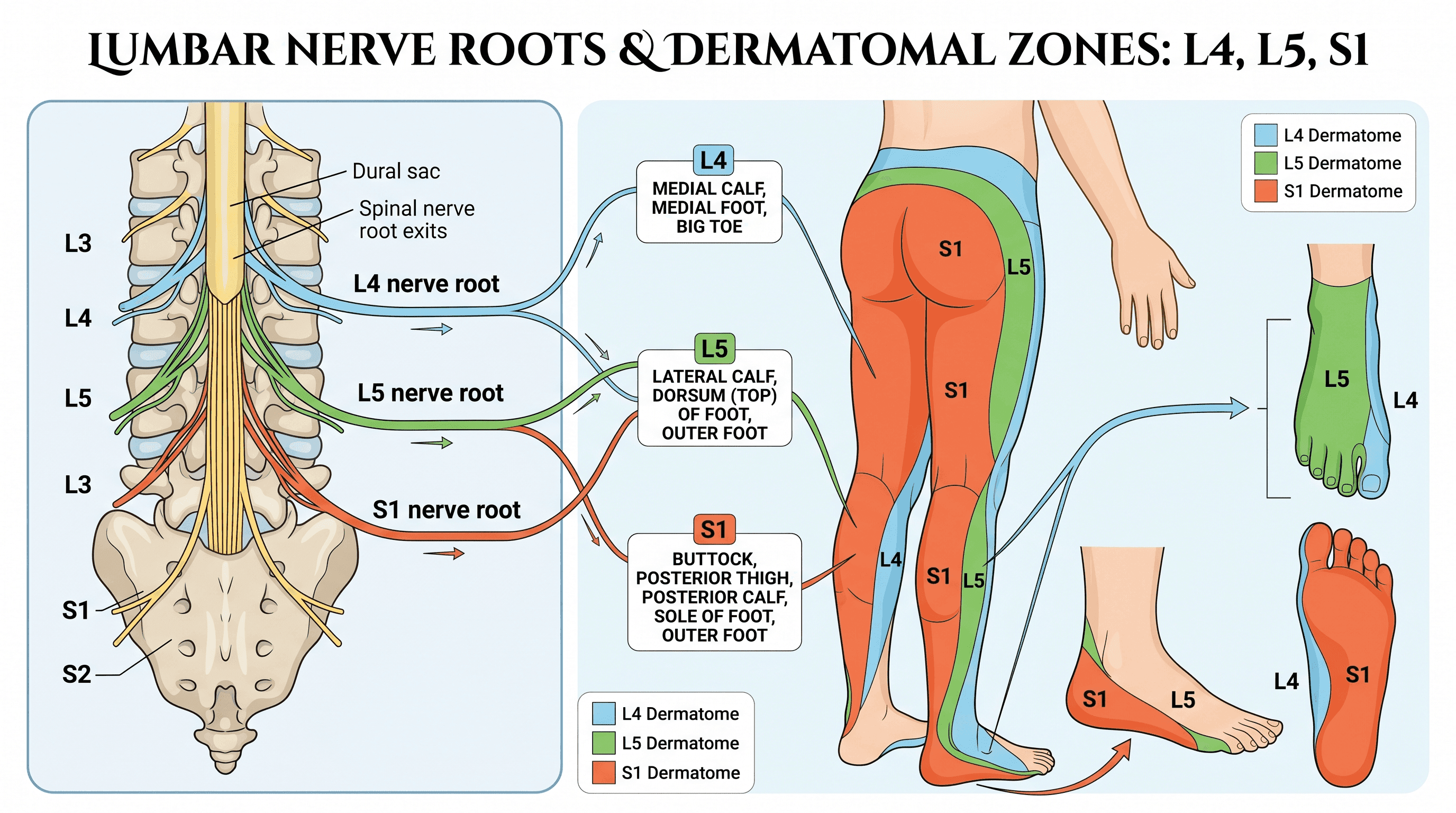
The lumbar nerve roots are the starting point for understanding almost everything that happens below the waist after back surgery.
The nerve roots most involved in buttock and leg symptoms after lumbar fusion are L4, L5, and S1. L4 supplies sensation to the inner shin and helps control the quadriceps. L5 runs along the outer shin and top of the foot. S1, the root most closely tied to classic buttock pain, travels down the back of the thigh and calf and supplies the heel and outer foot. When any of these roots is compressed, irritated, or surgically handled, pain follows the dermatomal map they supply.
Three things that happen during and after fusion surgery set the stage for this pain. First, nerve retraction during surgery physically moves nerve roots aside to access the spine, and even careful retraction produces some degree of mechanical stress on the nerve tissue. Second, the body's inflammatory response after surgery produces localized swelling around the nerve roots in the days and weeks that follow, which can compress or irritate them even when the original compression has been relieved. Third, scar tissue formation at the fusion site can develop over months and, in some patients, encases nerve roots in a condition called epidural fibrosis.
The Five Most Common Causes: And How to Tell Them Apart
Post-Surgical Nerve Inflammation
This is the most common source of leg and buttock pain in the first eight weeks after surgery, and it is also the most likely to resolve on its own.
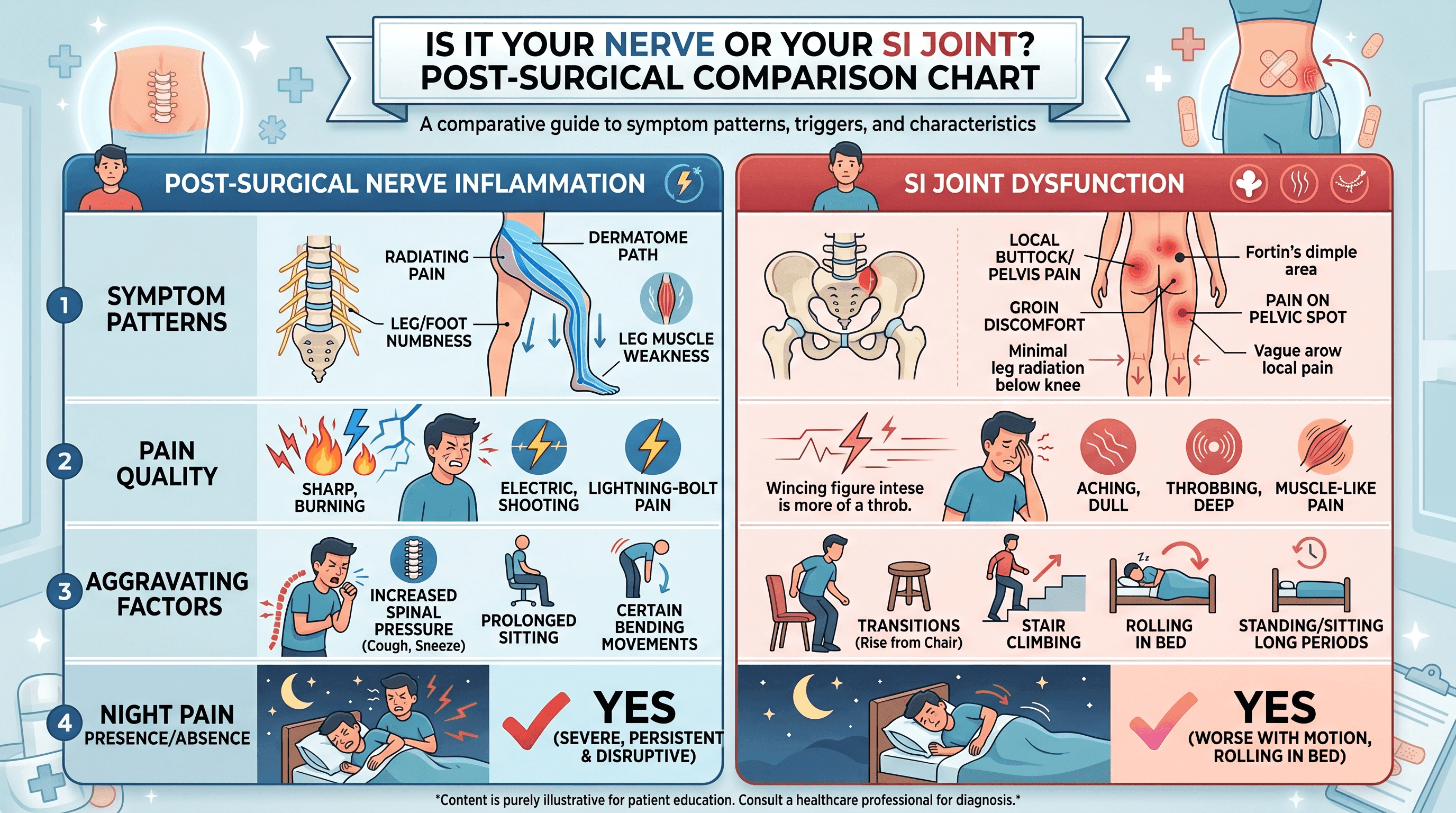
The sensation is typically described as burning, shooting, or electric-shock quality pain that follows a predictable path down the leg or into the buttock. It often worsens with prolonged sitting or activity and eases slightly with movement or positional changes. This pattern reflects the nerve's hypersensitivity as it responds to the mechanical handling it experienced during surgery and to the post-operative inflammatory environment around it.
According to the NIH, nerve root inflammation following decompressive spine surgery is expected and generally temporary, with most patients experiencing meaningful reduction in radicular symptoms within weeks to a few months as inflammation subsides.
The "Nerve Awakening" Phase
A nerve that was chronically compressed before surgery does not simply return to normal function the moment pressure is removed. Instead, it goes through a phase that many patients find deeply counterintuitive: it gets louder before it gets quieter.
As blood flow returns to previously compressed nerve tissue and the nerve begins regenerating, it sends out hyperactive signals. These manifest as tingling, burning, or electric sensations that travel along the nerve's path. Patients often assume this means the surgery failed, but this pattern is actually a sign the nerve is waking up. The discomfort is real, but the biology behind it is largely positive. Understanding this phase is one of the most reassuring pieces of information a post-fusion patient can receive, and it is rarely explained clearly before discharge.
Scar Tissue (Epidural Fibrosis): The Delayed-Onset Cause
Epidural fibrosis refers to scar tissue that forms around the nerve roots in the epidural space following surgery, and it typically presents differently from the acute nerve inflammation described above.
The onset is usually delayed, appearing between three and six months post-operatively, after an initial period of improvement. The quality of pain is more of a dull, positional ache that worsens with sustained postures, whether sitting for extended periods or standing for long stretches. It often lacks the sharp, electric character of acute radiculopathy. Many patients describe it as feeling like the original nerve symptoms have returned, which can be distressing after a period of feeling better.
According to PMC research on postoperative complications, epidural fibrosis is one of the most common contributors to failed back surgery syndrome. Treatments including nerve mobilization exercises (nerve gliding protocols) and myofascial release have shown benefit in managing symptoms related to perineural scar tissue.
Sacroiliac (SI) Joint Dysfunction: The Missed Diagnosis
This section covers one of the most underrecognized and undertreated causes of persistent buttock pain after lumbar fusion, and the data behind it is striking.
The sacroiliac joint sits at the base of the spine, connecting the sacrum to the ilium of the pelvis on each side. Under normal circumstances, the lumbar spine and SI joint share the load of absorbing shock and transferring forces between the upper and lower body. When the lumbar spine is fused, that shock-absorbing capacity is reduced or eliminated at the fused segments. The SI joint below the fusion must now bear a disproportionate share of that mechanical load, which subjects it to accelerated stress and, in many patients, dysfunction.
Research published in PMC (2022) found that the SI joint is the source of persistent buttock pain in up to 43% of patients following lumbosacral fusion. The same research identified night pain as present in 81.8% of SI joint-origin cases, making nocturnal buttock pain a useful clinical clue that points toward this diagnosis rather than nerve root involvement.
What makes this particularly relevant is that SI joint dysfunction is highly treatable once it is correctly identified. Ultrasound-guided SI joint blocks are both diagnostic and therapeutic, confirming the diagnosis through immediate pain relief and providing weeks to months of symptom control. This cause is completely absent from most post-surgical recovery content patients encounter online, which means many spend months attributing their SI joint pain to nerve problems or failed surgery.
Piriformis Syndrome: When the Muscle Is the Problem
The piriformis is a small, deep muscle in the buttock that runs from the sacrum to the top of the femur. The sciatic nerve passes either beneath or through it. After spinal fusion, two things happen that frequently push the piriformis into dysfunction.
First, altered gait mechanics during recovery change how load is distributed through the hip and pelvis, placing chronic tension on the piriformis. Second, surgical positioning and post-operative muscle guarding can leave the piriformis in a state of sustained contraction. When the piriformis tightens enough, it compresses the sciatic nerve at the hip level rather than at the spine, a condition that mimics radicular nerve pain closely enough to be mistaken for surgical failure.
The distinguishing feature of piriformis syndrome is that the pain is deep in the buttock and reliably worsens with sitting and with hip internal rotation, such as crossing the legs. It does not follow a clean dermatomal pattern the way L5 or S1 nerve root pain does. Piriformis stretching and targeted physical therapy directed at the hip and gluteal musculature are highly effective for this cause when correctly identified.
Failed Back Surgery Syndrome (FBSS)
Failed back surgery syndrome is a clinical term, not a single diagnosis, and it is widely misunderstood.
Research published in PMC places the incidence of FBSS at roughly 10 to 40% following spinal surgery, depending on patient selection and surgical indication. The condition describes persistent or recurrent low back or leg pain following technically successful spine surgery, and it has two distinct presentations that point toward different underlying mechanisms.
In the first type, pain was never meaningfully relieved after surgery, which suggests incomplete decompression or incorrect level identification. In the second type, pain improved initially but returned weeks to months later, which points toward a new or evolving pain generator such as epidural fibrosis, adjacent segment disease, or SI joint dysfunction developing after the initial healing period. FBSS is a diagnosis of exclusion: it should be considered only after the specific causes described above have been evaluated and either treated or ruled out.
What Is Normal Pain vs. a Warning Sign: A Recovery Timeline Guide
Knowing what to expect at each stage of recovery is one of the most practical tools a post-fusion patient can have.
Weeks 1 to 6: Severe pain in the first 72 hours is expected and reflects surgical trauma to muscle and tissue. Leg symptoms from nerve root irritation are common during this window and do not indicate a problem. Pain should be gradually, if unevenly, declining. The nerve awakening phase is active during this period.
Months 2 to 3: By this point, the surgical incision pain should be substantially resolved. Nerve-related leg symptoms should be showing visible improvement, even if they have not disappeared. A plateau with no directional improvement during this window warrants a call to the surgical team.
Months 3 to 6: Lingering buttock and leg pain that has not followed an improving trajectory deserves formal evaluation. This window is when SI joint dysfunction most often becomes symptomatic, and when epidural fibrosis begins to present clinically. Physical therapy referral and imaging review are appropriate steps.
Months 6 to 12: Persistent and functionally limiting pain at this stage meets the time-based criteria for FBSS evaluation. A comprehensive workup including advanced imaging, EMG or nerve conduction studies, and diagnostic injections is reasonable. This is not the end of the road; it is the beginning of a more targeted diagnostic phase.
Beyond 1 year: Nerve healing can continue for up to two years after surgery, particularly in patients who had prolonged preoperative compression. Slow, ongoing improvements in sensation and strength are still possible and real. Adjacent segment disease, a condition in which the spinal levels above or below a fusion experience accelerated degeneration due to altered biomechanics, can also emerge during this window and warrants imaging evaluation.
Red-Flag Symptoms That Need Same-Day Medical Attention
While most post-fusion leg and buttock pain follows a predictable and manageable course, certain symptoms require immediate evaluation.
Cauda equina syndrome is the most urgent: it involves saddle anesthesia (numbness in the inner thighs, groin, and perineal area), loss of bowel or bladder control, and progressive bilateral leg weakness. This is a surgical emergency. Any patient who develops these symptoms after spinal fusion should proceed to an emergency department without delay.
Sudden new mechanical pain, distinct in character from the nerve pain experienced since surgery, can signal hardware failure or pseudarthrosis (failure of the fusion to consolidate). Signs of infection include fever above 101 degrees Fahrenheit, increasing redness or warmth at the incision, and wound drainage that restarts or worsens after an initial period of healing. Rapidly progressive neurological deficits, including new foot drop or sudden loss of muscle strength in the leg, also require same-day contact with the surgical team.
How Doctors Diagnose the Source of Your Leg and Buttock Pain
A structured diagnostic workup is what separates targeted treatment from guesswork, and knowing what to expect at a follow-up appointment helps patients advocate for themselves.
The physical exam typically begins with the straight leg raise test, a highly sensitive screen for nerve root compression that reproduces radicular symptoms when positive. The FABER test (hip flexion, abduction, and external rotation) specifically stresses the SI joint and reproduces SI joint-origin buttock pain when the joint is the source.
Advanced imaging follows when the examination raises specific concerns. MRI is the gold standard for visualizing scar tissue, nerve root compression, and soft tissue changes around the fusion site. CT scanning is better suited for assessing hardware position and fusion consolidation. EMG and nerve conduction studies quantify the degree of nerve injury and help distinguish ongoing compression from a nerve in active recovery.
Diagnostic injections are particularly useful because they are both investigative and therapeutic. A fluoroscopy or ultrasound-guided SI joint block that produces immediate and substantial pain relief confirms SI joint origin and often provides weeks of symptom control. Similarly, an epidural steroid injection targeted at the affected nerve root level can confirm nerve root inflammation and reduce it simultaneously.
If you are unsure where to begin, finding a qualified specialist through Momentary Lab's doctor directory can help you connect with physicians experienced in post-surgical spine pain evaluation.
Treatment Options: From Conservative to Interventional
Physical Therapy: The First-Line Foundation
Physical therapy after spinal fusion is not a generic exercise program. When matched to the specific pain source, it is one of the most effective tools available.
For nerve-related symptoms, neural mobilization, also called nerve gliding, is a specific technique that gently mobilizes the nerve through its surrounding tissue, reducing adhesion formation and promoting normal nerve movement. For SI joint dysfunction, a targeted program of lumbar stabilization combined with hip and gluteal strengthening addresses the mechanical imbalance that drove the SI joint into dysfunction in the first place. For piriformis syndrome, a dedicated piriformis and hip flexor stretching protocol, combined with gait retraining, often produces rapid improvement once the correct diagnosis is established. Manual therapy directed at soft tissue restrictions can complement these approaches across all three presentations.
Pain Medications and Nerve-Targeted Drugs
Traditional opioid pain medications are poorly suited to neuropathic pain, which is the type of pain that dominates the post-fusion recovery experience for many patients. This is not a flaw in the medications; it is a mismatch between drug mechanism and pain type.
NSAIDs reduce prostaglandin-mediated inflammation and work best for the musculoskeletal and tissue-damage component of post-surgical pain. Acetaminophen provides baseline analgesic coverage without anti-inflammatory action. The drugs most specifically targeted to nerve pain are gabapentinoids: gabapentin and pregabalin (brand name Lyrica). These work by binding to voltage-gated calcium channels in the dorsal horn of the spinal cord, dampening the hyperactive nerve signaling that drives burning and shooting pain. According to the Mayo Clinic, gabapentin is a first-line treatment for neuropathic pain, including post-surgical radicular symptoms. Extended use of any of these agents requires medical supervision, and the decision to continue, adjust, or taper should be made collaboratively with the treating physician.
Targeted Injections by Pain Source
Injections are most useful when matched to a specific anatomical target, rather than applied broadly.
Epidural steroid injections deliver corticosteroid directly to the epidural space adjacent to the affected nerve root, reducing inflammatory mediators and providing relief that typically lasts weeks to months. For SI joint-origin buttock pain, an ultrasound-guided or fluoroscopy-guided SI joint block is both the definitive diagnostic test and an effective treatment. For piriformis syndrome, trigger point injections into the piriformis muscle can break the cycle of chronic spasm and allow the physical therapy program to take hold.
Spinal Cord Stimulation for Refractory FBSS
For patients with persistent, refractory pain meeting FBSS criteria who have not responded adequately to conservative and interventional measures, spinal cord stimulation (SCS) is an evidence-supported option. The device delivers low-level electrical impulses to the spinal cord via implanted leads, modulating the pain signals before they reach conscious perception. SCS is reversible, which distinguishes it from repeat surgical intervention, and it has a well-established evidence base for FBSS specifically. This approach is typically considered after other treatments have been fully explored.
Signs Your Nerve Is Healing: Positive Indicators to Watch For
This is one of the most-searched topics among post-fusion patients and one of the least covered in clinical recovery content.
The Tinel's sign concept, more familiar in the context of carpal tunnel syndrome, applies to recovering spinal nerves as well. As a nerve regenerates, tapping along its pathway produces a tingling sensation that progresses distally over time. This is not a problem; it is a marker of active regeneration moving forward through the nerve.
Tingling and increased sensitivity that precede the return of normal sensation are also encouraging signs, not causes for concern. Many patients interpret new tingling as things getting worse, when in fact it reflects the nerve becoming capable of transmitting signals again after a period of relative silence.
Pain that migrates distally, meaning it moves from the proximal buttock or thigh progressively down toward the calf and foot over time, is another reliable indicator of nerve regeneration. The nerve regenerates from the point of injury outward, so symptoms tracking distally along a dermatomal path over weeks or months suggest the recovery process is working as intended.
Finally, slowly expanding zones of normal sensation, where areas of numbness or altered feeling gradually shrink as normal feeling returns from the edges inward, represent one of the clearest observable signs of nerve healing a patient can monitor at home.
Frequently Asked Questions
Is it normal to have buttock pain 6 months after spinal fusion?
Yes, buttock pain at 6 months post-fusion is not rare, though it warrants evaluation to identify the specific cause. At this stage, SI joint dysfunction is responsible for up to 43% of persistent buttock pain in patients who have had lumbosacral fusion. Epidural fibrosis and piriformis syndrome are also active possibilities. Six months is the appropriate point to pursue a structured diagnostic workup if symptoms have not improved directionally, rather than waiting longer without investigation.
Why is my leg pain worse after fusion surgery than before?
Several mechanisms can cause leg pain to worsen temporarily after fusion. Surgical nerve retraction produces mechanical stress on nerve roots, and the post-operative inflammatory response adds chemical irritation on top of that. The nerve awakening phase, in which a previously compressed nerve becomes hyperactive as blood flow returns, also causes pain that feels worse than preoperative symptoms even when the underlying pathology has been addressed. In most cases, this worsening is time-limited and reflects normal biological processes rather than a surgical complication.
Can the SI joint cause buttock pain after lumbar fusion?
Yes, and it does so more often than most patients are told. Lumbar fusion removes the shock-absorbing function from the fused segments, which transfers increased mechanical load to the SI joint below. Research published in PMC has found that the SI joint is the source of persistent buttock pain in up to 43% of post-fusion patients. Night pain is a particularly useful clue pointing toward SI joint origin. The diagnosis is confirmed and often treated simultaneously with an ultrasound-guided SI joint injection.
How long does nerve pain last after spinal fusion?
Acute post-surgical nerve pain typically peaks in the first days to weeks and begins declining by weeks 6 to 8 in most patients. Nerve regeneration following decompression of a chronically compressed root can continue for up to two years, meaning slow, ongoing improvement in tingling, numbness, and pain is possible and documented well beyond the first year. Nerve pain that shows no improving trend by month 6 and remains functionally limiting warrants a formal evaluation rather than continued watchful waiting.
What exercises help with leg and buttock pain after fusion?
The most effective exercises depend on the underlying cause. For nerve-related symptoms, nerve gliding protocols (neural mobilization) reduce adhesion and improve nerve mobility through surrounding tissue. For SI joint dysfunction, lumbar stabilization exercises combined with progressive hip and gluteal strengthening address the mechanical drivers. For piriformis syndrome, targeted piriformis stretching and hip flexor release are the first steps. Short, frequent walks also promote nerve mobility and circulation without loading the spine excessively. A physical therapist with spine rehabilitation experience can match the program to the specific cause.
References
- NIH National Library of Medicine, NBK448172 — Overview of lumbar nerve root anatomy, dermatomal distribution, and post-surgical radiculopathy management.
- PMC: Epidural Fibrosis and Failed Back Surgery Syndrome (PMC3029082) — Research on epidural fibrosis as a contributor to persistent post-operative pain and failed back surgery syndrome.
- PMC: Sacroiliac Joint Dysfunction After Lumbar Fusion (PMC10562770) — Study identifying SI joint dysfunction as the cause of persistent buttock pain in up to 43% of post-fusion patients, including night pain as a diagnostic clue.
- PMC: Failed Back Surgery Syndrome Incidence and Management (PMC9605753) — Research on FBSS incidence rates, clinical subtypes, and evidence base for treatment including spinal cord stimulation.
- Mayo Clinic: Gabapentin for Neuropathic Pain — Clinical guidance on gabapentinoid medications as first-line therapy for post-surgical neuropathic and radicular pain.