

Your surgeon sets the floor. Your habits set the ceiling.
That line is not a motivational poster. It is the most accurate frame for understanding meniscus surgery recovery. The procedure itself — whether a repair or a removal — takes roughly an hour. What happens in the weeks and months that follow is largely within your control. Sleep, nutrition, physical therapy compliance, swelling management, and mental readiness all shape how fast you get back to full function. This guide breaks down each of those levers, week by week, so recovery becomes something you actively drive rather than passively wait out.
At a Glance
| Topic | Key Facts |
|---|---|
| Surgery types | Meniscus repair (stitch-back) vs. partial meniscectomy (trim-out) |
| Repair recovery range | 3 to 6 months before return to sport |
| Meniscectomy recovery range | 4 to 6 weeks for most daily activities |
| Biggest accelerator | Physical therapy, started within the first few days |
| Biggest setback | Returning to weight-bearing activity too soon |
| Red-flag symptoms | Fever above 101°F, calf pain, drainage, worsening pain |
The Golden Rule: You Cannot Rush Biology (Repair vs. Removal)
The single most important thing to understand about meniscus surgery recovery is that the two main procedures follow completely different biological timelines, and confusing them is where most setbacks begin.
Repair vs. Meniscectomy: Why the Type of Surgery Changes Everything
The meniscus is not a uniform structure. The outer third, called the red zone, has a good blood supply and can heal when stitched back together. The inner two-thirds, called the white zone, has little to no direct blood flow. Tears in that region generally cannot heal, which is why they are trimmed away rather than repaired.
A partial meniscectomy, where the surgeon removes the damaged fragment and leaves healthy tissue in place, typically allows patients to bear weight within days. Most people return to desk work in one to two weeks and to more physical jobs in four to six weeks. A meniscus repair, where the surgeon sutures the tear so the tissue knits back together, demands a much more conservative approach. Weight-bearing is often restricted for four to six weeks, and a full return to sport can take three to six months.
Knowing which surgery you had is not optional information. It changes every decision you make during recovery.
The First 72 Hours: Aggressive Swelling Control
The first three days after meniscus surgery are the most underestimated window in the entire recovery arc. What happens inside that joint during those hours shapes how well the subsequent weeks go.
Swelling is the body's inflammatory response to surgical trauma, and some of it is necessary. Too much, though, inhibits the quadriceps muscle and delays the neuromuscular reactivation you need to walk normally again. Aggressive swelling control in the early hours is one of the few places where faster action directly produces faster recovery.
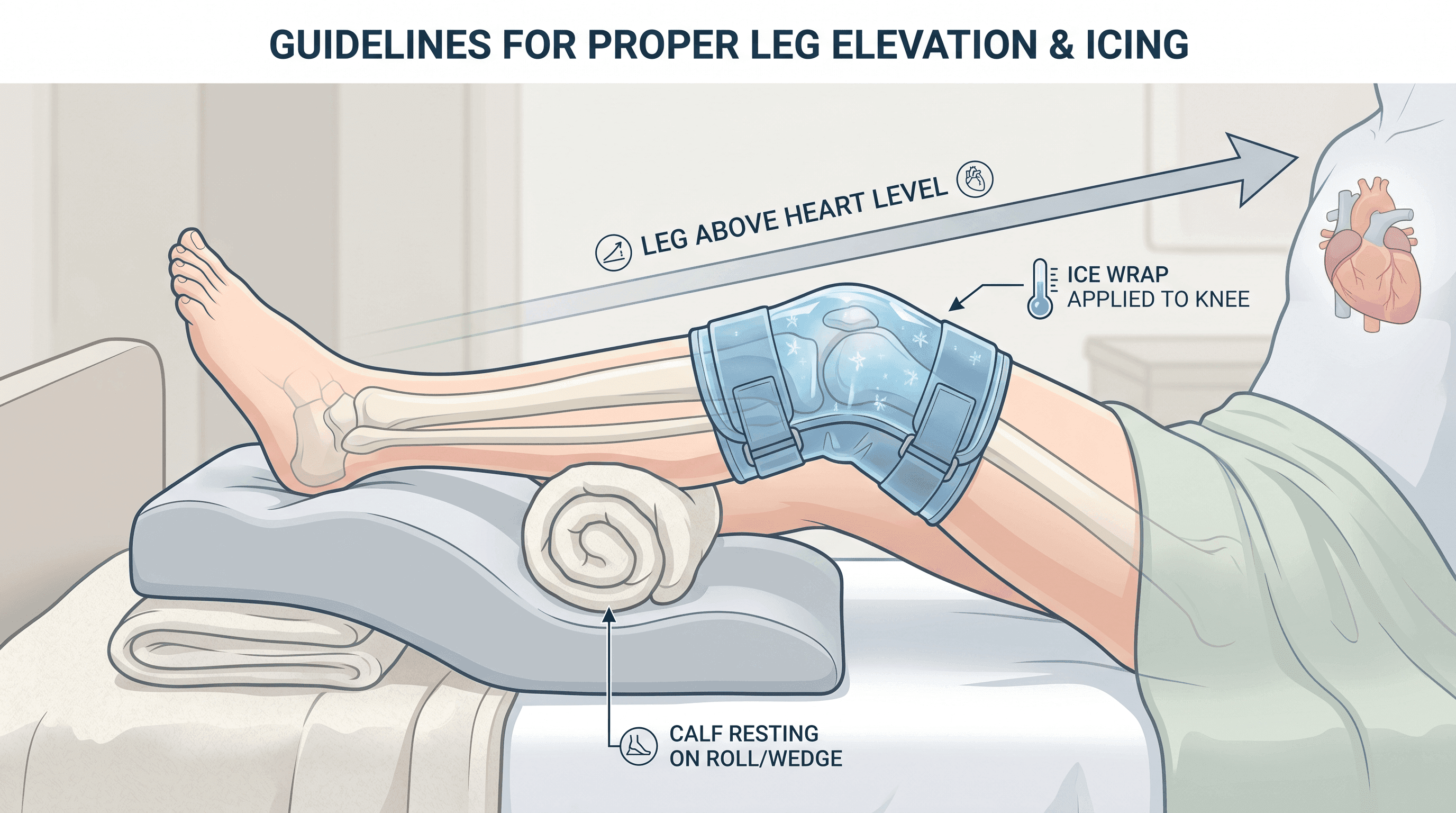
The R.I.C.E. protocol (Rest, Ice, Compression, Elevation) is the standard framework here. Ice the knee for 15 to 20 minutes every one to two hours during the first 48 to 72 hours. Elevation should place the leg above the level of the heart, not just propped on a pillow on the couch. A wedge pillow or two stacked firm pillows under the calf, not under the knee itself, achieves proper angle without putting pressure on the joint.
Continuous cold therapy machines, sometimes called cryotherapy compression units or by brand names like Game Ready or Cryocuff, circulate ice water through a wrap around the knee while simultaneously providing gentle compression. These devices maintain consistent cold more reliably than an ice pack. A doctor can advise on whether one is appropriate for a given patient.
Ankle pumps, the simple action of flexing and pointing the foot repeatedly, should begin the same day as surgery. They keep blood circulating and reduce the risk of deep vein thrombosis (DVT), a blood clot that can form when the leg is immobile. This is a non-negotiable early exercise, and it costs nothing.
Early Mobilization: Why Moving Prevents Long-Term Stiffness
Moving the knee soon after surgery can feel counterintuitive. It is not. Research published in Rehabilitation Research and Practice demonstrates that early functional rehabilitation after meniscus surgery produces better outcomes than prolonged immobilization. The concern is not whether to move; it is how and when.
Arthrofibrosis, the formation of excessive scar tissue inside the joint, is a documented complication of keeping the knee completely still for too long after surgery. Once it develops, it is far harder to reverse than it is to prevent. Gentle, controlled movement in the early days maintains the tissue's pliability and keeps the joint from locking into a reduced range of motion.
The first exercises a physical therapist will introduce are typically quad sets (tightening the thigh muscle while the leg is straight), heel slides (bending and straightening the knee while lying down), and straight-leg raises (lifting the leg without bending at the knee). None of these put compressive load on the repaired or trimmed meniscus. All of them begin rebuilding the neuromuscular connection between the brain and the quadriceps, which shuts down quickly after any knee surgery.
The goal in the first one to two weeks is not strength. It is range of motion and muscle activation. Getting to physical therapy within the first available appointment after surgery, before the knee stiffens, sets the tone for everything that follows.
Physical Therapy: The Single Biggest Accelerant
Physical therapy is the non-negotiable centerpiece of meniscus surgery recovery. Skipping sessions, spacing them too far apart, or substituting them with self-directed gym work carries real cost: slower range-of-motion return, weaker quad activation, and a higher re-injury risk when returning to activity.
A 2024 consensus from the ESSKA-AOSSM-AASPT, a formal international panel of sports medicine specialists, published updated rehabilitation guidelines for meniscus surgery covering meniscectomy, repair, and reconstruction. The consensus reinforces a phased, criteria-based approach rather than a time-based one. In other words, progressing to the next phase depends on meeting specific benchmarks, not just waiting a set number of weeks.
Phase One: Weeks One to Two
The focus here is on swelling reduction, restoring full extension (straightening) of the knee, and reactivating the quad. Exercises include quad sets, heel slides, and short-arc quads. Walking with crutches, with weight-bearing as tolerated for meniscectomy patients and weight-bearing restrictions for repair patients, begins under PT guidance.
Phase Two: Weeks Three to Six (Meniscectomy) or Weeks Six to Twelve (Repair)
As swelling recedes and range of motion returns, therapy shifts toward progressive loading. Stationary cycling, which maintains range of motion without placing rotational stress on the meniscus, is typically introduced here. Mini-squats to about 45 degrees and step-ups begin building functional strength. Single-leg balance exercises start retraining proprioception, the body's awareness of joint position, which is disrupted by the surgery itself.
Phase Three: Twelve Weeks and Beyond (Primarily for Repair Patients)
Return-to-sport criteria typically require at least 90 percent quadriceps strength symmetry compared to the non-operated leg, full pain-free range of motion, and functional performance benchmarks on hop tests. A doctor or physical therapist confirms readiness; there is no substitute for that assessment.
Fueling Your Healing: Nutrition and Hydration
What goes into the body during recovery directly affects how fast tissue repairs. This section fills a gap that most meniscus recovery guides leave completely empty.
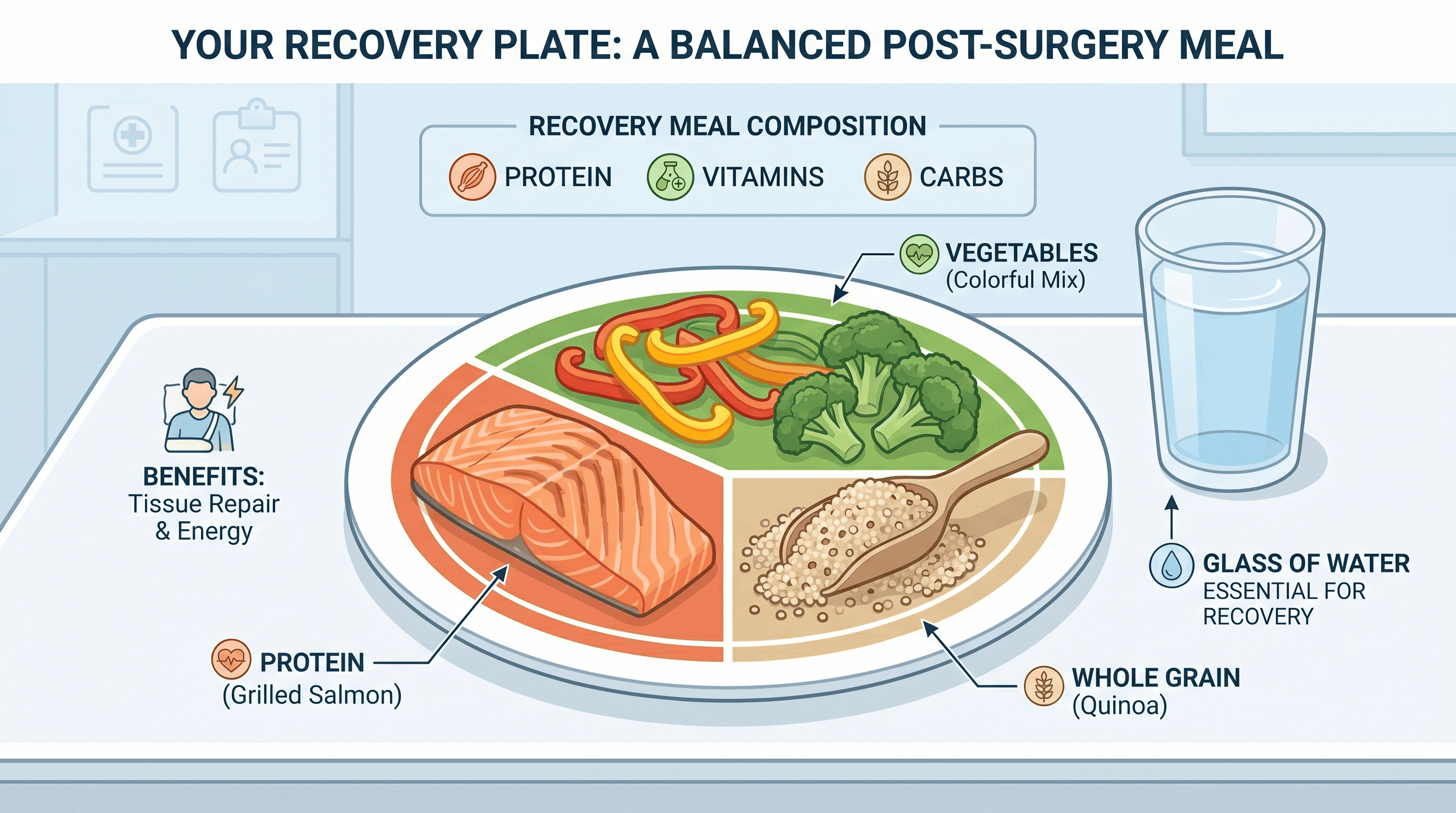
Protein is the most immediately practical lever. Muscle and connective tissue repair both depend on adequate amino acid availability. For surgical recovery, NIH-supported research on protein needs in clinical contexts generally supports a range of 1.2 to 1.6 grams of protein per kilogram of body weight per day. Practical sources include chicken, fish, Greek yogurt, eggs, legumes, and protein-fortified foods.
Omega-3 fatty acids, found in fatty fish like salmon and mackerel, as well as walnuts and flaxseed, support the resolution of the inflammatory process rather than simply suppressing it. This is a meaningful distinction: the goal is not to eliminate inflammation (which is part of healing) but to prevent it from dragging on past the acute phase.
Vitamin C plays a specific role in collagen synthesis. The body uses collagen to rebuild connective tissue, including cartilage-adjacent structures. Citrus fruits, bell peppers, broccoli, and strawberries are strong sources.
Alcohol and smoking should both be avoided during recovery. Smoking impairs circulation and slows tissue repair. Alcohol disrupts sleep architecture and can interact with pain medications.
Hydration matters for joint health and for another post-surgical reality: constipation. Anesthesia, post-operative opioid pain medications, and reduced mobility all slow the digestive system. Adequate water intake and fiber-rich foods, beans, whole grains, fruits with the skin, and vegetables, prevent that discomfort.
Advanced Recovery Tools: Modalities That Actually Work
Standard physical therapy forms the backbone of recovery. A few adjunctive tools can support it meaningfully, though none replaces the PT session itself.
Transcutaneous Electrical Nerve Stimulation (TENS) and Electrical Muscle Stimulation (EMS): TENS units deliver low-level electrical current through skin electrodes to modulate pain signals. EMS units deliver a stronger current designed to cause visible muscle contractions, which helps reactivate the quadriceps during the early weeks when voluntary activation is inhibited by pain and swelling. Physical therapists routinely use neuromuscular electrical stimulation (NMES) for this purpose. Home units are available, though settings should be confirmed with a PT.
Stationary cycling: Once sufficient range of motion returns (roughly 90 degrees of knee flexion), a stationary bike provides low-impact cardiovascular activity and continuous gentle range-of-motion work. The seat height should be adjusted so the knee never fully extends at the bottom of the pedal stroke. Resistance is kept minimal at first.
Medical-grade compression: Compression wraps or sleeves reduce swelling and provide proprioceptive feedback to the joint. They are not a substitute for elevation and ice in the acute phase, but they support ongoing swelling management during the rehabilitation weeks.
Biologics (PRP): Platelet-rich plasma (PRP) injection involves concentrating growth factors from a patient's own blood and injecting them into the repair site. Some surgeons offer it as an adjunct to meniscus repair to support healing in the avascular white-zone tissue. Evidence is still evolving. A doctor can advise on whether this option is appropriate given the type and location of a specific tear.
The Biggest Setbacks: What NOT to Do
The fastest path to a slower recovery runs through a handful of very common mistakes. Recognizing them in advance is the best protection.
Ditching crutches too early. For repair patients especially, premature full weight-bearing puts compressive and shear stress on sutures that have not yet integrated. The timeline for weight-bearing progression is not a suggestion; it reflects the biology of tissue healing.
Deep squatting and twisting motions. These generate high compressive loads and rotational stress inside the joint. Both should be avoided until a physical therapist explicitly clears them, which typically does not happen until well into the strength phase.
Skipping PT sessions. Every missed session is a gap in the neuromuscular retraining sequence. Muscle strength does not build linearly, and the proprioceptive work done in PT cannot be replicated by simply walking around.
Ignoring sharp, localized pain. General aching and stiffness during recovery are expected. Sharp pain that is new, worsening, or located at a specific point inside the joint is not. This warrants a call to the surgical team.
NSAID overuse. Non-steroidal anti-inflammatory drugs like ibuprofen can provide useful short-term pain relief, but chronic overuse may blunt aspects of the inflammatory signaling involved in tissue repair. A doctor or pharmacist can advise on appropriate duration and dosage for a given patient.
Smoking. Beyond its general health effects, smoking directly impairs the microcirculation that delivers oxygen and nutrients to healing tissue. This is particularly consequential for repair patients whose tissue must regenerate in a zone of already-limited blood supply.
What Not to Do After Meniscus Repair Surgery: Signs You're Pushing Too Fast
Knowing the warning signs of overload is just as important as knowing the exercises. Recovery is not linear, and bad days happen. The question is whether symptoms are within the expected range or outside it.
At two weeks post-surgery, some aching with physical therapy exercises and mild swelling by the end of the day are both normal. Sharp pain during exercises, significant warmup swelling that does not subside with elevation, or fever above 101°F are not normal and warrant contact with the surgical team.
At six weeks, for meniscectomy patients who are typically back to light daily activity by this point, some residual stiffness after prolonged sitting is common. Persistent swelling after walks, clicking with a sensation of catching inside the joint, or pain that is getting worse rather than better should be evaluated. Pain at six weeks after meniscus surgery that is not trending downward is a reason to follow up with a surgeon.
At three months, repair patients are often mid-way through the strength phase of rehabilitation. Muscle fatigue and some exercise-related soreness are expected. Instability (a feeling of the knee giving way), mechanical locking, or pain that limits the ability to perform PT exercises at all should be discussed with the orthopedic surgeon.
If any of the following symptoms appear at any point, contact the surgical team the same day: fever above 101°F, increasing redness or warmth around the incision, drainage from the surgical site, calf pain or swelling (which can signal DVT), or a sudden increase in pain that is not explained by activity.
When questions arise about symptoms or progress, connecting with a qualified specialist is the right next step. Find a physician or orthopedic specialist to help guide decisions about timing, physical therapy progression, and return-to-activity clearance.
FAQ
How long does it take to walk normally after meniscus surgery?
After a partial meniscectomy, most patients walk without crutches within one to two weeks and approach a normal gait within three to four weeks. After a meniscus repair, walking without assistance may take four to six weeks, and a fully natural gait pattern often returns closer to three months as strength and neuromuscular control are rebuilt through physical therapy.
Can you get back to 100% after meniscus surgery?
Many patients return to their pre-injury activity level after meniscus surgery, though the timeline and degree of recovery vary by surgery type, age, overall fitness, and how closely the rehabilitation protocol is followed. Meniscectomy patients generally have faster functional recovery. Repair patients often achieve strong long-term outcomes when the repair heals successfully, though return to high-impact sport typically takes six months or longer. A doctor can give a realistic individual prognosis.
Can I drive 3 days after meniscus surgery?
For most right-knee surgeries, driving is not safe within three days. A common benchmark for return to driving is approximately two weeks post-surgery for the right knee, once the patient can perform an emergency stop without hesitation or pain. Left-knee patients with an automatic transmission may be cleared somewhat sooner. The surgeon's specific clearance is required before driving resumes; this is not a self-assessed milestone.
What not to do after meniscus repair surgery?
Avoid deep squats, twisting or pivoting motions, running, and jumping until explicitly cleared by a physical therapist or surgeon. Do not bear full weight ahead of schedule, skip physical therapy appointments, smoke, or ignore new or worsening pain. Do not rely solely on pain medication to manage discomfort while pushing physical activity beyond the prescribed protocol.
References
- Cleveland Clinic: Meniscus Surgery — Overview of meniscus repair, partial meniscectomy, recovery timeline, and complication risks.
- Koch M. Early Functional Rehabilitation after Meniscus Surgery. Rehabil Res Pract. 2020; PMC7146095 — Evidence for early mobilization and functional rehabilitation after meniscus surgery vs. prolonged immobilization.
- Current Practices for Rehabilitation After Meniscus Repair: AOSSM Survey. Orthop J Sports Med. 2024; PMC11025434 — Survey of sports medicine specialists on current rehabilitation practices following meniscus repair.
- EU-US Meniscus Rehabilitation 2024 Consensus (ESSKA-AOSSM-AASPT). Knee Surg Sports Traumatol Arthrosc. 2025; PubMed 40353298 — International consensus guidelines for rehabilitation management after meniscus surgery, covering meniscectomy, repair, and reconstruction.