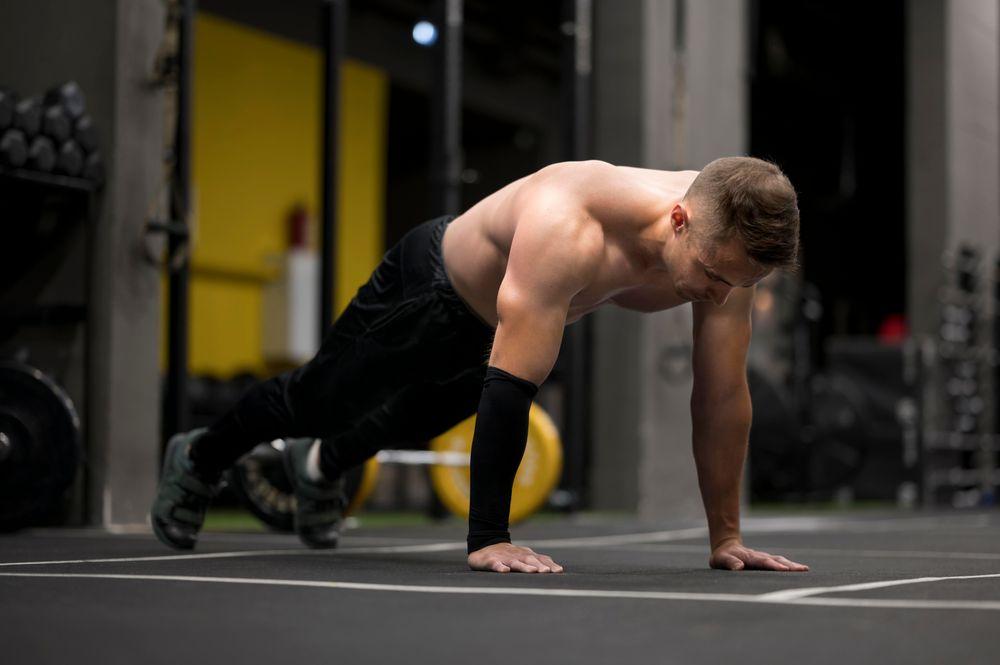


Push-ups feel like the simplest test of upper body fitness. After rotator cuff surgery, they become the most loaded question in your recovery, and the answer almost no one gives you straight.
This guide does exactly that. Not just when, but how to get there, with a step-by-step progression from surgery day to full floor push-ups, the objective criteria your PT is looking for at every gate, and the warning signs that tell you to pump the brakes.
At a Glance
| Topic | Key Facts |
|---|---|
| Earliest push-up variation | Wall push-ups around weeks 8 to 10 |
| Full floor push-ups | 4 to 6+ months depending on repair size |
| Primary risk | Re-tear from premature loading |
| Most important form rule | Elbows at 45 degrees, never flared to 90 |
| Progression principle | Criteria-based, not calendar-based |
| Key milestone before floor push-ups | 30-second pain-free straight-arm plank |
Why the Floor Is Off-Limits for 4 to 6+ Months
Most people want a straight timeline when they search this question. Here it is:
| Surgery Type | Wall Push-Ups | Incline Push-Ups | Floor Push-Ups |
|---|---|---|---|
| Small tear (under 3 cm), arthroscopic | ~8 to 10 weeks | ~3 months | ~4 to 5 months |
| Large tear (over 3 cm), multiple tendons, or open repair | ~12 weeks | ~4 months | ~6+ months |
These are general ranges based on common rehabilitation protocols. Your surgeon and physical therapist will give you the definitive green light based on your specific repair, tissue quality, and how your recovery is progressing.
So why such a long wait? A standard floor push-up is not a simple movement for a post-surgical shoulder. When you lower yourself toward the floor, your body weight, often 60 to 70 percent of your total bodyweight at the hands, transfers directly through the shoulder joint. The repaired tendons must simultaneously stabilize the humeral head, control scapular position, and transmit significant compressive and shear forces.
In the early weeks after surgery, the tendon-to-bone anchors holding your repair in place are genuinely fragile. The biological healing cascade, including revascularization, collagen remodeling, and tendon maturation, takes months to produce tissue strong enough to tolerate that load. Applying pressing force too early is one of the most common causes of re-tear, which affects a meaningful proportion of patients and often requires revision surgery.
The progression from wall to incline to floor is not arbitrary caution. It is a deliberate mechanical ladder designed to load the healing repair in controlled, graduated increments.
The Biomechanics of a Push-Up: Why It Is So Stressful on the Shoulder
Understanding why the push-up is so demanding on the repaired shoulder helps you respect the timeline rather than fight it.
A push-up is a closed kinetic chain exercise, meaning your hands are fixed against the floor while your body moves. This is actually favorable for shoulder joint congruence in healthy individuals, but it creates a specific problem after rotator cuff repair: the rotator cuff cannot escape the load. It must work.
Here is what the cuff is doing during every push-up repetition.
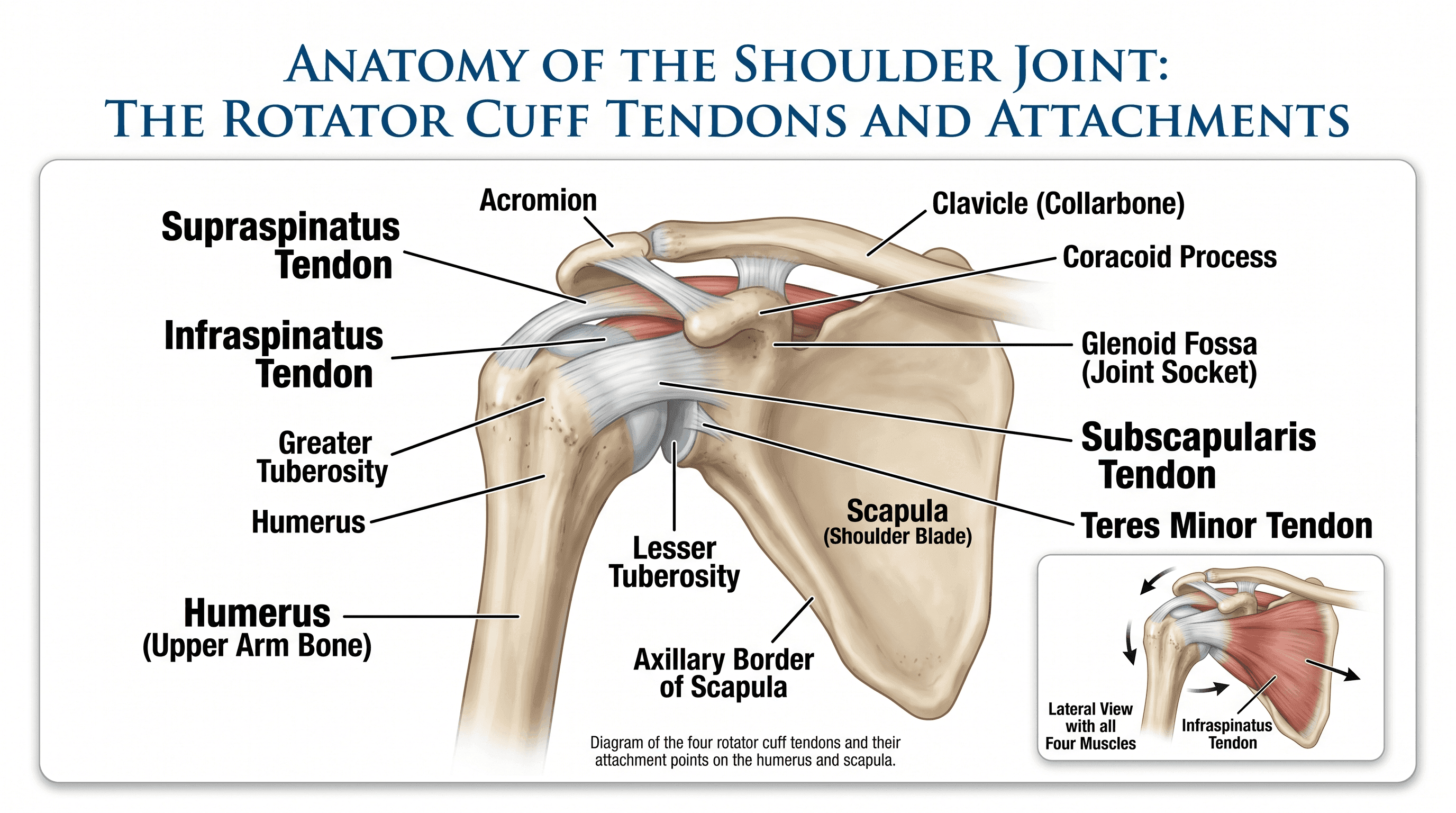
The supraspinatus, the most commonly torn tendon, depresses the humeral head and prevents it from migrating superiorly as the deltoid fires during pressing. Without adequate supraspinatus strength and integrity, the humeral head rides up and impinges against the acromion, which is precisely the mechanism that causes pain and re-injury.
The subscapularis, the large internal rotator on the front of the joint, is heavily loaded during the lowering phase. Subscapularis repairs are particularly vulnerable to push-up forces because the anterior shoulder position at the bottom of a push-up places the tendon under maximum stretch and load simultaneously. Surgeons who perform subscapularis repairs often have the most conservative push-up timelines for this reason.
The infraspinatus and teres minor, the posterior cuff muscles, work eccentrically to control the descent and maintain posterior capsule tension throughout the movement.
Scapular stabilizers, particularly the serratus anterior and lower trapezius, must control scapular upward rotation throughout the range of motion. Research on scapular mechanics in shoulder rehabilitation demonstrates that deficient scapular control significantly increases impingement risk and places abnormal loads on repaired cuff tissue.
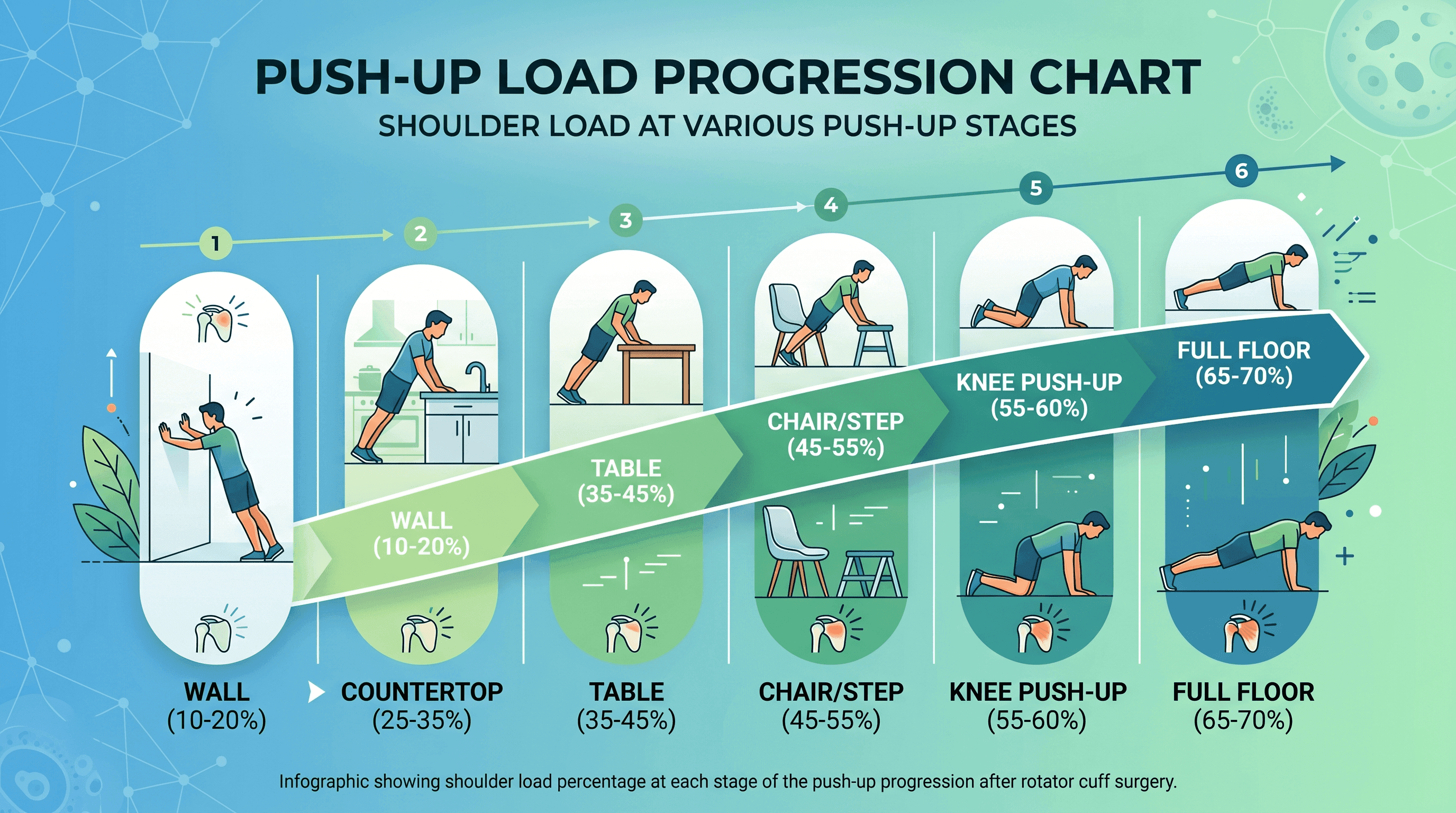
The upright angle of a wall push-up reduces the gravitational load on the shoulder to roughly 10 to 20 percent of body weight. Each degree you move toward horizontal increases the demand. A floor push-up at the bottom of the range can approach 70 percent of body weight through the shoulder, which is why the incline progression matters so much.
The Prerequisites: What You Must Achieve Before Trying a Push-Up
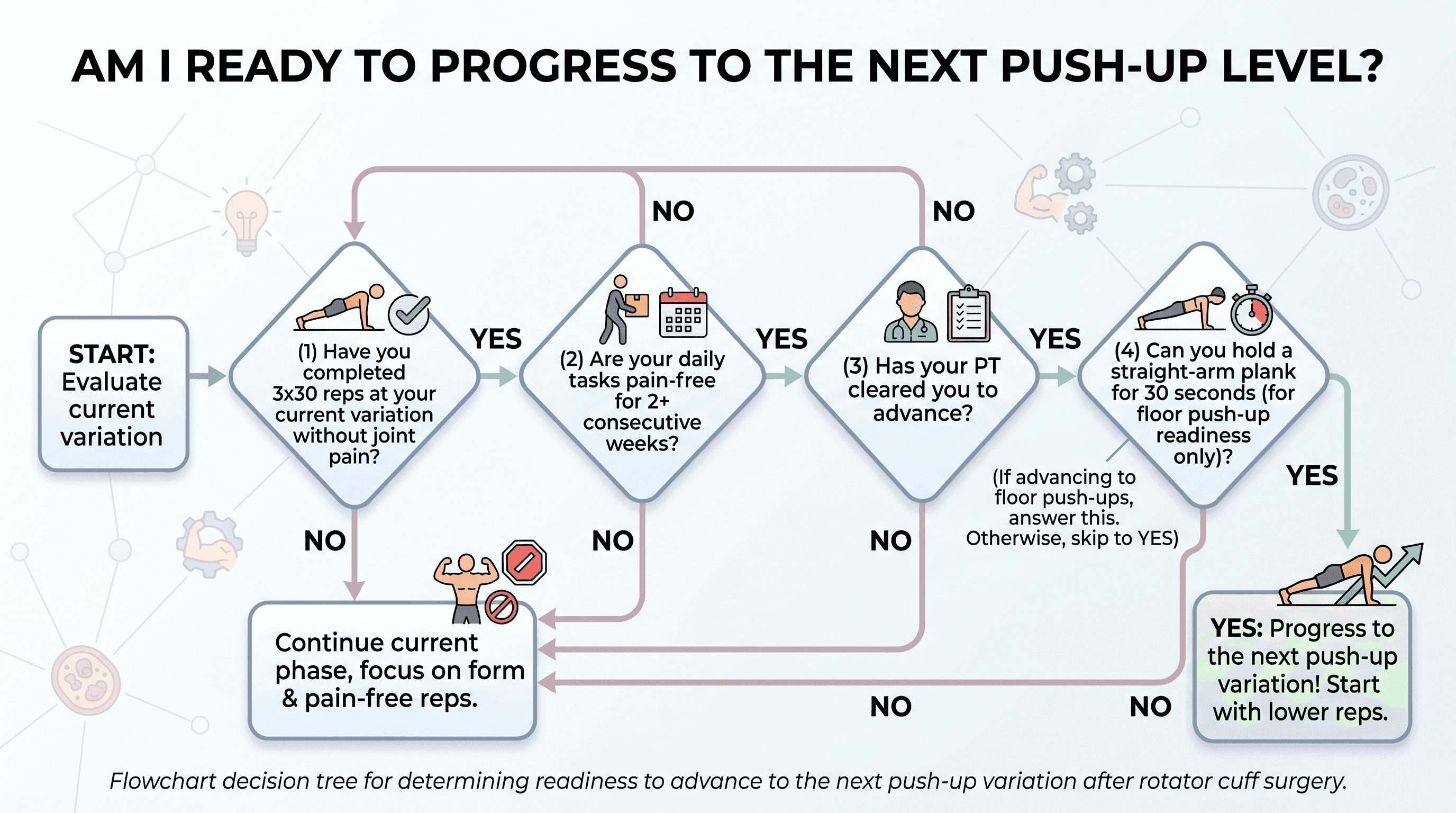
Time alone is not a reliable guide for push-up readiness. The research literature is unambiguous: criteria-based progression, not calendar-based progression, is the current standard of care for return to activity after rotator cuff repair.
Before any push-up variation is appropriate, most physical therapy protocols require the following.
Passive Range of Motion Restoration
Your shoulder should achieve passive forward flexion and external rotation within normal limits, typically greater than 150 degrees of forward flexion and greater than 40 degrees of external rotation. This indicates the capsule and tissue constraints are not restricting movement in ways that would cause compensatory loading during a push-up.
Full Active Range of Motion
You must be able to actively move your arm through the full range without pain or significant substitution patterns. If you are hiking your shoulder or leaning your trunk to reach overhead, the cuff musculature is not ready for a closed-chain pressing load.
Pain-Free Activities of Daily Living
Reaching into a cabinet, lifting a glass of water, pulling on a shirt: these must be comfortable for at least two consecutive weeks before you introduce any push-up variation. If routine daily tasks are still provocative, pushing through a set of wall push-ups will likely set you back.
Baseline Rotator Cuff Strength
The evidence-based benchmark used in return-to-activity research is at least 80 percent strength symmetry compared to the non-surgical shoulder. This is typically assessed with a handheld dynamometer by your PT. A practical proxy if you lack formal testing: can you perform pain-free shoulder external rotation and scaption against moderate manual resistance without apprehension?
No Apprehension with Arm Weight-Bearing
Before floor push-ups specifically, you should be able to bear weight through a straight arm, as in a plank position, without pain, clicking, or a sense of instability. The plank milestone is covered in its own section below.
The Push-Up Progression Protocol
This is the phase-by-phase roadmap most protocols converge on. Each phase has a readiness gate, the recommended variation, a rep target before advancing, and a brief note on what is happening biologically at that stage of healing.
Phase 1: Weeks 0 to 6, No Push-Up Activity of Any Kind
What is happening biologically: The repair is in its most vulnerable state. Tendon-to-bone reattachment involves a complex healing response where fibroblasts lay down early collagen bridges between the tendon stump and the bone trough. This tissue is biomechanically weak, and even modest compressive or tensile forces can disrupt the anchors before they have matured.
What to do: Wear your sling as instructed. Follow your PT's pendulum and passive range-of-motion exercises only. Do not attempt any pressing, pushing, or weight-bearing through the surgical arm.
What you can do for fitness: Lower body training such as squats, lunges, and stationary cycling, as well as isometric exercises of the contralateral arm and walking, are generally well-tolerated. Use this phase to build a cardiovascular base and maintain lower body strength.
Phase 2: Weeks 6 to 10, Wall Push-Ups Begin
Readiness gate: Sling discontinued, passive ROM restored, pain-free pendulums and early active-assisted exercises. Your PT should clear this transition explicitly.
The variation: Wall push-ups. Stand arm's length from a wall, place hands at shoulder width and shoulder height, and perform controlled push-up movements with your body in a straight line from heels to head.
Why this is safer: The upright position reduces the load through the shoulder to roughly 10 to 20 percent of body weight. The movement is nearly vertical, which dramatically reduces the shear forces on the repair compared to any inclined or floor position.
Form cues to follow: Place hands shoulder-width apart with fingers pointing slightly outward. Let elbows track at approximately 45 degrees to your torso rather than flaring out to 90 degrees, which reduces impingement risk and protects the anterior capsule. Initiate the movement by protracting the scapula as you push away from the wall, and control the descent rather than falling into the wall.
Progression target: Work up to 3 sets of 30 controlled wall push-ups before moving on. If you reach this without pain or fatigue in the shoulder joint, with chest and tricep fatigue expected and fine, you are ready for the next phase.
Phase 3: Months 3 to 4, Incline Push-Ups (Table to Step to Chair)
Readiness gate: Near-full active ROM, resistance band exercises pain-free, wall push-up target achieved.
The variation and sequence: Incline push-ups with progressively lowering surfaces, in this order: kitchen countertop at approximately 90 cm or 36 inches, which is similar in angle to wall push-ups but introduces more horizontal body position; a sturdy table at approximately 75 cm or 30 inches; an aerobic step or low bench at approximately 30 to 45 cm or 12 to 18 inches; and finally a chair seat at approximately 45 cm or 18 inches.
Each step down in surface height increases the percentage of body weight loaded through the shoulder. Move to the next surface only when you can complete 3 sets of 30 reps at the current height with no joint pain and good form.
Form cues for all incline variations: Maintain a rigid plank body position throughout. Keep elbows at 45 degrees and never flared. Protract the scapula on the push, thinking about pushing the surface away. Use a controlled 2-second descent followed by a 1-second push.
What the biology is doing: By month 3, the early collagen matrix has been remodeled into more mature, mechanically capable tissue. Studies on tendon-to-bone healing show that progressive mechanical loading during this window actually stimulates collagen fiber alignment and improves the tensile strength of the repair, making graduated loading beneficial rather than just tolerable.
Phase 4: Months 4 to 6, Knee Push-Ups, Then Floor Push-Ups
Readiness gate: Pain-free ADLs for two or more consecutive weeks, shoulder strength at least 80 percent of contralateral side, plank hold of 30 or more seconds without discomfort, chair push-up target achieved.
The progression within this phase: Begin with knee push-ups, which reduce the load by approximately 15 to 20 percent compared to a full floor push-up and introduce the horizontal position for the first time. Master 3 sets of 20 before advancing. Then introduce full floor push-ups with a slow, controlled tempo of 3 seconds down and 1 second up, at lower volume initially (2 sets of 8 to 10 reps).
The critical form point on elbow angle: Flaring elbows to 90 degrees places the anterior shoulder at maximum impingement risk and stretches the subscapularis repair at its most vulnerable angle. Keep elbows at 45 degrees consistently. This is the single most important technique cue for protecting a rotator cuff repair during push-ups.
What stays off-limits at this stage: Weighted vest push-ups, clapping or plyometric push-ups, handstand push-ups, wide-grip push-ups with elbows fully flared, and one-arm push-up variations all remain contraindicated until at least 6 months post-surgery and require explicit surgical clearance.
Protecting the Repair: Flawless Form Is Mandatory
Once cleared for any push-up variation, the quality of every repetition matters more than the quantity. Sloppy form that would be inconsequential for a healthy shoulder can be genuinely harmful to a healing repair.
The Non-Negotiable Form Rules
Elbows at 45 degrees, always. The military-style push-up with elbows close to the ribs is actually safer for shoulder health than the wide "T" position most people default to. The 45-degree angle distributes force more evenly across the cuff musculature and reduces impingement against the acromion.
No shoulder shrugging. If your shoulder girdle climbs toward your ear during the push, your scapular stabilizers are not controlling the movement. Stop the set, rest, and focus on keeping the shoulder blade depressed and packed throughout.
Control the descent completely. The lowering phase is where repairs are most vulnerable. Never drop into the bottom position. A 2 to 3 second eccentric lowering phase is a reasonable target throughout recovery.
Maintain a neutral spine. Sagging hips increase anterior pelvic tilt, which subtly alters shoulder mechanics. Keep the core engaged and the body in a rigid plank line. If your hips sag before your shoulders fatigue, your core conditioning needs work before your push-up volume increases.
Stop at first joint pain. Chest burn and tricep fatigue are fine. Any sharp, pinching, or localized sensation inside the shoulder joint itself means stop the set immediately.
Safer Alternatives to Build Chest Strength Early On
The timeline to push-ups is long. That does not mean your chest, anterior deltoid, and triceps need to atrophy while you wait. These alternatives allow meaningful upper body pressing work during recovery.
Phase 2 and Onward (Weeks 6 to 10)
Resistance Band Chest Press (Seated or Standing): Anchor a resistance band at chest height behind you, hold the ends, and press forward. The band's resistance curve loads the repair in the least vulnerable position, with the shoulder in a neutral, supported arc throughout.
Cable Chest Press (Low to Moderate Weight): Similar mechanics to the band press. The cable machine allows precise load control and a horizontal pressing path comparable to a push-up but without the closed-chain compressive element.
Phase 3 and Onward (Months 3 to 4)
Lying Dumbbell Floor Press: The floor limits range of motion at the bottom of the movement, with elbows contacting the floor before the shoulder reaches its most vulnerable anterior position. This natural range limiter makes the floor press significantly safer than a bench press for recovering shoulders. Start with light dumbbells at 5 to 10 pounds and progress gradually.
Seated Machine Chest Press: Machines provide a controlled movement path and allow the non-surgical arm to assist if needed. Adjust the seat height so the handles are at mid-chest level to avoid loading the shoulder in a compromised position.
What to Avoid Until Cleared for Full Push-Ups
The barbell bench press, particularly with a wide grip and deep range of motion, should remain off the table until you have been cleared for full floor push-ups and have demonstrated good shoulder stability. Research on shoulder loading during pressing movements consistently shows that wide-grip horizontal pressing generates the highest anterior shoulder forces, which is precisely the vector that stresses most rotator cuff repairs.
The Plank Milestone: A Necessary Stepping Stone
Before you attempt a floor push-up, you need to demonstrate that your shoulder can tolerate sustained isometric load in the weight-bearing position. The static plank is that test.
A floor push-up requires the shoulder to generate dynamic pressing force on top of static stability. If you cannot hold the top plank position without joint discomfort, pain, or instability, adding the dynamic component of a push-up is premature.
The Plank Progression for Post-Surgical Shoulders
Step 1: Forearm plank. Begin with a forearm plank, which places minimal demand on the shoulder in a weight-bearing position. Hold for 15 to 20 seconds and build to 60 seconds across 2 to 3 sets before advancing.
Step 2: Straight-arm plank (push-up top position). With hands directly under shoulders and elbows fully extended, hold the top push-up position. Start with 10 to 15 seconds and work toward a comfortable 30-second hold.
Step 3: Plank with shoulder taps. Shift weight to one hand briefly to touch the opposite shoulder. This introduces dynamic load transfer between sides, the same challenge present at the top of a push-up when pushing back up.
Achieving a 30-second pain-free straight-arm plank is a reasonable minimum benchmark before beginning floor push-ups. If planks trigger sharp shoulder pain, it signals the joint is not yet ready for the full closed-chain pressing load of a push-up.
Warning Signs: When to Stop Your Set Immediately
Knowing the difference between productive discomfort and harmful overload is one of the most practical skills in post-surgical recovery.
Normal Sensations: Keep Going
Muscle fatigue or burning in the chest, triceps, or anterior deltoid is the tissue you are training, which means the exercise is working. Mild muscular soreness 24 to 48 hours after a session is a normal training response that is diffuse, muscular, and resolves within 48 to 72 hours. Mild, generalized shoulder tiredness during a session is expected adaptation as long as it stays in the muscle belly and resolves with rest.
Stop Immediately: These Are Red Flags
Sharp, localized, pinching pain inside the shoulder joint during movement is categorically different from muscle fatigue. It feels like it is coming from inside the joint, often described as a catching or stabbing quality. Stop the set.
Clicking, clunking, or a sensation of the shoulder sliding during the exercise can indicate impingement, subacromial irritation, or biceps tendon involvement. Have your PT evaluate before continuing.
Increased swelling, warmth, or aching in the shoulder joint after exercise that persists for more than 24 hours is a sign of overloading, meaning you advanced too quickly.
Weakness or instability returning after a period of improvement is a warning to take seriously. If a shoulder that felt stable last week suddenly feels unsupported during push-ups this week, do not push through it. Regression in strength can be an early sign of re-tear.
The goal is not to avoid all discomfort. It is to distinguish between tissue that is adapting and a repair that is being overstressed. When in doubt, take a session off and reassess. One skipped workout will not set back your recovery. One re-tear might.
Factors That Can Extend Your Push-Up Timeline
Every recovery is individual. Several variables can push the timelines above in the longer direction.
Tear size and complexity matters because repairs involving tears larger than 3 cm, two or more tendons, or significant tendon retraction require longer biological healing times. The repair is mechanically larger and the tissue edges were under more tension when sutured together.
Age is a real factor, as tendon vascularity and healing capacity decline over time. Patients over 65 generally experience slower collagen maturation and may need an additional 4 to 8 weeks at each phase before advancing.
Tissue quality plays a significant role, since degenerative, chronic tears have poorer tissue quality than acute traumatic tears. Surgeons often note tissue quality in operative reports, and if yours noted "friable" or "degenerative" tissue, expect a conservative timeline.
Smoking directly impairs tendon vascularity and significantly slows the healing response. Research on smoking and tendon healing documents measurably worse outcomes in smokers following rotator cuff repair, including higher re-tear rates. Quitting before surgery and through recovery is one of the most impactful decisions you can make.
Early rehabilitation compliance shapes your entire trajectory. Skipping PT sessions or not performing home exercise programs during Phases 1 and 2 creates deficits in range of motion and muscle activation that must be corrected before later phases can be cleared.
Re-tear events affect approximately 20 to 30 percent of repaired rotator cuffs at some point post-operatively. A confirmed re-tear typically resets the progression timeline entirely.
If you are unsure whether your recovery is on track, or if you have concerns about your specific repair type, finding a board-certified orthopedic specialist for a consultation can help you get a clear, individualized picture of your timeline.
Frequently Asked Questions
Should I do push-ups with a rotator cuff injury before surgery?
It depends on the severity and type of tear. For partial-thickness tears managed conservatively, low-load wall push-ups may be permissible, but this needs to be determined by your orthopedic provider. For full-thickness tears awaiting surgery, most surgeons recommend avoiding any closed-chain pressing that loads the already-compromised tendon. Modified variations with bent elbows or elevated surfaces may reduce but not eliminate the risk. Get a specific recommendation before proceeding.
What exercises should I avoid after rotator cuff repair?
In the early phases, avoid all pressing, pushing, and overhead movements with the surgical arm. As you progress, continue to avoid dips, behind-the-neck press, wide-grip bench press, plyometric push-up variations, and any exercise that produces sharp joint pain. These restrictions ease progressively, so work with your PT to get clearance as you meet strength and ROM criteria.
How long does it take for tendons to reattach to bone after rotator cuff surgery?
The tendon-to-bone interface undergoes a staged healing process. Initial fibrovascular tissue bridges form in the first 3 to 6 weeks. Collagen deposition and maturation occur primarily between weeks 6 and 12. Remodeling of the repair into more mature, mechanically capable tissue continues through 6 to 12 months post-surgery. Studies using imaging and biomechanical analysis show that structural maturation of the repair is an ongoing process, which is why loading must be graduated and criteria-based rather than time-based.
How long after rotator cuff surgery until I can bench press?
The barbell bench press is generally one of the last movements cleared after rotator cuff repair. It involves a wide grip, deep shoulder flexion and horizontal abduction, and high loads, all factors that stress the anterior shoulder and supraspinatus. Most protocols do not clear bench pressing until full floor push-ups have been demonstrated pain-free and shoulder strength has reached at least 80 percent symmetry with the contralateral side. For most people that means no earlier than 5 to 6 months for small repairs, and 6 to 9 or more months for large or complex repairs. When you do return, start with a close-grip technique, controlled tempo, and conservative load.
Can I ever do handstand push-ups or plyometric push-ups after rotator cuff surgery?
Many patients do return to advanced push-up variations, but these require full recovery and explicit surgical clearance, typically no earlier than 9 to 12 months post-operatively and only if strength symmetry, pain-free function, and structural integrity of the repair have all been confirmed. These are goals worth aiming for, but they belong in the late-stage return-to-performance phase.
Is a knee push-up a safe modification earlier in recovery?
Knee push-ups reduce the load compared to a full floor push-up but still place significant demand on the shoulder, more than incline push-ups from a chair or step. Most protocols introduce knee push-ups as a bridge between chair-height incline push-ups and full floor push-ups around months 4 to 5, not as an early modification.
For personalized guidance on navigating your recovery timeline, symptoms, or treatment options, the Momentary Lab health navigator can help you find the right information and connect with the right care.
References
- Escamilla RF, et al. "Shoulder muscle activity and function in common shoulder rehabilitation exercises." PMC5366376 — Cited for tendon-to-bone healing and progressive mechanical loading during collagen remodeling.
- Systematic review on return-to-sport criteria after rotator cuff repair. British Journal of Sports Medicine. 2023. PubMed 36792854 — Cited for the 80% strength symmetry benchmark in criteria-based return to activity.
- Kibler WB, Sciascia A. "Current concepts: scapular dyskinesis." British Journal of Sports Medicine. PMC5834570 — Cited for scapular mechanics, impingement risk, and structural maturation timelines.
- Edwards PK, et al. "Clinical review of rotator cuff repair rehabilitation." PMC6370080 — Cited for shoulder loading during wide-grip horizontal pressing movements.
- Rotator cuff repair outcomes and healing rates: systematic review. 2025. PMC11905542 — Cited for re-tear rates post-operatively.
- Cancienne JM, et al. "Tobacco use and rotator cuff repair outcomes." PMC6435882 — Cited for smoking's impact on tendon vascularity and re-tear rates.