


Most people know shoulder replacement surgery hurts. What they don't know is when each type of hurt shows up, what it means, and whether it's normal. This guide covers every phase of shoulder replacement surgery recovery week by week, from the nerve block wearing off in the hospital to playing golf at month nine. Both anatomic and reverse total shoulder replacement timelines are covered side by side, because applying the wrong protocol to the wrong surgery is one of the most common mistakes patients make at home.
At a Glance
| Topic | Key Facts |
|---|---|
| Surgery types | Anatomic (TSA) and reverse total shoulder arthroplasty (RTSA) |
| Hospital stay | Typically 1 to 2 nights |
| Sling duration | 4 to 6 weeks for most patients |
| Driving clearance | Generally 4 to 6 weeks post-op, surgeon-dependent |
| Full passive ROM phase | Weeks 0 to 6 |
| Active muscle use begins | Weeks 6 to 8 |
| Return to desk work | Weeks 4 to 6 (non-dominant); weeks 6 to 8 (dominant arm) |
| Maximum medical improvement | 9 to 12 months |
| Long-term weight limit | Typically 25 lbs per most orthopedic protocols |
Before Surgery: The Week-1 Advantage Most Patients Miss
Prehab, short for pre-operative rehabilitation, refers to exercises and home preparation completed in the days or weeks before surgery. Surgeons at major orthopedic centers increasingly recommend a structured prehab window because patients who enter the operating room with stronger surrounding musculature and a clear home setup tend to exit the acute pain phase faster.
Prehab Exercises Your Surgeon May Recommend
The goal of prehab is not to push range of motion (ROM) into territory that causes pain. It is to maintain whatever mobility still exists and prime the rotator cuff and scapular stabilizer muscles that will carry the workload during early rehab. With a surgeon's clearance, gentle pendulum swings, supported elbow flexion, and light grip-strengthening exercises are commonly prescribed. Patients who complete consistent prehab typically report less early stiffness and transition to physical therapy (PT) with a stronger baseline.
Setting Up Your Home Before You Leave for Surgery
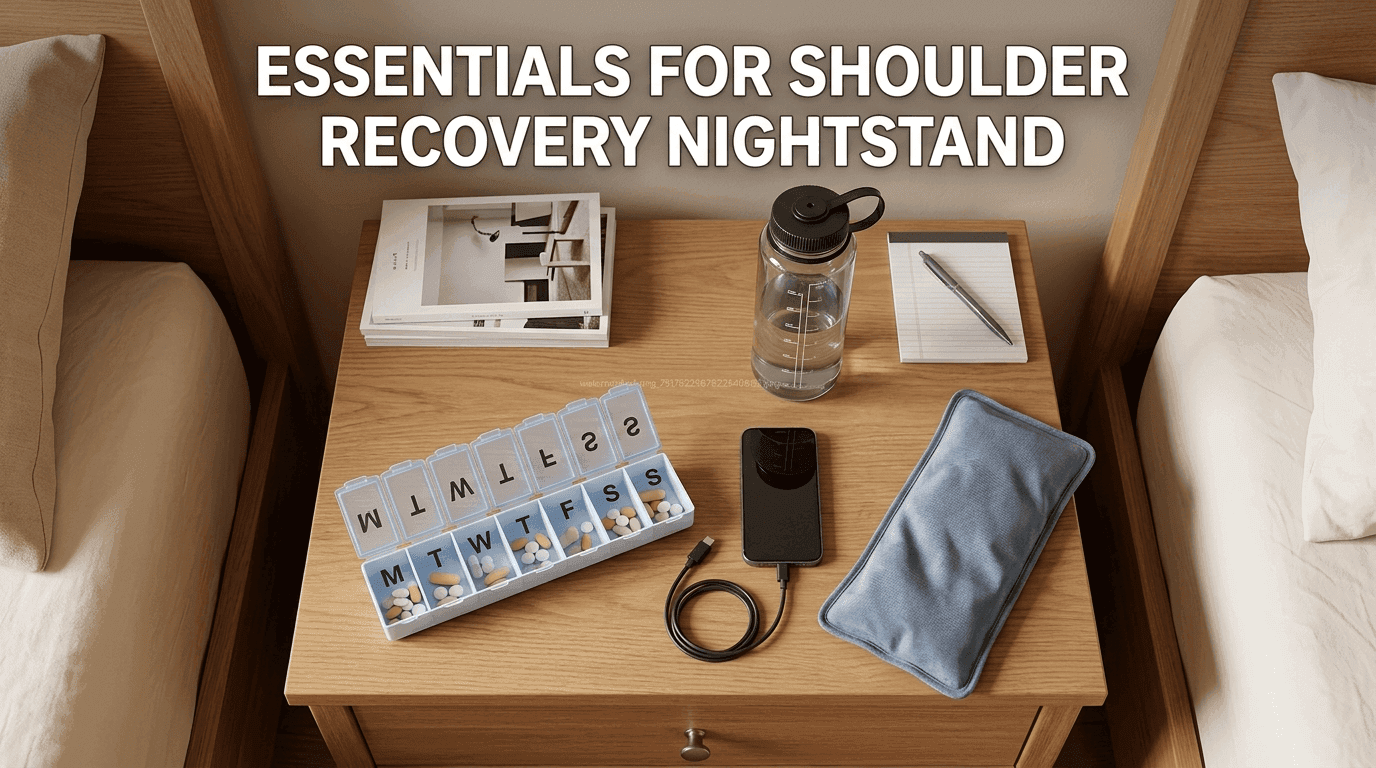
A recliner chair is not optional for the first two weeks; it will become the only position in which many patients can sleep comfortably. Set up a nightstand within easy one-handed reach stocked with medications, water, a phone charger, and something to read. Loose button-front or zip-front shirts eliminate the morning struggle of pulling fabric over a swollen shoulder. Slip-on shoes remove the need to bend and tie laces one-handed. Prepare several days of ready-to-eat meals in advance, and arrange for a caregiver or family member to be present for at least the first 72 hours. A raised toilet seat and a handheld shower head are also worthwhile investments before the surgery date.
Anatomic vs. Reverse Shoulder Replacement: Why Your Surgery Type Changes Your Timeline
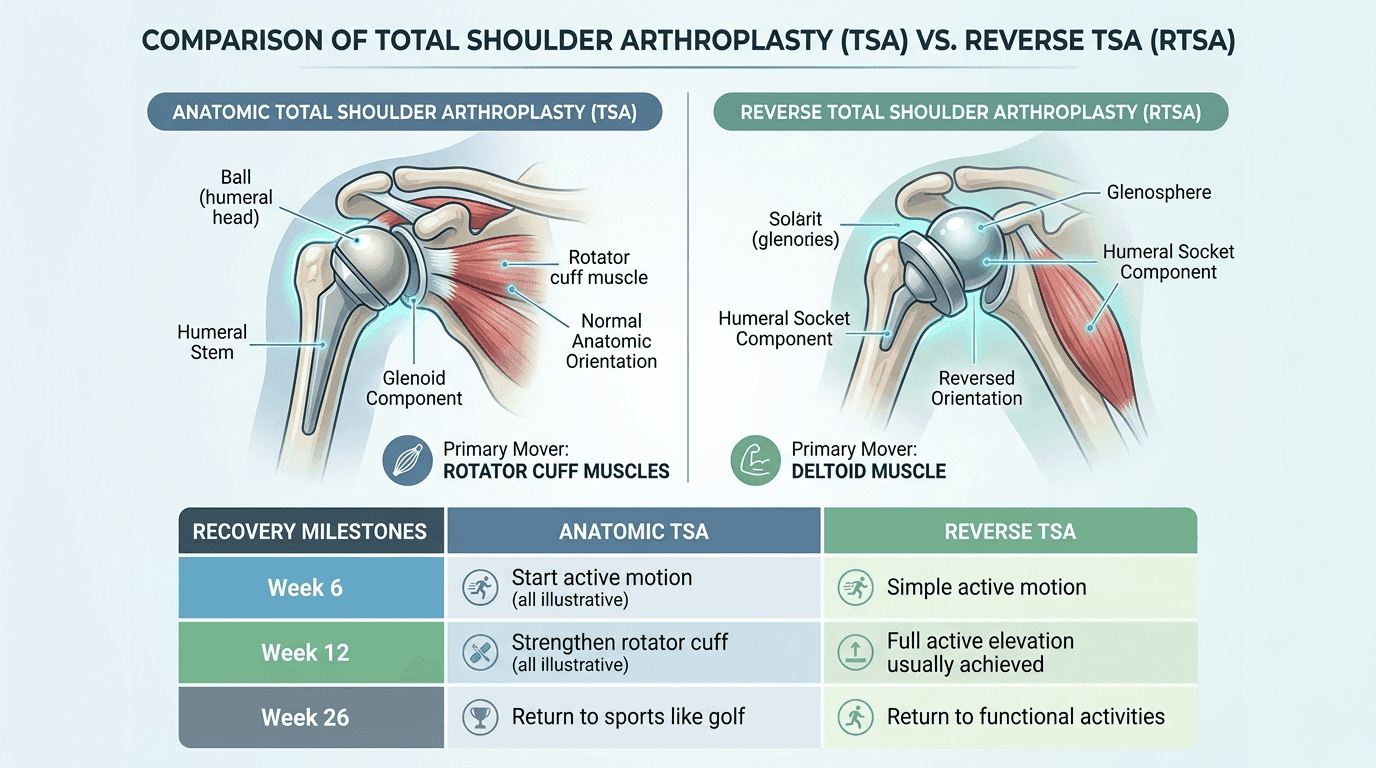
The two most common procedures are anatomic total shoulder arthroplasty (TSA) and reverse total shoulder arthroplasty (RTSA), and they follow meaningfully different recovery tracks.
In an anatomic TSA, the ball of the humerus and the socket of the scapula are replaced to mirror normal joint anatomy. This procedure requires an intact or repairable rotator cuff to function, and PT progresses toward rotator cuff strengthening relatively early in the active phase. According to Cleveland Clinic, anatomic TSA is most commonly performed for shoulder arthritis with a functional rotator cuff.
In a reverse TSA, the positions of the ball and socket are switched: a metal ball is fixed to the scapula and a socket is placed on the humerus. This design offloads work from the torn or absent rotator cuff and transfers it to the deltoid muscle. Because the deltoid is the primary mover after RTSA, rehab focuses on deltoid activation rather than rotator cuff strengthening. Sling duration after RTSA is often longer, and overhead reaching takes more time to return.
Where timelines differ between the two procedures, this guide notes it explicitly. Where a timeline applies to both, no distinction is made.
Day of Surgery Through Hospital Discharge: What to Expect in the First 24 to 48 Hours
Shoulder replacement surgery takes roughly two hours, per Cleveland Clinic. Most patients spend one to two nights in the hospital before discharge, though same-day discharge is increasingly offered at high-volume centers for healthy patients who meet recovery criteria.
In the recovery room, nurses monitor blood pressure, oxygen levels, and surgical site drainage. Pain is usually well managed in the first hours because of the regional nerve block placed before or during surgery.
The Nerve Block: What It Does and When It Wears Off
A regional nerve block, typically an interscalene brachial plexus block, numbs the shoulder, upper arm, and part of the hand for anywhere from 12 to 24 hours after surgery. Patients often describe the arm as feeling completely absent, which can be disorienting but is entirely expected. The block begins to wear off gradually, and when it does, post-surgical pain steps in quickly. This transition catches many patients off guard.
The most important preparation for block fadeout is having oral pain medication on board before numbness disappears, not after. Surgeons typically instruct patients to take the first dose of prescribed medication proactively, usually four to six hours after surgery, so the medication reaches therapeutic levels before the block fully wears off. If a patient waits until pain is severe before taking medication, they will spend several hours catching up while already in significant discomfort.
Week 1 to 2: Pain Management, Sling Use, and Your First Exercises
Weeks one and two are survival mode. The surgical pain peaks in this window and requires consistent, around-the-clock medication management rather than reactive dosing. Opioid medications prescribed at discharge are typically intended for this phase only, and patients who take them on a schedule rather than waiting for pain to peak manage this period considerably better.
Ice applied for 15 to 20 minutes every two to three hours reduces both swelling and pain. A dedicated ice machine or wrap system is easier to use one-handed than loose ice packs.
The sling goes on at discharge and stays on at essentially all times, including sleep, for the first few weeks. Removing it briefly for exercises is permitted, but the arm should not hang freely for extended periods.
Passive ROM exercises typically begin within the first few days of returning home, often with the guidance of a home health PT or outpatient therapist. "Passive" means the therapist or the patient's other hand is moving the arm; the shoulder's own muscles are not contracting. Pendulum exercises, where gravity and a gentle swinging motion create small circular movements, are the classic week-one staple. Elbow bends and hand squeezes maintain forearm and hand circulation.
ADL Milestone: What You Can Realistically Do in Week 1
Activities of daily living (ADLs) are significantly restricted in week one. Brushing teeth and eating with the non-operative arm are manageable, as is typing one-handed. Reaching overhead, lifting anything heavier than a coffee cup, buttoning a shirt, or showering without assistance are not realistic in week one. A sponge bath using one arm is the practical hygiene option. Sleeping in a flat bed is typically not comfortable enough to attempt; most patients sleep semi-reclined in a chair or with multiple pillows propped behind them.
How to Sleep After Shoulder Replacement Surgery
Sleep is the most consistently frustrating part of early recovery, and most patients are not warned clearly enough about it before surgery. For nights one through fourteen, sleeping in a recliner at roughly 45 degrees or propped in bed with a wedge pillow behind the back and a firm pillow under the operative elbow is the standard approach. This position reduces shoulder swelling and takes gravitational stress off the healing joint.
From weeks three to six, some patients transition to sleeping on the non-operative side with a pillow tucked under the operative arm for support. Rolling onto the operative side is not permitted. Full flat-bed sleeping with cleared positions is typically discussed at the six-week follow-up appointment.
Phase Milestone Checklist: Weeks 1 to 2
By the end of week two, a patient recovering on schedule should be able to perform pendulum exercises independently, manage oral pain medication without caregiver assistance, complete basic hand and elbow exercises, maintain consistent ice therapy, and sleep in a reclined position for four to six hour stretches.
Week 3 to 6: Sling Weaning, Early PT, and Returning to Light Daily Life
By week three, the acute surgical pain has shifted to a duller, persistent ache. Bruising that appeared at the shoulder in week one has often migrated down to the elbow, forearm, and hand by week two or three; this is normal gravity-driven fluid movement, not a new injury.
Physical therapy shifts in this window from passive ROM to assisted active ROM. The patient begins to contribute small amounts of muscle activation to movements, but the therapist still provides significant support. The goal is to prevent scar tissue from forming in the capsule that surrounds the joint, a condition called adhesive capsulitis or frozen shoulder, which can significantly complicate recovery if early motion is not maintained.
Sling weaning typically begins around week four for anatomic TSA patients and closer to week five or six for reverse TSA patients, though the exact timeline is surgeon-specific. Most surgeons advise a gradual approach: wearing the sling in public or when fatigued, then transitioning out of it at home for increasing periods throughout the day.
PT Exercises in Weeks 3 to 6: What Your Therapist Will Have You Doing
In this window, physical therapists commonly introduce table slides (using a towel to slide the arm forward on a flat surface), pulley exercises (a rope-and-pulley system where the non-operative arm assists the operative one), and supine-assisted shoulder flexion. These exercises feel modest compared to what the shoulder needs to eventually accomplish, but they are doing precise and important work, stretching the capsule progressively while protecting the healing tendon repair or implant fixation.
Elbow extension and forearm rotation exercises become more aggressive to prevent stiffness that accumulated during sling immobilization.
Phase Milestone Checklist: Weeks 3 to 6
By the end of week six, a patient recovering on schedule should be out of the sling or nearly so, cleared to return to driving (see FAQ section), able to eat with the operative arm with elbow bent, managing daily hygiene independently, and sleeping in bed with a pillow support system rather than a recliner.
Weeks 7 to 12: Building Active Strength and Expanding Movement
Week six or seven marks the transition to active-assisted and eventually fully active motion, meaning the patient's own muscles are now expected to begin driving movement without support from the therapist or the other arm. For anatomic TSA patients, this means rotator cuff activation starts in earnest. For reverse TSA patients, deltoid strengthening takes center stage.
This phase introduces a new type of discomfort: deep muscular soreness. The rotator cuff and deltoid muscles have been immobilized in a sling for four to six weeks and have lost meaningful strength and neuromuscular coordination. When they reactivate, they ache in a way that feels different from surgical pain, more like the soreness after a hard workout in muscles that have not been used in months. This is expected and does not mean the implant is in trouble.
Resistance bands are introduced progressively. Light overhead reaching toward a cabinet is a realistic functional goal by week twelve for many patients, though it varies by surgery type and individual progress. Night pain, which can be significant in weeks one through six, typically begins to improve meaningfully by weeks eight to ten.
Phase Milestone Checklist: Weeks 7 to 12
By the end of week twelve, most patients can reach into a cabinet at shoulder height, wash their hair with minimal assistance, complete a light ADL routine independently, use resistance bands in PT, and sleep through the night with only occasional positional discomfort.
Months 4 to 6: Functional Independence and Return to Activity
This phase is where patients often first think "I'm glad I did this." Functional independence in most daily tasks is achievable by month four for anatomic TSA patients and month five or six for reverse TSA patients.
Return to desk work is realistic for many patients in this window. Light-duty physical work may also be possible depending on the job description, though any occupation involving lifting, reaching overhead, or repetitive shoulder use requires specific clearance from the surgical team.
Regarding sports and exercise: swimming (with stroke modifications), golf, and recreational cycling are activities that many patients return to in this window with surgeon clearance. Contact sports, heavy overhead lifting, and activities that involve repeated high-force shoulder loading are generally not cleared and, in many cases, are permanently restricted. A surgeon can advise on individual cases based on implant type, bone quality, and patient age.
Months 6 to 12 and Beyond: Long-Term Milestones and Implant Care
Maximum medical improvement (MMI) for shoulder replacement typically falls between nine and twelve months post-surgery, though subtle functional gains can continue beyond that window for many patients.
Permanent activity considerations include a standard long-term weight restriction of approximately 25 pounds for repetitive lifting, a guideline supported by the American Academy of Orthopaedic Surgeons. High-impact overhead activities and contact sports carry a risk of implant loosening or fracture around the prosthesis and are typically not cleared on a long-term basis.
Patients should inform every future healthcare provider, including dentists and physicians performing any invasive procedure, that they have a shoulder prosthesis. Bacteremia from dental work or surgical procedures can reach the implant and cause deep joint infection, which is a serious complication. The American Academy of Orthopaedic Surgeons has specific antibiotic prophylaxis guidance for patients with joint replacements.
Annual follow-up appointments with the orthopedic surgeon allow monitoring of implant position, bone stock around the prosthesis, and any early signs of loosening on imaging.
Recovery Is Not Always Linear: Setbacks, Plateaus, and When to Call Your Surgeon
One of the most anxiety-producing aspects of shoulder replacement recovery is not knowing whether a bad day is a normal fluctuation or a sign of something going wrong. Recovery does not proceed in a straight upward line. Good weeks follow frustrating ones. A five-day period of increased aching often precedes a meaningful functional breakthrough.
A plateau in ROM or strength is common around weeks four through six and again around months three and four. These plateaus are not failures; they reflect the biology of tissue remodeling and often break on their own with consistent PT and patience.
Normal vs. Concerning: A Symptom Guide by Week
Weeks 1 to 2: Normal findings include significant swelling at the shoulder, bruising migrating down toward the elbow and hand, moderate-to-severe pain requiring scheduled opioid medication, inability to sleep flat, and dependence on the sling at all times. Concerning findings include a fever above 101.5°F, excessive drainage or opening of the incision, chest pain or shortness of breath, or calf pain with swelling (which can indicate a blood clot).
Weeks 3 to 6: Normal findings include residual swelling, soreness with PT exercises, difficulty sleeping without a recliner, and limited active use of the arm. Concerning findings include sudden increase in pain not explained by activity, new warmth or redness spreading from the incision, or any sensation of instability or clicking accompanied by sudden pain.
Weeks 7 to 12: Normal findings include muscle soreness during active rehab, occasional night pain, and frustration with ROM plateaus. Concerning findings include persistent fever, a shoulder that suddenly feels different or "wrong," significant return of pain after a period of clear improvement, or a sensation of the shoulder "going out."
If questions arise at any point during recovery, connecting with the surgical team directly is always the right call. For non-urgent questions between appointments, many patients find it helpful to see a doctor online through a virtual primary care provider to clarify whether a new symptom warrants an in-person visit or can be managed at home.
Phase Milestone Checklist: Months 4 to 12
By month six, most patients have functional independence in daily tasks, a good baseline of active ROM, and clearance for low-impact recreational activity. By month twelve, shoulder strength is approaching a stable long-term level, PT has typically concluded, and the implant is well-integrated into the surrounding bone.
Nutrition, Lifestyle, and Factors That Influence How Fast You Heal
What happens outside of PT has a direct effect on how quickly the tissue around the new implant heals and how well strength returns.
Protein intake is a significant variable. Tissue repair requires amino acids, and patients who are underweight or eating poorly before and after surgery have slower healing timelines. Aiming for adequate daily protein from whole food sources like eggs, fish, poultry, legumes, and dairy supports the repair process.
Vitamin C is involved in collagen synthesis, the structural protein that forms tendon and connective tissue. Adequate vitamin C intake from whole food sources or supplementation supports the collagen scaffolding that forms around the healing joint capsule.
Sleep quality directly affects tissue regeneration. Growth hormone, which drives cellular repair, is predominantly released during deep sleep. Patients who are managing significant sleep disruption due to positional pain may find that addressing sleep architecture, through physical positioning improvements and appropriate pain management, accelerates overall recovery.
Smoking significantly impairs post-surgical healing. Nicotine reduces blood flow to tissues, slows collagen synthesis, and increases infection risk. Patients who smoke are advised to stop before surgery and avoid smoking throughout the recovery period.
Body mass index (BMI) and age affect recovery trajectory in ways that a surgeon can advise on individually. Older patients and those with higher BMI often have longer passive-to-active transition timelines, but this does not predict the final functional outcome.
Frequently Asked Questions
Why am I so tired three weeks after shoulder surgery?
Post-surgical fatigue at three weeks is common and has multiple contributing factors. General anesthesia, blood loss during surgery, opioid medications, disrupted sleep from pain and positioning, and the significant metabolic energy demand of tissue healing all compound to produce fatigue that many patients underestimate. Three weeks is still deep within the acute recovery window. The body is working hard even when nothing visible seems to be happening. Most patients notice energy levels beginning to stabilize between weeks four and six as pain medications are reduced and sleep quality improves.
What should I expect four weeks after shoulder surgery?
At four weeks, most anatomic TSA patients are beginning the transition out of the sling, and night pain is typically starting to ease. Pain medication has usually been stepped down from opioids to over-the-counter options like acetaminophen and NSAIDs. PT is progressing from passive to assisted active ROM. Patients can often perform light one-handed daily tasks, including some personal hygiene independently, eating with the operative arm in a supported position, and light desk work with surgeon clearance. Driving is not yet cleared for most patients at four weeks.
Is shoulder replacement a big operation?
Yes. Shoulder replacement is a major joint arthroplasty procedure that involves general or regional anesthesia, bone resection, and hardware implantation. The procedure takes approximately two hours, per Cleveland Clinic, and carries the same category of systemic risks as any major orthopedic surgery, including blood clot, infection, nerve injury, and anesthetic complications. Most patients do very well, but the recovery window is measured in months rather than weeks, and treating it like a minor procedure is a setup for unmet expectations.
What can you never do after shoulder replacement?
Long-term activity restrictions after shoulder replacement are real and permanent for most patients. Heavy repetitive lifting above a 25-pound threshold is consistently cited in orthopedic literature as a risk factor for implant loosening over time. Contact sports (football, martial arts, hockey), high-impact overhead activities, and occupational or recreational tasks that load the shoulder with high force are generally not recommended on a permanent basis. These restrictions protect the longevity of the implant. A surgeon can advise on individual cases and specific activity categories.
If questions come up as recovery progresses, whether symptoms feel uncertain or it is unclear which phase to expect next, using Momentary's AI health navigator can help think through what is happening and what steps make sense next.
References
- Cleveland Clinic: Shoulder Replacement Surgery — Cited for procedure overview, surgical duration, anatomic vs. reverse TSA explanation, and recovery expectations.
- PMC11276123 — NIH/PubMed Central — Cited for post-operative rehabilitation protocols and recovery timeline data.
- PMC9516623 — NIH/PubMed Central — Cited for reverse total shoulder arthroplasty outcomes and functional recovery benchmarks.
- PubMed 34223429 — Cited for anatomic total shoulder arthroplasty recovery timelines and PT milestones.
- PMC4190476 — NIH/PubMed Central — Cited for prehabilitation evidence and pre-operative exercise protocols in shoulder surgery.
- PMC3094637 — NIH/PubMed Central — Cited for long-term implant restrictions and maximum medical improvement data in shoulder arthroplasty.