

At a Glance
| Topic | Key Facts |
|---|---|
| Primary cause | Surgical trauma to muscles, bone, and nerves surrounding the femur |
| Prevalence | Affects an estimated 3–25% of hip replacement patients, higher with cementless implants |
| Most common types | Dull mid-thigh ache, burning outer thigh, start-up pain on first steps |
| Typical resolution | Bruising and swelling: 3–4 weeks; bone-implant ache: 3–6 months |
| Red flag symptoms | Sudden sharp pain, calf swelling, redness, fever, or new weakness in the quadriceps |
| Surgical approach matters | Anterior vs. posterior approach creates different thigh pain patterns |
You just had your hip replaced. The joint itself feels better than it has in years. But your thigh? Your thigh is a different story. It aches when you stand up, burns along the outer edge, and sometimes the first few steps after resting feel almost unbearable. Nobody warned you about the thigh.
Here is the thing: thigh pain after hip replacement surgery is one of the most common, most under-explained complaints in orthopedic recovery. The hip joint gets all the attention, but the surrounding bone, muscles, and nerves absorb a significant share of the surgical impact. Understanding what kind of thigh pain you have, and why, is the first step toward managing it with confidence.
This guide is organized around your actual experience. Not a textbook list of clinical causes, but the specific sensations patients describe: the dull morning ache, the burning outer thigh, the sudden sharp jab, the eerie start-up pain that eases after a few steps. Each of those patterns points to something different, and this article will help you understand which one applies to you.
What Is Femoral Stem Thigh Pain, and Is It Normal?
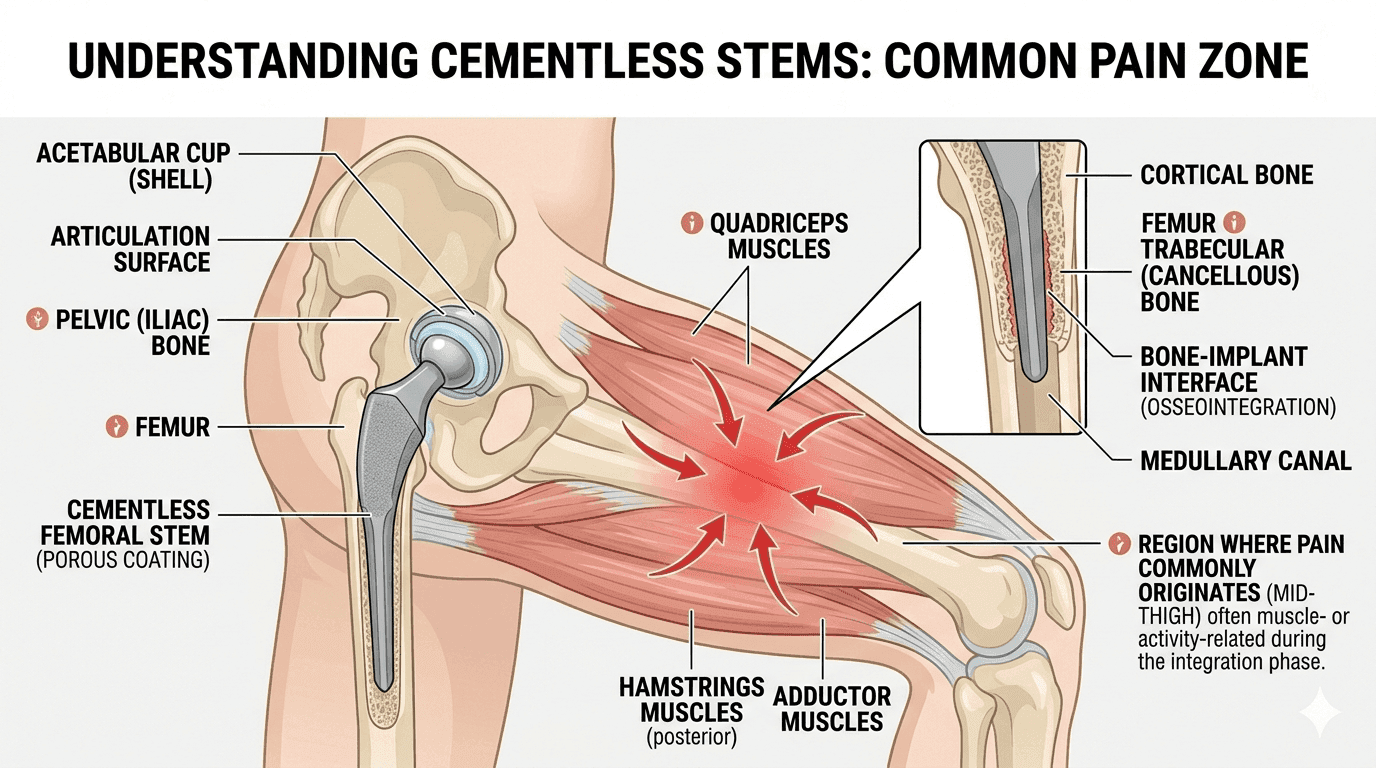
Femoral stem thigh pain is the clinical name for aching that originates where the implant's metal stem sits inside the femur (thigh bone), and yes, for most patients, some degree of it is completely normal.
During a total hip arthroplasty (hip replacement surgery), a surgeon removes the ball at the top of the femur and places a metal stem inside the bone's hollow shaft. That stem bears your full body weight every time you stand or walk. The femur, which has never experienced a rigid metal implant before, reacts to this new load-bearing relationship with inflammation, pressure, and sometimes significant pain in the mid-thigh region, often well below the actual hip incision site. This disconnect between where the surgery happened and where the pain is felt is one of the main reasons patients are caught off guard.
How Common Is Thigh Pain After Hip Replacement?
Research published in the orthopedic literature has reported thigh pain prevalence rates ranging from approximately 3% to 25% among hip replacement patients, with higher rates associated with uncemented (press-fit) implants. The shift toward cementless implant designs over the past two decades, driven by their better long-term fixation outcomes in younger, more active patients, has made post-operative thigh pain more common in the recovery period. The reassuring fact: the majority of these cases resolve on their own as the bone fuses to the implant over several months.
How Your Surgical Approach Affects Where and Why You Hurt
One of the most overlooked variables in thigh pain after hip replacement surgery is the surgical approach: the specific route the surgeon took to access your hip joint. Anterior, posterior, and lateral approaches each create different patterns of muscle disturbance and nerve exposure, which means they each tend to produce different thigh pain profiles.
Anterior Approach and Outer Thigh Burning or Numbness
The anterior approach, where the surgeon enters from the front of the hip, is popular because it avoids cutting through major muscles. But it carries a specific nerve risk that the posterior approach does not: potential traction or displacement of the lateral femoral cutaneous nerve (LFCN), a sensory nerve that runs along the outer thigh.
When this nerve is stretched or compressed during surgery, the result is a burning, tingling, or numb sensation along the outer and upper thigh, a condition called meralgia paresthetica (meh-RAL-juh par-es-THEE-zee-uh). This is a purely sensory issue, meaning it does not cause muscle weakness or affect how you walk. Studies have documented LFCN-related symptoms in a meaningful proportion of anterior approach patients, though most cases resolve within three to six months as nerve irritation subsides. If the numbness is your only symptom and there is no accompanying muscle weakness or sudden severe pain, it is almost certainly nerve-related and not a sign that anything has gone wrong with the implant.
Posterior Approach and Mid-Thigh Aching
The posterior approach, entering from the back of the hip, avoids the LFCN entirely. But it requires the surgeon to temporarily detach some of the deep gluteal muscles and the short external rotators, a group of small stabilizing muscles at the back of the hip. As those muscles heal and reconnect, patients often experience a more generalized, muscle-origin aching that tends to spread into the upper and mid-thigh. This type of pain typically feels more like deep muscle soreness after a hard workout rather than the burning or tingling quality associated with nerve involvement. Most patients describe it as heaviest in the morning or after prolonged sitting, and it tends to improve steadily through the first six to eight weeks.
A Phase-by-Phase Guide to Thigh Pain Recovery
Thigh pain after total hip arthroplasty does not follow a single fixed timeline. It evolves through distinct phases as the tissues heal, the bone adapts, and the implant integrates. Understanding the phase you are currently in helps you interpret your pain accurately rather than catastrophizing normal healing.
First Two Weeks: Acute Surgical Pain
In the first two weeks after surgery, widespread thigh pain is expected and normal. The entire soft tissue envelope around the hip has been opened, retracted, and closed. Muscles, fascia, tendons, and the periosteum (the sensitive membrane covering the femur) have all been disrupted. Pain at this stage is sharp, broadly located, and poorly localized.
A hallmark early complaint is start-up pain: an intense mid-thigh ache that hits hardest on the first three to five steps after sitting or lying down, then gradually loosens as you keep moving. This is the implant and surrounding bone adjusting to load with each initial weight-bearing cycle. It is uncomfortable, but it is not a warning sign.
Weeks Three to Six: Early Osseointegration
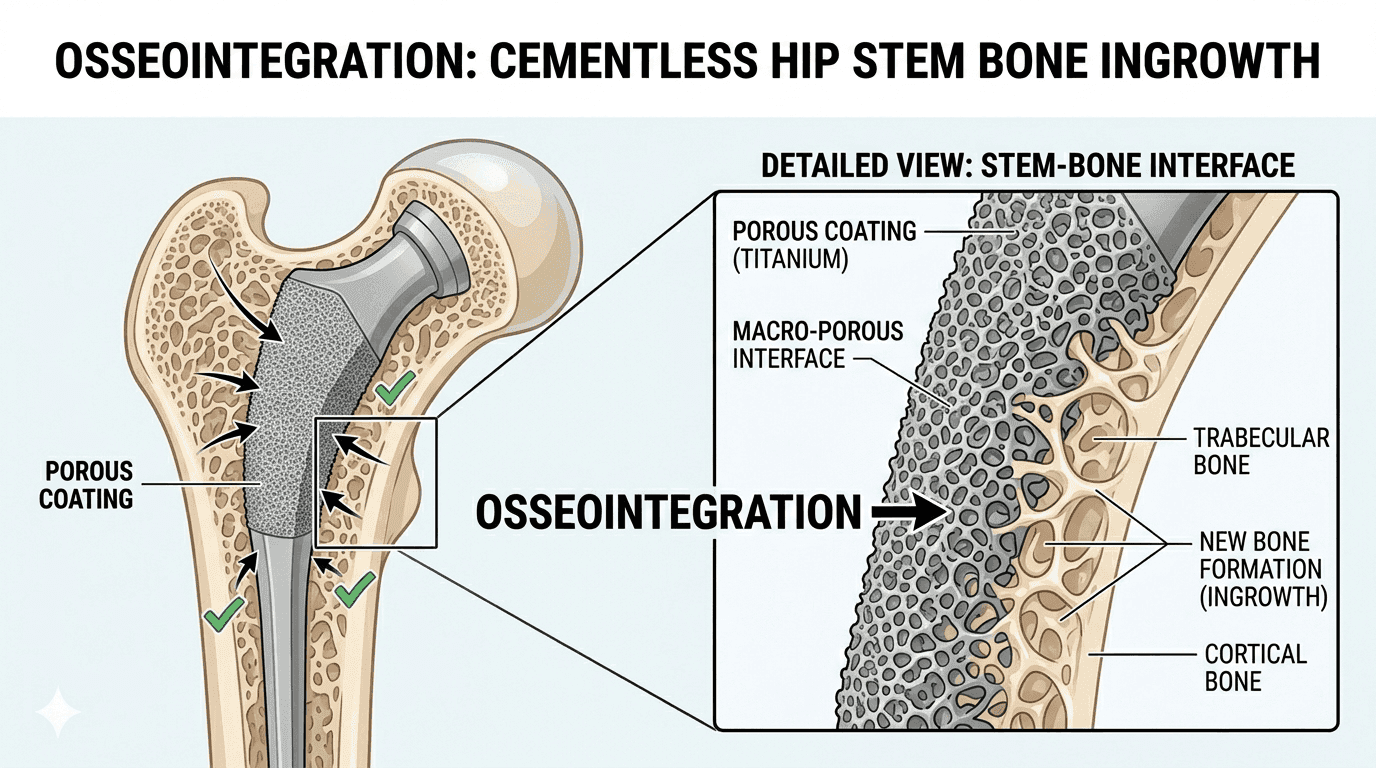
Osseointegration is the process by which your living bone cells grow directly into the porous surface coating of a cementless implant, essentially fusing the stem in place. This process is most active between weeks three and six, and it is also when many patients notice the most pronounced activity-related thigh aching. The femur is essentially remodeling itself around a rigid titanium implant, a process that generates localized inflammation and pressure-sensitive discomfort that worsens with weight-bearing and eases with rest.
Months Three to Six: When Most Pain Should Resolve
For the majority of patients with uncomplicated recoveries, thigh pain diminishes significantly between months three and six. By this point, bone-implant integration is largely complete, the bruising and swelling that settled into the thigh in the early weeks have cleared, and the nervous system has largely adapted to the altered load patterns in the leg. Physical therapy during this phase focuses on restoring hip abductor strength and correcting any gait compensations that developed during the acute recovery. Persistent significant pain at the six-month mark is not something to dismiss. That threshold is widely regarded in orthopedic practice as the point at which a clinical evaluation is warranted to rule out underlying complications.
Six Months to Two Years: Persistent or Returning Pain
Pain that lingers beyond six months, or that returns after a pain-free period, is less likely to represent normal healing. Causes at this stage include implant loosening (where the stem has not fully integrated with the bone or has shifted), low-grade prosthetic joint infection, heterotopic ossification (abnormal bone formation in soft tissue around the implant), or unresolved nerve irritation from the original surgical approach. Each of these has a distinct pain profile, which the next section addresses in detail. Thigh pain that returns suddenly after weeks or months of feeling fine warrants prompt contact with your surgical team.
Decoding Your Pain: What Each Type Means
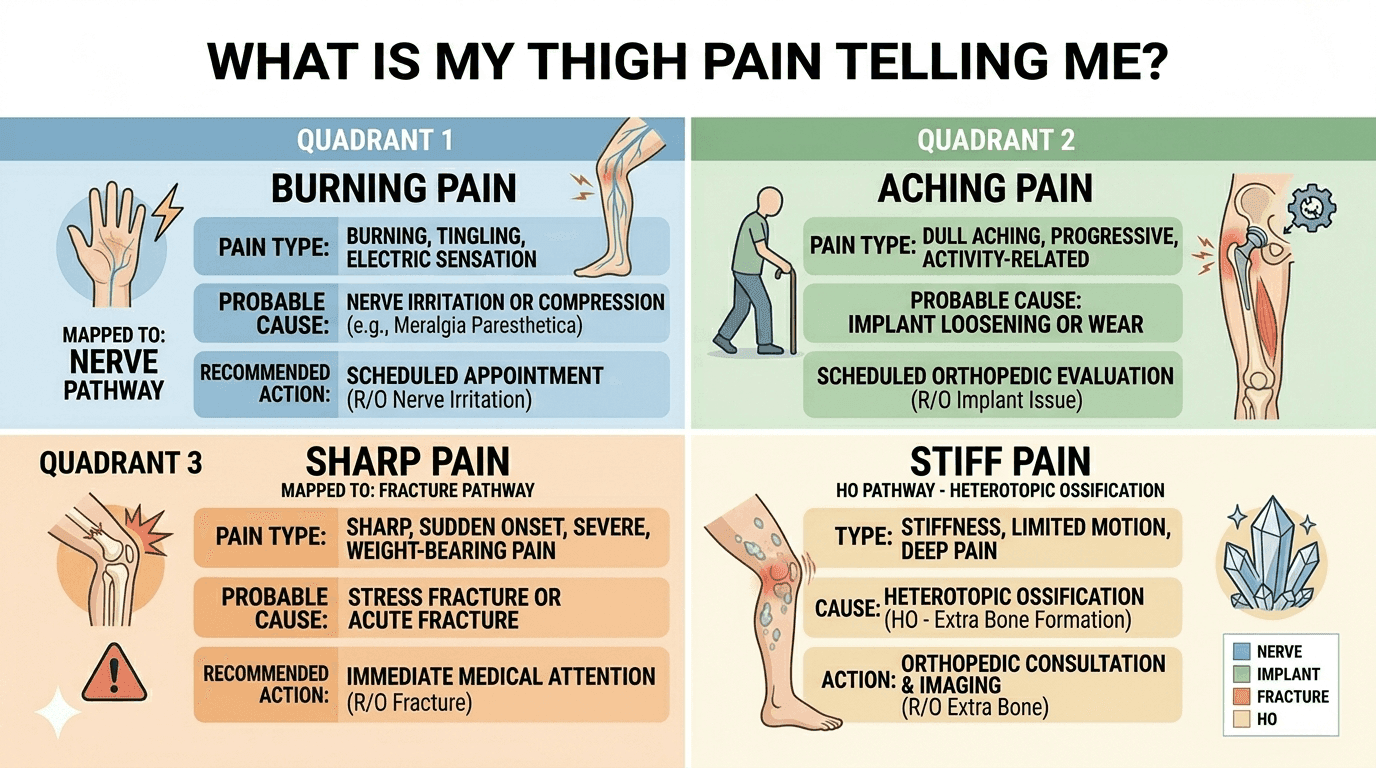
This section is organized around sensation, the way you actually experience and describe the pain, rather than clinical diagnosis. Find the description that matches your experience most closely.
Dull, Aching Mid-Thigh Pain (Especially on First Standing)
This is the most classic pattern of femoral stem thigh pain, and it is tied directly to load transfer mechanics. When a cementless stem is press-fitted into the femur, the bone-implant interface is stiffer than the natural bone-to-bone load transfer the body is used to. The stress concentrates differently along the length of the stem, often peaking in the mid-thigh rather than at the hip. The result is a predictable dull ache that is worst on the first few steps after rest, then improves with gentle movement, and returns after prolonged activity.
Research supports the association between cementless stem design, micro-motion at the bone-implant interface, and this specific start-up pain pattern. If this describes your pain and you are within the first six months of surgery, this presentation is consistent with normal healing. If it persists past six months without improvement, a bone scan or imaging review is a reasonable next step.
Burning, Tingling, or Numbness on the Outer Thigh
A burning or electric quality along the outer thigh, sometimes extending toward the knee or up toward the hip crease, is characteristic of lateral femoral cutaneous nerve involvement rather than bone or muscle pathology. As noted above, this is more common after the anterior approach and is classified as meralgia paresthetica when it meets diagnostic criteria.
The key distinguishing feature: this type of pain is sensory only. It does not cause the leg to feel weak, it does not make walking mechanically harder, and it tends to worsen with prolonged standing or tight clothing pressing on the outer thigh. Most cases resolve spontaneously within three to six months. If symptoms are severe and disruptive, a nerve block directed at the LFCN can provide meaningful temporary relief while healing progresses.
Sharp, Localized Pain That Came On Suddenly
A sudden onset of sharp, well-localized thigh pain, especially after a fall, a misstep, or an unusual physical load, is a red flag that requires urgent evaluation. This presentation can indicate a periprosthetic fracture, meaning a fracture of the femur in the region surrounding the implant. Periprosthetic fractures are uncommon but serious, and they are distinctly different from the gradual, activity-related soreness that characterizes normal recovery. If you experience a sudden new sharp pain in the thigh after a mechanical event of any kind, contact your surgeon or go to an emergency department promptly for imaging.
Deep Aching With Stiffness Limiting Range of Motion
A deep, persistent aching accompanied by a noticeable reduction in how far the hip and thigh can move, particularly if it develops or worsens several weeks after surgery, may point to heterotopic ossification (HO). HO is the formation of abnormal bone in the soft tissue surrounding the hip joint, a process that can restrict movement and cause ongoing pain. Patients who underwent lengthy surgeries, those with a history of HO after previous procedures, or those with certain inflammatory conditions have a higher baseline risk. Diagnosis is confirmed with plain X-ray. Treatment ranges from anti-inflammatory medication to, in severe cases, surgical removal of the abnormal bone.
Red Flags: When Thigh Pain Means Something Serious
Most thigh pain after hip replacement surgery represents normal healing, but several warning patterns require prompt medical attention.
Signs of deep vein thrombosis (DVT): A blood clot in the deep veins of the leg is one of the more serious post-operative risks. The pain associated with DVT tends to differ from surgical thigh pain in a specific way. It is often accompanied by warmth and redness over the affected area, visible swelling that is new or asymmetric compared to the other leg, and, most distinctively, cramping or tightening that extends into the calf. Surgical thigh pain does not usually extend below the knee and does not cause calf-specific symptoms. If you notice any combination of calf cramps, unusual leg warmth, and swelling that appeared after a period of reduced activity, seek evaluation the same day.
Signs of prosthetic joint infection: Infection after hip replacement is uncommon but can present subtly. The hallmarks are persistent warmth at the surgical site, swelling that is not improving as expected, fever, and thigh pain that worsens rather than improves over the weeks following surgery. An infected implant does not always look dramatically inflamed from the outside. If recovery feels like it is moving backward rather than forward, especially alongside any systemic symptoms like fatigue or low-grade fever, contact your care team.
Signs of implant loosening: An implant that has not achieved stable fixation, or one that has shifted after initial integration, produces a characteristic pain pattern known as start-up pain at a much later stage of recovery, typically after a pain-free interval. The key differentiator from normal early start-up pain is timing. Loosening-related thigh pain that begins or intensifies after the six-month mark, rather than resolving, warrants radiographic evaluation.
Signs of periprosthetic fracture: As described above, any sudden sharp pain in the thigh after a mechanical event, fall, or unusual load is a red flag. Inability to bear weight normally afterward increases urgency.
Quadriceps weakness as a femoral nerve warning: If thigh pain is accompanied by difficulty fully extending the knee, or if the quadriceps feel genuinely weak rather than just sore, this can indicate femoral nerve involvement. Femoral nerve injury during hip surgery is rare but does occur. A new onset of quadriceps weakness in the recovery period should be evaluated by your surgeon.
If you are uncertain whether what you are experiencing falls into a gray zone, connecting with a physician does not need to mean an in-person visit. You can see a doctor online through Momentary's virtual primary care to review your symptoms, discuss your recovery timeline, and get guidance on whether your situation requires an urgent in-person evaluation.
Does Your Implant Design Affect Your Risk?
Not all hip stems are built the same, and implant design has a real effect on how much thigh pain a patient experiences and how long it lasts.
The most fundamental distinction is between cemented and cementless (press-fit) implants. A cemented stem is fixed in place using bone cement, which distributes load evenly along the full length of the stem from day one. A cementless stem relies on the bone growing directly into its porous surface coating, a process that takes weeks to months. During that integration period, the micro-motion at the bone-implant interface that characterizes uncemented stems is directly associated with thigh pain, particularly the start-up pain pattern on first weight-bearing after rest.
Within the cementless category, stem geometry also matters. Short-stem and wedge-shaped stems distribute load differently than longer, straight stems. A stem that is significantly stiffer than the surrounding bone creates a mismatch in load transfer mechanics, concentrating stress at the tip of the stem. This "end-of-stem" pain refers specifically to the tenderness felt at the level of the tip of the femoral component, typically several inches below the hip, and is more common with certain stem geometries than others. Research has examined the relationship between stem design, stiffness mismatch, and thigh pain outcomes in detail, finding that implant geometry plays a meaningful role in determining which patients experience prolonged thigh pain.
Your surgeon chose a specific implant based on your bone quality, anatomy, age, and activity level. Understanding which type you received can help you calibrate your pain expectations and frame more specific questions for your follow-up appointments.
Treatment Options: From Self-Care to Revision Surgery
The right treatment approach depends entirely on what type of thigh pain you have. The diagnostic framework above should inform which path makes sense for your situation.
Conservative Management at Home
For normal healing-related thigh pain in the first weeks to months after surgery, conservative measures are the appropriate starting point. Ice applied to the thigh for fifteen to twenty minutes at a time can reduce local inflammation, particularly after physical therapy sessions or periods of increased activity. Elevation helps reduce dependent swelling, especially in the first weeks when bruising and fluid are migrating downward into the thigh. Anti-inflammatory medications, if cleared by your surgeon and not contraindicated by your other medications, can take the edge off the inflammation driving early thigh aching.
Positioning also matters. Prolonged sitting in low chairs increases compression on the hip and can worsen mid-thigh achiness. Using a raised toilet seat and sitting in chairs that keep the hips at or above knee level reduces this mechanical pressure during the early healing phase.
Physical Therapy for Thigh Pain After Hip Replacement
Physical therapy plays a specific and underappreciated role in resolving thigh pain, particularly when it persists into the three-to-six-month window. The goal is not just general strengthening but correcting the specific muscular imbalances that hip replacement surgery creates.
Hip abductor weakness (weakness in the gluteus medius, the muscle that stabilizes the pelvis during single-leg stance) is nearly universal in the early recovery period, regardless of surgical approach. When this muscle does not engage effectively, the body compensates with altered gait mechanics, including a lateral trunk lean toward the surgical side, that concentrates abnormal stress on the thigh. A physical therapist familiar with post-arthroplasty rehabilitation can identify these compensations and design targeted exercises to correct them.
Anterior approach patients often need additional attention to hip flexor mobility, given the proximity of the surgical corridor to those structures. Posterior approach patients typically need a longer focus on deep external rotator retraining to restore pelvic stability. These approach-specific differences in rehabilitation are rarely addressed in generic post-op exercise handouts, making a few sessions with a specialized physical therapist well worth the investment.
Medical Interventions
For nerve-related outer thigh pain that is not resolving on its own, a corticosteroid injection or a targeted nerve block directed at the lateral femoral cutaneous nerve can provide significant relief while healing continues. These are not permanent fixes but can reduce pain severity enough to allow full participation in physical therapy.
When the underlying cause is unclear, imaging is often the next step. A plain X-ray can identify implant loosening, heterotopic ossification, or periprosthetic fracture. A bone scan is more sensitive for detecting early loosening or stress changes around the implant before they become visible on X-ray. An MRI with metal-suppression sequences can evaluate soft tissue pathology, nerve issues, and early signs of infection.
When Revision Surgery Is Considered
Revision of the hip implant is a significant procedure and is considered only when conservative management has failed and a structural cause has been identified and confirmed. The most common reasons for revision related to thigh pain are confirmed implant loosening with failed osseointegration, prosthetic joint infection requiring implant removal, and periprosthetic fracture requiring surgical fixation.
Thigh pain alone, without imaging evidence of structural failure, is not typically an indication for revision. The decision requires a thorough evaluation, often including multiple imaging modalities and, in cases where infection is suspected, laboratory testing of synovial fluid from the joint.
Frequently Asked Questions
How long is thigh pain normal after hip replacement?
Most thigh pain related to surgical trauma, bruising, and early bone-implant integration resolves within three to six months. Acute swelling and soft tissue bruising that migrates into the thigh typically clears within three to four weeks. The deeper mid-thigh ache associated with cementless implant osseointegration often persists until the bone has grown firmly into the implant, a process that is largely complete by the four-to-six-month mark for most patients. Nerve-related burning or numbness from the anterior approach follows a similar timeline, with the majority of cases resolving within six months, though some patients experience residual sensory changes for up to a year.
Why is my thigh pain worse when I walk but better when I sit?
This pattern, worse with loading and better with rest, is characteristic of femoral stem micro-motion. When a cementless stem has not yet fully integrated with the surrounding bone, weight-bearing creates small mechanical movements at the bone-implant interface. Those micro-movements stimulate the periosteum (the pain-sensitive membrane lining the femur), producing the dull ache that worsens with walking. Sitting reduces load on the implant, which is why the pain eases when off your feet. This pattern is most pronounced in the first six to twelve weeks and typically resolves as osseointegration progresses.
Can thigh pain after hip replacement go away on its own?
For the majority of patients, yes. Normal healing-related thigh pain, including start-up pain, activity-related mid-thigh aching, and outer thigh numbness from nerve traction, resolves without specific intervention beyond rest, gradual activity progression, and physical therapy. The body's bone-remodeling process eventually stabilizes the implant, nerve irritation diminishes as inflammation resolves, and the muscles regain enough strength to reduce compensatory stress patterns. Pain that does not follow this expected trajectory of gradual improvement, or that returns after a pain-free period, should be evaluated rather than waited out.
Is outer thigh numbness after hip replacement permanent?
In most cases, no. Outer thigh numbness or burning after hip replacement, particularly following an anterior approach, reflects irritation of the lateral femoral cutaneous nerve rather than permanent nerve damage. The majority of patients see significant improvement within three to six months. A smaller subset may notice mild sensory changes for up to twelve months. True permanent LFCN injury is uncommon, and the absence of motor involvement (no muscle weakness, no walking difficulty) is a reassuring indicator that the nerve has been irritated rather than severed.
If you have reviewed your symptoms against the patterns above and still have questions about what your thigh pain means, use Momentary's AI health navigator to explore your symptoms, understand possible causes, and get a clearer sense of what next steps are appropriate for your situation.
References
- Morrey BF. Cited research on femoral stem thigh pain prevalence, cementless implants. — Cited for prevalence data on thigh pain after total hip arthroplasty.
- PMC Study on lateral femoral cutaneous nerve and anterior approach hip surgery. — Cited for LFCN injury rates following anterior approach total hip arthroplasty.
- Engh CA et al. Cited research on cementless stem micro-motion and start-up thigh pain. — Cited for the relationship between cementless implant micro-motion and thigh pain patterns.
- Research on stem stiffness mismatch and thigh pain in cementless total hip arthroplasty. — Cited for the association between cementless stem design and thigh pain during osseointegration.
- Implant geometry and its role in thigh pain outcomes following total hip arthroplasty. — Cited for the relationship between stem design, stiffness, and end-of-stem thigh pain.