

Most people heading into spinal fusion surgery feel reasonably informed. They've read the pamphlets, watched the hospital's prep video, maybe even spent a few hours on Reddit. But the gap between what surgeons explain in a 20-minute pre-op consult and what recovery actually feels like is wide enough to blindside even the most prepared patient.
This guide fills that gap. It covers the strict physical rules you cannot break, the practical daily realities nobody mentions until you're struggling with them alone at 2 a.m., and the emotional terrain that catches nearly every patient off guard. Every claim here is anchored to clinical research or authoritative medical guidance. This is the honest, warm, research-backed version of what a friend who had the surgery AND did the homework would tell you before you sign the consent form.
At a Glance
| Topic | Key Facts |
|---|---|
| Primary restriction | No Bending, Lifting, or Twisting (BLT rule) for 6 to 12 weeks minimum |
| Hospital stay | Typically 1 to 3 days post-surgery |
| Full fusion timeline | 6 to 18 months depending on levels fused and individual biology |
| Most common unexpected challenge | Constipation from opioid pain medications |
| Emotional risk | Up to 47% of surgical patients experience post-discharge depression |
| Adaptive gear you'll need immediately | Grabber tools, toilet seat riser, slip-on shoes, dressing aids |
| Recovery pattern | Nonlinear: good weeks followed by setbacks are completely normal |
The Absolute Law of No BLT: Bending, Lifting, and Twisting
The single most important thing to understand before spinal fusion surgery is that the "No BLT" rule is not a guideline or a soft recommendation. It is a hard physical protocol designed to protect titanium hardware and a bone graft that has not yet fused to your vertebrae.
Spinal fusion involves placing hardware, typically rods and screws, alongside a bone graft to encourage two or more vertebrae to grow together into one solid segment. In the weeks and months after surgery, that bone graft is fragile and vulnerable. Bending forward, lifting objects, and twisting the torso can torque the instrumentation, disrupt the graft site, and, in the worst cases, cause hardware failure or a non-union (meaning the bone never fuses at all).
Surgeons typically enforce the BLT restriction for six to twelve weeks at minimum, and some extend it through the full six-month early fusion window depending on how many levels were fused and how your imaging looks.
What the BLT rule actually prohibits in daily life: You cannot tie your own shoes. You cannot pick up something you dropped. You cannot roll over in bed the normal way. You cannot reach into a low cabinet or lift a bag of groceries. You cannot twist to look behind you while reversing a car. Every one of these ordinary movements is temporarily off the table, and preparing your environment and your mindset around this reality before surgery day makes recovery dramatically more manageable.
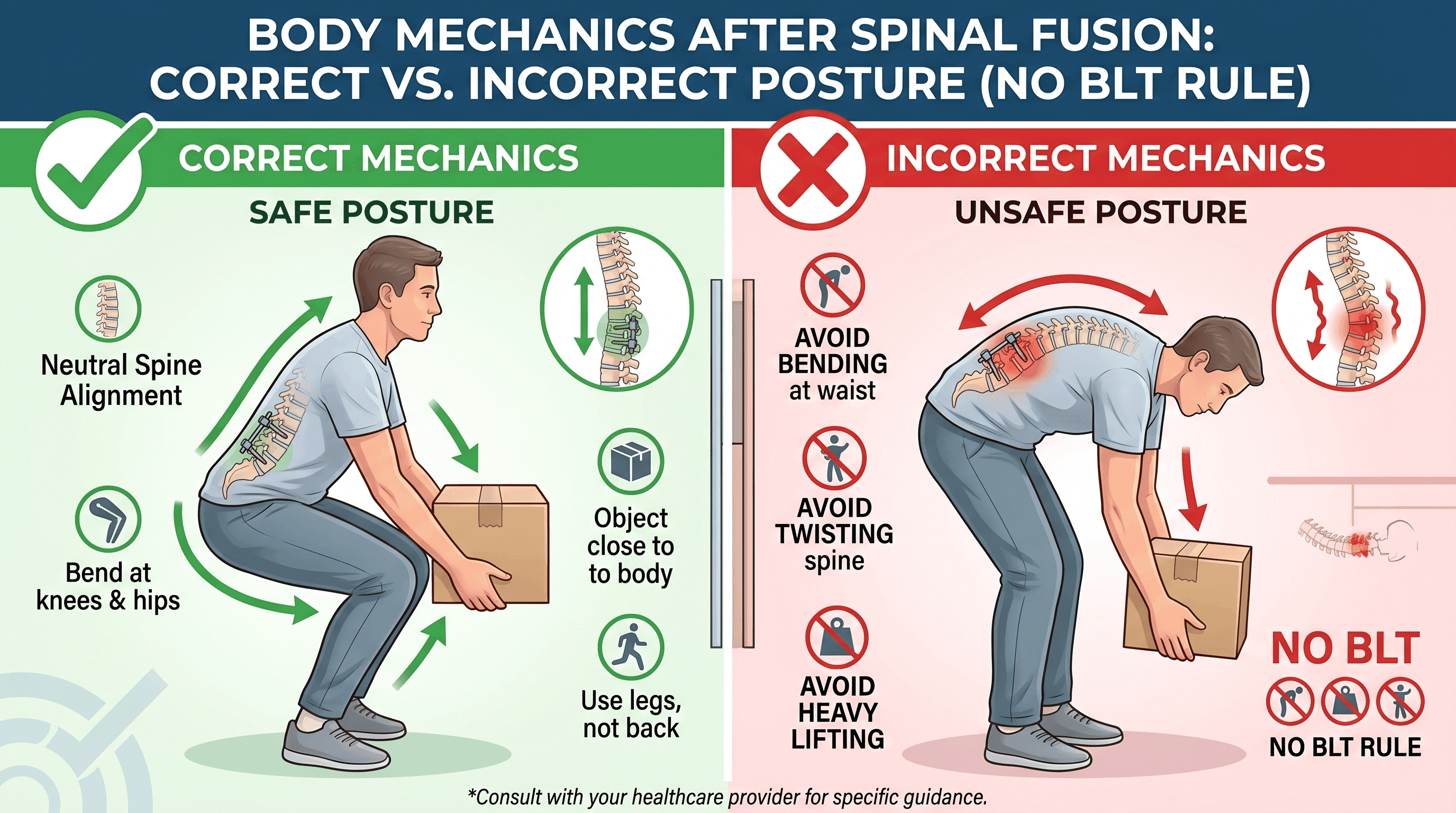
Key Takeaway: The No BLT rule exists to protect hardware and a bone graft that cannot protect itself. Violating it is not discomfort-inducing — it is potentially surgery-repeating.
The Grabber Tool Will Become Your Best Friend
Before surgery, buy at least three reacher-grabber tools and station one in every room you will spend time in.
A reacher-grabber, sometimes called a grabber tool, is a long-handled mechanical claw that lets you pick up objects from the floor, reach into low spaces, and retrieve items from shelves without bending or twisting. After spinal fusion, dropping a pen is no longer a minor inconvenience. It becomes a genuine problem with no safe solution unless a grabber is within arm's reach.
Most patients underestimate this until Day Two at home, when they drop their phone on the way to the bathroom and realize they cannot get it without breaking every rule their surgeon just gave them.
Set up your recovery station before you leave for surgery. A recovery station is a bedside or recliner-side command center that has everything within arm's reach: medications and a written schedule, a water bottle with a long straw, a phone charger, the TV remote, reading glasses, a grabber tool, tissues, and a small trash receptacle. You will spend the majority of your first two weeks in one spot, and having to ask someone to retrieve every item you need is both logistically exhausting and emotionally deflating.
Other adaptive tools worth purchasing before surgery day include a long-handled shoehorn, a dressing stick for pulling on pants and socks without bending, and a long-handled bath sponge for showering. None of these are expensive. All of them are worth having before you need them rather than after.
Key Takeaway: Grabber tools, dressing aids, and a pre-built recovery station are not optional conveniences; they are spinal fusion recovery infrastructure.
Bathroom Logistics: The Stuff Nobody Warns You About
Two bathroom realities hit almost every spinal fusion patient, and neither of them is discussed with adequate candor during pre-op consultations.
The mechanics of toileting after spinal fusion surgery require advance planning. Standard toilet height puts most people in a position that involves significant hip and spine flexion to sit down and stand up, which conflicts directly with the BLT restriction. A raised toilet seat riser, typically adding three to five inches of height, reduces the depth of that flexion and makes sitting and standing far safer and far less painful. These are widely available, inexpensive, and should be installed before you come home from the hospital.
Constipation from opioid pain medications is one of the most universally unexpected post-surgical experiences, and it begins within the first day or two of taking narcotic pain relievers. Opioids slow the movement of the gastrointestinal tract, and after major surgery when your activity is minimal and your nutrition is inconsistent, constipation can become severe enough to be more distressing than the surgical pain itself.
Your surgeon or discharge nurse should provide a bowel management protocol before you leave the hospital. If they do not volunteer one, ask explicitly: "What stool softener or laxative do you recommend starting Day One, and at what dose?" Starting a stool softener proactively rather than reactively is the standard clinical approach. Docusate sodium (Colace) is commonly recommended, often in combination with polyethylene glycol (MiraLAX) for more persistent cases, but always confirm the plan with your care team given your individual medication list.
High-fiber foods, adequate hydration, and gentle ambulation (walking) all support bowel function during recovery, which is one more reason your care team will push you to get up and walk as soon as safely possible.
Key Takeaway: A toilet seat riser and a proactive bowel management protocol are two of the highest-impact items you can arrange before surgery day.
The Log Roll Is the Only Way Out of Bed
One of the first things a physical therapist will teach you after spinal fusion surgery is the log roll technique: the specific, coordinated sequence of movements required to get in and out of bed without twisting the spine.
The log roll is not complicated, but it is counterintuitive enough that patients who have not practiced it before surgery often instinctively try to sit straight up, which is exactly the motion that can torque a fresh fusion site.
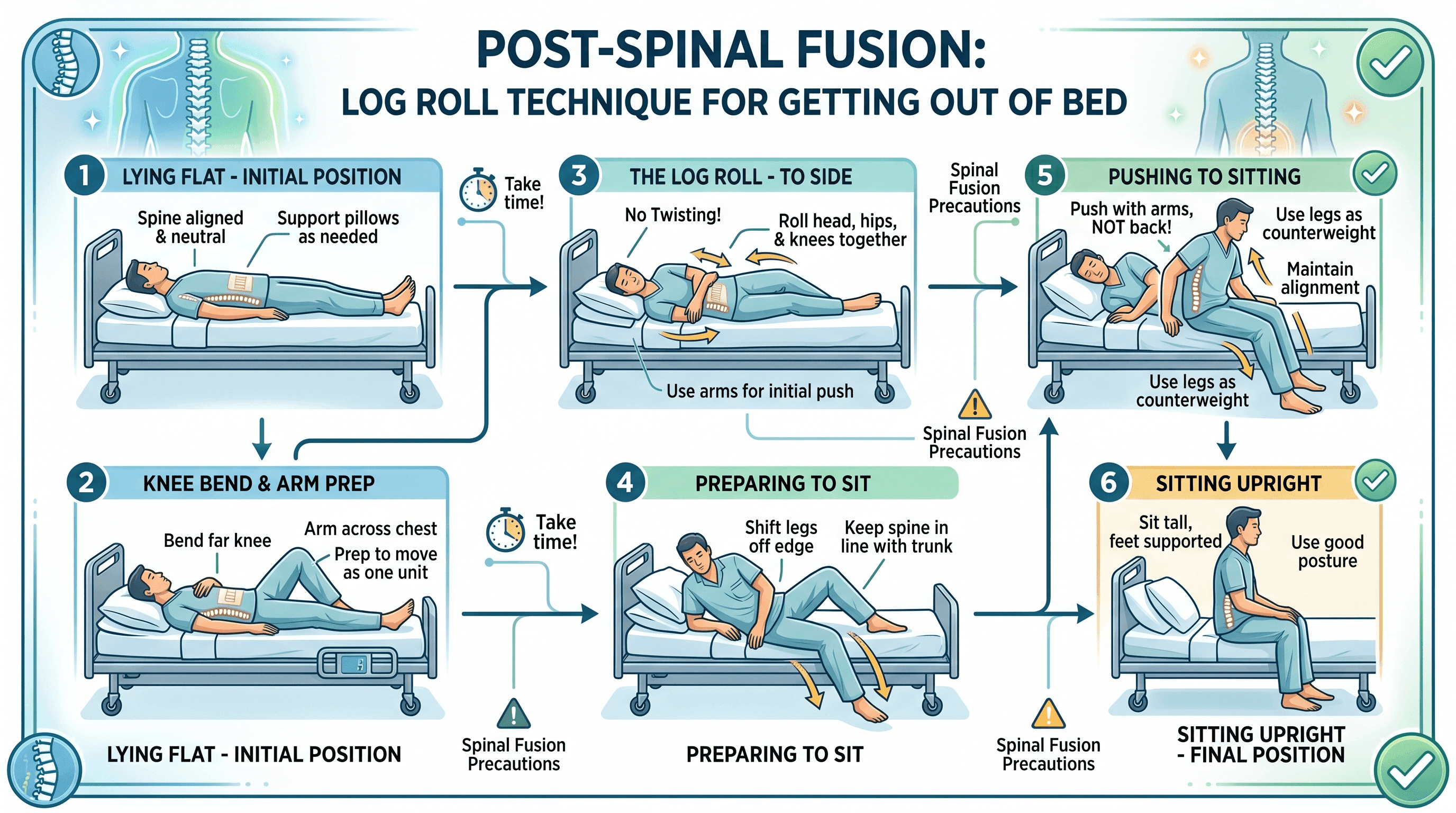
The log roll technique for getting out of bed:
Start by lying flat on your back. Bend your knees so your feet are flat on the mattress. Using your arms and not your abdominal muscles, gently roll your entire body as one unit onto your side, keeping your shoulders and hips aligned so the spine does not twist. Once on your side at the edge of the bed, lower your legs off the side of the mattress while simultaneously pushing up with your arms to bring your torso upright. Sit at the edge for 30 seconds before standing to allow blood pressure to stabilize.
Getting back into bed reverses the sequence: sit at the edge, lower yourself onto one side with arm support, then roll your entire body as one unit back to flat.
Practicing this motion before surgery, even while perfectly healthy, builds the muscle memory that makes it feel less foreign when you are groggy and in pain on your first post-operative night. Ask your surgeon's office if a pre-operative physical therapy session is available or recommended, specifically to practice this maneuver.
Key Takeaway: The log roll is the mandatory technique for getting in and out of bed after spinal fusion. Practicing it before surgery significantly reduces the risk of an involuntary, painful twist on Day One.
Nerve Pain Gets Worse Before It Gets Better
This is one of the least-discussed aspects of spinal fusion recovery, and for patients who experience it, the lack of warning makes it feel alarming.
After spinal fusion surgery, nerves that were compressed, irritated, or traumatized by disc herniation, stenosis, or the surgical process itself begin to heal. That healing process is not quiet. As previously damaged nerve fibers regenerate, they can produce electrical sensations: sharp shooting pain, burning, tingling, or stabbing feelings that travel down the leg or arm in the nerve's distribution path.
This phenomenon is sometimes called "nerve awakening," and the counterintuitive reality is that increasing nerve pain in the weeks after surgery can actually signal that healing is occurring, not that something has gone wrong. A nerve that was dormant and crushed for months may produce significantly more sensation as it begins to recover than it did when it was being compressed.
The distinction that matters is trajectory. Nerve sensations that are gradually changing over weeks, even if they feel intense, are typically part of the healing arc. New, sudden, severe neurological changes, particularly new weakness, loss of bowel or bladder control, or numbness that is rapidly spreading, require prompt contact with the surgical team.
According to research published in PMC, nerve recovery after spinal decompression and fusion can continue for 12 to 24 months in some patients, which means managing expectations around the timeline is as important as managing the sensations themselves.
Medications commonly used for nerve pain, including gabapentin (Neurontin) and pregabalin (Lyrica), are often prescribed as part of the post-operative pain management plan. If nerve sensations are significantly disrupting sleep or daily function, discuss adjusting the approach with the surgical team rather than waiting it out in silence.
Key Takeaway: Nerve pain that feels worse in the weeks after surgery can be a sign of nerve healing, not failure. The trajectory over time matters more than any single day's intensity.
Post-Op Depression Is Incredibly Common
The emotional side of spinal fusion recovery is real, it is common, and it is dramatically underrepresented in pre-surgical counseling.
Research published in BMC Surgery found that up to 47% of patients undergoing major surgery experience clinically significant depression within nine months of discharge. Spinal fusion patients face a particular constellation of contributing factors: opioid medications directly alter mood and emotional regulation, physical dependence on others for basic tasks creates a profound sense of lost autonomy, sleep is fragmented and poor quality for weeks, and the activities that many people use to regulate their emotional state (exercise, driving, social activities) are temporarily restricted or entirely off limits.
The first two to four weeks are commonly the hardest. You may feel trapped, frustrated, sad, or unlike yourself in ways that feel disproportionate to what you expected. That feeling is not weakness. It is a documented physiological and psychological response to major surgery, pain, and opioid medication.
Practical approaches that help: Setting one small achievable goal each day, even something as modest as walking to the end of the driveway, creates a sense of forward motion when the overall timeline feels overwhelming. Connecting with others who have had the surgery, through online communities or in-person support groups, reduces the isolation that amplifies low mood. If depression is severe, persistent, or accompanied by thoughts of self-harm, speaking with a mental health professional is not optional. Untreated post-surgical depression is associated with worse pain outcomes and slower functional recovery.
Discussing your emotional health history with your surgeon before the operation is also worthwhile. Patients with a history of depression or anxiety may benefit from a proactive mental health referral as part of the surgical plan.
Key Takeaway: Post-op depression after spinal fusion is not a personal failure. It is a clinically documented outcome that responds to proactive support, community, and in many cases, professional guidance.
Wardrobe Overhauls Are Mandatory
Before surgery day, go through your closet and set aside everything that requires bending, twisting, tying, or tight overhead movement to put on. That is likely most of it.
Slip-on shoes are non-negotiable for at least the first six to twelve weeks. Crocs, Kiziks (hands-free shoes), or any wide-opening slip-on with a firm sole are ideal. Anything with laces or buckles is impossible to put on without bending to foot level, which the BLT rule prohibits.
Clothing should be loose-fitting, elastic-waisted, and easy to step into rather than pull over the head. Oversized sweatpants and drawstring shorts are the functional wardrobe of spinal fusion recovery. Anything that requires twisting to dress or pulling tight across the surgical site will be avoided instinctively, so buying appropriate items before surgery means you never have to improvise in pain.
For patients who have had a posterior (back) approach, sitting with any waistband pressure directly on the incision site can be uncomfortable in the early weeks. Soft fabrics and high-rise elastic waistbands that sit above the incision work better than low-rise styles.
A dressing stick (a long-handled tool that hooks and guides clothing) and a long-handled shoehorn eliminate the need to reach the foot entirely. These pair with the grabber tool to form the core toolkit of early recovery dressing independence.
Key Takeaway: Slip-on shoes, elastic-waist clothing, and dressing aids are pre-surgery purchases, not afterthoughts. Buy them before you come home.
Healing Is a Rollercoaster, Not a Straight Line
Setting accurate timeline expectations before spinal fusion surgery is one of the most protective things a patient can do for their mental health during recovery.
Spinal fusion does not heal on a clean upward curve. The biological process of bone fusion is slow, and the functional recovery that rides alongside it is genuinely nonlinear. Having a good week followed by a terrible week is normal. Having a month of meaningful progress followed by a pain flare is normal. The setbacks do not mean the fusion is failing. They mean recovery from major surgery is happening in a body that has a lot of competing demands.
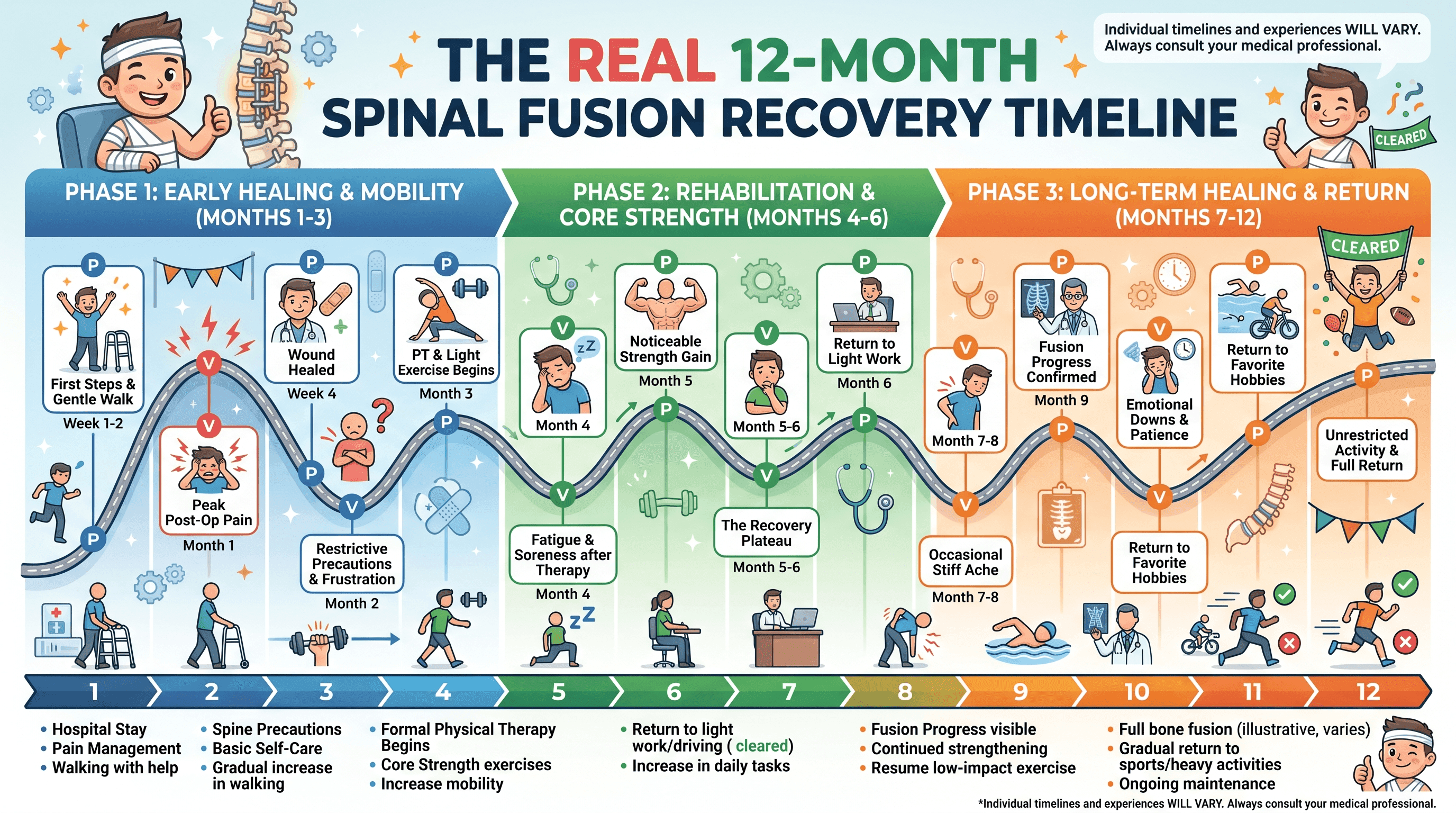
The three biological phases of spinal fusion recovery:
| Recovery Phase | What's Happening | What You Can Do | What to Avoid |
|---|---|---|---|
| Weeks 1 to 6 (Surgical Healing) | Incision heals, inflammation resolves, hardware settles | Walk daily (short distances), manage pain, practice log roll | Any BLT movement, driving, lifting anything over a few pounds |
| Months 2 to 6 (Early Fusion) | Bone graft begins to mineralize and bridge the vertebrae | Increase walking duration, begin formal PT if cleared | High-impact activity, contact sports, ignoring pain signals |
| Months 6 to 18 (Full Fusion and Functional Recovery) | Fusion matures; strength and mobility rebuild | Progressive PT, gradual return to activity, strength training | Returning to heavy labor before imaging confirms fusion |
According to the American Academy of Orthopaedic Surgeons, return-to-work timelines vary significantly by job type. Sedentary desk work typically allows a return at four to six weeks with accommodations. Light physical work may be possible at three to four months. Heavy manual labor, if permitted at all, generally requires a minimum of six months and in some cases results in permanent restrictions depending on the number of levels fused and the nature of the work.
Feeling better is not the same as being fused. Bone fusion is confirmed by imaging, not by symptom improvement alone. Many patients feel substantially improved at three months and assume the hard part is over, not realizing the fusion is still actively forming and remains vulnerable.
Key Takeaway: Recovery from spinal fusion surgery takes 6 to 18 months to complete biologically. Feeling better early is a milestone, not a finish line.
Consulting a Specialist and What to Ask
If you are still in the decision-making phase or approaching the pre-surgical window, connecting with a board-certified spine specialist to review your specific imaging, surgical approach, and post-operative plan is genuinely worthwhile. A second opinion before a procedure of this magnitude is always reasonable to request. You can find a spine specialist or primary care physician near you to start that conversation or get a referral to someone whose revision rates and surgical volume you can evaluate directly.
Questions to ask your surgeon before consenting:
- Have all non-surgical options been fully exhausted for my specific diagnosis?
- How many spinal levels will be fused, and why?
- What is your personal revision rate for this procedure?
- What surgical approach will you use (anterior, posterior, lateral), and why is that approach right for my anatomy?
- What does a realistic recovery timeline look like for someone with my health profile?
- What is your plan for pain medication tapering within the first 30 days?
Questions to ask at follow-up appointments:
- At 6 weeks: Is my current activity level appropriate for what you see on imaging?
- At 3 months: Am I cleared to begin formal physical therapy?
- At 6 months: Is there evidence of bridging bone on X-ray, and is the fusion progressing as expected?
FAQ
What can you never do again after spinal fusion?
Most people who achieve solid fusion return to a wide range of activities over time. High-impact sports such as tackle football, downhill skiing, and competitive distance running are typically discouraged for multi-level fusions because of the stress they place on adjacent segments. Heavy manual labor may require permanent modification depending on the number of levels fused. A spine surgeon can advise on individual cases based on imaging and work demands.
What happens if you fuse L4 and L5?
L4-L5 is one of the most commonly fused segments because it carries a significant share of lumbar load. Fusing this level eliminates motion at that segment and increases mechanical demand on the segments above and below, particularly L3-L4 and L5-S1. According to research published in PMC, this adjacent segment stress is a known long-term consideration that surgeons aim to minimize through precise alignment and technique. Most patients do well over the long term, though monitoring adjacent levels at follow-up appointments is standard practice.
How many hours does spinal fusion surgery take?
Surgical duration depends on the number of levels being fused and the approach used. A single-level lumbar fusion typically takes one to three hours. Multi-level fusions or procedures requiring both anterior and posterior approaches may extend to four to six hours or longer. Your surgeon will give a case-specific estimate during the pre-operative consultation.
What will I need at home after spinal fusion surgery?
The essentials include a reacher-grabber tool in every primary room, a raised toilet seat, slip-on shoes, elastic-waist clothing, a long-handled bath sponge, a dressing stick, a firm mattress or surface for sleeping, and a pre-stocked recovery station at your primary resting spot. Arranging a caregiver for at least the first one to two weeks is clinically advisable since safe post-operative mobility requires assistance for many tasks. The American Academy of Orthopaedic Surgeons offers a structured pre-surgery home preparation checklist worth reviewing with your care team.
Closing
Knowing all of this does not make spinal fusion surgery easy. But it does make it navigable. The patients who report the best outcomes are not the ones who had the smoothest recoveries. They are the ones who had realistic expectations, prepared their environments in advance, communicated openly with their surgeons, and gave the fusion process the full biological time it required without cutting corners. That long-game mindset, more than any single piece of equipment or technique, is what the research consistently points to as the differentiating factor.
For ongoing health navigation and guidance on finding the right care for your needs, Momentary Lab's AI healthcare navigator can help you understand your options and identify next steps.
References
- American Academy of Orthopaedic Surgeons (AAOS) — OrthoInfo — Guidance on preparing for low back surgery, home preparation, and activity restrictions.
- PMC — Nerve Recovery After Spinal Fusion — Research on nerve regeneration timelines following spinal decompression and fusion procedures.
- PMC — Post-Surgical Depression Incidence — Study on rates of post-discharge depression in major surgical patients, including incidence data cited in this article.
- PMC — Adjacent Segment Disease After Lumbar Fusion — Research on adjacent segment stress and degeneration following L4-L5 and other lumbar fusion procedures.