

Most patients leave the hospital after spinal fusion surgery with a discharge sheet, a list of restrictions, and one burning question their surgeon somehow never fully answered: when can I actually go somewhere?
The honest answer is that it varies by surgery type, transport mode, and how your individual recovery is tracking. But that does not mean the question has no answer. This guide breaks it down by every major variable so you can plan with confidence rather than guessing.
At a Glance
| Topic | Key Facts |
|---|---|
| Short car trips (passenger) | Often permitted within 1 to 2 weeks post-op |
| Long car trips (over 2 hours) | Typically cleared around 4 to 6 weeks |
| Flying after single-level lumbar fusion | Often cleared at 4 to 6 weeks for short-haul |
| Flying after multilevel lumbar fusion | May require 6 to 12 weeks before air travel |
| Cervical fusion (ACDF) recovery window | Generally faster than lumbar; travel possible at 2 to 4 weeks |
| DVT risk window | Highest in first 4 to 6 weeks post-surgery |
| Driving restriction | Until off opioid pain medication (legal, not just medical) |
| No BLT rule | No Bending, Lifting, or Twisting throughout early recovery |
The Short Answer: Travel Timelines at a Glance
The timeline for post-fusion travel is not a single number. It shifts depending on how many spinal levels were fused, whether the surgery was cervical or lumbar, and whether you are driving or riding.
| Surgery Type | Short Car Trip (Passenger) | Long Car Trip / Road Trip | Short-Haul Flight | Long-Haul Flight |
|---|---|---|---|---|
| Cervical ACDF (1 level) | 1 to 2 weeks | 2 to 4 weeks | 2 to 4 weeks | 6+ weeks |
| Lumbar Fusion (1 level) | 1 to 2 weeks | 4 to 6 weeks | 4 to 6 weeks | 6 to 8 weeks |
| Lumbar Fusion (2+ levels) | 2 to 3 weeks | 6 to 8 weeks | 6 to 12 weeks | 12+ weeks |
| Minimally Invasive Fusion | 1 to 2 weeks | 3 to 4 weeks | 3 to 5 weeks | 6+ weeks |
These are general windows. A surgeon reviewing your imaging and clinical progress makes the final call.
Why Spinal Fusion Changes the Travel Calculus
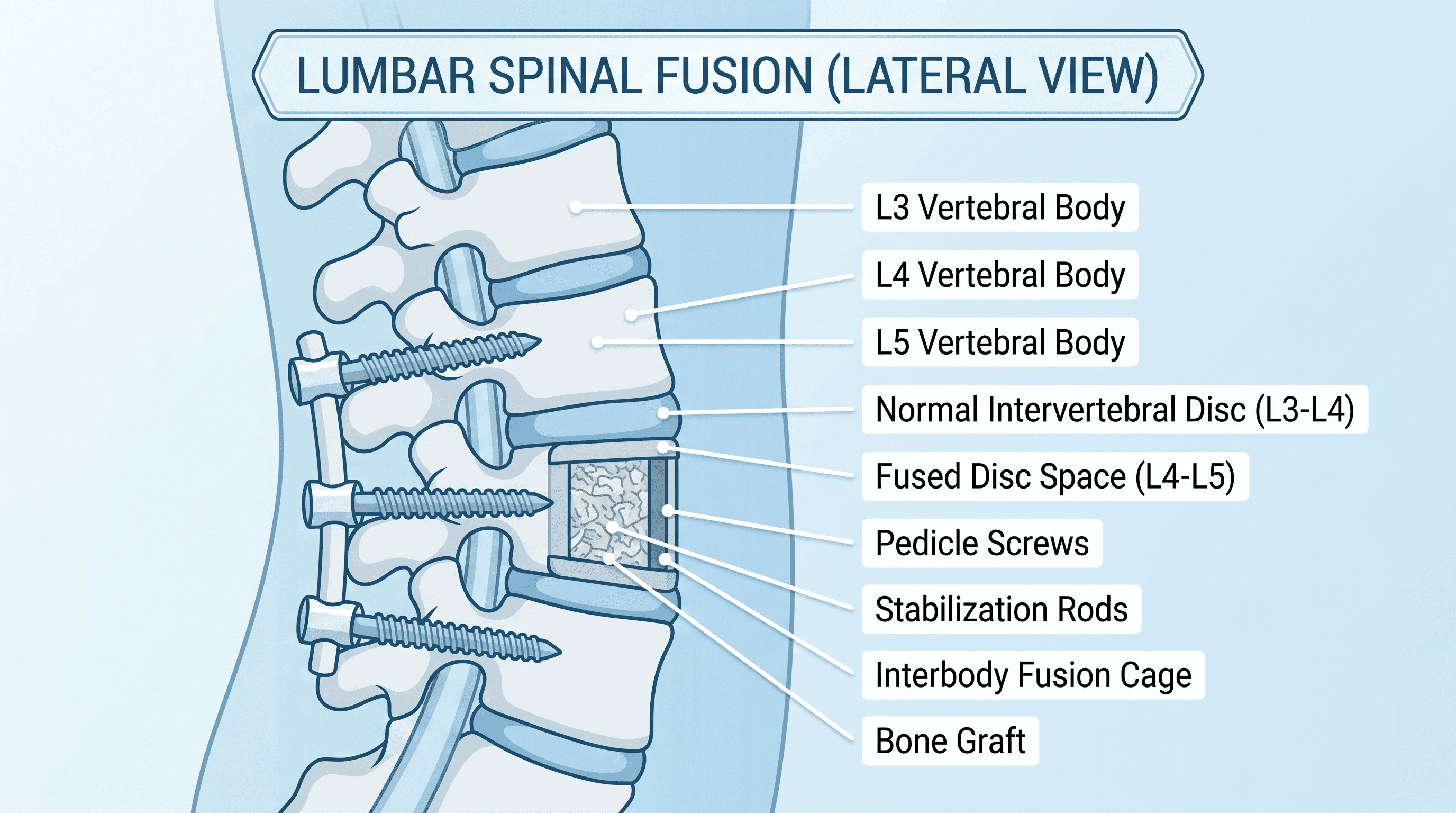
Spinal fusion is not just a mechanical repair. It is a biological process. The surgery deposits bone graft material (your own bone, donor bone, or a synthetic substitute) at the fusion site and stabilizes it with metal hardware. Over the following weeks and months, your body grows new bone across that graft, knitting the vertebrae together permanently.
During that early window, the graft site is fragile. Prolonged sitting compresses the lumbar discs and increases axial load on the fusion. Vibration from roads or turbulence can stress hardware before osseointegration is complete. Overhead lifting strains the posterior elements of a cervical or lumbar repair. Crowds in airports create collision risk when your protective reflexes are still blunted by pain medication.
Every travel restriction your surgeon gives you maps directly to one of these biological realities. Understanding that connection makes the guidance easier to follow and harder to rationalize away.
Cervical Fusion (ACDF/PCDF): What Is Different for Travelers
Anterior cervical discectomy and fusion (ACDF) patients face a different set of travel challenges than lumbar patients. Neck brace restrictions limit head rotation, which creates real problems for safe driving, and throat soreness from anterior surgical access can make eating on planes uncomfortable for the first week or two. The upside is that cervical recovery tends to move faster overall. Many single-level ACDF patients get travel clearance within two to four weeks for moderate distances, provided they are off narcotics and healing well.
Lumbar Fusion: Single-Level vs. Multilevel Differences
The number of levels fused is one of the strongest predictors of travel readiness. Research published in PMC indicates that single-level lumbar fusion patients may be cleared for car travel as early as two weeks, while multilevel lumbar fusion patients often require six to twelve weeks before air travel is advisable. The difference is not arbitrary. More fusion levels mean a larger surgical footprint, greater inflammation, more hardware, and a longer window before the graft site achieves sufficient stability to tolerate travel stress.
Your Clearance Milestones: What Surgeons Actually Check Before Saying Yes
The phrase "ask your surgeon" is not wrong. It is just incomplete. Knowing what your surgeon is actually evaluating gives you a concrete checklist to track rather than a vague waiting game.
Before clearing a patient for travel, most spine surgeons confirm several specific criteria. The surgical incision should be fully closed and dry, with no signs of discharge or wound breakdown. The patient should be off opioid narcotic pain medication entirely, both because narcotics impair driving and because dependence on them often signals inadequately controlled pain. Remaining pain should be manageable with over-the-counter options like acetaminophen or ibuprofen (as directed). Imaging at the follow-up appointment should show early evidence of fusion progress at the graft site. There should be no signs of deep vein thrombosis (DVT), infection, or fever. And the patient should have adequate mobility to board independently, sit for the planned duration with breaks, and manage their own carry-on without lifting.
Most of these criteria align with the standard four- to six-week post-op follow-up window, which is why that timeframe appears so frequently in general guidance. But if your recovery is ahead of schedule or behind it, that follow-up appointment is where the real answer lives.
Car Travel After Spinal Fusion
Car travel breaks into two distinct categories: riding as a passenger and driving. The rules are meaningfully different for each.
As a passenger, short trips of under thirty minutes are generally safe within the first one to two weeks after surgery, provided the car has adequate seat adjustment and lumbar support. Longer road trips require more recovery time, closer to four to six weeks for single-level lumbar fusion and six to eight weeks for multilevel procedures. The key variable is not just distance but cumulative time in the seated position, which loads the lumbar spine continuously.
Driving is a harder restriction. It is not simply a comfort issue. Operating a vehicle while on opioid pain medication is illegal in every US state, and most patients require opioids for at least two to four weeks post-fusion. Beyond the legal dimension, safe driving requires the ability to brake suddenly, turn the neck quickly, and respond to unexpected hazards. These movements are exactly what early fusion recovery restricts. Cervical fusion patients face an additional barrier: limited head rotation while wearing a neck brace makes shoulder-checking functionally impossible.
Practical tips for car travel as a passenger include placing a rolled towel or small lumbar pillow in the curve of the lower back, reclining the seat slightly rather than sitting bolt-upright, and stopping every twenty to thirty minutes on longer trips to stand, walk briefly, and restore circulation. Avoid rough back roads or unpaved surfaces during the first four to six weeks, as vibration transfers directly to the fusion site.
Flying After Spinal Fusion
Flying introduces a specific set of risks that go beyond simple discomfort. Cabin pressure changes, restricted movement in coach seats, dehydration from recirculated cabin air, and long continuous sitting all compound the existing post-surgical DVT risk.
For short-haul flights (under three hours), single-level lumbar fusion patients are typically cleared around four to six weeks. Multilevel lumbar fusion patients usually need six to twelve weeks before short-haul air travel, based on research into surgeon-recommended return-to-activity timelines. Long-haul flights (over six hours) warrant additional caution regardless of fusion type and are generally deferred to eight to twelve weeks or beyond.
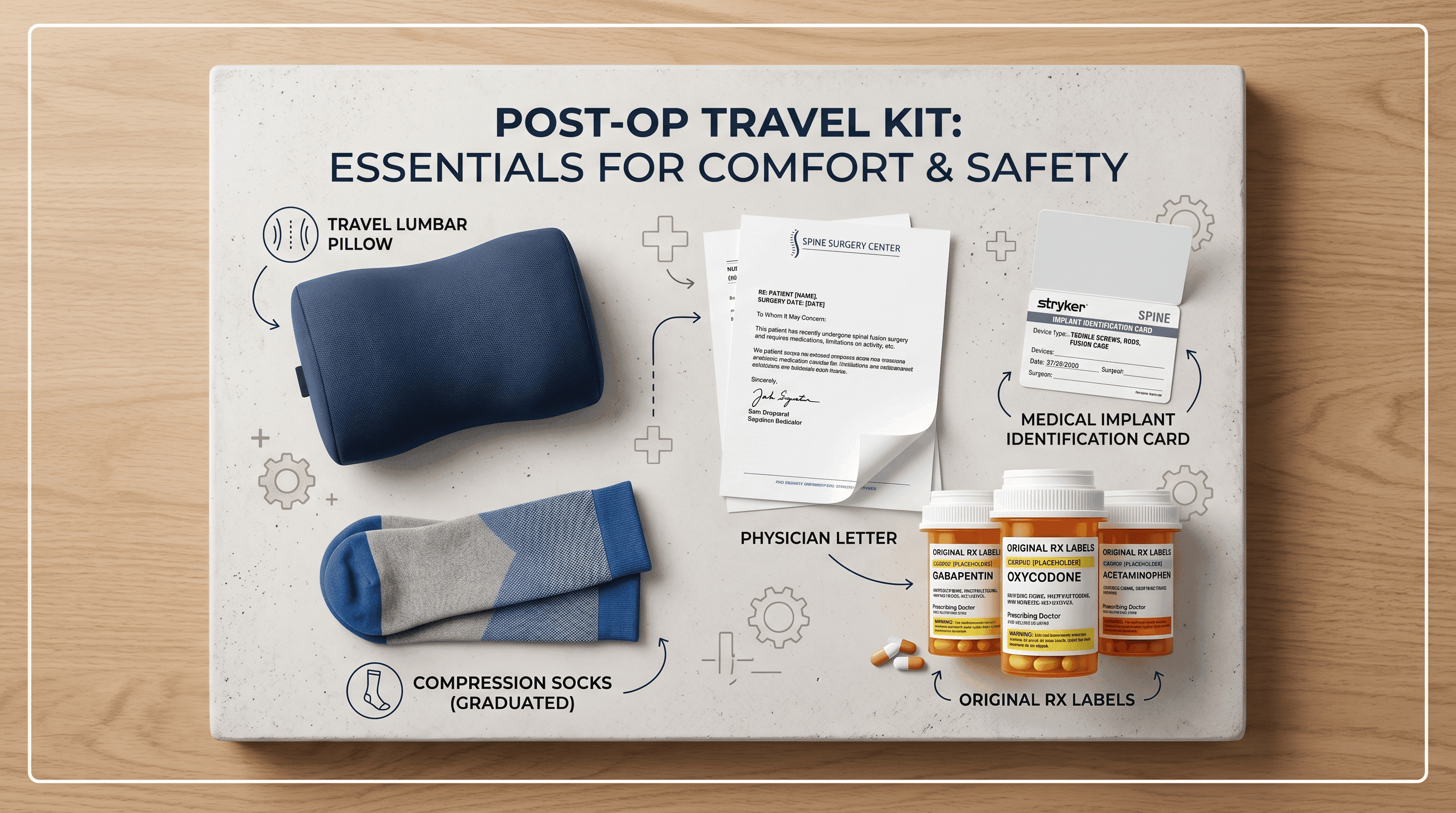
Practical flying strategies include booking an aisle seat without exception, which allows you to stand and walk the aisle every forty-five to sixty minutes without disturbing seatmates. Do not attempt to lift luggage into overhead bins. Gate-check your carry-on bag if needed, and consider shipping heavier bags to your destination in advance. Wear graduated compression socks (15 to 20 mmHg) starting two hours before the flight to support venous return in the legs. Notify the airline of mobility needs at booking, not at the gate, to arrange pre-boarding and any wheelchair assistance through the terminal.
Will My Spinal Implants Trigger Airport Security?
This is one of the most common questions spinal fusion patients search before their first post-op trip, and the answer is reassuring but requires a small preparation step. Modern titanium spinal implants rarely trigger standard walk-through metal detectors. However, millimeter-wave body scanners used at many US airports can detect the hardware and prompt additional screening.
The practical solution is simple: carry a copy of your operative report or implant card in your wallet, notify the TSA officer before entering the screening lane that you have spinal hardware, and request a manual pat-down if you prefer to avoid the scanner. TSA officers handle implant-related screening routinely. Having documentation on hand speeds the process.
Flying with Post-Op Prescriptions: What You Need to Know
Carrying opioids, muscle relaxants, or nerve medications through airport security requires a few straightforward preparations. Keep all medications in their original pharmacy-labeled bottles. Bring a signed physician letter on clinic letterhead explaining your prescriptions, especially for controlled substances. For domestic US travel, this is rarely an issue, but for international destinations, research the destination country's specific rules around importing controlled substances well in advance of travel, as some countries have strict restrictions or require advance permits.
The DVT Risk: Why Prolonged Sitting Is Dangerous
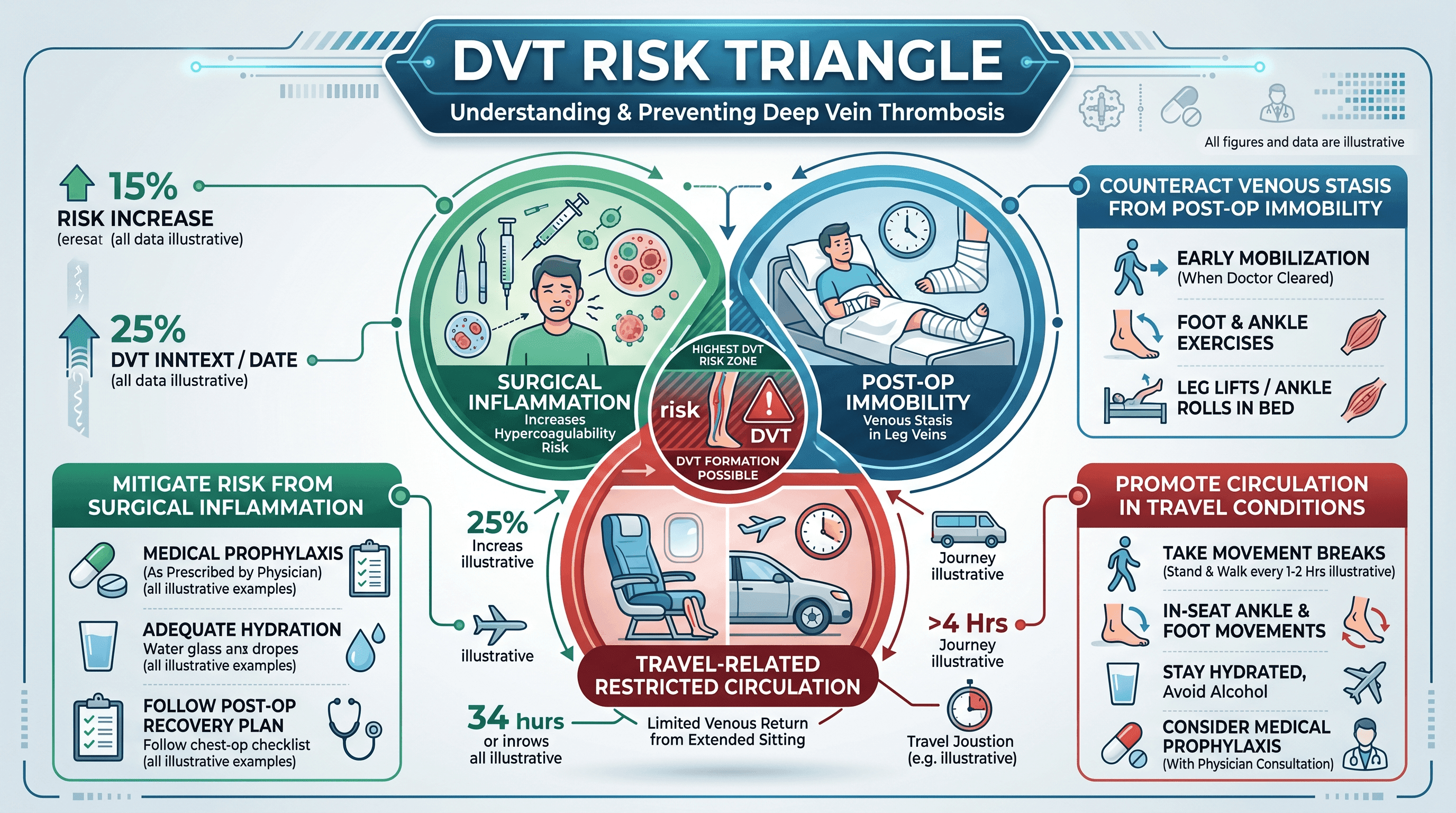
Deep vein thrombosis (DVT) is a blood clot that forms in a deep vein, most often in the calf or thigh. After spinal fusion surgery, DVT risk is elevated by three overlapping factors: the surgery itself triggers an inflammatory clotting response, post-operative immobility slows venous blood flow in the legs, and prolonged seated travel further restricts that circulation.
According to the CDC, DVT risk from air travel is compounded by long flight duration and underlying surgical history. Research published in PMC confirms that blood flow in the popliteal vein of the leg is significantly reduced during prolonged seated postures, which is the exact condition of sustained car or plane travel.
The highest-risk window is the first four to six weeks after surgery, which is precisely why most surgeons restrict long-distance travel during this period. Warning signs of DVT include one-sided calf swelling, redness or warmth along the inner leg, and calf pain that worsens with foot flexion. If these symptoms appear during or after travel, seek emergency evaluation immediately.
Preventive strategies include compression socks, regular leg movement (ankle pumps every twenty minutes while seated), adequate hydration, and avoiding alcohol during flights. Surgeons may also prescribe a short course of blood thinners in the highest-risk patients during the early post-operative period.
Navigating the Airport
The airport itself, independent of the flight, is a significant physical challenge in early recovery. Terminal walks at major US airports often exceed half a mile between security and the gate. Security lanes require removing shoes, lifting bags, and moving quickly through narrow spaces. Boarding lines mean standing still for extended periods, which increases lumbar load. Crowded concourses create collision risk.
The practical answer is wheelchair assistance, and there is no good reason to resist requesting it. Airlines provide complimentary wheelchair transport from the curb to the gate, including security escort, at no cost. Request it when booking, confirm it at check-in, and arrive with extra time. Pre-boarding is typically offered to passengers with mobility assistance requests, which eliminates the standing line entirely and gives you time to get settled before the cabin fills.
If you are using a cervical brace, notify security that the brace is a post-surgical medical device before approaching the screening lane. This avoids confusion and generally speeds the process.
The Luggage Problem and the No BLT Rule
Surgeons use the acronym BLT, standing for Bending, Lifting, and Twisting, to describe the three movements that put the most stress on a spinal fusion site during early recovery. All three are effectively banned for the first six to twelve weeks depending on the procedure.
Travel, unfortunately, is a BLT minefield. Lifting a carry-on bag overhead, bending to retrieve luggage from a baggage carousel, twisting in a car seat to check the back window: each of these movements can stress the hardware and graft before fusion is established. Surgeons who encounter patients with hardware complications frequently trace them back to exactly these types of incidents.
The solution is advance planning. Ship checked baggage to your destination rather than checking it at the airport. Use a small, lightweight carry-on that fits under the seat in front of you and requires no overhead lifting. Ask a travel companion to handle all bag loading and retrieval. At baggage claim, use a luggage cart and let someone else lift bags onto it. These feel like inconveniences. They are actually the difference between a smooth trip and a serious setback.
Patients looking for additional guidance on managing recovery within daily life can find a doctor or spine specialist who can provide personalized recovery milestones and clearance timing based on imaging and clinical progress.
Surviving the Seat: The 45-Minute Rule
The single most actionable travel survival strategy after spinal fusion is this: do not stay seated for more than forty-five to sixty minutes at a stretch.
On flights, this means walking the aisle once per hour, which also reduces DVT risk. On road trips, it means stopping at a rest area, getting out of the car, and walking for five to ten minutes before continuing. In trains or buses, it means standing in the aisle or vestibule area periodically.
While seated, ankle pumps (rhythmically flexing and pointing the feet) maintain venous flow in the calves without requiring you to stand. Shift your weight gently from side to side every fifteen to twenty minutes to redistribute pressure across the lumbar spine. Avoid crossing the legs, which further restricts popliteal blood flow. If your seat has a recline function, use a slight recline rather than sitting fully upright, as an upright 90-degree seated position actually increases intradiscal pressure more than a modest recline.
Train, Bus, and Cruise Travel After Spinal Fusion
These transport modes get almost no coverage in standard post-fusion travel guides, despite representing genuine patient questions.
Trains offer more freedom of movement than planes, with wider aisles and the ability to walk between cars. That is a meaningful advantage for spine patients. The drawback is vibration. Train vibration, particularly on older tracks or regional lines, transmits directly to the spine and can be significant. Lumbar fusion patients should use the same forty-five-minute standing rule as on flights and pack a lumbar support cushion for the seat.
Buses combine the vibration problem of trains with even less freedom of movement. Long-haul bus travel is generally a poor choice in the first eight to ten weeks after lumbar fusion. If bus travel is unavoidable, prioritize front-of-bus seating where vibration is lowest and stop frequency is higher.
Cruises present the most complex picture of any leisure travel option. Cruise ships carry onboard medical staff at most major lines, but they do not carry imaging equipment. If your pain changes in a way that warrants a CT or MRI, the ship cannot provide it. Added risks include uneven deck surfaces, narrow gangway inclines, emergency evacuation difficulty, and the reality that weather-related ship motion adds unpredictable vibration and postural challenge. As a general rule, cruise travel should be deferred until the surgeon confirms solid early fusion on imaging, which is rarely before eight to twelve weeks for lumbar procedures. Cruises are the highest-risk leisure option during early spinal fusion recovery.
International Travel: Unique Risks When You Are Far From Your Surgeon
International travel after spinal fusion introduces risks that go beyond what domestic trips present. If pain escalates or new neurological symptoms appear abroad, access to spine-capable imaging (MRI, CT) varies significantly by destination. In some countries, obtaining a scan quickly requires navigating a private-pay system in an unfamiliar language.
Medication continuity is a separate concern. Opioids, muscle relaxants, and anticonvulsants used for nerve pain (such as gabapentin) are controlled substances in most countries and may be subject to strict import limits or outright prohibition. Research destination-country rules well before travel. Many countries also use different brand names for the same medications, which complicates emergency resupply if medications are lost or delayed.
Ultra-long-haul flights of ten or more hours substantially compound DVT risk. Research published in PMC documents the relationship between extended immobility and venous thromboembolic events, a risk particularly relevant to post-surgical patients. On flights of this length, consider consulting your surgeon about whether a short prophylactic anticoagulant course is appropriate.
Travel insurance is non-negotiable for international post-fusion travel, and standard trip cancellation policies are not sufficient. Look specifically for policies that cover pre-existing surgical conditions and include medical evacuation coverage. Services such as MedjetAssist provide hospital-to-hospital air evacuation, which is relevant if you require spine-specific care unavailable at your destination.
Before departure, save your surgical team's after-hours emergency contact number to your phone. Save the nearest major hospital's address in your destination city. Keep your operative report and implant card accessible, not buried in checked luggage.
What to Do If Symptoms Worsen While You Are Traveling
No competitor article addresses this, and it is the information patients most need if something goes wrong.
The following symptoms warrant an immediate visit to the nearest emergency room, regardless of where you are. These are not normal travel discomfort. These are red flags.
A fever above 101 degrees Fahrenheit after spinal surgery suggests possible infection at the surgical site or, less commonly, meningitis. New or worsening weakness or numbness in the legs, feet, or arms indicates possible hardware displacement or nerve compression that requires imaging. Sudden severe pain at the surgical site that is clearly different from your baseline post-op pain warrants evaluation. Redness, warmth, or discharge from the incision suggests wound breakdown or infection. One-sided calf swelling with pain is a DVT red flag requiring immediate evaluation and possible anticoagulation.
Normal travel discomfort after spinal fusion includes general fatigue, mild to moderate positional discomfort, and temporary soreness that improves after changing position or walking. If you can relieve discomfort by moving, resting, or applying ice, it is likely not an emergency. If symptoms are progressive, unrelenting, or accompanied by any of the red flags above, do not wait it out.
Before any travel, save your surgeon's after-hours emergency number as a contact on your phone. Save the address of the closest hospital to your travel destination. For international travel, research English-language emergency services at your destination and consider carrying a document with your surgical history translated into the local language.
Pre-Travel Checklist: How to Prepare for Your First Post-Fusion Trip
Use this checklist before any trip, regardless of distance or transport mode.
- Surgeon written clearance confirmed at the most recent follow-up appointment, not assumed from a prior visit.
- Off opioid pain medications entirely, or a physician travel letter obtained if a short course is still in progress.
- Graduated compression socks (15 to 20 mmHg) packed and available for all seated travel segments.
- Lumbar or cervical travel support pillow sourced and tested for fit in your intended seat.
- Travel insurance purchased, with explicit confirmation that the policy covers pre-existing surgical conditions and medical evacuation.
- Medical records and operative report saved to your phone's photos or a cloud service, accessible without Wi-Fi.
- Surgeon's after-hours emergency contact number saved to your phone.
- Implant card or operative summary printed and placed in your wallet.
- Aisle seat booked on all flights.
- Heavy luggage shipped to the destination in advance, or a porter or travel companion arranged to manage bags.
- All medications stored in original pharmacy-labeled containers, with a physician letter for controlled substances.
- Nearest hospital address at your destination saved to your phone.
FAQ
How to sit in a car after spine surgery? Sit in the front passenger seat where you can recline slightly and adjust leg room fully. Place a small lumbar support pillow or rolled towel in the curve of your lower back. Recline the seat a few degrees rather than sitting at a strict 90-degree angle, which increases intradiscal pressure. Stop every twenty to thirty minutes on longer trips to stand briefly and walk. Avoid sitting in the back seat during early recovery, as the seat geometry is less adjustable and the position is harder to modify for comfort.
Can I fly after spinal fusion surgery? Yes, but the timing depends on your surgery type and recovery progress. Single-level lumbar fusion patients are often cleared for short-haul flights (under three hours) around four to six weeks. Multilevel lumbar fusion patients typically wait six to twelve weeks. Cervical fusion patients may be cleared somewhat earlier, often two to four weeks for short-haul. No patient should fly while still on opioid medications. Book an aisle seat, wear compression socks, walk the aisle every forty-five to sixty minutes, and skip overhead bin lifting entirely.
Can you stay alone after spinal fusion surgery? During the first two to three weeks, most spine surgeons recommend having another adult present at home. Early recovery involves limitations on bending, lifting, and twisting that make basic household tasks difficult and potentially harmful. If living alone is unavoidable, set up your living area before surgery: place frequently used items at counter height, set up a first-floor sleeping area if stairs are involved, and arrange grocery delivery. Check with your surgeon about your specific situation, as minimally invasive procedures may allow earlier independent living than open multilevel fusions.
Can I lift heavy objects after spinal fusion? No, not during early recovery. The No BLT (Bending, Lifting, Twisting) rule applies throughout the first six to twelve weeks for most fusion procedures. Lifting heavy objects, including suitcases, car doors, or even groceries, before fusion is established risks stressing the graft site and hardware. Most surgeons set a specific weight limit (often ten pounds or less) for the first several weeks, with gradual increases under guidance as healing progresses. Travel-related luggage handling should be delegated entirely to a travel companion or porter during this period.
How long after spinal fusion can I travel internationally? International travel is generally deferred longer than domestic travel due to the combined risks of ultra-long-haul flights, limited access to spine-capable imaging abroad, controlled substance import restrictions, and medical evacuation logistics. Most spine surgeons recommend waiting until early fusion is confirmed on imaging, which is typically at the three-month follow-up for lumbar procedures. Patients considering international travel within the first three months should discuss the specific destination, flight duration, and available medical infrastructure with their surgical team before booking. The Momentary Lab AI Healthcare Navigator can help you understand your condition and prepare informed questions before that conversation.
References
- PMC: Surgeon survey on postoperative activity restrictions after lumbar fusion — Cited for single-level vs. multilevel lumbar fusion travel timeline data.
- PMC: Venous blood flow and prolonged immobility — Cited for popliteal vein blood flow research supporting DVT risk during prolonged seated travel.
- PMC: Venous thromboembolism and extended immobility — Cited for ultra-long-haul flight DVT risk in post-surgical patients.
- CDC: Travel and DVT risk — Cited for DVT risk compounded by travel history and flight duration.