


If you've just been told you have a torn meniscus and you're wondering whether you can avoid surgery, here's the honest answer: it depends on your specific tear. Some meniscus tears can be managed without surgery and many patients go on to recover full, comfortable function. Others carry genuine long-term risks if left without intervention. The difference comes down to where the tear is, what kind it is, your age, your activity level, and how your knee responds to conservative care. This guide walks through all of it so you and your doctor can make the most informed decision together.
At a Glance
| Topic | Key Facts |
|---|---|
| Meniscus function | C-shaped cartilage that absorbs shock and stabilizes the knee joint |
| Most common tear types | Degenerative (wear-related) and traumatic (acute injury) |
| Who heals without surgery | Outer-zone tears, degenerative tears in patients 45+, stable tears with minimal symptoms |
| Who may need surgery | Bucket-handle tears, white-zone tears, locked knees, failed conservative treatment |
| Conservative options | Physical therapy, NSAIDs, corticosteroid injections, activity modification |
| OA risk | Untreated tears (especially inner-zone) are associated with accelerated knee osteoarthritis |
| Key evidence | FIDELITY and ESCAPE trials support conservative care for degenerative tears |
Do All Meniscus Tears Require Surgery?
Not all meniscus tears need to be repaired surgically, and that is not a controversial statement anymore. A growing body of clinical trial data has shifted the conversation significantly over the past decade. The answer depends on the tear type, its location within the meniscus, the severity of your symptoms, and whether your knee has any mechanical dysfunction.
According to the Mayo Clinic, initial treatment for a torn meniscus often involves rest, ice, and pain relief, with surgery considered only when conservative measures fail or the injury is severe. Many patients, particularly those with degenerative tears, improve substantially with physical therapy alone and never require the operating room. Others, especially those with certain tear patterns that cause the knee to lock or buckle, are better served by surgical intervention.
The important thing here is that "surgery vs. no surgery" is not a binary choice based on severity alone. It is a decision tree with multiple branches.
Traumatic vs. Degenerative Tears
Understanding which category your tear falls into is the first step toward understanding your prognosis.
Traumatic tears happen suddenly. A hard pivot on the basketball court, a tackle in football, a mis-step on a hike. The meniscus is torn by a rapid, forceful twist of the knee while the foot stays planted. These tears are common in younger, active patients and tend to be cleaner in shape, which makes them better candidates for repair if surgery is ultimately needed.
Degenerative tears develop over time as the cartilage gradually weakens with age or from conditions like knee osteoarthritis. The Cleveland Clinic notes that as cartilage wears down, the meniscus can tear from a motion as minor as stepping off a curb. These tears are far more common in patients over 45 and they respond meaningfully better to conservative treatment. Multiple randomized controlled trials have shown that for degenerative tears, physical therapy produces outcomes equivalent to partial meniscus removal at the 5-year mark.
The distinction matters because a 28-year-old athlete with a traumatic bucket-handle tear and a 55-year-old with a degenerative horizontal tear are not dealing with the same injury, even if both are called "a torn meniscus."
What Actually Happens to the Torn Cartilage Inside Your Knee?
This is where the biology gets important, and where many patients are understandably confused.
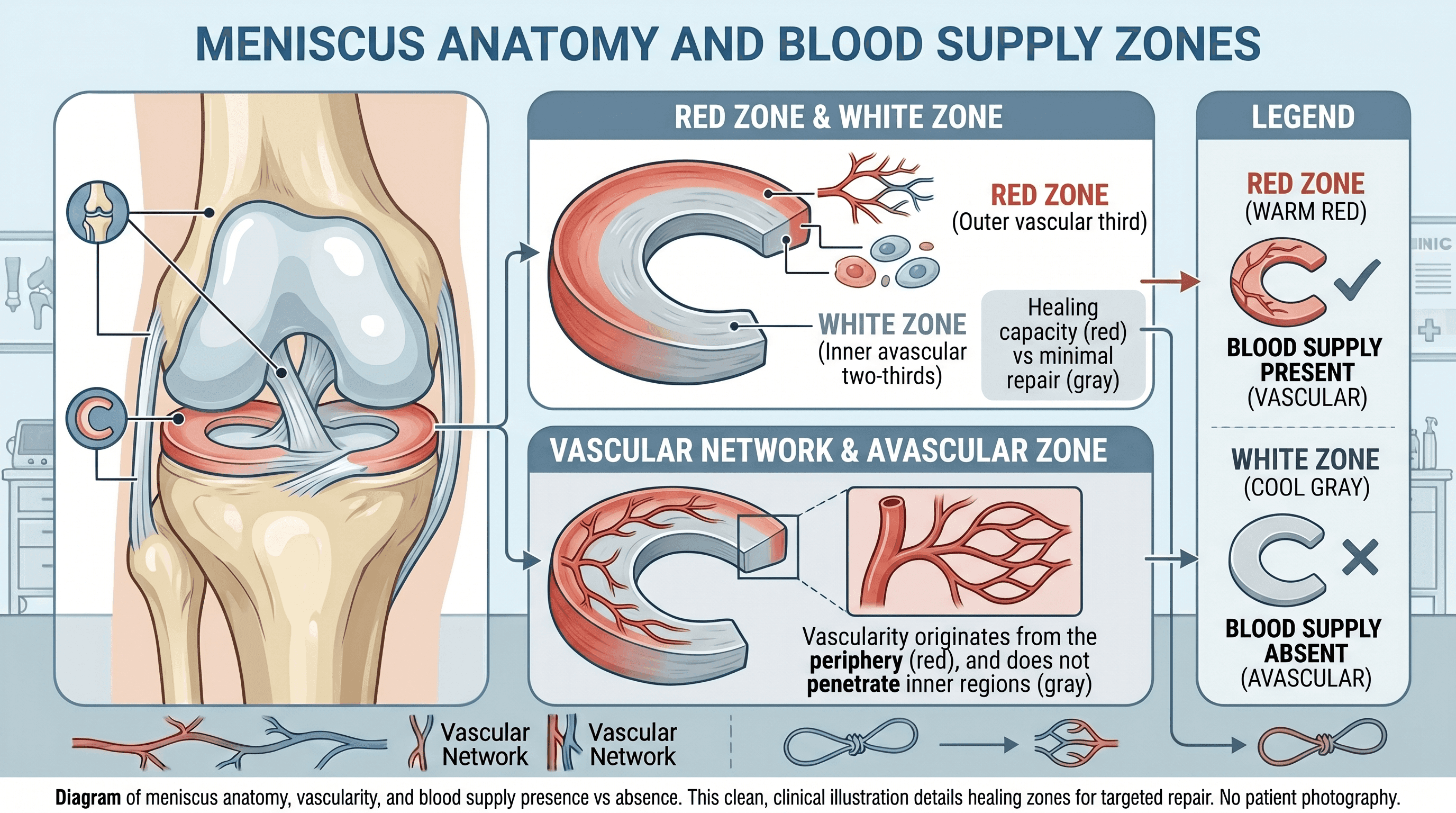
The meniscus is not uniformly equipped to heal itself. It is divided into zones based on blood supply, and that blood supply is everything when it comes to natural healing.
Tears in the Red Zone (Outer Third)
The outer one-third of the meniscus, called the "red zone," receives a meaningful blood supply from surrounding vessels. When a tear occurs here, the body has the raw material it needs to attempt healing: oxygen, nutrients, and regenerative cells carried in blood. Stable, longitudinal (vertical) tears in this zone, particularly in younger patients, have genuine healing potential with conservative management. A 2009 study published in Arthritis & Rheumatism (Englund et al., via the Multicenter Osteoarthritis Study) found that many meniscal tears are actually asymptomatic and do not inevitably progress to functional impairment. Healing timelines for red-zone tears with appropriate physical therapy typically range from 6 to 12 weeks, though return to high-demand sport may take longer.
Tears in the White Zone (Inner Two-Thirds)
The inner two-thirds of the meniscus, the "white zone," has no direct blood supply. Cartilage cells here receive nutrients through diffusion from joint fluid, which is far less efficient. When a tear occurs in this avascular region, the body simply cannot mount a healing response. The torn tissue does not knit back together. Pain may subside over time as inflammation settles, but the structural damage remains. Radial, horizontal cleavage, and complex tears in the white zone fall into this category. They do not heal spontaneously, and if symptoms persist or worsen, medical evaluation is needed.
What Happens If a Torn Meniscus Goes Untreated
This is the question most people actually want answered. If you manage without surgery, what are you signing up for?
The answer varies sharply by tear type. For a stable, outer-zone tear in an otherwise healthy knee, the long-term picture can be quite good with proper rehabilitation. For certain other tear patterns, the risks of going without intervention accumulate over time.
Short-Term Consequences (Weeks to Months)
In the short window after a meniscal tear, most people experience swelling (often described as a chronically puffy knee, also called chronic knee effusion), stiffness, and pain with twisting or pivoting movements. Some feel a catching or clicking sensation during motion. A fragment of torn meniscus can occasionally catch in the joint, producing what clinicians call a "true mechanical lock," where the knee physically cannot be fully straightened. This is distinct from the stiffness-related pseudolocking that comes simply from swelling and muscle guarding.
If a bucket-handle tear, where a large flap of meniscus flips into the joint like a handle on a bucket, goes unaddressed, the locked knee can become progressively more difficult to extend and the risk of articular cartilage damage rises sharply with each episode of locking.
Long-Term Consequences (Years)
The longer-term concern with untreated meniscal damage is its relationship to knee osteoarthritis (OA). The meniscus functions as a shock absorber and load distributor. When it is torn and not functioning correctly, the articular cartilage on the ends of the femur and tibia bears more direct contact stress than it was designed to handle.
A landmark study via the Multicenter Osteoarthritis Study, published in Arthritis & Rheumatism, found that meniscal tears in knees without surgery were significantly associated with the development of radiographic osteoarthritis among middle-aged and elderly persons. The association was strongest for tears in the posterior horn and for tears that involved the body of the meniscus. This does not mean that every untreated tear leads to OA, but it does mean the risk is real and should factor into the decision.
Patients who develop progressive OA may experience joint space narrowing, increasing stiffness with activity, and eventually reduced mobility that affects daily life. Whether conservative management can delay or modify this trajectory depends heavily on how well the quadriceps and surrounding musculature are maintained.
Warning Signs Your Untreated Tear Is Getting Worse
Many patients try conservative management first and do well. But some do not, and knowing the warning signs is genuinely useful.
Seek prompt orthopedic evaluation if you notice any of the following: your knee locks up and physically cannot be straightened (true mechanical locking, not just stiffness), you experience sudden giving-way episodes where the knee buckles under your weight, your pain is increasing rather than gradually improving after 6 to 8 weeks of physical therapy, you notice significant worsening of swelling after periods of activity, or you have new nighttime pain that disturbs sleep. These patterns suggest either that the tear is mechanically active in the joint or that additional damage is occurring.
Increasing instability in particular warrants attention, as repetitive giving-way can accelerate articular cartilage wear over time.
When Non-Surgical Treatment Genuinely Works
For the right patient and the right tear, the research supporting conservative management is strong.
A 2023 systematic review and meta-analysis with individual participant data from 605 randomized patients, published in Osteoarthritis and Cartilage, found that arthroscopic partial meniscectomy did not produce superior outcomes compared to non-surgical or sham treatment for patients with MRI-confirmed degenerative meniscus tears. This mirrors findings from earlier landmark trials including the FIDELITY trial (Sihvonen et al.), in which a sham surgery procedure produced the same clinical results as actual partial meniscectomy for degenerative tears. The ESCAPE trial similarly found that physical therapy produced equivalent outcomes to partial meniscectomy for degenerative tears at the 5-year follow-up.
Degenerative Tears (Age 45 and Older)
For patients over 45 with degenerative meniscal tears and no true mechanical locking, non-surgical management is now considered the appropriate first-line approach by most major orthopedic guidelines. The ideal conservative candidate has manageable pain, no instability, no locked knee, and realistic goals focused on preserving daily function rather than returning to competitive sport. Success in this group is defined as a meaningful reduction in pain and restoration of comfortable, functional movement, not necessarily the disappearance of the structural tear on MRI.
Traumatic Tears in Younger, Active Patients
This group is more nuanced. Some younger patients with traumatic tears and stable knees do respond well to a structured neuromuscular rehabilitation program. The DREAM trial data, examining supervised rehabilitation in traumatic tears in stable knees, showed that outcomes at 12 months were comparable between surgery and rehabilitation in select patients. A doctor can advise on whether individual circumstances support a rehabilitation-first approach. Patients with high-demand sport requirements and mechanically active tears often require surgical evaluation sooner.
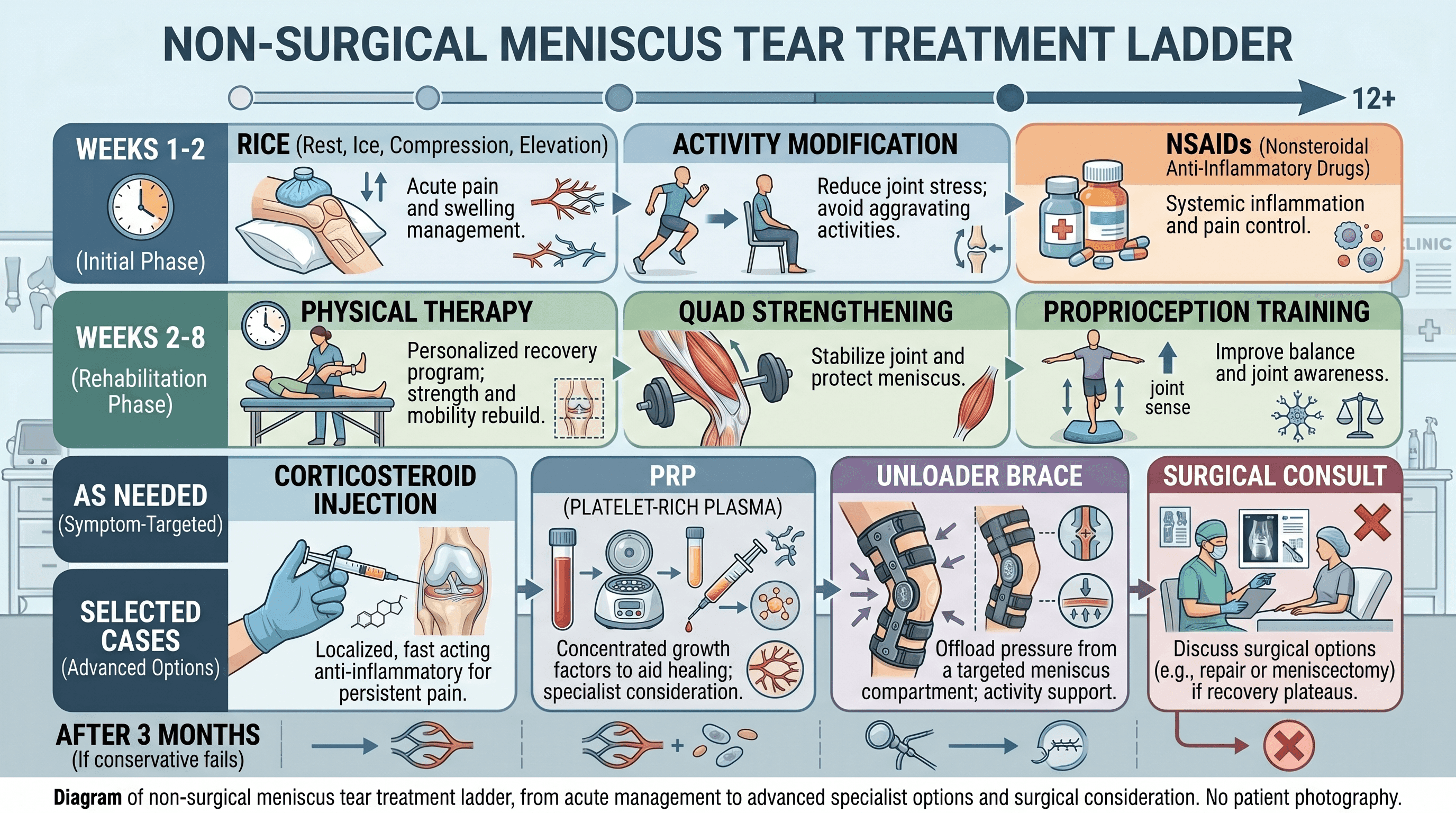
Conservative Treatment Options Beyond RICE
Most competitors stop at RICE (rest, ice, compression, elevation). That is a starting point, not a treatment plan.
Structured physical therapy is the backbone of non-surgical meniscus management. The goal is not to "fix" the tear but to offload it. By strengthening the quadriceps, hamstrings, glutes, and hip abductors, patients redistribute mechanical force away from the injured cartilage. Quad strengthening for meniscus pain is particularly well-supported; a strong quad reduces compressive loads across the knee joint during walking, stair climbing, and most daily activities. A good PT protocol also includes proprioceptive training to reduce giving-way risk and gait retraining to normalize movement patterns that might otherwise place excessive stress on the meniscus.
NSAIDs (non-steroidal anti-inflammatory drugs) like ibuprofen and naproxen sodium address the inflammatory component that drives much of the acute pain and swelling. They do not treat the underlying structural tear but can make rehabilitation more comfortable in the early weeks.
Corticosteroid injections can quiet significant inflammation when oral NSAIDs are insufficient. They are most useful as a bridge to allow therapy to progress, but their benefit is typically temporary. Repeated injections are approached cautiously due to potential effects on cartilage over time; a doctor can advise on frequency and appropriateness.
Platelet-rich plasma (PRP) injections have attracted interest as a regenerative option. A 2024 systematic review found promising signals for PRP in knee cartilage conditions, but the evidence base for meniscal tears specifically remains variable in quality. PRP is not yet a standard recommendation for isolated meniscus tears and should be discussed with a specialist.
Knee bracing can reduce instability and offload the affected compartment during activity. An unloader brace, which shifts load toward the healthier compartment of the knee, may be useful for patients with concurrent mild OA.
A Decision-Making Framework: Surgery or Non-Surgical?
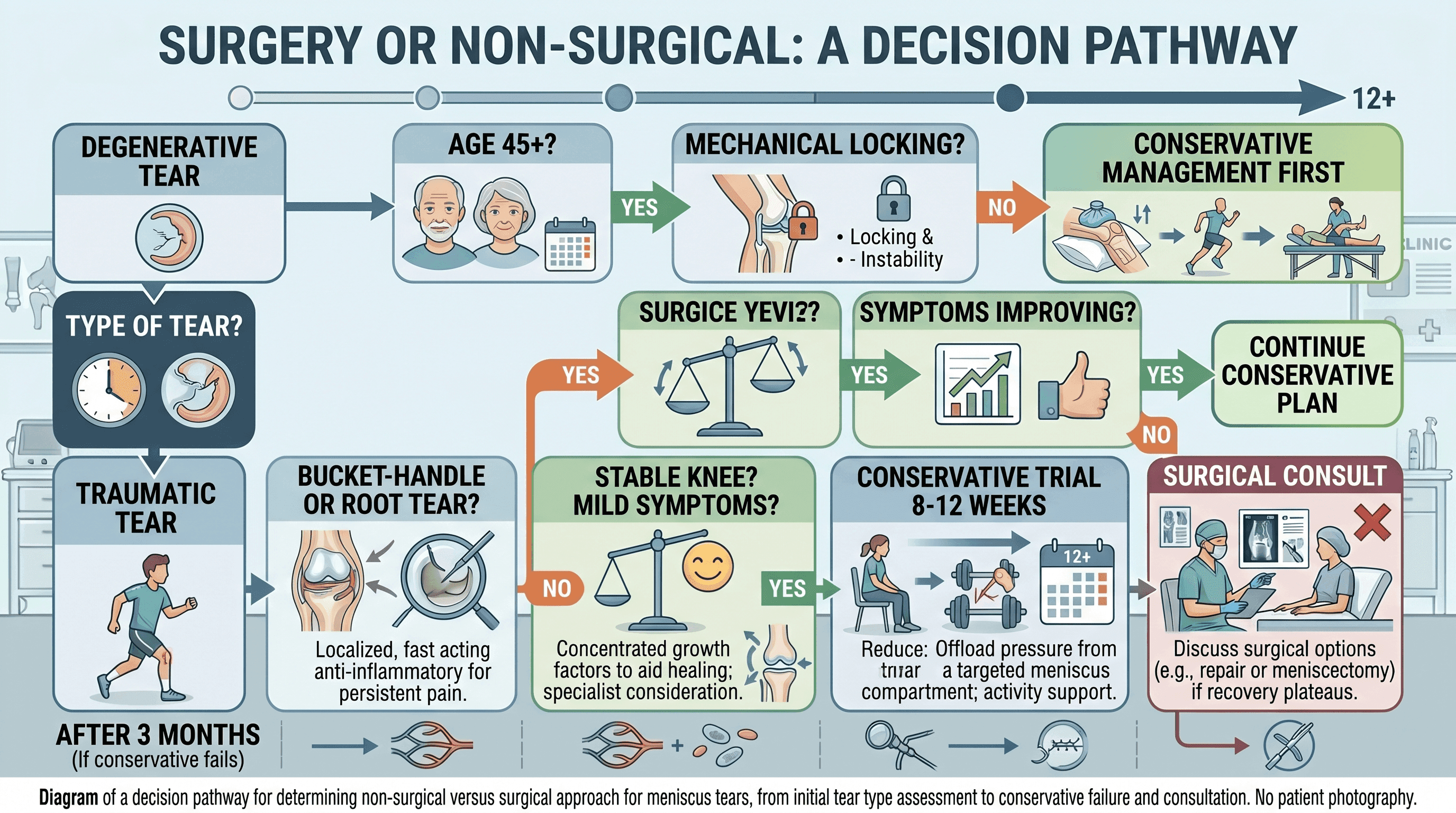
If you're trying to decide whether to pursue surgery, a structured approach is more useful than going purely on gut feeling or on a single metric like pain level.
Strong Indicators for Surgery
The following factors generally point toward a surgical conversation with an orthopedic surgeon: true mechanical locking of the knee that cannot be resolved, a bucket-handle tear confirmed on MRI, white-zone tears with persistent and disabling symptoms, root tears (where the meniscus detaches at its attachment point, which carries high OA risk if untreated), failure to improve after 3 months of consistent supervised physical therapy, or high-demand athletes who require reliable return to full sport. If you are experiencing any of these, connecting with a qualified orthopedic specialist is the appropriate next step. You can find a doctor near you to request a specialist referral and get an individualized assessment.
Strong Indicators for Non-Surgical Management
The following factors support a conservative-first approach: a degenerative tear in a patient aged 45 or older, a stable longitudinal tear in the red zone with mild symptoms, no mechanical locking or true giving-way episodes, a patient whose goals are functional daily life rather than high-demand athletics, and meaningful symptom improvement within the first 4 to 6 weeks of structured therapy. Patients in this group often do very well without surgery and have clinical trial evidence backing their choice.
Shared decision-making, where you and your orthopedic provider review the MRI findings, tear characteristics, and your personal goals together, is the gold standard approach.
Frequently Asked Questions
Can I live with a meniscus tear without surgery? Many people live comfortably with a meniscus tear without surgery, particularly those with degenerative tears or stable outer-zone injuries. With structured physical therapy, activity modification, and appropriate pain management, functional quality of life can be maintained. Whether this is the right long-term approach for a specific tear depends on the tear's location, type, and the presence of mechanical symptoms. A physician can evaluate the MRI and advise on the most appropriate path.
How long can I go without meniscus surgery? There is no universal time limit, but delaying surgery when mechanical symptoms like locking or progressive instability are present can allow additional cartilage damage to accumulate. For patients on a conservative path without those symptoms, the timeline is guided by symptom trajectory. Most physicians recommend reassessing after 8 to 12 weeks of active physical therapy. If symptoms are not improving or are worsening, the surgical conversation should be revisited sooner rather than later.
Is it worth fixing a torn meniscus? For certain tear types, yes. Bucket-handle tears, root tears, and traumatic tears in young athletes often benefit substantially from repair, especially when done in a timely window. For degenerative tears in patients over 45, the clinical evidence suggests that surgery often does not produce meaningfully better outcomes than supervised rehabilitation. The worth of the procedure depends entirely on the tear's characteristics and the patient's goals.
Can you recover 100% from a meniscus tear? Full functional recovery is achievable for many patients, both surgical and non-surgical, depending on tear type, age, and rehabilitation effort. Patients with outer-zone tears that heal with conservative care, and younger patients who undergo successful surgical repair (not just removal), tend to have the strongest long-term outcomes. Degenerative tears may not "heal" structurally but can become asymptomatic with good rehabilitation. Recovery expectations should be calibrated with a physician who has reviewed the specific MRI findings.
Can symptoms improve even if the tear doesn't heal structurally? Yes, and this is an important point many patients miss. Inflammation, which drives much of the pain and swelling, can resolve significantly even when the structural tear in the avascular white zone remains unchanged on MRI. Strengthening the muscles around the knee reduces mechanical load on the damaged area, which often quiets symptoms substantially. Pain reduction is not the same as structural healing, but for functional purposes, the outcome can still be excellent.
What makes a torn meniscus worse? High-impact activities that involve deep squatting, pivoting, or prolonged impact on an unstable knee can aggravate a tear and increase the risk of fragment displacement. Exercises to avoid with a torn meniscus in the acute phase typically include deep squats, lunges past 90 degrees, running on uneven terrain, and contact sport. A physical therapist can outline a safe progression specific to the tear type and symptom level.
If you want personalized guidance on navigating your knee care options, the Momentary Lab AI Healthcare Navigator can help you understand your symptoms and identify appropriate next steps.
References
- Mayo Clinic — Torn meniscus diagnosis and treatment overview, including initial conservative and surgical options.
- Cleveland Clinic — Torn meniscus overview, causes, symptoms, and management; source for degenerative vs. traumatic tear context.
- Englund M, et al. — Multicenter Osteoarthritis Study (PMC) — Study on meniscal tears in knees without surgery and development of radiographic osteoarthritis among middle-aged and elderly persons; published in Arthritis & Rheumatism, 2009.
- Osteoarthritis Cartilage, 2023 — PubMed — Systematic review and meta-analysis (605 patients) comparing arthroscopic partial meniscectomy vs. non-surgical or sham treatment for MRI-confirmed degenerative meniscus tears.