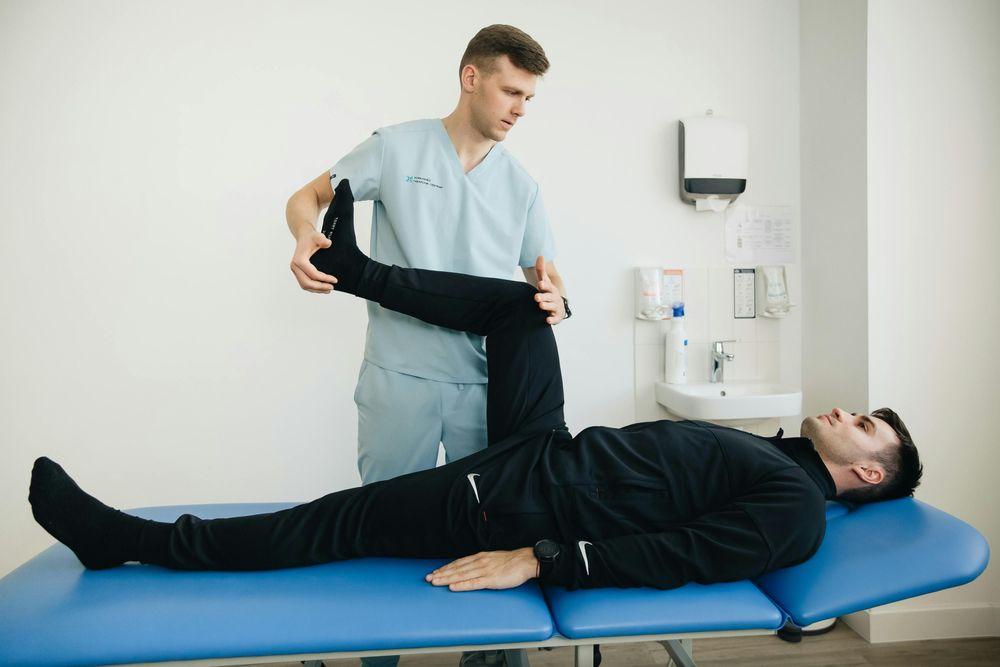


At a Glance
| Topic | Key Facts |
|---|---|
| Primary risk of violations | Joint dislocation, blood clots, implant loosening |
| Surgical approaches | Posterior (stricter rules) vs. Anterior (fewer formal precautions) |
| Most critical early restriction | No hip bending past 90 degrees (posterior approach) |
| Driving restriction | Absolute ban while taking narcotic pain medication |
| PT timeline | Continues for weeks to months — do not stop when pain improves |
| Permanent restrictions | High-impact sports, extreme hip flexion, heavy pivoting movements |
| Recovery milestone | Most temporary restrictions lift between 6 and 12 weeks |
Hip replacement surgery removes years of grinding arthritis pain and gives patients a second chance at mobility. But that same relief — the sudden disappearance of pain that had been constant for months or years — is one of the biggest risks in early recovery. When patients feel better than they have in years within the first two weeks, the temptation to return to normal life is powerful. And that is exactly when the most damaging mistakes happen.
This guide is structured differently from most hip replacement advice online. Because what not to do after hip replacement surgery depends significantly on which type of surgery was performed. Anterior and posterior approaches carry very different restriction sets, and conflating them leads to unnecessary anxiety for some patients and dangerous overconfidence in others.
The Ultimate Goal: Preventing a Dislocation
Every restriction in hip replacement recovery maps to a specific biological risk, and dislocation is the one that drives most of the early rules.
The new titanium ball-and-socket joint itself is exceptionally strong. The problem is the soft tissue surrounding it. Surgery disrupts the muscles, tendons, and joint capsule that normally hold the hip in place. Until that tissue heals and the surrounding muscles regain their strength, the new joint can be levered out of the socket if positioned incorrectly. According to the American Academy of Orthopaedic Surgeons (AAOS), dislocation is most likely within the first few months after surgery, which is exactly why the early restriction windows are so strict.
Beyond dislocation, the other major risks that restrictions protect against include deep vein thrombosis (DVT, or blood clots forming in the leg veins), implant loosening from premature high-impact loading, wound complications from poor positioning, and muscle tearing from overexertion before the tissue has healed.
Understanding the "why" behind each rule makes compliance far easier. These are not arbitrary limitations. They are temporary guardrails around a healing process that, if respected, leads to outcomes most patients describe as life-changing.
Know Your Surgery Type — The Rules Are Not the Same for Everyone
This is the section most hip replacement guides skip entirely, and it matters more than any other single piece of information in this article.
The two most common surgical approaches, posterior and anterior, carry meaningfully different precaution sets. A patient who had an anterior approach following their surgeon's classic posterior precautions may be limiting recovery unnecessarily. A patient who had a posterior approach assuming they have the same freedom as an anterior patient is taking serious risks.
A 2020 systematic review published in JAMA found that posterior approach patients face a higher early dislocation risk compared to anterior approach patients, which underpins why the precaution sets diverge so significantly. Always confirm the surgical approach with the operating surgeon before assuming which rules apply.
Posterior Approach: The Strictest Precautions
In a posterior approach, the surgeon accesses the hip joint from the back, which requires cutting through some of the posterior hip muscles and the joint capsule. Those structures are then repaired at the end of surgery, but they remain vulnerable during the healing period. This is what creates the elevated dislocation risk and necessitates the strict classic hip precautions for the first six to twelve weeks.
The three core restrictions for posterior approach patients are: no bending the hip past 90 degrees, no crossing the legs or ankles, and no internally rotating the operated leg (turning the foot inward toward the other foot). These three movements, in combination or alone, can lever the ball of the new joint right out of the socket.
Anterior Approach: Fewer Restrictions, Different Tradeoffs
The anterior approach accesses the hip from the front of the body, working between the muscles rather than cutting through them. Because the posterior capsule and muscles are left intact, the early dislocation risk via classic posterior movements is significantly lower. Many surgeons who perform anterior approach surgery do not impose the formal 90-degree or leg-crossing restrictions at all.
That said, anterior approach patients are not restriction-free. The main things to avoid after an anterior hip replacement are extreme backward extension of the leg (think deep lunges) and severe outward rotation. Wound healing still applies regardless of approach, meaning no submersion in water, no heavy lifting, and no high-impact activity until the surgeon clears it. If in doubt, confirm with the surgical team in writing which specific precautions apply.
Movement Mistakes to Avoid in the First Six Weeks
The first six weeks are when the tissue around the new joint is doing its most critical healing work, and movement violations during this window carry the highest consequences.
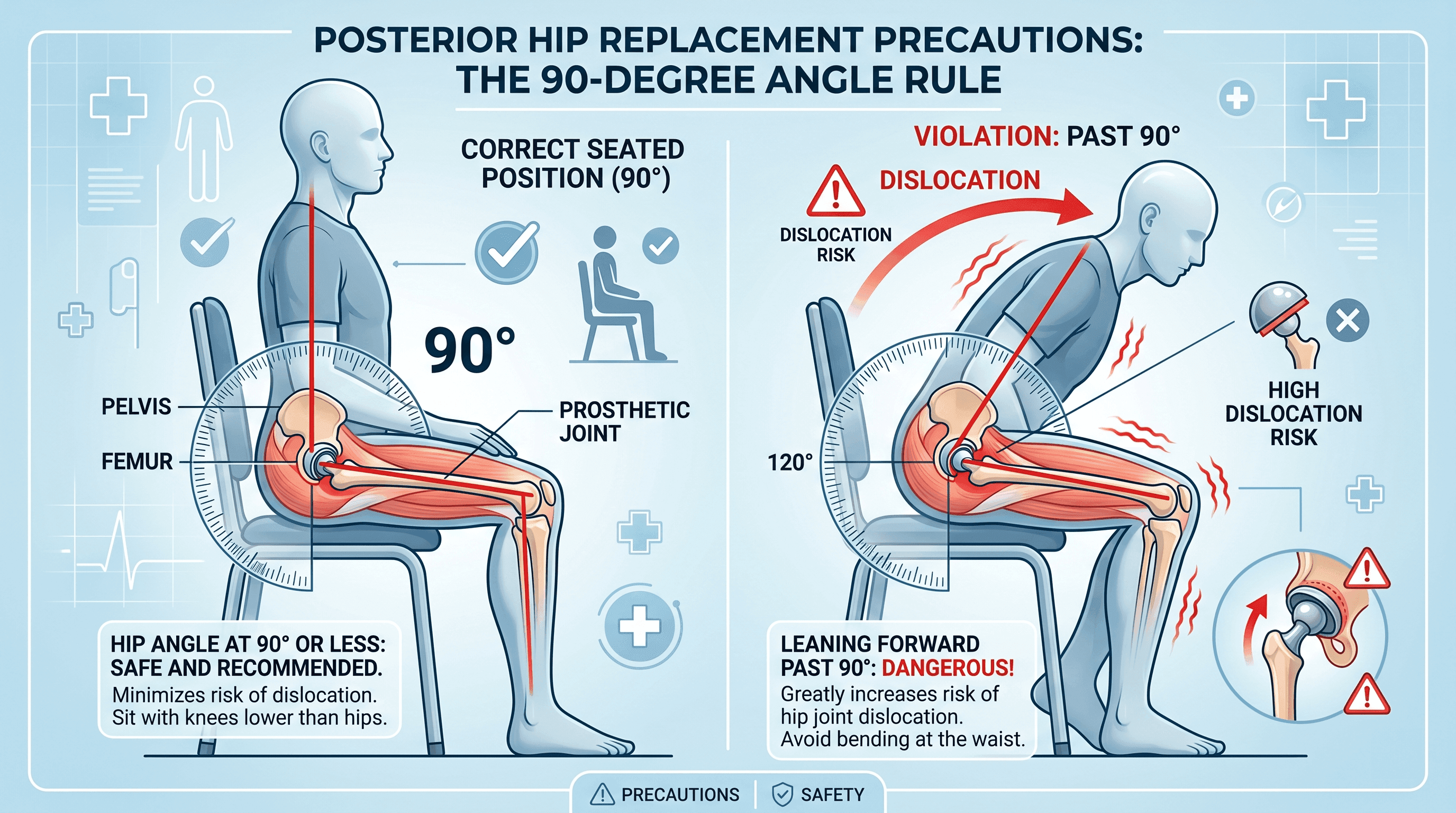
The table below maps the key movement restrictions for posterior approach patients to the clinical reason behind each one.
| Restriction | Why It Matters |
|---|---|
| No bending hip past 90 degrees | Pushes ball toward back of socket where capsule is healing |
| No crossing legs or ankles | Rotates femur inward, creating dislocation force |
| No internal rotation (pigeon-toed position) | Directly levers the posterior capsule open |
| No pivoting or twisting on the operated leg | Combines rotation and shear force on healing tissue |
| No lifting the knee above hip height | Creates the same flexion risk as bending forward |
| No low seats without hip above knee angle | Violates 90-degree rule every time the patient sits |
The 90-Degree Rule in Everyday Life
The 90-degree rule is abstract until it collides with real daily tasks, and that collision happens constantly. Tying shoes requires hip flexion past 90 degrees. Picking something up off the floor does the same. Getting into a low car seat, using a standard toilet, reaching into a bottom cabinet, or leaning forward from a deep couch all produce exactly the movement that risks dislocation in the early weeks.
Practical alternatives make this manageable. A long-handled reacher or grabber picks up items from the floor without bending. An elevated toilet seat raiser, available at most pharmacies, brings the seat height up so the hip stays above the knee. A firm chair with armrests — where the thighs are roughly parallel to the floor or slightly declined — replaces the low sofa. For the car, sliding the seat all the way back and leaning the backrest slightly further than usual while keeping the leg extended outward (not swung inward) is the standard entry method physical therapists teach.
Sleeping Positions to Avoid
Sleep is one of the most commonly overlooked risk windows, because patients are not consciously monitoring position. For posterior approach patients, sleeping on the operated side in the early weeks places direct pressure on the healing posterior capsule and can create a slow rotational stress on the joint. Sleeping on the stomach also places the hip in extension and internal rotation simultaneously, which combines two restricted movements into one sustained position held for hours.
The recommended position for most posterior approach patients is on the back with a pillow or wedge between the knees to keep the legs in a neutral, slightly abducted position. Side sleeping on the non-operated side may be permitted with a firm pillow placed between the knees to prevent the top leg (operated side) from falling forward and crossing the midline. The abduction pillow provided at the hospital serves this exact purpose and should not be abandoned early, regardless of how uncomfortable it feels.
The timeline for when these sleep restrictions lift varies by patient and approach. Most surgeons reassess at the six-week mark. Do not make this call independently.
Activity and Lifestyle Mistakes That Slow Healing (Weeks 1 Through 12)
The movement restrictions are the most acute concern in the first days and weeks, but behavioral mistakes over the first three months have their own category of consequences, often quieter but just as damaging to long-term outcomes.
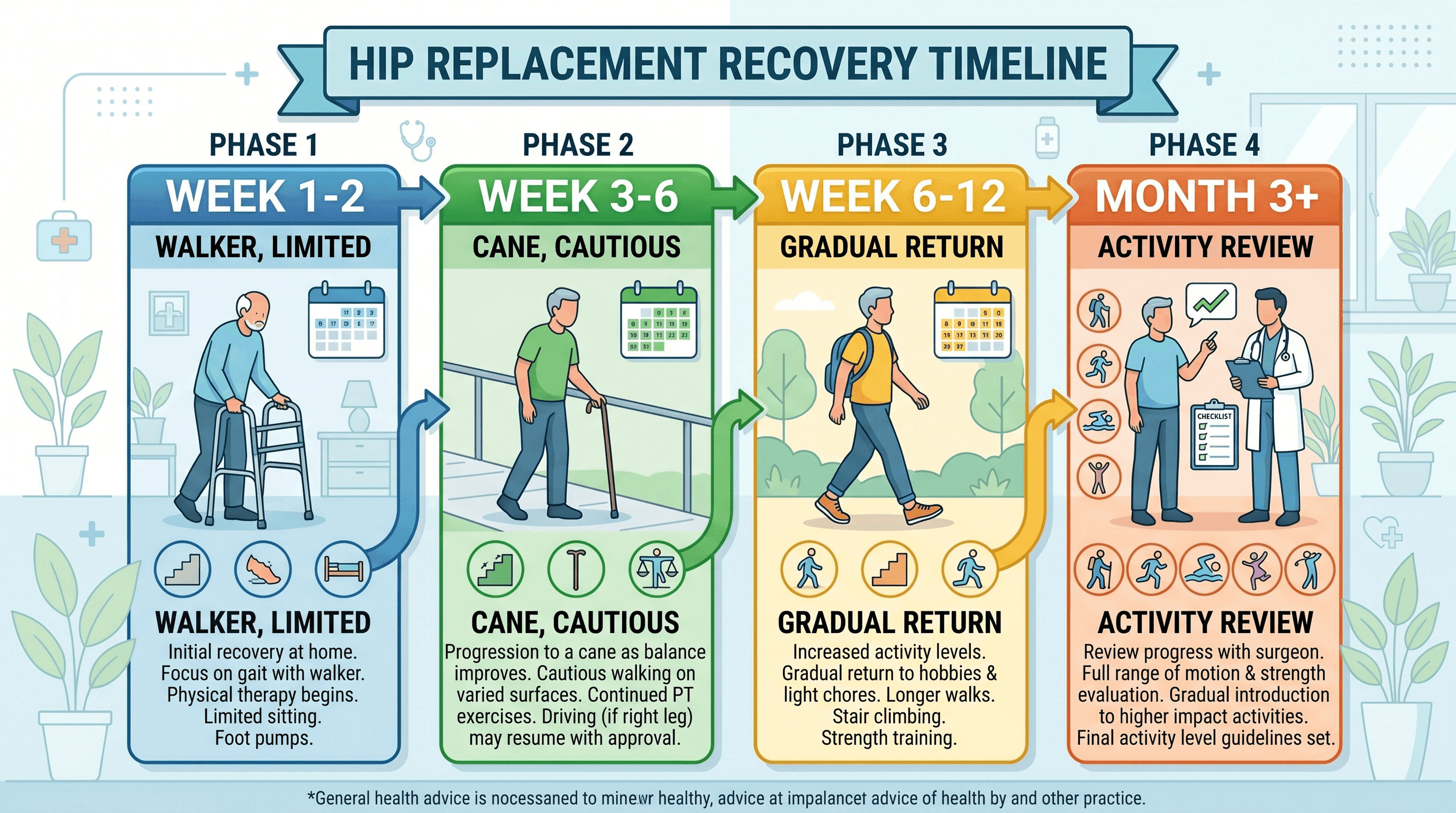
Skip Physical Therapy at Your Own Risk
Physical therapy after hip replacement is not optional pain management. It is the mechanism by which the muscles around the new joint are retrained to stabilize and protect it. The hip abductors, the hip flexors, and the gluteal muscles all play critical roles in long-term implant function. When those muscles atrophy from disuse or fail to rebuild because therapy was stopped early, the implant carries mechanical loads it was not designed to bear alone.
The most common mistake here is stopping therapy the moment the pain resolves. Pain resolution signals that healing is progressing, not that it is complete. A PT program prescribed for twelve weeks should run for twelve weeks. According to Penn Medicine's orthopedic recovery resources, consistent adherence to a physical therapy program is one of the strongest predictors of a successful functional outcome.
Do Not Drive Until the Surgeon Clears It
The driving restriction after hip replacement is often misunderstood as a fixed timeline, such as "no driving for six weeks." In reality, the restriction depends on several variables: which hip was replaced, whether the patient is still taking narcotic pain medication, and whether the patient can demonstrate adequate emergency braking reaction time.
A left hip replacement in a vehicle with an automatic transmission generally has a shorter clearance timeline than a right hip replacement, because the right foot controls the brake pedal. But the absolute rule that overrides all of this is narcotic medication. Anyone taking opioid pain medications is legally and medically prohibited from driving, regardless of how functional the hip feels. The sedative effects of narcotics impair reaction time and judgment in ways the patient may not perceive subjectively.
Even as a passenger on longer trips, sitting in a low car seat for extended periods creates sustained hip flexion and limits venous circulation in the leg, which increases clot risk. On any car trip in the early recovery period, stop every thirty to sixty minutes to stand and walk briefly.
Home Environment Mistakes That Create Fall Risk
The home environment is one of the least-discussed contributors to post-operative complications, and it deserves its own section because it is entirely within the patient's control before surgery begins.
Most falls after hip replacement happen at home, in familiar spaces patients stop treating as hazardous. Loose area rugs and throw rugs are among the most common culprits; they catch walker and cane tips and can slide underfoot. Low coffee tables at shin height create a fall trap when patients misjudge clearance with a walker. Dim hallway or bathroom lighting, especially at night, removes the visual information needed to navigate safely.
The bathroom deserves particular attention. A grab bar next to the toilet is not optional during recovery; a towel rack, which is what many patients reach for instinctively, is not weight-bearing and will pull away from the wall. A handheld shower attachment allows bathing without the need to step over a tub edge or turn the operated leg awkwardly under a fixed showerhead. Non-slip bath mats with suction backings replace the slide risk of standard bath mats.
Pathways through the home should be cleared of power cords, pet toys, and any object that requires stepping around or over. The NHS recovery guidance for hip replacement patients specifically identifies home hazard assessment as a core component of pre-operative planning, not an afterthought.
Eating, Hydration, and Medication Mistakes
Nutrition and medication management after hip replacement are rarely covered in mainstream recovery guides, but several mistakes in this category have clinical consequences.
Constipation from narcotic pain medication is almost universal in the first one to two weeks and is frequently underestimated. Opioids slow gastrointestinal motility, and straining during a bowel movement can elevate blood pressure sharply and cause inadvertent core muscle contraction that places stress on the surgical site. A stool softener prescribed alongside pain medication is the standard approach, and it should be taken proactively rather than waiting for the problem to develop.
Alcohol during early recovery interacts with narcotic pain medications in ways that can be dangerous, amplifying sedation and impairing the balance and coordination patients rely on while using walkers and canes. Most surgeons recommend avoiding alcohol entirely while taking prescription pain medications.
Patients on blood thinners (anticoagulants) such as warfarin should not alter their dose or stop the medication without direct instruction from their care team, even if they feel the bleeding risk has passed. Blood clot prevention is active, not passive, and the medication schedule is calibrated to a specific risk window. Stopping early dramatically increases DVT risk. Hydration also plays a direct role in clot prevention. Staying well-hydrated keeps blood viscosity within a healthy range and supports circulation. The Cleveland Clinic recommends that surgical patients maintain consistent fluid intake throughout recovery unless a physician has imposed fluid restrictions for another medical reason.
Warning Signs to Never Ignore
Recovery from hip replacement is generally a steady progression, and most discomfort in the early weeks is expected and manageable. But certain symptoms indicate something has gone wrong and require immediate medical attention.
A fever above 101 degrees Fahrenheit in the days or weeks following surgery can indicate infection at the surgical site or internally. Surgical site infections are serious complications, and early treatment is far more effective than delayed intervention. Similarly, increasing redness, warmth, or discharge from the wound after the initial post-operative days are over warrants a call to the surgical team.
Calf swelling, pain, or warmth in the lower leg of the operated limb is a potential sign of deep vein thrombosis (DVT). DVT is a serious complication because the clot can travel to the lungs and become a pulmonary embolism (PE). Shortness of breath, chest pain, or an unexplained rapid heart rate after hip replacement should be treated as a medical emergency and trigger a call to emergency services immediately.
Sudden severe pain in the operated hip that differs qualitatively from the expected post-operative soreness can be a sign of dislocation. A dislocated hip replacement often produces a sensation of the joint being "out," visible asymmetry in leg length, and an inability to bear weight. This requires emergency care. If any of these warning signs appear, connect with a primary care provider or seek emergency evaluation. For non-emergency questions about recovery, booking a virtual visit with a licensed provider is a fast and accessible option that does not require leaving home during early recovery.
Long-Term Mistakes: What to Avoid Even After Full Recovery
The restrictions in the first six to twelve weeks are mostly temporary. But hip replacement does carry some permanent lifestyle adjustments, and understanding them early prevents frustration later.
High-impact activities place repetitive stress on the polyethylene (plastic) liner inside the new hip joint. That liner has a finite lifespan, and high-impact sports accelerate its wear. Distance running, singles tennis, basketball, and high-impact aerobics are activities most orthopedic surgeons advise avoiding permanently or at minimum significantly limiting.
The activities that are strongly encouraged and well-tolerated by the new joint include swimming, cycling (stationary or outdoor), walking, golf (with a cart for early return), and low-impact hiking on even terrain. These activities provide cardiovascular and muscular benefits without the repetitive vertical loading that degrades the implant.
The question of whether patients can ever cross their legs again depends on the surgical approach. Posterior approach patients are often advised to maintain the no-crossing-legs restriction long-term or permanently. Anterior approach patients typically face no such permanent restriction. A surgeon can advise on individual cases based on implant type, approach, and long-term imaging.
A Recovery Timeline: When the Restrictions Start to Lift
Recovery from hip replacement is not a single event; it is a staged process. Understanding the general arc of when restrictions typically lift helps patients set realistic expectations without becoming overly cautious beyond the necessary period.
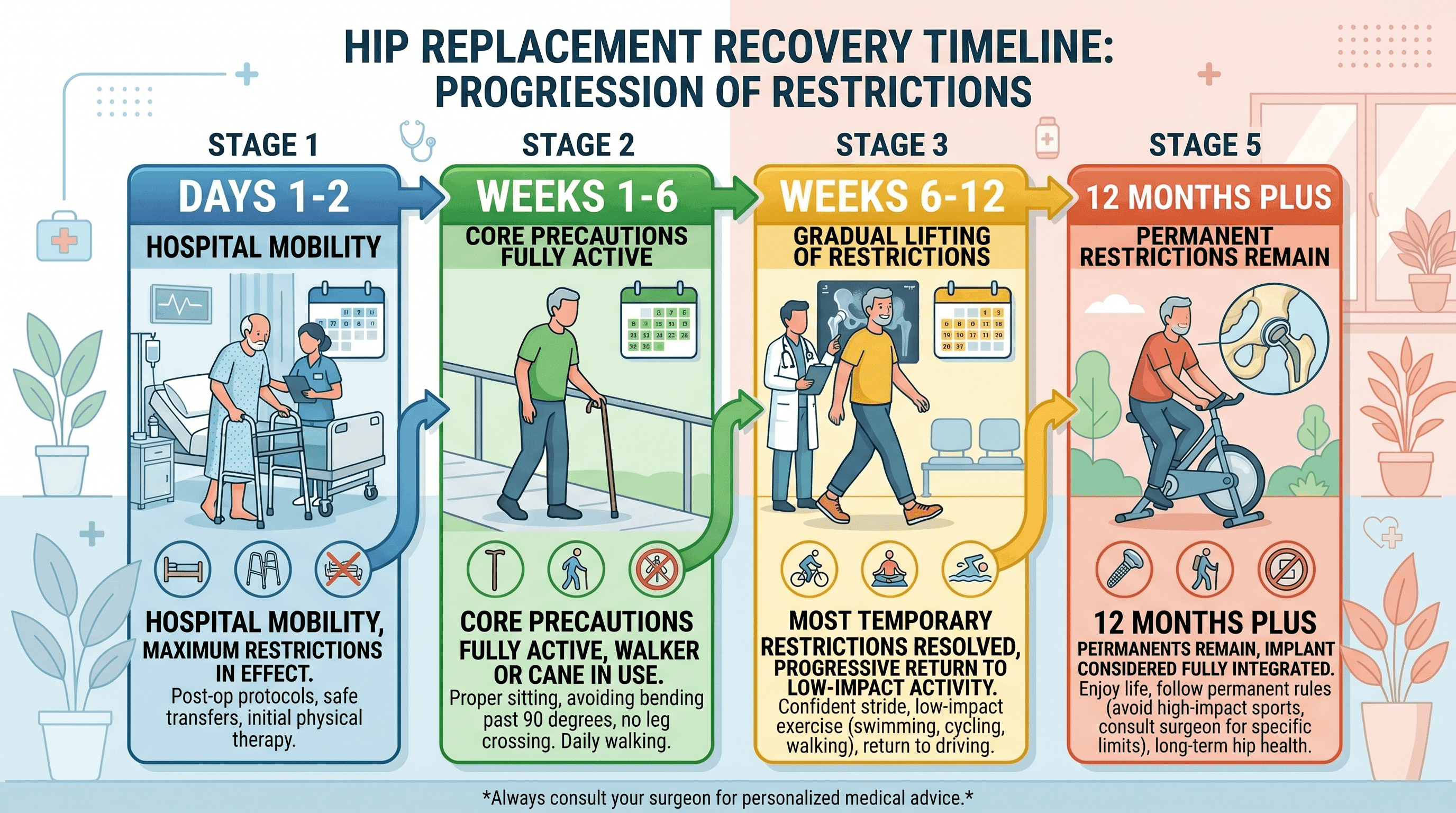
In the first one to two days post-surgery, patients are in the hospital, learning to stand and walk short distances with a physical therapist's direct supervision. All restrictions are fully active. From discharge through week six, the complete precaution set applies. This is the most critical compliance window. At the six-week post-operative appointment, the surgeon typically reviews imaging and functional status and may begin lifting specific restrictions based on individual progress.
Between weeks six and twelve, many patients transition off mobility aids and begin returning to light daily activities. Between months three and six, most temporary restrictions have been fully resolved for patients with uncomplicated recoveries. The twelve-month mark is considered by many orthopedic surgeons as the point at which the new hip is fully integrated and functioning at its intended level. Permanent restrictions remain active regardless of how well the hip feels.
Questions to Ask Your Surgeon Before Leaving the Hospital
The rules that apply to any given patient depend on factors that only the surgical team can confirm. These questions help ensure nothing is assumed:
Which surgical approach was used, and which specific precautions apply to that approach for this patient? At what joint angle does the flexion restriction apply, and are there any additional rotation restrictions specific to the implant used? What is the expected driving clearance timeline based on which hip was replaced and the current pain management plan? What are the specific signs of dislocation, infection, or DVT that should trigger an emergency call versus a next-available appointment? At what point is it safe to transition from a walker to a cane, and what functional test determines readiness? When is the six-week follow-up appointment, and what milestones need to be met before any restrictions can be lifted?
Frequently Asked Questions
What are the three rules after hip replacement surgery?
For posterior approach patients, the three core rules are: do not bend the hip past 90 degrees, do not cross the legs or ankles, and do not internally rotate the operated leg. These three restrictions directly address the most common dislocation mechanisms in the early healing period. Anterior approach patients typically do not follow these same three rules and should confirm their specific precautions with their surgeon.
What can you never do again after a hip replacement?
The permanent restrictions that apply to most hip replacement patients regardless of surgical approach include sustained high-impact sports such as distance running and singles tennis, extreme hip flexion beyond what normal daily activity requires, and heavy repetitive pivoting movements. Activities like swimming, cycling, golf, and walking are generally encouraged long-term. Posterior approach patients may also maintain permanent restrictions on leg crossing.
How many days of bed rest are needed after hip replacement surgery?
Hip replacement recovery is not characterized by extended bed rest. Early mobilization, typically beginning within hours of surgery, is standard practice and is directly associated with better outcomes. According to Penn Medicine's orthopedic recovery program, patients are usually walking short distances the day of or the day after surgery. Extended bed rest without movement increases blood clot risk and delays muscle recovery.
How far should I walk ten days after hip replacement surgery?
Walking distance at ten days varies considerably between patients based on pre-operative fitness, age, surgical approach, and individual recovery trajectory. A surgeon or physical therapist can advise on individual cases and provide specific distance targets as part of a personalized PT plan. The general goal at this stage is gradual and consistent progression rather than a fixed distance number. Most patients are walking short distances around the home or neighborhood with a cane or walker at the ten-day mark.
When can I return to normal activities after hip replacement?
Most temporary restrictions lift between six and twelve weeks post-surgery, pending surgeon review at the follow-up appointment. Low-impact daily activities resume progressively across this window. Full return to low-impact sport and recreational activity typically occurs between three and six months. High-impact restrictions are often permanent.
Is it normal to feel fatigued weeks after hip replacement surgery?
Yes. Surgical recovery places significant physiological demands on the body regardless of how straightforward the procedure was. Fatigue during the first several weeks, and sometimes beyond, is a normal part of healing. Adequate sleep, nutrition, and hydration support recovery, while pushing through fatigue with excessive activity can set it back.
If questions arise about symptoms during recovery and visiting a clinic in person feels difficult, using Momentary's AI health navigator can help explore what symptoms may indicate and clarify what level of care is appropriate next.
References
- American Academy of Orthopaedic Surgeons (AAOS) — Activities after hip replacement: recovery guidelines and activity restrictions.
- Penn Medicine / Bone and Joint Institute — Dos and don'ts after hip replacement surgery; PT adherence and mobility milestones.
- JAMA — Posterior vs. Anterior Approach Dislocation Risk — Systematic review comparing dislocation rates between surgical approaches.
- NHS — Recovering from a Hip Replacement — Home preparation, hazard assessment, and recovery milestones.
- PMC — Hip Replacement Outcomes and Approach Comparison — Peer-reviewed meta-analysis of surgical approach outcomes and precaution evidence.
- NCBI Bookshelf — Total Hip Arthroplasty — Clinical overview of total hip arthroplasty, indications, and post-operative management.
- PMC — Physical Therapy After Total Hip Arthroplasty — Evidence on PT protocols and outcomes following total hip replacement.