


Most people scheduled for meniscus surgery spend a lot of time researching the surgery itself and far less time thinking about the anesthesia. But the type of anesthesia chosen directly shapes how comfortable you are on the day of surgery, how quickly you wake up, and how well your pain is controlled through the night. This guide walks through every option, why each is chosen, and what to expect from the moment the IV goes in to the moment you walk out the door.
At a Glance
| Topic | Key Facts |
|---|---|
| Most common approach | Spinal (regional) anesthesia with IV sedation |
| Fully asleep option | General anesthesia (IV induction + inhaled agents) |
| Nerve block role | Add-on for pain control; not a standalone replacement |
| Local/MAC option | Rare; reserved for short, simple procedures |
| Surgery duration | Partial meniscectomy: approx. 20 to 30 min; repair: 60 to 90 min |
| Most patients go home | Same day (outpatient procedure) |
| Fasting requirement | Typically 6 to 12 hours before surgery |
The Four Types of Anesthesia Used for Meniscus Surgery
Meniscus surgery almost always takes place as a knee arthroscopy, a minimally invasive procedure performed through two or three small incisions. Because the surgery is done through a camera and small tools rather than a large open incision, patients do not always need to be completely unconscious. According to MedlinePlus, four distinct anesthesia approaches may be used for knee arthroscopy: general anesthesia, spinal (regional) anesthesia, a regional nerve block, and local anesthesia.
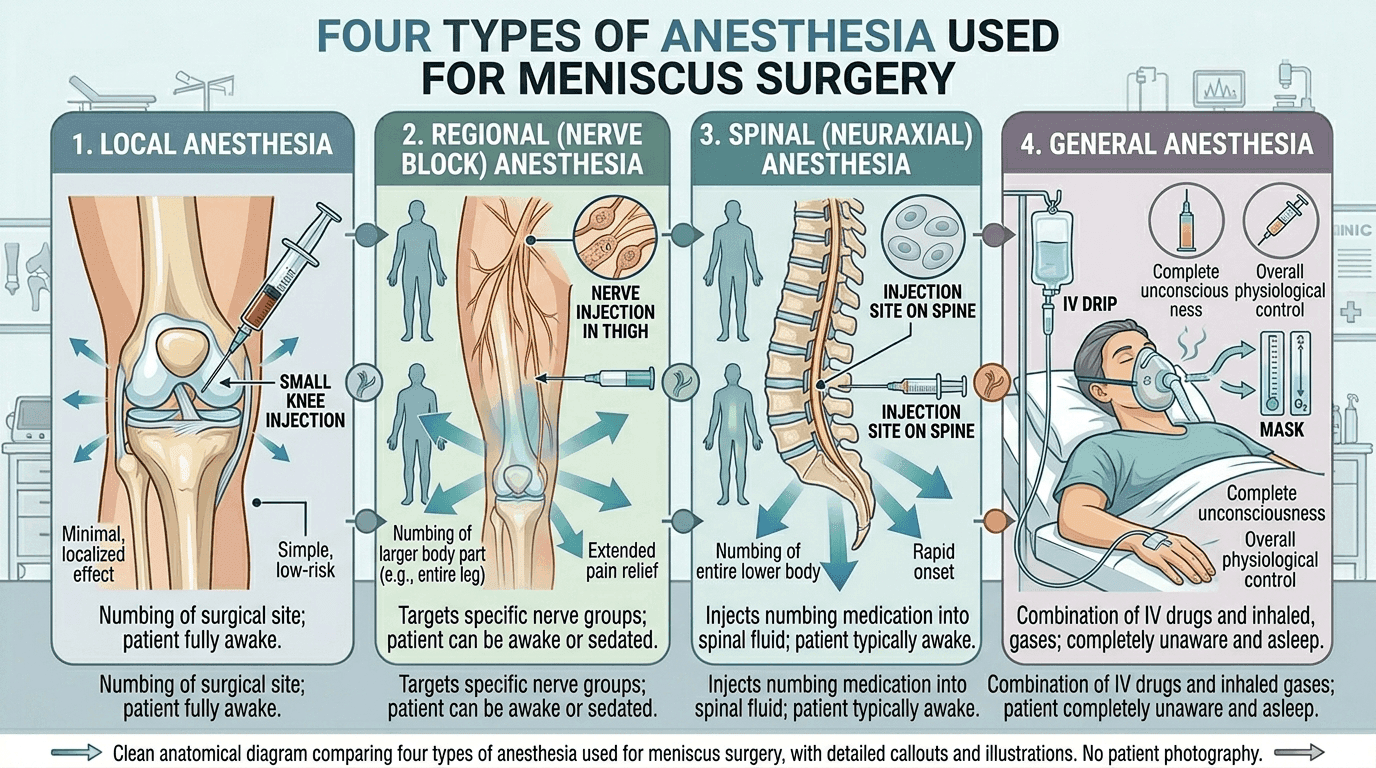
Comparison of Anesthesia Types for Meniscus Surgery
| Type | How It Is Administered | Conscious During Surgery? | Typical Use Case |
|---|---|---|---|
| General | IV induction + inhaled agent; LMA or breathing tube | No — fully asleep | Complex or lengthy procedures; strong patient preference for unconsciousness |
| Spinal (Regional) | Single injection into lumbar spinal fluid | Awake but usually sedated | Most arthroscopic knee procedures; standard approach |
| Nerve Block | Injection near femoral or adductor canal nerve | Varies — usually combined with general or spinal | Add-on for post-op pain control; extended procedures |
| Local/MAC | Intra-articular and portal injections + IV sedation | Lightly awake or deeply drowsy | Short, simple meniscectomy; selected low-risk patients |
General Anesthesia: Fully Asleep
General anesthesia renders a patient completely unconscious using a combination of intravenous medications and inhaled agents. The anesthesiologist induces sleep through an IV, then maintains it with a gas such as sevoflurane delivered through a Laryngeal Mask Airway (LMA) or, less commonly for short arthroscopic cases, an endotracheal tube. Vital signs are continuously monitored throughout.
Surgeons tend to prefer general anesthesia for longer or more complex cases, for patients who have strong anxiety about being aware during the procedure, or when a spinal block would be contraindicated. The trade-off is that post-operative nausea and vomiting (PONV) is more common with general anesthesia than with regional approaches. Patients also typically spend more time in the post-anesthesia care unit (PACU) before meeting discharge criteria, though modern short-acting agents have narrowed this gap considerably.
Spinal (Regional) Anesthesia: Numb from the Waist Down
Spinal anesthesia, the most widely used approach for arthroscopic knee surgery, involves a single injection of local anesthetic into the cerebrospinal fluid at the lumbar level, producing complete numbness from the waist down. Most patients also receive IV sedation alongside the spinal block, so they remain relaxed or lightly asleep and remember little of the procedure.
Cleveland Clinic notes that anesthesiologists give patients receiving regional anesthesia a sedative to keep them comfortable throughout. Because the patient is not fully anesthetized with inhaled agents, recovery from spinal anesthesia tends to involve less grogginess and fewer episodes of nausea compared with general anesthesia. The sensory block typically resolves within one to four hours after surgery, though the exact timeline depends on the local anesthetic used and the dose.
Nerve Blocks: The Increasingly Common Add-On
A nerve block for meniscus surgery is not a replacement for general or spinal anesthesia; it is most commonly administered alongside one of those approaches to extend pain control after the operation ends. The two blocks used most often for knee surgery are the femoral nerve block and the adductor canal block (also called a saphenous nerve block).
As MedlinePlus describes, a regional nerve block for knee arthroscopy involves injecting local anesthetic around the nerve in the groin or thigh, blocking pain signals from the knee while the patient is asleep during the operation. The adductor canal block has gained particular favor because it provides primarily sensory blockade, preserving quadriceps muscle strength and reducing fall risk in the early recovery period, whereas a femoral nerve block produces more motor weakness.
Clinical research has confirmed the analgesic benefit. A randomized, double-blind trial published in the Canadian Journal of Anaesthesia found that patients who received an ultrasound-guided adductor canal block before arthroscopic medial meniscectomy had significantly lower pain scores on arrival to the PACU compared with the sham group, and 24-hour opioid consumption was meaningfully reduced. A systematic review in Anesthesia and Analgesia similarly found that adductor canal block provides improved rest pain relief and reduced opioid consumption for up to 24 hours after ambulatory arthroscopic knee surgery.
Nerve blocks typically last between six and 24 hours depending on the local anesthetic concentration and whether a long-acting agent like ropivacaine or bupivacaine is used. Patients and their families should be counseled before surgery that a "rebound pain window" can occur when the block wears off, and most care teams address this by prescribing scheduled oral anti-inflammatory or analgesic medications to be taken before that window arrives.
Local Anesthesia With Sedation (MAC): Rare, but It Exists
Monitored Anesthesia Care (MAC) combined with intra-articular local anesthetic injection is an option for highly selected patients undergoing short, straightforward procedures such as a simple partial meniscectomy. The surgeon injects lidocaine and/or bupivacaine directly into the knee portals and joint cavity, while an anesthesiologist administers light IV sedation using agents such as midazolam, fentanyl, and propofol.
A prospective clinical trial published in a peer-reviewed journal found that patients in the local anesthesia and sedation group had a shorter time from room entry to surgery start compared with the spinal group (approximately 39 minutes vs. 55 minutes), and recovery room discharge times were also faster. That said, local/MAC anesthesia is not appropriate for complex repairs, longer procedures, patients with significant anxiety, or cases where the surgeon needs broad joint access. The risk of inadequate anesthesia requiring conversion to a deeper approach also exists, and most centers reserve this technique for carefully selected cases only.
How Your Surgical Team Decides Which Anesthesia You Get
No single anesthesia approach is correct for every patient. The decision involves a structured pre-operative assessment that weighs five primary factors: the type of procedure planned, estimated operative time, patient age, overall health status (expressed as an ASA physical status classification), and the combined preference of the surgeon and anesthesiologist. Understanding each factor helps patients ask better questions and feel less like passive recipients of a decision made without them.
Does Repair vs. Meniscectomy Change the Anesthesia Approach?
Yes, and this is one of the most important distinctions. A partial meniscectomy, which involves trimming away damaged cartilage, typically takes 20 to 30 minutes. A meniscus repair, which involves suturing the torn tissue back together, can take 60 to 90 minutes or longer depending on tear complexity and location.
Longer operative times favor spinal or general anesthesia over local/MAC, which may provide insufficient coverage as the procedure extends. Repair patients are also more likely to receive a nerve block add-on, because post-operative pain from a repair tends to be more sustained than from a simple trim. Patients undergoing repair may also experience more swelling and inflammation in the first 24 to 48 hours, making prolonged regional analgesia particularly valuable.
Health and Patient Factors the Anesthesiologist Weighs
Beyond the procedure itself, the anesthesiologist conducts a thorough review of the patient's health history. The ASA physical status classification, a scale from I (healthy) to VI (not expected to survive without surgery), plays a central role in stratifying risk. Older patients and those with higher ASA classifications are more likely to be steered toward regional techniques that avoid the systemic effects of general anesthesia.
Specific conditions the anesthesiologist considers include cardiovascular disease, pulmonary conditions such as asthma or COPD, obstructive sleep apnea, obesity (BMI above 35), active smoking, and bleeding disorders. MedlinePlus advises patients to inform their surgical team about all medications, supplements, and health conditions before surgery, as blood thinners, diabetes medications, and other drugs can affect anesthetic management. Patients with sleep apnea, for example, present airway challenges under general anesthesia that may tip the team toward a spinal approach whenever possible. Patients with a spinal deformity or prior lumbar surgery may be poor candidates for spinal anesthesia, making general anesthesia the safer choice.
Patient anxiety levels matter too. A patient who is deeply anxious about any awareness during the procedure may be best served by general anesthesia, while a patient who prefers to avoid intubation can often have that preference accommodated through regional techniques with sedation.
If you are unsure which option is best for your situation, find a specialist through Momentary Lab who can review your health history alongside your surgical plan and help you navigate pre-operative decisions with confidence.
What to Expect on Surgery Day: From IV to Waking Up
One of the most common questions from patients is whether they will be awake during meniscus surgery. The answer depends on which anesthesia type is used, but for most patients the practical experience is that they remember very little of the procedure regardless of whether they received general or spinal anesthesia, because sedation is typically co-administered.
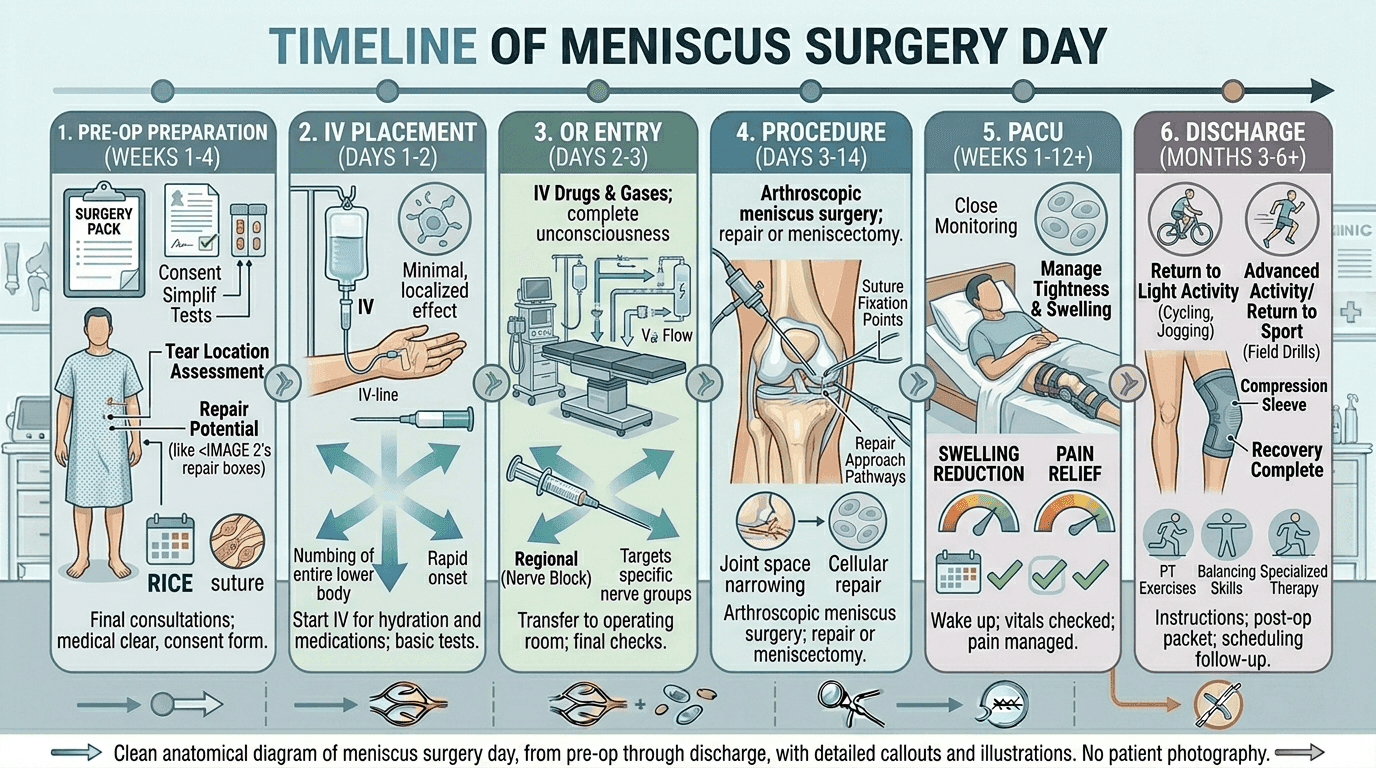
If You Receive General Anesthesia
After IV access is established in the pre-op area, the anesthesiologist administers a short-acting induction agent (commonly propofol) that puts you to sleep within seconds. Once unconscious, an LMA or endotracheal tube is placed to maintain the airway and deliver the inhaled anesthetic. Vital signs are monitored continuously throughout.
When surgery ends, the inhaled agent is discontinued and you begin to emerge from anesthesia in the OR. Most patients are transferred to the PACU still groggy and take 30 to 60 minutes to become oriented. A sore throat may occur if an endotracheal tube was used. Post-operative nausea is more common with general anesthesia than with regional approaches, though anti-nausea medications are routinely administered. Patients receiving general anesthesia may spend slightly more time in the PACU before meeting criteria for discharge home.
If You Receive Spinal or Regional Anesthesia
The spinal injection is performed while you are seated or lying in a curled position on the procedure table. A small needle is inserted into the lower lumbar spine and local anesthetic is injected into the spinal fluid. The process takes only a few minutes, and onset of numbness below the waist typically occurs within five to 15 minutes. IV sedation is then administered so most patients sleep comfortably through the operation.
Waking up from spinal anesthesia with sedation tends to be smoother and quicker than from general anesthesia. Less grogginess and lower PONV rates are consistent clinical observations. After the procedure, your legs will feel heavy, weak, and numb for a period, which can be disconcerting if you are not expecting it. Your care team will monitor sensation and motor function return before discharge. Full return of sensation typically occurs within one to four hours, though this varies by the agent and dose used.
If You Received a Nerve Block
When a nerve block was administered alongside your primary anesthesia, the numbness in your knee or lower leg may persist for six to 24 hours post-operatively. This can feel strange: you may be able to move but notice little to no sensation around the knee joint itself. That is the block working as intended.
The most important thing to know is that the block will wear off, and it can do so relatively quickly once the local anesthetic is metabolized. Your surgical team will typically prescribe scheduled oral pain medications (often a non-steroidal anti-inflammatory agent and/or acetaminophen) to be taken before the block wears off, creating a pain-control bridge so there is no gap in coverage. Patients and caregivers should be briefed on this transition window before going home.
How Anesthesia Type Affects Your Recovery
Anesthesia choice has measurable downstream effects on recovery speed, pain experience, nausea rates, and how soon you meet discharge criteria — all of which are worth understanding before surgery, not after.
A prospective clinical trial comparing local anesthesia with sedation to spinal anesthesia for knee arthroscopy found that patients in the local/sedation group had meaningfully shorter recovery room times, though both groups were managed safely. A propensity-score-matched cohort study published in 2025 found that spinal anesthesia was associated with approximately 23 minutes of longer overall recovery time compared with general anesthesia for knee arthroscopy, though patients receiving spinal were more likely to bypass the first phase of recovery entirely, suggesting a different but comparable discharge pathway.
For patients who receive a nerve block, clinical data consistently show reduced opioid requirements in the first 24 hours post-operatively. The randomized trial published in the Canadian Journal of Anaesthesia found that patients receiving an ultrasound-guided adductor canal block consumed roughly 37% less opioid medication over the first 24 hours compared with patients who received a sham injection. Lower opioid use translates to lower rates of nausea, constipation, and daytime sedation, all of which matter when you are trying to get mobile and begin rehabilitation.
General anesthesia carries the highest rates of PONV among the three approaches, though modern antiemetics and shorter-acting agents have substantially reduced this issue. Patients with a prior history of PONV or motion sickness may want to discuss this explicitly with their anesthesiologist, as prophylactic antiemetics and an anesthetic plan that minimizes volatile agent exposure can help.
Mobility timeline after meniscectomy is generally good regardless of anesthesia type. Many patients can bear weight on the day of surgery. Patients who have undergone a repair may require crutches for several weeks and a more gradual return to activity, as Cleveland Clinic notes that full recovery from repair may take several months compared with a few weeks for a straightforward meniscectomy.
Questions to Ask Your Anesthesiologist Before Meniscus Surgery
Most patients meet their anesthesiologist only briefly before surgery. That conversation is short, but it is the right moment to ask direct questions. These questions will help you walk into that meeting prepared.
Am I a candidate for a nerve block? Not all facilities or anesthesiologists routinely offer nerve blocks for outpatient knee arthroscopy. Asking directly opens the conversation and allows discussion of whether the added analgesia is appropriate for your case.
Will I be fully unconscious or just sedated? Even with spinal anesthesia, many patients assume they will be awake and anxious throughout. Understanding that sedation will keep you comfortable and largely unaware can relieve significant pre-operative anxiety.
Can I request regional anesthesia instead of general? In many cases, yes. Patient preference is a legitimate factor in anesthesia planning, and most anesthesiologists will accommodate this request if your health status permits.
What happens if the nerve block wears off in the middle of the night? Ask about the oral pain medication plan that bridges the gap. You should leave the hospital with a clear written plan for what to take and when.
Will my current medications affect the anesthesia? Blood thinners, antidepressants, blood pressure medications, and supplements such as fish oil and vitamin E all have potential interactions with anesthetic agents. Bring a complete medication list.
How long will my leg feel numb after surgery? The answer depends on the anesthesia type used and helps you plan for mobility assistance and a safe ride home.
What are the specific risks given my health history? This is always a fair question. Anesthesiologists are trained to discuss individual risk based on your ASA classification, comorbidities, and age.
FAQ
Which anesthesia is given for meniscus surgery? Spinal (regional) anesthesia with IV sedation is the most commonly used approach for arthroscopic meniscus surgery. General anesthesia is also widely used, particularly for longer or more complex procedures. Nerve blocks are frequently administered as an add-on to reduce post-operative pain and limit opioid use.
Will I be intubated for arthroscopic knee surgery? Not always. Many patients receiving general anesthesia for knee arthroscopy are managed with a Laryngeal Mask Airway (LMA) rather than a full endotracheal tube, because the procedure is short and does not require deep muscle relaxation. Your anesthesiologist will select the airway device based on your anatomy, health history, and operative needs.
Is it hard to walk after meniscus surgery? Walking ability on surgery day depends on the type of procedure and the anesthesia used. As Cleveland Clinic notes, most patients can bear weight after a partial meniscectomy within hours, while meniscus repair patients may need crutches for several weeks. If a nerve block was placed, leg weakness may temporarily affect balance until the block resolves.
Is meniscus tear surgery major or minor surgery? Arthroscopic meniscus surgery is classified as a minimally invasive outpatient procedure, and most patients go home the same day. However, recovery demands vary widely. A partial meniscectomy generally carries a two to eight week return-to-activity timeline. A meniscus repair is a more technically involved operation requiring three to six months of structured rehabilitation, making it a more significant undertaking despite its small incisions.
How long does anesthesia last after knee surgery? General anesthesia wears off within minutes once the inhaled agent is discontinued, though grogginess may persist for a few hours. Spinal anesthesia typically resolves within one to four hours post-operatively. A nerve block can last six to 24 hours depending on the local anesthetic used.
Can I choose my anesthesia type for meniscus surgery? Patient preference is a legitimate factor in the decision. You can discuss preferences with your anesthesiologist during the pre-operative consultation. Your health history, ASA classification, and the specifics of your procedure may limit certain options. Express your preferences early and ask what is feasible given your clinical profile.
Still navigating your care options or trying to understand what steps come next? The Momentary Lab AI Healthcare Navigator can help you find reliable health information and understand your care pathway before your next appointment.
References
- MedlinePlus, National Library of Medicine — Knee arthroscopy anesthesia types, including spinal, general, local, and regional nerve block options.
- Cleveland Clinic — Meniscus surgery overview, including anesthesia delivery and post-operative recovery timelines.
- AAOS OrthoInfo — Meniscus repair procedure description and patient guidance.
- Hanson NA et al., Canadian Journal of Anaesthesia (2013) — Randomized double-blind trial on ultrasound-guided adductor canal block for arthroscopic medial meniscectomy; opioid consumption and PACU pain score outcomes.
- Karaarslan S et al., PMC (2017) — Randomized trial comparing femoral nerve block and adductor canal block for pain after arthroscopic knee surgery.
- Lin C et al., AANA Journal (2025) — Propensity-score-matched cohort study comparing spinal and general anesthesia recovery times for knee arthroscopy.
- Elkassabany NM et al., Anesthesia and Analgesia (2019) — Systematic review of adductor canal block for ambulatory arthroscopic knee surgery.
- ScienceDirect Clinical Trial (2016) — Prospective comparative trial of local anesthesia with sedation vs. spinal anesthesia for knee arthroscopy; procedure and recovery time data.