


Most articles about driving after knee surgery bury the lead: they treat ACL surgery and meniscus surgery as the same procedure with the same recovery clock. They are not. If you had both done together, which is common, the type of meniscus work performed changes your driving timeline entirely. A partial meniscectomy (trimming) is very different from a meniscus repair (stitching), and confusing the two can mean getting behind the wheel weeks too early, or staying off the road longer than necessary.
This guide separates the two procedures, gives real week-by-week ranges for every surgery combination, and covers the two non-negotiable rules that apply regardless of how good the knee feels.
At a Glance
| Topic | Key Facts |
|---|---|
| ACL-only, right knee | Return to driving: 4 to 6 weeks post-op |
| ACL-only, left knee (automatic) | Return to driving: 2 to 4 weeks post-op |
| ACL + meniscectomy (trimming) | ACL timeline governs; meniscectomy adds minimal restriction |
| ACL + meniscus repair, right knee | 6 to 10 weeks depending on repair type |
| ACL + meniscus repair, left knee | 4 to 6 weeks minimum; longer for root/complex repairs |
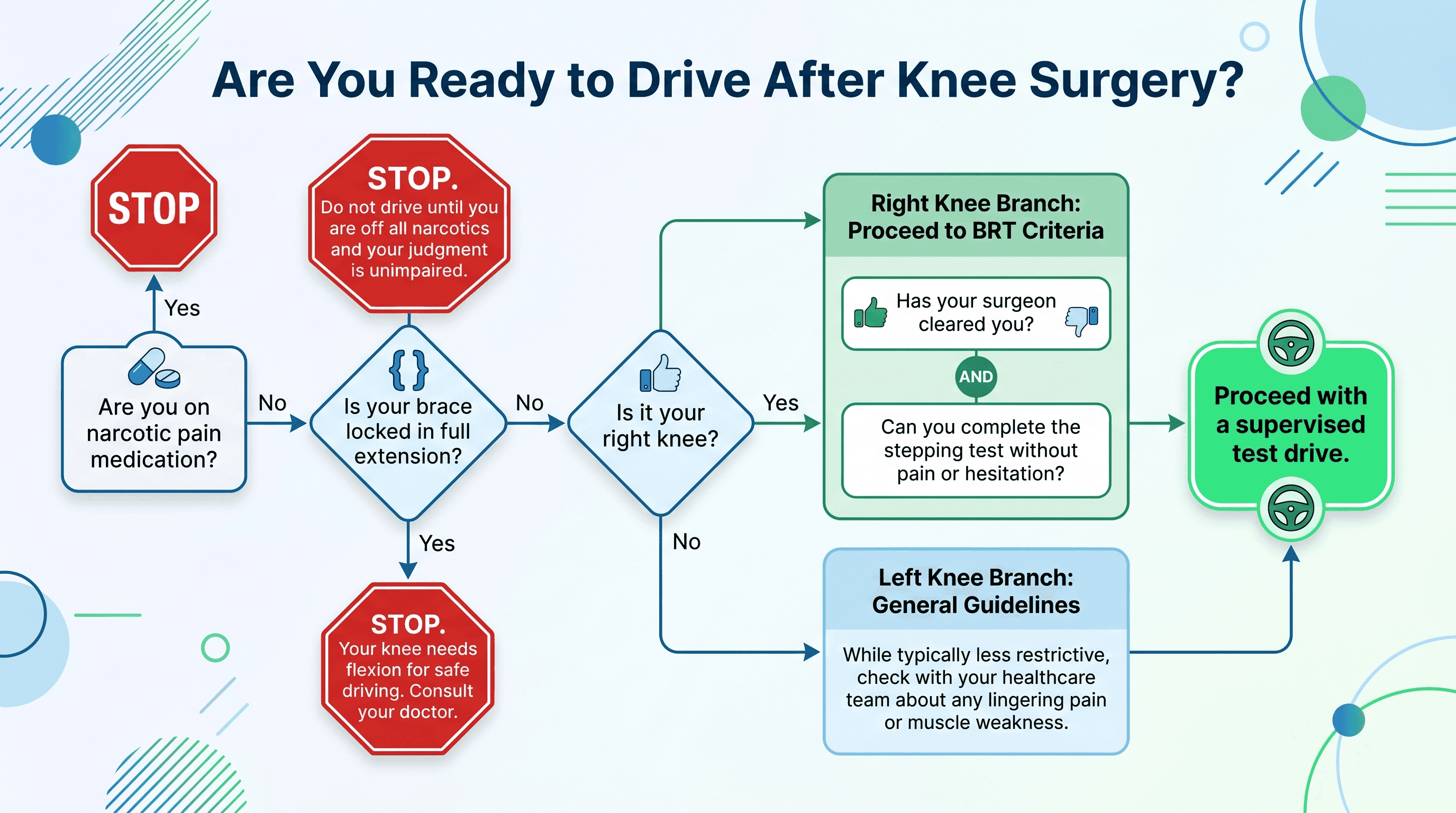
| Universal dealbreakers | Active narcotic use; locked straight-leg brace |
| Key clinical benchmark | Brake reaction time (BRT) must normalize before driving |
The Short Answer: Your Timeline Depends on Which Surgery You Had
The table below is the reference most patients need first. Week ranges assume an automatic transmission and standard postoperative recovery without complications. Manual transmission adds 1 to 2 weeks across all scenarios.
| Surgery Type | Right Knee | Left Knee (Automatic) |
|---|---|---|
| ACL reconstruction only | 4 to 6 weeks | 2 to 4 weeks |
| ACL + partial meniscectomy | 4 to 6 weeks | 2 to 4 weeks |
| ACL + meniscus repair (non-displaced/stable) | 6 to 8 weeks | 4 to 6 weeks |
| ACL + meniscus repair (root or complex) | 8 to 12 weeks | 6 to 10 weeks |
ACL Reconstruction Alone
For right knee ACL reconstruction, the clinical consensus points to 4 to 6 weeks before brake reaction time normalizes. A PMC systematic review on return to driving after ACLR found that patients with right-sided surgery demonstrated significantly slower brake response times until the sixth postoperative week. For left-knee patients driving an automatic, the same body of evidence showed recovery to normal braking parameters within 2 weeks, because the left leg is not responsible for emergency braking in an automatic vehicle.
This is the baseline. Every combined-surgery scenario builds on or extends it.
ACL Reconstruction Plus Meniscectomy (Trimming)
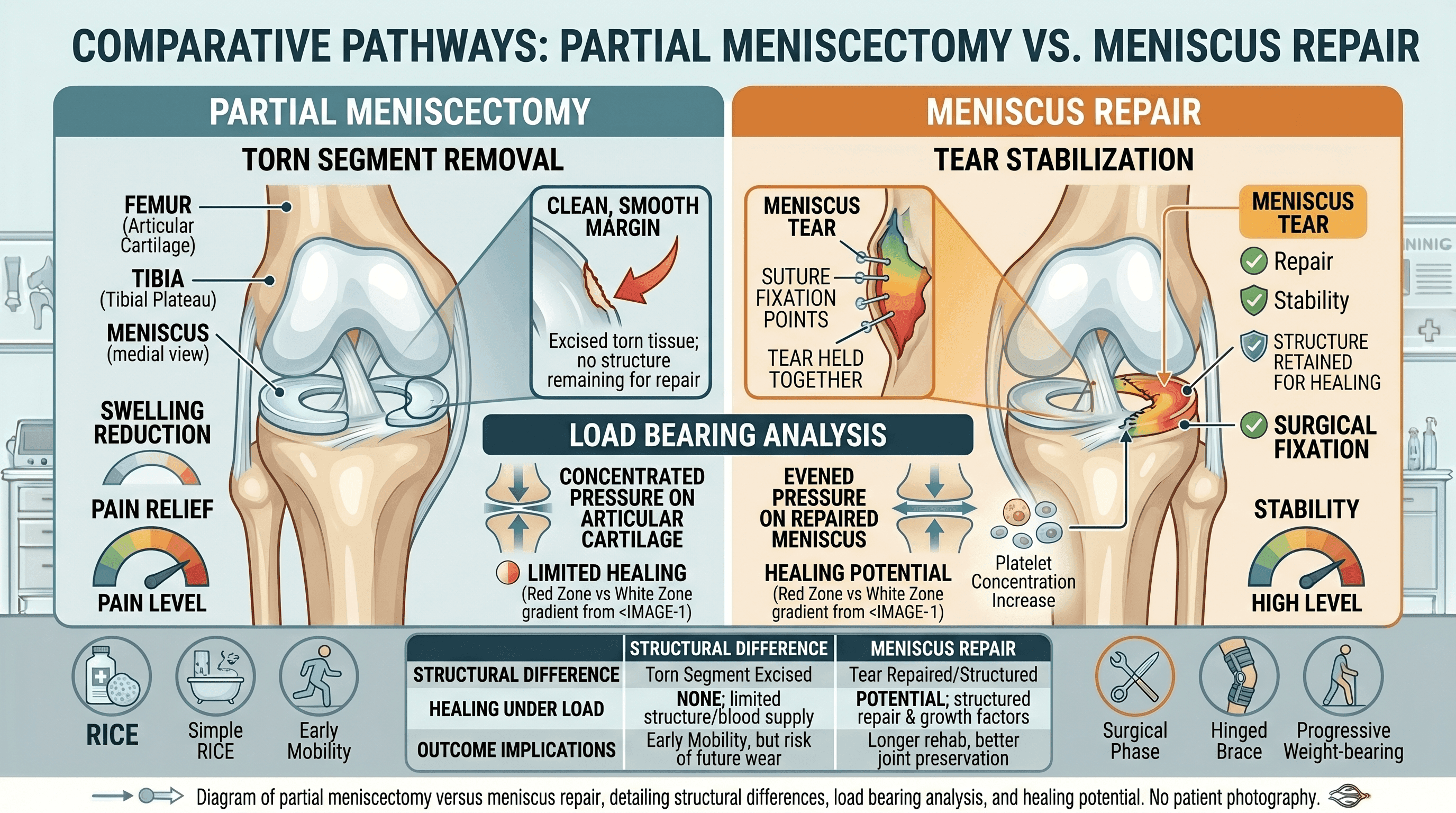
A partial meniscectomy removes the damaged portion of the meniscus rather than stitching it. Because no healing tissue is preserved, there is no non-weight-bearing requirement. Patients who undergo meniscectomy alone are typically off crutches within days and can drive as soon as they are off narcotic pain medication, often within 1 to 3 days. When meniscectomy is combined with ACL reconstruction, the ACL timeline is the limiting factor. The trimming does not meaningfully extend the return-to-driving window.
ACL Reconstruction Plus Meniscus Repair
This is the combination that most online articles get wrong. A meniscus repair preserves the torn tissue and sutures it back together, but biological healing requires protecting that repair from load for several weeks. Research published in the Journal of Orthopaedic Surgery and Research shows that for complex or unstable tears, including root and radial tears, non-weight-bearing for up to six weeks is warranted. Stable vertical or ramp tears may permit protected weight-bearing sooner, but that distinction is made by the surgeon based on intraoperative findings.
When the repair requires non-weight-bearing, a locked straight-leg brace is standard. A patient wearing a locked brace literally cannot flex the knee to engage a brake pedal safely. For right-knee root repairs, combined timelines of 8 to 12 weeks are common. For non-displaced repairs on the right knee, 6 to 8 weeks is a reasonable range. Left-knee repairs follow shorter timelines but still exceed the standard ACL-only window.
The Two Universal Dealbreakers
Before the specific timelines matter, two rules apply to every patient regardless of which leg, which surgery, or how good they feel.
Narcotic Pain Medication Is a Hard Stop
Opioid medications, including hydrocodone, oxycodone, and tramadol, impair reaction time, judgment, and coordination even when taken exactly as prescribed. The National Highway Traffic Safety Administration is explicit that prescription opioids are associated with increased crash risk and that violating state laws against driving while impaired by any substance can result in arrest. "Taken as prescribed" is not a legal defense if impairment is present.
In most US states, driving with opioids in your system that affect your ability to operate a vehicle is classified as driving under the influence of drugs (DUID), regardless of whether the prescription is legitimate. A population-based case-control study published in BMC Public Health found that prescription opioid use was independently associated with a significantly increased risk of fatal crash involvement. The rule is simple: zero narcotics, then consider driving. Not "feeling okay" on narcotics, and not "just the morning dose."
The median time to opioid discontinuation after ACL reconstruction is approximately 9 days, but individual variation is wide. Some patients are off narcotics in 3 to 4 days; others take longer, particularly after combined procedures with more tissue disruption.
A Locked Straight-Leg Brace Prohibits Driving
If the post-operative protocol requires a brace locked in full extension, the patient cannot generate the knee flexion needed to press a brake pedal with control. This is not a comfort issue. It is a mechanical issue. Patients recovering from meniscus repair, particularly complex repairs, are commonly placed in a locked brace for 4 to 6 weeks. No amount of subjective recovery matters until that brace is unlocked for weight-bearing activity and the surgeon confirms the knee can move freely enough for safe pedal operation.
The Right Knee Timeline: The Braking Leg
The right leg is the active braking leg in any vehicle, manual or automatic. Emergency braking demands a fast-twitch neuromuscular response: the foot must move from the accelerator to the brake pedal and apply full pressure in a fraction of a second. After right-knee ACL surgery, that neuromuscular loop is disrupted by pain, swelling, proprioceptive changes, and graft-site tenderness.
Why Brake Reaction Time Is the Clinical Benchmark
Brake reaction time (BRT) is the measurable interval between a driver perceiving a hazard and the moment of full brake pedal depression. A vehicle traveling at 60 mph covers more than 80 feet in under one second. A delay of even 900 milliseconds, which is clinically meaningful in post-surgical patients at 2 weeks, translates directly into stopping distance.
A prospective case series study published via PubMed tested 27 patients after right-knee ACL reconstruction across three graft types at 7 to 10 days, 3 weeks, and 6 weeks. All patients showed statistically significant BRT impairment compared to healthy controls at the earliest time point, regardless of graft type. By 3 weeks, tibialis anterior allograft patients had normalized. By 6 weeks, hamstring autograft patients had normalized. Patellar tendon autograft patients continued to show impairment in brake travel time at 6 weeks.
This study is the reason graft type matters for your driving timeline, a detail most online guides skip entirely.
Graft Type and What It Means for Your Timeline
If you received a tibialis anterior allograft (donor tissue), BRT recovery is fastest, typically by 3 weeks post-op for right-knee patients. Hamstring autograft patients generally normalize by 6 weeks. Patients who received a bone-patellar tendon-bone (BPTB) autograft face the longest recovery because harvest-site pain at the front of the knee directly affects the ability to press a pedal firmly and comfortably. Even when the knee is technically capable, anterior pain with pedal depression can be limiting.
If you are unsure which graft type was used, that information will be in your surgical report. Ask the front desk for a copy if one was not given to you at discharge.
Combined Right Knee Surgery: The Extended Clock
For right-knee ACL plus meniscus repair, the timelines in the reference table at the top of this article apply. A systematic review on rehabilitation after posterolateral meniscal root repair with ACL reconstruction found that most authors recommended non-weight-bearing or toe-touch loading for 4 to 6 weeks, with gradual progression to full loading between 8 and 12 weeks. That 8 to 12-week window for complex combined repairs is not a conservative estimate. It reflects what the tissue biology requires.
The Left Knee Timeline: The Faster Path Back
For patients driving an automatic transmission, the left leg is essentially a passenger during normal driving. It does not operate the accelerator or the brake, which means the neuromuscular performance demands are dramatically lower. The same body of research that showed right-knee ACLR patients needing 6 weeks found that left-knee patients returned to normal driving reaction times within approximately 2 weeks.
That said, 2 weeks for left-knee ACL-only surgery in an automatic vehicle represents the floor, not the guarantee. Both universal dealbreakers from Section 2 still apply, the brace must be off or unlocked, and narcotics must be discontinued. Surgeons also need to provide explicit clearance.
For left-knee ACL combined with meniscus repair, the weight-bearing restrictions still govern the timeline. A non-weight-bearing left knee in a locked brace cannot safely modulate the brake or clutch under urgent conditions, even if the leg is not the primary braking leg. The minimum for combined left-knee surgery with a stable repair is 4 to 6 weeks; complex or root repairs extend that to 6 to 10 weeks.
Manual Transmission: An Extended Timeline for Every Patient
A manual (stick shift) transmission requires coordinated bilateral leg function: the right foot manages the accelerator and brake while the left foot operates the clutch. For left-knee patients, this erases the usual timing advantage entirely. Operating a heavy clutch pedal with a recovering left knee, particularly one in a locked brace or subject to non-weight-bearing restrictions, is not safe and may not be mechanically possible in the early weeks.
For right-knee patients, manual transmission adds 1 to 2 weeks beyond the automatic equivalent because the left leg is load-sharing in a way it does not in automatic vehicles, and the coordinated movement pattern demands full bilateral lower extremity function.
The practical guidance: if you drive a manual and are recovering from combined ACL and meniscus surgery, add at least 2 weeks to whatever timeline is shown in the reference table.
The Brake Reaction Test: How Physical Therapists Clear You
Physical therapists and orthopedic surgeons use a set of functional criteria to determine readiness for driving. Driving simulators are not available in most clinical settings, so proxies are used instead. The two most common are the stepping test and the standing test.
The stepping test measures how quickly a patient can transfer weight from one foot to the other in a seated position, simulating the accelerator-to-brake movement. The standing test evaluates single-leg stability and load tolerance. Research cited in a PubMed study on driving reaction time before and after ACL reconstruction found a strong correlation between performance on these two tests and actual brake reaction time, making them valid clinical proxies when a simulator is unavailable.
Additional criteria your care team may assess before driving clearance include full passive knee extension, ability to fully flex to 90 degrees, adequate quadriceps activation (typically greater than 70% of the unaffected side), and no significant joint effusion at rest. Range of motion and strength are not the only markers. Speed of muscle activation matters just as much for safe braking.
A Practical Return-to-Driving Plan for Your First Week Back
Getting surgical clearance is not the same as being ready for the highway. A supervised, graduated return is safer and, importantly, reduces the anxiety most post-surgical patients feel about driving again.
Start with a parking lot session before returning to public roads. Park in an empty lot, adjust the seat so the operative knee has comfortable range of motion in the pedal position, and practice 10 to 15 emergency stops at low speed. The goal is to confirm, physically, that the brake response is fast and pain-free under controlled conditions.
For the first 2 weeks back, avoid rush-hour traffic, construction zones, and unfamiliar roads. Keep trips under 30 minutes initially, as fatigue in a recovering limb can build during sustained pedal use. Freeway driving, which demands faster decisions and greater braking force, should come after confidence on side streets.
If the knee swells noticeably after a driving session, that is the body signaling that the activity level exceeded current tissue tolerance. Cut back trip length and check in with the care team.
One common question: can you drive with a knee brace? If the brace is unlocked, hinged, and allows full pedal range of motion, most surgeons permit it. A locked brace prohibits driving. Confirm with your insurer whether brace use affects coverage terms, as policies vary.
When you are ready to consult a specialist or want a second opinion on your recovery milestones, find a qualified orthopedic surgeon near you through Momentary Lab to get personalized clearance guidance.
Red Flags: When to Call Before Your Next Appointment
Most patients progress through the timelines above without complications. But a subset of patients will fall off the expected curve, and those patients should not wait for their next scheduled visit to raise the issue.
Call your surgeon's office if any of the following occur: persistent resting swelling beyond week 4 of recovery, inability to achieve the weight-bearing milestones your protocol specifies by the expected date, sharp pain when bending the knee to 90 degrees, any new fever or changes at the wound site, or a sudden loss of range of motion after a period of steady improvement. These findings can indicate poor graft integration, a repair failure, or infection, all of which require clinical evaluation before any return-to-activity decisions are made.
Frequently Asked Questions
How long do I have to wait to drive after ACL and meniscus surgery?
It depends on which type of meniscus surgery was performed and which leg was operated on. ACL reconstruction combined with partial meniscectomy follows the ACL timeline: 4 to 6 weeks for the right leg, 2 to 4 weeks for the left leg in an automatic vehicle. ACL combined with meniscus repair takes longer because the repair requires non-weight-bearing protection. Right-knee combined cases typically require 6 to 10 weeks; complex root repairs may extend to 12 weeks.
What are the restrictions after ACL and meniscus surgery?
Weight-bearing restrictions depend on the specific procedures. Meniscectomy allows immediate weight-bearing; meniscus repair typically requires 4 to 6 weeks of non-weight-bearing or protected weight-bearing, depending on tear type. A locked brace is often required during the non-weight-bearing phase. Driving is restricted until the brace is unlocked, narcotic medications are fully discontinued, and the surgeon provides explicit clearance.
Can I ride a bike after ACL surgery?
Stationary cycling is often introduced earlier than other exercises, sometimes within the first 2 to 4 weeks, as it promotes range of motion with low joint load. Outdoor cycling on public roads involves balance demands, unpredictable terrain, and emergency braking requirements that make it a later return-to-activity milestone. Check with the surgical team before any outdoor bike use, particularly if a meniscus repair was performed.
When can I fully bend my knee after ACL and meniscus surgery?
For ACL alone, full flexion is typically a goal achieved between weeks 8 and 12 of rehabilitation. When a meniscus repair is added, particularly a root or complex repair, flexion is deliberately restricted to 0 to 90 degrees for the first 4 to 6 weeks to protect the repair from excessive compressive and shear loads. Full flexion may not be achieved until 3 to 4 months post-op in complex combined cases.
Can I drive with a knee brace after ACL surgery?
A hinged knee brace that is unlocked and allows the full range of motion required for pedal operation is generally permitted once the surgeon clears driving. A locked straight-leg brace prohibits safe driving. Confirm with both the surgeon and your auto insurer before driving with any brace in place.
How does graft type affect when I can drive?
Graft type affects the BRT recovery curve specifically for right-knee patients. Tibialis anterior allograft recipients tend to normalize BRT by 3 weeks. Hamstring autograft patients typically reach normal by 6 weeks. Patellar tendon autograft patients may show continued impairment in brake travel time at 6 weeks due to anterior knee donor-site pain. Check your surgical report for your specific graft type and factor this into your timeline conversation with the care team.
For broader guidance on managing your recovery options and navigating the right specialist or care pathway, the Momentary Lab AI Healthcare Navigator can help you find relevant health information and connect with the right resources.
References
- Salem HS, Park DH, Friedman JL, et al. Return to Driving After Anterior Cruciate Ligament Reconstruction: A Systematic Review. PMC. — Systematic review covering brake reaction time normalization timelines after ACLR, including right vs left knee and graft-type comparisons.
- Gotlin RS, et al. Measurement of brake response time after right anterior cruciate ligament reconstruction. PubMed. — Prospective study demonstrating BRT equivalence to AAA norms at 4 to 6 weeks post-ACLR.
- Palma S, et al. Patients Generally May Return to Driving 4 Weeks After Hip Arthroscopy and 6 Weeks After Knee Arthroscopy. PMC. — Meta-analysis of BRT following knee arthroscopic procedures including ACLR; supports 6-week right-knee guideline.
- Landes P, et al. Driving Reaction Time After Right Knee Anterior Cruciate Ligament Reconstruction. PMC. — Prospective case series comparing BRT across BPTB, hamstring, and allograft graft types at multiple postoperative time points.
- Driving reaction time before and after anterior cruciate ligament reconstruction. PubMed. — Study documenting 6-week normalization for right ACL, 2-week normalization for left ACL, with stepping and standing test correlations.
- Rehabilitation and Return to Sports After Isolated Meniscal Repairs. PMC. — Evidence-based review of weight-bearing protocols differentiated by tear type; supports 6-week non-weight-bearing for complex/root repairs.
- Postoperative Weight-Bearing, Range-of-Motion Protocols After Concomitant Posterolateral Meniscal Root Repair with ACL Reconstruction. PMC. — Systematic review supporting 4 to 6 weeks non-weight-bearing and 8 to 12-week progression for combined PLMR repair with ACLR.
- NHTSA: Prescription and Over-the-Counter Medicines and Driving. — Federal guidance on prescription opioid impairment and DUID risk for drivers.
- Prescription Opioids, Alcohol and Fatal Motor Vehicle Crashes. BMC Public Health. — Population-based case-control study demonstrating significantly increased fatal crash risk with prescription opioid use.## Meta Title Driving After ACL + Meniscus Surgery: When Is It Safe?