

| Topic | Key Facts |
|---|---|
| First bath (tub submersion) | No earlier than 4 to 6 weeks post-op |
| First shower | Typically 2 to 5 days post-op, once surgeon confirms |
| Sponge bath phase | Days 1 to 5; keep incision completely dry |
| Hot tub or pool | Minimum 6 to 8 weeks, often longer |
| Primary infection risk | Stagnant water carries bacteria that can seed a healing spinal wound |
| Incision "ready for soaking" signs | No scabbing, no open edges, no drainage, steri-strips detached |
The Strict 4 to 6-Week Rule
Submerging a spinal fusion incision in a bathtub, hot tub, or swimming pool is off-limits until a surgeon explicitly says otherwise.
That timeline is not arbitrary. The 4 to 6-week window reflects how long it takes for the outer skin layers and deeper soft tissue to close securely enough that standing water cannot penetrate the wound bed. Most surgeons set this boundary at the first post-operative follow-up visit, and clearance depends entirely on how the incision looks that day, not on how many days have passed on a calendar.
Some patients receive clearance at four weeks. Others wait eight. The difference usually comes down to healing speed, surgery complexity, and individual risk factors covered later in this guide.
What does not change across procedures is the underlying reason for the restriction. Sitting in a bath means resting a fresh surgical wound in water that can carry bacteria into tissue that has almost no immune defense yet. The result, in worst-case scenarios, is a deep spinal infection that requires repeat surgery to treat.
Until the surgeon gives a clear, verbal or written green light at a follow-up exam, the bathtub stays off the table.
Showers vs. Baths: Why the Difference Matters
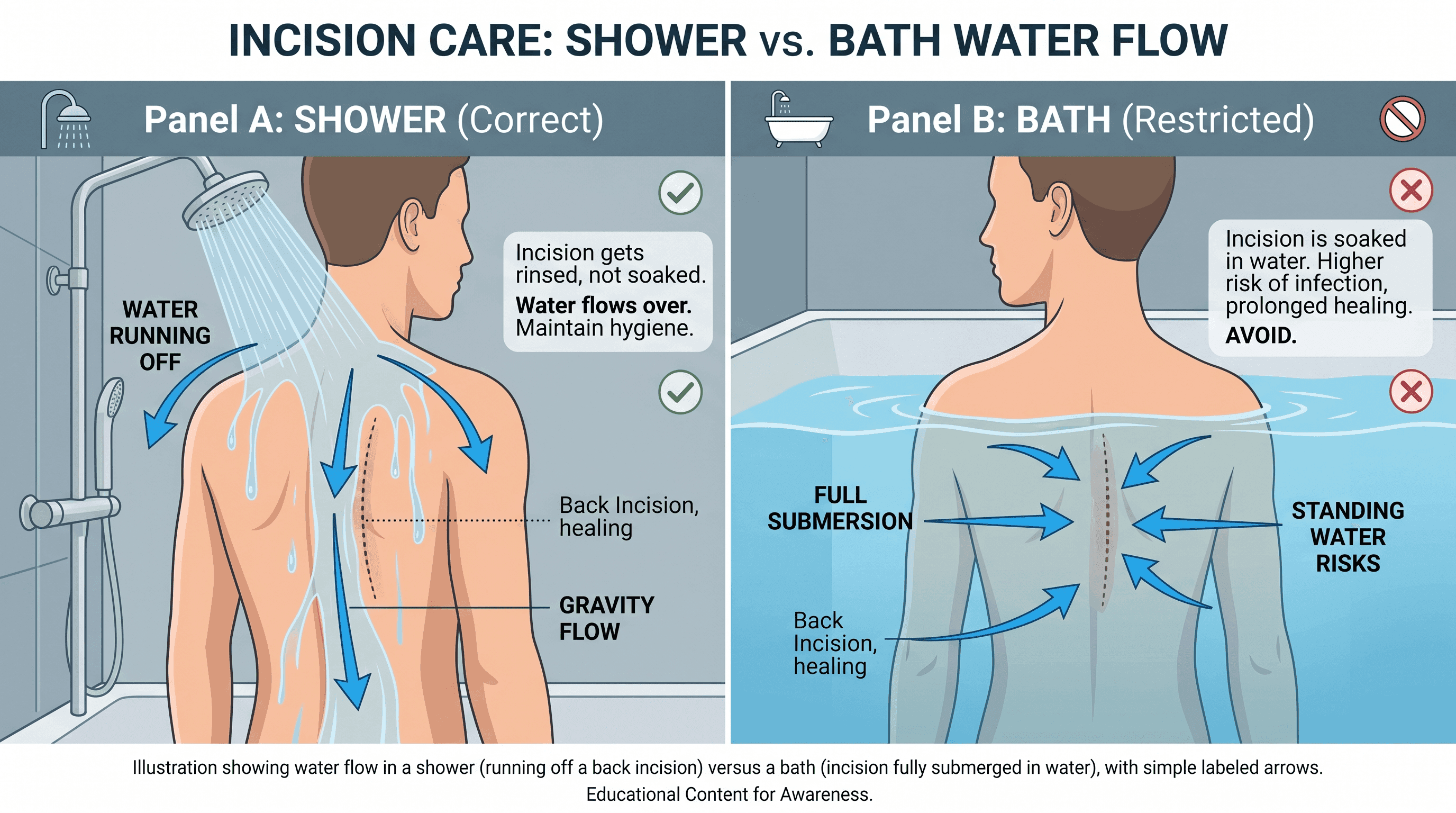
A shower and a bath feel similar in daily life, but for a healing spinal incision they are entirely different exposures.
When standing in a shower, water runs over the skin and falls away immediately. There is no pooling, no prolonged skin contact, and no opportunity for bacteria to work their way into a wound edge. That is why most surgeons clear patients to shower within two to five days of surgery, once the surgical dressing has been assessed and basic stability is confirmed.
A bath is the opposite situation. The incision site sits submerged in stagnant water for minutes at a time. Tap water is not sterile. Bathtub surfaces harbor bacteria even after cleaning. The combination of warmth, moisture, and prolonged contact creates ideal conditions for microbial entry into a wound that still has microscopic openings, even if it looks closed on the surface.
This distinction matters because patients often assume that if showering is safe, bathing must be safe too. That assumption leads to premature soaking, which is one of the more common causes of early post-operative surgical site infections in spine patients.
The Devastating Risk of Surgical Site Infections
Surgical site infections (SSIs) following spinal fusion are a serious complication, and water exposure before the incision is fully sealed is a direct pathway to one.
According to a study published in PMC, SSI rates after standard spinal fusion procedures range from approximately 2 to 5 percent, rising to as high as 8.5 percent in cases involving instrumentation such as pedicle screws and rods. The presence of hardware raises the stakes considerably, because bacteria that reach metal implants form biofilms that are extremely difficult to eradicate with antibiotics alone.
Two types of SSI matter here. Superficial infections involve only the skin and the tissue just beneath it. They typically appear between days five and thirty after surgery and show up as redness, warmth, and sometimes drainage from the incision. These are treatable with oral antibiotics in most cases.
Deep infections are far more serious. They can develop weeks or even months after the procedure, particularly when implants are present. Research published in PMC notes that deep SSIs following instrumented spinal procedures often require surgical debridement and, in some cases, implant removal, which can compromise the fusion outcome entirely.
Bathwater is not the only source of infection risk, but it is one of the most preventable. Keeping the incision dry during the healing window eliminates this particular pathway entirely.
"The incidence of surgical site infection after spinal surgery ranges from 0.7% to 16% depending on patient risk factors and procedural complexity." — PMC, Surgical Site Infections in Spinal Surgery
The Sponge Bath Phase (Days 1 to 5)
For the first several days after spinal fusion, the goal is to stay clean without letting water anywhere near the incision dressing.
Most hospitals send patients home with a waterproof or occlusive dressing in place. That dressing should not be removed, soaked, or peeled back unless a nurse or surgeon instructs otherwise. During this phase, a careful sponge bath at the sink is the correct approach.
The technique is straightforward. Use a soft washcloth or sponge, warm (not hot) water, and a gentle soap. Clean the body section by section, working around the back entirely. The face, underarms, arms, chest, and legs can all be washed without any risk to the incision. The back, and any area within several inches of the wound, stays dry.
For patients who had cervical (neck) fusion, the same principle applies at the throat incision. Washing the face and hair in this phase requires avoiding water runoff toward the incision. Leaning over a sink with a cup or a gentle handheld sprayer directed away from the neck works well for hair rinsing.
Patients who cannot stand comfortably during the sponge bath phase should sit on a stable stool or chair near the sink. A caregiver's help during the first few days is genuinely useful, not just cautious.
Transitioning to the Shower Safely
Most surgeons clear patients for supervised showering somewhere between day two and day five, depending on incision appearance and whether the patient is stable enough to stand.
Before the first shower, confirm with the care team whether the dressing should come off, stay on, or be covered with a waterproof cover. Some surgeons use waterproof dressings designed to stay on during showering. Others prefer the dressing removed and the incision exposed briefly to air and water. Do not guess at this step.
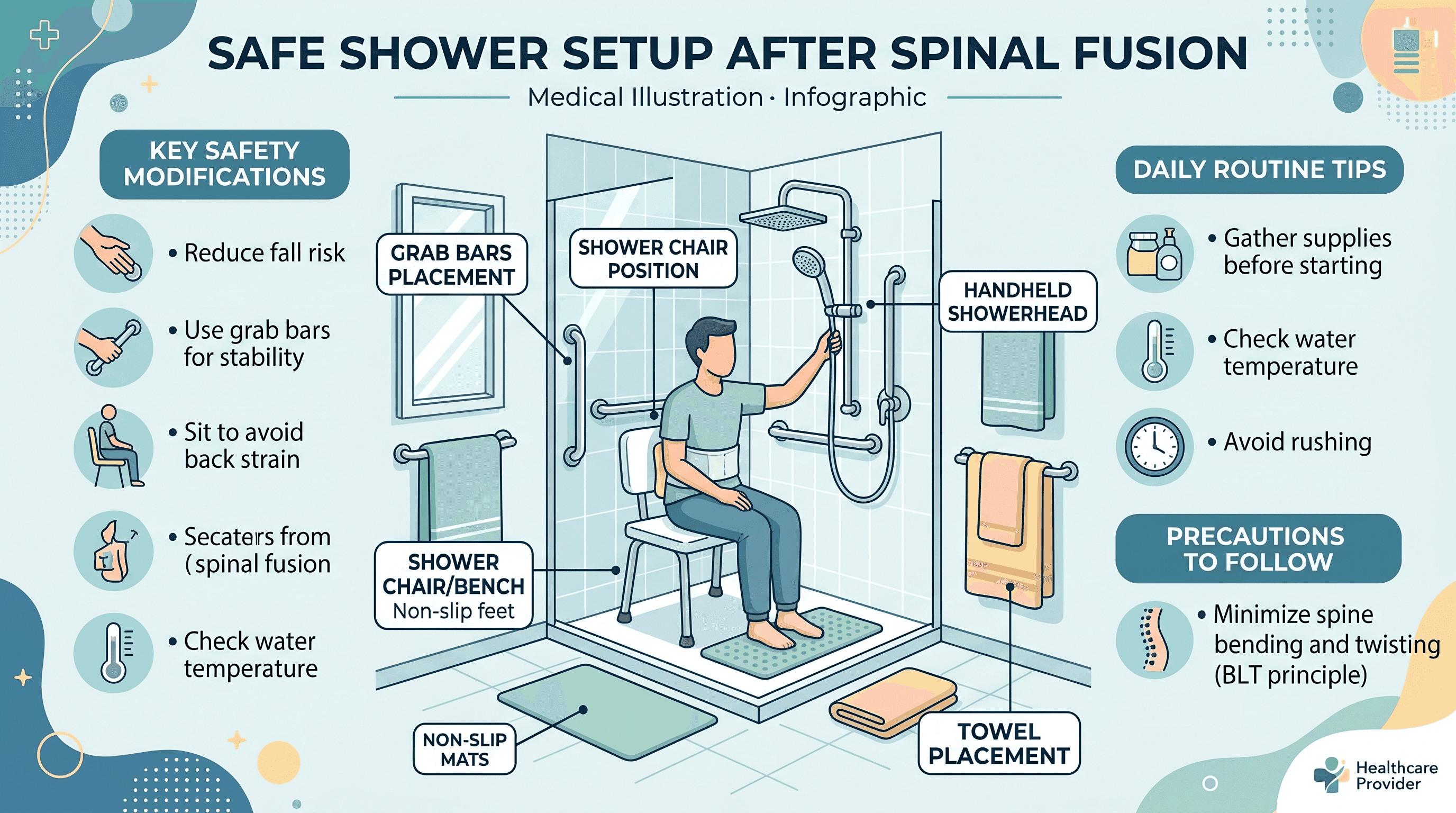
First-shower setup checklist:
A non-slip bath mat inside the tub or shower floor is non-negotiable after spinal surgery. Balance and coordination are affected by pain medications and post-operative fatigue. A shower chair or fold-down bench allows patients to sit during washing, which significantly reduces the risk of a fall. A handheld showerhead makes directing water away from the incision much easier than a fixed overhead stream.
Water temperature should be lukewarm, not hot. Hot water causes vasodilation (widening of blood vessels), which can increase post-operative swelling and cause lightheadedness in patients still on pain medication.
Bending, lifting, twisting (BLT) restrictions apply inside the shower. Most lumbar fusion patients are on strict BLT restrictions for the first six to twelve weeks. This means no bending at the waist to reach feet or legs. A long-handled bath sponge or back-washing tool makes it possible to clean the lower legs and feet while staying upright.
After washing, pat the incision area dry with a clean, soft towel. Do not rub. Do not apply lotion, ointment, petroleum jelly, or any powder to the incision area unless specifically directed by the surgeon. These products trap moisture and bacteria against the healing wound.
Post-Wash Incision Care
What happens in the two minutes after showering matters as much as the shower itself.
Once the incision has been rinsed (if cleared by the surgeon), the drying protocol is: gently pat with a clean, dry towel, moving along the length of the wound without lateral friction. Allow the area to air dry for one to two additional minutes before covering.
Never apply any of the following to a healing spinal fusion incision unless a surgeon specifically prescribes it: antibiotic ointments (including over-the-counter products like Neosporin), hydrogen peroxide, rubbing alcohol, vitamin E oil, or scar creams. These products either disrupt the natural healing process or introduce irritants to tissue that needs only moisture balance and protection.
Steri-strips, if applied by the surgical team, should be left in place until they fall off naturally. Pulling them off early can reopen fragile skin edges. If a steri-strip begins peeling at the edges, it can be carefully trimmed with clean scissors, but the central portion over the incision should stay in place.
If a waterproof dressing is in use, follow the surgeon's specific instructions for replacement. Most are designed to stay on for five to seven days before a fresh one is applied.
When Is the Green Light for Baths Finally Given?
Bath clearance happens at a follow-up appointment, not on a fixed calendar date. But understanding what surgeons look for helps patients know what "healed enough" actually means.
The 5-point incision readiness checklist:
- No open skin edges. The incision should be fully closed along its entire length, with no gaps, no tenting, and no areas where the skin looks like it has not fully joined.
- No drainage or new crusting. Some crusting in the first week is normal. By week four, there should be no fresh discharge, no yellow or green material, and no wet areas along the scar line.
- No expanding redness. A thin, pinkish scar line is normal and expected. Redness that extends more than a centimeter from the wound edge, or redness that is growing, warrants a call to the surgeon before any bath.
- Steri-strips have detached naturally. Steri-strips fall off on their own once the skin beneath them has sufficient tensile strength. Natural detachment is one signal that the outer skin is closing well.
- Surgeon confirmed at follow-up. Self-assessment is a guide, not a substitute. The surgeon examines the incision directly and can assess deeper tissue health that is not visible from the outside.
Patients who meet all five criteria on their own assessment but have not yet had their follow-up appointment should wait for that appointment before bathing. The checklist informs the conversation, not replaces it.
If a doctor visit is needed before that follow-up window, find a physician through Momentary Lab's doctor search to connect with a specialist who can assess the incision in person.
Factors That Can Delay Bath Clearance
Two patients can have the same surgery on the same day and receive different bath clearance dates. Several variables reliably slow wound healing after spinal fusion.
Smoking significantly impairs surgical wound healing. Research published in PubMed documents that smoking roughly doubles the risk of surgical site infection by reducing tissue oxygenation and impairing the immune response at the wound site. Patients who smoke are often counseled to stop four to eight weeks before elective spine surgery for this reason.
Diabetes is one of the most significant risk factors for delayed healing and SSI after spinal surgery. According to research in PMC, poorly controlled blood glucose impairs neutrophil function (the white blood cells responsible for fighting bacteria at wound sites), slows collagen synthesis, and reduces the body's ability to form new blood vessels in healing tissue. Studies have reported SSI risk increases of up to six times in diabetic patients compared to non-diabetic counterparts.
Obesity puts mechanical stress on the incision and creates a thicker tissue layer through which healing must progress. Adipose (fat) tissue has lower blood supply than muscle, which means slower oxygen delivery to the wound site.
Corticosteroid use suppresses the immune system and directly inhibits the inflammatory phase of wound healing, which is the phase that clears bacteria and initiates tissue repair. Patients on long-term steroids for conditions such as rheumatoid arthritis or inflammatory bowel disease routinely take longer to achieve incision closure.
Multilevel fusion and revision surgery involve larger incisions, more tissue disruption, and longer operative times, all of which correlate with higher SSI rates and slower healing. A study in the Journal of Spinal Disorders identifies multilevel procedures as an independent risk factor for post-operative infection.
Patients with any of these factors should expect their surgeon to be more conservative with bath clearance timing and should not push for early clearance based on peer comparisons or online timelines.
Warning Signs to Call the Doctor About
Early identification of a surgical site infection makes a significant difference in outcome. These are the signs that warrant a call to the surgeon, not a wait-and-see approach.
Expanding redness. Some pinkness around the incision is expected in the first two to three weeks. Redness that is visibly spreading from one check to the next, especially if it feels warm to the touch, is not normal.
Fever above 101.5°F. A low-grade fever in the first 48 hours after surgery can reflect normal post-operative inflammation. A fever that develops after the first few days, or one that exceeds 101.5°F, is a signal to call the care team the same day.
Purulent or foul-smelling drainage. Clear or faintly pink discharge in the first few days can be normal. Yellow, green, or cloudy discharge, particularly with an odor, is not. Any drainage that soaks through a dressing should be reported.
Incision reopening. If skin edges that appeared closed begin to separate, especially after showering or movement, the incision has dehisced. This requires prompt evaluation.
Worsening pain at the incision site. Pain at the fusion level itself is expected. Pain that is specifically localized to the surface wound, and that is increasing rather than decreasing past the first week, can signal a developing infection.
These signs do not always mean infection, but they cannot be safely assessed at home. A surgeon who sees the incision directly can distinguish between normal healing variation and early infection far more reliably than any symptom list.
Safe Bathing Technique Once the Surgeon Clears You
The first bath after surgical clearance warrants the same deliberate preparation as the first shower.
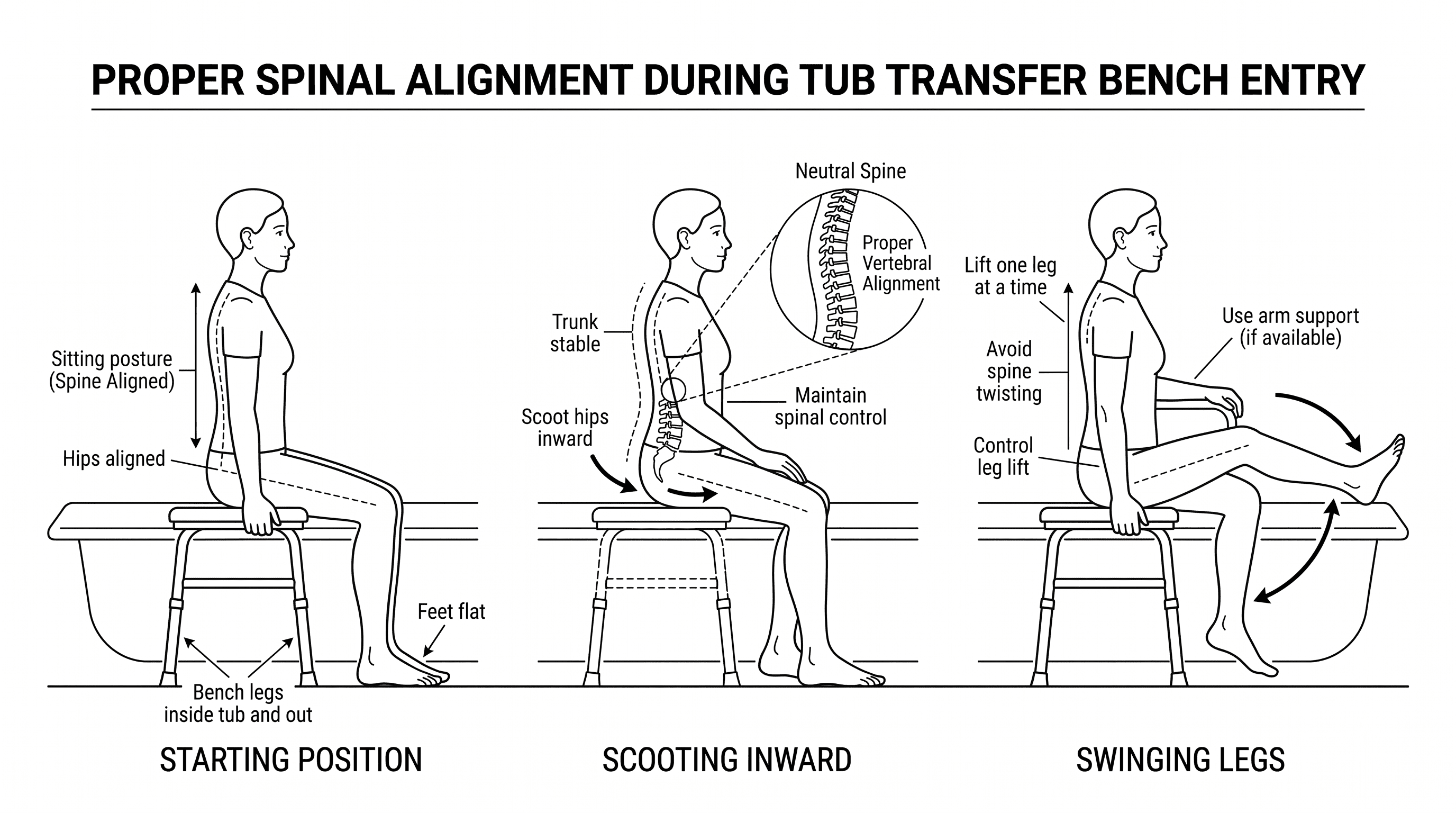
Bathroom setup: Place a non-slip mat both inside the tub and on the floor beside it. A tub transfer bench, which bridges the outside of the tub edge and the tub floor, makes entry and exit far safer for patients still recovering from lumbar surgery. Grab bars mounted to the wall (not suction-cup bars) provide the most reliable support.
Water temperature: Keep it lukewarm. Hot water dilates blood vessels, lowers blood pressure temporarily, and increases the risk of dizziness when rising. For patients still recovering from spinal fusion, a dizzy spell during tub exit is a real fall risk.
Tub entry technique: Sit on the edge of the tub first. Lower one leg into the tub, then the other, while keeping the trunk upright or minimally inclined. Do not bend sharply at the waist or twist to get into position. Patients on lumbar BLT restrictions should confirm with their surgeon or physical therapist that tub bathing is compatible with their movement restrictions before attempting it.
Duration: Start with ten minutes maximum. Prolonged soaking in the early weeks after clearance can still macerate (soften and weaken) the scar tissue even after the incision has closed. Brief soaks are appropriate; long baths are not.
After the bath: Pat the incision area completely dry. Inspect the scar for any changes: new redness, softening of the scar tissue, or any areas that look different than before the bath. If anything looks unusual, photograph it and contact the care team.
Hot tubs and swimming pools remain off-limits even after bath clearance. Hot tub water contains bacterial loads and high temperatures that pose additional risk. Pool water, despite chlorination, is not sterile and contains organisms that can cause wound infections in immunocompromised tissue. Most surgeons recommend a minimum of six to eight weeks after surgery before any pool or hot tub exposure, and some wait until follow-up imaging confirms solid fusion progress.
Frequently Asked Questions
Can I shower the day after spinal fusion surgery?
Most surgeons do not clear patients for showering until day two at the earliest, and many prefer to wait until day three to five when the initial dressing has been evaluated at a follow-up or home health visit. The specific timing depends on the dressing type used and individual incision condition. Ask the care team before the first shower, not after.
How to wash your hair after spinal fusion surgery?
For lumbar fusion patients, hair can typically be washed in the shower once showering is cleared, using a handheld showerhead to direct water carefully and avoid bending the spine. Cervical (neck) fusion patients face a more specific challenge because water runoff can reach the throat incision. In the first two to three weeks after ACDF, leaning over a sink while a caregiver or family member rinses the hair from behind is the safest method. A dry shampoo is also a practical option during the early days.
When can I swim after spinal fusion surgery?
Swimming involves full submersion and chlorinated water exposure. Most spinal surgeons recommend waiting a minimum of six to eight weeks, and only after the incision has received explicit clearance at a follow-up appointment. Open-water swimming (lakes, oceans) carries significantly higher bacterial exposure and should wait even longer.
Can I use Epsom salts or bath oils after spinal fusion?
Epsom salts and bath oils should not be used until the incision is fully mature, which typically takes three to six months after surgery. Even after bath clearance, the scar tissue in the early weeks is still relatively fragile and permeable. Products added to bathwater can irritate or sensitize healing skin. A doctor can advise on individual cases regarding when topical bath additives are appropriate.
What are the restrictions after spinal fusion?
Spinal fusion patients are typically placed on BLT restrictions (no bending, lifting, or twisting) for the first six to twelve weeks. Driving is usually restricted while on narcotic pain medications. Returning to work depends on job type. Sexual activity restrictions vary by surgeon. A detailed activity-by-activity timeline is best reviewed with the treating surgeon at each follow-up appointment.
What should I be doing 3 weeks after spinal fusion?
At three weeks, most lumbar fusion patients are walking short distances regularly, managing pain with reduced medication, and attending physical therapy if prescribed. The incision should be visibly closing and free of active drainage by this point. Bathing is still not cleared at three weeks for most patients. Light activity is encouraged; heavy exertion, bending, and lifting are not. Any concerns about healing progress at the three-week mark are worth raising at the next scheduled follow-up.
For more support navigating your recovery questions and finding relevant health information, Momentary Lab's AI Healthcare Navigator can help direct you to the right resources.
References
- PubMed, Lindström & Lindström (1996) — Cited for smoking's effect on surgical wound healing and doubled SSI risk.
- Journal of Spinal Disorders (ScienceDirect) — Cited for multilevel fusion as an independent risk factor for post-operative spinal infection.
- PMC, Wound Healing and Infection in Spinal Surgery — Cited for deep SSI requiring surgical debridement and implant removal in instrumented fusions.
- PMC, SSI Incidence and Risk Factors in Spine Surgery — Cited for SSI rate range (0.7% to 16%), diabetes-related SSI risk increase, and neutrophil function impairment.
- PMC, SSI Rates in Instrumented vs. Non-Instrumented Spinal Fusion — Cited for 2 to 5% standard SSI rate and up to 8.5% with instrumentation.
- NIH/NCBI Bookshelf, Wound Care and Surgical Site Management — Cited as reference for general surgical wound care and post-operative management principles.