

It is 11:30 PM. One of your kids is flushed and glassy-eyed, the thermometer just read 102.4°F, and your pediatrician's office is closed. A year ago, you would have typed your symptoms into a search engine and ended up buried in a list of possibilities ranging from "common cold" to something far scarier. In 2026, a growing number of people skip that rabbit hole entirely and open an AI health tool instead.
An ai doctor for fever is not a physician and never claims to be one. But it is something concretely useful: a structured, 24/7 triage guide that takes your temperature reading, asks targeted clinical questions, and tells you whether you need the ER, a telehealth visit, or a good night's sleep. This article explains exactly how those tools work, what research says about their accuracy, and where their limits are, so you can use them wisely.
At a Glance
| Topic | Key Facts |
|---|---|
| Fever threshold (adults and children) | 100.4°F (38°C) or higher, per CDC |
| High-grade fever in adults | Above 103°F (39.4°C) warrants same-day medical care |
| Hyperpyrexia | 104°F+ is a medical emergency |
| Infants under 3 months | Any fever requires immediate medical attention, per AAP |
| Cancer patients on chemotherapy | Any fever of 100.4°F+ requires immediate contact with oncologist, per CDC |
| AI symptom checker accuracy | Significant variation across platforms; best-performing AI tools outperform traditional checkers in clinical vignette studies, per JMIR AI |
| What AI cannot do | Physical exam, lab orders, imaging, direct observation |
Your 24/7 Digital First Responder
An AI doctor for fever is best understood as a triage officer, not a diagnostician. Its core job is to analyze the information you provide (temperature reading, associated symptoms, health history, age) and determine where on the urgency spectrum your situation falls. The output is not a diagnosis. It is a risk assessment: should you head to the ER now, book a telehealth appointment in the morning, or manage this at home with fluids and rest?
That framing matters because fever covers an enormous range of clinical reality. A 100.6°F temperature in a healthy 32-year-old who feels mildly achy is almost never an emergency. The same reading in a 6-week-old infant or a cancer patient on chemotherapy is a potential emergency by definition. A good AI fever tool applies that context to every response, which is exactly what a generic web search cannot do.
Integration with Smart Vitals: The Connected Home in 2026
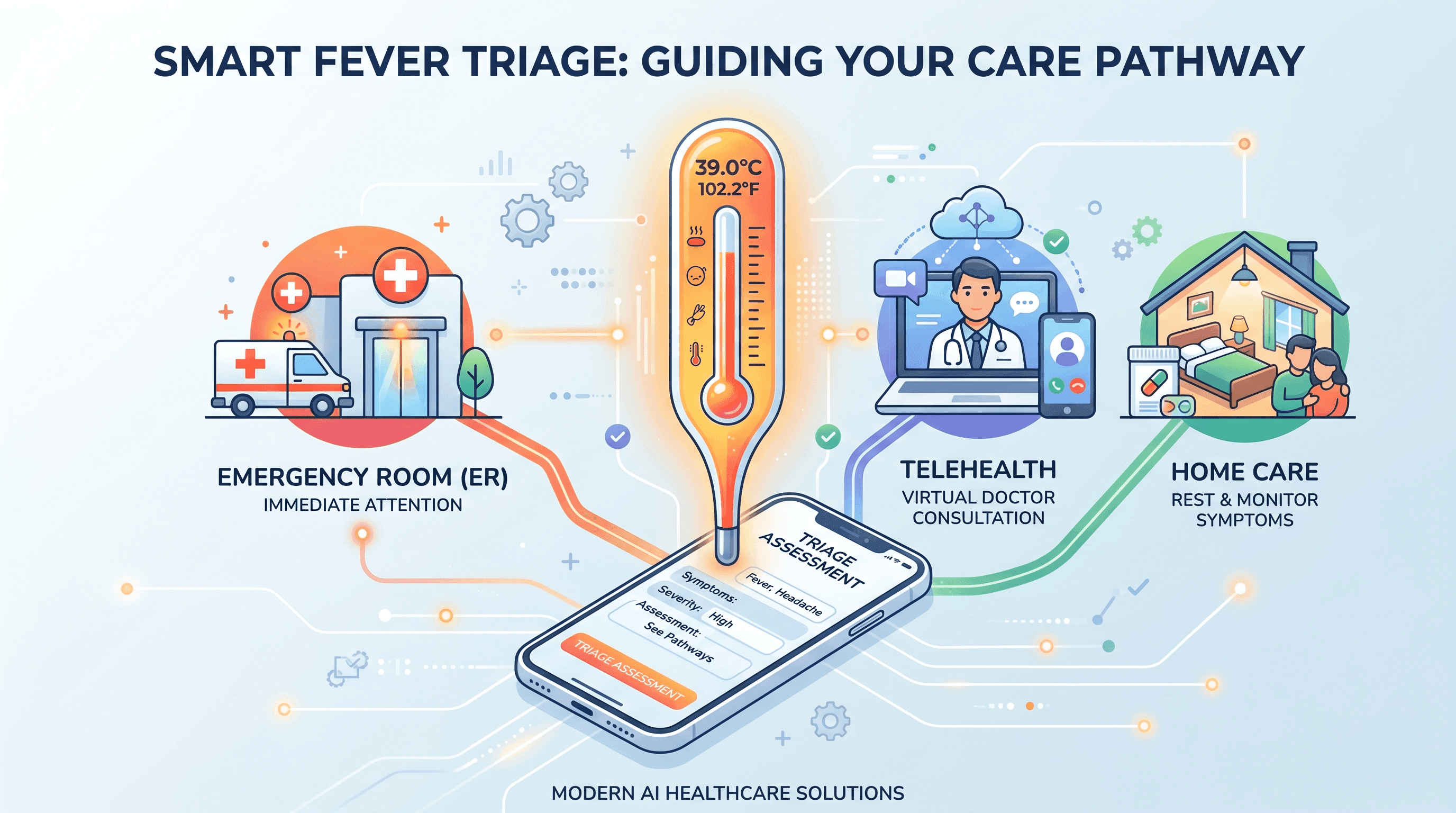
One of the most meaningful shifts in AI-assisted fever management is the move from single-point readings to trend-based monitoring. Earlier generations of symptom checkers relied entirely on what users typed. In 2026, many AI health platforms can sync directly with smart thermometers and consumer wearables, devices that log temperature, heart rate, and sleep quality in real time.
This matters clinically because a fever's trajectory tells a different story than its peak. A temperature that has risen 0.8°F over three hours signals something different from one that has been stable at 101°F for two days. AI tools that integrate with continuous monitoring can flag rising trends before symptoms escalate, giving users a more accurate clinical picture rather than a single moment in time.
Research published in BMC Medical Informatics has explored how wearable physiological sensors can track subtle deviations in body temperature and heart rate variability to detect early signs of infection. That research forms part of the scientific foundation behind next-generation AI fever monitoring: the idea that ambient, passive data collection can make triage guidance both earlier and more accurate.
For practical purposes today, even without full wearable integration, most AI platforms will ask you to enter sequential temperature readings over time rather than a single number. That alone improves triage quality significantly.
Triage and Differential Diagnosis: The "Why" Behind the Fever
Knowing the temperature is only the first question. The more important question is what is causing it.
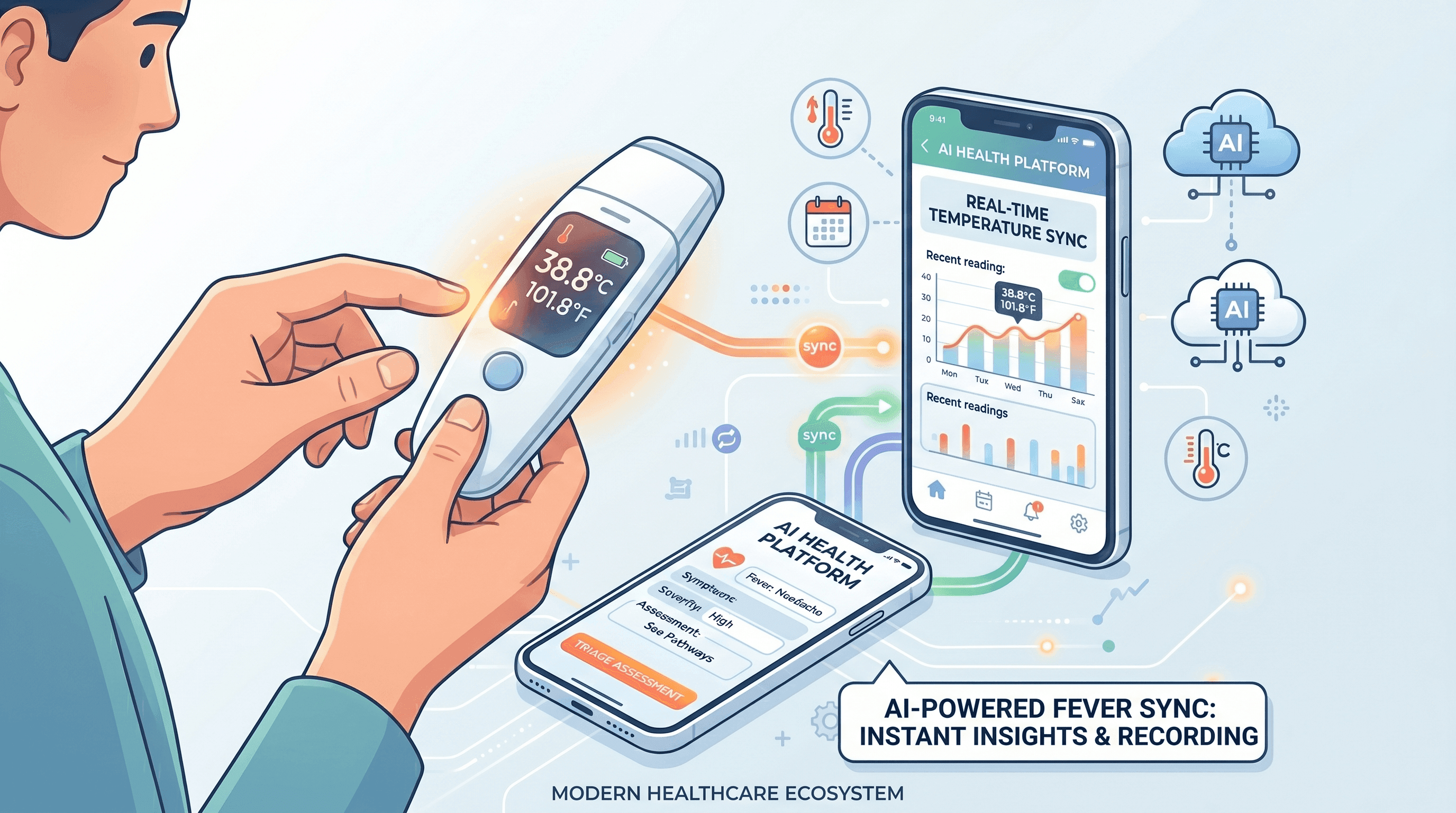
AI doctor tools address this through structured, clinical-grade questioning. After you enter your temperature and age, a good platform will ask about the duration of the fever, associated symptoms (sore throat, cough, urinary burning, headache, rash, stiff neck), recent travel, known exposures, and underlying health conditions. That sequence mirrors the intake questions a triage nurse would ask.
Under the hood, the tool processes your answers using natural language parsing that maps your inputs to standardized medical codes. It then runs a probabilistic match against a library of conditions, assigning likelihood scores to possible causes and narrowing a differential. The output is not "you have strep throat." It is something closer to: "Your symptoms are consistent with a viral upper respiratory infection. There are no red flags for a more serious cause at this time, but if symptoms worsen or persist beyond 72 hours, a medical evaluation is advisable."
The difference between a symptom checker and an AI doctor platform
These two categories are often used interchangeably, but they work differently. A basic symptom checker returns a list of possible conditions based on your inputs. An AI doctor platform goes further: it includes triage recommendations, urgency levels, and, in some cases, a pathway to connect with a licensed physician if the AI determines you need one. Understanding which type you are using helps you calibrate how much weight to put on the output.
For fever specifically, the most useful platforms combine symptom-based differential diagnosis with a clear triage recommendation. If the tool gives you a list of conditions but no guidance on what to do next, treat its output as a starting point for a conversation with a provider.
How Accurate Is an AI Doctor for Fever?
Accuracy varies considerably across platforms, and the honest answer is that AI fever tools perform best in common, uncomplicated presentations and least reliably in rare or atypical ones.
A clinical vignette study published in JMIR AI in 2024 evaluated six symptom checkers against a set of 400 peer-reviewed case scenarios, each approved by at least five independent primary care physicians. Performance varied dramatically, but the best-performing tool (an AI-based platform using a Bayesian network architecture) significantly outperformed both traditional symptom checkers and the other AI-based competitors. The study's authors concluded that AI-based approaches show real promise for improving diagnostic capabilities in digital triage tools, while emphasizing that performance is not uniform across platforms.
A separate analysis using a conversational AI system found top-one diagnostic accuracy of 81.8% across 400 test cases, with 95.8% accuracy on specialist referral recommendations. The same system required roughly 47% fewer questions than conventional symptom checkers to reach a triage recommendation, which reduces the burden on users at the moment they are least comfortable.
What this means practically: a well-designed AI fever tool used by a healthy adult with a common presentation is reasonably reliable for guiding the first step. That first step is triage direction, not diagnosis. For complex presentations, rare conditions, or high-risk populations, AI accuracy drops and human clinical judgment is irreplaceable.
"The performance variation between symptom checkers is substantial, suggesting that symptom checkers cannot be treated as a single entity." Per Hammoud et al., JMIR AI, 2024
What an AI Doctor Cannot Do for a Fever
This is the section no AI tool's marketing team wants you to read, but it may be the most useful part of this article.
No AI fever tool, regardless of how sophisticated its architecture, can perform a physical examination. A clinician evaluating a patient with fever will palpate lymph nodes, examine the throat, listen to lung sounds, assess skin turgor, and check for neck stiffness. All of those clinical data points are invisible to a text or voice-based AI tool. That gap matters enormously for certain diagnoses.
AI cannot order laboratory testing or imaging. If your fever needs a throat culture, a urine culture, a chest X-ray, or a complete blood count, a physician must order those tests. An AI tool can tell you that those tests might be indicated. It cannot obtain the results.
AI cannot detect non-verbal clinical cues. A provider in the room with you notices whether you look toxic, whether you are struggling to breathe, whether your color is off. Those observations are not transmittable through a symptom checker.
There are specific clinical scenarios where AI fever tools are not appropriate as a primary triage step:
Any presentation suggesting meningitis (high fever with severe headache, stiff neck, and light sensitivity) warrants emergency care, not a symptom checker. Presentations consistent with sepsis, including fever with rapid heart rate, confusion, and extreme fatigue, require immediate emergency evaluation. Febrile neutropenia in cancer patients on chemotherapy is an oncological emergency by definition. And infants under 3 months old with any fever above 100.4°F need in-person medical evaluation before any at-home management.
The right framing is this: use an AI fever tool as a triage guide, not as a gatekeeper between you and care you may need.
Fever Triage by Population: The Thresholds Change Depending on Who Has the Fever
Fever thresholds and the appropriate level of urgency are not the same across all patients. Age, immune status, and underlying conditions change the calculus significantly.
Fever in Adults (18 to 64)
For healthy adults, Mayo Clinic guidelines define a fever as a temperature of 100.4°F (38°C) or higher. A temperature of 103°F or above warrants a same-day call to a healthcare provider. At 105°F or above, emergency care is the appropriate next step.
Red flags that warrant immediate care regardless of temperature include a severe or worsening headache, stiff neck, non-blanching rash, confusion, difficulty breathing, or chest pain. An AI symptom checker is appropriate for initial triage when an adult has a low-grade fever below 102°F with no red-flag symptoms and is trying to determine whether care is needed.
Fever in Children and Infants
Pediatric fever thresholds vary by age, and the younger the child, the lower the threshold for immediate concern.
For infants under 3 months old, the American Academy of Pediatrics is clear: any rectal temperature of 100.4°F or higher is a reason for immediate medical evaluation. Do not use an AI symptom checker as the first step for a newborn or young infant with a fever. The risk of serious bacterial infection in this age group is high enough that in-person evaluation is the only appropriate response.
For children aged 3 to 36 months, a temperature above 102°F that persists for more than 24 hours warrants contact with a pediatrician. For children over 3 years of age, the thresholds begin to approach adult guidelines, though parents should still watch for febrile seizures and signs of dehydration. AI tools are more appropriate for guiding triage in older children with mild, uncomplicated fever presentations.
Fever in Older Adults (65 and Older)
Older adults present a specific challenge that many AI fever tools do not adequately address: a blunted fever response. The same infection that would produce a 103°F fever in a younger adult may produce only a 99°F reading in someone over 65, because the thermoregulatory system becomes less robust with age. That means a lower-grade fever in an older adult may signal a more serious infection than the number alone suggests. If an older adult has a fever accompanied by confusion, extreme fatigue, or loss of appetite, prompt medical evaluation is warranted even when the temperature looks moderate.
High-Risk Groups: Pregnant, Immunocompromised, and Post-Chemotherapy Patients
For anyone in a high-risk category, the threshold for seeking care drops significantly.
The CDC is explicit for cancer patients on chemotherapy: call your oncologist immediately if your temperature reaches 100.4°F (38°C) or higher. A fever in this population may be the only sign of a life-threatening infection, because chemotherapy suppresses the white blood cells that would otherwise produce additional symptoms. The Cleveland Clinic similarly emphasizes that any fever of 100.5°F or higher in a cancer patient should prompt immediate oncologist contact and possible ER evaluation.
For pregnant patients, fever above 100.4°F warrants prompt medical contact, as elevated temperatures in pregnancy carry risks to fetal development that require clinical evaluation.
AI symptom checkers are not appropriate as primary triage tools for any of these populations.
AI Doctor, Telehealth Doctor, Urgent Care, or ER? A Fever Decision Framework
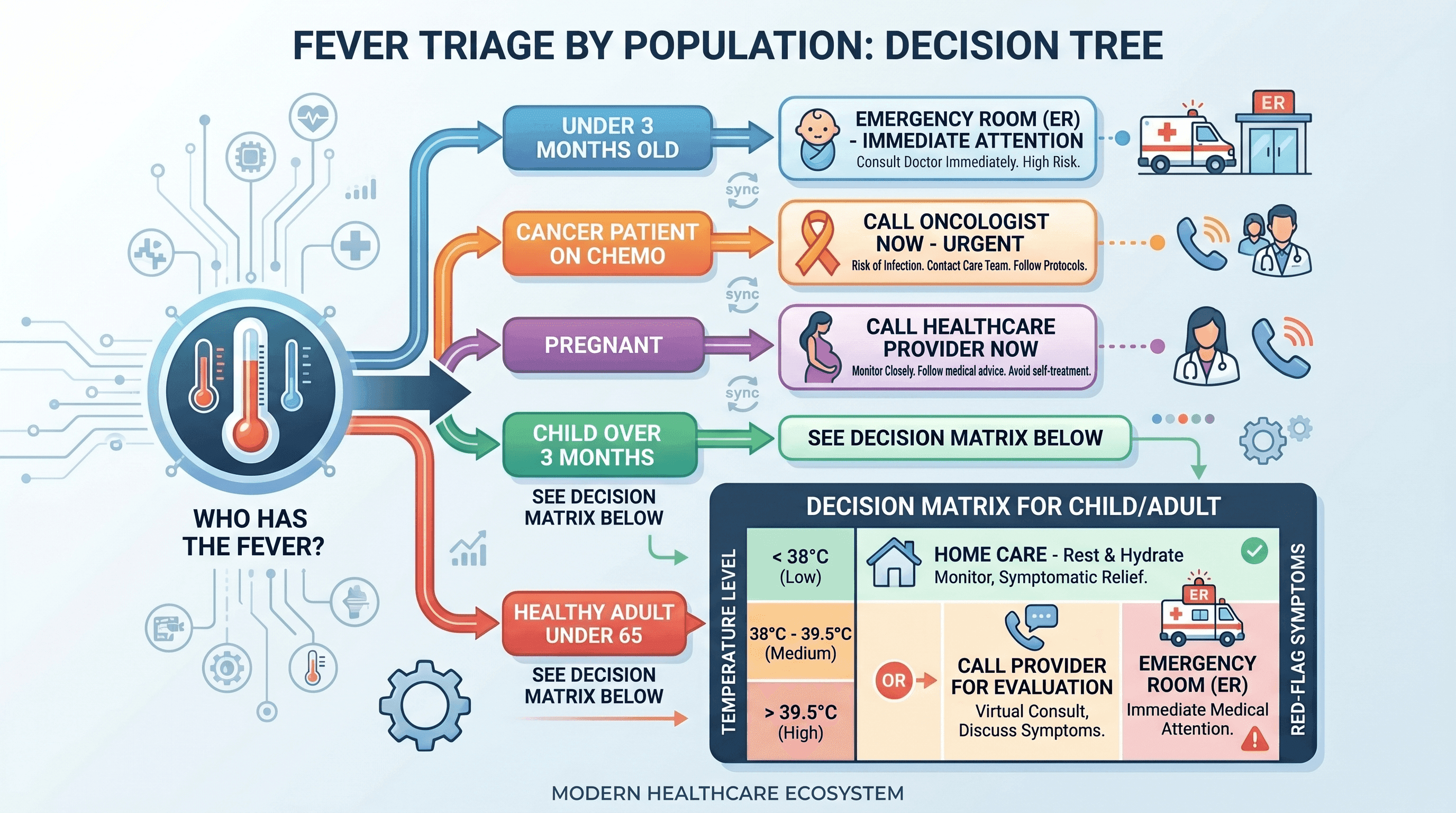
The four-tier framework below is designed for adults aged 18 to 64 without high-risk conditions. For children or high-risk individuals, apply the population-specific guidance above.
| Situation | Appropriate Next Step |
|---|---|
| Fever below 102°F, adult, no red flags, trying to decide if care is needed | AI fever tool or symptom checker for initial triage |
| Fever 102°F to 103°F, adult, mild associated symptoms, possible need for prescription | Telehealth visit with a licensed provider |
| Fever 103°F and above, or any fever with moderate symptoms, or child with fever lasting more than 24 to 48 hours | Urgent care or same-day clinic visit |
| Fever 105°F or above, confusion, seizure, difficulty breathing, non-blanching rash, immunocompromised with any fever, infant under 3 months with any fever | Emergency room or call 911 |
If any part of the clinical picture does not fit neatly into one of the upper tiers, defaulting to the more conservative option is always reasonable. When in doubt about whether your symptoms warrant emergency care, connect with a primary care provider through a telehealth visit so a licensed clinician can assess your situation directly rather than relying on a decision table.
Passive Monitoring and Early Sepsis Detection
One of the more meaningful advances in AI health monitoring is the potential to detect early warning signs of serious infection before a high fever develops.
Sepsis, a life-threatening escalation of infection in which the body's own response begins damaging its organs, often begins with subtle physiological changes. Heart rate variability (HRV), the variation in time intervals between heartbeats, is one of those early signals. Research published in 2024 demonstrated that HRV features, when analyzed by machine learning models, can be used to build predictive models for sepsis detection with substantial accuracy before clinical symptoms become obvious. A separate systematic review found that AI-based sepsis prediction models using electronic health record data achieved AUC (accuracy) scores above 0.90 in multiple validation studies.
Current consumer AI health platforms do not yet perform clinical-grade sepsis prediction. But the underlying science is being translated into wearable and ambient monitoring tools that can flag concerning trends in heart rate, temperature, and oxygen saturation, and prompt users to seek evaluation earlier than they might otherwise.
This is the "hidden threat" angle of AI fever monitoring: not just responding to a high temperature, but potentially catching the conditions that precede one.
The Seamless Clinician Handoff
An often-overlooked feature of the better AI health platforms is what happens after the triage conversation ends. Some platforms automatically generate a structured summary of your symptom session, including the timeline of symptoms, temperature readings, and associated complaints, formatted in a way that can be shared directly with a clinician.
That handoff matters. A provider reviewing a well-organized symptom summary at the start of a sick visit can spend more time on examination and clinical reasoning, and less time on intake questions. For telehealth visits in particular, where the window is shorter and the physical exam is limited, a clear symptom history reduces the chance that important information gets missed.
When you use an AI fever tool, look for the option to save or share your session summary. Bringing that record to a telehealth or in-person visit is a practical way to ensure the clinical encounter starts with the full picture.
Home Care While You Wait: What Actually Helps
For adults and older children with mild to moderate fever who are waiting to see a provider or managing at home, there are a few things that actually help and a few to avoid.
Mayo Clinic recommendations for home fever management include staying well hydrated, dressing in light clothing, and using a light blanket only if you feel chilled. Acetaminophen and ibuprofen are both appropriate for fever reduction in adults and children over 6 months; follow dosing instructions on the package and confirm weight-based dosing with a pharmacist or provider for children. Do not give aspirin to anyone under 18 years old, as it carries a risk of Reye's syndrome, a rare but serious condition affecting the liver and brain.
Rubbing alcohol wipe-downs and ice baths are not recommended. Lukewarm sponging has limited evidence for benefit and is generally considered lower-risk than aggressive cooling measures, but it is not a substitute for appropriate medical care when thresholds are exceeded.
If a fever persists beyond three days in an adult, or does not respond to over-the-counter medications, that pattern warrants medical evaluation regardless of the temperature reading.
Privacy and Health Data in 2026
Any AI health platform that collects your symptoms, temperature readings, and health history is handling sensitive personal data. Before using a platform, it is reasonable to ask: where does that data go, and who can access it?
Reputable platforms in the US healthcare AI space are required to comply with HIPAA (the Health Insurance Portability and Accountability Act) when handling protected health information. Some platforms use federated learning architectures, in which AI model training happens without raw personal data ever leaving the user's device, as a way to improve privacy guarantees. Others store data in encrypted, HIPAA-compliant cloud environments.
The practical guidance: read the privacy policy of any AI health tool before using it. Look for explicit statements about HIPAA compliance, data sharing with third parties, and whether your data is used to train the model. If a platform is vague on those points, that is worth factoring into your decision about whether to use it.
FAQ: Questions People Ask an AI Doctor About Fever
Can an AI doctor tell me what's causing my fever?
Not with the certainty a physician can. An AI fever tool can provide a list of possible causes ranked by probability, based on your symptoms and history. It cannot perform a physical examination, order diagnostic testing, or account for clinical signs that are only visible in person. The output is a probability-ranked differential, not a confirmed diagnosis. For a confirmed cause, a provider evaluation is required.
Is it safe to use an AI symptom checker for a baby with a fever?
For infants under 3 months old, no. The American Academy of Pediatrics is clear that any fever of 100.4°F or higher in an infant under 3 months requires immediate in-person medical evaluation. AI symptom checkers are not appropriate as a first step for this age group. For older infants and children, AI tools can support parental decision-making but should never substitute for clinical judgment when symptoms are concerning.
Can an AI doctor prescribe medication for a fever?
No. AI symptom checkers and AI doctor platforms do not have prescribing authority. Only a licensed physician, nurse practitioner, or physician assistant can prescribe medication. If your fever management requires a prescription (an antibiotic for a bacterial infection, for example), you need a telehealth or in-person visit with a licensed provider.
How is an AI doctor different from just Googling my symptoms?
A search engine returns a ranked list of web pages. An AI health tool asks you structured clinical questions, applies probabilistic reasoning to your specific combination of symptoms, and returns a triage recommendation with an urgency level. The quality of the output depends heavily on the platform's underlying clinical architecture, but even a basic AI tool provides a more organized and targeted experience than an open web search. The main practical difference is that an AI tool guides you toward a next step; a search engine mostly gives you more things to read.
Should I use an AI doctor app or call my doctor's nurse line?
Both are reasonable options for non-emergency fever triage, and they complement each other. A nurse line provides human clinical judgment, which is always more reliable for complex or borderline presentations. An AI tool is available at 3 AM without a hold time and is well-suited to helping you decide whether the situation even warrants calling the nurse line. For mild to moderate presentations in healthy adults, starting with an AI triage tool is reasonable. For children, older adults, anyone in a high-risk group, or any presentation that feels clearly concerning, a nurse line or provider contact is the better first call. You can also use Momentary's AI health navigator to explore your symptoms, understand your options, and determine the best next step for your specific situation.
References
- Mayo Clinic: Fever: Symptoms and Causes. Clinical thresholds for fever in adults and children, including when to seek care.
- Mayo Clinic: Fever: First Aid. Guidance on home management of fever in adults and children.
- American Academy of Pediatrics: Evaluation and Management of Well-Appearing Febrile Infants 8 to 60 Days Old. AAP clinical practice guideline on fever in young infants, including threshold definitions and management algorithms.
- CDC: Watch Out for Fever (Cancer Patients). CDC guidance on fever thresholds and response protocols for patients undergoing chemotherapy.
- Cleveland Clinic: When You Have Cancer, Take a Fever Seriously. Clinical guidance on fever management for oncology patients.
- Hammoud M, et al.: Evaluating the Diagnostic Performance of Symptom Checkers: Clinical Vignette Study. JMIR AI, 2024. Peer-reviewed comparison of AI and traditional symptom checkers across 400 clinical vignettes.
- Link BK, et al.: Biomedical Engineering Letters, 2024. Research on wearable physiological sensor applications for infection monitoring.


