

At a Glance
| Topic | Key Facts |
|---|---|
| Market size | Ambient scribe segment alone hit $600M in 2025, growing 2.4× year-over-year |
| Physician adoption | AI use among physicians nearly doubled between 2024 and 2025 (AMA) |
| FDA-cleared AI devices | More than 1,250 cleared as of July 2025 |
| Top ROI driver | Administrative automation yields roughly $3.20 per $1 invested |
| Biggest implementation gap | 63% of health systems have no formal AI governance policy |
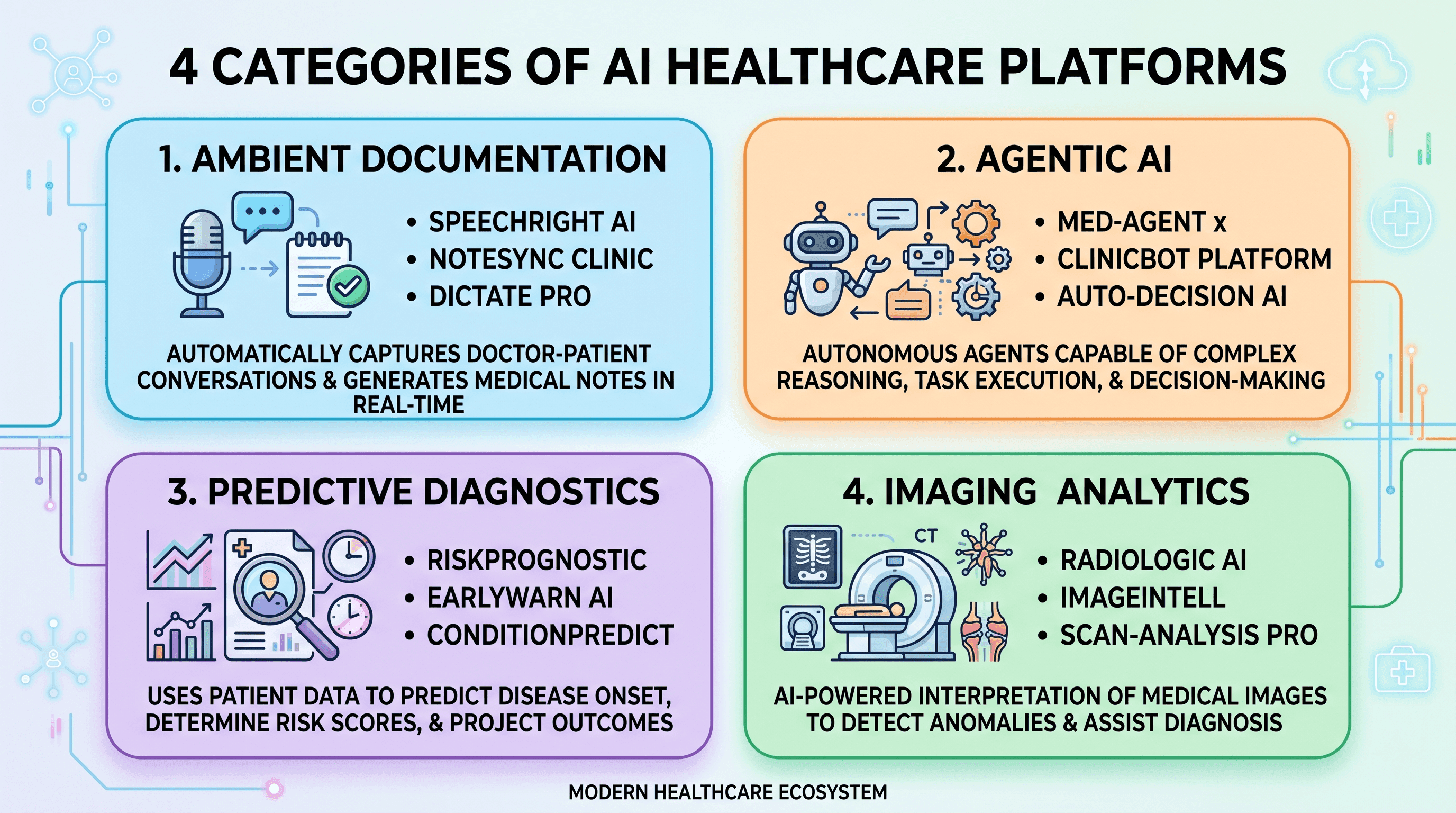
| Platform categories | Ambient documentation, agentic AI, predictive diagnostics, imaging analytics |
| Regulatory shift | FDA's January 2025 draft guidance introduced Total Product Lifecycle (TPLC) model |
The question that every health system CIO, VP of Clinical Informatics, and practice administrator is sitting with right now is not whether to adopt AI. That decision is mostly made. The real question is which platform is actually worth the investment, and how do you evaluate that without getting burned by vendor promises that outrun clinical reality.
The ambient scribe market hit $600M in 2025, growing 2.4 times year-over-year according to Menlo Ventures. Physician AI adoption nearly doubled in a single year per the American Medical Association. OpenAI entered the healthcare enterprise market in 2026. These are not signals of a nascent trend; they are signs of a market that has crossed an inflection point.
What this guide does is give you the framework before the vendor list. Because without a clear taxonomy of what these platforms actually do and how they differ, comparing one tool against another is like comparing a scalpel to an MRI machine: they both belong in a hospital, but they are not competing for the same job. This piece covers the four major platform categories, the real cost structures buyers routinely underestimate, a vendor-neutral 6-factor scorecard, the regulatory shifts that went live in 2025 and 2026, and the implementation framework that separates successful deployments from expensive pilots that quietly fade out.
The Shift from Silos to Native Intelligence
The defining feature of the 2026 AI healthcare platform market is that the standalone-app era is ending.
For most of the 2010s and early 2020s, healthcare AI looked like a collection of point solutions: one tool for radiology reads, another for prior authorization, another for appointment reminders. Each one solved a narrow problem and created a new integration headache. Clinicians ended up toggling between systems, re-entering data, and managing alerts from platforms that had no awareness of each other.
The shift happening now is toward what the industry is calling native intelligence, meaning AI that is embedded directly within the systems clinicians already use rather than bolted on beside them. Platforms like Oracle Health and athenaOne are no longer just electronic health record (EHR) systems with AI add-ons; they are repositioning themselves as AI-first clinical operating environments that pull from EHR data, lab results, imaging findings, and scheduling patterns simultaneously to deliver real-time context at the point of care.
This matters for procurement because it changes the evaluation question entirely. The relevant question is no longer "does this AI tool do X well?" It is "does this platform reduce the number of systems my clinicians have to interact with, and does it fit into my existing data architecture without creating new compliance exposure?" Those are harder questions, and most vendor sales cycles are not designed to answer them.
"Health systems that treat AI as an organizational transformation rather than a technology purchase are the ones achieving measurable ROI within 14 months." — Johns Hopkins Engineering, AI in Healthcare
Task AI vs. Agentic AI: Why the Distinction Matters for Procurement
Before any platform comparison is useful, buyers need to understand the difference between task AI and agentic AI, because the procurement process, governance requirements, and risk profiles are fundamentally different.
Task AI refers to single-workflow tools that perform one defined function reliably. An ambient scribe that converts a physician-patient conversation into a structured clinical note is task AI. A radiology AI that flags a pulmonary embolism on a CT scan is task AI. These tools are well-understood, often FDA-cleared, and carry contained risk profiles.
Agentic AI refers to systems that can chain multiple steps together autonomously to complete a complex goal, often through API integrations with external systems, without human review at each intermediate step. A platform that receives a patient refill request, checks the formulary, verifies the patient's insurance status, routes the prior authorization, and confirms the prescription with the pharmacy without a staff member touching it is agentic. The upside is dramatic throughput gains. The governance requirement is substantially higher because errors at one step cascade through the entire chain.
Health systems should understand that contracts, liability clauses, and oversight mechanisms differ meaningfully between these two categories. Buying an ambient scribe and buying an agentic prior authorization engine are not the same procurement decision.
The Leading AI Healthcare Platforms by Category
The 2026 platform market organizes cleanly into four categories. Comparing tools across categories is not a useful exercise; this section keeps each category separate so the comparison is between actual competitors.
Clinical Documentation and Ambient Scribes
Ambient documentation is the largest and most mature category of clinical AI today, and it is the entry point for the majority of health system AI deployments.
The category leaders in 2026 are Nuance DAX (Microsoft), Abridge, Augmedix, DeepScribe, and Suki. Nuance DAX holds approximately 33% of the ambient scribe market, with Abridge at roughly 30% and Ambience at around 13%, according to Menlo Ventures' 2025 survey data. These tools listen to physician-patient conversations, generate structured clinical notes in real time, and push those notes into the EHR for physician review and sign-off.
The clinical evidence base is growing. A study published in JAMA Network Open found that ambient scribes reduced documentation time by up to 70% and were associated with a 31% reduction in physician-reported burnout scores. Mayo Clinic's deployment of Abridge across more than 2,000 physicians serves as one of the most widely cited enterprise validation signals in the market.
| Platform | EHR Integration | HIPAA BAA | FDA Status | Primary Strength |
|---|---|---|---|---|
| Nuance DAX | Native Epic, Cerner | Yes | Not required (documentation) | Enterprise scale, Microsoft ecosystem |
| Abridge | Epic native | Yes | Not required | Clinical accuracy, Mayo validation |
| Augmedix | Epic, athena | Yes | Not required | Specialty workflows |
| DeepScribe | Multi-EHR | Yes | Not required | Customizable templates |
| Suki | Epic, Cerner, athena | Yes | Not required | Voice-first UX |
The practical differentiator among these platforms is not headline accuracy but EHR integration depth. A platform with native Epic integration (meaning it writes directly to the Epic chart without middleware) introduces fewer failure points, requires less IT overhead, and typically has faster physician onboarding than one running through a third-party integration layer.
Agentic AI: Platforms That Execute Tasks
Agentic AI platforms represent the sharpest growth area in the 2026 market, and also the area where governance gaps are most likely to create organizational risk.
These platforms do not just surface information; they take action. Prior authorization platforms like Cohere Health and Rhyme use agentic workflows to submit, track, and respond to payer requests without manual staff input. Patient engagement platforms like Hyro and Kore.ai handle appointment scheduling, prescription refill routing, and insurance verification through conversational AI agents that connect directly to EHR and payer APIs.
The business case is clearest in revenue cycle management (RCM). Administrative AI in RCM is growing at roughly 10 times year-over-year, and organizations using automated prior authorization tools report processing times dropping from days to hours. CodaMetrix, deployed at Mass General Brigham, has demonstrated medical coding accuracy above 95%, reducing coding-related claim denials measurably.
What makes these platforms procurement-intensive is that "agentic" means the system is making consequential decisions, routing clinical information, initiating financial transactions, or escalating care flags, without a human reviewing each step. Health systems adopting agentic platforms need a defined human-in-the-loop protocol, clear audit trail requirements, and vendor contractual commitments to BAA terms that cover every sub-processor the agent touches.
Predictive Diagnostics and Risk Stratification
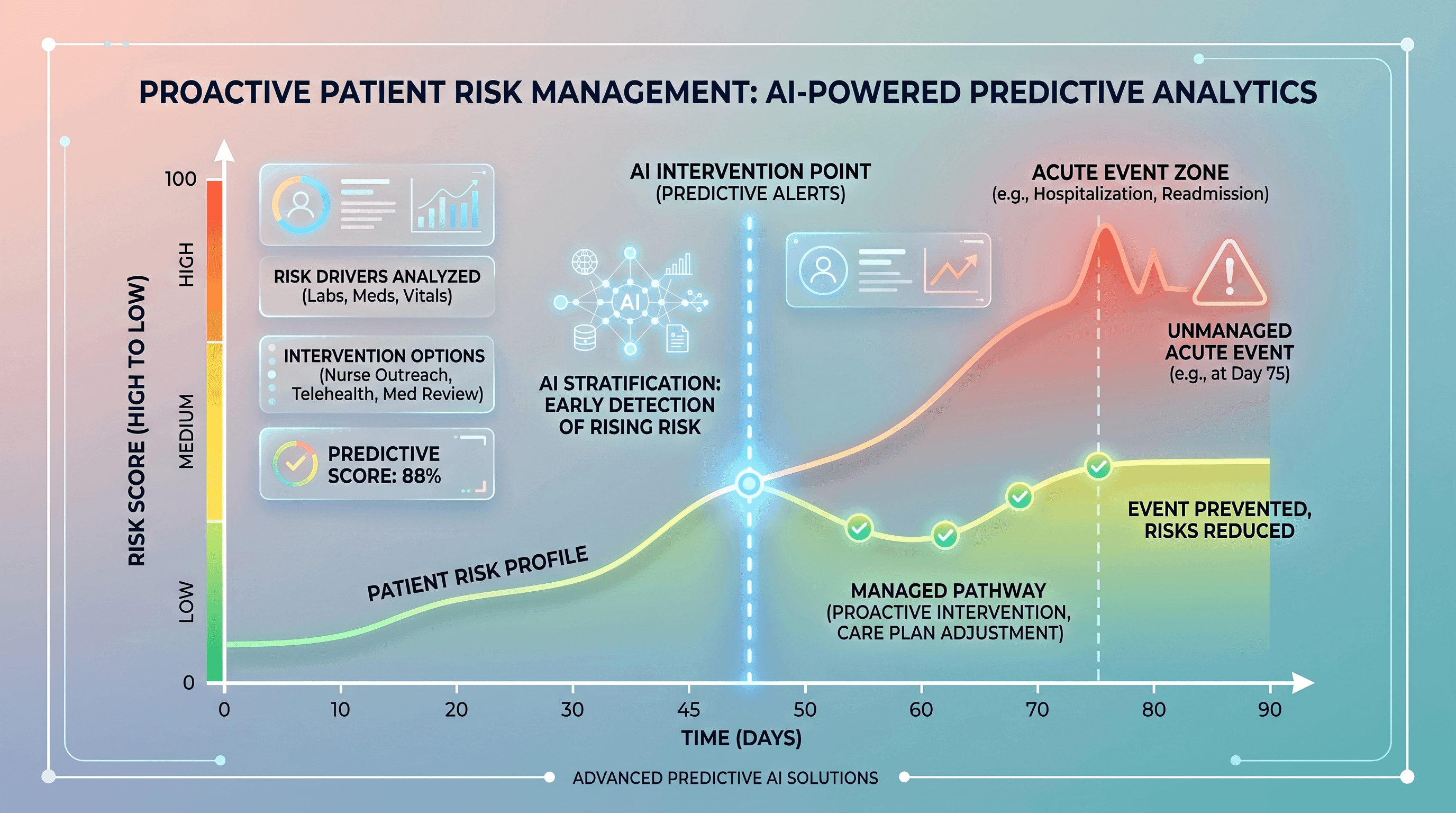
Predictive diagnostic platforms answer a different question than documentation or administrative tools. Where scribes ask "what happened in this visit," predictive platforms ask "which patients will need intervention before they know it themselves."
RAAPID uses real-time clinical data to identify patients on deteriorating trajectories within hospital settings. Tempus combines genomic sequencing data with clinical records to identify oncology patients who match clinical trial criteria or who may benefit from targeted therapies. Tempus's platform now reaches approximately 65% of U.S. academic medical centers according to company-reported data.
The value proposition in this category is upstream care. Research published in PMC demonstrates that AI-based risk stratification tools can identify rising-risk patients with chronic conditions earlier than traditional care gap analysis, potentially reducing acute admissions. For health systems operating under value-based care contracts, this is where predictive AI pays back fastest: catching a patient before a hospitalization is worth multiples of what catching them after costs.
The Convergence of Imaging and Analytics
Imaging AI is the category with the most FDA-cleared devices and the longest clinical validation track record. The FDA had cleared more than 1,250 AI medical devices as of July 2025, with radiology and cardiology accounting for the largest share.
Viz.ai operates across more than 1,700 hospitals and uses AI to analyze CT imaging for stroke, aortic disease, and pulmonary embolism, routing time-critical findings directly to the on-call specialist's mobile device within minutes of image acquisition. Aidoc takes a similar always-on approach across multiple pathologies, functioning as a continuous second read on all imaging studies rather than a selective screening layer.
Qure.ai focuses on chest X-ray interpretation, with validated performance for tuberculosis detection, pneumonia flagging, and fracture identification. The platform is particularly relevant for health systems managing high imaging volumes with limited radiologist coverage.
The integration model here matters. Imaging AI that sits in a separate viewer requires radiologists to context-switch. Imaging AI embedded directly in the PACS (picture archiving and communication system) workstation, surfacing findings as an overlay within the tool radiologists already use, drives substantially higher adoption and faster time-to-review.
What AI Healthcare Platforms Actually Cost and How to Calculate ROI
This is the section most vendor sales decks skip, and the most important one for any procurement team to understand before a single RFP goes out.
The industry benchmark for AI healthcare ROI is approximately $3.20 returned for every $1 invested, with administrative AI reaching that return within roughly 14 months. Diagnostic AI takes longer to compound but produces returns that scale with patient volume over a 2-to-3-year window.
The problem is that most buyers budget only for platform licensing and underestimate the true cost of deployment by 40 to 60 percent.
The 6 True Cost Categories Most Buyers Miss
Platform licensing is the line item that appears in every budget. The five categories that frequently do not appear are where deployments stall or overspend.
Data preparation can consume up to 40% of a project budget when the source data is unstructured, stored in legacy formats, or inconsistently coded across departments. AI models perform only as well as the data they are trained and validated on. A platform that arrives with strong benchmark performance but is fed poorly structured patient records will underperform its published metrics immediately.
EHR integration costs vary dramatically based on whether the platform has a native connection to the health system's EHR or requires a middleware layer. Native integrations typically run $10,000 to $50,000 for implementation. Custom or middleware integrations can reach $50,000 to $250,000 or more depending on complexity. Bespoke build-from-scratch AI infrastructure starts above $100,000 and scales with scope.
Staff training costs are underestimated in virtually every budget. Clinical champions require dedicated time, technical staff need new workflow protocols, and physician onboarding for ambient scribes, for example, typically takes 2 to 4 weeks before documentation quality stabilizes.
Model retraining and ongoing governance add recurring costs that do not appear in year-one licensing quotes. AI models drift as patient populations shift, coding standards change, or EHR configurations are updated. Contracts should explicitly state who bears the cost of model retraining and how frequently it occurs.
Change management is the cost category that most directly determines whether a deployment succeeds or stalls. Organizations that invest in physician champions and structured adoption programs see adoption rates of 78% or higher within six months. Those that launch without formal change management typically see adoption rates around 31%, according to data from Johns Hopkins.
Highest-ROI Starting Points by Organization Type
Not every use case delivers the same return on the same timeline, and the right starting point depends on organizational type.
For large health systems, administrative automation delivers the fastest measured payback. The Menlo Ventures 2025 survey of more than 700 healthcare executives found that 39% of health system respondents cited administrative AI as their highest-returning investment. Prior authorization automation, medical coding AI, and revenue cycle tools in this category produce returns within the first year.
For pharma and biotech organizations, drug discovery AI represents the top ROI category, cited by 46% of respondents in the same survey. AI platforms that accelerate target identification and clinical trial matching are the highest-leverage investments in that sector.
For digital health and virtual care organizations, virtual assistant and patient engagement AI produces the most consistent returns, cited by 37% of respondents. These platforms reduce call volume, improve appointment adherence, and extend care capacity without proportional staffing increases.
How to Evaluate and Select an AI Healthcare Platform: A 6-Factor Scorecard
The vendor market in 2026 is large enough that most health systems can find multiple platforms that claim to solve any given problem. The question is which ones will actually perform in a production environment, at your patient volume, within your EHR ecosystem, and under your compliance posture.
This scorecard is designed for procurement teams who need a structured evaluation process that does not rely on vendor-provided benchmarks alone.
Factor 1: Clinical validation evidence. Peer-reviewed publications in journals like JAMA or the New England Journal of Medicine carry more weight than company white papers. Ask specifically for validation data from patient populations that demographically resemble the health system's own. Performance on diverse populations differs from performance on the homogeneous datasets that many AI tools were originally trained on.
Factor 2: EHR integration depth. Native integrations (direct API connections to Epic, Oracle Health, athenaOne) reduce implementation risk and IT maintenance burden. Middleware-based integrations introduce additional failure points and require ongoing monitoring. Ask whether the integration is certified by the EHR vendor or supported only by the AI vendor.
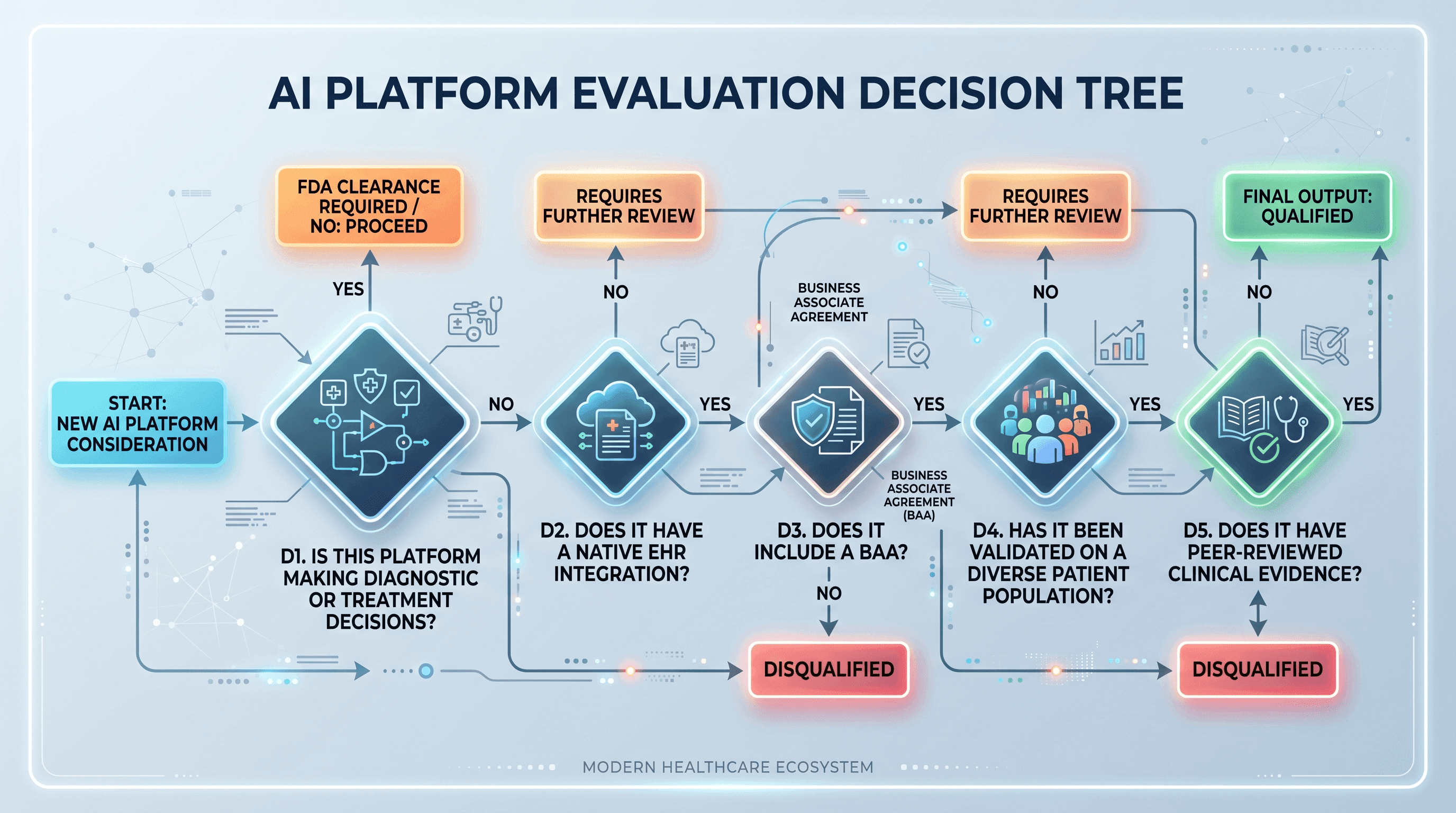
Factor 3: Compliance posture. The minimum bar for any platform handling protected health information (PHI) is a signed Business Associate Agreement (BAA), SOC 2 Type II certification, and HITRUST certification where applicable. These are table stakes, not differentiators; the absence of any one of them is a disqualifying condition.
Factor 4: FDA clearance status and SaMD classification. Software as a Medical Device (SaMD) designation applies when a platform makes diagnostic claims, treatment recommendations, or physiological analyses. Tools in this category require FDA clearance. Documentation tools, scheduling platforms, and general wellness applications typically do not. Misclassifying a diagnostic AI as administrative software creates regulatory exposure.
Factor 5: Three-year total cost of ownership. Calculate licensing plus data preparation, integration, training, model retraining, and governance overhead across three years, not one. A platform with a lower year-one license that requires significant middleware and retraining may cost more at year three than a more expensive native platform.
Factor 6: Change management and clinical champion support. Ask vendors specifically what onboarding support they provide, what adoption rates their existing customers report at 90 days and at 12 months, and whether they can provide references from health systems of similar size and EHR configuration.
Questions to Ask Every AI Vendor Before Signing
These ten questions surface the information that vendor demos rarely volunteer and that procurement teams consistently wish they had asked earlier.
Where does patient data reside, and in which geographic regions are your servers located? This matters for state-level data protection compliance and for health systems with contractual patient data residency requirements.
How do you monitor for model drift, and what is your process for retraining when performance degrades? A platform that cannot answer this question concretely has not solved the long-term reliability problem.
What is the full audit trail for every decision or recommendation this platform makes? Regulators and payers increasingly require the ability to reconstruct why an AI made a specific recommendation.
Has this platform been tested for bias across patient demographic groups including race, age, and socioeconomic status? Bias audits should be third-party verified, not self-reported.
What are the contract exit terms, including data portability and deletion obligations? A platform that makes it prohibitively difficult to switch vendors creates lock-in that compounds over time.
Who are your subcontractors and sub-processors, and are each of them covered under a BAA? The primary vendor's BAA does not automatically extend to every third party they use.
What is your committed SLA for a PHI breach event, including notification timeline and remediation support? HIPAA breach notification has specific timing requirements; vendor response commitments should match.
Are you on the KLAS Research registry, and can you provide three customer references from health systems with comparable patient volume and EHR environment? KLAS scores are the closest thing healthcare technology has to independent performance benchmarks.
What is your regulatory cooperation commitment if your platform is named in a payer audit or state investigation? Vendors should be contractually committed to cooperation, not just responsive on a best-efforts basis.
What specific outcome metrics have your existing health system customers achieved, and are those metrics auditable? Vendor-reported outcomes should be verifiable through customer references, not self-certified.
Compliance, Regulation, and Governance: What Changed in 2025 and 2026
The regulatory environment for AI healthcare platforms shifted materially in 2025, and health systems that have not updated their procurement and governance frameworks are operating with outdated risk assumptions.
The most consequential federal development was the FDA's January 2025 draft guidance introducing the Total Product Lifecycle (TPLC) model for AI-enabled medical devices. The TPLC approach requires manufacturers to demonstrate ongoing performance monitoring and to report significant performance changes after initial clearance, not just at the time of approval. This means that an FDA-cleared AI platform is not a one-time regulatory event; it requires sustained post-market surveillance and transparency.
The FDA had cleared more than 1,250 AI medical devices as of July 2025, according to the agency's publicly updated database. Radiology and cardiology account for the largest concentrations of cleared devices. This volume gives health system procurement teams a useful filter: any diagnostic or imaging AI platform that has not pursued FDA clearance should be treated with heightened scrutiny.
At the state level, 250 or more bills addressing healthcare AI were introduced across state legislatures in 2025 and 2026, with Colorado's framework representing the most stringent requirements. Colorado mandates annual bias assessments and impact reports for high-risk AI systems. Health systems operating in multiple states should treat Colorado's framework as the de facto compliance ceiling and apply it broadly rather than managing state-by-state variations reactively.
The HIPAA Security Rule proposed update in 2025 expanded expectations around AI-specific security controls, particularly for platforms that use large language models trained on or fine-tuned with PHI. The practical effect is that HIPAA-compliant conversational AI requires documentation of model training data provenance, not just access controls on the production system.
Does Your AI Platform Need FDA Clearance?
This is among the most frequently asked and least clearly answered questions in health system AI procurement, and the rule of thumb is straightforward.
Software as a Medical Device (SaMD) applies when a platform makes diagnostic claims (identifying a specific condition from imaging or lab data), treatment recommendations (advising a specific clinical action), or physiological analyses (interpreting waveform data to characterize a patient's clinical state). Any platform functioning in one of these modes requires FDA clearance before it can be used in clinical decision-making.
Scheduling tools, ambient documentation platforms, general administrative automation, and patient wellness applications typically do not meet the SaMD threshold and do not require FDA clearance. The distinction matters for procurement because deploying an uncleaned diagnostic AI creates liability exposure for the health system, not just the vendor.
Building an AI Governance Framework for Your Health System
The governance gap in healthcare AI is not a minor compliance footnote. A 2025 survey found that 63% of organizations deploying AI in clinical settings had no formal AI governance policy in place. That means the majority of health system AI deployments are running without defined processes for monitoring performance, managing bias, handling errors, or retiring underperforming tools.
The Joint Commission and the Coalition for Health AI (CHAI) published a seven-area governance framework covering fairness, transparency, accountability, reliability, privacy, safety, and equity. These seven domains map directly to the questions a procurement team should be asking before any contract is signed, and they provide a defensible structure for ongoing oversight after deployment.
Clinical champions are not optional infrastructure; they are the single most reliable predictor of adoption success. Johns Hopkins data shows that AI deployments with named, trained clinical champions achieve 78% adoption rates. Those without them average 31%. The governance framework should include a named clinical champion for every platform deployed, with defined responsibilities for monitoring alerts, reporting anomalies, and representing clinical users in vendor performance reviews.
Implementation: How High-Performing Health Systems Go from Pilot to Production
Buying an AI healthcare platform is roughly 30% of the challenge. Getting it used, at scale, with measurable outcomes is the other 70%.
The BCG framework for AI implementation in healthcare distributes effort as follows: approximately 10% goes to algorithm selection and model performance, 20% goes to technology and data infrastructure, and 70% goes to people and process transformation. Health systems that invert this ratio, spending most of their energy on platform features and almost none on change management, consistently underperform on adoption metrics.
The readiness assessment that should precede any platform purchase covers three questions. First, is the health system's data structured in a way that the AI platform can consume? FHIR R4 compliance is the current interoperability standard; systems still operating on HL7 v2 feeds without FHIR mapping will require data engineering work before any AI platform can perform at specification. Second, is there EHR compatibility between the platform and the system's live EHR environment, not just the vendor's reference environment? Third, is there named executive sponsorship with budget authority and a mandate to resolve adoption barriers at the department level?
Starting with high-ROI, low-validation-burden use cases is the deployment strategy that produces the fastest proof of value. Administrative automation, documentation support, and patient scheduling AI all have shorter payback windows and lower clinical risk profiles than diagnostic AI. Establishing demonstrated wins in these categories builds the organizational confidence and governance muscle needed to expand into higher-acuity applications.
A virtual care layer can complement an AI platform deployment by extending access and continuity between clinical AI-assisted workflows and live care. Health systems exploring how AI-augmented care intersects with patient access can connect with a primary care provider through Momentary to understand how telehealth and AI-assisted triage work together in practice.
5 Warning Signs Your AI Implementation Is Heading for Failure
These five patterns appear consistently in AI deployments that produce expensive pilots with no measurable outcomes.
The first warning sign is vague goal-setting. Statements like "improve efficiency" or "reduce administrative burden" are not measurable targets. Successful deployments define specific metrics before go-live: documentation time per note, prior authorization turnaround time, coding denial rate, and so on.
The second warning sign is no governance policy at launch. Deploying a platform without a defined process for monitoring performance, reviewing anomalies, and retiring underperforming tools means the health system has no mechanism for catching problems before they compound.
The third warning sign is skipping the data readiness audit. Platforms deployed against poorly structured or inconsistently coded data will underperform. The data audit should happen before the vendor agreement is signed, not after.
The fourth warning sign is poor change management with no clinical champion. As noted earlier, the adoption rate differential between championed and unchampioned deployments is stark: 78% versus 31%. Health systems that skip the clinical champion structure are effectively choosing to waste half their investment.
The fifth warning sign is measuring ROI at 12 months and declaring a verdict. Administrative AI can often show returns within 12 months. Diagnostic and predictive AI require 2 to 3 years to compound meaningfully across a patient population. Setting a 12-month ROI evaluation window for a diagnostic platform creates a structural bias toward declaring failure prematurely.
Security and Safety: Governance in the Generative Era
Generative AI introduces a category of risk that earlier generations of healthcare AI did not carry, and it is one that governance frameworks are still catching up to.
Research published in Nature indicates that even leading large language models can produce clinically harmful or misleading recommendations in a meaningful percentage of edge cases when operating without structured guardrails. This is not a reason to avoid generative AI in healthcare; it is a reason to define precisely where it operates with and without human-in-the-loop review.
HIPAA-compliant conversational AI requires more than a BAA. It requires documented data handling protocols covering what happens to conversation data after each interaction, whether the platform uses interaction data to retrain its models, and whether PHI can appear in model outputs that are logged or stored in systems outside the BAA scope. Health systems should require vendors to provide a PHI data flow diagram that covers every system the conversational layer touches.
Federated learning is an emerging approach that some platforms use to train models across distributed datasets without moving raw patient data to a central server. Where it is implemented correctly, it provides a meaningful privacy advantage. Procurement teams should ask whether a platform's federated learning implementation has been independently audited rather than accepting the vendor's characterization at face value.
The human-in-the-loop requirement varies by use case. Ambient documentation with physician sign-off before note finalization is an appropriate model for that category. Agentic prior authorization that routes and responds without physician review requires a different oversight structure. Imaging AI that surfaces a finding to a radiologist who then makes the clinical decision is appropriate. Imaging AI that initiates a clinical order without radiologist confirmation is not. Defining these boundaries in the contract, not just in internal policy, is the governance step that most health systems skip.
The Limits: Where the Platform Ends and the Doctor Begins
AI healthcare platforms in 2026 are genuinely capable of handling high-volume, repetitive, structured work at a scale and consistency that no human workforce can match. That is the honest case for them.
But the boundary between what these platforms can do and what they cannot do is not moving as fast as the marketing language around them suggests. Johns Hopkins research on AI in healthcare consistently emphasizes that AI performs strongest on tasks with clear, structured inputs and well-defined outputs, and faces real limitations in the ambiguous, contextually layered situations that characterize the hardest clinical decisions.
A platform can surface a risk score. It cannot sit with a patient whose risk score is elevated and understand why they have not been filling their prescriptions: whether it is cost, confusion, distrust, or a life circumstance the EHR has no field for. That conversation requires a clinician.
A platform can flag an imaging finding at 2 a.m. when no radiologist is reviewing the queue. It cannot carry the accountability for the decision that follows.
A platform can generate a structured clinical note from a physician-patient conversation. It cannot replace the judgment that shaped what the physician chose to say, ask, and observe in that room.
The practical implication for health system leaders is that the ROI calculation for AI platforms should always include the human roles that remain after automation: not as a rounding error, but as the function that gives the automation its clinical meaning. The platform provides the evidence. The care team provides the decision.
If a patient or care team member wants to understand what a clinical AI flag means for their specific situation, using an AI health tool to explore symptoms and next steps, like Momentary's AI health navigator, can help bridge the gap between data outputs and actionable understanding.
What Is Next: Trends Shaping AI Healthcare Platforms Through 2027
The 2026 market is a transition point, not a plateau, and the platforms that earn leadership positions over the next two years will be the ones that solve problems the current generation is still leaving open.
Agentic AI is moving from isolated pilots to production deployment at scale. The shift from single-task tools to multi-step autonomous agents handling complex workflows, prior authorizations, care gap closures, and patient follow-up sequences, will accelerate. The governance and contracting frameworks to manage this responsibly are still developing, and organizations that build those frameworks now will have a structural advantage.
Multimodal AI, meaning systems that can simultaneously process clinical notes, imaging data, genomic sequences, and wearable sensor output in a unified model, is reaching early commercial deployment. Tempus's integration of genomic and clinical data is a current example; the next generation will extend this to continuous physiological monitoring data and patient-reported outcomes.
Open-source model adoption is rising rapidly in healthcare. The NVIDIA 2026 healthcare AI survey found that 82% of healthcare organizations described open-source AI models as moderately to extremely important to their strategy. Open-source foundations with proprietary fine-tuning on institution-specific data offer a middle path between vendor lock-in and the cost of building from scratch.
The emerging concept of an AI control plane, a unified governance and compliance layer that sits above all deployed AI tools and enforces consistent PHI handling, bias monitoring, audit trail generation, and regulatory reporting, is beginning to appear in enterprise platform offerings. Health systems managing five or more deployed AI tools will find a control plane approach substantially easier to govern than tool-by-tool policy management.
Drug discovery AI will increasingly intersect with clinical care as genomic platforms like Tempus connect trial identification directly to patient records, making clinical trial enrollment a standard workflow rather than a research department function.
Frequently Asked Questions
Which AI tool is best for healthcare?
There is no single best AI tool for healthcare because different tools solve different problems. For clinical documentation and physician burnout reduction, Nuance DAX and Abridge are the most widely validated platforms as of 2026. For diagnostic imaging, Viz.ai and Aidoc have the strongest FDA clearance track records. For administrative automation and revenue cycle management, platforms like CodaMetrix and Cohere Health lead on published accuracy benchmarks. The right answer depends on the organization's size, EHR environment, primary pain point, and compliance posture. The 6-factor scorecard in this article provides a vendor-neutral framework for making that determination.
Is ChatGPT HIPAA compliant?
ChatGPT in its standard consumer form is not HIPAA compliant. OpenAI offers a healthcare-specific enterprise arrangement that includes a Business Associate Agreement, but deploying any large language model in a HIPAA-regulated context requires more than a BAA: it requires documented data handling protocols, PHI data flow mapping, and model training data provenance disclosures. Health systems should evaluate any large language model deployment against the full HIPAA Security Rule requirements, including the 2025 proposed update that expanded expectations for AI-specific security controls, rather than treating a BAA alone as sufficient.
Who is leading AI in healthcare?
Market leadership varies by category. In ambient clinical documentation, Nuance DAX (Microsoft) and Abridge hold the largest market shares as of 2026. In diagnostic imaging AI, Viz.ai operates across the most hospitals. In oncology AI, Tempus reaches the largest share of academic medical centers. In revenue cycle and administrative AI, CodaMetrix and Cohere Health are among the most cited enterprise deployments. No single company leads across all four categories. The European Commission's eHealth and Digital Health framework and the Medical Futurist's tracking of top healthcare AI companies both provide useful reference points for tracking the broader competitive landscape.
What is the most common AI in healthcare?
Clinical documentation AI, specifically ambient scribes that convert physician-patient conversations into structured clinical notes, is currently the most widely deployed category of AI in healthcare. The ambient scribe market reached $600M in 2025 and is growing at 2.4 times year-over-year. The second most common deployment type is administrative AI for prior authorization and medical coding. Diagnostic imaging AI, while the most extensively FDA-cleared category, tends to require larger infrastructure investments and is more concentrated in health system and academic medical center settings than in smaller practices.
What should a health system prioritize when starting with AI?
Start with a data readiness audit before any vendor conversation. Platforms perform only as well as the data they consume. After confirming data readiness, match the use case to the organization type: administrative automation for large health systems seeking fast ROI, patient engagement AI for digital health organizations, and predictive analytics for systems operating under value-based care contracts. Build the governance framework before the first platform goes live, not after.
How do AI healthcare platforms handle patient data privacy?
HIPAA compliance requires at minimum a signed Business Associate Agreement covering every platform and sub-processor that touches PHI. Beyond the BAA, privacy-protective platforms use data minimization (processing only what is needed for the defined task), access controls tied to role-based permissions, audit logs for every data interaction, and documented retention and deletion policies. Federated learning approaches, where the model trains on distributed data without centralizing raw patient records, offer an additional privacy layer that some platforms now offer. Health systems should require a complete PHI data flow diagram from every vendor as a standard procurement deliverable.
References
- American Medical Association (AMA) — Cited for data on physician AI adoption rates nearly doubling between 2024 and 2025.
- Johns Hopkins Engineering, AI in Healthcare — Cited for clinical champion adoption data (78% vs. 31%) and AI performance boundaries in clinical decision-making.
- JAMA Network Open — Cited for ambient scribe burnout-reduction and documentation time data.
- PMC / National Center for Biotechnology Information — Cited for AI-based risk stratification outcomes in chronic disease management.
- Nature — Cited for data on large language model error rates in clinical contexts without structured guardrails.
- European Commission eHealth and Digital Health — Cited in FAQ for tracking AI healthcare leadership landscape.
- The Medical Futurist — Cited in FAQ as a reference for tracking leading AI healthcare companies by category.


